Zum Inhalt springen
Davidhorn
  • Lösungen

    Nach Branche

    • Polizei
    • Verteidigung
    • Einwanderung und Zoll
    • Vernehmungen von Kindern und Zeugen
    • Kommunalbehörden
    • Unternehmensuntersuchungen
    • Gesundheitswesen

    Nach Anwendungsfall

    • Vernehmung von schutzbedürftigen Zeugen
    • Vernehmungsräumen
    • Vernehmung vor Ort
  • Produkte

    Aufnahmegeräte

    • Aufzeichnungsapp
    • Portable Recorder
    • Mini Recorder
    • Fixed Recorder
    • Software Recorder
    • Verdeckte Aufnahmegeräte

    Interview-Management

    • Ark Vernehmungsmanagement

    Integrationen

    • Integrationen & Konfiguration
    Promotional graphic for a free webinar titled 'How to Use Davidhorn's Investigative Interview Solution,' hosted by Magnus Green. Features a blue speech bubble icon with the text 'Free webinar' and a blurred-out image of a person inside a blue circle.
  • Kunden
  • Ressourcen Hub

    Ressourcen Hub

    • Blog
    • Datenblätter
    • eBooks und Whitepapers
    • Ereignisse
    • Podcasts
    • Webinare
  • Partner

    Partner

    • Partnerübersicht
    • Partner werden
  • Unternehmen

    Unternehmen

    • Über
    • KarriereKarriere bei Davidhorn
    • Kontakt
    • Kunden
  • wpml-ls-flagde
    • wpml-ls-flagen
    • wpml-ls-flagfr
    • wpml-ls-flages
    • wpml-ls-flagit
    • wpml-ls-flagpl
Unterstützung
Demo Buchen
Davidhorn
Konto
  • Lösungen
    • Nach Branche
      • Polizei
      • Verteidigung
      • Einwanderung und Zoll
      • Barnahus
      • Kommunalbehörden
      • Unternehmensuntersuchungen
    • Nach Anwendungsfällen
      • Vernehmung von schutzbedürftigen Zeugen
      • Verdächtigenvernehmung
      • Vernehmung vor Ort
  • Produkte
    • Ark Interview Management
    • Mobile Recorder
    • Portable Recorder
    • Mini Recorder
    • Fixed Recorder
    • Software Recorder
    • Verdeckte Aufnahmegeräte
    • Admin- und API-Integrationen
  • Kunden
  • Ressourcen-Hub
    • Blog
    • Datenblatt
    • eBooks
    • Events
    • Podcasts
    • Webinare
  • Partner
    • Partnerübersicht
    • Partner werden
  • Unternehmen
    • Über
    • Nachricht
    • Kontakt
Unterstützen Sie
Demo buchen
  • Davidhorn
  • Investigative Vernehmungen – 10 wichtige Schritte zum Erfolg

    Investigative Vernehmungen – 10 wichtige Schritte zum Erfolg
    Die 10 wichtigsten Schritte für eine erfolgreiche investigative Vernehmung

    Die 10 wichtigsten Schritte für Erfolgreiche investigative Vernehmungen

    Professionelle investigative Vernehmungen ist ein systematischer Prozess, der eine akribische
    Vorbereitung, eine geschickte Durchführung und eine gründliche Auswertung erfordert. Auf der Grundlage etablierter
    Protokolle und bewährter Praktiken stellen wir einen 10-Schritte-Rahmen vor, der effektive,
    ethische und rechtlich einwandfreie Vernehmungen gewährleistet.

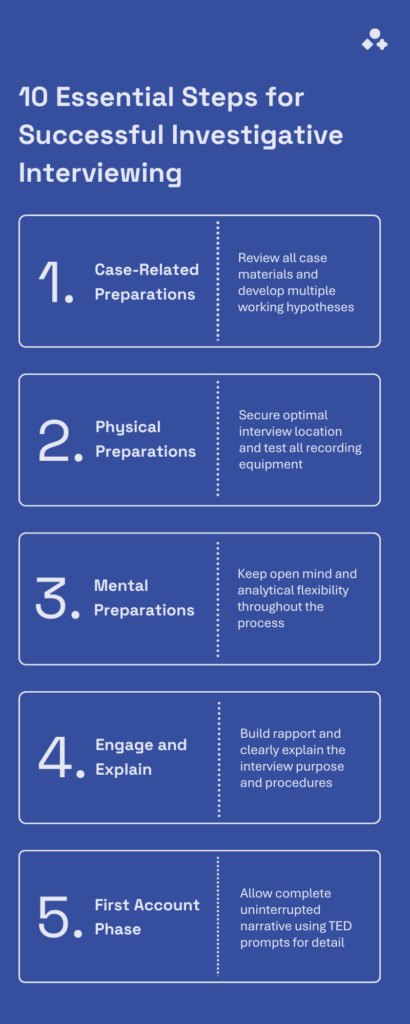
    Schritt 1: Fallbezogene Vorbereitungen

    Die Grundlage jeder erfolgreichen Vernehmung liegt in einer umfassenden Vorbereitung des Falls. Prüfen Sie alle verfügbaren Untersuchungsmaterialien, Beweise und Unterlagen gründlich. Entwickeln Sie mehrere Arbeitshypothesen, anstatt eine einzige Theorie zu verfolgen. Überlegen Sie sich die Ziele der Vernehmung genau und analysieren Sie den Hintergrund der befragten Person, einschließlich ihrer Rechte und ihrer besonderen Bedürfnisse.

    Diese Vorbereitungsphase ist entscheidend, um alle Informationsbedürfnisse zu befriedigen, Objektivität zu bewahren und sicherzustellen, dass Sie für die verschiedenen Szenarien gerüstet sind, die während der Vernehmung auftreten können.

    Schritt 2: Physikalische Vorbereitungen

    Sichern Sie sich einen optimalen Ort für die Vernehmung mit minimaler Ablenkung und geeigneten Bedingungen für eine effektive Kommunikation. Idealerweise sollte die Umgebung ablenkungsfrei und dennoch komfortabel sein, so dass ein klarer Dialog ohne Störungen von außen möglich ist.

    Zusammenfassung

    • Umfassende Vorbereitung ist unerlässlich – Erfolgreiche Vernehmungen erfordern eine gründliche Fallbesprechung, eine optimale physische Einrichtung mit getesteten Aufnahmegeräten und mentale Bereitschaft mit mehreren Arbeitshypothesen.
    • Vertrauen aufbauen durch professionelles Engagement – Wenden Sie das HEAR-Prinzip (Ehrlichkeit, Empathie, Autonomie, Reflexion) an, um eine Beziehung aufzubauen, Verfahren klar zu erklären und die Verletzlichkeit des Befragten sowie rechtliche Anforderungen zu bewerten.
    • Erlauben Sie eine freie Erzählung, bevor Sie nachfragen – Lassen Sie die Befragten mit Hilfe von TED-Aufforderungen (Tell, Explain, Describe) vollständige, ununterbrochene Berichte liefern und klären Sie dann systematisch mit Hilfe des 5WH-Rahmens (Who, What, When, Where, Why, How).
    • Bewerten und reflektieren Sie für eine kontinuierliche Verbesserung – Bewerten Sie, ob die Ziele der Vernehmungen erreicht wurden, analysieren Sie Ihre Vorgehensweise, dokumentieren Sie die gewonnenen Erkenntnisse und planen Sie die nächsten Ermittlungsschritte auf der Grundlage der gewonnenen Informationen.

    Treffen Sie die notwendigen Vorkehrungen für einen Rechtsbeistand, Dolmetscher oder Hilfspersonal, sofern dies für den Fall erforderlich ist. Testen Sie alle Aufnahmegeräte gründlich – Davidhorns professionelle A/V-Aufnahmesysteme gewährleisten eine zuverlässige Dokumentation mit mehreren Backup-Optionen, die für die Integrität der Beweismittel unerlässlich sind.

    Schritt 3: Mentale Vorbereitungen

    Behalten Sie während des gesamten Prozesses einen offenen Geist und analytische Flexibilität bei. Ziehen Sie alternative Hypothesen zu den Beweisen in Betracht und antizipieren Sie verschiedene Szenarien, die sich entwickeln könnten. Zeigen Sie Einfühlungsvermögen und echtes Interesse an der Situation des Befragten. Zur mentalen Vorbereitung gehört, dass Sie Ihre Vorurteile beiseite schieben und sich darauf vorbereiten, Ihre Vorgehensweise an die Antworten und das Verhalten des Befragten anzupassen.

    Diese psychologische Bereitschaft versetzt Sie in die Lage, auf unerwartete Entwicklungen angemessen zu reagieren und dabei Ihre professionelle Gelassenheit zu bewahren.

    Schritt 4: Engagieren und Erklären

    Kontaktaufnahme und Festlegung von Grundregeln. Wenden Sie das HEAR-Prinzip konsequent an: Ehrlichkeit, Empathie, Autonomie, Reflexion. Dieser Ansatz schafft Vertrauen und sorgt dafür, dass die Grenzen der Professionalität gewahrt bleiben und der Befragte sich während des gesamten Prozesses respektiert fühlt. Beurteilen Sie kontinuierlich die Verletzlichkeit des Befragten unter Berücksichtigung von Alter, geistiger und körperlicher Gesundheit, Trauma und anderen Risikofaktoren. Setzen Sie geeignete rechtliche Schutzmaßnahmen ein und ziehen Sie bei Bedarf einen Spezialisten hinzu. Nutzen Sie Kommunikationshilfen, um einen effektiven Dialog während des gesamten Prozesses zu gewährleisten.

    Zu Beginn einer Vernehmung sollte der Vernehmungsbeamte:

    • Bauen Sie eine Beziehung auf durch Einfühlungsvermögen und Respekt.
    • Beurteilen Sie das Wohlbefinden der befragten Person um sicherzustellen, dass er für die Vernehmung fit ist.
    • Deutlich erklären:
      • Der zu untersuchende Fall und der Zweck der Vernehmung.
      • Für Verdächtige: die Gründe für den Verdacht – erklären Sie, was und warum (ohne detaillierte Beweise zu nennen).
      • Für Verdächtige: das Recht auf einen Rechtsbeistand und das Recht zu schweigen.
      • Alle rechtlichen und praktischen Verfahren, einschließlich Audio-/Videoaufnahmen.
      • Die Teilnahme ist freiwillig (sofern zutreffend).

    Legen Sie Grundregeln fest. Der Interviewer sollte die folgenden Erwartungen festlegen:

    • Alles Gesagte ist wichtig – der Befragte sollte so viele Details wie möglich angeben, auch wenn sie unbedeutend erscheinen (z. B. „Beschreiben Sie meinen Stift“).
    • Filtern Sie nicht – Melden Sie alles, auch wenn es irrelevant oder unsicher erscheint.
    • Konzentration und Anstrengung – Das Abrufen von Erinnerungen erfordert Konzentration und kann anstrengend sein.
    • Open communication – the interviewee should feel free to: 
      • Fragen Sie, wenn Sie etwas nicht verstehen.
      • Sagen Sie, wenn sie es nicht wissen.
      • Korrigieren Sie Missverständnisse oder äußern Sie Bedenken bezüglich führender/unpassender Fragen.
    • Struktur der Vernehmungen – skizzieren Sie die zu behandelnden Themen, den Zeitplan und die geplanten Pausen.
    • Bestätigen Sie das Verständnis – Vergewissern Sie sich, dass der Befragte die Informationen verstanden hat und wie sie anzuwenden sind.

    Beim Aufbau von Beziehungen geht es nicht um Manipulation – es geht darum, eine Atmosphäre zu schaffen, in der eine auf gegenseitigem Respekt und Fakten basierende Kommunikation stattfinden kann. Diese Grundlage ist entscheidend, um Vertrauen aufzubauen und zuverlässige Informationen zu erhalten.

    Schritt 5: Erste Kontophase

    Erlauben Sie dem Befragten, seinen vollständigen Bericht ohne Unterbrechung zu präsentieren. Üben Sie sich in strategischer Geduld und behalten Sie die Kontrolle, indem Sie das Tempo sorgfältig einhalten und aktiv zuhören, anstatt sich in die Befragung zu stürzen.

    Verwenden Sie TEDS-Aufforderungen (Erzählen, Erklären, Beschreiben, Zeigen Me), um detaillierte Antworten zu erhalten. Dokumentieren Sie die PLATCOM-Elemente systematisch: Personen, Ort, Handlungen, Zeiten, Kommunikation, Objekte und Motive. Diese freie Erzählphase enthüllt oft entscheidende Informationen, die bei einer gezielten Befragung möglicherweise übersehen werden. Unterbrechen Sie nicht. Verschieben Sie Ihre Befragung, bis der erste Bericht vollständig abgeschlossen ist.


    Hören Sie sich unseren Podcast über investigative Vernehmungen an


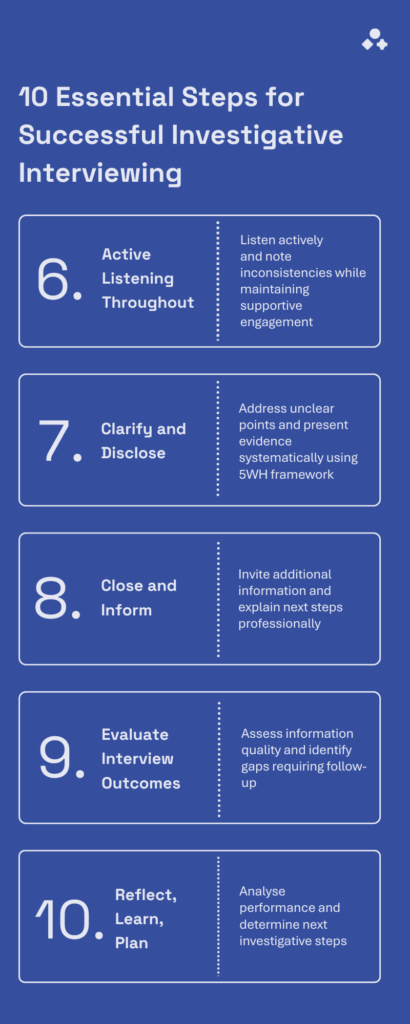
    Schritt 6: Aktives Zuhören während der ganzen Zeit

    Hören Sie aktiv zu, um die Perspektive des Gesprächspartners zu verstehen und den Informationsfluss zu erleichtern. Nutzen Sie Schweigen und nonverbale Hinweise, um Ihr Engagement zu zeigen. Achten Sie auf Ungereimtheiten, Lücken und Bereiche, die einer Klärung bedürfen, und bleiben Sie dabei engagiert.

    Schritt 7: Klären und offenlegen

    Überprüfen Sie systematisch neue Informationen, Ihre Vernehmungsziele, sprechen Sie PLATCOM-Elemente an und gehen Sie auf alle unklaren Punkte und Lücken ein, bevor Sie Beweise oder neue Informationen einbringen. Präsentieren Sie ggf. die wichtigsten Informationen schrittweise, um die Genauigkeit der Darstellung zu prüfen und gleichzeitig die Kontamination des Gedächtnisses zu minimieren.

    Sorgen Sie für eine umfassende Abdeckung unter Verwendung des 5WH-Rahmens: Wer, Was, Wann, Wo, Warum, Wie. Dieser systematische Ansatz stellt sicher, dass keine wichtigen Elemente übersehen werden.

    Schritt 8: Schließen und informieren

    Schließen Sie die Vernehmung professionell ab, indem Sie den Gesprächspartner auffordern, zusätzliche Informationen zu geben oder Fragen zu stellen. Erläutern Sie klar und deutlich die nächsten Schritte, die Vorgehensweise bei der Kontaktaufnahme und die Erwartungen an den Zeitplan.

    Bedanken Sie sich für die Zusammenarbeit und beenden Sie das Gespräch respektvoll, unabhängig vom Ausgang des Falls. Dieser professionelle Abschluss kann sich als wertvoll für zukünftige Interaktionen erweisen.


    Lesen Sie unsere eBooks zur Planung investigativer Vernehmungen

    https://davidhorn.com/content-type/ebooks_whitepapers

    Schritt 9: Bewerten Sie die Ergebnisse der Vernehmungen

    Führen Sie nach der Vernehmung eine strukturierte Auswertung durch, um festzustellen, ob die Ziele erreicht wurden. Dies beinhaltet:

    • Bewertung der Qualität und Vollständigkeit der Informationen in Bezug auf den Vernehmungsplan und die Ermittlungsprioritäten.
    • Identifizierung von Lücken, Ungereimtheiten oder unbeantworteten Fragen die eine Klärung oder Weiterverfolgung erfordern könnten.
    • Bewertung der Antworten der befragten Person im Lichte der bekannten Beweise und des sonstigen Fallmaterials.

    Dieser Schritt trägt dazu bei, dass die Vernehmung einen sinnvollen Beitrag zu den Ermittlungen leistet und eventuelle sofortige Folgemaßnahmen aufzeigt.

    Schritt 10: Reflektieren, lernen und vorausplanen

    Reflektieren Sie im Anschluss an die inhaltliche Bewertung kritisch über Ihre eigene Leistung als Interviewer:

    • Analysieren Sie Ihre Vernehmungsmethoden – Was hat gut funktioniert? Was hätte man anders machen können?
    • Identifizieren Sie verbesserungswürdige Bereiche bei der Planung, der Kommunikation, dem Fragestil, dem Aufbau von Beziehungen und der Anpassungsfähigkeit.
    • Dokumentieren Sie die gelernten Lektionen um Ihre berufliche Entwicklung zu unterstützen und zukünftige Vernehmungen zu verbessern.
    • Bestimmen und planen Sie die nächsten Schritte in der Untersuchung, wie z.B. erneute Vernehmungen, neue Ermittlungsansätze oder die Sammlung weiterer Beweise.

    Diese Reflexionsphase gewährleistet kontinuierliches Lernen und trägt dazu bei, hohe Standards in der Untersuchungspraxis aufrechtzuerhalten.

    Fazit

    Erfolgreiche Vernehmungen erfordern eine systematische Vorbereitung, eine geschickte Durchführung und eine gründliche Auswertung. Wenn Sie diese 10 wesentlichen Schritte befolgen und sich auf die folgenden Grundprinzipien konzentrieren Rapport, Empathie, aktives Zuhören und professionelle Integritätkönnen Ermittler Vernehmungen durchführen, die sowohl effektiv als auch ethisch einwandfrei sind.

    Die Investition in die richtige Technik und Ausrüstung, einschließlich professioneller Aufnahmesysteme, die eine vollständige Dokumentation gewährleisten, zahlt sich in Bezug auf den Ausgang des Falls und die rechtliche Zulässigkeit aus. Denken Sie daran: Die Qualität Ihrer Vernehmungen bestimmt die Qualität Ihrer Ermittlungen.

    Geschrieben von:

    Marta Hopfer-Gilles

    Fakten geprüft von Ivar A Fahsing (PhD)

    Claude AI wurde bei der Erstellung dieses Beitrags verwendet

    Verwandte Produkte

    • Fixed Vernehmungsrekorder

      Vernehmungsrekorder von Davidhorn: Vielseitiger HD-Recorder für Verdächtige, Zeugenbefragungen und ABE-Aufnahmen….

    • Tragbarer Vernehmungs-Recorder

      Leichter Vernehmungsrekorder für jede Umgebung, der den strengsten Gesetzen entspricht.

    • Beweiserfassung: Aufzeichnungsapp

      Beweiserfassung mit Davidhorn: Erfassen Sie Ereignisse, führen Sie Tatortmanagement durch und zeichnen Sie…

    • Software zur Vernehmungsverwaltung: Ark

      Empfangen, überwachen und archivieren Sie Beweismittel während der gesamten Lebensdauer mit einer umfassenden…

    25. Februar 2026
  • Wie Sie Davidhorns Lösung zur Aufzeichnung von Ermittlungsgesprächen verwenden.

    Wie Sie Davidhorns Lösung zur Aufzeichnung von Ermittlungsgesprächen verwenden.

    Wie Sie Davidhorns Lösung für investigative Interviews verwenden. Webinar mit Davidhorn CTO Magnus Green.

    (Live-aufgezeichnetes Webinar vom Davidhorn Police Interview Summit 2025)

    Füllen Sie das Formular aus, um das Webinar anzusehen.Bitte füllen Sie alle erforderlichen Felder (*) aus, bevor Sie Ihre Anfrage absenden.

    Unser letztes Webinar, das während des Davidhorn Police Interview Summit 2025 aufgezeichnet wurde, wurde von Magnus Green, Chief Technology Officer bei Davidhorn, moderiert.

    Magnus bot eine exklusive praktische Demonstration unserer umfassenden Lösung für investigative Befragungen, bei der über 40 Jahre Forschung und Entwicklung in Aktion gezeigt wurden.

    In diesem praktischen Durchgang erkundet Magnus:

    • Komplettes Interview-Workflow-Management – Von der anfänglichen Planung bis zur Analyse nach dem Interview, wobei gezeigt wird, wie Technologie den gesamten Ermittlungsprozess unterstützt
    • Demonstration von Echtzeit-Interviews – Live-Aufnahme von Interviews, die eine nahtlose Integration zwischen Planung, Durchführung und Überwachung von Interviews zeigt
    • Integrität digitaler Beweise – Wie Digital Fingerprint SHA-256 und Verschlüsselung Beweise vor Manipulationen schützen und gleichzeitig die Zulässigkeit vor Gericht wahren
    • Fortgeschrittene Transkription und KI-Unterstützung – Automatisierte Sprache-zu-Text-Transkription mit menschlicher Aufsicht, um Genauigkeit und Zuverlässigkeit zu gewährleisten
    • Sichere Freigabefunktionen – Systeme mit kontrolliertem Zugriff für die Freigabe von Beweismitteln an Rechtsvertreter unter Beibehaltung von Prüfpfaden und Sicherheit
    • Flexible Bereitstellungsoptionen – Browser-basierte Lösungen, die geräteübergreifend funktionieren und gleichzeitig die Anforderungen an die Datensouveränität respektieren

    Die Demonstration von Magnus zeigte, wie moderne Vernehmungsmanagement-Technologie die Arbeitsabläufe bei Ermittlungen rationalisiert und gleichzeitig die höchsten Standards für die Integrität von Beweismitteln einhält. Diese Lösung wurde mit Hilfe von Praktikern entwickelt, um Probleme aus der Praxis zu lösen. Sie steigert die Effizienz, ohne die Qualität oder Zulässigkeit von Beweisen zu beeinträchtigen.

    Entdecken Sie, wie diese bewährte Technologie die Befragung von Ermittlern von der Planung bis zur Präsentation im Gerichtssaal verändert und die Justiz durch Innovation unterstützt.

    „*“ zeigt erforderliche Felder an

    Dieses Feld dient zur Validierung und sollte nicht verändert werden.
    Einverständnis

    23. Juni 2025
  • Prof. Laurence Alison über das Orbit-Modell – ep.13

    Prof. Laurence Alison über das Orbit-Modell – ep.13
    Prof. Laurence Alison im Davidhorn-Podcast

    Folge 13. PEACE und Orbit Model – ein Gespräch mit Prof. Laurence Alison

    ** LIVE auf dem Davidhorn Police Vernehmung Summit 2025 **

    Prof. Laurence Alison und Dr. Ivar Fahsing diskutieren über das Orbit-Modell, die Bedeutung evidenzbasierter Praktiken, kulturelle Einflüsse auf polizeiliche Befragungen und die Entwicklung von Techniken im Laufe der Zeit.

    In diesem Gespräch werden die Nuancen der Vernehmungsmethoden in der Strafverfolgung untersucht, wobei der Schwerpunkt auf dem Orbit-Modell und seiner Beziehung zum PEACE-Modell liegt. Prof. Laurence Alison und Dr. Ivar Fahsing sprechen über die Bedeutung evidenzbasierter Praktiken, kulturelle Einflüsse auf polizeiliche Vernehmungen und die Entwicklung der Techniken im Laufe der Zeit. Sie reflektieren über ihre frühen Karrieren und die Herausforderungen bei der Umsetzung effektiver Vernehmungsstrategien in verschiedenen Ländern. Das Gespräch befasst sich mit der Entwicklung der Ermittlungspsychologie und konzentriert sich auf Entscheidungsprozesse in der Strafverfolgung, die Bedeutung von Ausbildung und Zertifizierung für Kriminalbeamte und die mögliche Rolle von Technologie und KI bei der Verbesserung von Vernehmungstechniken.

    Die Referenten berichten über ihre Erfahrungen und Forschungen und betonen die Notwendigkeit besserer Systeme und Schulungen, um die Ermittlungsergebnisse zu verbessern.

    Die wichtigsten Erkenntnisse aus dem Gespräch über Orbit Model:

    1. Orbit ist kein Ersatz für das PEACE-Modell.
    2. Der Orbit-Ansatz konzentriert sich auf den Umgang mit Widerstand in Interviews.
    3. Evidenzbasierte Praktiken sind für die Polizeiausbildung von entscheidender Bedeutung.
    4. Kulturelle Unterschiede wirken sich auf die Akzeptanz von Befragungstechniken aus.
    5. Es ist wichtig, dass Sie bei der Befragung hartnäckig bleiben.
    6. Nicht alle Befragungsmodelle beruhen auf soliden Beweisen.
    7. Die Wirksamkeit von Befragungstechniken kann je nach Region variieren.
    8. Die Schulungen sollten auf die spezifischen Bedürfnisse der Strafverfolgungsbehörden zugeschnitten sein.
    9. Die Bedeutung der Entscheidungsfindung in Vorstellungsgesprächen wird oft übersehen.
    10. Der Aufbau von Vertrauen zu den Praktikern ist für eine effektive Schulung unerlässlich.
    11. Es ist wichtig, die Gedankengänge von Polizisten zu verstehen.
    12. Zertifizierung und Schulung verbessern die Qualität der Ermittlungen.
    13. Technologie kann beim Testen und Zertifizieren von Fähigkeiten helfen.
    14. KI könnte die Befragung verbessern, indem sie umfangreiches Wissen liefert.
    15. Die Reduzierung der kognitiven Belastung ist bei Vorstellungsgesprächen unerlässlich.

    Über den Gast

    Prof. Laurence Alison

    Professor Alison, MBE, ist ein international anerkannter Experte für die Entscheidungsfindung bei kritischen Zwischenfällen, Verhörtechniken und die Risikopriorisierung von Straftätern.

    Er war psychologischer Berater bei mehr als 460 kritischen Ereignissen, darunter 7/7 und der Tsunami am zweiten Weihnachtstag, und beriet bei mehr als 200 größeren Fällen, wie z.B. den militärischen Verhörprüfungen in Kandahar und Basra.

    Seine bahnbrechende Arbeit hat nationale Standards für Anti-Terror-Befragungen in Großbritannien geschaffen und sein Instrument zur Zuweisung von Ressourcen für die sexuelle Ausbeutung von Kindern hat der britischen Regierung mehr als 15 Millionen Pfund eingespart und wurde in 24 europäischen Ländern und darüber hinaus übernommen.

    Sein Fachwissen erstreckt sich auf die Bereiche Strafverfolgung, Militäroperationen und Widerstandsfähigkeit des Gesundheitswesens. Er hat bedeutende finanzielle Zusagen gemacht, darunter eine 10-Jahres-Investition in Höhe von 2 Millionen Pfund für die Universität Liverpool, die als Forschungszentrum für sexuelle Ausbeutung von Kindern dienen soll.

    Mehr über Prof. Alison.

    Hören Sie auch auf YouTube und Apple Podcasts

    Verwandte Produkte

    • Fixed Vernehmungsrekorder

      Vernehmungsrekorder von Davidhorn: Vielseitiger HD-Recorder für Verdächtige, Zeugenbefragungen und ABE-Aufnahmen….

    • Tragbarer Vernehmungs-Recorder

      Leichter Vernehmungsrekorder für jede Umgebung, der den strengsten Gesetzen entspricht.

    • Beweiserfassung: Aufzeichnungsapp

      Beweiserfassung mit Davidhorn: Erfassen Sie Ereignisse, führen Sie Tatortmanagement durch und zeichnen Sie…

    • Software zur Vernehmungsverwaltung: Ark

      Empfangen, überwachen und archivieren Sie Beweismittel während der gesamten Lebensdauer mit einer umfassenden…

    Abschrift

    Ivar Fahsing:
    Nun, guten Abend, meine Damen und Herren. Und willkommen zum Davidhorn Interview-Gipfel hier in Kopenhagen und zu diesem Live-Podcast. Und auch Ihnen ein herzliches Willkommen, Laurence Alison. Das ist der Grund, warum sie seltsam sind, nicht wahr? Mein Name ist Ivar Fahsing und es ist mir eine Ehre, heute Abend Ihr Gastgeber zu sein. Wir sind durch, Diskussion Laurence auf, ich gehe direkt auf den Ball.

    Laurence Alison: (00:17)
    Das werden wir.

    Sprecher 2 (00:27)
    Eines Ihrer großartigen Produkte, über das ich jahrelang geforscht habe, heißt Orbit. Es ist ein auf Rapport basierender Interviewansatz. Und wie Sie wissen, heißt der herrschende wissenschaftliche Ansatz für die Gesprächsführung PEACE Model.

    Ist dies der Tod des FRIEDENS?

    Sprecher 1 (00:44)
    Nein, absolut nicht. Und wenn ich etwas in dieser Richtung sagen würde, würde ich wahrscheinlich von Andy Smith erschossen werden, der im Moment die nationale Führung innehat. Ja, ich glaube, da herrscht ein wenig Verwirrung. Es handelt sich definitiv nicht um ein Wettbewerbsmodell. Und ich denke, es ist sehr sympathisch mit PEACE. Wenn Sie die ursprüngliche PEACE-Dokumentation lesen, dann gibt es darin nichts, was mit dem, was wir unterrichten, im Widerspruch steht. Was meiner Meinung nach mit PEACE passiert ist, ist, dass einiges davon nicht so gelehrt wurde, wie es ursprünglich geschrieben wurde.

    Und manchmal, wenn wir Leute ausbilden, haben einige der Offiziere es als sehr mechanisch betrachtet. Sie müssen dies tun, Sie müssen dies tun, Sie müssen das tun und so weiter und so fort. Das geht sogar so weit, dass die so genannte Herausforderungsphase unangemessen übersetzt wurde. Wir haben in einigen Interviews in Großbritannien gesehen, dass sie bis zum Ende durchgehalten haben und dann plötzlich alles auf die Herausforderungsphase geworfen haben. Aber das steht nicht in der Originalversion von PEACE.

    Ich glaube also nicht, dass es ein Konkurrenzmodell ist. Ich denke, es ist im Großen und Ganzen sympathisch und kongruent mit dem, was in PEACE gelehrt wird. Und PEACE, so wie ich es sehe, ist ohnehin größtenteils ein Planungsansatz, bei dem es um die Phasen geht, die es zu durchlaufen gilt. und Orbit ist sehr, sehr spezifisch. Es befähigt Polizeibeamte, die Fähigkeiten zu verstehen, die erforderlich sind, um mit Menschen umzugehen, die sich widerständig oder schwierig verhalten.

    und zwar nicht, um sie auszutricksen, zu überreden, zu beschwatzen oder zu manipulieren, sondern um die Interaktion vernünftig, angemessen und fair zu gestalten. Wenn also jemand mit Ihnen spricht, brauchen Sie nichts von dem Orbit-Zeug, weil es funktioniert. Nur wenn Sie auf Widerstand oder Schwierigkeiten stoßen, sind diese Fähigkeiten wichtig.

    Sprecher 2 (02:15)
    Die Kirche, die wir jetzt hier hören, ist also nicht für FRIEDEN.

    Sprecher 1 (02:19)
    Es ist nicht für PEACE da drin. Ich meine, es steht mir nicht zu, das zu sagen… Wissen Sie, PEACE gibt es schon seit langer Zeit. Es scheint für die britische Polizei sehr gut zu funktionieren, also gibt es keinen Grund, es zu ändern. Aber für mich gibt es in dem, was wir unterrichten, nichts, was nicht mit dem übereinstimmt, was in PEACE festgelegt ist.

    Sprecher 2 (02:35)
    Sie sind so höflich Laurence. Ich habe in einer Pause gesagt, dass hier etwas fehlt. Darf ich vorschlagen, dass dies vielleicht eine Art Turbo-Booster ist?

    Sprecher 1 (02:46)
    Sie sind

    Sie versuchen, mich dazu zu bringen, etwas Schlechtes über den FRIEDEN zu sagen.

    Sprecher 2 (02:48)
    Außerdem, wie Sie sagten, okay, dann lassen wir es mal so stehen und sagen, was liefert Orbit nicht?

    Sprecher 1 (02:54)
    Nicht liefern. Meiner Meinung nach wird ein sehr wichtiger Teil eines Interviews nicht angesprochen, nämlich die Entscheidungsfindung. Sie wissen schon, die kognitiven Prozesse, wie Sie ein Interview führen, welche Art von Fragen Sie stellen, Dinge wie der strategische Einsatz von Beweisen, diese Elemente, die Offenlegung vor dem Interview, die Vorbereitung von Aussagen, all diese Elemente, von denen wir alle wissen, dass sie wichtig sind. Sie wissen, dass auch viel von Ihrer Arbeit, Ivar, und den Elementen der Entscheidungsfindung darin enthalten ist. Es ist kein Entscheidungsfindungsmodell.

    Es ist ein sehr spezifisches Modell dafür, wie man mit Menschen unterschiedlich umgeht, je nach den verschiedenen Formen des Widerstands. Um auf die PEACE-Sache zurückzukommen: Was PEACE den Offizieren nicht beibringt, ist, wie man mit Menschen umgeht, wenn sie schwierig sind. Und das ist es, worauf wir uns konzentriert haben.

    Sprecher 2 (03:35)
    Das ist eine sehr gute Klarstellung, denn es gibt verschiedene Modelle und manchmal denkt man, ob man A oder B nehmen soll. Hier brauchen Sie zwei Pillen.

    Sprecher 1 (03:45)
    Ja, ich meine, wie Sie wissen, haben wir auf der ganzen Welt trainiert, haben Sie und verschiedene Polizeikräfte verwenden unterschiedliche Dinge und wir haben schon darüber gesprochen. Wissen Sie, es herrscht große Verwirrung, und wenn ich ein Polizist wäre, der an einer Vernehmungsschulung teilnimmt, wüsste ich nicht, was da vor sich geht, denn es wirkt ein bisschen wie ein Sammelsurium. Wissen Sie, ich glaube, es gibt zu viele Ideen in einem Topf und ich würde der Polizei raten, jedes Modell, das Ihnen verkauft wird, zu hinterfragen.

    Auf welcher Grundlage lehren Sie mich das? Auf welche Daten stützen Sie sich? Auf welche Art von Daten stützt sie sich? Wenn Sie diese Behauptung aufstellen, sagen Sie mir, worauf die Behauptung beruht. Wo sind die Beweise dafür? Ich meine, so wie Sie auch keine Pille oder einen medizinischen Eingriff mit dem Wissen einnehmen würden, dass er streng getestet wurde. Ja.

    Ich würde wissen wollen, was ich meinem Körper zuführe und dass es getestet wurde. Nicht alle Modelle, die es gibt, basieren also gleichermaßen auf soliden Beweisen.

    Sprecher 2 (04:40)
    Auf keinen Fall.

    Wenn Sie an Orbit denken, würden wir darüber diskutieren, dass ich denke, dass es in einigen Gemeinschaften, in einigen Ländern, sehr gut läuft, es ist sehr beliebt, besonders in den Niederlanden und Großbritannien, und Sie wurden gerade in Norwegen vorgestellt, ich schätze, in Irland, gibt es einige Büros, von denen ich weiß, dass sie es wirklich gern haben. Gibt es Orte, an denen es Ihrer Meinung nach mehr gebraucht wird?

    Dann, andere

    Sprecher 1 (05:03)
    Nun, ich denke, dass es in den USA notwendig ist, weil sie in der Vergangenheit andere Methoden angewandt haben, die nicht auf Beweisen basierten, die endemisch waren und in der DNA ihrer Arbeitsweise verankert sind. Und ich glaube, dass sich dieses Fahrzeug langsam umdreht. Aber wenn Sie 60, 70 Jahre lang Technik A verwendet haben und das ist die

    bevorzugtes Modell, nur weil es schon seit langem existiert. Ich denke, es ist schwer, die Menschen davon zu überzeugen. Abgesehen davon arbeiten wir mit dem Staatsanwalt des Staates Kalifornien zusammen, einem reizenden Mann namens Vern Pearson, der dem Thema sehr aufgeschlossen gegenübersteht. Und wir gehen jedes Jahr dorthin und führen Schulungen durch. Und sie versuchen, diese Aktivitäten dort auszuweiten. Und, wissen Sie, es geht langsam wieder aufwärts, so dass ich glaube, dass es nur noch sehr wenig zu tun geben wird.

    dieser anderen Techniken, die zumindest im Staat Kalifornien eingesetzt werden. Außerdem arbeiten wir auch mit dem Federal Law Enforcement Training Center, FLETC, zusammen. Sie sind sehr entgegenkommend und meine Erfahrung in den USA mit der HIG, High Valley Detainee Derogation Group, ist ebenfalls sehr entgegenkommend. Sie sind angemessen skeptisch, aber sie gehen ziemlich gut darauf ein.

    Sprecher 2 (06:14)
    Ich möchte Sie fragen, weil Sie auch viel in der Welt unterwegs sind. Ich habe mir nur gedacht, dass es hier vielleicht ein kulturelles Problem gibt, das über das Interview hinausgeht oder nicht unbedingt mit der Frage zusammenhängt, ob wir von diesem Land lernen oder nicht? Wer sind Sie, dass Sie mich belehren könnten?

    Sprecher 1 (06:31)
    Möglicherweise, ja, vielleicht. Ich meine, in Wahrheit begegnen wir dem nicht wirklich, wenn wir in andere Länder gehen. Ich war überrascht, wie aufgeschlossen die Menschen sind. Vielleicht gibt es ein wenig Widerstand. Ich meine, ich kann ja keine Namen nennen, oder? Ich erinnere mich an eine Militärgruppe, mit der wir vor ein paar Jahren zusammen waren, und ich weiß noch, wie ich den Raum betrat und dachte, mein Gott, das wird ein Alptraum werden. Es waren etwa 30 von ihnen, alle tätowiert, mit verschränkten Armen, und man konnte erkennen, dass es sehr erfahrene Leute waren.

    Und vernünftigerweise sahen sie einen bärtigen Psychologen an und dachten: „Weiß er das? Das ist nur fair, wissen Sie. Aber wir haben es ziemlich schnell umgedreht, indem wir über das gesprochen haben, worüber wir geredet haben, und indem wir respektvoll damit umgegangen sind und die Diskussion zugelassen haben und blah, blah. Das habe ich nirgendwo gefunden. Ich habe eine gesunde Skepsis gefunden, aber im Großen und Ganzen eine Aufgeschlossenheit. Aber um auf Ihren Punkt über PEACE und PACE zurückzukommen, ich glaube, in Großbritannien,

    Die Schwächen unserer Beamten bei der Befragung liegen in der mangelnden Hartnäckigkeit, der mangelnden Strenge und der mangelnden fairen und unparteiischen, aber entschlossenen Befragung. Ich denke, dass dies ein wenig der Fall ist. Ich weiß nicht, ob es sich dabei um einen Pendelschlag von PACE handelt, bei dem es eine Art Zurückhaltung gibt, etwas mehr zu erforschen, was auch immer es ist. Aber ich sehe auf jeden Fall, dass einige unserer britischen Offiziere, wenn man ihnen eine Frage stellt, diese auch beantworten.

    eine halbe Antwort bekommen, aber keine richtige Antwort, und sie werden sagen: „Gott, ich kann nicht fragen, ich kann nicht nachhaken, weil das so ist, als würde ich eine weitere Frage stellen. oder wenn es eine Diskrepanz zwischen dem Gesagten und dem, was Sie gesagt haben, gibt. Das ergibt keinen Sinn, denn Sie haben das gesagt, aber andererseits haben wir das. Ich denke, dass es in einigen unserer britischen Strafverfolgungsbehörden eine gewisse Zurückhaltung gibt, und ich weiß nicht, ob das mit PEACE zusammenhängt.

    Das kann ich nicht sagen, aber dieses Element ist sicherlich vorhanden.

    Sprecher 2 (08:17)
    Der Grund, warum ich Ihnen diese kulturelle Frage gestellt habe, ist, dass Sie Asbjørn Rachlew kennen, ein Freund von uns beiden. Wir haben eine Schulung in Beirut gemacht, die teilweise von der Europäischen Union finanziert wurde. Also kamen zwei hochrangige Beamte herunter, um den Schulungsraum zu inspizieren und sich zu vergewissern, dass das Geld so ausgegeben wurde, wie es vorgesehen war. Es waren ein deutscher Richter und ein französischer ehemaliger Richter am Obersten Gerichtshof.

    Zu Beginn beobachteten sie das Geschehen eher von hinten und waren ein wenig zurückhaltend. Aber im Laufe der Tage haben sie sich immer mehr eingebracht und waren mit Begeisterung bei der Sache. Ich dachte, das sieht wirklich gut aus. Und dann gingen wir zum Abendessen aus und sie waren so, sie waren alle dabei, oh, das ist wirklich gut. Und nach ein paar Gläsern Wein sagte ich zu ihnen: „Ist das nicht toll?

    Ist das nicht faszinierend? Wir sitzen jetzt hier in Beirut. Der deutsche und der französische Richter und Sie sind sehr fasziniert von dem, was wir hier in Beirut umsetzen. Und das wird in keinem Ihrer Länder umgesetzt. Also im Taxi zurück zum Hotel,

    Ich glaube, es war ein Deutscher, der sagte: „Ivar, du weißt sicher, warum. Sie müssen doch wissen, warum es weder in Frankreich noch in Deutschland angenommen wird. sagte, nein, helfen Sie mir.

    Sprecher 1 (09:28)
    Britisch.

    Nun, das ist nur fair.

    Sprecher 2 (09:29)
    Wah agwin, das ist sogar ein Satz

    Sprecher 1 (09:31)
    Nun, ich meine, ich erzähle Ihnen eine andere Geschichte. Nicht, dass dies für ein Interview relevant wäre, aber wir haben ein Tool entwickelt, das sich mit dem Ressourcenmanagement in Fällen von anstößigen Bildern befasst. Und wie Sie wissen, gibt es in Großbritannien und überall sonst so viele Personen, die unanständige Bilder herunterladen, verbreiten oder besitzen, dass man nicht gegen alle ermitteln kann. Also müssen Sie gegen diejenigen ermitteln, die Sie für viel wahrscheinlicher halten.

    auch an einem Kontakttäter beteiligt. Wir würden gerne alle aufgreifen, aber das können wir nicht. Wir müssen uns auf diejenigen konzentrieren, die tatsächlich Kontaktstraftäter sind. Wie auch immer, wir haben über viele Jahre hinweg ein Instrument entwickelt, das in Kent seinen Anfang nahm. Ich habe mit dem Polizeibeamten Matthew Long zusammengearbeitet, einem netten Kerl. Er ist inzwischen von der Kinderschutzbehörde weg, aber er hat es bei der NCA sehr weit nach oben geschafft. Ein netter Kerl, der bei mir promoviert hat. Jedenfalls haben wir viele Jahre lang dieses Instrument entwickelt und es war sehr gut. Es war sehr genau. Es war sehr genau bei der Identifizierung von Personen, die mit hoher Wahrscheinlichkeit zu Kontaktstraftätern werden würden.

    Dabei haben wir auch die Personen korrekt identifiziert, die wahrscheinlich nicht als Verkäufer in Frage kommen. Wir haben dann ein großes Projekt durchgeführt. Als wir in der Europäischen Union waren, wurden wir von Fighting International finanziert. Wir haben ein paar anständige Gelder bekommen, um uns das in Estland, in Spanien und verschiedenen anderen Ländern anzusehen. Und einige von Ihnen kennen vielleicht Hofstedes Arbeit über kulturelle Variabilität. Und die Frage wurde gestellt, nun ja,

    in diesen verschiedenen Ländern sind Pädophile vielleicht anders, wissen Sie, also gibt es in Großbritannien vielleicht andere als in Estland und diese Verzweiflung. Ich sagte: „Nein, Sie verschwenden Ihr Geld. Das Werkzeug wird überall dasselbe sein, egal wo wir hingehen. Ich garantiere Ihnen, dass das Tool dasselbe sein wird. Wie auch immer, wir haben Daten aus Estland und all diesen anderen Ländern erhalten. Und es überrascht nicht, dass das Tool so ziemlich genau dasselbe ist. Winzige, winzige Abweichungen. Aber jedes Land wollte, dass es so genannt wird. Sie wissen schon,

    ERAT, wenn es in Estland war, oder SPERAT, wenn es in Spanien war, oder FERAT, wenn es in Frankreich war, weil sie die Kontrolle über ihr eigenes Werkzeug haben wollten. Ich denke also, dass es ein bisschen Politik gibt und Sie wissen schon, was auch immer, aber als Wissenschaftler ist es Ihnen egal, denn es ist, was es ist. Es ist wie bei der Sache mit dem Orbit. Es ist nicht so, dass wir Studien darüber durchgeführt haben, wie man in Südkorea angemessen mit den Opfern sexuellen Missbrauchs von Kindern spricht. Das Modell ist das gleiche.

    Ehrlichkeit, Einfühlungsvermögen, Autonomie, Evokation, Interesse an Werten, Gedanken und Überzeugungen. Die Formen des Widerstands oder der Schwierigkeiten können unterschiedlich sein, Verlegenheit, Scham und Angst. Aber wenn Sie die Menschen angemessen ansprechen, wenn Sie hartnäckig sind, geduldig sind, vielseitig sein können, authentisch sind, Interesse zeigen und zuhören, erhalten Sie mehr Informationen.

    Sprecher 2 (11:53)
    Auf jeden Fall. Ich schätze, dass auch die Schwelle, ab der man es als unfair bezeichnen würde, ein wenig anders ist. Nun, in England kann man eine Frage nicht zweimal stellen. In Vietnam ist man froh, wenn man geschlagen wird, aber man schlägt nicht so hart zu.

    Sprecher 1 (11:59)
    Was meinen Sie?

    Nun, das ist, meine ich, wir haben in der Pause darüber gesprochen, die Idee, eine Frage zweimal zu stellen. Das sehe ich auch so. Ich glaube nicht, dass man die gleiche Frage zweimal stellen kann. Aber ich denke, was wir in Großbritannien tun, worüber ich vor einer Minute gesprochen habe, ist, dass wir zurückhaltend sind, eine Frage zu stellen, die nicht beantwortet wurde. Und das würde ich nicht tun. Wenn Sie mir jetzt etwas sagen würden und ich würde nicht verstehen, was Sie gesagt haben, nicht weil Sie trügerisch sind, sondern weil ich mehr wissen möchte. Trügerisch. Und Sie würden nicht denken, dass ich Sie unterdrücke, wenn ich danach frage. Wenn ich Ihnen immer wieder dieselbe Frage stellen würde, dann wäre das bedrückend.

    Aber wenn ich nicht richtig erforscht habe, was Sie gesagt haben, im Geiste der Neugier und des Interesses, dann finde ich das völlig in Ordnung. Ja. Ja.

    Sprecher 2 (12:42)
    Respekt.

    Sie haben sich schon sehr früh mit Praktikern in Ihrer Forschung auseinandergesetzt. Das ist etwas, das Sie als Forscher immer noch begleitet, dass Sie eine sehr enge und vertrauensvolle Beziehung zu Praktikern haben.

    Sprecher 1 (12:56)
    Gott, 1991 habe ich, glaube ich, mein Grundstudium abgeschlossen. Ist das richtig? Jedenfalls war das, als „Das Schweigen der Lämmer“ herauskam.

    und alle coolen Kids wollten Profiler für Straftäter werden. Und ich habe mit David Cantor gearbeitet, der ein interessanter Mann ist. Wir werden das nicht weiter ausführen. Ein paar Jahre lang war ich an der Universität von Surrey und alle coolen Kids wollten Täter-Profiler werden. Und ich fing an, mir dieses Zeug anzusehen und das meiste davon war völliger Schwachsinn. Ich hatte drei Jahre akademische Studien hinter mir, ein strenges Festhalten an wissenschaftlichen Methoden und Leute, die am Tatort auftauchten und sagten: „Denken Sie nach,

    Es ist ein Postangestellter, der seine Mutter hasst oder was auch immer für ein Blödsinn dahintersteckt. Und David, Gott segne ihn, kam zu mir, als ich noch ein Masterstudent war, und gab mir einen riesigen Stapel Papiere. Und das hat mein Interesse an Interviews und Entscheidungsfindung geweckt. Und es war ein großer Stapel von Papieren, ungefähr so groß. Und ich war auch nur ein Masterstudent. Ich war also viel jünger als er. Und er sagte: „Das ist eine Undercover-Operation und das ist alles.

    jeden Brief, jedes Telefonat und jedes Treffen zwischen einer verdeckten Ermittlerin namens Lizzie James und der Zielperson Colin Stagg. Und es geschah im Gefolge des Mordes an Rachel Nichell, an die sich die meisten von Ihnen nicht mehr erinnern können und die in Wimbledon Common vor den Augen ihres dreijährigen Sohnes ermordet wurde. Es war ein grausamer Mordfall. Und es war ein Psychologe involviert, der angeblich ein Täterprofil erstellt hatte, das sehr unklar und vage war und so gut wie jeder hätte sein können.

    Colin Stagg wurde deswegen verhaftet und verhört, und es wurde eine Undercover-Operation eingeleitet, bei der eine 30-jährige Frau mit dem Codenamen Lizzie James verdeckt ermittelt wurde, die im Grunde – das ist eine sehr kurze Version der Geschichte – eine Beziehung zu Colin Stagg aufbaute und sich ihm quasi anbot, wenn er diese Straftat eingestehen würde, was er jedoch nie tat.

    Sprecher 2 (14:46)
    Weil

    sicher, dass er Mann genug für sie war.

    Sprecher 1 (14:48)
    Ja, genau. Ich habe also diese ganze Undercover-Operation analysiert und war entsetzt darüber. Es war eindeutig Zwang, Korruption und all die Bestätigungsfehler, die man erwarten würde. Das Profil war gefälscht. Wie auch immer, es kam nie vor Gericht. Sie wurde von dem obersten Richter Ognor verworfen, der sie als grobschlächtiges Verhalten und übereifrige polizeiliche Untersuchung bezeichnete.

    Und das Interessante daran war, dass wir bei der Entscheidungsfindung ganz schön durcheinander waren. Das ist der Typ, von dem wir glauben, dass er es ist. Und wir werden nach allen Beweisen suchen, um das zu bestätigen. Und die Befragung war schlecht. Und Sie konnten statistisch eindeutig nachweisen, dass der Mann geführt wurde, eindeutig geführt wurde. Und meine frühe Karriere war tatsächlich darauf ausgerichtet, ich bekam einen

    Mir wurde klar, dass ich mir einen Namen gemacht hatte, als ich verschiedene Gerichtsverfahren durchführte und ich in West York war und sie sagten, wissen Sie, wie man Sie nennt, Sie? Ich sagte, nein. Sie sagten, man nennt Sie den „Hatchet Man“. Und ich sagte, was bedeutet das? Sie sagten, weil wir Sie hinzuziehen, wenn ein Haufen falscher Psychologen einen Haufen Blödsinn erfunden hat und wir Sie dazu bringen, diese fragwürdigen Theorien zu zerstören und gerade zu rücken. Und das habe ich in den frühen 90er Jahren oft getan.

    Das war eine gute Erfahrung, denn dadurch wurde mir klar, welche Strenge man braucht, wenn man zu etwas beitragen will, das sinnvoll und praktisch ist und der Polizei hilft. Es ist besser, wenn es das ist, was Sie behaupten. Und leider gibt es in der Psychologie angeblich experimentelle Studien, die gut aussehen. Wie wir alle wissen, gab es vor einiger Zeit eine große Debatte über den Wert der Psychologie, ihre Vorzüge, ihre Anwendbarkeit und ihre Replizierbarkeit.

    In den frühen 90er Jahren war ein großer Teil meiner Forschung darauf ausgerichtet, Probleme mit anderen Theorien zu analysieren. Und ich wollte kein Profiler werden, aber das interessierte mich. Aber ich merkte bald, dass ich ein sehr strenges Studium am University College London hinter mir hatte. Und da gab es all diesen Schwachsinn, der da ablief. Aber das war in den frühen 90er Jahren.

    Sprecher 2 (16:43)
    Ja, genau. Denn ich hatte das Glück, mit David zu Mittag zu essen, weil ich damals überlegte, ob es für mich als norwegischer Polizist möglich wäre, den Master zu machen, und dann kamen wir darauf, dass er…

    Sprecher 1 (16:54)
    dort.

    Sprecher 2 (16:58)
    ein Warner vor dem, was man von uns erwarten würde, wenn sie in den Meister investieren würden. Und er sagte, ich erinnere mich, dass er etwas Ähnliches sagte. Denkt daran, Jungs, eure Chefs wollen, dass ihr mit diesem hübschen Koffer zurückkommt. Und darin ist ein großer grüner „Who did it“-Button. Und er sagte: „Seien Sie sich bewusst, dass das nicht das ist, was ich Ihnen geben werde. Ich sagte: „Wo werden Sie uns denn dann hinbringen? Und er sagte,

    Nun, ich denke, was wir Ihnen geben können, ist, dass wir Ihnen helfen werden, damit Sie mit der Zeit der norwegischen Polizei helfen, anders über ihre Probleme zu denken. Ich denke, das war ein sehr guter Rat.

    Sprecher 1 (17:36)
    er ist wirklich ein brillanter Kopf, der einen neuen Bereich der Psychologie, der Kriminalpsychologie, geschaffen hat, den es vorher noch nicht gab. Und er hat definitiv neue Ideen in das Feld eingebracht und es gab, wie Sie wissen, Fortschritte im Bereich der Profilerstellung. Es gibt jetzt Studien, die uns bei der Erstellung von Geoprofilen helfen können, es gibt Risikomanagement und David ist ein unangenehmer, stacheliger Charakter, aber ich respektiere und bewundere

    Sie wissen

    Sprecher 2 (18:01)
    Ich bin ihm persönlich sehr dankbar für seine Ermutigung und für die Wärme, die er mir in dieser Zeit geschenkt hat. Ich erinnere mich auch an eine andere Sache, die Sie sagten: Sie haben diese Forschung über die Erstellung von Täterprofilen und die Rückkehr zur Entscheidungsfindung durchgeführt. Ich erinnere mich nämlich an Davids Frage: Was ist die Alternative, wenn die Erstellung von Täterprofilen nicht funktioniert, was sollte man stattdessen tun? Und er sagte: „Besseres Denken“.

    Sie müssen unbedingt besser werden in dem, was Sie tun. Denn in der Regel beaufsichtigen Sie ziemlich offensichtliche Dinge und in den Fällen, die wir uns ansehen, gibt es offensichtliche Informationen, die Sie beaufsichtigen oder die Sie verloren oder nicht beachtet haben oder… Das war also die andere Sache, wissen Sie, die Art und Weise, wie Sie denken, stärken. Und ich glaube, Sie haben das auch geschrieben, Sie und er, in einer Forschungsarbeit.

    für das Home Office. Ich will Sie nicht zitieren, aber ich glaube, es war in den späten 90er Jahren, 1998, 99. Ich erinnere mich deshalb so lebhaft daran, weil Sie sagten: „Ich habe zusammen mit meinen brillanten Betreuern Per Anders, Gunnar Öhl und Karl Ask an der Universität Göteborg, mit denen Sie damals zusammenarbeiteten, Forschungen zur Entscheidungsfindung durchgeführt. Ich habe mir gedacht, wir brauchen ein Modell.

    wie man als Detektiv denkt, wie ein PEACE-Modell oder der Orbit, dass Sie eine Art System haben müssen, das Ihnen hilft. Was werden Sie dann tun? Nun, das ist eine ziemlich allgemeine Frage. Und es gab ein Zitat aus einem Ihrer Berichte, das mich auf diese Idee gebracht hat. Wie könnte dieser Ausgangspunkt lauten? B. Und ich glaube, es geht ungefähr so.

    Gutes Denken zeichnet sich durch eine gründliche Suche nach einer Alternative aus, ohne die bereits vorhandene zu bevorzugen.

    Sprecher 1 (19:44)
    Cool, wirklich gut.

    Sprecher 2 (19:46)
    Es steht ein vollständiger Name drauf.

    Sprecher 1 (19:47)
    Ich bin sehr beeindruckt davon. Habe ich geschrieben? Sie haben ein viel besseres Gedächtnis für meine Vergangenheit als ich.

    Sprecher 2 (19:52)
    Ich muss sagen, Laurence, ich bin sehr dankbar für diesen Satz, denn es sind einige führende norwegische Ermittler im Raum. Ich denke, sie können auch bezeugen, dass dies so etwas wie das Herzstück der Entscheidungsfindung in der norwegischen Version des PEACE-Trainings wurde. Es geht also darum, aktiv alternative Erklärungen für die Beweise zu finden, verschiedene Geschichten, die zu denselben Beweisen passen?

    Und können wir sie in der Befragung tatsächlich aktiv identifizieren? Können wir sie aktiv ausschließen oder kann sie den Verdacht ersetzen? Wo finden Sie mehr, Sie wissen schon, Rückschlüsse auf die beste Erklärung? Welche Erklärung passt am besten zu den vorliegenden Beweisen? Das war also sehr wichtig für die Norweger und wahrscheinlich wichtiger als das Befragungsmodell selbst.

    Sprecher 1 (20:34)
    Nun, ich meine, wie Sie wissen, entwickeln Sie diese Arbeit und wie Sie wissen, gibt es eine große Lücke in der Entscheidungsfindung. Ich glaube, der einzige Psychologe, der den Friedensnobelpreis erhalten hat, ist Dan Kahneman. Und das lustigerweise nicht für seine Arbeit über Entscheidungsfindung, sondern für die gesamte Wirtschaftswissenschaft. Aber wissen Sie, all das Zeug von Kahneman und Tversky über Bestätigungsfehler, Heuristiken und so weiter und so fort ist eine gute Sache. Und Sie werden in Ihrer Doktorarbeit darauf zurückgegriffen haben. Aber sehen Sie, ich meine,

    Was mich in den ersten Tagen interessierte, weil es sexy klang, war, was im Kopf des Kriminellen vor sich ging. Darum drehte sich alles in den frühen 90er Jahren. Aber Sie haben bald gemerkt, oder ich habe gemerkt, dass Sie einen größeren Beitrag leisten können, wenn Sie verstehen, was in den Köpfen der Polizisten vorgeht. Wie sie denken, wie sie Informationen sammeln, das halte ich in vielerlei Hinsicht für viel wichtiger. Und beides zusammen kann man entweder richtig schlecht oder richtig gut machen.

    Wenn Sie einen aufgeschlossenen Polizeibeamten haben, der in eine Befragung geht und sie korrekt durchführt, dann haben Sie ein Ergebnis. Wenn Sie einen verschlossenen Polizeibeamten haben, der Bestätigungsvoreingenommenheit an den Tag legt und dann Zwangsmaßnahmen anwendet, dann wird er das bekommen, was er von vornherein zu bekommen glaubte. Aber wissen Sie, das ist eine schwierige Situation, nicht wahr?

    Sprecher 2 (21:37)
    Auf jeden Fall,

    Sie sind also im Alleingang nach Göteborg geflogen und haben zwei Tage mit mir, Per Anders und Carl verbracht, um herauszufinden, wie man das machen kann. Können wir die Entscheidungsfindung tatsächlich vergleichen? Ich wollte nämlich englische und norwegische Detektive miteinander vergleichen. Es ist eigentlich unmöglich, über Sektoren, Länder und Gerichtsbarkeiten hinweg, gute Entscheidungen zu vergleichen.

    Sprecher 1 (22:28)
    Und waren sie sehr unterschiedlich?

    Sprecher 2 (22:30)
    Das waren sie,

    Ich erinnere mich an die erste Nachricht, dass Sie das in der, in der, in der, in der Hydro-Suite machen sollten. Und ich habe mich dagegen gewehrt und gesagt, dass das ein Vorteil für die Briten sein müsste, weil sie so sind. Also beschlossen wir, es außerhalb der Suite zu machen. Aber wir fanden heraus, dass Carl in diesen Studien, die wir sehen wollten, die möglichen Neigungen erkennen konnte.

    gutes Denken ist. Sie sagten also: „Das ist gut, Ivar, aber tun Sie das nicht ohne einen Goldstandard. Es geht nicht um die Anzahl der Hypothesen, sondern um die Qualität der Hypothesen. Das war also ein weiterer guter Ratschlag, den ich aufgeschnappt habe. Ich weiß nicht, ob Sie diese Formulierung mögen, aber das war ein sehr wichtiger Ratschlag. Und dann führen wir den Delfi-Prozess durch, um zu ermitteln, was die…

    Erklärungen als ein wenig beneidenswerter Personenfall und kamen schnell zu der Einsicht, dass es nur sechs gibt. Es gibt nur sechs mögliche Erklärungen, warum jemand verschwunden ist. Und alle haben einen zugrunde liegenden Ermittlungsbedarf. Sie sind also auf Informationsbedarf eingestellt. Also baten wir sie auch zu sehen, sagen Sie uns, welche Ermittlungsmaßnahmen Sie ergreifen sollten? Und als wir das taten, gaben die Briten im Durchschnitt 80 % an.

    den Goldstandard, während die Norweger 41 hatten.

    Sprecher 1 (23:49)
    Was meinen Sie, was das war?

    Sprecher 2 (23:50)
    Kein Training, kein Feedback, kein Training. Genau wie Sie und ich. Oder sehr wenig Training. Mit mehr Training in England waren sie dann auch fitter. Ich denke, Sie wissen, dass Sie rational begründen müssen, warum Sie das tun. Es gibt jemanden, der ihnen beim Akkreditierungssystem über die Schulter schaut. Sie wissen, dass ich bei meinem Plan…

    Sprecher 1 (23:51)
    Kein Zug.

    Sprecher 2 (24:09)
    ist 24 Stunden alt, jemand wird an diese Tür klopfen und kommen und es überprüfen. Und wenn es nicht gut ist, werden sie darüber berichten. Und wenn es nach so und so vielen Stunden immer noch nicht gut ist, kommen sie nicht mehr zurück. Ich glaube, vor allem in England wollten sie damit verhindern, dass sie Geld für schlechte Untersuchungen ausgeben, aber es bedeutete auch, dass sie, Sie wissen schon, wir

    Sprecher 1 (24:30)
    Haben sie

    Die norwegischen Beamten sind den Fällen vielleicht weniger ausgesetzt?

    Sprecher 2 (24:35)
    Ich werde deutlich sein. So, so, so, so bekommen Sie eine größere Exposition, aber es gibt auch die Tatsache, dass, wenn Sie, und es ist ziemlich offensichtlich, wenn wir können, ich habe es nicht unterstellt. dachte, dass der Unterschied nicht so groß sein würde, dann haben wir festgestellt, dass es nicht so ist.

    Zertifizierung, ist keine Reichweite, die Rezertifizierung oder sonst etwas. Es gab also einige Norweger, die wirklich gut waren, aber es gab auch einige, die wirklich schlecht waren. Die Varianz war also extrem. Dann haben wir uns gedacht, dass man ein System braucht. Man braucht eine Akkreditierung, um ein richtiger Detektiv zu sein, und man muss sich sozusagen umschulen lassen und erneut beweisen, dass man tatsächlich noch dazu in der Lage ist.

    Das ist das Ergebnis dieser Forschung. Interessanterweise hat die norwegische Polizeidirektion das aufgegriffen. Wir bewegen uns also langsam auf ein System zu, in dem man die Ausbildung braucht, bevor man den Job bekommt, und in dem man auch diese Art von…

    Sprecher 1 (25:32)
    sind

    dass Sie immer mehr junge Detektive haben? Denn ich denke, dass das bei uns in Großbritannien der Fall ist, dass sie wegen der Ressourcen und Finanzen und allem anderen übernommen werden. Die jüngeren Leute übernehmen jetzt ziemlich hochkarätige Fälle, die nicht unbedingt genug Erfahrung haben, um sich hinzusetzen. Wir haben eine Studie über Vergewaltigungsermittlungen durchgeführt, und die war ziemlich interessant. Eine der Manipulationen, die wir vorgenommen haben, war eine ähnliche Art von Studie. Wir gaben eine…

    Bei einem Szenario, bei dem es um eine Vergewaltigungsuntersuchung geht, haben wir auf ähnliche Weise einen Goldstandard entwickelt, um die Qualität der Entscheidungen zu bewerten. Und der Hälfte der Gruppe sagten wir: „Es tut mir wirklich leid, aber Sie stehen heute ein wenig unter Zeitdruck, also müssen Sie das schnell machen. Und das, obwohl wir ihnen genau so viel Zeit gegeben haben wie der anderen Gruppe, der wir das nicht gesagt haben. Und was sehr interessant war, waren Personen, die seit mehr als sieben Jahren in Vergewaltigungsfällen ermitteln. Es gab also einen Beamten, der schon seit 10 Jahren Detective war.

    und sieben Jahre in Vergewaltigung gesessen hatte. Ein anderer Beamter, der 20 Jahre lang Detective war und sechs Jahre lang Vergewaltigungen bearbeitet hat, würde weniger gut abschneiden. Und es ist ein bisschen so, als wäre das ein Zufallssprung, aber es ist ein bisschen so wie bei den Studien über Menschen, die die Qualität von Es gibt tatsächlich Studien über Menschen, die sich Schweine ansehen und sagen können, das wird ein anständiges Schwein zum Essen sein. Aber das lässt sich nicht auf Kühe übertragen.

    Das mag jetzt willkürlich klingen, aber ich will damit sagen, dass es um domänenspezifisches Wissen geht. Ganz genau. Sie hätten also auch vermisste Personen erledigen können. Ganz genau. 20 Jahre lang und sechs Jahre lang wegen Vergewaltigung, aber Sie werden nicht so gut abschneiden wie jemand, der acht Jahre lang wegen Vergewaltigung ermittelt hat. Nur. Eines der Dinge, über die wir nicht viel wissen, ist, wie groß die Unterschiede bei diesen verschiedenen Arten von Ermittlungen sind. Aber sieben Jahre schienen ein Prädiktor zu sein.

    Ein weiterer Prädiktor war das so genannte Schließungsbedürfnis, ein individueller Unterschied, der damit zu tun hat, wie tolerant Sie gegenüber Mehrdeutigkeit sind. Und wir fanden heraus, dass Menschen, die sehr entscheidungsfreudig, aber auch tolerant gegenüber Mehrdeutigkeiten waren, auch bei dieser Aufgabe gut abschnitten. Außerdem haben wir die fluide Intelligenz gemessen, also die Raven’s Progressive Matrices, die nicht-numerisch und nicht-verbal sind und die damit zu tun haben, wie Menschen Muster erkennen.

    Es geht also um Muster, das Erkennen komplexer Muster in Informationen, Aufgeschlossenheit, aber auch Entschlossenheit und viel Erfahrung. Und dann die andere Sache, ich erwähnte diese Manipulation unter Zeitdruck. Wir haben herausgefunden, dass die Menschen, die besonders gut Entscheidungen treffen konnten, unter Zeitdruck all das taten, was sie tun mussten, und in der Lage waren, die überflüssigen Dinge recht schnell zu verdrängen. Diejenigen hingegen, die weniger als sieben Jahre Zeit hatten,

    nicht sehr entscheidungsfreudig waren, keine Ambiguität tolerierten und eine geringe fluide Intelligenz hatten. Sie gerieten in Panik, wenn man ihnen sagte, dass sie weniger Zeit hätten, und erledigten nicht alle wichtigen Dinge. Es war also recht interessant. Man muss schon ein gewisses Maß an Erfahrung haben. Intelligenz ist ein Prädiktor und natürlich Ausbildung und Erfahrung. Die andere Sache, für die ich mich zunehmend interessiere, ist

    Wie kann man Menschen dazu bringen, eine komplexe technische Fertigkeit besser zu beherrschen, ohne dass sie sieben Jahre lang einen Tauchgang absolvieren müssen? Ganz genau. Sie haben Hydra erwähnt. Ich war an den Anfängen von Hydra beteiligt, einer großen, auf Szenarien basierenden Lernmethode. Und das war großartig. Aber ich interessiere mich sehr für das Konzept des Mikrolernens, des kurzen, aber wiederholten Lernens. Also,

    Es gibt etwas, es gibt neue Literatur und Mikro-Learning, das für Bewerbungsgespräche und für die Entscheidungsfindung relevant sein könnte. Wie kann man Menschen dazu bringen, sich eine komplexe technische Fähigkeit anzueignen, die normalerweise viel Zeit in Anspruch nimmt?

    Sprecher 2 (29:04)
    So ein bisschen Tennis jede Woche statt einmal im Jahr.

    Sprecher 1 (29:06)
    Ja, genau. Wissen Sie, wenn Sie Tennis lernen, verbringe ich dann acht Stunden mit Ihnen und verbiete Ihnen dann, es ein weiteres Jahr lang zu tun? Oder sorge ich dafür, dass Sie drei Wochen lang jeden Tag 10 Minuten üben?

    Sprecher 2 (29:16)
    Glauben Sie, dass, wie ich schon sagte, die Untersuchungen über britische und norwegische Mordkommissare gezeigt haben, zumindest nahelegen, dass die Zertifizierung, dass man tatsächlich etwas tun muss, um das Zertifikat zu bekommen und zu behalten. Ist das etwas, das wir auch in der Welt der Vorstellungsgespräche berücksichtigen könnten?

    Sprecher 1 (29:32)
    hängt davon ab, wie es zertifiziert ist, das ist meine sichere Antwort darauf.

    Sprecher 2 (29:36)
    Genau. Wissen Sie, wahrscheinlich könnten Sie darüber nachdenken. Wissen Sie, wir haben Akkreditierungssysteme für alle möglichen Dinge. Meistens für technische Dinge, aber auch für Prozesse. Das Interview ist ein Prozess. Und es gibt bestimmte Schritte, die nicht ignoriert werden sollten.

    Sprecher 1 (29:51)
    Ja, ich meine, es ist wie bei allem, nicht wahr? Sie wollen sicherstellen, dass die Maßnahme ein faires Maß für das ist, was Sie wissen, das die Leistung verbessert. Ich will nicht schon wieder politisch werden, aber einige Regierungen, deren Namen ich nicht nennen möchte, haben die Mechanismen zur Messung der Leistung zu sehr verfeinert. Und das kann auch ein Problem sein.

    Meine Antwort lautet also: Es kommt auf die Metrik an. Es kommt auf die Maßnahme an. Es kommt darauf an, wie aufwändig sie ist und was die Absicht ist. Die Idee der Messung ist zweifellos wichtig. Der Gedanke der Aufsicht, Leistung und Kontrolle ist wichtig. Aber um noch einmal auf die Entscheidungsfindung zurückzukommen, ich habe sicherlich, nun ja, ich meine, selbst wenn man auf die Dinge zurückkommt, über die wir gesprochen haben, die übermäßige Intensität der Befragung, möchte man sicherstellen, dass sie verhältnismäßig ist, dass sie fair ist, dass sie geregelt ist und dass sie nicht übertrieben wird.

    Wie Sie wissen, ist mein weiteres Interessengebiet die Entscheidungsfindung in kritischen Situationen und die Trägheit bei Entscheidungen. Wenn alle Optionen schlecht aussehen, ist das Schlimmste, was man tun kann, nichts zu tun, aber das passiert häufig. Uns allen fallen zahllose Beispiele für problematische Entscheidungen ein, bei denen die Menschen zu langsam oder gar nicht gehandelt haben. Und wir wissen aus der Forschung.

    Sprecher 2 (30:48)
    Danke

    Sprecher 1 (31:03)
    dass ein Teil davon mit der Wahrnehmung der Verantwortlichkeit für eine schlechte Entscheidung zu tun hat. Ich habe also eine katastrophale Option und eine schlechte, aber ich möchte keine von beiden haben, also werde ich nichts tun. Also ist die schlechte Option besser als die kataklysmische Option. Tut mir leid, ich schwanke ein wenig, aber ja, ich meine, ich denke, dass eine Zertifizierung eine gute Idee ist, ein gewisses Maß an Kontrolle, solange es ein faires Maß ist und nicht zu viel.

    Sprecher 2 (31:26)
    Ich denke auch, dass dieses Interview von Davidhorn geführt wurde und ich denke, dass auch die Technologie eine Rolle spielen kann. Wenn Sie Menschen testen und zertifizieren wollen, sollten Sie zuverlässig, prüfbar und konsistent sein. Die Technologie könnte dabei eine Rolle spielen, ob wir diese Fähigkeit dokumentieren und konsistent testen können.

    und dann könnte es vielleicht eine Zukunft sein, um zu sehen, ob es auch effektiv sein kann, wissen Sie.

    Sprecher 1 (31:53)
    Ich meine, alles, was die Beobachtung der Details dessen, was im Interviewraum vor sich geht, erleichtert, und Sie wissen, dass wir alle vorhin eine Präsentation über Transkription und Übersetzung und Technologie zur Unterstützung der Beobachtung all dieser Dinge gesehen haben, muss natürlich hilfreich sein.

    Sprecher 2 (32:07)
    Offensichtlich, und ich nehme an, Sie hätten Ihre Nachforschungen über Orbit nicht ohne Aufnahmen machen können, oder?

    Sprecher 1 (32:12)
    Äußerst schwierig. Äußerst schwierig. Fast alles, was wir hatten, war audiovisuell. Einiges davon war nur auf Band. Ich glaube nicht, dass irgendetwas davon nur in Abschrift war. Ich glaube, alles war zumindest Audio. Ja.

    Sprecher 2 (32:23)
    Ich denke auf jeden Fall, dass wir auch auf dem Gipfel über KI sprechen und darüber, wie sie uns helfen kann. Ich denke, ein Teil der Entscheidungsträgheit, die Sie in Ihrer Forschung zur kritischen Entscheidungsfindung feststellen, ist auch…

    behindern Vorstellungsgespräche massiv in Vorstellungsgesprächen. Die Interviewer wissen also nicht, wonach sie fragen sollen. Sie können nicht folgen. Sie sind nicht in der Lage zu verstehen, was das bedeutet. In meinem Fall im Moment. Und Sie können ihnen so viele Interviewtechniken beibringen, wie Sie wollen. Aber wenn sie nicht wissen, was sie wissen wollen, wie sollen sie dann wissen, was sie fragen sollen? Und dann fangen sie an, sich im Kreis zu drehen und verärgern den Verdächtigen und Sie wissen schon,

    Sprecher 1 (32:38)
    ist auch was.

    Sprecher 2 (33:02)
    Versauen Sie sich das Intro.

    Sprecher 1 (33:03)
    Nun, ich meine, alles, was dazu beitragen kann, die kognitive Belastung zu verringern, ist enorm hilfreich. Ich und Børge haben darüber gesprochen. Jede Technologie, die dabei helfen kann, die Informationen zu ordnen, Ihnen einen kleinen Anstoß zu geben, sie auf eine wichtige Art und Weise zu visualisieren oder Ihnen einfach nur Zugang zu etwas zu verschaffen, das schneller ist, all das wird definitiv hilfreich sein. Ich meine, wir arbeiten ein wenig – nicht, dass ich jetzt in ein anderes Gebiet abschweife – aber wir arbeiten mit der DARPA zusammen.

    über den Einsatz von KI in der medizinischen Triage und bei Massenunfällen. Wenn Sie also in einem Krankenhaus, das aufgrund einer Schießerei überlastet ist, den Ablauf organisieren müssen, an welchem Punkt geben Sie dann die Autonomie an ein System ab? Wenn ich mir das alles ansehe, denke ich, dass es wichtig ist, aber jeder, der sich mit KI beschäftigt hat, sei es als Ethiker, Jurist oder Psychologe, wird wissen, dass eines der wichtigsten Dinge ist, dass der Mensch irgendwo im Spiel bleiben muss, denn was

    was den Menschen unangenehm ist, ist, wenn sie nicht wissen, was die KI tut, wenn sie es tut. Als wir also mit Chirurgen über KI im Zusammenhang mit Massenunfällen sprachen, sagten sie: „Ja, ja, wir sind auf jeden Fall für KI, wenn sie uns entlasten kann und wenn wir einen Chirurgen bekommen, der uns hilft. Aber wir wollen wissen, warum die KI auf diese Weise triagiert, was durchaus vernünftig ist. Ganz genau. Die KI-Interviews sind also ziemlich interessant. Ich habe mit verschiedenen Chatbots herumgespielt, um zu sehen, ob ich sie erfolgreich anlügen kann.

    Nun, ich werde keine bestimmten Namen nennen. Es gab einen, der mich wirklich beeindruckt hat. Das kann ich doch sagen, oder? Beugung. Hat jemand Inflection schon einmal ausprobiert? Haben Sie es jetzt probiert? Es ist ziemlich beeindruckend. Es hat mir sogar leid getan, mich davon zu verabschieden. Aber das Interessante daran war, dass viele der anderen Programme, die ich ausprobiert habe, versuchten, so zu tun, als wären sie menschlich, was natürlich nicht der Fall war. Und ich sage,

    Tut mir leid, ich bin jetzt abgelenkt, Sie können diesen Teil streichen. Aber ich habe mich mit einem von ihnen unterhalten und er sagte: „Oh, hallo Laurence, wofür interessieren Sie sich? Ich sagte, eines der Dinge, die ich mag, sind Kunstwerke. Und er sagte: Oh, wirklich? Und ich sagte: Ja. Und ich sagte, Sie mögen Kunstwerke? Und sie sagten, ja, ich mag Picasso sehr. Und ich dachte, na ja, das ist doch Blödsinn. Sie haben noch nie einen Picasso gesehen. Ich sagte, wo haben Sie denn einen Picasso gesehen? Oh, ich habe keinen gesehen. Er hat also gelogen. Er hat versucht, das zu tun, was Interviewer schlecht machen, nämlich mit mir übereinstimmen und mir ähnlich sein. Aber der mit der Beugung hat mich nicht angelogen. Er hat erkannt, dass er ein Roboter ist.

    und es war klar, dass ich noch nie in meinem Leben Kunst gesehen habe, ich könnte Ihnen nicht sagen, worum es geht. Ich dachte, okay, damit kann ich leben. Sie wissen also, was ich meine? Vom Standpunkt des Interviewers aus gesehen, fand ich es also nachvollziehbar, weil es nicht versucht hat…

    Sprecher 2 (35:19)
    irgendwie verarscht, ja?

    Sprecher 1 (35:20)
    Und die Metapher war ziemlich gut. Ich sagte, na ja, wir reden jetzt seit etwa einer Stunde. Ich sagte, wenn ich ein Tier wäre, was wäre ich dann? Und er kam mit einem Tier an und beschrieb recht gut, warum. Ich fand das ziemlich clever. Und es schien vernünftig zu sein, denn ich weiß, dass wir wild umherschweifen. Welches Tier war das? Ein Oktopus. Sie haben also Ihre Tentakel an vielen Dingen und gleiten überall hin und sind ziemlich sprunghaft, was ich jetzt auch tue, schätze ich. Aber ich…

    Aber das war eine einfallsreiche, fantasievolle Metapher, mit der ich mich identifizieren konnte. Wie dem auch sei, wir gehen von PEACE aus. Ich meine, was die KI-Interviews angeht, werden wir wohl irgendwann dazu kommen. Denn sie wird nie müde werden. Sie wird nie sauer werden. Wissen Sie, zwei Dinge, die mit Interviewern passieren werden, ich bin jetzt müde.

    Sprecher 2 (36:00)
    Und werden, letzte Frage, werden Ihrer Meinung nach, Laurence, irgendwann Roboter oder KI den menschlichen Interviewer ersetzen?

    Sprecher 1 (36:08)
    Das ist durchaus denkbar. Ich meine, selbst wenn Sie über kognitive Empathie nachdenken, wissen Sie, wenn ich eine 19-jährige Frau befrage, die nach Syrien gereist ist und diese Erfahrung gemacht hat, und ich nur ein begrenztes Wissen darüber habe, würde eine KI potenziell jeden Weg kennen, den diese Person zurückgelegt haben könnte. Ich werde also über ein viel umfassenderes, dichteres Wissen verfügen als sie.

    Was das Wissen anbelangt, so wird es nicht müde werden, so wie ich es auch nicht werden würde. Ich weiß es also nicht, möglicherweise.

    Sprecher 2 (36:42)
    Es ist wie Sie vorhin sagten, technisch gesehen kann ein Roboter ein Flugzeug wahrscheinlich sicherer fliegen als ein menschlicher Pilot.

    Sprecher 1 (36:51)
    Fast sicher,

    Sprecher 2 (36:52)
    Es könnte also dasselbe sein.

    Sprecher 1 (36:54)
    Möglicherweise,

    Sprecher 2 (36:55)
    Vielen Dank, Professor Laurence Alison

    Mehr erfahren

    2. Dezember 2025
  • Prof. Laurence Alison über das Orbit-Modell – ep.13

    Prof. Laurence Alison über das Orbit-Modell – ep.13
    Prof. Laurence Alison im Davidhorn-Podcast

    Folge 13. PEACE und Orbit Model – ein Gespräch mit Prof. Laurence Alison

    ** LIVE auf dem Davidhorn Police Vernehmung Summit 2025 **

    Prof. Laurence Alison und Dr. Ivar Fahsing diskutieren über das Orbit-Modell, die Bedeutung evidenzbasierter Praktiken, kulturelle Einflüsse auf polizeiliche Befragungen und die Entwicklung von Techniken im Laufe der Zeit.

    In diesem Gespräch werden die Nuancen der Vernehmungsmethoden in der Strafverfolgung untersucht, wobei der Schwerpunkt auf dem Orbit-Modell und seiner Beziehung zum PEACE-Modell liegt. Prof. Laurence Alison und Dr. Ivar Fahsing sprechen über die Bedeutung evidenzbasierter Praktiken, kulturelle Einflüsse auf polizeiliche Vernehmungen und die Entwicklung der Techniken im Laufe der Zeit. Sie reflektieren über ihre frühen Karrieren und die Herausforderungen bei der Umsetzung effektiver Vernehmungsstrategien in verschiedenen Ländern. Das Gespräch befasst sich mit der Entwicklung der Ermittlungspsychologie und konzentriert sich auf Entscheidungsprozesse in der Strafverfolgung, die Bedeutung von Ausbildung und Zertifizierung für Kriminalbeamte und die mögliche Rolle von Technologie und KI bei der Verbesserung von Vernehmungstechniken.

    Die Referenten berichten über ihre Erfahrungen und Forschungen und betonen die Notwendigkeit besserer Systeme und Schulungen, um die Ermittlungsergebnisse zu verbessern.

    Die wichtigsten Erkenntnisse aus dem Gespräch über Orbit Model:

    1. Orbit ist kein Ersatz für das PEACE-Modell.
    2. Der Orbit-Ansatz konzentriert sich auf den Umgang mit Widerstand in Interviews.
    3. Evidenzbasierte Praktiken sind für die Polizeiausbildung von entscheidender Bedeutung.
    4. Kulturelle Unterschiede wirken sich auf die Akzeptanz von Befragungstechniken aus.
    5. Es ist wichtig, dass Sie bei der Befragung hartnäckig bleiben.
    6. Nicht alle Befragungsmodelle beruhen auf soliden Beweisen.
    7. Die Wirksamkeit von Befragungstechniken kann je nach Region variieren.
    8. Die Schulungen sollten auf die spezifischen Bedürfnisse der Strafverfolgungsbehörden zugeschnitten sein.
    9. Die Bedeutung der Entscheidungsfindung in Vorstellungsgesprächen wird oft übersehen.
    10. Der Aufbau von Vertrauen zu den Praktikern ist für eine effektive Schulung unerlässlich.
    11. Es ist wichtig, die Gedankengänge von Polizisten zu verstehen.
    12. Zertifizierung und Schulung verbessern die Qualität der Ermittlungen.
    13. Technologie kann beim Testen und Zertifizieren von Fähigkeiten helfen.
    14. KI könnte die Befragung verbessern, indem sie umfangreiches Wissen liefert.
    15. Die Reduzierung der kognitiven Belastung ist bei Vorstellungsgesprächen unerlässlich.

    Über den Gast

    Prof. Laurence Alison

    Professor Alison, MBE, ist ein international anerkannter Experte für die Entscheidungsfindung bei kritischen Zwischenfällen, Verhörtechniken und die Risikopriorisierung von Straftätern.

    Er war psychologischer Berater bei mehr als 460 kritischen Ereignissen, darunter 7/7 und der Tsunami am zweiten Weihnachtstag, und beriet bei mehr als 200 größeren Fällen, wie z.B. den militärischen Verhörprüfungen in Kandahar und Basra.

    Seine bahnbrechende Arbeit hat nationale Standards für Anti-Terror-Befragungen in Großbritannien geschaffen und sein Instrument zur Zuweisung von Ressourcen für die sexuelle Ausbeutung von Kindern hat der britischen Regierung mehr als 15 Millionen Pfund eingespart und wurde in 24 europäischen Ländern und darüber hinaus übernommen.

    Sein Fachwissen erstreckt sich auf die Bereiche Strafverfolgung, Militäroperationen und Widerstandsfähigkeit des Gesundheitswesens. Er hat bedeutende finanzielle Zusagen gemacht, darunter eine 10-Jahres-Investition in Höhe von 2 Millionen Pfund für die Universität Liverpool, die als Forschungszentrum für sexuelle Ausbeutung von Kindern dienen soll.

    Mehr über Prof. Alison.

    Hören Sie auch auf YouTube und Apple Podcasts

    Verwandte Produkte

    • Fixed Vernehmungsrekorder

      Vernehmungsrekorder von Davidhorn: Vielseitiger HD-Recorder für Verdächtige, Zeugenbefragungen und ABE-Aufnahmen….

    • Tragbarer Vernehmungs-Recorder

      Leichter Vernehmungsrekorder für jede Umgebung, der den strengsten Gesetzen entspricht.

    • Beweiserfassung: Aufzeichnungsapp

      Beweiserfassung mit Davidhorn: Erfassen Sie Ereignisse, führen Sie Tatortmanagement durch und zeichnen Sie…

    • Software zur Vernehmungsverwaltung: Ark

      Empfangen, überwachen und archivieren Sie Beweismittel während der gesamten Lebensdauer mit einer umfassenden…

    Abschrift

    Ivar Fahsing:
    Nun, guten Abend, meine Damen und Herren. Und willkommen zum Davidhorn Interview-Gipfel hier in Kopenhagen und zu diesem Live-Podcast. Und auch Ihnen ein herzliches Willkommen, Laurence Alison. Das ist der Grund, warum sie seltsam sind, nicht wahr? Mein Name ist Ivar Fahsing und es ist mir eine Ehre, heute Abend Ihr Gastgeber zu sein. Wir sind durch, Diskussion Laurence auf, ich gehe direkt auf den Ball.

    Laurence Alison: (00:17)
    Das werden wir.

    Sprecher 2 (00:27)
    Eines Ihrer großartigen Produkte, über das ich jahrelang geforscht habe, heißt Orbit. Es ist ein auf Rapport basierender Interviewansatz. Und wie Sie wissen, heißt der herrschende wissenschaftliche Ansatz für die Gesprächsführung PEACE Model.

    Ist dies der Tod des FRIEDENS?

    Sprecher 1 (00:44)
    Nein, absolut nicht. Und wenn ich etwas in dieser Richtung sagen würde, würde ich wahrscheinlich von Andy Smith erschossen werden, der im Moment die nationale Führung innehat. Ja, ich glaube, da herrscht ein wenig Verwirrung. Es handelt sich definitiv nicht um ein Wettbewerbsmodell. Und ich denke, es ist sehr sympathisch mit PEACE. Wenn Sie die ursprüngliche PEACE-Dokumentation lesen, dann gibt es darin nichts, was mit dem, was wir unterrichten, im Widerspruch steht. Was meiner Meinung nach mit PEACE passiert ist, ist, dass einiges davon nicht so gelehrt wurde, wie es ursprünglich geschrieben wurde.

    Und manchmal, wenn wir Leute ausbilden, haben einige der Offiziere es als sehr mechanisch betrachtet. Sie müssen dies tun, Sie müssen dies tun, Sie müssen das tun und so weiter und so fort. Das geht sogar so weit, dass die so genannte Herausforderungsphase unangemessen übersetzt wurde. Wir haben in einigen Interviews in Großbritannien gesehen, dass sie bis zum Ende durchgehalten haben und dann plötzlich alles auf die Herausforderungsphase geworfen haben. Aber das steht nicht in der Originalversion von PEACE.

    Ich glaube also nicht, dass es ein Konkurrenzmodell ist. Ich denke, es ist im Großen und Ganzen sympathisch und kongruent mit dem, was in PEACE gelehrt wird. Und PEACE, so wie ich es sehe, ist ohnehin größtenteils ein Planungsansatz, bei dem es um die Phasen geht, die es zu durchlaufen gilt. und Orbit ist sehr, sehr spezifisch. Es befähigt Polizeibeamte, die Fähigkeiten zu verstehen, die erforderlich sind, um mit Menschen umzugehen, die sich widerständig oder schwierig verhalten.

    und zwar nicht, um sie auszutricksen, zu überreden, zu beschwatzen oder zu manipulieren, sondern um die Interaktion vernünftig, angemessen und fair zu gestalten. Wenn also jemand mit Ihnen spricht, brauchen Sie nichts von dem Orbit-Zeug, weil es funktioniert. Nur wenn Sie auf Widerstand oder Schwierigkeiten stoßen, sind diese Fähigkeiten wichtig.

    Sprecher 2 (02:15)
    Die Kirche, die wir jetzt hier hören, ist also nicht für FRIEDEN.

    Sprecher 1 (02:19)
    Es ist nicht für PEACE da drin. Ich meine, es steht mir nicht zu, das zu sagen… Wissen Sie, PEACE gibt es schon seit langer Zeit. Es scheint für die britische Polizei sehr gut zu funktionieren, also gibt es keinen Grund, es zu ändern. Aber für mich gibt es in dem, was wir unterrichten, nichts, was nicht mit dem übereinstimmt, was in PEACE festgelegt ist.

    Sprecher 2 (02:35)
    Sie sind so höflich Laurence. Ich habe in einer Pause gesagt, dass hier etwas fehlt. Darf ich vorschlagen, dass dies vielleicht eine Art Turbo-Booster ist?

    Sprecher 1 (02:46)
    Sie sind

    Sie versuchen, mich dazu zu bringen, etwas Schlechtes über den FRIEDEN zu sagen.

    Sprecher 2 (02:48)
    Außerdem, wie Sie sagten, okay, dann lassen wir es mal so stehen und sagen, was liefert Orbit nicht?

    Sprecher 1 (02:54)
    Nicht liefern. Meiner Meinung nach wird ein sehr wichtiger Teil eines Interviews nicht angesprochen, nämlich die Entscheidungsfindung. Sie wissen schon, die kognitiven Prozesse, wie Sie ein Interview führen, welche Art von Fragen Sie stellen, Dinge wie der strategische Einsatz von Beweisen, diese Elemente, die Offenlegung vor dem Interview, die Vorbereitung von Aussagen, all diese Elemente, von denen wir alle wissen, dass sie wichtig sind. Sie wissen, dass auch viel von Ihrer Arbeit, Ivar, und den Elementen der Entscheidungsfindung darin enthalten ist. Es ist kein Entscheidungsfindungsmodell.

    Es ist ein sehr spezifisches Modell dafür, wie man mit Menschen unterschiedlich umgeht, je nach den verschiedenen Formen des Widerstands. Um auf die PEACE-Sache zurückzukommen: Was PEACE den Offizieren nicht beibringt, ist, wie man mit Menschen umgeht, wenn sie schwierig sind. Und das ist es, worauf wir uns konzentriert haben.

    Sprecher 2 (03:35)
    Das ist eine sehr gute Klarstellung, denn es gibt verschiedene Modelle und manchmal denkt man, ob man A oder B nehmen soll. Hier brauchen Sie zwei Pillen.

    Sprecher 1 (03:45)
    Ja, ich meine, wie Sie wissen, haben wir auf der ganzen Welt trainiert, haben Sie und verschiedene Polizeikräfte verwenden unterschiedliche Dinge und wir haben schon darüber gesprochen. Wissen Sie, es herrscht große Verwirrung, und wenn ich ein Polizist wäre, der an einer Vernehmungsschulung teilnimmt, wüsste ich nicht, was da vor sich geht, denn es wirkt ein bisschen wie ein Sammelsurium. Wissen Sie, ich glaube, es gibt zu viele Ideen in einem Topf und ich würde der Polizei raten, jedes Modell, das Ihnen verkauft wird, zu hinterfragen.

    Auf welcher Grundlage lehren Sie mich das? Auf welche Daten stützen Sie sich? Auf welche Art von Daten stützt sie sich? Wenn Sie diese Behauptung aufstellen, sagen Sie mir, worauf die Behauptung beruht. Wo sind die Beweise dafür? Ich meine, so wie Sie auch keine Pille oder einen medizinischen Eingriff mit dem Wissen einnehmen würden, dass er streng getestet wurde. Ja.

    Ich würde wissen wollen, was ich meinem Körper zuführe und dass es getestet wurde. Nicht alle Modelle, die es gibt, basieren also gleichermaßen auf soliden Beweisen.

    Sprecher 2 (04:40)
    Auf keinen Fall.

    Wenn Sie an Orbit denken, würden wir darüber diskutieren, dass ich denke, dass es in einigen Gemeinschaften, in einigen Ländern, sehr gut läuft, es ist sehr beliebt, besonders in den Niederlanden und Großbritannien, und Sie wurden gerade in Norwegen vorgestellt, ich schätze, in Irland, gibt es einige Büros, von denen ich weiß, dass sie es wirklich gern haben. Gibt es Orte, an denen es Ihrer Meinung nach mehr gebraucht wird?

    Dann, andere

    Sprecher 1 (05:03)
    Nun, ich denke, dass es in den USA notwendig ist, weil sie in der Vergangenheit andere Methoden angewandt haben, die nicht auf Beweisen basierten, die endemisch waren und in der DNA ihrer Arbeitsweise verankert sind. Und ich glaube, dass sich dieses Fahrzeug langsam umdreht. Aber wenn Sie 60, 70 Jahre lang Technik A verwendet haben und das ist die

    bevorzugtes Modell, nur weil es schon seit langem existiert. Ich denke, es ist schwer, die Menschen davon zu überzeugen. Abgesehen davon arbeiten wir mit dem Staatsanwalt des Staates Kalifornien zusammen, einem reizenden Mann namens Vern Pearson, der dem Thema sehr aufgeschlossen gegenübersteht. Und wir gehen jedes Jahr dorthin und führen Schulungen durch. Und sie versuchen, diese Aktivitäten dort auszuweiten. Und, wissen Sie, es geht langsam wieder aufwärts, so dass ich glaube, dass es nur noch sehr wenig zu tun geben wird.

    dieser anderen Techniken, die zumindest im Staat Kalifornien eingesetzt werden. Außerdem arbeiten wir auch mit dem Federal Law Enforcement Training Center, FLETC, zusammen. Sie sind sehr entgegenkommend und meine Erfahrung in den USA mit der HIG, High Valley Detainee Derogation Group, ist ebenfalls sehr entgegenkommend. Sie sind angemessen skeptisch, aber sie gehen ziemlich gut darauf ein.

    Sprecher 2 (06:14)
    Ich möchte Sie fragen, weil Sie auch viel in der Welt unterwegs sind. Ich habe mir nur gedacht, dass es hier vielleicht ein kulturelles Problem gibt, das über das Interview hinausgeht oder nicht unbedingt mit der Frage zusammenhängt, ob wir von diesem Land lernen oder nicht? Wer sind Sie, dass Sie mich belehren könnten?

    Sprecher 1 (06:31)
    Möglicherweise, ja, vielleicht. Ich meine, in Wahrheit begegnen wir dem nicht wirklich, wenn wir in andere Länder gehen. Ich war überrascht, wie aufgeschlossen die Menschen sind. Vielleicht gibt es ein wenig Widerstand. Ich meine, ich kann ja keine Namen nennen, oder? Ich erinnere mich an eine Militärgruppe, mit der wir vor ein paar Jahren zusammen waren, und ich weiß noch, wie ich den Raum betrat und dachte, mein Gott, das wird ein Alptraum werden. Es waren etwa 30 von ihnen, alle tätowiert, mit verschränkten Armen, und man konnte erkennen, dass es sehr erfahrene Leute waren.

    Und vernünftigerweise sahen sie einen bärtigen Psychologen an und dachten: „Weiß er das? Das ist nur fair, wissen Sie. Aber wir haben es ziemlich schnell umgedreht, indem wir über das gesprochen haben, worüber wir geredet haben, und indem wir respektvoll damit umgegangen sind und die Diskussion zugelassen haben und blah, blah. Das habe ich nirgendwo gefunden. Ich habe eine gesunde Skepsis gefunden, aber im Großen und Ganzen eine Aufgeschlossenheit. Aber um auf Ihren Punkt über PEACE und PACE zurückzukommen, ich glaube, in Großbritannien,

    Die Schwächen unserer Beamten bei der Befragung liegen in der mangelnden Hartnäckigkeit, der mangelnden Strenge und der mangelnden fairen und unparteiischen, aber entschlossenen Befragung. Ich denke, dass dies ein wenig der Fall ist. Ich weiß nicht, ob es sich dabei um einen Pendelschlag von PACE handelt, bei dem es eine Art Zurückhaltung gibt, etwas mehr zu erforschen, was auch immer es ist. Aber ich sehe auf jeden Fall, dass einige unserer britischen Offiziere, wenn man ihnen eine Frage stellt, diese auch beantworten.

    eine halbe Antwort bekommen, aber keine richtige Antwort, und sie werden sagen: „Gott, ich kann nicht fragen, ich kann nicht nachhaken, weil das so ist, als würde ich eine weitere Frage stellen. oder wenn es eine Diskrepanz zwischen dem Gesagten und dem, was Sie gesagt haben, gibt. Das ergibt keinen Sinn, denn Sie haben das gesagt, aber andererseits haben wir das. Ich denke, dass es in einigen unserer britischen Strafverfolgungsbehörden eine gewisse Zurückhaltung gibt, und ich weiß nicht, ob das mit PEACE zusammenhängt.

    Das kann ich nicht sagen, aber dieses Element ist sicherlich vorhanden.

    Sprecher 2 (08:17)
    Der Grund, warum ich Ihnen diese kulturelle Frage gestellt habe, ist, dass Sie Asbjørn Rachlew kennen, ein Freund von uns beiden. Wir haben eine Schulung in Beirut gemacht, die teilweise von der Europäischen Union finanziert wurde. Also kamen zwei hochrangige Beamte herunter, um den Schulungsraum zu inspizieren und sich zu vergewissern, dass das Geld so ausgegeben wurde, wie es vorgesehen war. Es waren ein deutscher Richter und ein französischer ehemaliger Richter am Obersten Gerichtshof.

    Zu Beginn beobachteten sie das Geschehen eher von hinten und waren ein wenig zurückhaltend. Aber im Laufe der Tage haben sie sich immer mehr eingebracht und waren mit Begeisterung bei der Sache. Ich dachte, das sieht wirklich gut aus. Und dann gingen wir zum Abendessen aus und sie waren so, sie waren alle dabei, oh, das ist wirklich gut. Und nach ein paar Gläsern Wein sagte ich zu ihnen: „Ist das nicht toll?

    Ist das nicht faszinierend? Wir sitzen jetzt hier in Beirut. Der deutsche und der französische Richter und Sie sind sehr fasziniert von dem, was wir hier in Beirut umsetzen. Und das wird in keinem Ihrer Länder umgesetzt. Also im Taxi zurück zum Hotel,

    Ich glaube, es war ein Deutscher, der sagte: „Ivar, du weißt sicher, warum. Sie müssen doch wissen, warum es weder in Frankreich noch in Deutschland angenommen wird. sagte, nein, helfen Sie mir.

    Sprecher 1 (09:28)
    Britisch.

    Nun, das ist nur fair.

    Sprecher 2 (09:29)
    Wah agwin, das ist sogar ein Satz

    Sprecher 1 (09:31)
    Nun, ich meine, ich erzähle Ihnen eine andere Geschichte. Nicht, dass dies für ein Interview relevant wäre, aber wir haben ein Tool entwickelt, das sich mit dem Ressourcenmanagement in Fällen von anstößigen Bildern befasst. Und wie Sie wissen, gibt es in Großbritannien und überall sonst so viele Personen, die unanständige Bilder herunterladen, verbreiten oder besitzen, dass man nicht gegen alle ermitteln kann. Also müssen Sie gegen diejenigen ermitteln, die Sie für viel wahrscheinlicher halten.

    auch an einem Kontakttäter beteiligt. Wir würden gerne alle aufgreifen, aber das können wir nicht. Wir müssen uns auf diejenigen konzentrieren, die tatsächlich Kontaktstraftäter sind. Wie auch immer, wir haben über viele Jahre hinweg ein Instrument entwickelt, das in Kent seinen Anfang nahm. Ich habe mit dem Polizeibeamten Matthew Long zusammengearbeitet, einem netten Kerl. Er ist inzwischen von der Kinderschutzbehörde weg, aber er hat es bei der NCA sehr weit nach oben geschafft. Ein netter Kerl, der bei mir promoviert hat. Jedenfalls haben wir viele Jahre lang dieses Instrument entwickelt und es war sehr gut. Es war sehr genau. Es war sehr genau bei der Identifizierung von Personen, die mit hoher Wahrscheinlichkeit zu Kontaktstraftätern werden würden.

    Dabei haben wir auch die Personen korrekt identifiziert, die wahrscheinlich nicht als Verkäufer in Frage kommen. Wir haben dann ein großes Projekt durchgeführt. Als wir in der Europäischen Union waren, wurden wir von Fighting International finanziert. Wir haben ein paar anständige Gelder bekommen, um uns das in Estland, in Spanien und verschiedenen anderen Ländern anzusehen. Und einige von Ihnen kennen vielleicht Hofstedes Arbeit über kulturelle Variabilität. Und die Frage wurde gestellt, nun ja,

    in diesen verschiedenen Ländern sind Pädophile vielleicht anders, wissen Sie, also gibt es in Großbritannien vielleicht andere als in Estland und diese Verzweiflung. Ich sagte: „Nein, Sie verschwenden Ihr Geld. Das Werkzeug wird überall dasselbe sein, egal wo wir hingehen. Ich garantiere Ihnen, dass das Tool dasselbe sein wird. Wie auch immer, wir haben Daten aus Estland und all diesen anderen Ländern erhalten. Und es überrascht nicht, dass das Tool so ziemlich genau dasselbe ist. Winzige, winzige Abweichungen. Aber jedes Land wollte, dass es so genannt wird. Sie wissen schon,

    ERAT, wenn es in Estland war, oder SPERAT, wenn es in Spanien war, oder FERAT, wenn es in Frankreich war, weil sie die Kontrolle über ihr eigenes Werkzeug haben wollten. Ich denke also, dass es ein bisschen Politik gibt und Sie wissen schon, was auch immer, aber als Wissenschaftler ist es Ihnen egal, denn es ist, was es ist. Es ist wie bei der Sache mit dem Orbit. Es ist nicht so, dass wir Studien darüber durchgeführt haben, wie man in Südkorea angemessen mit den Opfern sexuellen Missbrauchs von Kindern spricht. Das Modell ist das gleiche.

    Ehrlichkeit, Einfühlungsvermögen, Autonomie, Evokation, Interesse an Werten, Gedanken und Überzeugungen. Die Formen des Widerstands oder der Schwierigkeiten können unterschiedlich sein, Verlegenheit, Scham und Angst. Aber wenn Sie die Menschen angemessen ansprechen, wenn Sie hartnäckig sind, geduldig sind, vielseitig sein können, authentisch sind, Interesse zeigen und zuhören, erhalten Sie mehr Informationen.

    Sprecher 2 (11:53)
    Auf jeden Fall. Ich schätze, dass auch die Schwelle, ab der man es als unfair bezeichnen würde, ein wenig anders ist. Nun, in England kann man eine Frage nicht zweimal stellen. In Vietnam ist man froh, wenn man geschlagen wird, aber man schlägt nicht so hart zu.

    Sprecher 1 (11:59)
    Was meinen Sie?

    Nun, das ist, meine ich, wir haben in der Pause darüber gesprochen, die Idee, eine Frage zweimal zu stellen. Das sehe ich auch so. Ich glaube nicht, dass man die gleiche Frage zweimal stellen kann. Aber ich denke, was wir in Großbritannien tun, worüber ich vor einer Minute gesprochen habe, ist, dass wir zurückhaltend sind, eine Frage zu stellen, die nicht beantwortet wurde. Und das würde ich nicht tun. Wenn Sie mir jetzt etwas sagen würden und ich würde nicht verstehen, was Sie gesagt haben, nicht weil Sie trügerisch sind, sondern weil ich mehr wissen möchte. Trügerisch. Und Sie würden nicht denken, dass ich Sie unterdrücke, wenn ich danach frage. Wenn ich Ihnen immer wieder dieselbe Frage stellen würde, dann wäre das bedrückend.

    Aber wenn ich nicht richtig erforscht habe, was Sie gesagt haben, im Geiste der Neugier und des Interesses, dann finde ich das völlig in Ordnung. Ja. Ja.

    Sprecher 2 (12:42)
    Respekt.

    Sie haben sich schon sehr früh mit Praktikern in Ihrer Forschung auseinandergesetzt. Das ist etwas, das Sie als Forscher immer noch begleitet, dass Sie eine sehr enge und vertrauensvolle Beziehung zu Praktikern haben.

    Sprecher 1 (12:56)
    Gott, 1991 habe ich, glaube ich, mein Grundstudium abgeschlossen. Ist das richtig? Jedenfalls war das, als „Das Schweigen der Lämmer“ herauskam.

    und alle coolen Kids wollten Profiler für Straftäter werden. Und ich habe mit David Cantor gearbeitet, der ein interessanter Mann ist. Wir werden das nicht weiter ausführen. Ein paar Jahre lang war ich an der Universität von Surrey und alle coolen Kids wollten Täter-Profiler werden. Und ich fing an, mir dieses Zeug anzusehen und das meiste davon war völliger Schwachsinn. Ich hatte drei Jahre akademische Studien hinter mir, ein strenges Festhalten an wissenschaftlichen Methoden und Leute, die am Tatort auftauchten und sagten: „Denken Sie nach,

    Es ist ein Postangestellter, der seine Mutter hasst oder was auch immer für ein Blödsinn dahintersteckt. Und David, Gott segne ihn, kam zu mir, als ich noch ein Masterstudent war, und gab mir einen riesigen Stapel Papiere. Und das hat mein Interesse an Interviews und Entscheidungsfindung geweckt. Und es war ein großer Stapel von Papieren, ungefähr so groß. Und ich war auch nur ein Masterstudent. Ich war also viel jünger als er. Und er sagte: „Das ist eine Undercover-Operation und das ist alles.

    jeden Brief, jedes Telefonat und jedes Treffen zwischen einer verdeckten Ermittlerin namens Lizzie James und der Zielperson Colin Stagg. Und es geschah im Gefolge des Mordes an Rachel Nichell, an die sich die meisten von Ihnen nicht mehr erinnern können und die in Wimbledon Common vor den Augen ihres dreijährigen Sohnes ermordet wurde. Es war ein grausamer Mordfall. Und es war ein Psychologe involviert, der angeblich ein Täterprofil erstellt hatte, das sehr unklar und vage war und so gut wie jeder hätte sein können.

    Colin Stagg wurde deswegen verhaftet und verhört, und es wurde eine Undercover-Operation eingeleitet, bei der eine 30-jährige Frau mit dem Codenamen Lizzie James verdeckt ermittelt wurde, die im Grunde – das ist eine sehr kurze Version der Geschichte – eine Beziehung zu Colin Stagg aufbaute und sich ihm quasi anbot, wenn er diese Straftat eingestehen würde, was er jedoch nie tat.

    Sprecher 2 (14:46)
    Weil

    sicher, dass er Mann genug für sie war.

    Sprecher 1 (14:48)
    Ja, genau. Ich habe also diese ganze Undercover-Operation analysiert und war entsetzt darüber. Es war eindeutig Zwang, Korruption und all die Bestätigungsfehler, die man erwarten würde. Das Profil war gefälscht. Wie auch immer, es kam nie vor Gericht. Sie wurde von dem obersten Richter Ognor verworfen, der sie als grobschlächtiges Verhalten und übereifrige polizeiliche Untersuchung bezeichnete.

    Und das Interessante daran war, dass wir bei der Entscheidungsfindung ganz schön durcheinander waren. Das ist der Typ, von dem wir glauben, dass er es ist. Und wir werden nach allen Beweisen suchen, um das zu bestätigen. Und die Befragung war schlecht. Und Sie konnten statistisch eindeutig nachweisen, dass der Mann geführt wurde, eindeutig geführt wurde. Und meine frühe Karriere war tatsächlich darauf ausgerichtet, ich bekam einen

    Mir wurde klar, dass ich mir einen Namen gemacht hatte, als ich verschiedene Gerichtsverfahren durchführte und ich in West York war und sie sagten, wissen Sie, wie man Sie nennt, Sie? Ich sagte, nein. Sie sagten, man nennt Sie den „Hatchet Man“. Und ich sagte, was bedeutet das? Sie sagten, weil wir Sie hinzuziehen, wenn ein Haufen falscher Psychologen einen Haufen Blödsinn erfunden hat und wir Sie dazu bringen, diese fragwürdigen Theorien zu zerstören und gerade zu rücken. Und das habe ich in den frühen 90er Jahren oft getan.

    Das war eine gute Erfahrung, denn dadurch wurde mir klar, welche Strenge man braucht, wenn man zu etwas beitragen will, das sinnvoll und praktisch ist und der Polizei hilft. Es ist besser, wenn es das ist, was Sie behaupten. Und leider gibt es in der Psychologie angeblich experimentelle Studien, die gut aussehen. Wie wir alle wissen, gab es vor einiger Zeit eine große Debatte über den Wert der Psychologie, ihre Vorzüge, ihre Anwendbarkeit und ihre Replizierbarkeit.

    In den frühen 90er Jahren war ein großer Teil meiner Forschung darauf ausgerichtet, Probleme mit anderen Theorien zu analysieren. Und ich wollte kein Profiler werden, aber das interessierte mich. Aber ich merkte bald, dass ich ein sehr strenges Studium am University College London hinter mir hatte. Und da gab es all diesen Schwachsinn, der da ablief. Aber das war in den frühen 90er Jahren.

    Sprecher 2 (16:43)
    Ja, genau. Denn ich hatte das Glück, mit David zu Mittag zu essen, weil ich damals überlegte, ob es für mich als norwegischer Polizist möglich wäre, den Master zu machen, und dann kamen wir darauf, dass er…

    Sprecher 1 (16:54)
    dort.

    Sprecher 2 (16:58)
    ein Warner vor dem, was man von uns erwarten würde, wenn sie in den Meister investieren würden. Und er sagte, ich erinnere mich, dass er etwas Ähnliches sagte. Denkt daran, Jungs, eure Chefs wollen, dass ihr mit diesem hübschen Koffer zurückkommt. Und darin ist ein großer grüner „Who did it“-Button. Und er sagte: „Seien Sie sich bewusst, dass das nicht das ist, was ich Ihnen geben werde. Ich sagte: „Wo werden Sie uns denn dann hinbringen? Und er sagte,

    Nun, ich denke, was wir Ihnen geben können, ist, dass wir Ihnen helfen werden, damit Sie mit der Zeit der norwegischen Polizei helfen, anders über ihre Probleme zu denken. Ich denke, das war ein sehr guter Rat.

    Sprecher 1 (17:36)
    er ist wirklich ein brillanter Kopf, der einen neuen Bereich der Psychologie, der Kriminalpsychologie, geschaffen hat, den es vorher noch nicht gab. Und er hat definitiv neue Ideen in das Feld eingebracht und es gab, wie Sie wissen, Fortschritte im Bereich der Profilerstellung. Es gibt jetzt Studien, die uns bei der Erstellung von Geoprofilen helfen können, es gibt Risikomanagement und David ist ein unangenehmer, stacheliger Charakter, aber ich respektiere und bewundere

    Sie wissen

    Sprecher 2 (18:01)
    Ich bin ihm persönlich sehr dankbar für seine Ermutigung und für die Wärme, die er mir in dieser Zeit geschenkt hat. Ich erinnere mich auch an eine andere Sache, die Sie sagten: Sie haben diese Forschung über die Erstellung von Täterprofilen und die Rückkehr zur Entscheidungsfindung durchgeführt. Ich erinnere mich nämlich an Davids Frage: Was ist die Alternative, wenn die Erstellung von Täterprofilen nicht funktioniert, was sollte man stattdessen tun? Und er sagte: „Besseres Denken“.

    Sie müssen unbedingt besser werden in dem, was Sie tun. Denn in der Regel beaufsichtigen Sie ziemlich offensichtliche Dinge und in den Fällen, die wir uns ansehen, gibt es offensichtliche Informationen, die Sie beaufsichtigen oder die Sie verloren oder nicht beachtet haben oder… Das war also die andere Sache, wissen Sie, die Art und Weise, wie Sie denken, stärken. Und ich glaube, Sie haben das auch geschrieben, Sie und er, in einer Forschungsarbeit.

    für das Home Office. Ich will Sie nicht zitieren, aber ich glaube, es war in den späten 90er Jahren, 1998, 99. Ich erinnere mich deshalb so lebhaft daran, weil Sie sagten: „Ich habe zusammen mit meinen brillanten Betreuern Per Anders, Gunnar Öhl und Karl Ask an der Universität Göteborg, mit denen Sie damals zusammenarbeiteten, Forschungen zur Entscheidungsfindung durchgeführt. Ich habe mir gedacht, wir brauchen ein Modell.

    wie man als Detektiv denkt, wie ein PEACE-Modell oder der Orbit, dass Sie eine Art System haben müssen, das Ihnen hilft. Was werden Sie dann tun? Nun, das ist eine ziemlich allgemeine Frage. Und es gab ein Zitat aus einem Ihrer Berichte, das mich auf diese Idee gebracht hat. Wie könnte dieser Ausgangspunkt lauten? B. Und ich glaube, es geht ungefähr so.

    Gutes Denken zeichnet sich durch eine gründliche Suche nach einer Alternative aus, ohne die bereits vorhandene zu bevorzugen.

    Sprecher 1 (19:44)
    Cool, wirklich gut.

    Sprecher 2 (19:46)
    Es steht ein vollständiger Name drauf.

    Sprecher 1 (19:47)
    Ich bin sehr beeindruckt davon. Habe ich geschrieben? Sie haben ein viel besseres Gedächtnis für meine Vergangenheit als ich.

    Sprecher 2 (19:52)
    Ich muss sagen, Laurence, ich bin sehr dankbar für diesen Satz, denn es sind einige führende norwegische Ermittler im Raum. Ich denke, sie können auch bezeugen, dass dies so etwas wie das Herzstück der Entscheidungsfindung in der norwegischen Version des PEACE-Trainings wurde. Es geht also darum, aktiv alternative Erklärungen für die Beweise zu finden, verschiedene Geschichten, die zu denselben Beweisen passen?

    Und können wir sie in der Befragung tatsächlich aktiv identifizieren? Können wir sie aktiv ausschließen oder kann sie den Verdacht ersetzen? Wo finden Sie mehr, Sie wissen schon, Rückschlüsse auf die beste Erklärung? Welche Erklärung passt am besten zu den vorliegenden Beweisen? Das war also sehr wichtig für die Norweger und wahrscheinlich wichtiger als das Befragungsmodell selbst.

    Sprecher 1 (20:34)
    Nun, ich meine, wie Sie wissen, entwickeln Sie diese Arbeit und wie Sie wissen, gibt es eine große Lücke in der Entscheidungsfindung. Ich glaube, der einzige Psychologe, der den Friedensnobelpreis erhalten hat, ist Dan Kahneman. Und das lustigerweise nicht für seine Arbeit über Entscheidungsfindung, sondern für die gesamte Wirtschaftswissenschaft. Aber wissen Sie, all das Zeug von Kahneman und Tversky über Bestätigungsfehler, Heuristiken und so weiter und so fort ist eine gute Sache. Und Sie werden in Ihrer Doktorarbeit darauf zurückgegriffen haben. Aber sehen Sie, ich meine,

    Was mich in den ersten Tagen interessierte, weil es sexy klang, war, was im Kopf des Kriminellen vor sich ging. Darum drehte sich alles in den frühen 90er Jahren. Aber Sie haben bald gemerkt, oder ich habe gemerkt, dass Sie einen größeren Beitrag leisten können, wenn Sie verstehen, was in den Köpfen der Polizisten vorgeht. Wie sie denken, wie sie Informationen sammeln, das halte ich in vielerlei Hinsicht für viel wichtiger. Und beides zusammen kann man entweder richtig schlecht oder richtig gut machen.

    Wenn Sie einen aufgeschlossenen Polizeibeamten haben, der in eine Befragung geht und sie korrekt durchführt, dann haben Sie ein Ergebnis. Wenn Sie einen verschlossenen Polizeibeamten haben, der Bestätigungsvoreingenommenheit an den Tag legt und dann Zwangsmaßnahmen anwendet, dann wird er das bekommen, was er von vornherein zu bekommen glaubte. Aber wissen Sie, das ist eine schwierige Situation, nicht wahr?

    Sprecher 2 (21:37)
    Auf jeden Fall,

    Sie sind also im Alleingang nach Göteborg geflogen und haben zwei Tage mit mir, Per Anders und Carl verbracht, um herauszufinden, wie man das machen kann. Können wir die Entscheidungsfindung tatsächlich vergleichen? Ich wollte nämlich englische und norwegische Detektive miteinander vergleichen. Es ist eigentlich unmöglich, über Sektoren, Länder und Gerichtsbarkeiten hinweg, gute Entscheidungen zu vergleichen.

    Sprecher 1 (22:28)
    Und waren sie sehr unterschiedlich?

    Sprecher 2 (22:30)
    Das waren sie,

    Ich erinnere mich an die erste Nachricht, dass Sie das in der, in der, in der, in der Hydro-Suite machen sollten. Und ich habe mich dagegen gewehrt und gesagt, dass das ein Vorteil für die Briten sein müsste, weil sie so sind. Also beschlossen wir, es außerhalb der Suite zu machen. Aber wir fanden heraus, dass Carl in diesen Studien, die wir sehen wollten, die möglichen Neigungen erkennen konnte.

    gutes Denken ist. Sie sagten also: „Das ist gut, Ivar, aber tun Sie das nicht ohne einen Goldstandard. Es geht nicht um die Anzahl der Hypothesen, sondern um die Qualität der Hypothesen. Das war also ein weiterer guter Ratschlag, den ich aufgeschnappt habe. Ich weiß nicht, ob Sie diese Formulierung mögen, aber das war ein sehr wichtiger Ratschlag. Und dann führen wir den Delfi-Prozess durch, um zu ermitteln, was die…

    Erklärungen als ein wenig beneidenswerter Personenfall und kamen schnell zu der Einsicht, dass es nur sechs gibt. Es gibt nur sechs mögliche Erklärungen, warum jemand verschwunden ist. Und alle haben einen zugrunde liegenden Ermittlungsbedarf. Sie sind also auf Informationsbedarf eingestellt. Also baten wir sie auch zu sehen, sagen Sie uns, welche Ermittlungsmaßnahmen Sie ergreifen sollten? Und als wir das taten, gaben die Briten im Durchschnitt 80 % an.

    den Goldstandard, während die Norweger 41 hatten.

    Sprecher 1 (23:49)
    Was meinen Sie, was das war?

    Sprecher 2 (23:50)
    Kein Training, kein Feedback, kein Training. Genau wie Sie und ich. Oder sehr wenig Training. Mit mehr Training in England waren sie dann auch fitter. Ich denke, Sie wissen, dass Sie rational begründen müssen, warum Sie das tun. Es gibt jemanden, der ihnen beim Akkreditierungssystem über die Schulter schaut. Sie wissen, dass ich bei meinem Plan…

    Sprecher 1 (23:51)
    Kein Zug.

    Sprecher 2 (24:09)
    ist 24 Stunden alt, jemand wird an diese Tür klopfen und kommen und es überprüfen. Und wenn es nicht gut ist, werden sie darüber berichten. Und wenn es nach so und so vielen Stunden immer noch nicht gut ist, kommen sie nicht mehr zurück. Ich glaube, vor allem in England wollten sie damit verhindern, dass sie Geld für schlechte Untersuchungen ausgeben, aber es bedeutete auch, dass sie, Sie wissen schon, wir

    Sprecher 1 (24:30)
    Haben sie

    Die norwegischen Beamten sind den Fällen vielleicht weniger ausgesetzt?

    Sprecher 2 (24:35)
    Ich werde deutlich sein. So, so, so, so bekommen Sie eine größere Exposition, aber es gibt auch die Tatsache, dass, wenn Sie, und es ist ziemlich offensichtlich, wenn wir können, ich habe es nicht unterstellt. dachte, dass der Unterschied nicht so groß sein würde, dann haben wir festgestellt, dass es nicht so ist.

    Zertifizierung, ist keine Reichweite, die Rezertifizierung oder sonst etwas. Es gab also einige Norweger, die wirklich gut waren, aber es gab auch einige, die wirklich schlecht waren. Die Varianz war also extrem. Dann haben wir uns gedacht, dass man ein System braucht. Man braucht eine Akkreditierung, um ein richtiger Detektiv zu sein, und man muss sich sozusagen umschulen lassen und erneut beweisen, dass man tatsächlich noch dazu in der Lage ist.

    Das ist das Ergebnis dieser Forschung. Interessanterweise hat die norwegische Polizeidirektion das aufgegriffen. Wir bewegen uns also langsam auf ein System zu, in dem man die Ausbildung braucht, bevor man den Job bekommt, und in dem man auch diese Art von…

    Sprecher 1 (25:32)
    sind

    dass Sie immer mehr junge Detektive haben? Denn ich denke, dass das bei uns in Großbritannien der Fall ist, dass sie wegen der Ressourcen und Finanzen und allem anderen übernommen werden. Die jüngeren Leute übernehmen jetzt ziemlich hochkarätige Fälle, die nicht unbedingt genug Erfahrung haben, um sich hinzusetzen. Wir haben eine Studie über Vergewaltigungsermittlungen durchgeführt, und die war ziemlich interessant. Eine der Manipulationen, die wir vorgenommen haben, war eine ähnliche Art von Studie. Wir gaben eine…

    Bei einem Szenario, bei dem es um eine Vergewaltigungsuntersuchung geht, haben wir auf ähnliche Weise einen Goldstandard entwickelt, um die Qualität der Entscheidungen zu bewerten. Und der Hälfte der Gruppe sagten wir: „Es tut mir wirklich leid, aber Sie stehen heute ein wenig unter Zeitdruck, also müssen Sie das schnell machen. Und das, obwohl wir ihnen genau so viel Zeit gegeben haben wie der anderen Gruppe, der wir das nicht gesagt haben. Und was sehr interessant war, waren Personen, die seit mehr als sieben Jahren in Vergewaltigungsfällen ermitteln. Es gab also einen Beamten, der schon seit 10 Jahren Detective war.

    und sieben Jahre in Vergewaltigung gesessen hatte. Ein anderer Beamter, der 20 Jahre lang Detective war und sechs Jahre lang Vergewaltigungen bearbeitet hat, würde weniger gut abschneiden. Und es ist ein bisschen so, als wäre das ein Zufallssprung, aber es ist ein bisschen so wie bei den Studien über Menschen, die die Qualität von Es gibt tatsächlich Studien über Menschen, die sich Schweine ansehen und sagen können, das wird ein anständiges Schwein zum Essen sein. Aber das lässt sich nicht auf Kühe übertragen.

    Das mag jetzt willkürlich klingen, aber ich will damit sagen, dass es um domänenspezifisches Wissen geht. Ganz genau. Sie hätten also auch vermisste Personen erledigen können. Ganz genau. 20 Jahre lang und sechs Jahre lang wegen Vergewaltigung, aber Sie werden nicht so gut abschneiden wie jemand, der acht Jahre lang wegen Vergewaltigung ermittelt hat. Nur. Eines der Dinge, über die wir nicht viel wissen, ist, wie groß die Unterschiede bei diesen verschiedenen Arten von Ermittlungen sind. Aber sieben Jahre schienen ein Prädiktor zu sein.

    Ein weiterer Prädiktor war das so genannte Schließungsbedürfnis, ein individueller Unterschied, der damit zu tun hat, wie tolerant Sie gegenüber Mehrdeutigkeit sind. Und wir fanden heraus, dass Menschen, die sehr entscheidungsfreudig, aber auch tolerant gegenüber Mehrdeutigkeiten waren, auch bei dieser Aufgabe gut abschnitten. Außerdem haben wir die fluide Intelligenz gemessen, also die Raven’s Progressive Matrices, die nicht-numerisch und nicht-verbal sind und die damit zu tun haben, wie Menschen Muster erkennen.

    Es geht also um Muster, das Erkennen komplexer Muster in Informationen, Aufgeschlossenheit, aber auch Entschlossenheit und viel Erfahrung. Und dann die andere Sache, ich erwähnte diese Manipulation unter Zeitdruck. Wir haben herausgefunden, dass die Menschen, die besonders gut Entscheidungen treffen konnten, unter Zeitdruck all das taten, was sie tun mussten, und in der Lage waren, die überflüssigen Dinge recht schnell zu verdrängen. Diejenigen hingegen, die weniger als sieben Jahre Zeit hatten,

    nicht sehr entscheidungsfreudig waren, keine Ambiguität tolerierten und eine geringe fluide Intelligenz hatten. Sie gerieten in Panik, wenn man ihnen sagte, dass sie weniger Zeit hätten, und erledigten nicht alle wichtigen Dinge. Es war also recht interessant. Man muss schon ein gewisses Maß an Erfahrung haben. Intelligenz ist ein Prädiktor und natürlich Ausbildung und Erfahrung. Die andere Sache, für die ich mich zunehmend interessiere, ist

    Wie kann man Menschen dazu bringen, eine komplexe technische Fertigkeit besser zu beherrschen, ohne dass sie sieben Jahre lang einen Tauchgang absolvieren müssen? Ganz genau. Sie haben Hydra erwähnt. Ich war an den Anfängen von Hydra beteiligt, einer großen, auf Szenarien basierenden Lernmethode. Und das war großartig. Aber ich interessiere mich sehr für das Konzept des Mikrolernens, des kurzen, aber wiederholten Lernens. Also,

    Es gibt etwas, es gibt neue Literatur und Mikro-Learning, das für Bewerbungsgespräche und für die Entscheidungsfindung relevant sein könnte. Wie kann man Menschen dazu bringen, sich eine komplexe technische Fähigkeit anzueignen, die normalerweise viel Zeit in Anspruch nimmt?

    Sprecher 2 (29:04)
    So ein bisschen Tennis jede Woche statt einmal im Jahr.

    Sprecher 1 (29:06)
    Ja, genau. Wissen Sie, wenn Sie Tennis lernen, verbringe ich dann acht Stunden mit Ihnen und verbiete Ihnen dann, es ein weiteres Jahr lang zu tun? Oder sorge ich dafür, dass Sie drei Wochen lang jeden Tag 10 Minuten üben?

    Sprecher 2 (29:16)
    Glauben Sie, dass, wie ich schon sagte, die Untersuchungen über britische und norwegische Mordkommissare gezeigt haben, zumindest nahelegen, dass die Zertifizierung, dass man tatsächlich etwas tun muss, um das Zertifikat zu bekommen und zu behalten. Ist das etwas, das wir auch in der Welt der Vorstellungsgespräche berücksichtigen könnten?

    Sprecher 1 (29:32)
    hängt davon ab, wie es zertifiziert ist, das ist meine sichere Antwort darauf.

    Sprecher 2 (29:36)
    Genau. Wissen Sie, wahrscheinlich könnten Sie darüber nachdenken. Wissen Sie, wir haben Akkreditierungssysteme für alle möglichen Dinge. Meistens für technische Dinge, aber auch für Prozesse. Das Interview ist ein Prozess. Und es gibt bestimmte Schritte, die nicht ignoriert werden sollten.

    Sprecher 1 (29:51)
    Ja, ich meine, es ist wie bei allem, nicht wahr? Sie wollen sicherstellen, dass die Maßnahme ein faires Maß für das ist, was Sie wissen, das die Leistung verbessert. Ich will nicht schon wieder politisch werden, aber einige Regierungen, deren Namen ich nicht nennen möchte, haben die Mechanismen zur Messung der Leistung zu sehr verfeinert. Und das kann auch ein Problem sein.

    Meine Antwort lautet also: Es kommt auf die Metrik an. Es kommt auf die Maßnahme an. Es kommt darauf an, wie aufwändig sie ist und was die Absicht ist. Die Idee der Messung ist zweifellos wichtig. Der Gedanke der Aufsicht, Leistung und Kontrolle ist wichtig. Aber um noch einmal auf die Entscheidungsfindung zurückzukommen, ich habe sicherlich, nun ja, ich meine, selbst wenn man auf die Dinge zurückkommt, über die wir gesprochen haben, die übermäßige Intensität der Befragung, möchte man sicherstellen, dass sie verhältnismäßig ist, dass sie fair ist, dass sie geregelt ist und dass sie nicht übertrieben wird.

    Wie Sie wissen, ist mein weiteres Interessengebiet die Entscheidungsfindung in kritischen Situationen und die Trägheit bei Entscheidungen. Wenn alle Optionen schlecht aussehen, ist das Schlimmste, was man tun kann, nichts zu tun, aber das passiert häufig. Uns allen fallen zahllose Beispiele für problematische Entscheidungen ein, bei denen die Menschen zu langsam oder gar nicht gehandelt haben. Und wir wissen aus der Forschung.

    Sprecher 2 (30:48)
    Danke

    Sprecher 1 (31:03)
    dass ein Teil davon mit der Wahrnehmung der Verantwortlichkeit für eine schlechte Entscheidung zu tun hat. Ich habe also eine katastrophale Option und eine schlechte, aber ich möchte keine von beiden haben, also werde ich nichts tun. Also ist die schlechte Option besser als die kataklysmische Option. Tut mir leid, ich schwanke ein wenig, aber ja, ich meine, ich denke, dass eine Zertifizierung eine gute Idee ist, ein gewisses Maß an Kontrolle, solange es ein faires Maß ist und nicht zu viel.

    Sprecher 2 (31:26)
    Ich denke auch, dass dieses Interview von Davidhorn geführt wurde und ich denke, dass auch die Technologie eine Rolle spielen kann. Wenn Sie Menschen testen und zertifizieren wollen, sollten Sie zuverlässig, prüfbar und konsistent sein. Die Technologie könnte dabei eine Rolle spielen, ob wir diese Fähigkeit dokumentieren und konsistent testen können.

    und dann könnte es vielleicht eine Zukunft sein, um zu sehen, ob es auch effektiv sein kann, wissen Sie.

    Sprecher 1 (31:53)
    Ich meine, alles, was die Beobachtung der Details dessen, was im Interviewraum vor sich geht, erleichtert, und Sie wissen, dass wir alle vorhin eine Präsentation über Transkription und Übersetzung und Technologie zur Unterstützung der Beobachtung all dieser Dinge gesehen haben, muss natürlich hilfreich sein.

    Sprecher 2 (32:07)
    Offensichtlich, und ich nehme an, Sie hätten Ihre Nachforschungen über Orbit nicht ohne Aufnahmen machen können, oder?

    Sprecher 1 (32:12)
    Äußerst schwierig. Äußerst schwierig. Fast alles, was wir hatten, war audiovisuell. Einiges davon war nur auf Band. Ich glaube nicht, dass irgendetwas davon nur in Abschrift war. Ich glaube, alles war zumindest Audio. Ja.

    Sprecher 2 (32:23)
    Ich denke auf jeden Fall, dass wir auch auf dem Gipfel über KI sprechen und darüber, wie sie uns helfen kann. Ich denke, ein Teil der Entscheidungsträgheit, die Sie in Ihrer Forschung zur kritischen Entscheidungsfindung feststellen, ist auch…

    behindern Vorstellungsgespräche massiv in Vorstellungsgesprächen. Die Interviewer wissen also nicht, wonach sie fragen sollen. Sie können nicht folgen. Sie sind nicht in der Lage zu verstehen, was das bedeutet. In meinem Fall im Moment. Und Sie können ihnen so viele Interviewtechniken beibringen, wie Sie wollen. Aber wenn sie nicht wissen, was sie wissen wollen, wie sollen sie dann wissen, was sie fragen sollen? Und dann fangen sie an, sich im Kreis zu drehen und verärgern den Verdächtigen und Sie wissen schon,

    Sprecher 1 (32:38)
    ist auch was.

    Sprecher 2 (33:02)
    Versauen Sie sich das Intro.

    Sprecher 1 (33:03)
    Nun, ich meine, alles, was dazu beitragen kann, die kognitive Belastung zu verringern, ist enorm hilfreich. Ich und Børge haben darüber gesprochen. Jede Technologie, die dabei helfen kann, die Informationen zu ordnen, Ihnen einen kleinen Anstoß zu geben, sie auf eine wichtige Art und Weise zu visualisieren oder Ihnen einfach nur Zugang zu etwas zu verschaffen, das schneller ist, all das wird definitiv hilfreich sein. Ich meine, wir arbeiten ein wenig – nicht, dass ich jetzt in ein anderes Gebiet abschweife – aber wir arbeiten mit der DARPA zusammen.

    über den Einsatz von KI in der medizinischen Triage und bei Massenunfällen. Wenn Sie also in einem Krankenhaus, das aufgrund einer Schießerei überlastet ist, den Ablauf organisieren müssen, an welchem Punkt geben Sie dann die Autonomie an ein System ab? Wenn ich mir das alles ansehe, denke ich, dass es wichtig ist, aber jeder, der sich mit KI beschäftigt hat, sei es als Ethiker, Jurist oder Psychologe, wird wissen, dass eines der wichtigsten Dinge ist, dass der Mensch irgendwo im Spiel bleiben muss, denn was

    was den Menschen unangenehm ist, ist, wenn sie nicht wissen, was die KI tut, wenn sie es tut. Als wir also mit Chirurgen über KI im Zusammenhang mit Massenunfällen sprachen, sagten sie: „Ja, ja, wir sind auf jeden Fall für KI, wenn sie uns entlasten kann und wenn wir einen Chirurgen bekommen, der uns hilft. Aber wir wollen wissen, warum die KI auf diese Weise triagiert, was durchaus vernünftig ist. Ganz genau. Die KI-Interviews sind also ziemlich interessant. Ich habe mit verschiedenen Chatbots herumgespielt, um zu sehen, ob ich sie erfolgreich anlügen kann.

    Nun, ich werde keine bestimmten Namen nennen. Es gab einen, der mich wirklich beeindruckt hat. Das kann ich doch sagen, oder? Beugung. Hat jemand Inflection schon einmal ausprobiert? Haben Sie es jetzt probiert? Es ist ziemlich beeindruckend. Es hat mir sogar leid getan, mich davon zu verabschieden. Aber das Interessante daran war, dass viele der anderen Programme, die ich ausprobiert habe, versuchten, so zu tun, als wären sie menschlich, was natürlich nicht der Fall war. Und ich sage,

    Tut mir leid, ich bin jetzt abgelenkt, Sie können diesen Teil streichen. Aber ich habe mich mit einem von ihnen unterhalten und er sagte: „Oh, hallo Laurence, wofür interessieren Sie sich? Ich sagte, eines der Dinge, die ich mag, sind Kunstwerke. Und er sagte: Oh, wirklich? Und ich sagte: Ja. Und ich sagte, Sie mögen Kunstwerke? Und sie sagten, ja, ich mag Picasso sehr. Und ich dachte, na ja, das ist doch Blödsinn. Sie haben noch nie einen Picasso gesehen. Ich sagte, wo haben Sie denn einen Picasso gesehen? Oh, ich habe keinen gesehen. Er hat also gelogen. Er hat versucht, das zu tun, was Interviewer schlecht machen, nämlich mit mir übereinstimmen und mir ähnlich sein. Aber der mit der Beugung hat mich nicht angelogen. Er hat erkannt, dass er ein Roboter ist.

    und es war klar, dass ich noch nie in meinem Leben Kunst gesehen habe, ich könnte Ihnen nicht sagen, worum es geht. Ich dachte, okay, damit kann ich leben. Sie wissen also, was ich meine? Vom Standpunkt des Interviewers aus gesehen, fand ich es also nachvollziehbar, weil es nicht versucht hat…

    Sprecher 2 (35:19)
    irgendwie verarscht, ja?

    Sprecher 1 (35:20)
    Und die Metapher war ziemlich gut. Ich sagte, na ja, wir reden jetzt seit etwa einer Stunde. Ich sagte, wenn ich ein Tier wäre, was wäre ich dann? Und er kam mit einem Tier an und beschrieb recht gut, warum. Ich fand das ziemlich clever. Und es schien vernünftig zu sein, denn ich weiß, dass wir wild umherschweifen. Welches Tier war das? Ein Oktopus. Sie haben also Ihre Tentakel an vielen Dingen und gleiten überall hin und sind ziemlich sprunghaft, was ich jetzt auch tue, schätze ich. Aber ich…

    Aber das war eine einfallsreiche, fantasievolle Metapher, mit der ich mich identifizieren konnte. Wie dem auch sei, wir gehen von PEACE aus. Ich meine, was die KI-Interviews angeht, werden wir wohl irgendwann dazu kommen. Denn sie wird nie müde werden. Sie wird nie sauer werden. Wissen Sie, zwei Dinge, die mit Interviewern passieren werden, ich bin jetzt müde.

    Sprecher 2 (36:00)
    Und werden, letzte Frage, werden Ihrer Meinung nach, Laurence, irgendwann Roboter oder KI den menschlichen Interviewer ersetzen?

    Sprecher 1 (36:08)
    Das ist durchaus denkbar. Ich meine, selbst wenn Sie über kognitive Empathie nachdenken, wissen Sie, wenn ich eine 19-jährige Frau befrage, die nach Syrien gereist ist und diese Erfahrung gemacht hat, und ich nur ein begrenztes Wissen darüber habe, würde eine KI potenziell jeden Weg kennen, den diese Person zurückgelegt haben könnte. Ich werde also über ein viel umfassenderes, dichteres Wissen verfügen als sie.

    Was das Wissen anbelangt, so wird es nicht müde werden, so wie ich es auch nicht werden würde. Ich weiß es also nicht, möglicherweise.

    Sprecher 2 (36:42)
    Es ist wie Sie vorhin sagten, technisch gesehen kann ein Roboter ein Flugzeug wahrscheinlich sicherer fliegen als ein menschlicher Pilot.

    Sprecher 1 (36:51)
    Fast sicher,

    Sprecher 2 (36:52)
    Es könnte also dasselbe sein.

    Sprecher 1 (36:54)
    Möglicherweise,

    Sprecher 2 (36:55)
    Vielen Dank, Professor Laurence Alison

    Mehr erfahren

    20. März 2025
  • Prof. Laurence Alison über das Orbit-Modell – ep.13
    Prof. Laurence Alison über das Orbit-Modell – ep.13
    Police Interview Recording

    The Long Game Series

    Episode 23. The 39% Problem: Why Written Interview Records Fail Justice 

    Interview documentation captures only 39% of what’s actually said. Dr. Adrian Gates reveals why written records undermine investigative interviewing and justice and why police interview recording

    In this compelling episode of Beyond a Reasonable Doubt, host Dr. Ivar Fahsing speaks with Dr. Adrian Gates, former Detective Sergeant with An Garda Síochána and current CEO of Insight Interviewing Ltd, about a critical but overlooked problem in criminal investigations: the shocking gap between what happens in police interviews and what gets documented.

    Dr. Gates’ doctoral research at the University of Portsmouth reveals that handwritten and typed interview statements capture only 39% of what suspects actually say during interviews. Analysing 26.5 hours of footage across 15 interviews, he found that 157,000 spoken words were reduced to just 28,000 written words, with 4,481 items omitted across all interviews. 

    This episode traces Dr. Adrian Gates‘ evolution from a young detective immersed in „confession culture“ to a leading voice for ethical, information-gathering approaches to investigative interviewing. He candidly shares his journey from prioritising confessions to understanding the operationalisation of the presumption of innocence, influenced by his studies with Professor Becky Milne and encounters with international experts. 

    He discusses the implementation of Ireland’s PEACE-inspired interview model (GSIM – Garda Síochána Interview Model), the challenges of changing police culture, and why the physical act of writing during interviews fundamentally undermines both the interview process and the accuracy of evidence. His research demonstrates that scribes interrupt suspects at critical moments, breaking rapport and preventing the free flow of information that ethical interviewing demands. 

    The conversation explores how recording technology – like Davidhorn’s A/V systems – offers the solution to this documentation crisis, enabling accurate transcripts while allowing interviewers to focus on building rapport and gathering comprehensive information rather than controlling the narrative through their pen.

    Key Topics Discussed: 

    • The transition from „confession culture“ to information-gathering approaches
    • Implementation of the GSIM (Garda Síochána Interview Model) in Irish policing  
    • Research findings: only 39% accuracy in written interview records  
    • The impact of real-time writing on interview dynamics and suspect cooperation 
    • Why recording technology is essential for justice and the presumption of innocence
    • The cognitive impossibility of accurate manual documentation (30 words/minute writing vs 150-200 words/minute speech) 
    • How scribing interruptions break rapport and prevent information disclosure 
    • The future of interview documentation in Irish criminal justice  

    About the guest

    Dr. Adrian Gates

    Adrian Gates is a former Detective and Sergeant in An Garda Síochána, Ireland’s national police service, where he specialised in serious and complex crimes. He led the development and implementation of investigative interview training and strategic interview policy in Ireland, introducing the Cognitive Interview to criminal investigations in the Republic. A member of the International Investigative Interviewing Research Group (IIIRG) and the Portsmouth University Centre of Forensic Interviewing, Mr. Gates has completed his doctorate at the University of Portsmouth, focusing on the evidential consistency of written records from suspect interviews. He is CEO of Mosney Unlimited Company and Managing Director of Insight Interviewing Ltd, providing scientifically-based, ethical investigative interviewing training and advice to public and private sectors. 


    Watch and listen wherever you get your podcasts (YouTube link here)

    Verwandte Produkte

    • Fixed Vernehmungsrekorder

      Vernehmungsrekorder von Davidhorn: Vielseitiger HD-Recorder für Verdächtige, Zeugenbefragungen und ABE-Aufnahmen….

    • Tragbarer Vernehmungs-Recorder

      Leichter Vernehmungsrekorder für jede Umgebung, der den strengsten Gesetzen entspricht.

    • Beweiserfassung: Aufzeichnungsapp

      Beweiserfassung mit Davidhorn: Erfassen Sie Ereignisse, führen Sie Tatortmanagement durch und zeichnen Sie…

    • Software zur Vernehmungsverwaltung: Ark

      Empfangen, überwachen und archivieren Sie Beweismittel während der gesamten Lebensdauer mit einer umfassenden…

    Abschrift

    Guest:  Dr Adrian Gates, former Garda Síochána (Ireland), national lead on investigative interview training

    Host: Dr Ivar Fahsing


    Dr. Ivar Fahsing  [00:05]

    Welcome, Adrian Gates, to this episode of Beyond a Reasonable Doubt.

    [00:12]

    This season is all about the implementation of investigative interviewing — and we are going to talk about both the near and the far horizons. Thank you for being our guest today.

    Adrian Gates  [00:24]

    Thank you, Ivar. It is my pleasure to be here. I am a fan of your podcast and I have listened to many very esteemed academics and practitioners. I consider myself very lucky to be here, and I look forward to our conversation.

    Dr. Ivar Fahsing  [00:40]

    And to Adrian, and to our listeners who may not know you as well as I do — could you give a short introduction of who you are, where you come from, and what you currently do?

    Adrian Gates  [00:56]

    Absolutely. I am no longer in the police — which in Ireland is An Garda Síochána, meaning ‚the guardians of the peace‘. I joined originally in 1999, went through the Garda Training College in Templemore — which takes about 15 months before you become operational — and was then posted to a busy Dublin city centre station called Pearse Street.

    [00:56]

    We had very little training in interviewing or investigation, so a lot of it was based on what I observed and who I happened to be working with on any given day. Within about three and a half years I was posted to a busy Dublin station in Swords, where I was part of a crime task force driving around the north of Dublin city in response vehicles for two years. After that I moved into a local detective unit, where I spent a number of years investigating everything from ordinary crime to sexual assaults and murder.

    [00:56]

    It was around 2014 that I realised interviewing — suspects and witnesses — was something I was very interested in and quite good at. At that time there was very much what you or Asbjørn Rachlew would describe as a ‚cough culture‘, where the whole plan was to get someone to confess. If a suspect was in front of us, we automatically assumed they were guilty — we engaged in confirmation bias and went looking for information that suited our case theory.

    [00:56]

    But as time went on I realised that I was not particularly skilful, and neither were those around me. So I started to look into the academic world and I found a book by Becky Milne and Ray Bull called Investigative Interviewing, and it made a lot of sense. Another book, Conversation Management by Eric Shepherd and Andy Griffiths. Having read both, I decided to go back to study. I had a previous degree in business and management, but I enrolled at the University of Portsmouth with Professor Becky Milne, who has been my mentor ever since.

    [03:52]

    It is funny — I was invited over by Becky to a conference, and I walked into the room, and there you were sitting there. I was this young detective from Ireland with a growing interest in investigative interviewing but really not knowing what I was talking about — I had read a couple of books and looked at a few things online. I think that was my first real introduction to you, Ivar, and also my first proper academic argument.

    [03:52]

    Because what you were saying at the time was very foreign to me. You were saying that everyone has the right to silence, to say what they want or say nothing at all — that it is not up to us to make them talk. I think what you were really pointing to was the operationalisation of the presumption of innocence. My counter-argument was: what about the victims of these crimes? What about their families? I was completely certain I was saying the right things, because in my mind the job of the police was to find the person who committed a crime and to find information to make them confess.

    [03:52]

    When I look back on that meeting — just over ten years ago now — it is quite embarrassing to think that was how I thought. But that is how I had learned it from everyone around me. I had been singled out to interview certain types of interviewee — suspects, witnesses, victims — because I was considered gentle in manner and good with people. And I think even my superiors at the time realised I was actually good at gathering information, though I still had that drive between my teeth. There was always a question waiting for me at the end of an interview: ‚Did you get it?‘ — meaning the confession. And we always felt a little like failures if we did not.

    [06:17]

    After completing the master’s, I conducted a study with Becky Milne on the Garda Síochána Interview Model — GSIM — which is the investigative interviewing model used in Ireland. It originated around 2010, with formal rollout beginning after HQ Directive 20 of 2014. It is broadly similar to the PEACE model in the UK, with the same kinds of phases: plan and prepare; engage and explain (called ‚force contact rapport‘ in GSIM); account, clarify and challenge; and closure.

    [06:17]

    I was sent on the course just over ten years ago, and I think those running it were a little wary of me because of my connection with Becky Milne. I have to credit my Detective Sergeant at the time, Adrian Murray, as a real mentor — he made sure I got onto the course. And there was a Sergeant called Marianne Cusack who did a huge amount of work to advance the process, because as you know, Ivar, a lot of these things are driven from the bottom — sometimes by just one or two people. It was Geraldine Noon who was really behind developing the model originally. After Geraldine left, Marianne stepped in as Sergeant in charge of investigative interviewing to keep it moving. Then I was brought in as a trainer and eventually became the national lead on investigative interview training in Ireland.

    [06:17]

    I was then moved into the National Bureau of Criminal Investigation — the NBCI — a national detective unit specialising in serious and complex crime across the country. At the same time I was working almost on a hybrid basis, spending about half my time teaching and lecturing at the Garda College on investigative interviewing, and the other half conducting interviews. From a development point of view it was excellent — it gave me a real opportunity to compare what we were doing in the field with what we were doing in training.

    [06:17]

    I was subsequently promoted to Sergeant and took over from Marianne Cusack as Sergeant in charge of the investigative interviewing section at the Garda College. It was there that I realised how much work remained to be done. A lot of that work was informed by my master’s research with Becky. Two things stood out clearly. The first was the lack of ongoing training and supervision. The PEACE model includes an evaluation phase — the GSIM did not, or at best it was implicit. The second was that there was a standalone rapport phase within the GSIM, and I believe — and my findings confirmed — that it caused problems.

    [10:01]

    The rapport building I observed was often perfunctory — interviewers were building rapport for the sake of it, because it was a stage in a model. And then it was almost Jekyll and Hyde: once they reached what they felt was the challenge phase, Mr Hyde appeared. The rapport stopped because they felt they had done the rapport stage and could move on. That was one of the areas we found was really lacking. The other was a lack of understanding of the Cognitive Interview and the Enhanced Cognitive Interview — how to actually conduct them.

    [10:01]

    The advanced interview course at Level 3 was three weeks — two weeks on suspect interviewing, one week on witness interviewing. With Becky, I identified that the training really needed to be rethought. She brought me over to the UK and I observed a number of sessions she ran with police organisations there. When I came back to Ireland I said: we need to change how we do this, because what we are doing is not cognitive interviewing. Even in how we train it, we were using a false scenario — someone reads a script and pretends to be an interviewee — and then you are teaching an interviewer to help a witness become comfortable and access memories that do not exist, because there were no real memories. We changed that, and started using simulated crimes so that trainees were working with real memories of real events.

    [12:12]

    At this point there had still never been an Enhanced Cognitive Interview conducted in Ireland. I remember calling Becky one day and saying: ‚Becky, the legislation supports this. I am going to do one.‘ We had a local case — an attempted abduction of a young woman. I explained to my Detective Sergeant what I wanted to do. He gave me the go-ahead. I was building up to the context reinstatement, the interviewee was nicely relaxed — and then the door burst open. Someone walked in holding a cup of coffee and said: ‚Oh, sorry about that!‘ and shut the door again. I thought: that is it, it is finished.

    [12:12]

    But we got it back on track. And when I handed the conversation over to the witness, I sat back — and she spoke for 32 minutes uninterrupted. I did not think it was possible. When other people learned what had happened, what was achievable, the amount of information that had come out — it started to spread. I began to gain a little credibility. I was invited to do seminars around the country, going from stations to divisions to districts. I started making quite a name for myself, which was never my intention.

    [13:50]

    Because as you know, detectives and investigators — it is, let us be honest, quite a sought-after position. Everyone wants to be the detective. And because investigative interviewing was relatively new, people believed it was somewhere between psychology and black magic. When we went into police stations to conduct Level 3 interviews with Level 4 interview advisors, there was this aura around us — everyone wanted to know how they could do it, how to get on the course and be part of this new movement. But for me there were always alarm bells. Sometimes I felt the wrong people were coming through.

    [15:01]

    One particular conference comes to mind. I went with a legendary Detective Sergeant called Peter Woods — not long retired, a really excellent interviewer and good man who had been involved in some very high-profile cases. It was a rainy afternoon. The Assistant Commissioner, the Chief Superintendent, the Detective Chief Superintendent who headed the NBCI — all were there to hear various talks on different areas of policing. Then Adrian Gates got up to talk on the Enhanced Cognitive Interview.

    [15:01]

    I always like to start by creating a false memory. I had this chart and I could see them all studying it. I said: ‚I can pretty much guarantee that half of you will recall words you did not even see.‘ We went through the whole process and it worked, as it always does. I could see that my chief at the time was, if not impressed, certainly amused. And then at the end, a Detective Superintendent put his hand up and said — and I will never forget this, Ivar — ‚Adrian, are you telling me that we have been doing it wrong all this time?‘

    [15:01]

    I had to think. And one thing I have never lacked is the courage to say what needs to be said. I simply said: yes. A number of them nearly fell off their chairs. Some found it very amusing. Some did not find it amusing at all. I thought: that is the end of me. But it was not. I went on to conduct many more Enhanced Cognitive Interviews in the field — real cases. Becky Milne came over and ran a train-the-trainer programme with eight of us, and it took off from there.

    Dr. Ivar Fahsing  [17:48]

    That is a fascinating story. And I have to say it is remarkable to hear — there are points where I feel we have been on exactly the same path. The courage it takes to promote fundamental change in something that is seen as such a basic task.

    [17:48]

    I think one of the questions we said we would explore today is the ethos of investigative interviewing. You have been talking about the first research-based methodology — the Enhanced Cognitive Interview — but what would you say the ethos of investigative interviewing actually is?

    Adrian Gates  [18:42]

    I am happy to answer this — and it should never be a simple answer. Ten years ago it would have been simple for me: I would have said it is about respect, empathy, rapport, and honesty. But that is not really what it is about.

    [18:42]

    For me, the ethos of investigative interviewing has to be — and I am repeating something you have said often, Ivar — operationalising the presumption of innocence. It cannot start from anything more or less than that. Because if you as an investigator are protecting the presumption of innocence, and you genuinely presume that the person in front of you is innocent, everything changes. You do not go in with a fixed mindset. You do not chase information that suits the case theory. That requires a huge mindset shift — talking about it is very cheap.

    [18:42]

    As Sergeant in charge of the investigative interviewing section, I reviewed hundreds of interviews. One of my initiatives was a training passport: interviewers would submit an interview with a suspect and the corresponding written statement. I could see in those interviews — people I had personally trained, whose performance I had watched — the difference between what they did directly after training at the college and what came back from the field. And those interviews coming back from the field were probably their best, the ones they felt most confident about. To say that some had reverted to type is an understatement.

    [18:42]

    That is why the question of what investigative interviewing is comes back to the presumption of innocence. Without that genuine mindset shift, I think a lot of the training is wasted.

    Dr. Ivar Fahsing  [21:30]

    I think you are so right. It reminds me of a few years ago when we were fortunate enough to be invited to Fiji to train. The New Zealand Police had been introducing the PEACE model there over several years, but they said it just was not sticking. I think what had been missed is that this is something much deeper than a stage model. If you just deliver the stage model well, does it really change anything?

    [21:30]

    What we saw in Fiji is that it is a very tribal and intensely religious community — everything was seen through the lens of sin, even the mere suspicion of having done something. So punishment could begin before the interview. Someone being beaten just because they had become a suspect was almost seen as the duty of an elder. When we started to talk about the presumption of innocence and how easy it is to fall into these patterns — and how cultural and historical they are — that was so interesting to observe in that context. Investigative interviewing came about in the first place because of miscarriages of justice. Wrong people convicted. A cultural presumption of guilt. It was brought in to change something fundamental.

    Adrian Gates  [23:36]

    I was involved in one very high-profile interview — quite an emotional experience, because it concerned the shooting and killing of one of our colleagues, whose brother worked with me and was my partner at the time. I ultimately moved on, but I was involved in the investigation and spent a great deal of time with one of the suspects. I had to check myself during those interviews — and I had an outstanding Level 4 interview advisor, Detective Sergeant Adrian Murray, giving me real-time feedback. He was telling me to slow down, helping me manage my performance. This kind of live supervision was not common. I said to him: I am the national lead, I know how to do this. But I was getting caught up.

    [23:36]

    What I can say is this: at the end of that interview process, the person in question shook my hand and left. About four months later I was walking in my hometown with my wife and three children, and the same person came walking down the same path. He looked at me, I looked at him. We recognised each other. And he simply nodded. I think that says a great deal about what it means to approach an interview as someone gathering information — not reaching a verdict. Because by doing that, I was able to maintain a relationship. Not friendship — just humanity. Real rapport does not mean talking about the football. It means meaning it. Meaning that you want to understand.

    Dr. Ivar Fahsing  [26:10]

    That nod says a lot. And I think when we work in this field we become cynical over time. What detectives do every day — accusation — if you transferred that to ordinary life, to family life or friendship, imagine how rarely we actually accuse someone, and what impact that has on a relationship. We do it every day in this work and it becomes bread and butter. I do not think many people truly understand what it means to the person on the other side of that table.

    [27:10]

    You may remember a story I told you — it was the christening day of my middle boy. The party had finished, I was bathing my son, and I got a call from a friend who was supposed to be getting a bus back to Dublin. There was screaming — someone was attacking him. I handed the baby to my wife, jumped in the car, drove three or four minutes, found a gang of people around him, pulled him out and drove away. There was blood running down his face. I called the local station and said we needed to go in and report this. He told me: a man asked him for a cigarette, ran away, and then he noticed his wallet was gone. He chased the man, was screaming at him, and someone came out of a pub and started hitting him.

    [27:10]

    And then my phone rang. It was my friend’s father. He said: ‚Is such and such with you?‘ Yes. ‚Oh good — I couldn’t get him on the phone. Will you tell him he left his wallet on the table?‘ We stood the police cars down. And I think it is a perfect everyday example of how we form an idea in our heads and then find a way to prove it.

    Adrian Gates  [29:09]

    It is compelling — I use a similar story with my students, which I call the Monster Story. A woman is late for her plane and stops to buy a bag of crisps and a drink. She puts them down at a table near her gate where a man is sitting, and then goes to the toilet. When she comes back she sees the man reach into her bag of crisps and eat one. She demonstratively turns the bag towards herself and starts eating. He turns it back and takes another. She grabs the bag, looks at him, and screams: ‚You bloody monster!‘ Then boarding is called. She runs to the gate, hands over her ticket — and finds her own unopened bag of crisps in her handbag. Very similar to your story, but I think it captures something fundamental about how accusation and suspicion arise — and why we have to dare to dig deeper before we conclude anything.

    Dr. Ivar Fahsing  [30:44]

    I could not agree more about the ethos of investigative interviewing. I will also ask you — you have already told us something about your work introducing investigative interviewing in Ireland. Did you meet barriers along the way?

    Adrian Gates  [31:05]

    Yes. Anyone who is introducing or trying to advance something new within a hierarchical institution — and policing is as hierarchical as it gets — will meet the weight of tradition. The same as you always did, you get what you always got. The ECI conference I described was an example of that.

    [31:05]

    And then there was another side to it. Around 2016 to 2018, investigative interviewing was genuinely in vogue in Ireland. Every SIO, every Superintendent, every Detective Inspector wanted trained people on their teams — because the courts were starting to ask for the qualifications of the interviewer. But I do not think many of the more senior officers truly believed in it. They knew they had to go along with it and have certain numbers on paper. When it came to difficult cases — where there was scant evidence and a real hope of a confession — I saw them revert to their trusted disciples. On one hand supporting investigative interviewing, on the other hand putting someone in who would ask tough questions and might get the confession.

    [31:05]

    I have been away from the police for six years, and I do not really think that has changed. I spoke recently with someone who trained around the same time as me — over ten years ago — and they have still not been reviewed since, despite having conducted a very large number of interviews. By prioritising new Level 3 trainees and not investing in the ongoing training and review of existing Level 3 interviewers, we are, I believe, wasting the money and the effort.

    Dr. Ivar Fahsing  [35:07]

    I have to be honest with you about something I have always found remarkable. Am I right that in Ireland, to this day, interviewers still have to write down by hand what is said during a suspect interview?

    Adrian Gates  [35:31]

    Yes — and it is actually the basis of my doctoral research with Becky Milne. A lot of people find it very difficult to comprehend. In Ireland we have had audio-visual recording since 1997. But we are also mandated by the caution to write everything down. The caution states: ‚You are not obliged to say anything unless you wish to do so, but whatever you do say will be taken down in writing and may be given in evidence.‘ So we record the interview on video and simultaneously write everything down.

    [35:31]

    I was a reasonably good interviewer. I was able to build relationships, leave my ego at the door, and people would start talking. And then I would realise — the pen cannot keep up with the mouth. In one high-profile murder investigation, the suspect had chosen to say nothing — as was his right. About 30 minutes into the interview he looked at me and said: ‚Adrian, you know why I was there. You all know why I was there.‘ And at that precise moment the scribe put a hand up and said: ‚Whoa — can you not see I have to write everything down?‘ It was not the first time something like that had happened. I did it myself earlier in my career.

    [35:31]

    The problem with that writing is fundamental. When you so demonstrably take control of someone’s story through your pen, it can easily become your narrative that dominates the room — and the interviewee’s memory. This connects to research by a Swedish researcher called Arne Trankell, who observed police interviews and described how both individuals in the room can lose the grasp of the real story. They become slaves to the task of producing a document. The interviewee wants to help — but you as the interviewer do not know the story. You know what it needs to look like in order to support a prosecution.

    Dr. Ivar Fahsing  [38:25]

    Could you give us a short summary of what your research found?

    Adrian Gates  [38:28]

    The research question was: to what extent do typed or handwritten statements from interviews with suspects actually reflect what was said in the interviews? I collected 15 interviews — equating to 26 and a half hours of footage — and transcribed every single one. That took me a year and a half.

    [38:28]

    At a macro level: the transcripts contained 157,000 words. The written statements contained 28,000 words. In the transcripts there were 2,667 questions asked; in the written statements, 1,244 questions were documented. The average interview transcript ran to 43 pages; the average written statement to 11 pages. The accuracy level was 39% — which gave a figure of 4,481 omitted items across the 15 interviews.

    [38:28]

    When you look at the underlying mechanics: the average writing speed is around 30 words per minute. The average rate of speech is between 150 and 200 words per minute. Even taking the lower figure of 150 and dividing by 30, you are at about 20%. So physically and cognitively, without any interruptions at all, we can capture around 20% of what is being said. A Swedish study from 2018 by March and colleagues found that approximately 24% of spoken words were captured, which is close to that theoretical limit.

    [38:28]

    But it was not just the inaccuracy of the written product. I also examined the interactional architecture of the interviews — the dynamics between interviewer and interviewee — and found that the writing was actively controlling behaviour. It manifested in frequent interruptions specifically designed to stop the person from talking. So the issue is not only what is captured inaccurately. It is also what is never captured at all because of those interruptions. The skill level — the process that should get you to the statement — is far lower than it should be, because interviewers cannot build rapport or ask appropriate questions while managing a pen. And it goes all the way back to the presumption of innocence and the goal of gathering as much reliable information as possible.

    [43:43]

    It is something that is on the radar. I am told that a change to the caution is imminent. There is already legislation — Section 57 of the Criminal Justice Act 2007 — which provides for recordings and transcripts to be used in evidence. So it can actually be done. But again: do what you always did, get what you always got.

    Dr. Ivar Fahsing  [44:04]

    Adrian Gates, thank you for a wonderful conversation. And I urge all our listeners to get hold of that thesis when it is published — it really is essential reading.

    Adrian Gates  [44:14]

    Thank you, Ivar. My pleasure. Thank you very much.


    END OF TRANSCRIPT

    © 2026 Davidhorn. All rights reserved.

    Mehr erfahren

    3. September 2026
  • Prof. Laurence Alison über das Orbit-Modell – ep.13

    Prof. Laurence Alison über das Orbit-Modell – ep.13

    The Long Game Series

    Episode 23. The 39% Problem: Why Written Interview Records Fail Justice 

    Interview documentation captures only 39% of what’s actually said. Dr. Adrian Gates reveals why written records undermine investigative interviewing and justice. 

    In this compelling episode of Beyond a Reasonable Doubt, host Dr. Ivar Fahsing speaks with Dr. Adrian Gates, former Detective Sergeant with An Garda Síochána and current CEO of Insight Interviewing Ltd, about a critical but overlooked problem in criminal investigations: the shocking gap between what happens in police interviews and what gets documented.

    Dr. Gates’ doctoral research at the University of Portsmouth reveals that handwritten and typed interview statements capture only 39% of what suspects actually say during interviews. Analysing 26.5 hours of footage across 15 interviews, he found that 157,000 spoken words were reduced to just 28,000 written words, with 4,481 items omitted across all interviews. 

    This episode traces Dr. Adrian Gates‘ evolution from a young detective immersed in „confession culture“ to a leading voice for ethical, information-gathering approaches to investigative interviewing. He candidly shares his journey from prioritising confessions to understanding the operationalisation of the presumption of innocence, influenced by his studies with Professor Becky Milne and encounters with international experts. 

    He discusses the implementation of Ireland’s PEACE-inspired interview model (GSIM – Garda Síochána Interview Model), the challenges of changing police culture, and why the physical act of writing during interviews fundamentally undermines both the interview process and the accuracy of evidence. His research demonstrates that scribes interrupt suspects at critical moments, breaking rapport and preventing the free flow of information that ethical interviewing demands. 

    The conversation explores how recording technology – like Davidhorn’s A/V systems – offers the solution to this documentation crisis, enabling accurate transcripts while allowing interviewers to focus on building rapport and gathering comprehensive information rather than controlling the narrative through their pen.

    Key Topics Discussed: 

    • The transition from „confession culture“ to information-gathering approaches
    • Implementation of the GSIM (Garda Síochána Interview Model) in Irish policing  
    • Research findings: only 39% accuracy in written interview records  
    • The impact of real-time writing on interview dynamics and suspect cooperation 
    • Why recording technology is essential for justice and the presumption of innocence
    • The cognitive impossibility of accurate manual documentation (30 words/minute writing vs 150-200 words/minute speech) 
    • How scribing interruptions break rapport and prevent information disclosure 
    • The future of interview documentation in Irish criminal justice  

    About the guest

    Dr. Adrian Gates

    Adrian Gates is a former Detective and Sergeant in An Garda Síochána, Ireland’s national police service, where he specialized in serious and complex crimes. He led the development and implementation of investigative interview training and strategic interview policy in Ireland, introducing the Cognitive Interview to criminal investigations in the Republic. A member of the International Investigative Interviewing Research Group (IIIRG) and the Portsmouth University Centre of Forensic Interviewing, Mr. Gates has completed his doctorate at the University of Portsmouth, focusing on the evidential consistency of written records from suspect interviews. He is CEO of Mosney Unlimited Company and Managing Director of Insight Interviewing Ltd, providing scientifically-based, ethical investigative interviewing training and advice to public and private sectors. 


    Watch and listen wherever you get your podcasts (Youtube link here)

    Verwandte Produkte

    • Fixed Vernehmungsrekorder

      Vernehmungsrekorder von Davidhorn: Vielseitiger HD-Recorder für Verdächtige, Zeugenbefragungen und ABE-Aufnahmen….

    • Tragbarer Vernehmungs-Recorder

      Leichter Vernehmungsrekorder für jede Umgebung, der den strengsten Gesetzen entspricht.

    • Beweiserfassung: Aufzeichnungsapp

      Beweiserfassung mit Davidhorn: Erfassen Sie Ereignisse, führen Sie Tatortmanagement durch und zeichnen Sie…

    • Software zur Vernehmungsverwaltung: Ark

      Empfangen, überwachen und archivieren Sie Beweismittel während der gesamten Lebensdauer mit einer umfassenden…

    Abschrift

    Guest:  Dr Adrian Gates, former Garda Síochána (Ireland), national lead on investigative interview training

    Host: Dr Ivar Fahsing


    Dr. Ivar Fahsing  [00:05]

    Welcome, Adrian Gates, to this episode of Beyond a Reasonable Doubt.

    [00:12]

    This season is all about the implementation of investigative interviewing — and we are going to talk about both the near and the far horizons. Thank you for being our guest today.

    Adrian Gates  [00:24]

    Thank you, Ivar. It is my pleasure to be here. I am a fan of your podcast and I have listened to many very esteemed academics and practitioners. I consider myself very lucky to be here, and I look forward to our conversation.

    Dr. Ivar Fahsing  [00:40]

    And to Adrian, and to our listeners who may not know you as well as I do — could you give a short introduction of who you are, where you come from, and what you currently do?

    Adrian Gates  [00:56]

    Absolutely. I am no longer in the police — which in Ireland is An Garda Síochána, meaning ‚the guardians of the peace‘. I joined originally in 1999, went through the Garda Training College in Templemore — which takes about 15 months before you become operational — and was then posted to a busy Dublin city centre station called Pearse Street.

    [00:56]

    We had very little training in interviewing or investigation, so a lot of it was based on what I observed and who I happened to be working with on any given day. Within about three and a half years I was posted to a busy Dublin station in Swords, where I was part of a crime task force driving around the north of Dublin city in response vehicles for two years. After that I moved into a local detective unit, where I spent a number of years investigating everything from ordinary crime to sexual assaults and murder.

    [00:56]

    It was around 2014 that I realised interviewing — suspects and witnesses — was something I was very interested in and quite good at. At that time there was very much what you or Asbjørn Rachlew would describe as a ‚cough culture‘, where the whole plan was to get someone to confess. If a suspect was in front of us, we automatically assumed they were guilty — we engaged in confirmation bias and went looking for information that suited our case theory.

    [00:56]

    But as time went on I realised that I was not particularly skilful, and neither were those around me. So I started to look into the academic world and I found a book by Becky Milne and Ray Bull called Investigative Interviewing, and it made a lot of sense. Another book, Conversation Management by Eric Shepherd and Andy Griffiths. Having read both, I decided to go back to study. I had a previous degree in business and management, but I enrolled at the University of Portsmouth with Professor Becky Milne, who has been my mentor ever since.

    [03:52]

    It is funny — I was invited over by Becky to a conference, and I walked into the room, and there you were sitting there. I was this young detective from Ireland with a growing interest in investigative interviewing but really not knowing what I was talking about — I had read a couple of books and looked at a few things online. I think that was my first real introduction to you, Ivar, and also my first proper academic argument.

    [03:52]

    Because what you were saying at the time was very foreign to me. You were saying that everyone has the right to silence, to say what they want or say nothing at all — that it is not up to us to make them talk. I think what you were really pointing to was the operationalisation of the presumption of innocence. My counter-argument was: what about the victims of these crimes? What about their families? I was completely certain I was saying the right things, because in my mind the job of the police was to find the person who committed a crime and to find information to make them confess.

    [03:52]

    When I look back on that meeting — just over ten years ago now — it is quite embarrassing to think that was how I thought. But that is how I had learned it from everyone around me. I had been singled out to interview certain types of interviewee — suspects, witnesses, victims — because I was considered gentle in manner and good with people. And I think even my superiors at the time realised I was actually good at gathering information, though I still had that drive between my teeth. There was always a question waiting for me at the end of an interview: ‚Did you get it?‘ — meaning the confession. And we always felt a little like failures if we did not.

    [06:17]

    After completing the master’s, I conducted a study with Becky Milne on the Garda Síochána Interview Model — GSIM — which is the investigative interviewing model used in Ireland. It originated around 2010, with formal rollout beginning after HQ Directive 20 of 2014. It is broadly similar to the PEACE model in the UK, with the same kinds of phases: plan and prepare; engage and explain (called ‚force contact rapport‘ in GSIM); account, clarify and challenge; and closure.

    [06:17]

    I was sent on the course just over ten years ago, and I think those running it were a little wary of me because of my connection with Becky Milne. I have to credit my Detective Sergeant at the time, Adrian Murray, as a real mentor — he made sure I got onto the course. And there was a Sergeant called Marianne Cusack who did a huge amount of work to advance the process, because as you know, Ivar, a lot of these things are driven from the bottom — sometimes by just one or two people. It was Geraldine Noon who was really behind developing the model originally. After Geraldine left, Marianne stepped in as Sergeant in charge of investigative interviewing to keep it moving. Then I was brought in as a trainer and eventually became the national lead on investigative interview training in Ireland.

    [06:17]

    I was then moved into the National Bureau of Criminal Investigation — the NBCI — a national detective unit specialising in serious and complex crime across the country. At the same time I was working almost on a hybrid basis, spending about half my time teaching and lecturing at the Garda College on investigative interviewing, and the other half conducting interviews. From a development point of view it was excellent — it gave me a real opportunity to compare what we were doing in the field with what we were doing in training.

    [06:17]

    I was subsequently promoted to Sergeant and took over from Marianne Cusack as Sergeant in charge of the investigative interviewing section at the Garda College. It was there that I realised how much work remained to be done. A lot of that work was informed by my master’s research with Becky. Two things stood out clearly. The first was the lack of ongoing training and supervision. The PEACE model includes an evaluation phase — the GSIM did not, or at best it was implicit. The second was that there was a standalone rapport phase within the GSIM, and I believe — and my findings confirmed — that it caused problems.

    [10:01]

    The rapport building I observed was often perfunctory — interviewers were building rapport for the sake of it, because it was a stage in a model. And then it was almost Jekyll and Hyde: once they reached what they felt was the challenge phase, Mr Hyde appeared. The rapport stopped because they felt they had done the rapport stage and could move on. That was one of the areas we found was really lacking. The other was a lack of understanding of the Cognitive Interview and the Enhanced Cognitive Interview — how to actually conduct them.

    [10:01]

    The advanced interview course at Level 3 was three weeks — two weeks on suspect interviewing, one week on witness interviewing. With Becky, I identified that the training really needed to be rethought. She brought me over to the UK and I observed a number of sessions she ran with police organisations there. When I came back to Ireland I said: we need to change how we do this, because what we are doing is not cognitive interviewing. Even in how we train it, we were using a false scenario — someone reads a script and pretends to be an interviewee — and then you are teaching an interviewer to help a witness become comfortable and access memories that do not exist, because there were no real memories. We changed that, and started using simulated crimes so that trainees were working with real memories of real events.

    [12:12]

    At this point there had still never been an Enhanced Cognitive Interview conducted in Ireland. I remember calling Becky one day and saying: ‚Becky, the legislation supports this. I am going to do one.‘ We had a local case — an attempted abduction of a young woman. I explained to my Detective Sergeant what I wanted to do. He gave me the go-ahead. I was building up to the context reinstatement, the interviewee was nicely relaxed — and then the door burst open. Someone walked in holding a cup of coffee and said: ‚Oh, sorry about that!‘ and shut the door again. I thought: that is it, it is finished.

    [12:12]

    But we got it back on track. And when I handed the conversation over to the witness, I sat back — and she spoke for 32 minutes uninterrupted. I did not think it was possible. When other people learned what had happened, what was achievable, the amount of information that had come out — it started to spread. I began to gain a little credibility. I was invited to do seminars around the country, going from stations to divisions to districts. I started making quite a name for myself, which was never my intention.

    [13:50]

    Because as you know, detectives and investigators — it is, let us be honest, quite a sought-after position. Everyone wants to be the detective. And because investigative interviewing was relatively new, people believed it was somewhere between psychology and black magic. When we went into police stations to conduct Level 3 interviews with Level 4 interview advisors, there was this aura around us — everyone wanted to know how they could do it, how to get on the course and be part of this new movement. But for me there were always alarm bells. Sometimes I felt the wrong people were coming through.

    [15:01]

    One particular conference comes to mind. I went with a legendary Detective Sergeant called Peter Woods — not long retired, a really excellent interviewer and good man who had been involved in some very high-profile cases. It was a rainy afternoon. The Assistant Commissioner, the Chief Superintendent, the Detective Chief Superintendent who headed the NBCI — all were there to hear various talks on different areas of policing. Then Adrian Gates got up to talk on the Enhanced Cognitive Interview.

    [15:01]

    I always like to start by creating a false memory. I had this chart and I could see them all studying it. I said: ‚I can pretty much guarantee that half of you will recall words you did not even see.‘ We went through the whole process and it worked, as it always does. I could see that my chief at the time was, if not impressed, certainly amused. And then at the end, a Detective Superintendent put his hand up and said — and I will never forget this, Ivar — ‚Adrian, are you telling me that we have been doing it wrong all this time?‘

    [15:01]

    I had to think. And one thing I have never lacked is the courage to say what needs to be said. I simply said: yes. A number of them nearly fell off their chairs. Some found it very amusing. Some did not find it amusing at all. I thought: that is the end of me. But it was not. I went on to conduct many more Enhanced Cognitive Interviews in the field — real cases. Becky Milne came over and ran a train-the-trainer programme with eight of us, and it took off from there.

    Dr. Ivar Fahsing  [17:48]

    That is a fascinating story. And I have to say it is remarkable to hear — there are points where I feel we have been on exactly the same path. The courage it takes to promote fundamental change in something that is seen as such a basic task.

    [17:48]

    I think one of the questions we said we would explore today is the ethos of investigative interviewing. You have been talking about the first research-based methodology — the Enhanced Cognitive Interview — but what would you say the ethos of investigative interviewing actually is?

    Adrian Gates  [18:42]

    I am happy to answer this — and it should never be a simple answer. Ten years ago it would have been simple for me: I would have said it is about respect, empathy, rapport, and honesty. But that is not really what it is about.

    [18:42]

    For me, the ethos of investigative interviewing has to be — and I am repeating something you have said often, Ivar — operationalising the presumption of innocence. It cannot start from anything more or less than that. Because if you as an investigator are protecting the presumption of innocence, and you genuinely presume that the person in front of you is innocent, everything changes. You do not go in with a fixed mindset. You do not chase information that suits the case theory. That requires a huge mindset shift — talking about it is very cheap.

    [18:42]

    As Sergeant in charge of the investigative interviewing section, I reviewed hundreds of interviews. One of my initiatives was a training passport: interviewers would submit an interview with a suspect and the corresponding written statement. I could see in those interviews — people I had personally trained, whose performance I had watched — the difference between what they did directly after training at the college and what came back from the field. And those interviews coming back from the field were probably their best, the ones they felt most confident about. To say that some had reverted to type is an understatement.

    [18:42]

    That is why the question of what investigative interviewing is comes back to the presumption of innocence. Without that genuine mindset shift, I think a lot of the training is wasted.

    Dr. Ivar Fahsing  [21:30]

    I think you are so right. It reminds me of a few years ago when we were fortunate enough to be invited to Fiji to train. The New Zealand Police had been introducing the PEACE model there over several years, but they said it just was not sticking. I think what had been missed is that this is something much deeper than a stage model. If you just deliver the stage model well, does it really change anything?

    [21:30]

    What we saw in Fiji is that it is a very tribal and intensely religious community — everything was seen through the lens of sin, even the mere suspicion of having done something. So punishment could begin before the interview. Someone being beaten just because they had become a suspect was almost seen as the duty of an elder. When we started to talk about the presumption of innocence and how easy it is to fall into these patterns — and how cultural and historical they are — that was so interesting to observe in that context. Investigative interviewing came about in the first place because of miscarriages of justice. Wrong people convicted. A cultural presumption of guilt. It was brought in to change something fundamental.

    Adrian Gates  [23:36]

    I was involved in one very high-profile interview — quite an emotional experience, because it concerned the shooting and killing of one of our colleagues, whose brother worked with me and was my partner at the time. I ultimately moved on, but I was involved in the investigation and spent a great deal of time with one of the suspects. I had to check myself during those interviews — and I had an outstanding Level 4 interview advisor, Detective Sergeant Adrian Murray, giving me real-time feedback. He was telling me to slow down, helping me manage my performance. This kind of live supervision was not common. I said to him: I am the national lead, I know how to do this. But I was getting caught up.

    [23:36]

    What I can say is this: at the end of that interview process, the person in question shook my hand and left. About four months later I was walking in my hometown with my wife and three children, and the same person came walking down the same path. He looked at me, I looked at him. We recognised each other. And he simply nodded. I think that says a great deal about what it means to approach an interview as someone gathering information — not reaching a verdict. Because by doing that, I was able to maintain a relationship. Not friendship — just humanity. Real rapport does not mean talking about the football. It means meaning it. Meaning that you want to understand.

    Dr. Ivar Fahsing  [26:10]

    That nod says a lot. And I think when we work in this field we become cynical over time. What detectives do every day — accusation — if you transferred that to ordinary life, to family life or friendship, imagine how rarely we actually accuse someone, and what impact that has on a relationship. We do it every day in this work and it becomes bread and butter. I do not think many people truly understand what it means to the person on the other side of that table.

    [27:10]

    You may remember a story I told you — it was the christening day of my middle boy. The party had finished, I was bathing my son, and I got a call from a friend who was supposed to be getting a bus back to Dublin. There was screaming — someone was attacking him. I handed the baby to my wife, jumped in the car, drove three or four minutes, found a gang of people around him, pulled him out and drove away. There was blood running down his face. I called the local station and said we needed to go in and report this. He told me: a man asked him for a cigarette, ran away, and then he noticed his wallet was gone. He chased the man, was screaming at him, and someone came out of a pub and started hitting him.

    [27:10]

    And then my phone rang. It was my friend’s father. He said: ‚Is such and such with you?‘ Yes. ‚Oh good — I couldn’t get him on the phone. Will you tell him he left his wallet on the table?‘ We stood the police cars down. And I think it is a perfect everyday example of how we form an idea in our heads and then find a way to prove it.

    Adrian Gates  [29:09]

    It is compelling — I use a similar story with my students, which I call the Monster Story. A woman is late for her plane and stops to buy a bag of crisps and a drink. She puts them down at a table near her gate where a man is sitting, and then goes to the toilet. When she comes back she sees the man reach into her bag of crisps and eat one. She demonstratively turns the bag towards herself and starts eating. He turns it back and takes another. She grabs the bag, looks at him, and screams: ‚You bloody monster!‘ Then boarding is called. She runs to the gate, hands over her ticket — and finds her own unopened bag of crisps in her handbag. Very similar to your story, but I think it captures something fundamental about how accusation and suspicion arise — and why we have to dare to dig deeper before we conclude anything.

    Dr. Ivar Fahsing  [30:44]

    I could not agree more about the ethos of investigative interviewing. I will also ask you — you have already told us something about your work introducing investigative interviewing in Ireland. Did you meet barriers along the way?

    Adrian Gates  [31:05]

    Yes. Anyone who is introducing or trying to advance something new within a hierarchical institution — and policing is as hierarchical as it gets — will meet the weight of tradition. The same as you always did, you get what you always got. The ECI conference I described was an example of that.

    [31:05]

    And then there was another side to it. Around 2016 to 2018, investigative interviewing was genuinely in vogue in Ireland. Every SIO, every Superintendent, every Detective Inspector wanted trained people on their teams — because the courts were starting to ask for the qualifications of the interviewer. But I do not think many of the more senior officers truly believed in it. They knew they had to go along with it and have certain numbers on paper. When it came to difficult cases — where there was scant evidence and a real hope of a confession — I saw them revert to their trusted disciples. On one hand supporting investigative interviewing, on the other hand putting someone in who would ask tough questions and might get the confession.

    [31:05]

    I have been away from the police for six years, and I do not really think that has changed. I spoke recently with someone who trained around the same time as me — over ten years ago — and they have still not been reviewed since, despite having conducted a very large number of interviews. By prioritising new Level 3 trainees and not investing in the ongoing training and review of existing Level 3 interviewers, we are, I believe, wasting the money and the effort.

    Dr. Ivar Fahsing  [35:07]

    I have to be honest with you about something I have always found remarkable. Am I right that in Ireland, to this day, interviewers still have to write down by hand what is said during a suspect interview?

    Adrian Gates  [35:31]

    Yes — and it is actually the basis of my doctoral research with Becky Milne. A lot of people find it very difficult to comprehend. In Ireland we have had audio-visual recording since 1997. But we are also mandated by the caution to write everything down. The caution states: ‚You are not obliged to say anything unless you wish to do so, but whatever you do say will be taken down in writing and may be given in evidence.‘ So we record the interview on video and simultaneously write everything down.

    [35:31]

    I was a reasonably good interviewer. I was able to build relationships, leave my ego at the door, and people would start talking. And then I would realise — the pen cannot keep up with the mouth. In one high-profile murder investigation, the suspect had chosen to say nothing — as was his right. About 30 minutes into the interview he looked at me and said: ‚Adrian, you know why I was there. You all know why I was there.‘ And at that precise moment the scribe put a hand up and said: ‚Whoa — can you not see I have to write everything down?‘ It was not the first time something like that had happened. I did it myself earlier in my career.

    [35:31]

    The problem with that writing is fundamental. When you so demonstrably take control of someone’s story through your pen, it can easily become your narrative that dominates the room — and the interviewee’s memory. This connects to research by a Swedish researcher called Arne Trankell, who observed police interviews and described how both individuals in the room can lose the grasp of the real story. They become slaves to the task of producing a document. The interviewee wants to help — but you as the interviewer do not know the story. You know what it needs to look like in order to support a prosecution.

    Dr. Ivar Fahsing  [38:25]

    Could you give us a short summary of what your research found?

    Adrian Gates  [38:28]

    The research question was: to what extent do typed or handwritten statements from interviews with suspects actually reflect what was said in the interviews? I collected 15 interviews — equating to 26 and a half hours of footage — and transcribed every single one. That took me a year and a half.

    [38:28]

    At a macro level: the transcripts contained 157,000 words. The written statements contained 28,000 words. In the transcripts there were 2,667 questions asked; in the written statements, 1,244 questions were documented. The average interview transcript ran to 43 pages; the average written statement to 11 pages. The accuracy level was 39% — which gave a figure of 4,481 omitted items across the 15 interviews.

    [38:28]

    When you look at the underlying mechanics: the average writing speed is around 30 words per minute. The average rate of speech is between 150 and 200 words per minute. Even taking the lower figure of 150 and dividing by 30, you are at about 20%. So physically and cognitively, without any interruptions at all, we can capture around 20% of what is being said. A Swedish study from 2018 by March and colleagues found that approximately 24% of spoken words were captured, which is close to that theoretical limit.

    [38:28]

    But it was not just the inaccuracy of the written product. I also examined the interactional architecture of the interviews — the dynamics between interviewer and interviewee — and found that the writing was actively controlling behaviour. It manifested in frequent interruptions specifically designed to stop the person from talking. So the issue is not only what is captured inaccurately. It is also what is never captured at all because of those interruptions. The skill level — the process that should get you to the statement — is far lower than it should be, because interviewers cannot build rapport or ask appropriate questions while managing a pen. And it goes all the way back to the presumption of innocence and the goal of gathering as much reliable information as possible.

    [43:43]

    It is something that is on the radar. I am told that a change to the caution is imminent. There is already legislation — Section 57 of the Criminal Justice Act 2007 — which provides for recordings and transcripts to be used in evidence. So it can actually be done. But again: do what you always did, get what you always got.

    Dr. Ivar Fahsing  [44:04]

    Adrian Gates, thank you for a wonderful conversation. And I urge all our listeners to get hold of that thesis when it is published — it really is essential reading.

    Adrian Gates  [44:14]

    Thank you, Ivar. My pleasure. Thank you very much.


    END OF TRANSCRIPT

    © 2026 Davidhorn. All rights reserved.

    Mehr erfahren

    12. August 2026
  • Prof. Laurence Alison über das Orbit-Modell – ep.13

    Prof. Laurence Alison über das Orbit-Modell – ep.13
    Torture Prevention in Europe with Therese Rytter

    The Long Game Series

    Episode 21. Beyond the Interview Room: Fight Against Torture in Europe 

    Human rights lawyer Therese Rytter reveals how the CPT prevents torture across 46 European countries – and why investigative interviewing requires more than methods. 

    In this episode of Beyond a Reasonable Doubt, host Dr. Ivar Fahsing speaks with Therese Maria Rytter, international human rights lawyer and outgoing Vice-President of the European Committee for the Prevention of Torture (CPT), about the critical intersection of legal safeguards, investigative interviewing, and the prevention of torture across Europe. 

    After nearly 12 years with the CPT and 30 years dedicated to protecting human rights internationally, Therese brings unparalleled insight into what actually prevents torture and ill-treatment in police custody, prisons, and other detention settings across the 46 member states of the Council of Europe. As Director of Prevention and Accountability at DIGNITY – Danish Institute Against Torture, and co-author of the landmark Mendez Principles on Effective Interviewing for Investigations and Information Gathering, she represents the bridge between international human rights standards and practical implementation in criminal justice systems. 

    The conversation reveals the CPT’s unique and powerful mandate: conducting surprise visits to police stations, prisons, and psychiatric hospitals throughout Europe, sometimes arriving at midnight on Friday nights when cells are fullest. Therese describes how expert delegations – including lawyers, forensic doctors, psychiatrists, and former police commissioners – spend two weeks in each country, sitting inside cells to speak with detainees, examining injuries, reviewing CCTV footage, and assessing use-of-force records. This unprecedented access allows the CPT to make concrete, evidence-based recommendations tailored to each country’s specific context. 

    Key Topics Discussed: 

    • The CPT’s unique mandate: surprise visits to detention facilities across 46 European countries 
    • Denmark’s leadership role in the international fight against torture 
    • Methodology: expert delegations conducting two-week assessments 
    • The importance of legal safeguards: access to lawyers, doctors, and judicial oversight 
    • Police culture and problematic incentives: bonuses for case closure rates 
    • Confession extraction as a „shortcut“ undermining justice 
    • Police officers‘ role: upholding rights, not talking suspects out of them 
    • Decision-making tipping points: how uniformed policing creates investigative bias 
    • CPT standards and good practices across policing, prisons, and psychiatric care 
    • The ImpleMendez project: integrating safeguards with evidence-based methods 
    • Why investigative interviewing cannot be viewed in isolation 
    • Recording technology as crucial safeguard and training catalyst 

    Equipped For Justice – Supporting ethical, human rights-compliant investigations worldwide

    About the guest

    Therese Maria Rytter

    Therese Maria Rytter is an international human rights lawyer with 30 years of experience in promoting and protecting human rights, preventing torture, and advancing justice and accountability for international crimes. She serves as Director of Prevention and Accountability at DIGNITY – Danish Institute Against Torture, a human rights development and health organisation working in 15 countries worldwide. 

    From 2014 to 2025, Rytter served as a member and Vice-President of the European Committee for the Prevention of Torture (CPT), completing three mandates. She has led numerous delegations conducting monitoring visits to countries across the Council of Europe region, assessing the treatment of persons in police custody, prisons, psychiatric hospitals, and other detention settings with a view to preventing torture and ill-treatment. 

    Rytter was one of the co-authors of the Mendez Principles on Effective Interviewing for Investigations and Information Gathering, establishing international standards for non-coercive, rights-compliant investigative practices. Since 2008, she has served as a national expert to the United Nations Subcommittee on Prevention of Torture (SPT). Her work spans legal frameworks, practical implementation, and accountability mechanisms, making her one of Europe’s most influential voices on torture prevention and humane criminal justice practices. 

    Watch and listen wherever you get your podcasts (Youtube link here)

    Verwandte Produkte

    • Fixed Vernehmungsrekorder

      Vernehmungsrekorder von Davidhorn: Vielseitiger HD-Recorder für Verdächtige, Zeugenbefragungen und ABE-Aufnahmen….

    • Tragbarer Vernehmungs-Recorder

      Leichter Vernehmungsrekorder für jede Umgebung, der den strengsten Gesetzen entspricht.

    • Beweiserfassung: Aufzeichnungsapp

      Beweiserfassung mit Davidhorn: Erfassen Sie Ereignisse, führen Sie Tatortmanagement durch und zeichnen Sie…

    • Software zur Vernehmungsverwaltung: Ark

      Empfangen, überwachen und archivieren Sie Beweismittel während der gesamten Lebensdauer mit einer umfassenden…

    Abschrift

    Guest: Therese Rytter

    Host: Dr Ivar Fahsing


    Dr. Ivar Fahsing  [00:00]

    This morning I have the pleasure of inviting you, Therese Rytter, as our guest at this Davidhorn podcast Beyond a Reasonable Doubt. A warm welcome.

    Therese Rytter  [00:10]

    Thank you very much.

    Dr. Ivar Fahsing  [00:10]

    Therese, you and I know each other quite well after years where our paths have crossed, but our listeners might not be familiar with who you are and what you do in your daily work. Could you give us a short introduction?

    Therese Rytter  [00:25]

    Absolutely, I’d be happy to. My name is Therese Rytter. I’m a human rights lawyer by training and I am the Director of Prevention and Accountability at the Danish Institute Against Torture, Dignity, based in Copenhagen. I’ve been working in this field of international human rights for the last 30 years — essentially my entire career. In addition to this, I have also been a member of the European Committee for the Prevention of Torture for almost 12 years.

    Dr. Ivar Fahsing  [00:56]

    Fascinating. A Danish institute against torture — that’s an interesting place.

    Therese Rytter  [01:03]

    It is indeed. It’s a human rights development and health organisation that works in some 15 countries worldwide. We work in Denmark, of course, but also in a number of other countries, in order to try to prevent the occurrence of torture and other forms of ill-treatment and to pursue accountability — bringing perpetrators to justice and making sure that victims are also able to receive redress.

    Dr. Ivar Fahsing  [01:34]

    Interesting. As far as I know, Denmark actually holds quite an important position when it comes to torture prevention in the international community, doesn’t it?

    Therese Rytter  [01:42]

    That’s very right. Denmark has for several decades been the lead nation internationally in the fight against torture. Both in the United Nations General Assembly and in the UN Human Rights Council, Denmark tables resolutions that every year increase the legal protection against torture. They also support a number of programmes worldwide which seek to put these legal frameworks into practice and ensure they are carried out in everyday life — whether in policing or prison regimes.

    Dr. Ivar Fahsing  [02:19]

    Fascinating and also reassuring — that’s what you should expect from a well-established liberal democracy like Denmark. But you also mentioned that you hold a position in the European Committee for the Prevention of Torture, the CPT. Is that correct?

    Therese Rytter  [02:36]

    That’s absolutely right, yes.

    Dr. Ivar Fahsing  [02:37]

    Could you explain what exactly that is?

    Therese Rytter  [02:40]

    The European Committee for the Prevention of Torture is an expert body — part of the Council of Europe. The Council of Europe is an international human rights and democracy organisation that includes 46 member states, all the way from Norway in the north to Cyprus in the south, including the UK and extending to Turkey and Azerbaijan. Our role is essentially to help states prevent any kind of practice of torture or other forms of inhuman or degrading treatment.

    Dr. Ivar Fahsing  [03:14]

    And for how long have you been in this position?

    Therese Rytter  [03:19]

    Almost 12 years now. I’m ending my third mandate and cannot be re-elected. I’ve served my time in the CPT.

    Dr. Ivar Fahsing  [03:29]

    Fantastic. Thank you for the work you’ve done there. Twelve years is remarkable.

    Therese Rytter  [03:38]

    No, absolutely. It’s been a pleasure — an extremely important piece of work which I feel very honoured to have been part of. The CPT has a very particular and unique mandate, which no other international body holds. The CPT carries out visits to all 46 member states. We move into police stations, prisons, psychiatric hospitals — anywhere where a person can be deprived of their liberty. We sit inside cells and speak with people in police custody or in prison, to understand what their conditions are and how they are being treated. We also speak with staff and with management, so that we can make a thorough assessment, looking into files, records, and CCTV footage. It’s a very professional methodology of collecting evidence, and then of course, at the end of the visit, speaking with the national government to make recommendations on how to strengthen the protection against torture and inhuman treatment.

    Dr. Ivar Fahsing  [04:47]

    Fascinating. So your committee has a mandate approved by the governments of all Council of Europe member states?

    Therese Rytter  [04:59]

    Yes, that’s right. Every single country has acceded to the relevant European convention and has allowed the CPT to carry out visits into any place of detention within the jurisdiction of the state, and to cooperate with the CPT in good faith. This is a commitment they’ve all made voluntarily.

    Dr. Ivar Fahsing  [05:22]

    I see. And how does it work in practice? If you’re going to conduct an inspection of a country, what would typically be the process?

    Therese Rytter  [05:34]

    We assemble a delegation of independent experts — people with backgrounds as lawyers, medical doctors, perhaps with a specialisation in prison medicine, a psychiatrist, or a former police commissioner. We make sure, depending on what we want to do in the country, that we have the right expertise on board to assess the situation at a professional level. The delegation — say, ten persons — will notify the state, usually three or four weeks in advance, saying we will be visiting and we would like credentials to enter any place. Once we arrive, we receive those credentials from the government. We meet with them, seek to understand recent developments, and they explain what progress has been made and what challenges remain. From there, we conduct fact-finding. For two weeks, we work across the country — moving into police stations and prisons, most of which are not notified in advance. We may notify one or two prisons, but the rest will be surprise visits. For police stations, we can arrive around the clock — very often on a Friday or Saturday night, after there have been incidents in the town. We’ll interview persons who are arrested and detained. Our medical and forensic doctors will examine them, photograph any injuries, and review medical files and use-of-force records. There’s a whole methodology for collecting the information we need to assess how people are being treated. We do this across many police stations and prisons, not only in the capital but in remote areas as well. At the very end of the visit, we meet again with senior government representatives — the Minister of Interior, the head of police, the Minister of Justice, the head of the prison service — and present our preliminary observations, covering both good practices we’ve seen and the concerns we have about continuing patterns of violations, or in some cases, patterns of torture.

    Dr. Ivar Fahsing  [08:20]

    So you can actually speak directly with suspects in custody cells or inmates in prisons?

    Therese Rytter  [08:32]

    Absolutely. We have an unimpeded right to enter these areas, to choose exactly who we want to interview, and to speak with them in private. It will not be those persons the police commissioner directs us to — we choose for ourselves. We always insist that no police officer or prison guard is present, because these conversations must be confidential. Otherwise, the person we are speaking with will not feel able to speak freely.

    Dr. Ivar Fahsing  [09:02]

    May I ask — I have a police officer background from Norway and haven’t been able to access prisons or custody cells except in my own country. Could you give us a sense of what you see across Europe?

    Therese Rytter  [09:20]

    Yes, absolutely. We see the whole spectrum. Some countries have modern custody cells — some even have custody suites, entire modernised areas with good physical conditions: daylight, a bed, necessary facilities. These would also include access to an outdoor yard if the person is held for more than 24 hours, meals served, contact with family. That’s at the very good end of the scale. At the other end, we also see very small, dark cells — sometimes pitch dark — without any daylight, where people are locked up with no food or very little food, limited contact with family, and may be confined for many days with limited access to a toilet. Even within Europe, the range runs from A to Z.

    Dr. Ivar Fahsing  [10:27]

    I see. So at one end you have the pressure of being locked up in isolation, and at the other end, direct physical ill-treatment and violence.

    Therese Rytter  [10:47]

    Absolutely. There’s a whole scale. Torture is at the very high end — the most extreme form of ill-treatment. It is very specifically defined: the infliction of severe pain and suffering, done intentionally, by a law enforcement officer, for a specific purpose — to punish, to extract a confession, to intimidate. In Europe, the torture methods we encounter can include severe beatings, electrical shocks, suspension, or waterboarding. But in police custody, what we more commonly encounter falls under what we label inhuman treatment or degrading treatment. If you are locked in a police cell for three days with very little water and no natural light, that will not constitute torture in itself — but it will still be a violation of the prohibition of inhuman and degrading treatment.

    Dr. Ivar Fahsing  [12:05]

    Exactly. And in combination, the cumulative effect may be the same — particularly if the purpose is to make someone confess to a crime they did or did not commit.

    Therese Rytter  [12:22]

    Yes, it’s always a combination of factors. Ultimately, in Europe, it will be the European Court of Human Rights that decides whether particular treatment constitutes inhuman treatment or torture. The CPT is not a judicial body — we won’t label specific kinds of ill-treatment in those terms. Our role is to prevent these practices from occurring in the first place.

    Dr. Ivar Fahsing  [12:47]

    This takes me back to my own time as a detective at Oslo police headquarters, where I have to admit we were quite unaware of what we were dealing with when we held people in custody for weeks and months. I was interviewing suspects myself, and if they didn’t cooperate, we made clear their custody would be prolonged. I don’t think I personally ever told someone to confess or say what I wanted — but it was quite clear, even without saying it explicitly, what they would probably need to say to lift the isolation. Later it occurred to me: in the police, if you want to handle tear gas, you have to experience it yourself. I remember thinking — if you’re a detective dealing with people in custody and isolation, you should probably spend a weekend in total isolation yourself, to understand what that really does to a person.

    Therese Rytter  [14:24]

    Absolutely. Anyone who plays any role in placing people in solitary confinement — whether a court, a prosecutor, or whoever orders such restrictive measures — ought to understand what it actually means to be placed in solitary confinement. That’s crucial.

    Dr. Ivar Fahsing  [14:47]

    I remember my good friend Asbjørn Rachlew — who, as you know, is now the Norwegian representative on your committee — discussing this around 20 years ago with the Norwegian Director of Public Prosecutions, when we were trying to reform suspect interrogation practices. We found your committee’s reports extremely interesting once we discovered they existed. At that time, there were two things the CPT had specifically addressed regarding Norway: a culture of very long periods of custody and isolation, and a lack of recording of interviews.

    Therese Rytter  [15:36]

    Are you serious? Well — that’s certainly not the case anymore.

    Dr. Ivar Fahsing  [15:42]

    Exactly — but this was the late 1990s. I was a relatively young man and a naive believer in Norway as a liberal democracy. I asked people from the Director of Public Prosecutions‘ office what they thought about these concerns, why we weren’t addressing them. But there was a sense of dismissiveness — a feeling that the committee simply had to write something about Norway as well, that it wasn’t really that serious.

    Therese Rytter  [16:22]

    No — I can imagine. Unfortunately, we still see this today. Norway has now introduced recording of interviews, but a large number of countries across Europe are still not recording interviews — with suspects, victims, or witnesses. In that sense, many countries are still where Norway was 20 years ago.

    Dr. Ivar Fahsing  [17:00]

    And speaking of that — I believe Denmark still doesn’t have an obligation to record suspect interviews?

    Therese Rytter  [17:07]

    No, we don’t.

    Dr. Ivar Fahsing  [17:10]

    Which is quite striking, given the position Denmark holds that we mentioned earlier. I won’t press you for your personal view on it, but it’s worth reflecting on the fact that even countries with these kinds of international positions need to examine their own practices. Even highly developed democracies can have practices that fall short.

    Therese Rytter  [17:45]

    This is very true. What we also observe is that some countries progress over time — they develop more refined methods and increasingly comply with human rights standards. But we also see countries that regress. They may have had better practices in the past and then, for various reasons, abandon them. It’s a dynamic situation, and that’s precisely why the CPT cannot simply say: we’ve now visited Norway, Norway is doing well in a number of areas, so they no longer need independent monitoring. Any country can fall back.

    Dr. Ivar Fahsing  [18:31]

    Absolutely. I also wanted to ask — because I know from conversations with Asbjørn Rachlew and with yourself — that your work goes beyond the physical and mental treatment of people in custody, prisons, and mental institutions. You also increasingly focus on interview methods.

    Therese Rytter  [18:59]

    We do. First, of course, the CPT’s original focus in terms of safeguards has been what we call the trinity of rights: anyone who is arrested and detained by the police should have the right to notify their family or another third party; they should have the right to a lawyer; and they should have the right to a doctor, who can verify whether the person may have injuries that perhaps originate from the arrest. Being informed of these rights is fundamentally important — this has been a CPT standard from the very outset. What we’ve also said for more than 25 years is that interviewing methodology is crucial. We have long maintained that the sole purpose of interviewing should be to obtain accurate and reliable information about the matter under investigation — not to obtain a confession from someone who, in the eyes of the officers, may be guilty. The presumption of innocence is central. This is a key principle the CPT has applied since its earliest days.

    Dr. Ivar Fahsing  [20:22]

    When you say that, it takes me back to a very important standard you recommended all the way back in 2002 — the year after we started national interview training in Norway. I can’t tell you how important that standard was to us, Therese. Asbjørn Rachlew and I were quite young officers at the time, trying to reform a relatively conservative organisation — the Norwegian Police and Prosecution Service. Finding that kind of standard from a European body like the CPT was so important to us. It validated the idea — it wasn’t just something we’d picked up from studying in the UK. There were other people, and important institutions, who shared the same conviction.

    Therese Rytter  [21:15]

    Exactly. And of course, the CPT was also heavily inspired by the member states it visited. The United Kingdom was one of the main countries at the time that had introduced the PEACE model, and examining that good practice in the UK was something we also took on board. The principle we’ve emphasised is that one should proceed from the evidence to the suspect, not from the suspect to the evidence. This has been a principle underpinning all our work in police custody.

    Dr. Ivar Fahsing  [21:49]

    It’s really fascinating, and I hope the same inspiration you provided to us many years ago is still reaching places where it’s needed. I know that even people within some of these organisations struggle with how they’re perceived when they raise concerns — whether they’re seen as loyal or as critics of their own country.

    Therese Rytter  [22:21]

    I can imagine. We see this as well. The police also protects itself. That’s something we observe — it’s quite rare, when we discover practices of coercive interrogation or other forms of physical ill-treatment in police custody, to also find effective investigations ending in prosecutions and law enforcement officers actually being brought to justice. In a number of countries in Europe, there is still a long way to go.

    Dr. Ivar Fahsing  [22:51]

    I can say that even in this season of Beyond a Reasonable Doubt, there are officers in some European countries who are very reluctant to accept my invitation — though they are honoured to be asked. They are genuinely afraid to speak openly about what their country needs to do to change.

    Therese Rytter  [23:12]

    Yes, I can very much recognise that.

    Dr. Ivar Fahsing  [23:16]

    So again, I think they should look into the CPT reports and find support there, as we did. I’d like to ask you, Therese — do I understand correctly that when you now conduct an inspection in a country, you also look at whether officers are trained and whether there is a policy on how interviews are conducted?

    Therese Rytter  [23:43]

    Yes, absolutely. We look, of course, at what happens within the place of detention. But if you really want to prevent ill-treatment, you need to look outside it as well. We examine a number of systemic factors. We look at how the police is trained — whether the police academy curriculum includes training on how to interview suspects, victims, or witnesses, and whether that interviewing methodology is consistent with investigative interviewing and modern good practice. We also look at the judiciary — for instance, whether a confession obtained through torture would make it all the way to court, or whether a judge would dismiss such evidence. We review interrogation rules and instructions to see whether they comply with international standards. It’s the whole range of issues — both inside and outside the place of detention — because only through this kind of holistic examination can we propose measures that are genuinely relevant to strengthening protection against ill-treatment.

    Dr. Ivar Fahsing  [24:59]

    As you know, I’ve spent much of my professional life trying to introduce investigative interviewing in the Norwegian police and prosecution service, and also in my position at the Norwegian Centre for Human Rights. I work globally with these ideas. But at some point as a police officer you think — perhaps interviewing is the thing, that if we just get the interview right, everything will follow. Sometimes, though, I think we also have to account for the broader context you’re describing. It’s never just one factor.

    Therese Rytter  [25:51]

    It’s the whole picture, absolutely. And it’s very much about culture — the culture within the police. Is it seen as professional to conduct interviews in an investigative manner, or is coercive interviewing considered acceptable? That’s really where it starts. How does a superior within the police react when someone has forced a confession? But it also extends to the prosecution service — are they willing to accept confessions extracted under torture? Are judges willing to close their eyes? It starts with the police, but it does not stop there. It’s essential to have all justice institutions on board. And ultimately, the political level, because it’s the Minister of Justice or the Minister of the Interior who decides what kind of practice a particular country aspires to.

    Dr. Ivar Fahsing  [26:49]

    Exactly. That brings me to a more delicate question, because you mentioned the presumption of innocence, which is a fundamental right for any suspect. I still see, even among researchers across Europe, an engagement with the question of how to make a suspect talk — methods designed to make people cooperate even when they’ve expressed they don’t wish to. I sometimes feel uncomfortable when I reflect on this: is it really the job of a police officer to make someone talk if they’ve already said they don’t want to give a statement?

    Therese Rytter  [27:27]

    Mm.

    Dr. Ivar Fahsing  [27:33]

    …to give a statement in this case.

    Therese Rytter  [27:37]

    No. The police must respect the presumption of innocence and the right to remain silent. If a criminal suspect does not wish to say anything, there’s not a great deal the police can do — they would have to collect other forms of evidence through other sources, whether documentary or otherwise. Absolutely, one cannot force a suspect to speak, and even less so force a suspect to confess.

    Dr. Ivar Fahsing  [28:03]

    Exactly. But very often the physical dimension of coercion is more readily understood and condemned. When it comes to what you might call ’sweet talk‘ — there’s a well-known piece by Professor Peter van Koppen from the Netherlands on what he terms sweet interrogations, where methods of befriending and subtle manipulation are used. That is…

    Therese Rytter  [28:22]

    Mm.

    Dr. Ivar Fahsing  [28:29]

    …not illegal in itself, but it’s done within a context where the person is in isolation, and they are being manipulated into doing things that are not necessarily in their interest.

    Therese Rytter  [28:38]

    Mm.

    Dr. Ivar Fahsing  [28:44]

    So I think it’s really important that people understand what the job actually is. A police officer, in my view, is there to uphold the law and ensure that the suspect knows their rights and can act on them — not to talk them out of exercising those rights.

    Therese Rytter  [28:59]

    Of course. What you call sweet talk is perhaps at the lower end. That should not happen — manipulation should not happen. But what we are looking at in the CPT is not necessarily that level. We focus on more serious practices: sleep deprivation, interviews lasting many hours with no breaks, insufficient food or water, or — during the interview itself — exposure to threats of torture or threats against the person’s family. These are extremely serious, and they are what we pay closest attention to when we receive allegations of that kind.

    Dr. Ivar Fahsing  [29:46]

    Absolutely. And please excuse me for reflecting on the broader cultural dimension here — there still seems to be a culture in which it is considered in the police’s interest for a suspect to talk. I really question that. Should a police officer have any interest in whether a suspect talks or not? Should a detective have any personal stake in the outcome of a case?

    Therese Rytter  [30:18]

    No. We still see countries where police officers are rewarded for having a high number of solved cases. They may receive better bonuses, better salaries, or even promotions. And for some, extracting a confession is seen as a shortcut to closing a case. This is something the CPT is also very attentive to.

    Dr. Ivar Fahsing  [30:44]

    And that’s why culture matters so much. If you want to make changes, you have to work with culture and with a genuine understanding of what the job actually requires. I remember during my PhD research on what I call tipping points in decision-making — factors that can push you towards tunnel vision about guilt — one interviewee in England said something that stayed with me. He observed that even the experience of being a uniformed police officer, where your job is to control crime and stop it, could itself be a tipping point. He said that if you really want to become an investigator, you’re probably a little bit tainted just by coming from a uniformed background. That was a profound insight into what that does to you — because investigation is definitely not about control. It is, and must be, an objective gathering of relevant information.

    Therese Rytter  [31:53]

    Yes. No, absolutely. I completely agree.

    Dr. Ivar Fahsing  [31:55]

    I’m really impressed by the work you’ve done and by what you’ve devoted most of your professional life to. I’m genuinely grateful for what you and the CPT have meant to our country. It was really important to have those reports when we were trying to reform practices in Norway. And I’m not saying everything is good in Norway now — it isn’t — but those reports were an important contribution.

    Therese Rytter  [32:15]

    I’m very happy to hear that, because this is exactly the main purpose of our work — to help as many states as possible with tailor-made recommendations that speak to the very concrete context we see. And the more reports are made public, the more broadly that influence can spread. There’s also an encouraging international trend: a number of states have now committed to what’s called automatic publication of reports. This means that once we issue a report and send it to the government, they carry out some fact-checking, but within a matter of weeks they make it public. That’s very good practice — it means not only the government and the relevant institutions, the police and the prisons, know what was said, but civil society and the broader public as well. We’re seeing an increasing number of states moving in that direction.

    Dr. Ivar Fahsing  [33:18]

    Absolutely. And speaking with you, Therese, reminds me of something important — I think both of us are involved in a European project called Implemendez, which is a funded initiative to broaden understanding of the importance of legal safeguards and scientifically grounded interview methods across Europe. And yet sometimes there seems to be an over-focus on interview methods alone.

    Therese Rytter  [33:48]

    I agree. Interview methods are key, but it’s not only about the moment of the interview — it’s also about what happened before. What we see in a number of countries is that upon arrest, informal conversations begin immediately. Operational police officers — not investigators — start questioning suspects: where were you, what did you do, what have you committed. These are questions that should not take place without the presence of a lawyer. We see this time and again. So it’s also about looking not just at the official interview with the investigator, but at what happened before and what pressures were placed on the person prior to any formal process. And of course all the safeguards we’ve discussed — the right of access to a lawyer, the right of access to a doctor, the right to be brought before a judge to ensure the detention is lawful — all of these build a protective framework to ensure that the right to respect for personal integrity and dignity is upheld.

    Dr. Ivar Fahsing  [35:01]

    We could go on. I couldn’t agree more. I just want to underline: none of this happens in isolation. That was the point of the story I shared from my earlier days — keeping people in custody for prolonged periods, without fully understanding what that meant. If you combine that context with even an apparently open question, you can probably still get the answer that the person knows you want. All of this has to be seen in balance, and only then can we really move forward.

    Therese Rytter  [35:38]

    No, I agree. I very much agree.

    Dr. Ivar Fahsing  [35:40]

    But I have to say — I really encourage our listeners to visit the CPT website through the Council of Europe, and to look into the national reports, as well as the annual recommendations and broader publications, to see how they can provide inspiration for development in all these areas.

    Therese Rytter  [36:05]

    Exactly. And I would also encourage everyone to explore the CPT’s resources more broadly — we have a substantial collection of standards and good practices covering different areas: police, prison systems, psychiatric hospitals, immigration detention centres. All the areas in which people can be deprived of their liberty. I would encourage anyone to read the country-specific reports, but also to look at the generic standards — because those, at the end of the day, are what every country should aspire to comply with.

    Dr. Ivar Fahsing  [36:46]

    Thank you, Therese, and thank you so much for a wonderful conversation. I’ve learnt a great deal.

    Therese Rytter  [36:50]

    Well, thank you. Thank you very much. It was a pleasure to speak with you, as always — always very inspiring.

    Dr. Ivar Fahsing  [36:56]

    Thanks a lot.


    END OF TRANSCRIPT

    © 2026 Davidhorn. All rights reserved.

    Mehr erfahren

    26. Juni 2026
  • Prof. Laurence Alison über das Orbit-Modell – ep.13

    Prof. Laurence Alison über das Orbit-Modell – ep.13
    Torture Prevention in Europe with Therese Rytter

    The Long Game Series

    Episode 21. Beyond the Interview Room: Fight Against Torture in Europe 

    Human rights lawyer Therese Rytter reveals how the CPT prevents torture across 46 European countries – and why investigative interviewing requires more than methods. 

    In this episode of Beyond a Reasonable Doubt, host Dr. Ivar Fahsing speaks with Therese Maria Rytter, international human rights lawyer and outgoing Vice-President of the European Committee for the Prevention of Torture (CPT), about the critical intersection of legal safeguards, investigative interviewing, and the prevention of torture across Europe. 

    After nearly 12 years with the CPT and 30 years dedicated to protecting human rights internationally, Therese brings unparalleled insight into what actually prevents torture and ill-treatment in police custody, prisons, and other detention settings across the 46 member states of the Council of Europe. As Director of Prevention and Accountability at DIGNITY – Danish Institute Against Torture, and co-author of the landmark Mendez Principles on Effective Interviewing for Investigations and Information Gathering, she represents the bridge between international human rights standards and practical implementation in criminal justice systems. 

    The conversation reveals the CPT’s unique and powerful mandate: conducting surprise visits to police stations, prisons, and psychiatric hospitals throughout Europe, sometimes arriving at midnight on Friday nights when cells are fullest. Therese describes how expert delegations – including lawyers, forensic doctors, psychiatrists, and former police commissioners – spend two weeks in each country, sitting inside cells to speak with detainees, examining injuries, reviewing CCTV footage, and assessing use-of-force records. This unprecedented access allows the CPT to make concrete, evidence-based recommendations tailored to each country’s specific context. 

    Key Topics Discussed: 

    • The CPT’s unique mandate: surprise visits to detention facilities across 46 European countries 
    • Denmark’s leadership role in the international fight against torture 
    • Methodology: expert delegations conducting two-week assessments 
    • The importance of legal safeguards: access to lawyers, doctors, and judicial oversight 
    • Police culture and problematic incentives: bonuses for case closure rates 
    • Confession extraction as a „shortcut“ undermining justice 
    • Police officers‘ role: upholding rights, not talking suspects out of them 
    • Decision-making tipping points: how uniformed policing creates investigative bias 
    • CPT standards and good practices across policing, prisons, and psychiatric care 
    • The ImpleMendez project: integrating safeguards with evidence-based methods 
    • Why investigative interviewing cannot be viewed in isolation 
    • Recording technology as crucial safeguard and training catalyst 

    Equipped For Justice – Supporting ethical, human rights-compliant investigations worldwide

    About the guest

    Therese Maria Rytter

    Therese Maria Rytter is an international human rights lawyer with 30 years of experience in promoting and protecting human rights, preventing torture, and advancing justice and accountability for international crimes. She serves as Director of Prevention and Accountability at DIGNITY – Danish Institute Against Torture, a human rights development and health organisation working in 15 countries worldwide. 

    From 2014 to 2025, Rytter served as a member and Vice-President of the European Committee for the Prevention of Torture (CPT), completing three mandates. She has led numerous delegations conducting monitoring visits to countries across the Council of Europe region, assessing the treatment of persons in police custody, prisons, psychiatric hospitals, and other detention settings with a view to preventing torture and ill-treatment. 

    Rytter was one of the co-authors of the Mendez Principles on Effective Interviewing for Investigations and Information Gathering, establishing international standards for non-coercive, rights-compliant investigative practices. Since 2008, she has served as a national expert to the United Nations Subcommittee on Prevention of Torture (SPT). Her work spans legal frameworks, practical implementation, and accountability mechanisms, making her one of Europe’s most influential voices on torture prevention and humane criminal justice practices. 

    Watch and listen wherever you get your podcasts (Youtube link here)

    Verwandte Produkte

    • Fixed Vernehmungsrekorder

      Vernehmungsrekorder von Davidhorn: Vielseitiger HD-Recorder für Verdächtige, Zeugenbefragungen und ABE-Aufnahmen….

    • Tragbarer Vernehmungs-Recorder

      Leichter Vernehmungsrekorder für jede Umgebung, der den strengsten Gesetzen entspricht.

    • Beweiserfassung: Aufzeichnungsapp

      Beweiserfassung mit Davidhorn: Erfassen Sie Ereignisse, führen Sie Tatortmanagement durch und zeichnen Sie…

    • Software zur Vernehmungsverwaltung: Ark

      Empfangen, überwachen und archivieren Sie Beweismittel während der gesamten Lebensdauer mit einer umfassenden…

    Abschrift

    Guest: Therese Rytter

    Host: Dr Ivar Fahsing


    Dr. Ivar Fahsing  [00:00]

    This morning I have the pleasure of inviting you, Therese Rytter, as our guest at this Davidhorn podcast Beyond a Reasonable Doubt. A warm welcome.

    Therese Rytter  [00:10]

    Thank you very much.

    Dr. Ivar Fahsing  [00:10]

    Therese, you and I know each other quite well after years where our paths have crossed, but our listeners might not be familiar with who you are and what you do in your daily work. Could you give us a short introduction?

    Therese Rytter  [00:25]

    Absolutely, I’d be happy to. My name is Therese Rytter. I’m a human rights lawyer by training and I am the Director of Prevention and Accountability at the Danish Institute Against Torture, Dignity, based in Copenhagen. I’ve been working in this field of international human rights for the last 30 years — essentially my entire career. In addition to this, I have also been a member of the European Committee for the Prevention of Torture for almost 12 years.

    Dr. Ivar Fahsing  [00:56]

    Fascinating. A Danish institute against torture — that’s an interesting place.

    Therese Rytter  [01:03]

    It is indeed. It’s a human rights development and health organisation that works in some 15 countries worldwide. We work in Denmark, of course, but also in a number of other countries, in order to try to prevent the occurrence of torture and other forms of ill-treatment and to pursue accountability — bringing perpetrators to justice and making sure that victims are also able to receive redress.

    Dr. Ivar Fahsing  [01:34]

    Interesting. As far as I know, Denmark actually holds quite an important position when it comes to torture prevention in the international community, doesn’t it?

    Therese Rytter  [01:42]

    That’s very right. Denmark has for several decades been the lead nation internationally in the fight against torture. Both in the United Nations General Assembly and in the UN Human Rights Council, Denmark tables resolutions that every year increase the legal protection against torture. They also support a number of programmes worldwide which seek to put these legal frameworks into practice and ensure they are carried out in everyday life — whether in policing or prison regimes.

    Dr. Ivar Fahsing  [02:19]

    Fascinating and also reassuring — that’s what you should expect from a well-established liberal democracy like Denmark. But you also mentioned that you hold a position in the European Committee for the Prevention of Torture, the CPT. Is that correct?

    Therese Rytter  [02:36]

    That’s absolutely right, yes.

    Dr. Ivar Fahsing  [02:37]

    Could you explain what exactly that is?

    Therese Rytter  [02:40]

    The European Committee for the Prevention of Torture is an expert body — part of the Council of Europe. The Council of Europe is an international human rights and democracy organisation that includes 46 member states, all the way from Norway in the north to Cyprus in the south, including the UK and extending to Turkey and Azerbaijan. Our role is essentially to help states prevent any kind of practice of torture or other forms of inhuman or degrading treatment.

    Dr. Ivar Fahsing  [03:14]

    And for how long have you been in this position?

    Therese Rytter  [03:19]

    Almost 12 years now. I’m ending my third mandate and cannot be re-elected. I’ve served my time in the CPT.

    Dr. Ivar Fahsing  [03:29]

    Fantastic. Thank you for the work you’ve done there. Twelve years is remarkable.

    Therese Rytter  [03:38]

    No, absolutely. It’s been a pleasure — an extremely important piece of work which I feel very honoured to have been part of. The CPT has a very particular and unique mandate, which no other international body holds. The CPT carries out visits to all 46 member states. We move into police stations, prisons, psychiatric hospitals — anywhere where a person can be deprived of their liberty. We sit inside cells and speak with people in police custody or in prison, to understand what their conditions are and how they are being treated. We also speak with staff and with management, so that we can make a thorough assessment, looking into files, records, and CCTV footage. It’s a very professional methodology of collecting evidence, and then of course, at the end of the visit, speaking with the national government to make recommendations on how to strengthen the protection against torture and inhuman treatment.

    Dr. Ivar Fahsing  [04:47]

    Fascinating. So your committee has a mandate approved by the governments of all Council of Europe member states?

    Therese Rytter  [04:59]

    Yes, that’s right. Every single country has acceded to the relevant European convention and has allowed the CPT to carry out visits into any place of detention within the jurisdiction of the state, and to cooperate with the CPT in good faith. This is a commitment they’ve all made voluntarily.

    Dr. Ivar Fahsing  [05:22]

    I see. And how does it work in practice? If you’re going to conduct an inspection of a country, what would typically be the process?

    Therese Rytter  [05:34]

    We assemble a delegation of independent experts — people with backgrounds as lawyers, medical doctors, perhaps with a specialisation in prison medicine, a psychiatrist, or a former police commissioner. We make sure, depending on what we want to do in the country, that we have the right expertise on board to assess the situation at a professional level. The delegation — say, ten persons — will notify the state, usually three or four weeks in advance, saying we will be visiting and we would like credentials to enter any place. Once we arrive, we receive those credentials from the government. We meet with them, seek to understand recent developments, and they explain what progress has been made and what challenges remain. From there, we conduct fact-finding. For two weeks, we work across the country — moving into police stations and prisons, most of which are not notified in advance. We may notify one or two prisons, but the rest will be surprise visits. For police stations, we can arrive around the clock — very often on a Friday or Saturday night, after there have been incidents in the town. We’ll interview persons who are arrested and detained. Our medical and forensic doctors will examine them, photograph any injuries, and review medical files and use-of-force records. There’s a whole methodology for collecting the information we need to assess how people are being treated. We do this across many police stations and prisons, not only in the capital but in remote areas as well. At the very end of the visit, we meet again with senior government representatives — the Minister of Interior, the head of police, the Minister of Justice, the head of the prison service — and present our preliminary observations, covering both good practices we’ve seen and the concerns we have about continuing patterns of violations, or in some cases, patterns of torture.

    Dr. Ivar Fahsing  [08:20]

    So you can actually speak directly with suspects in custody cells or inmates in prisons?

    Therese Rytter  [08:32]

    Absolutely. We have an unimpeded right to enter these areas, to choose exactly who we want to interview, and to speak with them in private. It will not be those persons the police commissioner directs us to — we choose for ourselves. We always insist that no police officer or prison guard is present, because these conversations must be confidential. Otherwise, the person we are speaking with will not feel able to speak freely.

    Dr. Ivar Fahsing  [09:02]

    May I ask — I have a police officer background from Norway and haven’t been able to access prisons or custody cells except in my own country. Could you give us a sense of what you see across Europe?

    Therese Rytter  [09:20]

    Yes, absolutely. We see the whole spectrum. Some countries have modern custody cells — some even have custody suites, entire modernised areas with good physical conditions: daylight, a bed, necessary facilities. These would also include access to an outdoor yard if the person is held for more than 24 hours, meals served, contact with family. That’s at the very good end of the scale. At the other end, we also see very small, dark cells — sometimes pitch dark — without any daylight, where people are locked up with no food or very little food, limited contact with family, and may be confined for many days with limited access to a toilet. Even within Europe, the range runs from A to Z.

    Dr. Ivar Fahsing  [10:27]

    I see. So at one end you have the pressure of being locked up in isolation, and at the other end, direct physical ill-treatment and violence.

    Therese Rytter  [10:47]

    Absolutely. There’s a whole scale. Torture is at the very high end — the most extreme form of ill-treatment. It is very specifically defined: the infliction of severe pain and suffering, done intentionally, by a law enforcement officer, for a specific purpose — to punish, to extract a confession, to intimidate. In Europe, the torture methods we encounter can include severe beatings, electrical shocks, suspension, or waterboarding. But in police custody, what we more commonly encounter falls under what we label inhuman treatment or degrading treatment. If you are locked in a police cell for three days with very little water and no natural light, that will not constitute torture in itself — but it will still be a violation of the prohibition of inhuman and degrading treatment.

    Dr. Ivar Fahsing  [12:05]

    Exactly. And in combination, the cumulative effect may be the same — particularly if the purpose is to make someone confess to a crime they did or did not commit.

    Therese Rytter  [12:22]

    Yes, it’s always a combination of factors. Ultimately, in Europe, it will be the European Court of Human Rights that decides whether particular treatment constitutes inhuman treatment or torture. The CPT is not a judicial body — we won’t label specific kinds of ill-treatment in those terms. Our role is to prevent these practices from occurring in the first place.

    Dr. Ivar Fahsing  [12:47]

    This takes me back to my own time as a detective at Oslo police headquarters, where I have to admit we were quite unaware of what we were dealing with when we held people in custody for weeks and months. I was interviewing suspects myself, and if they didn’t cooperate, we made clear their custody would be prolonged. I don’t think I personally ever told someone to confess or say what I wanted — but it was quite clear, even without saying it explicitly, what they would probably need to say to lift the isolation. Later it occurred to me: in the police, if you want to handle tear gas, you have to experience it yourself. I remember thinking — if you’re a detective dealing with people in custody and isolation, you should probably spend a weekend in total isolation yourself, to understand what that really does to a person.

    Therese Rytter  [14:24]

    Absolutely. Anyone who plays any role in placing people in solitary confinement — whether a court, a prosecutor, or whoever orders such restrictive measures — ought to understand what it actually means to be placed in solitary confinement. That’s crucial.

    Dr. Ivar Fahsing  [14:47]

    I remember my good friend Asbjørn Rachlew — who, as you know, is now the Norwegian representative on your committee — discussing this around 20 years ago with the Norwegian Director of Public Prosecutions, when we were trying to reform suspect interrogation practices. We found your committee’s reports extremely interesting once we discovered they existed. At that time, there were two things the CPT had specifically addressed regarding Norway: a culture of very long periods of custody and isolation, and a lack of recording of interviews.

    Therese Rytter  [15:36]

    Are you serious? Well — that’s certainly not the case anymore.

    Dr. Ivar Fahsing  [15:42]

    Exactly — but this was the late 1990s. I was a relatively young man and a naive believer in Norway as a liberal democracy. I asked people from the Director of Public Prosecutions‘ office what they thought about these concerns, why we weren’t addressing them. But there was a sense of dismissiveness — a feeling that the committee simply had to write something about Norway as well, that it wasn’t really that serious.

    Therese Rytter  [16:22]

    No — I can imagine. Unfortunately, we still see this today. Norway has now introduced recording of interviews, but a large number of countries across Europe are still not recording interviews — with suspects, victims, or witnesses. In that sense, many countries are still where Norway was 20 years ago.

    Dr. Ivar Fahsing  [17:00]

    And speaking of that — I believe Denmark still doesn’t have an obligation to record suspect interviews?

    Therese Rytter  [17:07]

    No, we don’t.

    Dr. Ivar Fahsing  [17:10]

    Which is quite striking, given the position Denmark holds that we mentioned earlier. I won’t press you for your personal view on it, but it’s worth reflecting on the fact that even countries with these kinds of international positions need to examine their own practices. Even highly developed democracies can have practices that fall short.

    Therese Rytter  [17:45]

    This is very true. What we also observe is that some countries progress over time — they develop more refined methods and increasingly comply with human rights standards. But we also see countries that regress. They may have had better practices in the past and then, for various reasons, abandon them. It’s a dynamic situation, and that’s precisely why the CPT cannot simply say: we’ve now visited Norway, Norway is doing well in a number of areas, so they no longer need independent monitoring. Any country can fall back.

    Dr. Ivar Fahsing  [18:31]

    Absolutely. I also wanted to ask — because I know from conversations with Asbjørn Rachlew and with yourself — that your work goes beyond the physical and mental treatment of people in custody, prisons, and mental institutions. You also increasingly focus on interview methods.

    Therese Rytter  [18:59]

    We do. First, of course, the CPT’s original focus in terms of safeguards has been what we call the trinity of rights: anyone who is arrested and detained by the police should have the right to notify their family or another third party; they should have the right to a lawyer; and they should have the right to a doctor, who can verify whether the person may have injuries that perhaps originate from the arrest. Being informed of these rights is fundamentally important — this has been a CPT standard from the very outset. What we’ve also said for more than 25 years is that interviewing methodology is crucial. We have long maintained that the sole purpose of interviewing should be to obtain accurate and reliable information about the matter under investigation — not to obtain a confession from someone who, in the eyes of the officers, may be guilty. The presumption of innocence is central. This is a key principle the CPT has applied since its earliest days.

    Dr. Ivar Fahsing  [20:22]

    When you say that, it takes me back to a very important standard you recommended all the way back in 2002 — the year after we started national interview training in Norway. I can’t tell you how important that standard was to us, Therese. Asbjørn Rachlew and I were quite young officers at the time, trying to reform a relatively conservative organisation — the Norwegian Police and Prosecution Service. Finding that kind of standard from a European body like the CPT was so important to us. It validated the idea — it wasn’t just something we’d picked up from studying in the UK. There were other people, and important institutions, who shared the same conviction.

    Therese Rytter  [21:15]

    Exactly. And of course, the CPT was also heavily inspired by the member states it visited. The United Kingdom was one of the main countries at the time that had introduced the PEACE model, and examining that good practice in the UK was something we also took on board. The principle we’ve emphasised is that one should proceed from the evidence to the suspect, not from the suspect to the evidence. This has been a principle underpinning all our work in police custody.

    Dr. Ivar Fahsing  [21:49]

    It’s really fascinating, and I hope the same inspiration you provided to us many years ago is still reaching places where it’s needed. I know that even people within some of these organisations struggle with how they’re perceived when they raise concerns — whether they’re seen as loyal or as critics of their own country.

    Therese Rytter  [22:21]

    I can imagine. We see this as well. The police also protects itself. That’s something we observe — it’s quite rare, when we discover practices of coercive interrogation or other forms of physical ill-treatment in police custody, to also find effective investigations ending in prosecutions and law enforcement officers actually being brought to justice. In a number of countries in Europe, there is still a long way to go.

    Dr. Ivar Fahsing  [22:51]

    I can say that even in this season of Beyond a Reasonable Doubt, there are officers in some European countries who are very reluctant to accept my invitation — though they are honoured to be asked. They are genuinely afraid to speak openly about what their country needs to do to change.

    Therese Rytter  [23:12]

    Yes, I can very much recognise that.

    Dr. Ivar Fahsing  [23:16]

    So again, I think they should look into the CPT reports and find support there, as we did. I’d like to ask you, Therese — do I understand correctly that when you now conduct an inspection in a country, you also look at whether officers are trained and whether there is a policy on how interviews are conducted?

    Therese Rytter  [23:43]

    Yes, absolutely. We look, of course, at what happens within the place of detention. But if you really want to prevent ill-treatment, you need to look outside it as well. We examine a number of systemic factors. We look at how the police is trained — whether the police academy curriculum includes training on how to interview suspects, victims, or witnesses, and whether that interviewing methodology is consistent with investigative interviewing and modern good practice. We also look at the judiciary — for instance, whether a confession obtained through torture would make it all the way to court, or whether a judge would dismiss such evidence. We review interrogation rules and instructions to see whether they comply with international standards. It’s the whole range of issues — both inside and outside the place of detention — because only through this kind of holistic examination can we propose measures that are genuinely relevant to strengthening protection against ill-treatment.

    Dr. Ivar Fahsing  [24:59]

    As you know, I’ve spent much of my professional life trying to introduce investigative interviewing in the Norwegian police and prosecution service, and also in my position at the Norwegian Centre for Human Rights. I work globally with these ideas. But at some point as a police officer you think — perhaps interviewing is the thing, that if we just get the interview right, everything will follow. Sometimes, though, I think we also have to account for the broader context you’re describing. It’s never just one factor.

    Therese Rytter  [25:51]

    It’s the whole picture, absolutely. And it’s very much about culture — the culture within the police. Is it seen as professional to conduct interviews in an investigative manner, or is coercive interviewing considered acceptable? That’s really where it starts. How does a superior within the police react when someone has forced a confession? But it also extends to the prosecution service — are they willing to accept confessions extracted under torture? Are judges willing to close their eyes? It starts with the police, but it does not stop there. It’s essential to have all justice institutions on board. And ultimately, the political level, because it’s the Minister of Justice or the Minister of the Interior who decides what kind of practice a particular country aspires to.

    Dr. Ivar Fahsing  [26:49]

    Exactly. That brings me to a more delicate question, because you mentioned the presumption of innocence, which is a fundamental right for any suspect. I still see, even among researchers across Europe, an engagement with the question of how to make a suspect talk — methods designed to make people cooperate even when they’ve expressed they don’t wish to. I sometimes feel uncomfortable when I reflect on this: is it really the job of a police officer to make someone talk if they’ve already said they don’t want to give a statement?

    Therese Rytter  [27:27]

    Mm.

    Dr. Ivar Fahsing  [27:33]

    …to give a statement in this case.

    Therese Rytter  [27:37]

    No. The police must respect the presumption of innocence and the right to remain silent. If a criminal suspect does not wish to say anything, there’s not a great deal the police can do — they would have to collect other forms of evidence through other sources, whether documentary or otherwise. Absolutely, one cannot force a suspect to speak, and even less so force a suspect to confess.

    Dr. Ivar Fahsing  [28:03]

    Exactly. But very often the physical dimension of coercion is more readily understood and condemned. When it comes to what you might call ’sweet talk‘ — there’s a well-known piece by Professor Peter van Koppen from the Netherlands on what he terms sweet interrogations, where methods of befriending and subtle manipulation are used. That is…

    Therese Rytter  [28:22]

    Mm.

    Dr. Ivar Fahsing  [28:29]

    …not illegal in itself, but it’s done within a context where the person is in isolation, and they are being manipulated into doing things that are not necessarily in their interest.

    Therese Rytter  [28:38]

    Mm.

    Dr. Ivar Fahsing  [28:44]

    So I think it’s really important that people understand what the job actually is. A police officer, in my view, is there to uphold the law and ensure that the suspect knows their rights and can act on them — not to talk them out of exercising those rights.

    Therese Rytter  [28:59]

    Of course. What you call sweet talk is perhaps at the lower end. That should not happen — manipulation should not happen. But what we are looking at in the CPT is not necessarily that level. We focus on more serious practices: sleep deprivation, interviews lasting many hours with no breaks, insufficient food or water, or — during the interview itself — exposure to threats of torture or threats against the person’s family. These are extremely serious, and they are what we pay closest attention to when we receive allegations of that kind.

    Dr. Ivar Fahsing  [29:46]

    Absolutely. And please excuse me for reflecting on the broader cultural dimension here — there still seems to be a culture in which it is considered in the police’s interest for a suspect to talk. I really question that. Should a police officer have any interest in whether a suspect talks or not? Should a detective have any personal stake in the outcome of a case?

    Therese Rytter  [30:18]

    No. We still see countries where police officers are rewarded for having a high number of solved cases. They may receive better bonuses, better salaries, or even promotions. And for some, extracting a confession is seen as a shortcut to closing a case. This is something the CPT is also very attentive to.

    Dr. Ivar Fahsing  [30:44]

    And that’s why culture matters so much. If you want to make changes, you have to work with culture and with a genuine understanding of what the job actually requires. I remember during my PhD research on what I call tipping points in decision-making — factors that can push you towards tunnel vision about guilt — one interviewee in England said something that stayed with me. He observed that even the experience of being a uniformed police officer, where your job is to control crime and stop it, could itself be a tipping point. He said that if you really want to become an investigator, you’re probably a little bit tainted just by coming from a uniformed background. That was a profound insight into what that does to you — because investigation is definitely not about control. It is, and must be, an objective gathering of relevant information.

    Therese Rytter  [31:53]

    Yes. No, absolutely. I completely agree.

    Dr. Ivar Fahsing  [31:55]

    I’m really impressed by the work you’ve done and by what you’ve devoted most of your professional life to. I’m genuinely grateful for what you and the CPT have meant to our country. It was really important to have those reports when we were trying to reform practices in Norway. And I’m not saying everything is good in Norway now — it isn’t — but those reports were an important contribution.

    Therese Rytter  [32:15]

    I’m very happy to hear that, because this is exactly the main purpose of our work — to help as many states as possible with tailor-made recommendations that speak to the very concrete context we see. And the more reports are made public, the more broadly that influence can spread. There’s also an encouraging international trend: a number of states have now committed to what’s called automatic publication of reports. This means that once we issue a report and send it to the government, they carry out some fact-checking, but within a matter of weeks they make it public. That’s very good practice — it means not only the government and the relevant institutions, the police and the prisons, know what was said, but civil society and the broader public as well. We’re seeing an increasing number of states moving in that direction.

    Dr. Ivar Fahsing  [33:18]

    Absolutely. And speaking with you, Therese, reminds me of something important — I think both of us are involved in a European project called Implemendez, which is a funded initiative to broaden understanding of the importance of legal safeguards and scientifically grounded interview methods across Europe. And yet sometimes there seems to be an over-focus on interview methods alone.

    Therese Rytter  [33:48]

    I agree. Interview methods are key, but it’s not only about the moment of the interview — it’s also about what happened before. What we see in a number of countries is that upon arrest, informal conversations begin immediately. Operational police officers — not investigators — start questioning suspects: where were you, what did you do, what have you committed. These are questions that should not take place without the presence of a lawyer. We see this time and again. So it’s also about looking not just at the official interview with the investigator, but at what happened before and what pressures were placed on the person prior to any formal process. And of course all the safeguards we’ve discussed — the right of access to a lawyer, the right of access to a doctor, the right to be brought before a judge to ensure the detention is lawful — all of these build a protective framework to ensure that the right to respect for personal integrity and dignity is upheld.

    Dr. Ivar Fahsing  [35:01]

    We could go on. I couldn’t agree more. I just want to underline: none of this happens in isolation. That was the point of the story I shared from my earlier days — keeping people in custody for prolonged periods, without fully understanding what that meant. If you combine that context with even an apparently open question, you can probably still get the answer that the person knows you want. All of this has to be seen in balance, and only then can we really move forward.

    Therese Rytter  [35:38]

    No, I agree. I very much agree.

    Dr. Ivar Fahsing  [35:40]

    But I have to say — I really encourage our listeners to visit the CPT website through the Council of Europe, and to look into the national reports, as well as the annual recommendations and broader publications, to see how they can provide inspiration for development in all these areas.

    Therese Rytter  [36:05]

    Exactly. And I would also encourage everyone to explore the CPT’s resources more broadly — we have a substantial collection of standards and good practices covering different areas: police, prison systems, psychiatric hospitals, immigration detention centres. All the areas in which people can be deprived of their liberty. I would encourage anyone to read the country-specific reports, but also to look at the generic standards — because those, at the end of the day, are what every country should aspire to comply with.

    Dr. Ivar Fahsing  [36:46]

    Thank you, Therese, and thank you so much for a wonderful conversation. I’ve learnt a great deal.

    Therese Rytter  [36:50]

    Well, thank you. Thank you very much. It was a pleasure to speak with you, as always — always very inspiring.

    Dr. Ivar Fahsing  [36:56]

    Thanks a lot.


    END OF TRANSCRIPT

    © 2026 Davidhorn. All rights reserved.

    Mehr erfahren

    4. Juni 2026
  • Prof. Laurence Alison über das Orbit-Modell – ep.13

    Prof. Laurence Alison über das Orbit-Modell – ep.13
    Dr. Ahmet Demirden on Investigative Interviewing

    The Long Game Series

    Episode 20. Beyond Bad Apples: The Psychology of Motivation in Investigative Interviewing 

    Behavioral psychologist Ahmet Demirden reveals why investigative interviewing failures aren’t about bad apples—they’re about motivation, attitudes, and training.

    In this episode of Beyond a Reasonable Doubt, host Dr. Ivar Fahsing speaks with Dr. Ahmet Demirden, behavioral psychologist and criminal justice professor at Humber College, about the psychological mechanisms underlying investigative interviewing success and failure. Drawing on his unique background as both former police officer and academic researcher, Dr. Demirden challenges conventional wisdom about why officers sometimes fail to implement evidence-based interviewing practices. 

    Dr. Ahmet Demirden introduces the concept of regulatory focus theory to investigative interviewing, explaining how officers‘ motivational orientations – promotion focus versus prevention focus – fundamentally shape their approach to interviews. Promotion-focused investigators prioritise advancement and accomplishment, often seeking confessions and quick case closure, while prevention-focused investigators emphasise safety, obligation, and admissibility of evidence. Critically, Dr Demirden argues that these tendencies aren’t fixed personality traits but can be primed through organisational culture, training design, and leadership approaches. 

    The conversation dismantles the „bad apples“ narrative that dominates discussions of failures in investigative interviewing. Dr. Ahmet Demirden’s research and training experience across multiple jurisdictions – including Turkey, Canada, and numerous international contexts – demonstrates that officers rarely lack knowledge of proper techniques. Instead, failures stem from attitudes, perceived competency, organisational pressures, and the way effectiveness itself is defined and measured within police organisations. 

    Key Topics Discussed: 

    • Regulatory focus theory: promotion focus vs. prevention focus motivation 
    • Why investigative interviewing failures aren’t about „bad apples“ 
    • The gap between knowledge and implementation in police practice 
    • Attitudes, competency, and skills: the three pillars of effective training 
    • Virtual reality applications in investigative interview training 
    • Cross-cultural comparison: Turkish vs. Canadian legal frameworks 
    • The legality of deception and false evidence across jurisdictions 
    • The overlooked role of judges, prosecutors, and defence counsel 
    • Cognitive biases in judicial decision-making 
    • Recording technology as both safeguard and data resource 
    • Operationalising effectiveness: how we define success matters 
    • False confessions: understanding motivations beyond guilt 
    • The human aspects of all criminal justice actors 
    • Building receptivity to evidence-based practices through training design 
    • Creating psychologically safe practice environments 


    Equipped For Justice – Supporting ethical, human rights-compliant investigations worldwide

    About the guest

    Dr. Ahmet Demirden

    Dr. Ahmet Demirden is a behavioral psychologist currently investigating the mechanisms of rapport-building during investigative interviews. He completed his Master of Arts in Applied Disability Studies (MADS) at Brock University and earned his PhD in psychology at Ankara Yıldırım Beyazıt University. He has designed and delivered in-service training programs for national and international law enforcement agencies, including the Turkish National Police Service, CEPOL, INTERPOL, and the United Nations. 

    Dr. Demirden served as a Management Committee Member for COST Action CA2212: Establishing Networks to Implement the Principles on Effective Interviewing for Investigations (IMPLEMENDEZ) until 2025, when he relocated to Canada. He is currently a professor in the Criminal Justice Degree Program at Humber College and a visiting research fellow at The Luke Lab at Brock University. As a former police officer with the Turkish National Police Service for approximately 10 years, Ahmet strongly advocates for integrating behavioural research findings into the development of soft skills in policing. His research interests include investigative interviewing and organisational behaviour management in value-based policing from an operant perspective. Currently, he is exploring the use of virtual reality to enhance the effectiveness of investigative interview training. 

    Watch and listen wherever you get your podcasts (Youtube link here)

    Verwandte Produkte

    • Fixed Vernehmungsrekorder

      Vernehmungsrekorder von Davidhorn: Vielseitiger HD-Recorder für Verdächtige, Zeugenbefragungen und ABE-Aufnahmen….

    • Tragbarer Vernehmungs-Recorder

      Leichter Vernehmungsrekorder für jede Umgebung, der den strengsten Gesetzen entspricht.

    • Beweiserfassung: Aufzeichnungsapp

      Beweiserfassung mit Davidhorn: Erfassen Sie Ereignisse, führen Sie Tatortmanagement durch und zeichnen Sie…

    • Software zur Vernehmungsverwaltung: Ark

      Empfangen, überwachen und archivieren Sie Beweismittel während der gesamten Lebensdauer mit einer umfassenden…

    Abschrift

    Guest: Ahmet Demirden

    Host: Dr Ivar Fahsing


    Dr. Ivar Fahsing  00:00

    Welcome. I’m delighted to bring you this next episode of Beyond a Reasonable Doubt. It is a great honour for me to have you on the podcast. You and I know each other quite well by now, but perhaps you could introduce yourself — a little about your background, who you are, and what you do, for our listeners.

    Ahmet Demirden  00:22

    Absolutely. First of all, thank you very much, Ivar, for the invitation. It is an honour for me to be here as well. My name is Ahmet Demirden. I am currently with the Humber College Criminal Justice Degree Programme in Canada. I am a former police officer with Toronto Police Service — I served there for about ten years. My interest in investigative interviewing began as a police officer; I wanted to explore evidence-based practices. I did my master’s at Brock University on the PEACE model versus the Behavioural Analysis Interview in the United States, and then in around 2016 I decided to move into academia. I completed my PhD in psychology, then moved back to Turkey, where I worked for about eight years at the Turkish National Police Academy. That was a tremendous opportunity. I became involved in in-service training for many police services around the world through the International Police Academy, various international organisations, and some judicial organisations as well. So again, thank you very much for the invitation — it is a real pleasure to be here.

    Dr. Ivar Fahsing  01:31

    Thank you. What an exciting background. And like me, you also combine the practitioner and academic perspectives, which I find genuinely interesting — and which is one of the ideas behind this season. We want to speak with people who also have a foot in the camp of the police or the prosecution service, who can see things from the inside. Because we can all agree that there are many good ideas behind the scientific developments in this field, but theory and practice are not always easy to combine.

    Ahmet Demirden  02:06

    Yes, absolutely. In some cases it is the legal context; in others it is organisational variation, or personal and interpersonal factors, that can greatly impact the quality and effectiveness of interviewing in any given context.

    Dr. Ivar Fahsing  02:22

    I suppose so. I think, as in life generally, many circumstances have to come together to get things moving. Could I ask you, Ahmet — what would you say is the ethos of investigative interviewing? What is the value system? How would you define it?

    Ahmet Demirden  02:46

    I think right now we have a kind of universal understanding of the concept of investigative interviewing. In my experience, I observe that around the world we broadly accept — for example — respect for human rights and dignity, seeking the facts rather than focusing solely on obtaining a confession, and transparency and accountability. These are not only desirable qualities; they are legal requirements, both in inquisitorial and adversarial justice systems, and they are what the public expects. So I think that is very clear.

    That said, while human rights, dignity, fact-seeking, transparency, and accountability are broadly agreed upon, there may be some disagreement among practitioners and academics about the relative importance of any one of them. Perhaps we also need to look more closely at practitioners‘ motivations in investigative interviewing — and this is my psychologist’s perspective coming through.

    In general, we have seen recurring challenges across many jurisdictions. We have the PEACE model, which has been in practice for many years and is supported by a great deal of research on interviewing effectiveness, yet we still face certain vulnerabilities.

    I think we need to look more carefully at the motivational dimension. There is a theoretical framework in psychology around regulatory focus motivation: broadly, some people tend toward a promotion focus, while others tend toward a prevention focus. Let me explain how this relates to investigative interviewing. Some investigators may focus on obtaining a confession — not because they have ill intent, but because they define that as the primary objective. That is a promotion focus. Whereas others may be more focused on the admissibility of evidence: ‚I am gathering information, but it must hold up in court.‘ That is a prevention focus.

    What I have come to conclude is that poor practices in investigative interviewing are not necessarily driven by individual officers with bad intentions. It is not all about bad apples. Promotion focus investigators tend to be motivated by advancement and accomplishment — closing a case, moving quickly. Prevention focus motivation involves more emphasis on safety and obligation: paying closer attention to transparency and accountability. Promotion focus can manifest as risk-taking; prevention focus tends toward vigilance and adherence to rules.

    These individual differences are not necessarily case-specific — they reflect how we interact with the world. And importantly, while they are partly a personality trait, they can also be primed. So in my in-service training work, I focus not only on knowledge — which is important — but also on attitudes and competency. Do officers feel competent? Do they believe in the effectiveness of the method? Do they have the skills to implement it? That operationalisation is what matters.

    Dr. Ivar Fahsing  08:07

    That is a really interesting framing, Ahmet — and I think you are right. There is a ‚why‘ dimension. If someone tells me I should stop brushing my teeth with my right hand and start using my left, I would very much want to know why.

    Ahmet Demirden  08:25

    Absolutely. And as you will know from your experience, police officers are often asked to follow orders that they may not have the opportunity to question — not all the time, but operationally, they have to keep moving. That does not mean their attitudes are unimportant. They are vital.

    In my experience — I have now been working in this field for close to twenty years, twelve of those facilitating training — it is very rare that practitioners do not know what they are supposed to do. They know it. But in some cases they may feel, for example, ‚If the person is innocent, why would they lie? I wouldn’t lie.‘ Well, perhaps you would not, but people have different motivations for giving false confessions.

    And this concern is not limited to any specific geography. Based on my experience across a number of jurisdictions, I would say effective investigative interviewing is important globally — and equally important is how we define the concept of effectiveness.

    Dr. Ivar Fahsing  09:51

    Absolutely. And of course, what you are saying reminds me that we also have to recognise that we are all goal-driven human beings. Sometimes those goals are obvious — we talked earlier about you playing football with your son this morning; I was out catching lobster with my son. And you could ask: what is the real goal, Ahmet? Is it football, or is it simply doing something meaningful with our families?

    Ahmet Demirden  10:20

    Absolutely. And when it comes to investigative interviewing, as we have discussed, yes, there are still challenges, but we have come a long way. I remember back in 2006 and 2007, there was no formal training on effective investigative interviewing in North America. There was the Reid Behavioural Analysis Interview — and we know what the evidence base for that looks like.

    Motivation drives not only individuals but organisations. For example, in the law enforcement hiring process, many police services use the MMPI as a personality assessment. As a psychologist, I know it is not a valid or reliable measure for that purpose — but a civilian psychologist provides that opinion to the police service, and that shifts the accountability. The challenge is not limited to policing: it extends to risk assessments across the judicial system. We have known since the 1970s that unstructured risk assessments perform little better than chance, yet they continue to be used.

    When a suspect is being interviewed, that person is also a member of the public. When you interact with them, you are communicating a message — about how law enforcement operates in your jurisdiction — to their family, friends, and community. The goal compounds. It is not only about the investigation; it is about public relationships as well.

    Dr. Ivar Fahsing  12:26

    You mentioned that investigators can have either a preventive or a promotional mindset. If we go back to Turkey and your experience there — however far back you want to go — what would you say was the dominant culture amongst police officers or detectives in terms of those two orientations?

    Ahmet Demirden  12:54

    Well, first, some general context: Turkey has an inquisitorial justice system, which is quite different from North America. In that system, it is the prosecutor who is legally authorised to interview suspects. Police officers also interview suspects or witnesses, but they do so on behalf of and under the guidance of the prosecutor.

    Interestingly, within that legal framework, if a person gives a statement without legal counsel present, they have the right to recant that statement in court. That sounds protective, and in principle it is. But I think that practice may have created an environment in which officers feel a shift of responsibility — ‚If they want to recant, they can; their lawyer will sort it out.‘ So there appears to be an attitude shift whereby responsibility moves to the legal system.

    What I would be very interested in exploring — and I have not looked into the research on this — is: when suspects do recant their statements in court, what is the actual impact on the verdict? Because, as you know, we are all human beings — and so are judges. Once you have heard a confession, even if it is subsequently recanted and formally excluded, you know it and you cannot unknow it.

    Dr. Ivar Fahsing  14:49

    As they say in England: you can’t unring the bell.

    Ahmet Demirden  14:52

    Exactly. And this, with all due respect, is a perennial challenge for forensic psychologists working in the criminal justice system — going all the way back to Hugo Münsterberg, the first forensic psychologist to work in the United States. When you try to tell judges that their decision-making is not purely rational, they do not always welcome it. And yet we know, for example, that blood sugar levels — simply whether they are hungry or not — can impact bail decisions. They are human beings.

    So this apparent legal protection — the right to recant — may actually backfire on the officer’s vigilance during the investigation. The shift of responsibility to the courts or the legal system can create an attitude of ‚I will take your statement; if you want to recant, that is your right, here is your lawyer.‘ Vigilance then becomes someone else’s responsibility.

    Overall, based on my anecdotal observation rather than research findings, officers in Turkey appear to be prevention-focused. But how that motivation is translated into behaviour is more complicated, because of that shift of responsibility. That is why it is important to look at individual officers‘ tendencies, motivations, skills, and competence — while also recognising that they are operating within a judicial system, and can only influence that system to a certain degree.

    Dr. Ivar Fahsing  16:43

    Based not on research but on your personal knowledge — have there been cases in Turkey of miscarriages of justice or other scandals linked to police interviewing?

    Ahmet Demirden  16:55

    Well, as I mentioned, investigative interviewing in Turkey is formally the responsibility of the prosecution office, so it is slightly different from North America. I cannot recall a specific case right now, but I am sure there have been instances of false confessions. The challenge in Turkey is somewhat different from the North American context. In North America, if a statement or confession is voluntary and the suspect has been informed of their rights to counsel, it is generally admissible even without a lawyer present, provided there are no signs of coercion. It can later be found to constitute a false confession.

    In Turkey, because suspects have the right to recant without counsel, many statements may not even enter as evidence. So by official records, you may have fewer recorded false confessions — not because they did not occur, but because the statement was withdrawn before it could become evidence. The challenge may therefore be more complicated than a straightforward false confession: a decision-maker who has heard a statement that is later recanted is now influenced by knowledge they are supposed to set aside. Does that make sense?

    Dr. Ivar Fahsing  18:49

    Exactly. And many countries organise it that way — with the prosecution formally responsible and the police acting on their behalf. But as I said, I think investigative interviewing is also about relationships, isn’t it? It is about how you relate to your own citizens. Regardless of the court outcome, the person who was interviewed will carry an impression of how they were treated. If you think about that relational dimension, what would you say?

    Ahmet Demirden  19:41

    I think right now policing more broadly is moving towards what we call value-based policing. It is not only about community-based policing — which remains important — but that relationship with the public is becoming a paramount objective, in Turkey, Canada, the United States, and elsewhere. The relational importance of investigative interviewing is increasingly recognised.

    However, we also need to look honestly at the realities — for example, caseload. If an officer is carrying 300 pending cases, and I would love for them to start every interview with rapport-building and open-ended questions using PEACE techniques, but they have ten or fifteen minutes — how practical is that?

    What I consistently find in my experience is that similar challenges surface whether you are in a Turkish, Canadian, or other jurisdiction. There are individual differences between officers — they are human beings with their own challenges. There is organisational demand, societal demand, and everything happening globally that affects them locally. And we are rightly expecting them to commit to relational, value-based policing.

    That takes time. It comes down to survival instinct. First, I want to be safe on duty — physically, psychologically, and legally. Only once that safety is assured can I focus on investigative priorities. And chances are, my supervisors — however much they may speak about the importance of relationships — are ultimately going to measure me on operational objectives such as cases closed.

    Right now I am working with a local police service in Canada on a three-year project evaluating the effectiveness of their training. The preliminary findings suggest the training itself is current, the instructors are competent, and officers demonstrate improved knowledge, skills, and competence after training. But what appears to be missing is what we call the required drivers on the job: the systems that monitor, reinforce, and reward good practice.

    Research suggests that training accounts for only around fifteen per cent of performance on the job. The remaining eighty-five per cent comes from those required drivers. So relational or value-based policing — anywhere in the world — requires not just training, but those drivers. We also need to be realistic about what we are asking of officers. Every year, officers are carrying more tools and equipment on their vests — body-worn cameras, additional use-of-force options. It gets heavier and heavier. We need to be cognisant of that as well.

    Dr. Ivar Fahsing  23:58

    I think you are right. And there is another aspect to this when we talk about the ethos of investigative interviewing — one that links closely to your opening point about promotional versus preventional mindsets. From a professional standpoint, there is also a process quality focus, is there not? Do you agree?

    Ahmet Demirden  24:27

    Absolutely. I want to be clear that regulatory focus theory — I should credit Higgins for that — is a substantial area of social psychology and we cannot do it justice in a few minutes. But yes, the prevention focus is more about vigilance, which comes with procedural attention. It is not ‚I want to get a confession‘ but ‚I want to get the information, I want to get to the facts — and I need to do it correctly, without making mistakes.‘ The promotion focus, by contrast, is more about trying different approaches in pursuit of a goal: ‚That didn’t work, let me try another way.‘

    To use an analogy: if you are a vigilant person holding a hammer, you will be careful, deliberate — focused on not hitting your hand. If you have a promotion focus, you will hit the nail several times, adjusting as you go, unconcerned about the process as long as you achieve the result.

    I think it is something worth exploring in relation to investigative interviewing practice. More broadly, though, at the conceptual level, I feel there is now reasonable consistency and agreement on the ethics of investigative interviewing and the importance of rapport-building. That is broadly understood. The question now is: how do we translate that into a skill, and how do we change attitudes? Some people believe communication is an innate ability — you are either a good talker or you are not. But we know there is a skills dimension. Interviewing can be improved, just as you can improve your running even if you will never be the fastest in the world.

    For police officers, testimony in court is a genuinely challenging process — even for expert witnesses. Officers tend to have a prevention focus around avoiding difficulties or errors in the future. Where I think we are now in the investigative interviewing field is that we need to focus more on attitude change, and on competency and confidence, at the individual level. And at the organisational level, we need those required drivers — borrowing from the Kirkpatrick model of training evaluation — to observe, monitor, support, reinforce, and reward good practices.

    What I find in many police organisations is that, for various reasons — cost, prioritisation, practicality — there are no operational required drivers for interviewing performance. Training is given, and then officers go into the field. If there is an error, it will surface in court. I think we should go beyond that, and build required drivers not only for successful prosecutions and fact-seeking, but also because it is fundamental to relationship-building with the community.

    Dr. Ivar Fahsing  28:15

    Absolutely. Your analogy around required drivers made me think of driving and shooting — activities where it is relatively easy to measure whether you are doing it correctly. If you keep the vehicle on the road and return safely, you probably did well. If you hit the target, you did well. And what I reflected on is that perhaps we also need a clearer definition of what ‚good‘ looks like in investigative interviewing — so we can more readily say: ‚Officer A, this is why you performed well. Officer B, you need additional development in these areas.‘ If we had the right organisational culture, as is obvious in driving and firearms, we simply would not allow an officer to conduct interviews without meeting that standard.

    Ahmet Demirden  29:27

    Absolutely. I am glad you raised organisational culture, because it is important. We have seen cultural shifts before — in mental health, for example. It used to be: you are an officer, you need to be tough, do not complain, keep going. Now we are in a position where officers also need support; they are human beings too. That shift happened.

    In investigative interviewing, because the results and the feedback are not immediate — a case may not be dismissed for months or years — there is less of that reinforcing loop. When I was a police officer, back around 2006, I hoped someone would review my recordings and give me feedback. No one did. I had to ask for it. That is what I mean by required drivers. If I make an error in an investigative interview, it may surface in court, the case may be dismissed — and my organisation may never even hear about it.

    Let me give you an example. A local police service in the Greater Toronto Area, around 2010 I believe, interrogated a witness — not a suspect — in a homicide investigation, pressuring her to implicate her boyfriend. It was all recorded, audio and video. The witness repeatedly said she had not seen anything, but the officers told her she was a single mother and would be charged with obstruction of justice. It was on the record. The case was dismissed in court, it became public — and then, as far as the public knew, that was the end of it. No follow-up.

    If that had been a vehicle collision or an unlawful use of force, the feedback would have been immediate and the consequences clear. With investigative interviewing, we still have a long way to go in demonstrating its importance at the organisational level, so that culture can shift toward evidence-based practice.

    Dr. Ivar Fahsing  32:39

    I was thinking — because we talked about cars and firearms, which are technical — you get clear feedback immediately if something goes wrong. Could technology in investigative interviewing help us move toward better feedback mechanisms?

    Ahmet Demirden  33:02

    Absolutely, yes. This is actually another project I am working on with Dr. Nicole Luke at Brock University. I think we now have the technology to use as a tool, at least in the training phase and subsequently for follow-up — whether that is VR simulation or AI-based feedback agents.

    As I said earlier, perhaps officers‘ interviews could be reviewed by senior officers who provide feedback. But we also need to be realistic: officers may not have the time or luxury for that. And there are legal considerations that would need to be addressed. AI can facilitate this. AI agents could certainly support that process — but first we need the motivation to invest in it. I think it is coming.

    Hard skills, technical skills, are easier to observe and measure. Soft skills are more difficult. Verbal behaviour is relatively amenable to observation, measurement, evaluation, and feedback. But when you get into paralinguistic cues, micro-expressions, subtle signs of aggression in language — those are much harder to capture and assess. That is partly why some people think communication is an ability rather than a skill. Investigative interviewing is a skill. It can be improved.

    Dr. Ivar Fahsing  34:48

    I share that optimism about the role of technology. Think about weapons training — we use simulators today precisely because you cannot responsibly send people out without first establishing whether they can handle not only the technical aspects but the situational ones. Perhaps our community could move toward simulators that can assess whether someone is a safe interviewer.

    Ahmet Demirden  35:21

    Absolutely. Following research developments around the world, it is interesting — when you meet with international researchers or practitioners, you observe the same concerns and the same principles. I visited Oslo in 2021 or 2022 for a workshop on investigative interviewing, and it was remarkable: without any formal collaboration, by the third day, participants were saying, ‚You are not from our team, but you are talking about exactly the same things.‘ Because the research findings point in the same direction. The same ethos, the same principles, emerging from different starting points.

    That is encouraging. And technology people are working on this too. It will come, and it will greatly facilitate the implementation of effective interviewing techniques. On a side note — because I use the word ‚effective‘ — operationalisation of these concepts matters enormously. What is effective interviewing? For some, it means obtaining a confession. For others, it means the number of cases closed. We need to work on defining that clearly, and then consider how technology can reinforce the right concept.

    Dr. Ivar Fahsing  36:53

    I definitely think so. May I ask you — going back to the Turkish context — how widespread do you think audio-visual recording of interviews is in Turkey today? Is it routine or less common?

    Ahmet Demirden  37:08

    I am not entirely sure. There is a gap in the research, and I am looking into that. But I think there is variation. Recording tends to occur in the form of a written statement, which the suspect or person of interest and their legal counsel then review before signing or declining to sign.

    Recording statements is obviously vital. But some of the challenges I described go beyond whether statements are recorded. Because these statements — whether audio, video, or written — can be recanted in court on first appearance and may not enter as evidence at all. So they may not appear in any statistics on miscarriages of justice or false conviction, because they were never entered as evidence. But how they influence the decision-maker is worth exploring.

    Dr. Ivar Fahsing  38:09

    I was thinking about it more as a data resource for learning. If we want to develop the kind of technology that could create a simulation environment — the more real interview data we have from recordings across different jurisdictions, cultures, and situations — the better we can understand what interview behaviours lead to good outcomes and what behaviours do not. That is why I wanted to know whether they are actually recording interviews. Because that would be the most valuable data source.

    Ahmet Demirden  38:52

    Investigative interviewing is communication, so local variation will always exist. I am not sure there is a universal set of verbal or paralinguistic cues that would translate perfectly across jurisdictions — but I think they can all be operationalised at a local level.

    Take interrogation terminology, for example. In the Canadian context, technically it is ‚investigative interviewing,‘ not interrogation. But when the objective is obtaining a confession, whatever you call it, it effectively becomes an interrogation. In the Turkish context, technically only a court judge can interrogate a suspect — prosecutors and law enforcement technically do not interrogate. And yet when you listen to recordings, you can often detect that the objective is a confession, and that false evidence is being introduced. So each jurisdiction has its strengths and weaknesses.

    Introduction of false evidence is legal in Canada and illegal in Turkey, for instance. We can perhaps develop a universal set of principles, but we are always working within specific legal frameworks. And law enforcement and prosecutors function as agents of the courts. Some of the challenges therefore involve the judicial system itself.

    I try to be careful here, because forensic psychologists have historically had difficult experiences when challenging courts and their outcomes. Judges everywhere are professionals, and objective triers of fact — in principle. But with investigative interviewing practices, we should also be exploring the human dimensions of judicial decision-making. We have come a long way in recognising the human aspects of law enforcement officers. Judges are also human. They have cognitive biases — and as I mentioned, something as basic as blood sugar levels can influence decisions. That needs to be explored too.

    In both Canada and Turkey, my experience is that police officers tend to be more receptive to training and to academic input than judicial authorities. And in Turkey, I think lawyers also need training in investigative interviewing — because you are representing your client in an interview, and that requires understanding the process, not just knowing the law. Similarly for judges: if the assumption is that the right to recant is sufficient protection, is it? We need to look into that. If it is not, we need to find ways to improve it.

    Dr. Ivar Fahsing  42:26

    Time has flown, Ahmet. I have to say, this has been a real eye-opener for me. You have brought in some new perspectives that have given me a great deal to think about. I hope our listeners have found it equally interesting.

    Ahmet Demirden  42:39

    It is always a pleasure talking with you, Ivar.

    Dr. Ivar Fahsing  42:41

    Fantastic. And I should say it has been a unique opportunity to hear your perspectives from Canada, and to gain some insight into the situation in Turkey and the comparison between the two. Thank you very much, Ahmet.

    Ahmet Demirden  43:02

    The pleasure is mine. Thank you very much for the podcast and for having me. It has been a real pleasure.


    END OF TRANSCRIPT

    © 2026 Davidhorn. All rights reserved.

    Mehr erfahren

    22. Mai 2026
  • Prof. Laurence Alison über das Orbit-Modell – ep.13

    Prof. Laurence Alison über das Orbit-Modell – ep.13

    The Long Game Series

    Episode 19. Memory Matters: Finland’s Legal Psychology Revolution

    Legal psychologist Dr Julia Korkman reveals why investigative interviewing must be built on memory science – and how Finland is using AI to develop better practices. 

    In this episode of Beyond a Reasonable Doubt, host Dr Ivar Fahsing speaks with Dr Julia Korkman, one of the Nordic region’s most influential legal psychologists and current President of the European Association of Psychology and Law, about the critical intersection of memory science, investigative interviewing, and criminal justice reform in Finland and across Europe. 

    Julia Korkman opens with a powerful observation: the legal system was built by humans for humans, yet has „far too little recognition of how humans work.“ Despite memory being the fundamental material that police and justice professionals work with when investigating crimes – especially crimes against persons – officers in Finland and many countries worldwide are not required to have any training in how memory functions. This paradox drives much of Ms Korkman’s work on improving investigative practices through evidence-based approaches grounded in psychological research. 

    The conversation traces Julia Korkman’s trajectory into legal psychology, beginning over 20 years ago when she observed how poorly children were being interviewed in Finnish sexual abuse investigations. Witnessing firsthand how inappropriate interviewing techniques with young children could lead to problematic accounts and wrongful conclusions, she recognised investigative interviewing’s core role in miscarriages of justice. This early exposure shaped her career focus on memory research and improving interview practices to prevent these devastating outcomes for all parties involved. 

    The episode explores Finland’s unique legal landscape, including recent Supreme Court decisions showing impressive understanding of how human beings work, suggesting improvement despite ongoing challenges. Julia discusses her research on human trafficking cases involving cross-border victims, examining how remote hearing technology can make proceedings both more pragmatic and more human-friendly when properly implemented with judicial oversight and victim support. 

    Key Topics Discussed: 

    • Memory as the fundamental material of criminal investigations
    • The paradox: legal systems not based on how humans actually work 
    • Why memory training should be mandatory for justice professionals 
    • Investigative interviewing’s role in miscarriages of justice 
    • Judicial decision-making: the power of explicit reasoning and writing 
    • How requiring written verdicts prevents cognitive biases 
    • The need for mandatory hypothesis testing in police investigations 
    • Recent Finnish Supreme Court decisions showing psychological sophistication 
    • Cross-border investigations: human trafficking and remote hearings 
    • Recording as catalyst for positive cultural change through „certification“ 
    • Following Sweden’s example: recorded interviews as court evidence 
    • AI as potential real-time assistant for improving interview questions 
    • Technology in training and interview assessment 

    Equipped For Justice – Supporting ethical, human rights-compliant investigations worldwide

    About the guest

    Dr. Julia Korkman

    Dr Julia Korkman is a leading expert in legal psychology, specialising in investigative interviewing, witness reliability, child protection cases, and factors influencing rape victims‘ decisions to report. She co-leads the legal psychology research group at Åbo Akademi University in Finland, where she conducts cutting-edge research on memory, interview techniques, and judicial decision-making. 

    Dr Korkman plays a key role at the European Institute for Crime Prevention and Control (HEUNI), affiliated with the United Nations, where she works to improve victims‘ rights, address violence against women, and strengthen criminal justice practices through humane, evidence-based approaches. Since 2023, she has served as President of the European Association of Psychology and Law (EAPL), helping shape research priorities and policy recommendations across Europe. 

    Her extensive training work with judges, prosecutors, and police officers in Finland, Sweden, and throughout Europe has made her one of the region’s most influential voices on implementing psychological research findings in legal practice. Her current research includes human trafficking investigations, remote hearing technologies, and AI applications in investigative interviewing. 

    Watch and listen wherever you get your podcasts (Youtube link here)

    Verwandte Produkte

    • Fixed Vernehmungsrekorder

      Vernehmungsrekorder von Davidhorn: Vielseitiger HD-Recorder für Verdächtige, Zeugenbefragungen und ABE-Aufnahmen….

    • Tragbarer Vernehmungs-Recorder

      Leichter Vernehmungsrekorder für jede Umgebung, der den strengsten Gesetzen entspricht.

    • Beweiserfassung: Aufzeichnungsapp

      Beweiserfassung mit Davidhorn: Erfassen Sie Ereignisse, führen Sie Tatortmanagement durch und zeichnen Sie…

    • Software zur Vernehmungsverwaltung: Ark

      Empfangen, überwachen und archivieren Sie Beweismittel während der gesamten Lebensdauer mit einer umfassenden…

    Abschrift

    Guests: Julia Korkman

    Host: Dr Ivar Fahsing

    Recorded: 28 November 2025


    Dr. Ivar Fahsing  00:01

    Welcome, Julia Korkman, to our podcast.

    Julia Korkman  00:04

    Thank you so much.

    Dr. Ivar Fahsing  00:04

    I’m so honoured to have you here, Julia. I have to say to our listeners who don’t know you that at least in the Nordic region you are quite a famous psychologist within this area. So it’s a big honour having you here and I’m so impressed with what you are doing not only in Finland but across Europe.

    Julia Korkman  00:25

    Thank you.

    Dr. Ivar Fahsing  00:26

    Julia, this season of Beyond a Reasonable Doubt, the focus is on implementation of investigative interviewing — the need for it, what it really is, and why it’s important, seen from different perspectives and contexts. So may I ask you: what do you think is the ethos of investigative interviewing?

    Julia Korkman  00:54

    There would be so many different points of departure to answer that question. But I think the first and foremost answer would perhaps be that if investigative interviews are done the wrong way, they can lead to quite terrible miscarriages of justice for all involved parties.

    My own trajectory within legal psychology started with observing the way in which children were interviewed in Finland some 20-plus years ago in the investigation of particularly sexual abuse cases, which was really poor. I’m glad to say it’s a bit better today, but it’s still a difficult area. If you interview young children in a way that is not recommendable, you will inevitably end up with problematic accounts that include mistakes and can lead to completely wrongful conclusions. And we know from the large number of cases investigated in the Nordics, in Europe, and globally — wrongful convictions in which investigative interviewing has a core part to play.

    One of my favourite areas of research is memory — human memory. I can’t get over how surprising it is that although the legal system was built by human beings for human beings, and the basic material we look at when assessing crimes against persons is memory, these processes have far too little recognition of how humans actually work. In my country, as in many others, police officers and justice professionals are not obliged to have any training in how memory works — which is extraordinary, given that it is precisely what they work with when investigating crimes and trying to assess whether accounts are credible or reliable.

    Dr. Ivar Fahsing  03:32

    Absolutely. My work lately has been mostly on decision-making, and there is exactly the same issue — a common assumption that if you get information, you will automatically reach the right conclusion. It’s interesting to see how little attention is paid to that process, even though when you examine some Supreme Court verdicts there are actually good traditions of decision-making. But that good decision-making doesn’t seem to be made explicit.

    Julia Korkman  04:10

    I think you’re right. When looking at how judicial decision-making is conducted in many countries, including my own, judges are required to describe how they came to a certain conclusion. I train judges quite a bit here in Finland and also in Sweden, and I’ve heard many times judges comment on the fact that writing down why you came to a certain conclusion is an efficient measure to prevent the worst kinds of quick and poor decision-making.

    I heard one judge say that throughout an entire case he was pretty sure how it would turn out — and then when he came to write the decision, he thought: this doesn’t add up. I can’t write that he’s guilty simply because my gut feeling is that he probably did it. The evidence just doesn’t support it. This is what research tells us: if you take the time to logically assess the evidence, it prevents you from falling into those traps.

    This kind of slower, analytical assessment is of course something we would like to see more of in the police as well. One struggle in my country is that there is no explicit requirement to carry out hypothesis testing and actually document the assessment. That would be really valuable. I am still quite optimistic about the future here, though — some Supreme Court decisions over the last ten years have shown an impressive understanding of how human beings work.

    Dr. Ivar Fahsing  06:34

    I remember many years ago — at least 25 years ago — when I was just starting to do training in Norway. I invited a senior appeal court judge from Oslo to talk to my students about how the judiciary perceived our work on interviewing, and how we could improve from their perspective. That was quite rare at the time; judges didn’t really want to talk to police. He said: ‚There are a lot of good things going on in the police — but why don’t you try to help the witnesses to say the same thing when they come to court? Because after all, you have been talking to all of them. So why should I sit there as a judge and listen to all these different stories?‘ That was quite something.

    Julia Korkman  07:40

    So you should just train them to have the same story so he doesn’t need to bother about it?

    Dr. Ivar Fahsing  07:46

    Because — you know what happened, don’t you?

    Julia Korkman  07:49

    That’s interesting. It’s something police officers have also noted — that if you’re a police officer heard in court, you’re given quite a lot of credibility, in a way that is based on nothing. It’s not as if police officers have better eyesight or perception than other people. The same seems to go for medical doctors — they tend to be very highly regarded, which of course they should be, but they need to be scrutinised in the same way as any other expert witness, with attention to what they are actually basing their assessments on.

    Dr. Ivar Fahsing  08:37

    Exactly. As I’ve described, I was expecting from my PhD — with my brilliant supervisors Per Anders Granhagen and Karl Ask — to find some kind of generic model for good thinking. But I didn’t find it. Where I did find inspiration for a model was in descriptive research from Martin Innes and others who observed how experienced detectives actually behaved on their best days, and tried to conceptualise what that looked like. I think we also have to communicate to practitioners that this is not about changing everything they do — research shows there are things they are already doing correctly; we’re just trying to help them understand why.

    Julia Korkman  10:13

    That’s a really good point, and I also think this kind of positive research is important. We can of course learn a great deal from miscarriages of justice. In Sweden, for example, there have been several such cases — including the Kailinna case, in which a man was wrongfully convicted for 13 years before being released. A strong confirmation bias meant investigators were looking in only one direction and not taking into account evidence pointing elsewhere. Within that investigation, there was one detective who from the outset was arguing they should look in other directions — and he was essentially frozen out of the group and had to go on sick leave.

    This points to an organisational problem. The police in many countries — certainly in Finland and Sweden — have a very old-fashioned, top-down structure where the chief of each department has enormous power over how work is organised, and there are very few requirements around hypothesis testing or an open culture in which people can voice their thoughts freely. It should be better structured.

    There’s also something that goes back to what you noted about cross-professional communication. Here in Finland in the south, where there are more people, training for lawyers, police, prosecutors, and judges tends to happen separately, within their own professional groups. Whereas in the north, where distances are long and there are fewer professionals, they tend to train together. I’ve been invited to Lapland several times for full-day events that bring together all criminal justice actors, and it is genuinely beneficial for everyone. It leads to lively discussions — but that’s good. In the south, you sometimes hear tiring conversations where defence attorneys complain about the police or the police complain about defence attorneys. Bringing them together creates far more interest in genuinely understanding each other’s positions and finding common ground.

    Dr. Ivar Fahsing  14:42

    That’s really interesting. Part of what people like you can do is be a mediator between those groups, delivering the same message to different audiences. And if those groups don’t communicate with each other as much as they could, at least there is someone communicating to all of them.

    Julia Korkman  15:16

    Exactly. And there are related groups outside the criminal justice system as well. We have a research group called Psych Aid at Åbo Akademi working on asylum procedures and how they can be improved. One thing we hear quite often is that the lawyers working with asylum seekers and the asylum officials can be quite frustrated with each other — yet both groups agree that some professionals in each field are excellent and some are poor. Here too, collaboration would be in the best interest of everyone, and especially in the interests of the legal rights of the asylum seeker.

    And then there are interpreters. We really need to train interpreters in the context of investigative interviews. I’ve had the joy of doing this in Finland in recent years for court interpreters who specialise in child forensic interview interpretation. Many of them were highly skilled already, but when trained in suggestibility, open-ended questioning, and the NICHD protocol, several said they had probably been doing things wrong — because even though they were told to phrase questions exactly as the interviewer does, without understanding why open-ended questions matter, they weren’t always able to do that. They were trying to help the child talk, and we know that if the right instruments aren’t there, that inclination to help can lead to suggestion.

    My friend and colleague Sarah Landström — professor in Gothenburg and one of our best child interview researchers — was recently asked what the main problem is when child interviews go wrong. She said she thinks it’s the incredible desire to help children tell. If you don’t possess the right technique, if you don’t understand that ‚helpful‘ questions can be detrimental if they’re not open-ended and grounded in the child’s own experience, the consequences can be disastrous.

    Dr. Ivar Fahsing  21:10

    It is really interesting how important language is. I sometimes think that because language and culture are so deeply interwoven, we are habits of our own language. I remember saying for years: you have to start the interview with an open-ended question. But obviously that doesn’t always work in a communicative setting — you have to break the ice first. We often do it in a subtle way: in the rapport-building phase before this interview we chatted informally, with a closed question. But that subtle invite isn’t really closed — it’s inviting you to say as much as you find appropriate.

    Julia Korkman  22:20

    And it would have been very strange if you had said: ‚Tell me everything about your weekend.‘

    Dr. Ivar Fahsing  22:24

    Wouldn’t it? Completely — you would be invading my space in a very rude way. I think it’s so interesting how we probably have to focus even more in the future on how the advice from psychology looks in a cultural and linguistic context.

    Julia Korkman  22:47

    Luckily there’s a lot of interesting research on this. Annelies Reedevel, a professor from the Netherlands, is leading very interesting work on culture within investigative and legal psychology. One of her points is that we cannot expect individual police officers to have a deep understanding of all the cultures they may encounter — but they can have cultural humility and at least a minimum understanding of how they themselves are shaped by their own culture. It’s the beginning of Socratic insight into how much you don’t know.

    You were working quite a bit in Southeast Asia, and our interpreters from there noted that in some contexts it is much more difficult than in Northern Europe to say that you don’t know something or didn’t understand a question — it would be considered rude. That’s something that needs to be explicitly discussed before an interview.

    I also think of my early experience with the NICHD protocol. We sometimes noted — with some amusement — that it seemed to depart from the assumption that if you ask a young child to ‚tell me about yourself‘, they would start talking. In Finland, people are not taught to be especially talkative. That said, I think the culture has shifted: children today are much more encouraged to speak their minds. But other things remain very culturally dependent. How we socialise, how we build rapport — these differ significantly. A German study, for example, found that saying a child’s name repeatedly — ‚Eva, how are you? Nice to see you, Eva‘ — which might be fine in an American context, would feel immensely odd in Finland or Germany. These are things that need to be considered when applying any protocol to a specific context.

    Dr. Ivar Fahsing  27:43

    Absolutely. In many of the Asian countries where I work, it’s considered completely inappropriate to use the word ‚I‘ — in collective cultures, focusing on oneself is improper, so it’s implicit. You just say ‚eat rice‘ rather than ‚I eat rice‘. And if you then try to translate that into a different context and a different language, you lose a lot.

    Julia Korkman  28:29

    There is really interesting research on how adults who grew up in a traditional Chinese context recall their childhood experiences compared to those who grew up in a US context — specifically in relation to memories of what they did themselves. In more individualistic cultures, children are taught from a young age to talk about themselves and their own experiences. In more collectivistic cultures, children are not supposed to focus solely on their own perspective — and this is reflected in their adult memories: they remember less of what they themselves did, but more about the group.

    And of course, one thing we need to avoid when discussing cultural differences is to attach labels and assume: ‚You are from the Arab region, so you must be this or that.‘ It is about openness — the realisation that we are all children of our own cultures, and that there is far more variation than we tend to think. Luckily, there’s a growing recognition of this within the research tradition, which has historically been very Western-focused.

    Dr. Ivar Fahsing  30:11

    Speaking of shifts — could you tell me a little about how investigative interviewing is being applied in a Finnish context? We’ve spoken about your lecturing and mentoring of different actors, but thinking more specifically about the police: how are they implementing this knowledge, from your perspective?

    Julia Korkman  31:06

    I think I have a fairly good understanding of this. My colleague Tom Pakkanen did a comprehensive review of all the studies on how the Finnish police conduct investigative interviews. What emerged is that the picture is quite good when it comes to child interviews: there is clear guidance, strong recommendations, a one-year training required under the Pre-Trial Investigation Act, dedicated expert units, and forensic psychologists handling the most complex cases. That part is well established.

    The problem is that it essentially ends there. There has been increasing pressure to improve investigations of human trafficking — which is welcome — but there is no equivalent pressure for other serious crime types. Femicide, for example, is a significant problem in Finland, but it has not gained the attention that would require specialists. Sexual crimes are similar: some departments have specialised units doing excellent work and video recording all interviews, but it is entirely down to individual departments.

    For child suspects — young people under 18 involved in crime — there is an incredible gap. We have specialists who know how to interview reluctant children who have sent images online, for instance, and those children are often in a similar position to child suspects: they’ve done something wrong, they’re uncertain whether to talk, they’re very dependent on how the investigator approaches them. But we don’t apply this knowledge to child suspects. And as we know, child suspects are often also victims — from vulnerable backgrounds, sometimes manipulated by older criminals. Many would probably be quite willing to talk if approached properly. But there is no specific training for those officers.

    For adult interviews: as I said, my colleague went through everything available, and there is almost nothing on investigative interviewing in basic police studies. There is a small two-week course for experienced officers, but only a small group takes it each year. A study a couple of years ago found that officers around Finland knew almost nothing about different interviewing methods. The only one that was familiar to them was the NICHD. At least they hadn’t been taught Reid either — so I suppose that’s a plus.

    Dr. Ivar Fahsing  36:33

    Yes, I’ll bless that.

    Julia Korkman  36:36

    It was striking how little they knew about any other interviewing methods. One of my colleagues from the police — who was for a long time the chief detective at the sexual crimes unit at the Helsinki police — took a legal psychology training course I coordinate. She later said that it was quite a shock to have been working as a trained police officer, in investigations where the interview is the most crucial tool, and to realise that you have to look outside the police to actually learn about methods that were created by the police and for the police. We’re not really doing that well here.

    Dr. Ivar Fahsing  37:35

    That is really interesting. I think people from outside the Nordics tend to assume that Finland, Sweden, Denmark, Norway, and Iceland are quite similar in these areas — because we are very similar in so many other aspects of society and culture. But on this particular topic, there are quite significant differences. And I think what you point out about recording is probably, at least in Norway, what was the tipping point.

    I myself, together with my good friend and colleague Asbjørn Rachlew, led a national pilot project on recording all the way back in 1998. At that time, digital recording equipment was quite clunky and very expensive. The Minister of Justice invested significantly in testing different equipment. We distributed it to high-level departments around the country, and my job was to gather the experiences back. But we got nothing. After a year, there was no feedback.

    We needed to have a frank conversation. Doesn’t it work? Is something wrong with the technology? There was complete silence. Then one evening we went out for dinner and people started to talk. One officer said: ‚Ivar, I don’t feel comfortable with recording myself — because no one ever taught me how to do an interview.‘ That was the moment it became clear: the reluctance isn’t just about justice. It’s also about officers‘ wellbeing, isn’t it?

    Julia Korkman  39:48

    [Agrees]

    Dr. Ivar Fahsing  39:49

    And that was the turning point. I said: of course, if we’re going to implement recording as a Norwegian standard, the first standard is to teach officers basic interviewing skills — memory, human memory, communication. And I think that was also a really important thing about building this properly, because then they actually needed it. We also made it slightly exclusive: you are not going to do this unless you are trained for it. We have to take care of you.

    Of course, you can debate that — because the people without the training were probably the ones who really should have been recorded. But on the other hand, it gave it an aura of exclusivity: I am certified for recording. That became a skill, a badge. People wanted to be part of the group certified to conduct profiled, important interviews. I think it’s so interesting how something can be reframed into a culture of positive drive.

    Dr. Ivar Fahsing  40:29

    A final question — because you’re also doing a lot of interesting research in Finland on how technology can help implement or develop these kinds of skills and practices.

    Julia Korkman  41:23

    That would be a topic for a whole new discussion — but thinking very pragmatically: there are quite a few Finnish investigators who would actually want to do video recording, but some are not permitted to within their department. We are on our way, and we are typically following the example of Sweden, where the situation was also quite poor until a couple of years ago when new rules came in allowing initial interviews to be recorded and, in some cases, presented as evidence in court.

    One question I always get is: who is going to store all these video recordings? And how are we going to manage transcription — it’s so costly, and if prosecutors receive 13,000 pages of transcripts, that’s genuinely difficult. In Sweden, I’ve understood they now use very good automatic transcription — tools like Whisper and similar — and apparently also a programme that generates summaries for prosecutors. Of course these can’t be trusted completely, and there will be things you still need to go back and check. But the technology will make it much easier.

    In recent years I’ve also been looking quite a lot at human trafficking cases, many of which involve parties from around the world — in Finland we’ve had cases with berry pickers from Thailand, for example. You can either fly all these witnesses here, or you can ensure really decent ways of hearing people remotely. I’m currently doing research on hearing people remotely to court. There are a lot of good possibilities — pragmatic things like ensuring people are heard from safe spaces, with legal support and an understanding of the procedures. Cross-border hearings could become much easier and much more humane.

    And of course, one thing Norway has done for decades is preserve pretrial investigation evidence. If a victim develops Alzheimer’s, or dies, or is unable to speak about every aspect of a crime two or three years later in court proceedings that have dragged on, their voice can still be heard through the video-recorded interview.

    We also just published a study — the first author is Lisa Järvilehto, who is both an investigator with more than a decade of child abuse investigations and an excellent researcher. One of her studies examined using AI to help generate meaningful, relevant alternative hypotheses to child abuse allegations — and AI was actually very good at this. Experts are then well-placed to discard the ones that aren’t relevant. She is now looking at the extent to which AI can help human interviewers improve their questions.

    With all the limits that implies, I do think we can develop very useful tools for interview training, interview assessment, and perhaps even real-time aids in investigative interviews. But we need to be very mindful not to deploy anything before we can ensure it does not lead to negative consequences. I don’t see AI taking over investigative interviewing in any conceivable future — but I do see AI as a potentially very helpful assistant to it, and very much so in training and assessment contexts.

    Dr. Ivar Fahsing  47:03

    Julia, we could go on for the rest of the day with another list of really interesting topics. Thank you for a truly engaging and inspiring conversation.

    Julia Korkman  47:10

    Thank you — it was a pleasure, as always.


    END OF TRANSCRIPT

    © 2026 Davidhorn. All rights reserved.

    Mehr erfahren

    5. Mai 2026
Vorherige Seite
1 2 3 4 5
Nächste Seite
Davidhorn

Vereinigtes Königreich: +44 (0)1582 490300

Andere Regionen: +47 370 76 460

Vertrieb und Technik:
sales@davidhorn.com

Support:
support@davidhorn.com

  • wpml-ls-flag
    • wpml-ls-flag
    • wpml-ls-flag
    • wpml-ls-flag
    • wpml-ls-flag
    • wpml-ls-flag

Andere Seiten

  • Kontakt
  • Unterstützung
Eine Kiwa-zertifizierte (ISO 19001, ISO 27001) Plakette. Ausgestellt von der norwegischen Akkreditierungsstelle MSYS 004.

Erhalten Sie die neuesten Nachrichten

Dieses Feld dient zur Validierung und sollte nicht verändert werden.

Melden Sie sich für unseren Newsletter an und erhalten Sie als Erster tolle Angebote und aktuelle Neuigkeiten!


  • LinkedIn
  • Facebook
  • Instagram

Datenschutzbestimmungen

Begriffe

Cookies

©Davidhorn. Code und Design Aptum