Przejdź do treści
Logo
  • Solutions

    By Industry

    • Policing
    • Defence
    • Immigration and Asylum
    • Child and Witness Interviewing
    • Local Authorities
    • Corporate Investigations
    • Healthcare

    By use case

    • Vulnerable witness interview
    • Suspect interview
    • Field interviews
  • Products

    Interview Management

    • Ark Interview Management

    Recorders

    • Capture App
    • Portable Recorder
    • Mini Recorder
    • Fixed Recorder
    • Software Recorder
    • Covert Recorders

    Integrations

    • System Integrations & Configuration
  • Customers
  • Resource Hub

    Resource Hub

    • Blog
    • Datasheets
    • eBooks and Whitepapers
    • Events
    • Podcasts
    • Webinars
    • Courses
  • Partners

    Partners

    • Partner overview
    • Become a Partner
  • Company

    Company

    • About
    • CareerJobs at Davidhorn
    • Contact
    • Customers
My account
Support
Book a Demo
Logo
  • Solutions
    • By Industry
      • Policing
      • Defence
      • Immigration & Asylum
      • Barnahus
      • Local Authorities
      • Corporate Investigations
    • By use cases
      • Vulnerable witness interview
      • Suspect interview
      • Field interviews
  • Products
    • Ark Interview Management
    • Mobile Recorder
    • Portable Recorder
    • Mini Recorder
    • Fixed Recorder
    • Software Recorder
    • Covert Recorders
    • System Integrations & Configuraton
      • Integrations and APIs
  • Customers
  • Resource Hub
    • Blog
    • Datasheet
    • eBooks
    • Events
    • Podcasts
    • Webinars
  • Partners
    • Partner overview
    • Become a Partner
  • Company
    • About
    • Career
    • News
    • Contact
Support
Book demo
  • Logo
  • Recording Asylum Interviews – new EU rules

    Recording Asylum Interviews – new EU rules
    Recording Asylum Interviews

    When an Interview Decides a Future: Why Recording Process Matters in Asylum Interviews 

    Personal interviews with immigration and asylum seekers often determine the outcome of a case. What is said, how it is said and how it is interpreted may later be reviewed in appeals or audits. Recording these interviews is therefore not only a regulatory requirement. It is a safeguard for fairness, transparency and institutional credibility in the asylum procedure. 

    Recording immigration interviews as a foundation 

    In-person immigration and asylum interviews are central to every immigration process. Decisions rely on detailed and sometimes life-defining testimony. Accurate documentation is, therefore, not just technical; it is procedural integrity. 

    Under  EU Pact on Migration and Asylum rules,  personal interviews in asylum procedures must be audio recorded. This includes the main interview where the applicant explains why they are seeking protection (the substantive interview), as well as interviews used to determine which EU state is responsible for handling the case: for example, based on where the person first entered the EU, was registered, or has family connections. 
     

    However, recording the interview is not enough. The recording must also be clear, secure and able to withstand legal review. 

    Summary

    • Asylum interviews are high-stakes — recordings must be accurate, secure, and legally robust to protect both applicants and authorities across appeals and audits.
    • EU regulations (EUAA guidance, EU Pact on Migration and Asylum) require audio recording of personal asylum interviews, but the quality, security, and handling of those recordings are equally critical.
    • Davidhorn’s solutions — built to police and judicial standards — bring tamper-proof storage, clear audio capture, structured workflows, and AI-assisted transcription to immigration settings, reducing post-interview workload while reinforcing procedural fairness.

    Why immigration interview recording matters 

    An immigration interview recording provides an objective record of what was said and how it was said. Applicants may be in a vulnerable or emotionally sensitive state during these interviews, which makes accurate and complete documentation particularly important.  Tone, pauses, silences, emotional expressions and interpreter translations are preserved. This reduces the risk of inconsistencies in the written record. 

    High-quality refuge interview recording should: 

    • Safeguard procedural rights 
    • Support first and second-instance decision-making 
    • Strengthen trust in sensitive immigration proceedings 
    • Protect both applicants and authorities 

    Legal requirements in asylum interviewing 

    Multilingual interview recording in asylum environments requires more than pressing “record”. EUAA guidance emphasises that recordings must be accurate, clear and intact and how the audio file is handled afterwards is critical. Authorities must ensure to have in place: 

    • Professional microphone and suitable acoustics 
    • Clear start, pause and stop procedures 
    • Automatic or continuous saving to prevent data loss 
    • Structured naming and metadata 
    • Accessible file formats for appeal review 
    • Integration with case management systems 
    • Secure storage with encryption, access logs and audit trails 
    • Defined retention management and governance procedures 

    In short, an evidential interview recorder used in this context must meet the same standards expected in police and judicial environments: tamper-evident, secure, and legally robust.  Corrupted files, missing segments or unclear audio can undermine the entire process. This is where technology becomes part of procedural fairness. 

    Davidhorn solutions for immigration and asylum authorities 

    Davidhorn’s recording solutions were developed for police and investigative interviews, where chain of custody and legal scrutiny are standard expectations. 
     
    For immigration and asylum authorities, this means having an interview recording solution that aligns with EU standards, while ensuring operational simplicity. Clear audio capture, structured workflows and tamper-proof file governance make sure that recordings can withstand legal review, while AI-assisted transcripts and searchable timestamps reduce post-interview workload. This creates a predictable, lower-stress interview environment for both interviewees and the officers handling sensitive and often complex cases.  
     

    Davidhorn interview recording tools offer: 

    • High-clarity multi-microphone configurations 
    • Time-stamping and bookmarking for efficient review 
    • Pause and resume functionality without file disruption 
    • Automated naming, structured metadata and automatic backup  
    • Interoperable record and file formats that integrate with centralized evidence systems 
    • Encrypted storage with permission-based access and full audit logging 
    • Configurable retention policies 
    • Reliable recording for in-person  interviews 
       

    When every word matters, the interview recording tools for immigration and asylum seekers must do their job accurately, securely, and without doubt.  
     
    High-integrity audio recording captured on Davidhorn interview tools does not replace procedural fairness. It reinforces it. 

    Related products

    • Fixed Recorder

      Fixed HD recorder for high security interview rooms.

    • Portable Recorder

      Lightweight, PACE-compliant interview recorder for any setting.

    • Capture

      Mobile app recorder for capturing evidence on the go.


    • Ark Interview Management

      Receive, monitor, and keep evidence throughout its lifetime.

    2026-03-12
  • Evidence-Led Investigation – Norway’s Justice Reform

    Evidence-Led Investigation – Norway’s Justice Reform
    Evidence-Led Investigation

    Norway’s Justice Reforms: A Global Benchmark for Evidence-Led Investigation 

    Principles recognised as essential to justice integrity are systematic documentation, transparent investigative reasoning, and clear audit trails. The landmark Norwegian inquiry NOU 2026:3 validates this vision – and points to a future where structured, evidence-led practices should become a global standard. 

    As Børge Hansen, CEO of Davidhorn, observes: „ The handling of the Baneheia case demonstrates the need for reform. As highlighted by the independent committee behind the NOU 2026:3 report, there is a clear and present need to support justice integrity by building robust and systematic documentation, transparent investigative reasoning and clear audit trails. It also emphasises the need for a 'second pair of eyes’ and greater competence and standardisation, particularly around technical evidence.” 

    The report’s recommendations shows that investigative technology must do more than simply record – it must actively support rigorous, transparent reasoning that can withstand independent scrutiny. NOU 2026:3 sets out precisely what that scrutiny demands. 

    Summary

    • Norwegian inquiry NOU 2026:3 calls for a fundamental shift from suspicion-based investigations to systematic testing of competing explanations
    • Report identifies confirmation bias as central risk and recommends structured documentation of multiple hypotheses and investigative reasoning
    • Børge Hansen links reforms to Baneheia case, emphasising need for robust documentation, transparent reasoning and „second pair of eyes” approach
    • Technology must actively support rigorous, transparent reasoning that withstands independent scrutiny – not just record events
    • If implemented, reforms could place Norway at forefront of international efforts towards transparent, evidence-led justice systems

    A major government inquiry into wrongful convictions might transform how criminal investigations are conducted in Norway, carrying implications far beyond its borders. 

    The report, NOU 2026:3, calls for a fundamental shift in investigative practice – from building cases around suspicion to systematically testing competing explanations. Investigators must actively challenge their own assumptions, document their reasoning, and ensure that their conclusions can be independently scrutinised. 

    The inquiry identifies confirmation bias – the tendency to favour information that supports an existing belief – as a central risk to investigative accuracy. It recommends structured methods that require investigators to formulate, test, and document multiple hypotheses and to clearly record how conclusions were reached. 

    The report also emphasises the need for increased transparency and accountability. Stronger documentation of investigative reasoning, it concludes, is essential to ensure that courts and oversight bodies can properly evaluate the reliability of evidence. 

    Built on decades of reform 

    These recommendations build on reforms that began roughly 25 years ago with the introduction of the KREATIV investigative interviewing model in Norway. Developed to move police work away from confession-driven approaches, the model emphasised open-minded inquiry and systematic evaluation of evidence. 

    Since then, these principles have been further developed through research, professional training, and national police education, leading to a gradual shift towards more structured, evidence-led investigative practices. 

    The inquiry also highlights the growing role of technology in strengthening investigative reliability. Beyond recording court proceedings, it recommends digital systems that can document investigative reasoning, organise complex evidence, and create clear audit trails showing how conclusions were reached. Such tools, the report suggests, could help investigators test competing hypotheses more systematically, reduce the risk of bias, and ensure that decisions remain transparent and reviewable. 

    From national tragedy to international example 

    The inquiry follows a series of tragic miscarriages of justice that have profoundly affected those involved and shaken confidence in the justice system. Yet observers suggest the reforms could turn those failures into a driver for progress. 

    If implemented, the recommendations may place Norway at the forefront of international efforts to create more transparent, reliable, and evidence-led justice systems. 

    Dr Ivar Fahsing, who, together with Dr Asbjørn Rachlew and Prof. Karl Ask, submitted an expert opinion to the commission on investigative practice and the evaluation of evidence, says the report represents an important milestone. 

    “I am impressed by the clearness and ambition of the recommendations,” he said. “If they are implemented, this could lead to a significantly safer and more evidence-led justice process.” 

    He added that the report demonstrates a deeper intellectual shift in how investigations and the evaluation of evidence are understood. 

    “It reflects a crucial convergence of philosophy, psychology and law – recognising that once an accusation is made, it becomes a knowledge claim that must be rigorously and transparently tested. In today’s highly complex information society, more structured methods and the responsible use of new technologies are essential to ensure that the reasoning behind criminal justice decisions is clearly documented and open to scrutiny. This requires all actors – from investigators to prosecutors – to demonstrate how alternative explanations consistent with innocence have been carefully examined and excluded. By making the pathway to proof explicit, this approach strengthens the burden of proof and reaffirms a foundational principle of justice, rooted in early Roman law, that the responsibility to prove guilt rests entirely with the accuser. Its full implementation would place Norway at the forefront of international legal reform, setting a new benchmark for transparency, accountability and evidential integrity in criminal justice.” 

    Related products

    • Fixed Recorder

      Fixed HD recorder for high security interview rooms.

    • Portable Recorder

      Lightweight, PACE-compliant interview recorder for any setting.

    • Capture

      Mobile app recorder for capturing evidence on the go.


    • Ark Interview Management

      Receive, monitor, and keep evidence throughout its lifetime.

    2026-02-25
  • Investigative Interviewing – 10 Essential Steps for Success

    Investigative Interviewing – 10 Essential Steps for Success
    The 10 Essential Steps for Successful Investigative Interviewing

    The 10 Essential Steps for Successful Investigative Interviewing 

    Professional investigative interviewing is a systematic process that requires meticulous
    preparation, skilled execution, and thorough evaluation. Drawing from established
    protocols and best practices, we present a 10-step framework that ensures effective,
    ethical, and legally sound interviews.

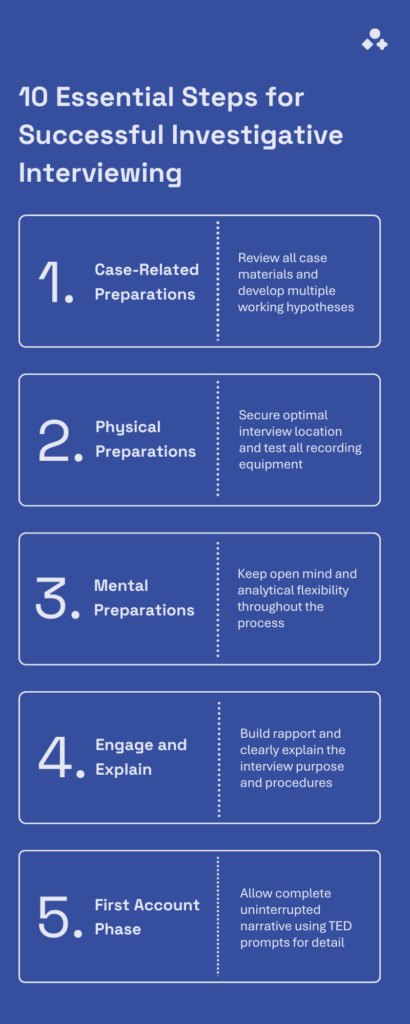
    Step 1: Case-Related Preparations 

    The foundation of any successful interview lies in comprehensive case preparation. Review all available investigation materials, evidence, and documentation thoroughly. Develop multiple working hypotheses rather than pursuing a single theory. Consider the interview’s aims and objectives clearly, and analyse the interviewee’s background, including their rights and any particular needs they may have. 

    This preparation phase is crucial for addressing all information needs, maintaining objectivity and ensuring you’re equipped to handle various scenarios that may arise during the interview process.  

    Step 2: Physical Preparations 

    Secure an optimal investigative interview location with minimal distractions and suitable conditions for effective communication. Ideally, the environment should be distraction-free yet comfortable, enabling clear dialogue without external interference. 

    Summary

    • Comprehensive Preparation is Essential – Successful interviews require thorough case review, optimal physical setup with tested recording equipment, and mental readiness with multiple working hypotheses.
    • Build Trust Through Professional Engagement – Apply the HEAR principle (Honesty, Empathy, Autonomy, Reflection) to establish rapport, explain procedures clearly, and assess interviewee vulnerability and legal requirements.
    • Allow Free Narrative Before Probing – Let interviewees provide complete uninterrupted accounts using TED prompts (Tell, Explain, Describe), then systematically clarify using the 5WH framework (Who, What, When, Where, Why, How).
    • Evaluate and Reflect for Continuous Improvement – Assess whether interview objectives were met, analye your performance techniques, document lessons learned, and plan next investigative steps based on obtained information.

    Make necessary arrangements for legal representation, interpreters, or support personnel as appropriate to the case. Test all recording equipment thoroughly – Davidhorn’s professional A/V recording systems ensure reliable documentation with multiple backup options, providing the support essential for evidential integrity. 

    Step 3: Mental Preparations 

    Maintain an open mind and analytical flexibility throughout the process. Consider alternative hypotheses to the evidence and anticipate different scenarios that may unfold. Show empathy and genuine interest in the interviewee’s situation. Mental preparation involves setting aside preconceptions and preparing to adapt your approach based on the interviewee’s responses and demeanour. 

    This psychological readiness enables you to respond appropriately to unexpected developments whilst maintaining professional composure. 

    Step 4: Engage and Explain 

    Initiating Contact and Establishing Ground Rules. Apply the HEAR principle consistently: Honesty, Empathy, Autonomy, Reflection. This approach builds trust whilst maintaining professional boundaries and ensuring the interviewee feels respected throughout the process. Continuously assess interviewee vulnerability considering age, mental and physical health, trauma, and other risk factors. Implement appropriate legal safeguards and consider specialist involvement when necessary. Utilise communication aids to ensure effective dialogue throughout the process. 

    At the beginning of an investigative interview, the interviewer should: 

    • Build rapport through empathy and respect. 
    • Assess the interviewee’s well-being to ensure they are fit for the interview. 
    • Clearly explain:
      • The case under investigation and the purpose of the interview. 
      • For suspects: the grounds for suspicion – explain what and why (without disclosing detailed evidence). 
      • For suspects: the right to legal counsel and the right to remain silent. 
      • All legal and practical procedures, including audio/video recording. 
      • That participation is voluntary (where applicable). 

    Establish Ground Rules. The interviewer should then set the following expectations: 

    • Everything said matters – the interviewee should provide as much detail as possible, even if it seems minor (e.g., „describe my pen”). 
    • Don’t filter – report everything, even if it seems irrelevant or uncertain. 
    • Focus and effort – memory recall takes concentration and may be tiring. 
    • Open communication – the interviewee should feel free to: 
      • Ask if they don’t understand. 
      • Say if they don’t know.
      • Correct misunderstandings or raise concerns about leading/inappropriate questions.
    • Interview structure – outline the topics to be covered, timing, and planned breaks. 
    • Confirm understanding – ensure the interviewee grasps the information and how it applies. 

    Rapport building isn’t about manipulation – it’s about creating an atmosphere where communication based on mutual respect and facts can occur. This foundation is crucial for establishing trust and obtaining reliable information. 

    Step 5: First Account Phase  

    Allow the interviewee to present their complete account without interruption. Exercise strategic patience and maintain control by carefully pacing and actively listening, rather than jumping into questioning. 

    Use TEDS prompts (Tell, Explain, Describe, Show Me) to encourage detailed responses. Document PLATCOM elements systematically: People, Location, Actions, Times, Communication, Objects and Motives. This free narrative phase often reveals crucial information that targeted questioning might miss. Do not interrupt. Postpone your probing until the first account is entirely over.  


    Listen to our podcast on Investigative Interviewing


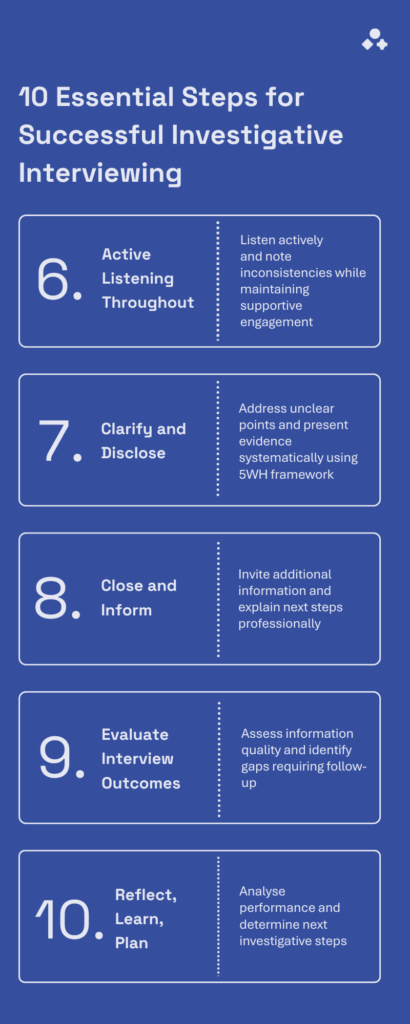
    Step 6: Active Listening Throughout   

    Listen actively to understand the interviewee’s perspective and facilitate the flow of information. Use silence and non-verbal cues to demonstrate engagement. Note inconsistencies, gaps, and areas requiring clarification whilst maintaining supportive engagement. 

    Step 7: Clarify and Disclose 

    Systematically review new information, your interview objectives, address PLATCOM elements and address all unclear points and gaps before introducing evidence or new information. If applicable, present key information stepwise to test account accuracy whilst minimising memory contamination. 

    Ensure comprehensive coverage using the 5WH framework: Who, What, When, Where, Why, How. This systematic approach ensures no crucial elements are overlooked. 

    Step 8: Close and Inform 

    Conclude the interview professionally by inviting the interviewee to provide additional information or ask questions. Clearly explain next steps, contact procedures, and timeline expectations. 

    Express appreciation for their cooperation and end respectfully, regardless of case outcomes. This professional closure may prove valuable for future interactions. 


    Read our eBooks on how to plan Investigative Interviews

    eBooks & whitepapers

    Step 9: Evaluate Interview Outcomes 

    After the interview, conduct a structured evaluation to determine whether the objectives were achieved. This includes: 

    • Assessing the quality and completeness of the information obtained in relation to the interview plan and investigative priorities. 
    • Identifying gaps, inconsistencies, or unanswered questions that may require clarification or follow-up. 
    • Evaluating the interviewee’s responses in light of known evidence and other case material. 

    This step helps ensure that the interview contributes meaningfully to the investigation and highlights any immediate follow-up actions. 

    Step 10: Reflect, Learn, and Plan Ahead 

    Following the evaluation of the content, reflect critically on your own performance as an interviewer: 

    • Analyse your interview techniques – What worked well? What could have been done differently? 
    • Identify areas for improvement in planning, communication, question style, rapport-building, and adaptability. 
    • Document lessons learned to support your ongoing professional development and improve future interviews. 
    • Determine and plan next steps in the investigation, such as re-interviews, new lines of inquiry, or further evidence collection. 

    This reflective phase ensures continuous learning and helps maintain high standards of investigative practice. 

    Conclusion 

    Successful investigative interviewing requires systematic preparation, skilled execution, and thorough evaluation. By following these 10 essential steps and maintaining focus on the core principles of Rapport, Empathy, Active Listening, and Professional Integrity, investigators can conduct interviews that are both effective and ethically sound. 

    The investment in proper technique and equipment, including professional recording systems that ensure complete documentation, pays dividends in terms of case outcomes and legal admissibility. Remember: the quality of your interviews determines the quality of your investigations. 

    Written by:

    Marta Hopfer-Gilles

    Fact checked by Ivar A Fahsing (PhD)  

    Claude AI was used while creating this post

    Related products

    • Fixed Recorder

      Fixed HD recorder for high security interview rooms.

    • Portable Recorder

      Lightweight, PACE-compliant interview recorder for any setting.

    • Capture

      Mobile app recorder for capturing evidence on the go.


    • Ark Interview Management

      Receive, monitor, and keep evidence throughout its lifetime.

    2025-07-31
  • How to Use Davidhorn’s Investigative Interview Recording Solution.

    How to Use Davidhorn’s Investigative Interview Recording Solution.

    How to Use Davidhorn’s Investigative Interview Solution. Webinar with Davidhorn CTO Magnus Green.

    (Live-recorded webinar from Davidhorn Police Interview Summit 2025)

    Fill out the form to watch the webinar.
 Please fill in all required fields (*) before submitting your inquiry.

    Our latest webinar, recorded during the Davidhorn Police Interview Summit 2025, was hosted by Magnus Green, Chief Technology Officer at Davidhorn.

    Magnus provided an exclusive hands-on demonstration of our comprehensive investigative interview solution, showcasing over 40 years of research and development in action.

    In this practical walkthrough, Magnus explored:

    • Complete interview workflow management – From initial planning through to post-interview analysis, demonstrating how technology supports the entire investigative process
    • Real-time interview demonstration – Live recording session showing seamless integration between planning, conducting, and monitoring interviews
    • Digital evidence integrity – How Digital Fingerprint SHA-256 and encryption protect evidence from tampering while maintaining court admissibility
    • Advanced transcription and AI assistance – Automated speech-to-text transcription capabilities with human oversight to ensure accuracy and reliability
    • Secure sharing capabilities – Controlled access systems for sharing evidence with legal representatives while maintaining audit trails and security
    • Flexible deployment options – Browser-based solutions that work across devices while respecting data sovereignty requirements

    Magnus’s demonstration highlighted how modern interview management technology streamlines investigative workflows while maintaining the highest standards of evidence integrity. Built with input from practitioners to solve real-world problems, this solution enhances efficiency without compromising the quality or admissibility of evidence.

    Discover how this proven technology transforms investigative interviewing from planning to courtroom presentation, supporting justice through innovation.

    "*" oznacza pola wymagane

    To pole jest używane do walidacji i powinno pozostać niezmienione.
    Country*
    Consent

    2025-06-23
  • Investigative Interviewing in Ukraine during Wartime – ep. 22

    Investigative Interviewing in Ukraine during Wartime – ep. 22
    Investigative Interviewing in Ukraine

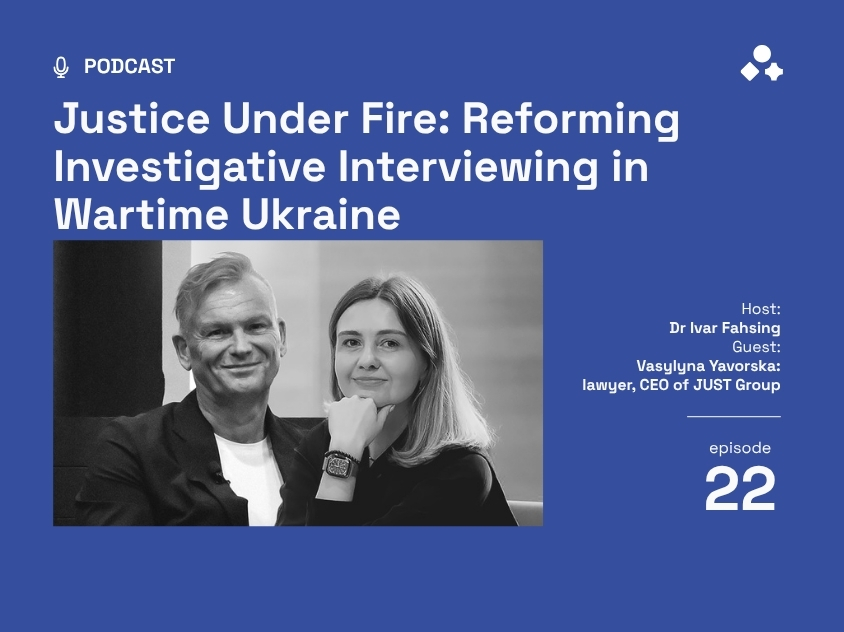
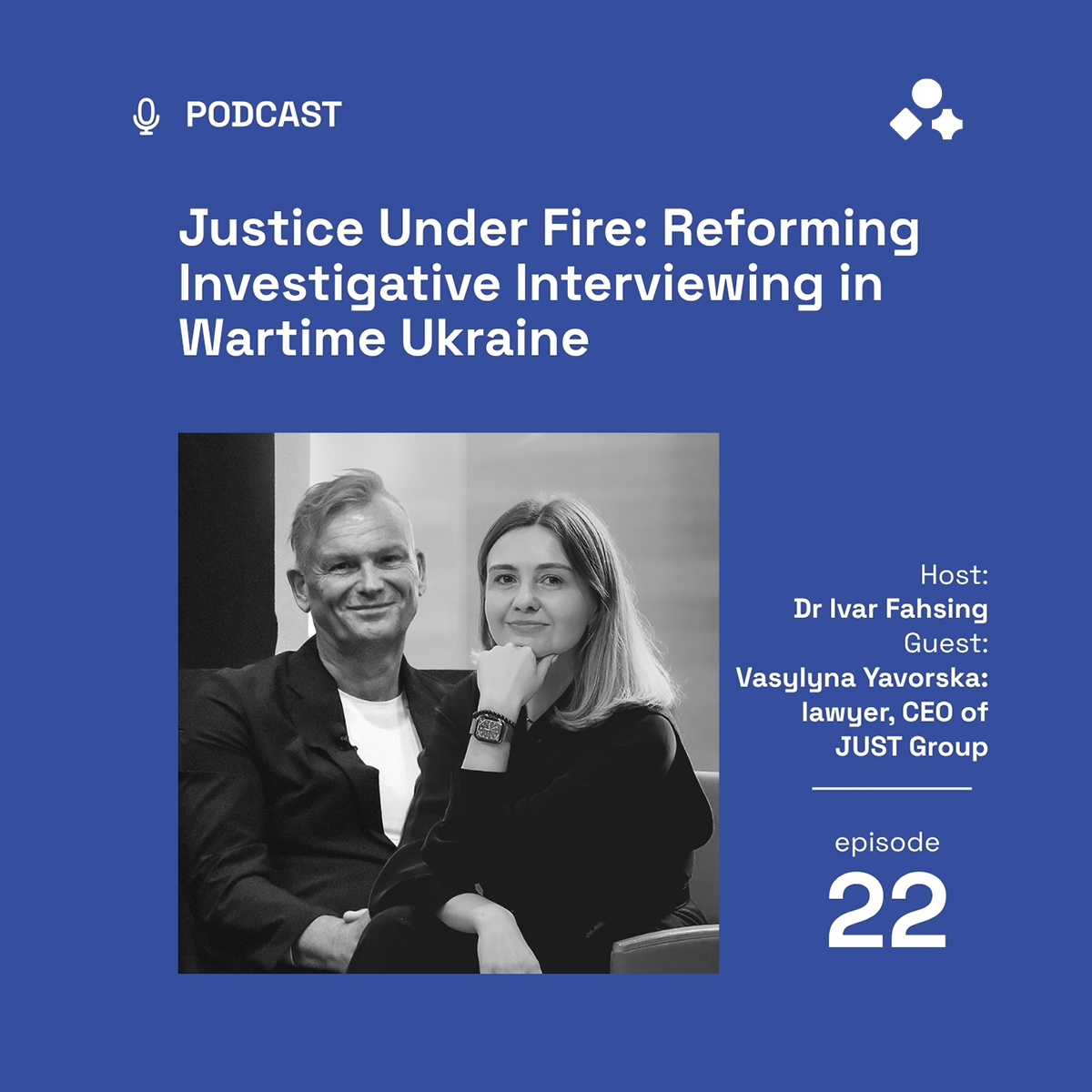
    Episode 22. Justice Under Fire: Reforming Investigative Interviewing in Wartime Ukraine

    Recorded live at the Davidhorn Police Interview Summit 2026, Manchester.

    In this episode, Dr Ivar Fahsing is joined by Vasylyna Yavorska — lawyer, criminal justice reformer, and CEO of JustGroup, Ukraine’s leading NGO for criminal justice transformation. 

    Vasylyna has coordinated Ukraine’s national expert team on investigative interviewing since 2017. She speaks about the challenge of shifting a system away from confession-driven success metrics, building coalitions for change inside resistant institutions, and the pivotal moment in March 2022 when her team was asked to develop prisoner-of-war interview guidelines while Kyiv was still partly under occupation. 

    She also addresses the barriers to scaling investigative interviewing across a large multi-agency system, why mandatory recording is central to her advocacy work, and how she sees technology and human judgment combining to deliver justice more quickly in complex cases. 

    Beyond a Reasonable Doubt is a podcast series hosted by Dr Ivar Fahsing, exploring investigative interviewing across jurisdictions, cultures, and disciplines. Produced by Davidhorn. 

    Recorded live at the Davidhorn Police Interview Summit 2026 in Manchester, Dr Ivar Fahsing speaks with Vasylyna Yavorska — Ukrainian lawyer, criminal justice reformer, and CEO of JustGroup — about what it means to try to transform a criminal justice system in the middle of a war. 

    Vasylyna has coordinated Ukraine’s national team of investigative interviewing experts since 2017. In this conversation, she talks candidly about the challenge of shifting practitioners away from confession-focused thinking, the structural barriers to scaling investigative interviewing across a large and complex justice system, and the moment in March 2022 — Kyiv still partly occupied — when her team was asked to develop guidelines for interviewing prisoners of war. 

    Topics covered include: defining success in an interview; building internal champions for change; why mandatory recording is an advocacy priority; the impact of martial law on Ukraine’s approach to pre-trial testimony; and what Vasylyna would most want from technology to support investigators handling complex, high-volume cases. 

    Main topics: 

    • Investigative interviewing as an entry point for systemic criminal justice reform 
    • Shifting from confession-focused to information-focused practice 
    • The 2020 finding: 61% of Ukrainian investigators defined confession as success 
    • What systemic change requires: leadership, training, infrastructure, monitoring 
    • Why reform matters more, not less, during active conflict 
    • Developing prisoner-of-war interview guidelines in March 2022 
    • War crimes interviewing in practice — the Bucha unit, 2,000+ interviews 
    • Managing resistance and building internal champions 
    • Horizontal learning among practitioners 
    • Barriers to scaling across a large, multi-agency system 
    • Mandatory recording — legislation, martial law, and the case for reform 
    • Technology and human judgment in complex, high-volume cases 

    Investigative interviewing reform in wartime Ukraine — Vasylyna Yavorska on systemic change, mandatory recording, and justice under pressure.

    About the guest

    Vasylyna Yavorska

    Vasylyna Yavorska is a Ukrainian lawyer and criminal justice reform specialist with over 15 years of experience designing systemic change in law enforcement. She is CEO of JustGroup, a national NGO focused on transforming Ukraine’s criminal justice system to be more effective, fair, and human-centred. Since 2017 she has coordinated Ukraine’s national team of experts on investigative interviewing, and has led work with the Office of the Prosecutor General and National Police on developing interviewing standards – including, from the first weeks of Russia’s full-scale invasion, guidelines for interviewing prisoners of war. She is currently active in scaling up investigative interviewing practice across Ukrainian law enforcement, including with war crimes units who have now conducted more than 2,000 interviews. 

    Watch and listen wherever you get your podcasts (Youtube link here)

    Related products

    • Fixed Recorder

      Fixed HD recorder for high security interview rooms.

    • Portable Recorder

      Lightweight, PACE-compliant interview recorder for any setting.

    • Capture

      Mobile app recorder for capturing evidence on the go.


    • Ark Interview Management

      Receive, monitor, and keep evidence throughout its lifetime.

    Transcript

    Guest: Vasylyna Yavorska

    Host: Dr Ivar Fahsing


    Dr. Ivar Fahsing  [00:10]

    Vasylyna Yavorska, welcome to our live podcast, recorded here at the Radisson Hotel in Manchester, England.

    [00:21]

    I’m so happy to have you as a guest. How are you? 

    Vasylyna Yavorska  [00:27]

    I’m fine, thank you. Glad to be here. 

    Dr. Ivar Fahsing  [00:30]

    I don’t know how often you appear in live broadcasts.

    Vasylyna Yavorska  [00:33]

    I have no experience of live broadcasts, but in Ukraine we have done such things. This is supposed to be a relaxing conversation between you and me. But of course we will try to go into topics that relate to investigative interviewing, fair trials, technology, and the wider implications of this.

    Dr. Ivar Fahsing  [00:56]

    But before we dive in, I would like you to give a short introduction — who you are, what you do, and where you work. 

    Vasylyna Yavorska  [01:04]

    I will start by saying that I am a lawyer by degree, but for more than the last 15 years I have been working in my own country, Ukraine, in what I love to call 'managing ideas’ — transforming the criminal justice system. I worked on many projects and initiatives, and what I love most of all is designing how we can achieve change within the criminal justice system. I have seen the system from very different perspectives.

    [01:41]

    The second role, which is probably very important for this podcast, is that I have been coordinator of the national team of experts on investigative interviewing since 2017. We were a small group of champions, enthusiastic about the need for this approach in our country — and we are still at it. 

    [02:05]

    The third role is that I am now CEO of the JustGroup, a national non-governmental organisation focused on the transformation of the criminal justice system. We want to make our system more effective, fair, and human-centred. These are my different perspectives.  

    Dr. Ivar Fahsing  [02:27]

    I have been happy to be working quite closely with you for many years, and I am really impressed by what you are doing. Could you go a little deeper? What is investigative interviewing to you? What is the idea or the ethos behind it?

    [02:46]

    We have this season of the Davidhorn podcast, called Beyond a Reasonable Doubt, and we have a set of questions we try to ask different people from different contexts, jurisdictions, and cultures — just to see how similar and how different they are. So the first question is always: what is investigative interviewing to you?

    Vasylyna Yavorska  [03:12]

    I personally tend to look at the criminal justice system from a human rights perspective, and I have had a rich background in human rights work in relation to law enforcement. But there was something — a gap I felt for many years. We very often spoke with law enforcement officials in the language of restriction: 'you shouldn’t do this or that.’ And when investigative interviewing was introduced in Ukraine — actually by your colleague Alvin Radcliffe in 2017 — we got the idea that here was a methodology which could introduce a shift in mindset for practitioners: how they could be efficient and at the same time observe human rights and safeguards.

    [04:16]

    For me personally, I now look at investigative interviewing not only as a methodology, a standard, or an approach to gathering information, but also as a very good entry point for system transformation — when we talk about how the criminal justice system thinks, how practitioners make decisions, how they define success. For me, it is something like a transformative shift. 

    Dr. Ivar Fahsing  [04:50]

    Absolutely. Would you say it changes your mindset? What do you mean by that?

    Vasylyna Yavorska  [04:55]

    The way we actually think, how we structure information, how we define our goals — what we want to achieve during the interview, or across the whole investigation. 

    [05:12]

    Together with our friends in the region, we are more than happy to have a partnership with the Regional Centre for Human Rights on a national development programme on investigative interviewing for Ukrainian practitioners. And one question we ask at the very beginning of every programme is: how do you define the success of an interview?

    [05:35]

    For me, it is a very diagnostic question — how do you see that you achieved your goal? How do you define that goal? And in 2020, we conducted research together with colleagues. At that time, 61% of Ukrainian investigators indicated that a confession was what they perceived as success during an investigation. So probably we needed to change something. For me personally, it is exactly that shift we are trying to achieve — to become more focused on gathering reliable information rather than on achieving a confession.

    Dr. Ivar Fahsing  [06:22]

    Couldn’t agree more. You also mentioned in the intro that you are actually trying to achieve systemic change. Does that mean you believe this mindset shift can have wider implications for your country? 

    Vasylyna Yavorska  [06:39]

    I think when we talk about systemic change, it is of course very important to shift the mindset of individual investigators and prosecutors. But I believe we need to do more. When we talk about systemic change, we need investigative interviewing — yes — but we also need to understand that it must be reflected in structural decisions, like standards embedded within the system, and infrastructure that supports a good environment for interviewing adults and children alike.

    [07:29]

    In our country we still face the problem of not having dedicated space for interviewing. It is very hard to talk about building rapport and good conversation when you are sharing a room with colleagues while trying to make contact with the person you are interviewing.

    [07:50]

    So I believe that systemic change is first about leadership and ownership — we need to reach the point where the leadership of the criminal justice system acknowledges: 'We are moving in this direction. We want to achieve this as our core standard.’ The second is training — we must work on mindset, skills, and infrastructure. And I believe we also need monitoring and evaluation tools within the system, to understand where we are, to stop and observe, and to analyse the data to see whether we are moving in the right direction or not. That is something we are still working on. 

    Dr. Ivar Fahsing  [08:46]

    Ukraine is in the middle of a war. Why is this important for you right now? 

    Vasylyna Yavorska  [08:53]

    It is both a hard and a simple question at the same time. I think back to March 2022 — the full-scale invasion of the Russian Federation into my country began in February 2022, and Crimea had been occupied since 2014. I was in the western part of Ukraine in early 2022, together with my son, feeling somewhat safer.

    [09:24]

    I was trying not to disconnect from my work on the criminal justice system. At that moment, part of the Kyiv region was still under occupation by the Russian Federation. And our team of experts on investigative interviewing was contacted by the Office of the Prosecutor General — could we talk about interviewing? And we had a Zoom call in March, under very strange and complex circumstances for all of us. 

    [10:04]

    And we discussed one thing: could we have guidelines for interviewing prisoners of war? I come back to that moment very often now. Because at that moment it became very clear to me that this was not about guidelines or instruments or training. It was about the choice of a country and a system — about values, about what we want to stand for as a country, as practitioners, as professionals. For me, it was a moment that gave me even more inspiration and strength to move on. 

    [10:53]

    And after that we had many discussions with the Office of the Prosecutor General and the National Police — especially those units investigating war crimes. They were highly supportive of any approaches that would allow them to collect reliable information. Because they understand very clearly that the challenges are greater now, and they need somehow to document everything that is happening — not just for courts and investigations, but for the next generation. 

    [11:42]

    And I believe that was a very important moment. After that, there was a very clear message from top leaders in the criminal justice system: we need to find a way to raise the standard of interviewing. We were not perfect then, and our investigators and prosecutors are still on the path — upskilling, developing, growing. But I believe it is important for the criminal justice system to make this choice and then to design a roadmap for how to move forward.

    Dr. Ivar Fahsing  [12:31]

    I find that fascinating. I don’t know if you know that Sigmund Freud is supposed to have said something like this — that fair trials and a good criminal justice system are the first prerequisite for a good democracy. I think that is a really interesting parallel to what you are saying.

    [12:57]

    I have had the privilege of talking with many of your prosecutors and detectives — sometimes not in person, because of the situation, so mostly online. I have never been in the room to see that interaction directly. How is this message, this change, this training received? Do prosecutors and detectives take it in? Do they handle it? 

    Vasylyna Yavorska  [13:33]

    I must be honest — it is absolutely natural for adults to be resistant to something new, generally. We have our backgrounds, we know what to do, and we have been doing it for decades. And then suddenly someone comes along and tries to explain that you need to do things differently. We still feel some resistance. But I believe it is a very constructive dialogue. We try to find the right words and the right language to explain, and to find the right arguments. From my perspective, it is a question of dialogue — how we build this dialogue with practitioners and institutions.

    [14:27]

    Another element is building real partnership and trust, because we understand this is a long journey. We are not expecting to change things from Monday. We are ready to be partners — to be with you on this road, facing all the challenges and finding solutions together. That is actually how we act as an organisation, because we are very focused on the role of partner to criminal justice practitioners and institutions, to ensure we can find the right arguments for them and overcome the resistance that I believe every system has.

    Dr. Ivar Fahsing  [15:17]

    I think all of us have that — it is probably rooted in the need to defend what you are already doing. If you change, do you have no honour in what you have already been doing? 

    Vasylyna Yavorska  [15:37]

    I would add that our approach is not to try to cover the whole system from the very beginning. It is to identify and engage the right people from within the system — those who are more ready for change. That is very important to me, because you can build links with the system and have allies inside it. It is much easier for an investigator to speak with their colleague and say: 'Look, I tried this approach, I tried this instrument, here is my experience — let’s discuss that.’ I believe that works very well, especially in a criminal justice context, because horizontal learning among people is very important.

    Dr. Ivar Fahsing  [16:54]

    Couldn’t agree more. And personally, I sometimes feel almost uncomfortable — I have to say — when I deliver these lectures in Ukraine, because I am, as you know, also psychologically touched by that war. It hurts. Of course it hurts all of us. 

    [17:16]

    Sometimes I feel I am delivering a somewhat peripheral message when I talk about interviewing. But as you know, we had training in Kraków, almost two years ago now — around two years ago — and the CEO of Davidhorn was there, together with Alex Fawcett from Manchester and Ruth Underwood from the Met.

    [17:43]

    I have delivered these kinds of trainings all around the world for many years. There are some positives in that — the coin does not always drop during the three days of training. But I have never seen a group of detectives and prosecutors able to adapt and absorb this more quickly than that group we trained in Kraków. I was so impressed. My personal experience of that hands-on training was really, really good.  

    [18:21]

    Also in Norway, when we started a similar process of change around 25 to 26 years ago — of course you should not spend all your time with people who resist. There are plenty of people who genuinely want this. Spend your time there and let it spread naturally. 

    Vasylyna Yavorska  [18:44]

    Yes, naturally. You cannot force some things to grow artificially. Sometimes it takes time, and you need to accept that and just move forward — step by step, not giving up, just looking for the next small step, but always moving forward.

    [19:09]

    And I believe that crisis can be the best motivator or the best driver, because when you are under pressure you try to find solutions, and you understand that you cannot continue working in the same way. For the Ukrainian system — across many different sectors — this crisis has actually become a driver, an additional motivation, an additional source of energy. Because you understand you need to defend yourself, your family, your values, your country. 

    Dr. Ivar Fahsing  [19:57]

    I told you a story yesterday — I have friends working for the Norwegian Navy Special Forces, the Norwegian SEALs, and they have been working quite closely with some of your divisions down there for some time. Officially, they are there to train you. But when we share a beer, they say: 'Ivar, we are actually the ones who learned the most.’ So it is a very dualistic and valuable relationship for my friends in the Norwegian Defence Forces as well.

    [20:32]

    And the way I have come to know Ukrainians is that I feel quite certain it will not be long until you are teaching us how to implement investigative interviewing, because things move very slowly in many European countries.

    [20:54]

    I really would like to share a story. We were delivering training together with the UK in Lebanon some years ago, funded by the Council of Europe. Two high-level observers came to see how we were progressing — one retired Supreme Court judge from Paris and a very senior judge from Germany. They were very serious people, but after a night or two they liked what they saw, and we went out to dinner together on the last evening with some parliamentary members and politicians from Beirut.

    [21:39]

    When the others left, they said: 'We are really impressed by this — we really like it.’ I said: 'Here we have one German and one French person coming to Beirut to see how we are implementing investigative interviewing. Are you aware that this does not exist in your countries?’ 'What?’ 'No, there is absolutely nothing that even resembles this.’ In France there are some pockets. In Germany very few. I was shocked. 

    [22:32]

    But then in the taxi home, the German said: 'Ivar, you surely know why.’ I said no. 'It’s British. We wouldn’t touch it with a stick.’ So there are cultural factors at play as well. 

    Vasylyna Yavorska  [22:48]

    That is probably true. But what we have is that our investigators and prosecutors are regularly practising — unfortunately, especially war crimes. I was just in Bucha last week, at a police unit that has a special war crimes team. Bucha, as you know, is a town near Kyiv — it was occupied during the early stages of the war and is unfortunately now a very well-known place. That unit has conducted around 2,000 interviews, and these are not easy interviews — they are typically with victims and witnesses of war crimes, and with prisoners of war.

    [23:45]

    I believe that this practice — interviewing, recording, and reflecting — combined with training, has allowed these professionals to grow. Unfortunately for us as a country. But we are practising, and I believe they will consolidate this expertise and experience and will be ready to share it with colleagues elsewhere, because we have very good people who are deeply committed to the core values of investigative interviewing. 

    Dr. Ivar Fahsing  [24:23]

    Really looking forward to that. And you mentioned that the French and Germans did not want it because it was British — well, that is why we are now trying to package it differently. The new UN standard, for instance, may help. But looking at Ukraine — are there particular barriers or issues that typically come up when you are implementing this? 

    Vasylyna Yavorska  [25:02]

    Thank you. The main challenge is probably — and it is a little bit of a joke — that we are still a big country. We have five investigative agencies and a large prosecutor service. We can be very optimistic that we will eventually cover all our investigators and prosecutors with training, monitoring and evaluation, upskilling, and so on. But I believe the biggest barrier is how to design the scaling-up properly.

    [25:42]

    We already have a national instructor team, a Community of Champions, practitioners, and recording in the war crimes unit. But there are still gaps in the system. The barrier I see is finding a way to extend training and practical support to the majority of investigators and prosecutors. 

    [26:18]

    Another challenge is infrastructure. As I mentioned at the outset, we really need to create environments where professionals can practise investigative interviewing. We cannot require investigators and prosecutors to conduct investigative interviewing if they do not have appropriate facilities to do so.

    [26:46]

    We are actually quite optimistic about integrating standards into the system, because it is already embedded in the strategic documents of the Office of the Prosecutor General — there will be national guidelines on investigative interviewing, and we believe that will happen this year. But managing the restructuring of training programmes across different types of agencies is still a challenge. 

    [27:19]

    And one more — monitoring and evaluation. I personally believe in this as a tool for learning, but there is still a perception that monitoring and evaluation are about control. That is also a cultural shift we need to introduce. We need to explain why and how we are doing it, and how to engage management and use peer-to-peer instruments to support each other — rather than simply checking whether requirements are met. 

    Dr. Ivar Fahsing  [28:11]

    No one wants to feel they are being made a fool of. I remember in Norway in the late 1990s — as has been said several times today — much of the innovation in this field was driven by miscarriages of justice. We had several serious ones surface in the 1990s, and the defence lawyers’ association publicly demanded the mandatory recording of all suspect interviews. 

    [28:46]

    The Ministry of Justice responded by launching a trial project, which was run by Asbjørn Rachlew and me as secretaries. We were young detectives at the time. Digital recording was then very new, very expensive, and quite bulky — almost the size of a guitar case.

    [29:16]

    We distributed equipment to about five police forces around Norway and waited to collect interviews and see what was happening. But very few interviews came back. We had spent a lot of money, so we held a meeting in Oslo for a frank discussion — what was happening? Didn’t it work? No one said anything. So we went out for a beer, and I said: 'It is not the equipment. It is just the fact that they do not know what to say.’ They were afraid to push the record button. 

    [29:58]

    That was when we realised these people needed training. Of course they need training if they want to feel confident and do a good job in front of a camera. So that was when we realised we needed a national training programme for interviewing, and we started developing that.

    [30:18]

    So what about recording today in Ukraine? 

    Vasylyna Yavorska  [30:21]

    From my perspective, it is very connected with infrastructure. I am absolutely certain that we need mandatory recording — not only to collect reliable and accurate information, but also to have the opportunity to review and learn. We have recording for children’s interviews, and the war crimes department is now recording many of its interviews, but not all. 

    [30:59]

    I believe we have some complications in our legislation. From a high-level perspective, I believe this is very connected with trust in the police. When the new Criminal Procedure Code was introduced in Ukraine more than ten years ago, our country was near the top of the European Court of Human Rights list for judgements on torture and ill-treatment. Because of that, a very strict standard was set in the legislation: no pre-trial testimony may be used during a court hearing. Judges must invite every witness and victim to give evidence at the hearing.

    [32:04]

    Now, under martial law, practitioners have more opportunity to use pre-trial testimony, because everyone understands that we may lose people, lose access to witnesses, and lose information. That is why practitioners are now trying and practising recording and introducing it to the courts. And at this moment we see that even judges and courts are more open to this entirely new approach. 

    [32:41]

    In this regard, I believe that mandatory recording will be the strongest argument: if all safeguards are in place and the recording quality is good, a judge can rely on that testimony. Because we are currently also facing the problem of extremely long court proceedings — we are effectively shifting the burden of investigation from investigators to judges, asking them to conduct interviews during hearings. From my perspective, that is not an efficient way for a criminal justice system to operate. 

    [33:39]

    We need very good investigative work by investigators and prosecutors, and then the judge should check — if there are questions, they have the opportunity to invite people to a court hearing. That is probably why mandatory recording will be a very important advocacy goal for the next stage as well. 

    Dr. Ivar Fahsing  [34:05]

    Exactly. You are here at a summit hosted by Davidhorn, a world-leading technology company focused on supporting better justice from the moment of first contact. If you could wish for something in terms of technological development, what would be highest on your list?

    Vasylyna Yavorska  [34:32]

    I have one wish, but it is not directly about investigative interviewing — all Ukrainians wish the same thing. But I believe I should come back to the message I have already mentioned: the most important change we need in the criminal justice system is about people, and the level of qualification of investigators and prosecutors.

    [35:12]

    As a civil society organisation, we sometimes ask too much of them. That is why I believe that creating the space where their time and efforts can be used efficiently gives us more opportunity to achieve justice in society. When we talk about very complex cases — war crimes, high-profile corruption cases, cases with enormous volumes of information — I believe there is a need to find the right combination of technology’s capacity to analyse, collect, and preserve information, and the human intellect and cognitive capabilities of professionals in the system.

    [36:13]

    Because ultimately, everyone needs to feel that justice exists. But sometimes it takes too long to wait for it. I believe that this combination of human professionalism and technology can help give us the chance for justice sooner. That is probably my answer, and my wish.

    Dr. Ivar Fahsing  [36:38]

    Yes — that tight interaction between the two. You are not talking about replacing human judgment, but about understanding more clearly where we can bring technology in, where we can assist, and where the decision must ultimately rest with the investigator or prosecutor. I believe that decisions should be taken by investigators and prosecutors. But where can technology assist them — and where do they simply need to say: 'This is my decision. This is what I am here for.’ 

    [37:18] 

    Vaselina, thank you so much for sharing your insights. I wish you a safe journey forward — for the future of Ukraine, but also for the future of a better, fairer, and more just society. Thank you so much for coming to the podcast. 

    Vasylyna Yavorska  [37:48] 

    Thank you. It is so nice to be here. 

    Dr. Ivar Fahsing  [37:50]

    I know the efforts you made to come here, and I also know you are about to leave for Geneva for another important meeting. Thank you so much. 

    Vasylyna Yavorska  [38:02] 

    Thank you so much. 


    END OF TRANSCRIPT

    © 2026 Davidhorn. All rights reserved.

    Read more

    2026-06-04
  • Torture Prevention in Europe – ep. 21

    Torture Prevention in Europe – ep. 21
    Torture Prevention in Europe with Therese Rytter

    The Long Game Series

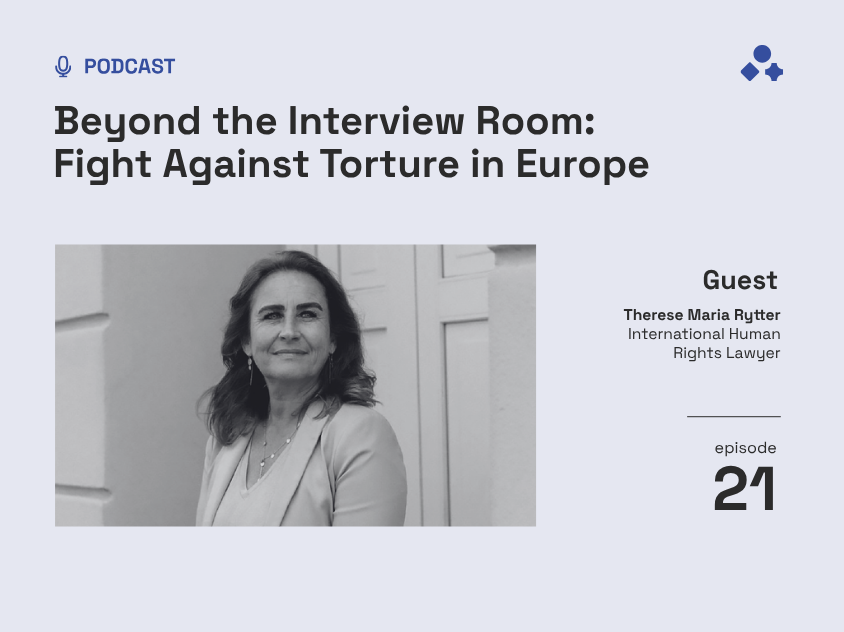
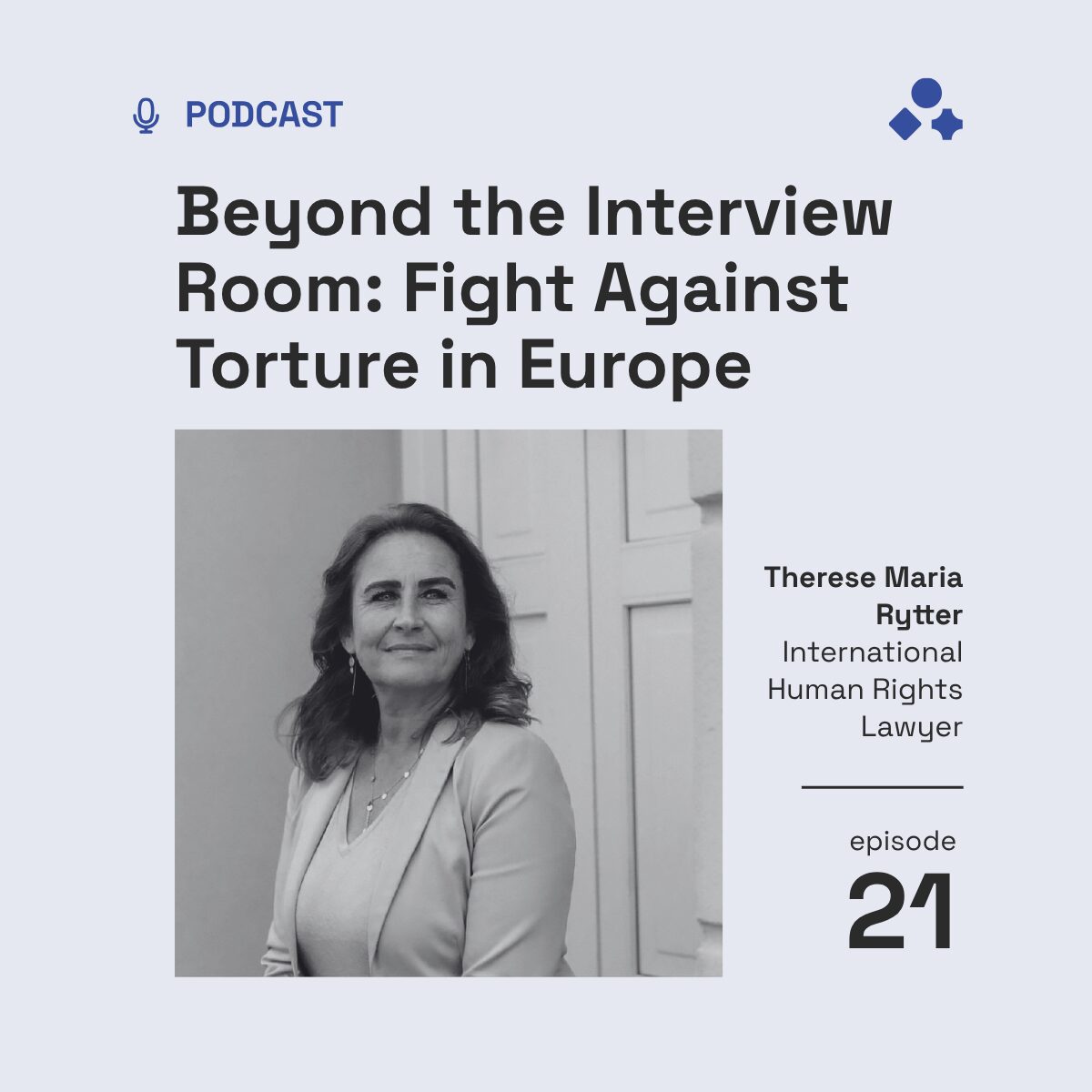
    Episode 21. Beyond the Interview Room: Fight Against Torture in Europe 

    Human rights lawyer Therese Rytter reveals how the CPT prevents torture across 46 European countries – and why investigative interviewing requires more than methods. 

    In this episode of Beyond a Reasonable Doubt, host Dr. Ivar Fahsing speaks with Therese Maria Rytter, international human rights lawyer and outgoing Vice-President of the European Committee for the Prevention of Torture (CPT), about the critical intersection of legal safeguards, investigative interviewing, and the prevention of torture across Europe. 

    After nearly 12 years with the CPT and 30 years dedicated to protecting human rights internationally, Therese brings unparalleled insight into what actually prevents torture and ill-treatment in police custody, prisons, and other detention settings across the 46 member states of the Council of Europe. As Director of Prevention and Accountability at DIGNITY – Danish Institute Against Torture, and co-author of the landmark Mendez Principles on Effective Interviewing for Investigations and Information Gathering, she represents the bridge between international human rights standards and practical implementation in criminal justice systems. 

    The conversation reveals the CPT’s unique and powerful mandate: conducting surprise visits to police stations, prisons, and psychiatric hospitals throughout Europe, sometimes arriving at midnight on Friday nights when cells are fullest. Therese describes how expert delegations – including lawyers, forensic doctors, psychiatrists, and former police commissioners – spend two weeks in each country, sitting inside cells to speak with detainees, examining injuries, reviewing CCTV footage, and assessing use-of-force records. This unprecedented access allows the CPT to make concrete, evidence-based recommendations tailored to each country’s specific context. 

    Key Topics Discussed: 

    • The CPT’s unique mandate: surprise visits to detention facilities across 46 European countries 
    • Denmark’s leadership role in the international fight against torture 
    • Methodology: expert delegations conducting two-week assessments 
    • The importance of legal safeguards: access to lawyers, doctors, and judicial oversight 
    • Police culture and problematic incentives: bonuses for case closure rates 
    • Confession extraction as a „shortcut” undermining justice 
    • Police officers’ role: upholding rights, not talking suspects out of them 
    • Decision-making tipping points: how uniformed policing creates investigative bias 
    • CPT standards and good practices across policing, prisons, and psychiatric care 
    • The ImpleMendez project: integrating safeguards with evidence-based methods 
    • Why investigative interviewing cannot be viewed in isolation 
    • Recording technology as crucial safeguard and training catalyst 

    Equipped For Justice – Supporting ethical, human rights-compliant investigations worldwide

    About the guest

    Therese Maria Rytter

    Therese Maria Rytter is an international human rights lawyer with 30 years of experience in promoting and protecting human rights, preventing torture, and advancing justice and accountability for international crimes. She serves as Director of Prevention and Accountability at DIGNITY – Danish Institute Against Torture, a human rights development and health organisation working in 15 countries worldwide. 

    From 2014 to 2025, Rytter served as a member and Vice-President of the European Committee for the Prevention of Torture (CPT), completing three mandates. She has led numerous delegations conducting monitoring visits to countries across the Council of Europe region, assessing the treatment of persons in police custody, prisons, psychiatric hospitals, and other detention settings with a view to preventing torture and ill-treatment. 

    Rytter was one of the co-authors of the Mendez Principles on Effective Interviewing for Investigations and Information Gathering, establishing international standards for non-coercive, rights-compliant investigative practices. Since 2008, she has served as a national expert to the United Nations Subcommittee on Prevention of Torture (SPT). Her work spans legal frameworks, practical implementation, and accountability mechanisms, making her one of Europe’s most influential voices on torture prevention and humane criminal justice practices. 

    Watch and listen wherever you get your podcasts (Youtube link here)

    Related products

    • Fixed Recorder

      Fixed HD recorder for high security interview rooms.

    • Portable Recorder

      Lightweight, PACE-compliant interview recorder for any setting.

    • Capture

      Mobile app recorder for capturing evidence on the go.


    • Ark Interview Management

      Receive, monitor, and keep evidence throughout its lifetime.

    Transcript

    Guest: Therese Rytter

    Host: Dr Ivar Fahsing


    Dr. Ivar Fahsing  [00:00]

    This morning I have the pleasure of inviting you, Therese Rytter, as our guest at this Davidhorn podcast Beyond a Reasonable Doubt. A warm welcome.

    Therese Rytter  [00:10]

    Thank you very much.

    Dr. Ivar Fahsing  [00:10]

    Therese, you and I know each other quite well after years where our paths have crossed, but our listeners might not be familiar with who you are and what you do in your daily work. Could you give us a short introduction?

    Therese Rytter  [00:25]

    Absolutely, I’d be happy to. My name is Therese Rytter. I’m a human rights lawyer by training and I am the Director of Prevention and Accountability at the Danish Institute Against Torture, Dignity, based in Copenhagen. I’ve been working in this field of international human rights for the last 30 years — essentially my entire career. In addition to this, I have also been a member of the European Committee for the Prevention of Torture for almost 12 years.

    Dr. Ivar Fahsing  [00:56]

    Fascinating. A Danish institute against torture — that’s an interesting place.

    Therese Rytter  [01:03]

    It is indeed. It’s a human rights development and health organisation that works in some 15 countries worldwide. We work in Denmark, of course, but also in a number of other countries, in order to try to prevent the occurrence of torture and other forms of ill-treatment and to pursue accountability — bringing perpetrators to justice and making sure that victims are also able to receive redress.

    Dr. Ivar Fahsing  [01:34]

    Interesting. As far as I know, Denmark actually holds quite an important position when it comes to torture prevention in the international community, doesn’t it?

    Therese Rytter  [01:42]

    That’s very right. Denmark has for several decades been the lead nation internationally in the fight against torture. Both in the United Nations General Assembly and in the UN Human Rights Council, Denmark tables resolutions that every year increase the legal protection against torture. They also support a number of programmes worldwide which seek to put these legal frameworks into practice and ensure they are carried out in everyday life — whether in policing or prison regimes.

    Dr. Ivar Fahsing  [02:19]

    Fascinating and also reassuring — that’s what you should expect from a well-established liberal democracy like Denmark. But you also mentioned that you hold a position in the European Committee for the Prevention of Torture, the CPT. Is that correct?

    Therese Rytter  [02:36]

    That’s absolutely right, yes.

    Dr. Ivar Fahsing  [02:37]

    Could you explain what exactly that is?

    Therese Rytter  [02:40]

    The European Committee for the Prevention of Torture is an expert body — part of the Council of Europe. The Council of Europe is an international human rights and democracy organisation that includes 46 member states, all the way from Norway in the north to Cyprus in the south, including the UK and extending to Turkey and Azerbaijan. Our role is essentially to help states prevent any kind of practice of torture or other forms of inhuman or degrading treatment.

    Dr. Ivar Fahsing  [03:14]

    And for how long have you been in this position?

    Therese Rytter  [03:19]

    Almost 12 years now. I’m ending my third mandate and cannot be re-elected. I’ve served my time in the CPT.

    Dr. Ivar Fahsing  [03:29]

    Fantastic. Thank you for the work you’ve done there. Twelve years is remarkable.

    Therese Rytter  [03:38]

    No, absolutely. It’s been a pleasure — an extremely important piece of work which I feel very honoured to have been part of. The CPT has a very particular and unique mandate, which no other international body holds. The CPT carries out visits to all 46 member states. We move into police stations, prisons, psychiatric hospitals — anywhere where a person can be deprived of their liberty. We sit inside cells and speak with people in police custody or in prison, to understand what their conditions are and how they are being treated. We also speak with staff and with management, so that we can make a thorough assessment, looking into files, records, and CCTV footage. It’s a very professional methodology of collecting evidence, and then of course, at the end of the visit, speaking with the national government to make recommendations on how to strengthen the protection against torture and inhuman treatment.

    Dr. Ivar Fahsing  [04:47]

    Fascinating. So your committee has a mandate approved by the governments of all Council of Europe member states?

    Therese Rytter  [04:59]

    Yes, that’s right. Every single country has acceded to the relevant European convention and has allowed the CPT to carry out visits into any place of detention within the jurisdiction of the state, and to cooperate with the CPT in good faith. This is a commitment they’ve all made voluntarily.

    Dr. Ivar Fahsing  [05:22]

    I see. And how does it work in practice? If you’re going to conduct an inspection of a country, what would typically be the process?

    Therese Rytter  [05:34]

    We assemble a delegation of independent experts — people with backgrounds as lawyers, medical doctors, perhaps with a specialisation in prison medicine, a psychiatrist, or a former police commissioner. We make sure, depending on what we want to do in the country, that we have the right expertise on board to assess the situation at a professional level. The delegation — say, ten persons — will notify the state, usually three or four weeks in advance, saying we will be visiting and we would like credentials to enter any place. Once we arrive, we receive those credentials from the government. We meet with them, seek to understand recent developments, and they explain what progress has been made and what challenges remain. From there, we conduct fact-finding. For two weeks, we work across the country — moving into police stations and prisons, most of which are not notified in advance. We may notify one or two prisons, but the rest will be surprise visits. For police stations, we can arrive around the clock — very often on a Friday or Saturday night, after there have been incidents in the town. We’ll interview persons who are arrested and detained. Our medical and forensic doctors will examine them, photograph any injuries, and review medical files and use-of-force records. There’s a whole methodology for collecting the information we need to assess how people are being treated. We do this across many police stations and prisons, not only in the capital but in remote areas as well. At the very end of the visit, we meet again with senior government representatives — the Minister of Interior, the head of police, the Minister of Justice, the head of the prison service — and present our preliminary observations, covering both good practices we’ve seen and the concerns we have about continuing patterns of violations, or in some cases, patterns of torture.

    Dr. Ivar Fahsing  [08:20]

    So you can actually speak directly with suspects in custody cells or inmates in prisons?

    Therese Rytter  [08:32]

    Absolutely. We have an unimpeded right to enter these areas, to choose exactly who we want to interview, and to speak with them in private. It will not be those persons the police commissioner directs us to — we choose for ourselves. We always insist that no police officer or prison guard is present, because these conversations must be confidential. Otherwise, the person we are speaking with will not feel able to speak freely.

    Dr. Ivar Fahsing  [09:02]

    May I ask — I have a police officer background from Norway and haven’t been able to access prisons or custody cells except in my own country. Could you give us a sense of what you see across Europe?

    Therese Rytter  [09:20]

    Yes, absolutely. We see the whole spectrum. Some countries have modern custody cells — some even have custody suites, entire modernised areas with good physical conditions: daylight, a bed, necessary facilities. These would also include access to an outdoor yard if the person is held for more than 24 hours, meals served, contact with family. That’s at the very good end of the scale. At the other end, we also see very small, dark cells — sometimes pitch dark — without any daylight, where people are locked up with no food or very little food, limited contact with family, and may be confined for many days with limited access to a toilet. Even within Europe, the range runs from A to Z.

    Dr. Ivar Fahsing  [10:27]

    I see. So at one end you have the pressure of being locked up in isolation, and at the other end, direct physical ill-treatment and violence.

    Therese Rytter  [10:47]

    Absolutely. There’s a whole scale. Torture is at the very high end — the most extreme form of ill-treatment. It is very specifically defined: the infliction of severe pain and suffering, done intentionally, by a law enforcement officer, for a specific purpose — to punish, to extract a confession, to intimidate. In Europe, the torture methods we encounter can include severe beatings, electrical shocks, suspension, or waterboarding. But in police custody, what we more commonly encounter falls under what we label inhuman treatment or degrading treatment. If you are locked in a police cell for three days with very little water and no natural light, that will not constitute torture in itself — but it will still be a violation of the prohibition of inhuman and degrading treatment.

    Dr. Ivar Fahsing  [12:05]

    Exactly. And in combination, the cumulative effect may be the same — particularly if the purpose is to make someone confess to a crime they did or did not commit.

    Therese Rytter  [12:22]

    Yes, it’s always a combination of factors. Ultimately, in Europe, it will be the European Court of Human Rights that decides whether particular treatment constitutes inhuman treatment or torture. The CPT is not a judicial body — we won’t label specific kinds of ill-treatment in those terms. Our role is to prevent these practices from occurring in the first place.

    Dr. Ivar Fahsing  [12:47]

    This takes me back to my own time as a detective at Oslo police headquarters, where I have to admit we were quite unaware of what we were dealing with when we held people in custody for weeks and months. I was interviewing suspects myself, and if they didn’t cooperate, we made clear their custody would be prolonged. I don’t think I personally ever told someone to confess or say what I wanted — but it was quite clear, even without saying it explicitly, what they would probably need to say to lift the isolation. Later it occurred to me: in the police, if you want to handle tear gas, you have to experience it yourself. I remember thinking — if you’re a detective dealing with people in custody and isolation, you should probably spend a weekend in total isolation yourself, to understand what that really does to a person.

    Therese Rytter  [14:24]

    Absolutely. Anyone who plays any role in placing people in solitary confinement — whether a court, a prosecutor, or whoever orders such restrictive measures — ought to understand what it actually means to be placed in solitary confinement. That’s crucial.

    Dr. Ivar Fahsing  [14:47]

    I remember my good friend Asbjørn Rachlew — who, as you know, is now the Norwegian representative on your committee — discussing this around 20 years ago with the Norwegian Director of Public Prosecutions, when we were trying to reform suspect interrogation practices. We found your committee’s reports extremely interesting once we discovered they existed. At that time, there were two things the CPT had specifically addressed regarding Norway: a culture of very long periods of custody and isolation, and a lack of recording of interviews.

    Therese Rytter  [15:36]

    Are you serious? Well — that’s certainly not the case anymore.

    Dr. Ivar Fahsing  [15:42]

    Exactly — but this was the late 1990s. I was a relatively young man and a naive believer in Norway as a liberal democracy. I asked people from the Director of Public Prosecutions’ office what they thought about these concerns, why we weren’t addressing them. But there was a sense of dismissiveness — a feeling that the committee simply had to write something about Norway as well, that it wasn’t really that serious.

    Therese Rytter  [16:22]

    No — I can imagine. Unfortunately, we still see this today. Norway has now introduced recording of interviews, but a large number of countries across Europe are still not recording interviews — with suspects, victims, or witnesses. In that sense, many countries are still where Norway was 20 years ago.

    Dr. Ivar Fahsing  [17:00]

    And speaking of that — I believe Denmark still doesn’t have an obligation to record suspect interviews?

    Therese Rytter  [17:07]

    No, we don’t.

    Dr. Ivar Fahsing  [17:10]

    Which is quite striking, given the position Denmark holds that we mentioned earlier. I won’t press you for your personal view on it, but it’s worth reflecting on the fact that even countries with these kinds of international positions need to examine their own practices. Even highly developed democracies can have practices that fall short.

    Therese Rytter  [17:45]

    This is very true. What we also observe is that some countries progress over time — they develop more refined methods and increasingly comply with human rights standards. But we also see countries that regress. They may have had better practices in the past and then, for various reasons, abandon them. It’s a dynamic situation, and that’s precisely why the CPT cannot simply say: we’ve now visited Norway, Norway is doing well in a number of areas, so they no longer need independent monitoring. Any country can fall back.

    Dr. Ivar Fahsing  [18:31]

    Absolutely. I also wanted to ask — because I know from conversations with Asbjørn Rachlew and with yourself — that your work goes beyond the physical and mental treatment of people in custody, prisons, and mental institutions. You also increasingly focus on interview methods.

    Therese Rytter  [18:59]

    We do. First, of course, the CPT’s original focus in terms of safeguards has been what we call the trinity of rights: anyone who is arrested and detained by the police should have the right to notify their family or another third party; they should have the right to a lawyer; and they should have the right to a doctor, who can verify whether the person may have injuries that perhaps originate from the arrest. Being informed of these rights is fundamentally important — this has been a CPT standard from the very outset. What we’ve also said for more than 25 years is that interviewing methodology is crucial. We have long maintained that the sole purpose of interviewing should be to obtain accurate and reliable information about the matter under investigation — not to obtain a confession from someone who, in the eyes of the officers, may be guilty. The presumption of innocence is central. This is a key principle the CPT has applied since its earliest days.

    Dr. Ivar Fahsing  [20:22]

    When you say that, it takes me back to a very important standard you recommended all the way back in 2002 — the year after we started national interview training in Norway. I can’t tell you how important that standard was to us, Therese. Asbjørn Rachlew and I were quite young officers at the time, trying to reform a relatively conservative organisation — the Norwegian Police and Prosecution Service. Finding that kind of standard from a European body like the CPT was so important to us. It validated the idea — it wasn’t just something we’d picked up from studying in the UK. There were other people, and important institutions, who shared the same conviction.

    Therese Rytter  [21:15]

    Exactly. And of course, the CPT was also heavily inspired by the member states it visited. The United Kingdom was one of the main countries at the time that had introduced the PEACE model, and examining that good practice in the UK was something we also took on board. The principle we’ve emphasised is that one should proceed from the evidence to the suspect, not from the suspect to the evidence. This has been a principle underpinning all our work in police custody.

    Dr. Ivar Fahsing  [21:49]

    It’s really fascinating, and I hope the same inspiration you provided to us many years ago is still reaching places where it’s needed. I know that even people within some of these organisations struggle with how they’re perceived when they raise concerns — whether they’re seen as loyal or as critics of their own country.

    Therese Rytter  [22:21]

    I can imagine. We see this as well. The police also protects itself. That’s something we observe — it’s quite rare, when we discover practices of coercive interrogation or other forms of physical ill-treatment in police custody, to also find effective investigations ending in prosecutions and law enforcement officers actually being brought to justice. In a number of countries in Europe, there is still a long way to go.

    Dr. Ivar Fahsing  [22:51]

    I can say that even in this season of Beyond a Reasonable Doubt, there are officers in some European countries who are very reluctant to accept my invitation — though they are honoured to be asked. They are genuinely afraid to speak openly about what their country needs to do to change.

    Therese Rytter  [23:12]

    Yes, I can very much recognise that.

    Dr. Ivar Fahsing  [23:16]

    So again, I think they should look into the CPT reports and find support there, as we did. I’d like to ask you, Therese — do I understand correctly that when you now conduct an inspection in a country, you also look at whether officers are trained and whether there is a policy on how interviews are conducted?

    Therese Rytter  [23:43]

    Yes, absolutely. We look, of course, at what happens within the place of detention. But if you really want to prevent ill-treatment, you need to look outside it as well. We examine a number of systemic factors. We look at how the police is trained — whether the police academy curriculum includes training on how to interview suspects, victims, or witnesses, and whether that interviewing methodology is consistent with investigative interviewing and modern good practice. We also look at the judiciary — for instance, whether a confession obtained through torture would make it all the way to court, or whether a judge would dismiss such evidence. We review interrogation rules and instructions to see whether they comply with international standards. It’s the whole range of issues — both inside and outside the place of detention — because only through this kind of holistic examination can we propose measures that are genuinely relevant to strengthening protection against ill-treatment.

    Dr. Ivar Fahsing  [24:59]

    As you know, I’ve spent much of my professional life trying to introduce investigative interviewing in the Norwegian police and prosecution service, and also in my position at the Norwegian Centre for Human Rights. I work globally with these ideas. But at some point as a police officer you think — perhaps interviewing is the thing, that if we just get the interview right, everything will follow. Sometimes, though, I think we also have to account for the broader context you’re describing. It’s never just one factor.

    Therese Rytter  [25:51]

    It’s the whole picture, absolutely. And it’s very much about culture — the culture within the police. Is it seen as professional to conduct interviews in an investigative manner, or is coercive interviewing considered acceptable? That’s really where it starts. How does a superior within the police react when someone has forced a confession? But it also extends to the prosecution service — are they willing to accept confessions extracted under torture? Are judges willing to close their eyes? It starts with the police, but it does not stop there. It’s essential to have all justice institutions on board. And ultimately, the political level, because it’s the Minister of Justice or the Minister of the Interior who decides what kind of practice a particular country aspires to.

    Dr. Ivar Fahsing  [26:49]

    Exactly. That brings me to a more delicate question, because you mentioned the presumption of innocence, which is a fundamental right for any suspect. I still see, even among researchers across Europe, an engagement with the question of how to make a suspect talk — methods designed to make people cooperate even when they’ve expressed they don’t wish to. I sometimes feel uncomfortable when I reflect on this: is it really the job of a police officer to make someone talk if they’ve already said they don’t want to give a statement?

    Therese Rytter  [27:27]

    Mm.

    Dr. Ivar Fahsing  [27:33]

    …to give a statement in this case.

    Therese Rytter  [27:37]

    No. The police must respect the presumption of innocence and the right to remain silent. If a criminal suspect does not wish to say anything, there’s not a great deal the police can do — they would have to collect other forms of evidence through other sources, whether documentary or otherwise. Absolutely, one cannot force a suspect to speak, and even less so force a suspect to confess.

    Dr. Ivar Fahsing  [28:03]

    Exactly. But very often the physical dimension of coercion is more readily understood and condemned. When it comes to what you might call 'sweet talk’ — there’s a well-known piece by Professor Peter van Koppen from the Netherlands on what he terms sweet interrogations, where methods of befriending and subtle manipulation are used. That is…

    Therese Rytter  [28:22]

    Mm.

    Dr. Ivar Fahsing  [28:29]

    …not illegal in itself, but it’s done within a context where the person is in isolation, and they are being manipulated into doing things that are not necessarily in their interest.

    Therese Rytter  [28:38]

    Mm.

    Dr. Ivar Fahsing  [28:44]

    So I think it’s really important that people understand what the job actually is. A police officer, in my view, is there to uphold the law and ensure that the suspect knows their rights and can act on them — not to talk them out of exercising those rights.

    Therese Rytter  [28:59]

    Of course. What you call sweet talk is perhaps at the lower end. That should not happen — manipulation should not happen. But what we are looking at in the CPT is not necessarily that level. We focus on more serious practices: sleep deprivation, interviews lasting many hours with no breaks, insufficient food or water, or — during the interview itself — exposure to threats of torture or threats against the person’s family. These are extremely serious, and they are what we pay closest attention to when we receive allegations of that kind.

    Dr. Ivar Fahsing  [29:46]

    Absolutely. And please excuse me for reflecting on the broader cultural dimension here — there still seems to be a culture in which it is considered in the police’s interest for a suspect to talk. I really question that. Should a police officer have any interest in whether a suspect talks or not? Should a detective have any personal stake in the outcome of a case?

    Therese Rytter  [30:18]

    No. We still see countries where police officers are rewarded for having a high number of solved cases. They may receive better bonuses, better salaries, or even promotions. And for some, extracting a confession is seen as a shortcut to closing a case. This is something the CPT is also very attentive to.

    Dr. Ivar Fahsing  [30:44]

    And that’s why culture matters so much. If you want to make changes, you have to work with culture and with a genuine understanding of what the job actually requires. I remember during my PhD research on what I call tipping points in decision-making — factors that can push you towards tunnel vision about guilt — one interviewee in England said something that stayed with me. He observed that even the experience of being a uniformed police officer, where your job is to control crime and stop it, could itself be a tipping point. He said that if you really want to become an investigator, you’re probably a little bit tainted just by coming from a uniformed background. That was a profound insight into what that does to you — because investigation is definitely not about control. It is, and must be, an objective gathering of relevant information.

    Therese Rytter  [31:53]

    Yes. No, absolutely. I completely agree.

    Dr. Ivar Fahsing  [31:55]

    I’m really impressed by the work you’ve done and by what you’ve devoted most of your professional life to. I’m genuinely grateful for what you and the CPT have meant to our country. It was really important to have those reports when we were trying to reform practices in Norway. And I’m not saying everything is good in Norway now — it isn’t — but those reports were an important contribution.

    Therese Rytter  [32:15]

    I’m very happy to hear that, because this is exactly the main purpose of our work — to help as many states as possible with tailor-made recommendations that speak to the very concrete context we see. And the more reports are made public, the more broadly that influence can spread. There’s also an encouraging international trend: a number of states have now committed to what’s called automatic publication of reports. This means that once we issue a report and send it to the government, they carry out some fact-checking, but within a matter of weeks they make it public. That’s very good practice — it means not only the government and the relevant institutions, the police and the prisons, know what was said, but civil society and the broader public as well. We’re seeing an increasing number of states moving in that direction.

    Dr. Ivar Fahsing  [33:18]

    Absolutely. And speaking with you, Therese, reminds me of something important — I think both of us are involved in a European project called Implemendez, which is a funded initiative to broaden understanding of the importance of legal safeguards and scientifically grounded interview methods across Europe. And yet sometimes there seems to be an over-focus on interview methods alone.

    Therese Rytter  [33:48]

    I agree. Interview methods are key, but it’s not only about the moment of the interview — it’s also about what happened before. What we see in a number of countries is that upon arrest, informal conversations begin immediately. Operational police officers — not investigators — start questioning suspects: where were you, what did you do, what have you committed. These are questions that should not take place without the presence of a lawyer. We see this time and again. So it’s also about looking not just at the official interview with the investigator, but at what happened before and what pressures were placed on the person prior to any formal process. And of course all the safeguards we’ve discussed — the right of access to a lawyer, the right of access to a doctor, the right to be brought before a judge to ensure the detention is lawful — all of these build a protective framework to ensure that the right to respect for personal integrity and dignity is upheld.

    Dr. Ivar Fahsing  [35:01]

    We could go on. I couldn’t agree more. I just want to underline: none of this happens in isolation. That was the point of the story I shared from my earlier days — keeping people in custody for prolonged periods, without fully understanding what that meant. If you combine that context with even an apparently open question, you can probably still get the answer that the person knows you want. All of this has to be seen in balance, and only then can we really move forward.

    Therese Rytter  [35:38]

    No, I agree. I very much agree.

    Dr. Ivar Fahsing  [35:40]

    But I have to say — I really encourage our listeners to visit the CPT website through the Council of Europe, and to look into the national reports, as well as the annual recommendations and broader publications, to see how they can provide inspiration for development in all these areas.

    Therese Rytter  [36:05]

    Exactly. And I would also encourage everyone to explore the CPT’s resources more broadly — we have a substantial collection of standards and good practices covering different areas: police, prison systems, psychiatric hospitals, immigration detention centres. All the areas in which people can be deprived of their liberty. I would encourage anyone to read the country-specific reports, but also to look at the generic standards — because those, at the end of the day, are what every country should aspire to comply with.

    Dr. Ivar Fahsing  [36:46]

    Thank you, Therese, and thank you so much for a wonderful conversation. I’ve learnt a great deal.

    Therese Rytter  [36:50]

    Well, thank you. Thank you very much. It was a pleasure to speak with you, as always — always very inspiring.

    Dr. Ivar Fahsing  [36:56]

    Thanks a lot.


    END OF TRANSCRIPT

    © 2026 Davidhorn. All rights reserved.

    Read more

    2026-05-22
  • Psychology of Motivation in Investigative Interviewing – ep.20

    Psychology of Motivation in Investigative Interviewing – ep.20
    Dr. Ahmet Demirden on Investigative Interviewing

    The Long Game Series

    Episode 20. Beyond Bad Apples: The Psychology of Motivation in Investigative Interviewing 

    Behavioral psychologist Ahmet Demirden reveals why investigative interviewing failures aren’t about bad apples—they’re about motivation, attitudes, and training.

    In this episode of Beyond a Reasonable Doubt, host Dr. Ivar Fahsing speaks with Dr. Ahmet Demirden, behavioral psychologist and criminal justice professor at Humber College, about the psychological mechanisms underlying investigative interviewing success and failure. Drawing on his unique background as both former police officer and academic researcher, Dr. Demirden challenges conventional wisdom about why officers sometimes fail to implement evidence-based interviewing practices. 

    Dr. Ahmet Demirden introduces the concept of regulatory focus theory to investigative interviewing, explaining how officers’ motivational orientations – promotion focus versus prevention focus – fundamentally shape their approach to interviews. Promotion-focused investigators prioritise advancement and accomplishment, often seeking confessions and quick case closure, while prevention-focused investigators emphasise safety, obligation, and admissibility of evidence. Critically, Dr Demirden argues that these tendencies aren’t fixed personality traits but can be primed through organisational culture, training design, and leadership approaches. 

    The conversation dismantles the „bad apples” narrative that dominates discussions of failures in investigative interviewing. Dr. Ahmet Demirden’s research and training experience across multiple jurisdictions – including Turkey, Canada, and numerous international contexts – demonstrates that officers rarely lack knowledge of proper techniques. Instead, failures stem from attitudes, perceived competency, organisational pressures, and the way effectiveness itself is defined and measured within police organisations. 

    Key Topics Discussed: 

    • Regulatory focus theory: promotion focus vs. prevention focus motivation 
    • Why investigative interviewing failures aren’t about „bad apples” 
    • The gap between knowledge and implementation in police practice 
    • Attitudes, competency, and skills: the three pillars of effective training 
    • Virtual reality applications in investigative interview training 
    • Cross-cultural comparison: Turkish vs. Canadian legal frameworks 
    • The legality of deception and false evidence across jurisdictions 
    • The overlooked role of judges, prosecutors, and defence counsel 
    • Cognitive biases in judicial decision-making 
    • Recording technology as both safeguard and data resource 
    • Operationalising effectiveness: how we define success matters 
    • False confessions: understanding motivations beyond guilt 
    • The human aspects of all criminal justice actors 
    • Building receptivity to evidence-based practices through training design 
    • Creating psychologically safe practice environments 


    Equipped For Justice – Supporting ethical, human rights-compliant investigations worldwide

    About the guest

    Dr. Ahmet Demirden

    Dr. Ahmet Demirden is a behavioral psychologist currently investigating the mechanisms of rapport-building during investigative interviews. He completed his Master of Arts in Applied Disability Studies (MADS) at Brock University and earned his PhD in psychology at Ankara Yıldırım Beyazıt University. He has designed and delivered in-service training programs for national and international law enforcement agencies, including the Turkish National Police Service, CEPOL, INTERPOL, and the United Nations. 

    Dr. Demirden served as a Management Committee Member for COST Action CA2212: Establishing Networks to Implement the Principles on Effective Interviewing for Investigations (IMPLEMENDEZ) until 2025, when he relocated to Canada. He is currently a professor in the Criminal Justice Degree Program at Humber College and a visiting research fellow at The Luke Lab at Brock University. As a former police officer with the Turkish National Police Service for approximately 10 years, Ahmet strongly advocates for integrating behavioural research findings into the development of soft skills in policing. His research interests include investigative interviewing and organisational behaviour management in value-based policing from an operant perspective. Currently, he is exploring the use of virtual reality to enhance the effectiveness of investigative interview training. 

    Watch and listen wherever you get your podcasts (Youtube link here)

    Related products

    • Fixed Recorder

      Fixed HD recorder for high security interview rooms.

    • Portable Recorder

      Lightweight, PACE-compliant interview recorder for any setting.

    • Capture

      Mobile app recorder for capturing evidence on the go.


    • Ark Interview Management

      Receive, monitor, and keep evidence throughout its lifetime.

    Transcript

    Guest: Ahmet Demirden

    Host: Dr Ivar Fahsing


    Dr. Ivar Fahsing  00:00

    Welcome. I’m delighted to bring you this next episode of Beyond a Reasonable Doubt. It is a great honour for me to have you on the podcast. You and I know each other quite well by now, but perhaps you could introduce yourself — a little about your background, who you are, and what you do, for our listeners.

    Ahmet Demirden  00:22

    Absolutely. First of all, thank you very much, Ivar, for the invitation. It is an honour for me to be here as well. My name is Ahmet Demirden. I am currently with the Humber College Criminal Justice Degree Programme in Canada. I am a former police officer with Toronto Police Service — I served there for about ten years. My interest in investigative interviewing began as a police officer; I wanted to explore evidence-based practices. I did my master’s at Brock University on the PEACE model versus the Behavioural Analysis Interview in the United States, and then in around 2016 I decided to move into academia. I completed my PhD in psychology, then moved back to Turkey, where I worked for about eight years at the Turkish National Police Academy. That was a tremendous opportunity. I became involved in in-service training for many police services around the world through the International Police Academy, various international organisations, and some judicial organisations as well. So again, thank you very much for the invitation — it is a real pleasure to be here.

    Dr. Ivar Fahsing  01:31

    Thank you. What an exciting background. And like me, you also combine the practitioner and academic perspectives, which I find genuinely interesting — and which is one of the ideas behind this season. We want to speak with people who also have a foot in the camp of the police or the prosecution service, who can see things from the inside. Because we can all agree that there are many good ideas behind the scientific developments in this field, but theory and practice are not always easy to combine.

    Ahmet Demirden  02:06

    Yes, absolutely. In some cases it is the legal context; in others it is organisational variation, or personal and interpersonal factors, that can greatly impact the quality and effectiveness of interviewing in any given context.

    Dr. Ivar Fahsing  02:22

    I suppose so. I think, as in life generally, many circumstances have to come together to get things moving. Could I ask you, Ahmet — what would you say is the ethos of investigative interviewing? What is the value system? How would you define it?

    Ahmet Demirden  02:46

    I think right now we have a kind of universal understanding of the concept of investigative interviewing. In my experience, I observe that around the world we broadly accept — for example — respect for human rights and dignity, seeking the facts rather than focusing solely on obtaining a confession, and transparency and accountability. These are not only desirable qualities; they are legal requirements, both in inquisitorial and adversarial justice systems, and they are what the public expects. So I think that is very clear.

    That said, while human rights, dignity, fact-seeking, transparency, and accountability are broadly agreed upon, there may be some disagreement among practitioners and academics about the relative importance of any one of them. Perhaps we also need to look more closely at practitioners’ motivations in investigative interviewing — and this is my psychologist’s perspective coming through.

    In general, we have seen recurring challenges across many jurisdictions. We have the PEACE model, which has been in practice for many years and is supported by a great deal of research on interviewing effectiveness, yet we still face certain vulnerabilities.

    I think we need to look more carefully at the motivational dimension. There is a theoretical framework in psychology around regulatory focus motivation: broadly, some people tend toward a promotion focus, while others tend toward a prevention focus. Let me explain how this relates to investigative interviewing. Some investigators may focus on obtaining a confession — not because they have ill intent, but because they define that as the primary objective. That is a promotion focus. Whereas others may be more focused on the admissibility of evidence: 'I am gathering information, but it must hold up in court.’ That is a prevention focus.

    What I have come to conclude is that poor practices in investigative interviewing are not necessarily driven by individual officers with bad intentions. It is not all about bad apples. Promotion focus investigators tend to be motivated by advancement and accomplishment — closing a case, moving quickly. Prevention focus motivation involves more emphasis on safety and obligation: paying closer attention to transparency and accountability. Promotion focus can manifest as risk-taking; prevention focus tends toward vigilance and adherence to rules.

    These individual differences are not necessarily case-specific — they reflect how we interact with the world. And importantly, while they are partly a personality trait, they can also be primed. So in my in-service training work, I focus not only on knowledge — which is important — but also on attitudes and competency. Do officers feel competent? Do they believe in the effectiveness of the method? Do they have the skills to implement it? That operationalisation is what matters.

    Dr. Ivar Fahsing  08:07

    That is a really interesting framing, Ahmet — and I think you are right. There is a 'why’ dimension. If someone tells me I should stop brushing my teeth with my right hand and start using my left, I would very much want to know why.

    Ahmet Demirden  08:25

    Absolutely. And as you will know from your experience, police officers are often asked to follow orders that they may not have the opportunity to question — not all the time, but operationally, they have to keep moving. That does not mean their attitudes are unimportant. They are vital.

    In my experience — I have now been working in this field for close to twenty years, twelve of those facilitating training — it is very rare that practitioners do not know what they are supposed to do. They know it. But in some cases they may feel, for example, 'If the person is innocent, why would they lie? I wouldn’t lie.’ Well, perhaps you would not, but people have different motivations for giving false confessions.

    And this concern is not limited to any specific geography. Based on my experience across a number of jurisdictions, I would say effective investigative interviewing is important globally — and equally important is how we define the concept of effectiveness.

    Dr. Ivar Fahsing  09:51

    Absolutely. And of course, what you are saying reminds me that we also have to recognise that we are all goal-driven human beings. Sometimes those goals are obvious — we talked earlier about you playing football with your son this morning; I was out catching lobster with my son. And you could ask: what is the real goal, Ahmet? Is it football, or is it simply doing something meaningful with our families?

    Ahmet Demirden  10:20

    Absolutely. And when it comes to investigative interviewing, as we have discussed, yes, there are still challenges, but we have come a long way. I remember back in 2006 and 2007, there was no formal training on effective investigative interviewing in North America. There was the Reid Behavioural Analysis Interview — and we know what the evidence base for that looks like.

    Motivation drives not only individuals but organisations. For example, in the law enforcement hiring process, many police services use the MMPI as a personality assessment. As a psychologist, I know it is not a valid or reliable measure for that purpose — but a civilian psychologist provides that opinion to the police service, and that shifts the accountability. The challenge is not limited to policing: it extends to risk assessments across the judicial system. We have known since the 1970s that unstructured risk assessments perform little better than chance, yet they continue to be used.

    When a suspect is being interviewed, that person is also a member of the public. When you interact with them, you are communicating a message — about how law enforcement operates in your jurisdiction — to their family, friends, and community. The goal compounds. It is not only about the investigation; it is about public relationships as well.

    Dr. Ivar Fahsing  12:26

    You mentioned that investigators can have either a preventive or a promotional mindset. If we go back to Turkey and your experience there — however far back you want to go — what would you say was the dominant culture amongst police officers or detectives in terms of those two orientations?

    Ahmet Demirden  12:54

    Well, first, some general context: Turkey has an inquisitorial justice system, which is quite different from North America. In that system, it is the prosecutor who is legally authorised to interview suspects. Police officers also interview suspects or witnesses, but they do so on behalf of and under the guidance of the prosecutor.

    Interestingly, within that legal framework, if a person gives a statement without legal counsel present, they have the right to recant that statement in court. That sounds protective, and in principle it is. But I think that practice may have created an environment in which officers feel a shift of responsibility — 'If they want to recant, they can; their lawyer will sort it out.’ So there appears to be an attitude shift whereby responsibility moves to the legal system.

    What I would be very interested in exploring — and I have not looked into the research on this — is: when suspects do recant their statements in court, what is the actual impact on the verdict? Because, as you know, we are all human beings — and so are judges. Once you have heard a confession, even if it is subsequently recanted and formally excluded, you know it and you cannot unknow it.

    Dr. Ivar Fahsing  14:49

    As they say in England: you can’t unring the bell.

    Ahmet Demirden  14:52

    Exactly. And this, with all due respect, is a perennial challenge for forensic psychologists working in the criminal justice system — going all the way back to Hugo Münsterberg, the first forensic psychologist to work in the United States. When you try to tell judges that their decision-making is not purely rational, they do not always welcome it. And yet we know, for example, that blood sugar levels — simply whether they are hungry or not — can impact bail decisions. They are human beings.

    So this apparent legal protection — the right to recant — may actually backfire on the officer’s vigilance during the investigation. The shift of responsibility to the courts or the legal system can create an attitude of 'I will take your statement; if you want to recant, that is your right, here is your lawyer.’ Vigilance then becomes someone else’s responsibility.

    Overall, based on my anecdotal observation rather than research findings, officers in Turkey appear to be prevention-focused. But how that motivation is translated into behaviour is more complicated, because of that shift of responsibility. That is why it is important to look at individual officers’ tendencies, motivations, skills, and competence — while also recognising that they are operating within a judicial system, and can only influence that system to a certain degree.

    Dr. Ivar Fahsing  16:43

    Based not on research but on your personal knowledge — have there been cases in Turkey of miscarriages of justice or other scandals linked to police interviewing?

    Ahmet Demirden  16:55

    Well, as I mentioned, investigative interviewing in Turkey is formally the responsibility of the prosecution office, so it is slightly different from North America. I cannot recall a specific case right now, but I am sure there have been instances of false confessions. The challenge in Turkey is somewhat different from the North American context. In North America, if a statement or confession is voluntary and the suspect has been informed of their rights to counsel, it is generally admissible even without a lawyer present, provided there are no signs of coercion. It can later be found to constitute a false confession.

    In Turkey, because suspects have the right to recant without counsel, many statements may not even enter as evidence. So by official records, you may have fewer recorded false confessions — not because they did not occur, but because the statement was withdrawn before it could become evidence. The challenge may therefore be more complicated than a straightforward false confession: a decision-maker who has heard a statement that is later recanted is now influenced by knowledge they are supposed to set aside. Does that make sense?

    Dr. Ivar Fahsing  18:49

    Exactly. And many countries organise it that way — with the prosecution formally responsible and the police acting on their behalf. But as I said, I think investigative interviewing is also about relationships, isn’t it? It is about how you relate to your own citizens. Regardless of the court outcome, the person who was interviewed will carry an impression of how they were treated. If you think about that relational dimension, what would you say?

    Ahmet Demirden  19:41

    I think right now policing more broadly is moving towards what we call value-based policing. It is not only about community-based policing — which remains important — but that relationship with the public is becoming a paramount objective, in Turkey, Canada, the United States, and elsewhere. The relational importance of investigative interviewing is increasingly recognised.

    However, we also need to look honestly at the realities — for example, caseload. If an officer is carrying 300 pending cases, and I would love for them to start every interview with rapport-building and open-ended questions using PEACE techniques, but they have ten or fifteen minutes — how practical is that?

    What I consistently find in my experience is that similar challenges surface whether you are in a Turkish, Canadian, or other jurisdiction. There are individual differences between officers — they are human beings with their own challenges. There is organisational demand, societal demand, and everything happening globally that affects them locally. And we are rightly expecting them to commit to relational, value-based policing.

    That takes time. It comes down to survival instinct. First, I want to be safe on duty — physically, psychologically, and legally. Only once that safety is assured can I focus on investigative priorities. And chances are, my supervisors — however much they may speak about the importance of relationships — are ultimately going to measure me on operational objectives such as cases closed.

    Right now I am working with a local police service in Canada on a three-year project evaluating the effectiveness of their training. The preliminary findings suggest the training itself is current, the instructors are competent, and officers demonstrate improved knowledge, skills, and competence after training. But what appears to be missing is what we call the required drivers on the job: the systems that monitor, reinforce, and reward good practice.

    Research suggests that training accounts for only around fifteen per cent of performance on the job. The remaining eighty-five per cent comes from those required drivers. So relational or value-based policing — anywhere in the world — requires not just training, but those drivers. We also need to be realistic about what we are asking of officers. Every year, officers are carrying more tools and equipment on their vests — body-worn cameras, additional use-of-force options. It gets heavier and heavier. We need to be cognisant of that as well.

    Dr. Ivar Fahsing  23:58

    I think you are right. And there is another aspect to this when we talk about the ethos of investigative interviewing — one that links closely to your opening point about promotional versus preventional mindsets. From a professional standpoint, there is also a process quality focus, is there not? Do you agree?

    Ahmet Demirden  24:27

    Absolutely. I want to be clear that regulatory focus theory — I should credit Higgins for that — is a substantial area of social psychology and we cannot do it justice in a few minutes. But yes, the prevention focus is more about vigilance, which comes with procedural attention. It is not 'I want to get a confession’ but 'I want to get the information, I want to get to the facts — and I need to do it correctly, without making mistakes.’ The promotion focus, by contrast, is more about trying different approaches in pursuit of a goal: 'That didn’t work, let me try another way.’

    To use an analogy: if you are a vigilant person holding a hammer, you will be careful, deliberate — focused on not hitting your hand. If you have a promotion focus, you will hit the nail several times, adjusting as you go, unconcerned about the process as long as you achieve the result.

    I think it is something worth exploring in relation to investigative interviewing practice. More broadly, though, at the conceptual level, I feel there is now reasonable consistency and agreement on the ethics of investigative interviewing and the importance of rapport-building. That is broadly understood. The question now is: how do we translate that into a skill, and how do we change attitudes? Some people believe communication is an innate ability — you are either a good talker or you are not. But we know there is a skills dimension. Interviewing can be improved, just as you can improve your running even if you will never be the fastest in the world.

    For police officers, testimony in court is a genuinely challenging process — even for expert witnesses. Officers tend to have a prevention focus around avoiding difficulties or errors in the future. Where I think we are now in the investigative interviewing field is that we need to focus more on attitude change, and on competency and confidence, at the individual level. And at the organisational level, we need those required drivers — borrowing from the Kirkpatrick model of training evaluation — to observe, monitor, support, reinforce, and reward good practices.

    What I find in many police organisations is that, for various reasons — cost, prioritisation, practicality — there are no operational required drivers for interviewing performance. Training is given, and then officers go into the field. If there is an error, it will surface in court. I think we should go beyond that, and build required drivers not only for successful prosecutions and fact-seeking, but also because it is fundamental to relationship-building with the community.

    Dr. Ivar Fahsing  28:15

    Absolutely. Your analogy around required drivers made me think of driving and shooting — activities where it is relatively easy to measure whether you are doing it correctly. If you keep the vehicle on the road and return safely, you probably did well. If you hit the target, you did well. And what I reflected on is that perhaps we also need a clearer definition of what 'good’ looks like in investigative interviewing — so we can more readily say: 'Officer A, this is why you performed well. Officer B, you need additional development in these areas.’ If we had the right organisational culture, as is obvious in driving and firearms, we simply would not allow an officer to conduct interviews without meeting that standard.

    Ahmet Demirden  29:27

    Absolutely. I am glad you raised organisational culture, because it is important. We have seen cultural shifts before — in mental health, for example. It used to be: you are an officer, you need to be tough, do not complain, keep going. Now we are in a position where officers also need support; they are human beings too. That shift happened.

    In investigative interviewing, because the results and the feedback are not immediate — a case may not be dismissed for months or years — there is less of that reinforcing loop. When I was a police officer, back around 2006, I hoped someone would review my recordings and give me feedback. No one did. I had to ask for it. That is what I mean by required drivers. If I make an error in an investigative interview, it may surface in court, the case may be dismissed — and my organisation may never even hear about it.

    Let me give you an example. A local police service in the Greater Toronto Area, around 2010 I believe, interrogated a witness — not a suspect — in a homicide investigation, pressuring her to implicate her boyfriend. It was all recorded, audio and video. The witness repeatedly said she had not seen anything, but the officers told her she was a single mother and would be charged with obstruction of justice. It was on the record. The case was dismissed in court, it became public — and then, as far as the public knew, that was the end of it. No follow-up.

    If that had been a vehicle collision or an unlawful use of force, the feedback would have been immediate and the consequences clear. With investigative interviewing, we still have a long way to go in demonstrating its importance at the organisational level, so that culture can shift toward evidence-based practice.

    Dr. Ivar Fahsing  32:39

    I was thinking — because we talked about cars and firearms, which are technical — you get clear feedback immediately if something goes wrong. Could technology in investigative interviewing help us move toward better feedback mechanisms?

    Ahmet Demirden  33:02

    Absolutely, yes. This is actually another project I am working on with Dr. Nicole Luke at Brock University. I think we now have the technology to use as a tool, at least in the training phase and subsequently for follow-up — whether that is VR simulation or AI-based feedback agents.

    As I said earlier, perhaps officers’ interviews could be reviewed by senior officers who provide feedback. But we also need to be realistic: officers may not have the time or luxury for that. And there are legal considerations that would need to be addressed. AI can facilitate this. AI agents could certainly support that process — but first we need the motivation to invest in it. I think it is coming.

    Hard skills, technical skills, are easier to observe and measure. Soft skills are more difficult. Verbal behaviour is relatively amenable to observation, measurement, evaluation, and feedback. But when you get into paralinguistic cues, micro-expressions, subtle signs of aggression in language — those are much harder to capture and assess. That is partly why some people think communication is an ability rather than a skill. Investigative interviewing is a skill. It can be improved.

    Dr. Ivar Fahsing  34:48

    I share that optimism about the role of technology. Think about weapons training — we use simulators today precisely because you cannot responsibly send people out without first establishing whether they can handle not only the technical aspects but the situational ones. Perhaps our community could move toward simulators that can assess whether someone is a safe interviewer.

    Ahmet Demirden  35:21

    Absolutely. Following research developments around the world, it is interesting — when you meet with international researchers or practitioners, you observe the same concerns and the same principles. I visited Oslo in 2021 or 2022 for a workshop on investigative interviewing, and it was remarkable: without any formal collaboration, by the third day, participants were saying, 'You are not from our team, but you are talking about exactly the same things.’ Because the research findings point in the same direction. The same ethos, the same principles, emerging from different starting points.

    That is encouraging. And technology people are working on this too. It will come, and it will greatly facilitate the implementation of effective interviewing techniques. On a side note — because I use the word 'effective’ — operationalisation of these concepts matters enormously. What is effective interviewing? For some, it means obtaining a confession. For others, it means the number of cases closed. We need to work on defining that clearly, and then consider how technology can reinforce the right concept.

    Dr. Ivar Fahsing  36:53

    I definitely think so. May I ask you — going back to the Turkish context — how widespread do you think audio-visual recording of interviews is in Turkey today? Is it routine or less common?

    Ahmet Demirden  37:08

    I am not entirely sure. There is a gap in the research, and I am looking into that. But I think there is variation. Recording tends to occur in the form of a written statement, which the suspect or person of interest and their legal counsel then review before signing or declining to sign.

    Recording statements is obviously vital. But some of the challenges I described go beyond whether statements are recorded. Because these statements — whether audio, video, or written — can be recanted in court on first appearance and may not enter as evidence at all. So they may not appear in any statistics on miscarriages of justice or false conviction, because they were never entered as evidence. But how they influence the decision-maker is worth exploring.

    Dr. Ivar Fahsing  38:09

    I was thinking about it more as a data resource for learning. If we want to develop the kind of technology that could create a simulation environment — the more real interview data we have from recordings across different jurisdictions, cultures, and situations — the better we can understand what interview behaviours lead to good outcomes and what behaviours do not. That is why I wanted to know whether they are actually recording interviews. Because that would be the most valuable data source.

    Ahmet Demirden  38:52

    Investigative interviewing is communication, so local variation will always exist. I am not sure there is a universal set of verbal or paralinguistic cues that would translate perfectly across jurisdictions — but I think they can all be operationalised at a local level.

    Take interrogation terminology, for example. In the Canadian context, technically it is 'investigative interviewing,’ not interrogation. But when the objective is obtaining a confession, whatever you call it, it effectively becomes an interrogation. In the Turkish context, technically only a court judge can interrogate a suspect — prosecutors and law enforcement technically do not interrogate. And yet when you listen to recordings, you can often detect that the objective is a confession, and that false evidence is being introduced. So each jurisdiction has its strengths and weaknesses.

    Introduction of false evidence is legal in Canada and illegal in Turkey, for instance. We can perhaps develop a universal set of principles, but we are always working within specific legal frameworks. And law enforcement and prosecutors function as agents of the courts. Some of the challenges therefore involve the judicial system itself.

    I try to be careful here, because forensic psychologists have historically had difficult experiences when challenging courts and their outcomes. Judges everywhere are professionals, and objective triers of fact — in principle. But with investigative interviewing practices, we should also be exploring the human dimensions of judicial decision-making. We have come a long way in recognising the human aspects of law enforcement officers. Judges are also human. They have cognitive biases — and as I mentioned, something as basic as blood sugar levels can influence decisions. That needs to be explored too.

    In both Canada and Turkey, my experience is that police officers tend to be more receptive to training and to academic input than judicial authorities. And in Turkey, I think lawyers also need training in investigative interviewing — because you are representing your client in an interview, and that requires understanding the process, not just knowing the law. Similarly for judges: if the assumption is that the right to recant is sufficient protection, is it? We need to look into that. If it is not, we need to find ways to improve it.

    Dr. Ivar Fahsing  42:26

    Time has flown, Ahmet. I have to say, this has been a real eye-opener for me. You have brought in some new perspectives that have given me a great deal to think about. I hope our listeners have found it equally interesting.

    Ahmet Demirden  42:39

    It is always a pleasure talking with you, Ivar.

    Dr. Ivar Fahsing  42:41

    Fantastic. And I should say it has been a unique opportunity to hear your perspectives from Canada, and to gain some insight into the situation in Turkey and the comparison between the two. Thank you very much, Ahmet.

    Ahmet Demirden  43:02

    The pleasure is mine. Thank you very much for the podcast and for having me. It has been a real pleasure.


    END OF TRANSCRIPT

    © 2026 Davidhorn. All rights reserved.

    Read more

    2026-05-05
  • Investigative interviewing in Finland – ep.19

    Investigative interviewing in Finland – ep.19

    The Long Game Series

    Episode 19. Memory Matters: Finland’s Legal Psychology Revolution

    Legal psychologist Dr Julia Korkman reveals why investigative interviewing must be built on memory science – and how Finland is using AI to develop better practices. 

    In this episode of Beyond a Reasonable Doubt, host Dr Ivar Fahsing speaks with Dr Julia Korkman, one of the Nordic region’s most influential legal psychologists and current President of the European Association of Psychology and Law, about the critical intersection of memory science, investigative interviewing, and criminal justice reform in Finland and across Europe. 

    Julia Korkman opens with a powerful observation: the legal system was built by humans for humans, yet has „far too little recognition of how humans work.” Despite memory being the fundamental material that police and justice professionals work with when investigating crimes – especially crimes against persons – officers in Finland and many countries worldwide are not required to have any training in how memory functions. This paradox drives much of Ms Korkman’s work on improving investigative practices through evidence-based approaches grounded in psychological research. 

    The conversation traces Julia Korkman’s trajectory into legal psychology, beginning over 20 years ago when she observed how poorly children were being interviewed in Finnish sexual abuse investigations. Witnessing firsthand how inappropriate interviewing techniques with young children could lead to problematic accounts and wrongful conclusions, she recognised investigative interviewing’s core role in miscarriages of justice. This early exposure shaped her career focus on memory research and improving interview practices to prevent these devastating outcomes for all parties involved. 

    The episode explores Finland’s unique legal landscape, including recent Supreme Court decisions showing impressive understanding of how human beings work, suggesting improvement despite ongoing challenges. Julia discusses her research on human trafficking cases involving cross-border victims, examining how remote hearing technology can make proceedings both more pragmatic and more human-friendly when properly implemented with judicial oversight and victim support. 

    Key Topics Discussed: 

    • Memory as the fundamental material of criminal investigations
    • The paradox: legal systems not based on how humans actually work 
    • Why memory training should be mandatory for justice professionals 
    • Investigative interviewing’s role in miscarriages of justice 
    • Judicial decision-making: the power of explicit reasoning and writing 
    • How requiring written verdicts prevents cognitive biases 
    • The need for mandatory hypothesis testing in police investigations 
    • Recent Finnish Supreme Court decisions showing psychological sophistication 
    • Cross-border investigations: human trafficking and remote hearings 
    • Recording as catalyst for positive cultural change through „certification” 
    • Following Sweden’s example: recorded interviews as court evidence 
    • AI as potential real-time assistant for improving interview questions 
    • Technology in training and interview assessment 

    Equipped For Justice – Supporting ethical, human rights-compliant investigations worldwide

    About the guest

    Dr. Julia Korkman

    Dr Julia Korkman is a leading expert in legal psychology, specialising in investigative interviewing, witness reliability, child protection cases, and factors influencing rape victims’ decisions to report. She co-leads the legal psychology research group at Åbo Akademi University in Finland, where she conducts cutting-edge research on memory, interview techniques, and judicial decision-making. 

    Dr Korkman plays a key role at the European Institute for Crime Prevention and Control (HEUNI), affiliated with the United Nations, where she works to improve victims’ rights, address violence against women, and strengthen criminal justice practices through humane, evidence-based approaches. Since 2023, she has served as President of the European Association of Psychology and Law (EAPL), helping shape research priorities and policy recommendations across Europe. 

    Her extensive training work with judges, prosecutors, and police officers in Finland, Sweden, and throughout Europe has made her one of the region’s most influential voices on implementing psychological research findings in legal practice. Her current research includes human trafficking investigations, remote hearing technologies, and AI applications in investigative interviewing. 

    Watch and listen wherever you get your podcasts (Youtube link here)

    Related products

    • Fixed Recorder

      Fixed HD recorder for high security interview rooms.

    • Portable Recorder

      Lightweight, PACE-compliant interview recorder for any setting.

    • Capture

      Mobile app recorder for capturing evidence on the go.


    • Ark Interview Management

      Receive, monitor, and keep evidence throughout its lifetime.

    Transcript

    Guests: Julia Korkman

    Host: Dr Ivar Fahsing

    Recorded: 28 November 2025


    Dr. Ivar Fahsing  00:01

    Welcome, Julia Korkman, to our podcast.

    Julia Korkman  00:04

    Thank you so much.

    Dr. Ivar Fahsing  00:04

    I’m so honoured to have you here, Julia. I have to say to our listeners who don’t know you that at least in the Nordic region you are quite a famous psychologist within this area. So it’s a big honour having you here and I’m so impressed with what you are doing not only in Finland but across Europe.

    Julia Korkman  00:25

    Thank you.

    Dr. Ivar Fahsing  00:26

    Julia, this season of Beyond a Reasonable Doubt, the focus is on implementation of investigative interviewing — the need for it, what it really is, and why it’s important, seen from different perspectives and contexts. So may I ask you: what do you think is the ethos of investigative interviewing?

    Julia Korkman  00:54

    There would be so many different points of departure to answer that question. But I think the first and foremost answer would perhaps be that if investigative interviews are done the wrong way, they can lead to quite terrible miscarriages of justice for all involved parties.

    My own trajectory within legal psychology started with observing the way in which children were interviewed in Finland some 20-plus years ago in the investigation of particularly sexual abuse cases, which was really poor. I’m glad to say it’s a bit better today, but it’s still a difficult area. If you interview young children in a way that is not recommendable, you will inevitably end up with problematic accounts that include mistakes and can lead to completely wrongful conclusions. And we know from the large number of cases investigated in the Nordics, in Europe, and globally — wrongful convictions in which investigative interviewing has a core part to play.

    One of my favourite areas of research is memory — human memory. I can’t get over how surprising it is that although the legal system was built by human beings for human beings, and the basic material we look at when assessing crimes against persons is memory, these processes have far too little recognition of how humans actually work. In my country, as in many others, police officers and justice professionals are not obliged to have any training in how memory works — which is extraordinary, given that it is precisely what they work with when investigating crimes and trying to assess whether accounts are credible or reliable.

    Dr. Ivar Fahsing  03:32

    Absolutely. My work lately has been mostly on decision-making, and there is exactly the same issue — a common assumption that if you get information, you will automatically reach the right conclusion. It’s interesting to see how little attention is paid to that process, even though when you examine some Supreme Court verdicts there are actually good traditions of decision-making. But that good decision-making doesn’t seem to be made explicit.

    Julia Korkman  04:10

    I think you’re right. When looking at how judicial decision-making is conducted in many countries, including my own, judges are required to describe how they came to a certain conclusion. I train judges quite a bit here in Finland and also in Sweden, and I’ve heard many times judges comment on the fact that writing down why you came to a certain conclusion is an efficient measure to prevent the worst kinds of quick and poor decision-making.

    I heard one judge say that throughout an entire case he was pretty sure how it would turn out — and then when he came to write the decision, he thought: this doesn’t add up. I can’t write that he’s guilty simply because my gut feeling is that he probably did it. The evidence just doesn’t support it. This is what research tells us: if you take the time to logically assess the evidence, it prevents you from falling into those traps.

    This kind of slower, analytical assessment is of course something we would like to see more of in the police as well. One struggle in my country is that there is no explicit requirement to carry out hypothesis testing and actually document the assessment. That would be really valuable. I am still quite optimistic about the future here, though — some Supreme Court decisions over the last ten years have shown an impressive understanding of how human beings work.

    Dr. Ivar Fahsing  06:34

    I remember many years ago — at least 25 years ago — when I was just starting to do training in Norway. I invited a senior appeal court judge from Oslo to talk to my students about how the judiciary perceived our work on interviewing, and how we could improve from their perspective. That was quite rare at the time; judges didn’t really want to talk to police. He said: 'There are a lot of good things going on in the police — but why don’t you try to help the witnesses to say the same thing when they come to court? Because after all, you have been talking to all of them. So why should I sit there as a judge and listen to all these different stories?’ That was quite something.

    Julia Korkman  07:40

    So you should just train them to have the same story so he doesn’t need to bother about it?

    Dr. Ivar Fahsing  07:46

    Because — you know what happened, don’t you?

    Julia Korkman  07:49

    That’s interesting. It’s something police officers have also noted — that if you’re a police officer heard in court, you’re given quite a lot of credibility, in a way that is based on nothing. It’s not as if police officers have better eyesight or perception than other people. The same seems to go for medical doctors — they tend to be very highly regarded, which of course they should be, but they need to be scrutinised in the same way as any other expert witness, with attention to what they are actually basing their assessments on.

    Dr. Ivar Fahsing  08:37

    Exactly. As I’ve described, I was expecting from my PhD — with my brilliant supervisors Per Anders Granhagen and Karl Ask — to find some kind of generic model for good thinking. But I didn’t find it. Where I did find inspiration for a model was in descriptive research from Martin Innes and others who observed how experienced detectives actually behaved on their best days, and tried to conceptualise what that looked like. I think we also have to communicate to practitioners that this is not about changing everything they do — research shows there are things they are already doing correctly; we’re just trying to help them understand why.

    Julia Korkman  10:13

    That’s a really good point, and I also think this kind of positive research is important. We can of course learn a great deal from miscarriages of justice. In Sweden, for example, there have been several such cases — including the Kailinna case, in which a man was wrongfully convicted for 13 years before being released. A strong confirmation bias meant investigators were looking in only one direction and not taking into account evidence pointing elsewhere. Within that investigation, there was one detective who from the outset was arguing they should look in other directions — and he was essentially frozen out of the group and had to go on sick leave.

    This points to an organisational problem. The police in many countries — certainly in Finland and Sweden — have a very old-fashioned, top-down structure where the chief of each department has enormous power over how work is organised, and there are very few requirements around hypothesis testing or an open culture in which people can voice their thoughts freely. It should be better structured.

    There’s also something that goes back to what you noted about cross-professional communication. Here in Finland in the south, where there are more people, training for lawyers, police, prosecutors, and judges tends to happen separately, within their own professional groups. Whereas in the north, where distances are long and there are fewer professionals, they tend to train together. I’ve been invited to Lapland several times for full-day events that bring together all criminal justice actors, and it is genuinely beneficial for everyone. It leads to lively discussions — but that’s good. In the south, you sometimes hear tiring conversations where defence attorneys complain about the police or the police complain about defence attorneys. Bringing them together creates far more interest in genuinely understanding each other’s positions and finding common ground.

    Dr. Ivar Fahsing  14:42

    That’s really interesting. Part of what people like you can do is be a mediator between those groups, delivering the same message to different audiences. And if those groups don’t communicate with each other as much as they could, at least there is someone communicating to all of them.

    Julia Korkman  15:16

    Exactly. And there are related groups outside the criminal justice system as well. We have a research group called Psych Aid at Åbo Akademi working on asylum procedures and how they can be improved. One thing we hear quite often is that the lawyers working with asylum seekers and the asylum officials can be quite frustrated with each other — yet both groups agree that some professionals in each field are excellent and some are poor. Here too, collaboration would be in the best interest of everyone, and especially in the interests of the legal rights of the asylum seeker.

    And then there are interpreters. We really need to train interpreters in the context of investigative interviews. I’ve had the joy of doing this in Finland in recent years for court interpreters who specialise in child forensic interview interpretation. Many of them were highly skilled already, but when trained in suggestibility, open-ended questioning, and the NICHD protocol, several said they had probably been doing things wrong — because even though they were told to phrase questions exactly as the interviewer does, without understanding why open-ended questions matter, they weren’t always able to do that. They were trying to help the child talk, and we know that if the right instruments aren’t there, that inclination to help can lead to suggestion.

    My friend and colleague Sarah Landström — professor in Gothenburg and one of our best child interview researchers — was recently asked what the main problem is when child interviews go wrong. She said she thinks it’s the incredible desire to help children tell. If you don’t possess the right technique, if you don’t understand that 'helpful’ questions can be detrimental if they’re not open-ended and grounded in the child’s own experience, the consequences can be disastrous.

    Dr. Ivar Fahsing  21:10

    It is really interesting how important language is. I sometimes think that because language and culture are so deeply interwoven, we are habits of our own language. I remember saying for years: you have to start the interview with an open-ended question. But obviously that doesn’t always work in a communicative setting — you have to break the ice first. We often do it in a subtle way: in the rapport-building phase before this interview we chatted informally, with a closed question. But that subtle invite isn’t really closed — it’s inviting you to say as much as you find appropriate.

    Julia Korkman  22:20

    And it would have been very strange if you had said: 'Tell me everything about your weekend.’

    Dr. Ivar Fahsing  22:24

    Wouldn’t it? Completely — you would be invading my space in a very rude way. I think it’s so interesting how we probably have to focus even more in the future on how the advice from psychology looks in a cultural and linguistic context.

    Julia Korkman  22:47

    Luckily there’s a lot of interesting research on this. Annelies Reedevel, a professor from the Netherlands, is leading very interesting work on culture within investigative and legal psychology. One of her points is that we cannot expect individual police officers to have a deep understanding of all the cultures they may encounter — but they can have cultural humility and at least a minimum understanding of how they themselves are shaped by their own culture. It’s the beginning of Socratic insight into how much you don’t know.

    You were working quite a bit in Southeast Asia, and our interpreters from there noted that in some contexts it is much more difficult than in Northern Europe to say that you don’t know something or didn’t understand a question — it would be considered rude. That’s something that needs to be explicitly discussed before an interview.

    I also think of my early experience with the NICHD protocol. We sometimes noted — with some amusement — that it seemed to depart from the assumption that if you ask a young child to 'tell me about yourself’, they would start talking. In Finland, people are not taught to be especially talkative. That said, I think the culture has shifted: children today are much more encouraged to speak their minds. But other things remain very culturally dependent. How we socialise, how we build rapport — these differ significantly. A German study, for example, found that saying a child’s name repeatedly — 'Eva, how are you? Nice to see you, Eva’ — which might be fine in an American context, would feel immensely odd in Finland or Germany. These are things that need to be considered when applying any protocol to a specific context.

    Dr. Ivar Fahsing  27:43

    Absolutely. In many of the Asian countries where I work, it’s considered completely inappropriate to use the word 'I’ — in collective cultures, focusing on oneself is improper, so it’s implicit. You just say 'eat rice’ rather than 'I eat rice’. And if you then try to translate that into a different context and a different language, you lose a lot.

    Julia Korkman  28:29

    There is really interesting research on how adults who grew up in a traditional Chinese context recall their childhood experiences compared to those who grew up in a US context — specifically in relation to memories of what they did themselves. In more individualistic cultures, children are taught from a young age to talk about themselves and their own experiences. In more collectivistic cultures, children are not supposed to focus solely on their own perspective — and this is reflected in their adult memories: they remember less of what they themselves did, but more about the group.

    And of course, one thing we need to avoid when discussing cultural differences is to attach labels and assume: 'You are from the Arab region, so you must be this or that.’ It is about openness — the realisation that we are all children of our own cultures, and that there is far more variation than we tend to think. Luckily, there’s a growing recognition of this within the research tradition, which has historically been very Western-focused.

    Dr. Ivar Fahsing  30:11

    Speaking of shifts — could you tell me a little about how investigative interviewing is being applied in a Finnish context? We’ve spoken about your lecturing and mentoring of different actors, but thinking more specifically about the police: how are they implementing this knowledge, from your perspective?

    Julia Korkman  31:06

    I think I have a fairly good understanding of this. My colleague Tom Pakkanen did a comprehensive review of all the studies on how the Finnish police conduct investigative interviews. What emerged is that the picture is quite good when it comes to child interviews: there is clear guidance, strong recommendations, a one-year training required under the Pre-Trial Investigation Act, dedicated expert units, and forensic psychologists handling the most complex cases. That part is well established.

    The problem is that it essentially ends there. There has been increasing pressure to improve investigations of human trafficking — which is welcome — but there is no equivalent pressure for other serious crime types. Femicide, for example, is a significant problem in Finland, but it has not gained the attention that would require specialists. Sexual crimes are similar: some departments have specialised units doing excellent work and video recording all interviews, but it is entirely down to individual departments.

    For child suspects — young people under 18 involved in crime — there is an incredible gap. We have specialists who know how to interview reluctant children who have sent images online, for instance, and those children are often in a similar position to child suspects: they’ve done something wrong, they’re uncertain whether to talk, they’re very dependent on how the investigator approaches them. But we don’t apply this knowledge to child suspects. And as we know, child suspects are often also victims — from vulnerable backgrounds, sometimes manipulated by older criminals. Many would probably be quite willing to talk if approached properly. But there is no specific training for those officers.

    For adult interviews: as I said, my colleague went through everything available, and there is almost nothing on investigative interviewing in basic police studies. There is a small two-week course for experienced officers, but only a small group takes it each year. A study a couple of years ago found that officers around Finland knew almost nothing about different interviewing methods. The only one that was familiar to them was the NICHD. At least they hadn’t been taught Reid either — so I suppose that’s a plus.

    Dr. Ivar Fahsing  36:33

    Yes, I’ll bless that.

    Julia Korkman  36:36

    It was striking how little they knew about any other interviewing methods. One of my colleagues from the police — who was for a long time the chief detective at the sexual crimes unit at the Helsinki police — took a legal psychology training course I coordinate. She later said that it was quite a shock to have been working as a trained police officer, in investigations where the interview is the most crucial tool, and to realise that you have to look outside the police to actually learn about methods that were created by the police and for the police. We’re not really doing that well here.

    Dr. Ivar Fahsing  37:35

    That is really interesting. I think people from outside the Nordics tend to assume that Finland, Sweden, Denmark, Norway, and Iceland are quite similar in these areas — because we are very similar in so many other aspects of society and culture. But on this particular topic, there are quite significant differences. And I think what you point out about recording is probably, at least in Norway, what was the tipping point.

    I myself, together with my good friend and colleague Asbjørn Rachlew, led a national pilot project on recording all the way back in 1998. At that time, digital recording equipment was quite clunky and very expensive. The Minister of Justice invested significantly in testing different equipment. We distributed it to high-level departments around the country, and my job was to gather the experiences back. But we got nothing. After a year, there was no feedback.

    We needed to have a frank conversation. Doesn’t it work? Is something wrong with the technology? There was complete silence. Then one evening we went out for dinner and people started to talk. One officer said: 'Ivar, I don’t feel comfortable with recording myself — because no one ever taught me how to do an interview.’ That was the moment it became clear: the reluctance isn’t just about justice. It’s also about officers’ wellbeing, isn’t it?

    Julia Korkman  39:48

    [Agrees]

    Dr. Ivar Fahsing  39:49

    And that was the turning point. I said: of course, if we’re going to implement recording as a Norwegian standard, the first standard is to teach officers basic interviewing skills — memory, human memory, communication. And I think that was also a really important thing about building this properly, because then they actually needed it. We also made it slightly exclusive: you are not going to do this unless you are trained for it. We have to take care of you.

    Of course, you can debate that — because the people without the training were probably the ones who really should have been recorded. But on the other hand, it gave it an aura of exclusivity: I am certified for recording. That became a skill, a badge. People wanted to be part of the group certified to conduct profiled, important interviews. I think it’s so interesting how something can be reframed into a culture of positive drive.

    Dr. Ivar Fahsing  40:29

    A final question — because you’re also doing a lot of interesting research in Finland on how technology can help implement or develop these kinds of skills and practices.

    Julia Korkman  41:23

    That would be a topic for a whole new discussion — but thinking very pragmatically: there are quite a few Finnish investigators who would actually want to do video recording, but some are not permitted to within their department. We are on our way, and we are typically following the example of Sweden, where the situation was also quite poor until a couple of years ago when new rules came in allowing initial interviews to be recorded and, in some cases, presented as evidence in court.

    One question I always get is: who is going to store all these video recordings? And how are we going to manage transcription — it’s so costly, and if prosecutors receive 13,000 pages of transcripts, that’s genuinely difficult. In Sweden, I’ve understood they now use very good automatic transcription — tools like Whisper and similar — and apparently also a programme that generates summaries for prosecutors. Of course these can’t be trusted completely, and there will be things you still need to go back and check. But the technology will make it much easier.

    In recent years I’ve also been looking quite a lot at human trafficking cases, many of which involve parties from around the world — in Finland we’ve had cases with berry pickers from Thailand, for example. You can either fly all these witnesses here, or you can ensure really decent ways of hearing people remotely. I’m currently doing research on hearing people remotely to court. There are a lot of good possibilities — pragmatic things like ensuring people are heard from safe spaces, with legal support and an understanding of the procedures. Cross-border hearings could become much easier and much more humane.

    And of course, one thing Norway has done for decades is preserve pretrial investigation evidence. If a victim develops Alzheimer’s, or dies, or is unable to speak about every aspect of a crime two or three years later in court proceedings that have dragged on, their voice can still be heard through the video-recorded interview.

    We also just published a study — the first author is Lisa Järvilehto, who is both an investigator with more than a decade of child abuse investigations and an excellent researcher. One of her studies examined using AI to help generate meaningful, relevant alternative hypotheses to child abuse allegations — and AI was actually very good at this. Experts are then well-placed to discard the ones that aren’t relevant. She is now looking at the extent to which AI can help human interviewers improve their questions.

    With all the limits that implies, I do think we can develop very useful tools for interview training, interview assessment, and perhaps even real-time aids in investigative interviews. But we need to be very mindful not to deploy anything before we can ensure it does not lead to negative consequences. I don’t see AI taking over investigative interviewing in any conceivable future — but I do see AI as a potentially very helpful assistant to it, and very much so in training and assessment contexts.

    Dr. Ivar Fahsing  47:03

    Julia, we could go on for the rest of the day with another list of really interesting topics. Thank you for a truly engaging and inspiring conversation.

    Julia Korkman  47:10

    Thank you — it was a pleasure, as always.


    END OF TRANSCRIPT

    © 2026 Davidhorn. All rights reserved.

    Read more

    2026-04-13
  • Investigative interviewing reform in practice – ep.18

    Investigative interviewing reform in practice – ep.18
    investigative interviewing reform with iIIRG co-directors

    Episode 18. Bridging Research and Practice of the Interview Room

    Every major interviewing framework – PEACE, KREATIV, ORBIT – distils to the same essentials: stay nice, ask good questions, and listen.

    So why does confession-driven culture remain so deeply embedded, even in systems that have formally adopted investigative interviewing?

    In this episode of Beyond a Reasonable Doubt, host Børge Hansen speaks with two leading members of iIIRG – the International Investigative Interviewing Research Group – about what actually makes reform stick, and what keeps pulling it back.

    In this conversation, they cover:

    • Why confession culture persists — the incentive structures across police, prosecutors and courts that sustain it, and why outcome-based thinking crowds out accuracy
    • The first safeguard to fail under pressure — why the opening minutes of an interview determine everything that follows, and what 'sinking to your level of training’ really means in practice
    • The accountability deficit — what supervisors miss when they only read written summaries, and why the entire justice system is making high-stakes decisions without seeing what actually happened in the room
    • Recording as a catalyst, not a luxury — how mandatory recording drove professional development in Norway, and why a technically excellent recording still needs independent expert analysis to be credible in court
    • AI in investigative interviewing — the risk of a new shortcut, shadow use of unapproved tools, and what responsible adoption actually requires
    • The global shift — from the Mendez Principles and the UN Manual to wartime implementation in Ukraine, how investigative interviewing has moved from niche reform to global professional standard
    • What a police chief can do on Monday morning — with no budget, no mandate, and no certainty — to start moving practice in the right direction

    Episode length: approximately 65 minutes

    Host: Børge Hansen, CEO, Davidhorn

    Production: Davidhorn – Beyond a Reasonable Doubt Podcast


    Equipped For Justice – Supporting ethical, human rights-compliant investigations worldwide

    About the guests

    Prof. Christopher E. Kelly

    Prof. Christopher E. Kelly is a professor of criminal justice with a research focus on what improves information quality in investigative interviews. He has partnered with law enforcement agencies in the United States and internationally for over a decade. Professor of Criminal Justice, Saint Joseph’s University, USA.

    Susanne H. Flølo

    Susanne Flølo is a human rights specialist and investigative interviewing practitioner. She has contributed to the UN Manual for Investigative Interviewing and the UNODC e-learning programme, and works at the Norwegian Centre for Human Rights (NCHR) and the Norwegian Mendez Centre.

    Watch and listen wherever you get your podcasts (Youtube link here)

    Related products

    • Fixed Recorder

      Fixed HD recorder for high security interview rooms.

    • Portable Recorder

      Lightweight, PACE-compliant interview recorder for any setting.

    • Capture

      Mobile app recorder for capturing evidence on the go.


    • Ark Interview Management

      Receive, monitor, and keep evidence throughout its lifetime.

    Transcript

    Guests: Susanne Flølo & Prof. Christopher E. Kelly

    Host: Børge Hansen

    Recorded: 20 February 2026


    Børge Hansen (Host)

    In a healthy democracy, the rule of law is only as strong as its most hidden moments. We talk about justice in public — in courtrooms and policy debates — but the real test happens when the door is closed. In that room, the tension is not just about solving a crime. It is about whether a system can stay objective under pressure. Can we move past confession-driven practices and treat interviewing as a forensic craft built for reliable facts?  00:00

    I am Børge Hansen and this is Beyond a Reasonable Doubt.

    In this series, we look at the mechanics of justice — from how interviews are conducted to how evidence holds up under scrutiny. Today is about the gap between what we know works and what actually happens under pressure: practice, supervision, and the minimum safeguards that any justice system should demand.

    Today I am joined by Susanne Flølo and Christopher E. Kelly. Both are active in the International Investigative Interviewing Research Group, iIIRG. They work to move evidence-based interviewing from research into day-to-day practice — where supervision, habits and culture decide what sticks.

    Susanne, you work in human rights and investigative interviewing standards. You have contributed to the UN Manual for Investigative Interviewing and the UNODC e-learning programme for investigative interviewing. Chris, you are a professor focusing on criminal justice, with a particular focus on what actually improves information quality in interviews.

    Susanne and Chris, thanks for joining us today. For listeners who have not come across iIIRG before — if you had to explain to a busy investigator in one sentence what iIIRG exists to change, and just as importantly, what iIIRG is deliberately not trying to be?

    Christopher E. Kelly (Guest)

    I can start with this. In one sentence, iIIRG was created to fill the space that exists between academic research and real-world practice. The explicit mission is to bring these two groups together — groups that have historically not always understood one another. When iIIRG was founded, in 2007 or 2008, it was with the explicit intention of bridging that gap between research and practice.  01:47

    Susanne Flølo (Guest)

    And I agree. First of all, thank you so much for having me — it is a great pleasure. I have listened to every episode of this podcast, so it is a real honour to have been invited. For me, the mission and purpose of iIIRG is very simple: we connect science to practice. We try to make sure that people who conduct interviews — whether they are police, military, immigration, or oversight bodies — actually have access to what works. And we try to help our members, whether practitioners, researchers, or other professionals, to uphold the highest possible professional standard in their work.  02:20

    Børge Hansen (Host)

    So what is your personal litmus test for an investigator who is operationally ready? One or two indicators.  03:05

    Susanne Flølo (Guest)

    A lot of people, I think, still treat interviewing as an art or an instinct. But to me, the litmus test of a good investigator is not the confession — however much Hollywood might lead us to believe otherwise. Rather, it is whether you are able to create the conditions for accurate, complete and reliable information to emerge. Interviewing is a disciplined forensic craft. It has methodology and structure, it is based on science, and it has profound consequences for justice, public trust, and even state stability.  03:10

    In every country we work in — whether Ukraine, Thailand, Brazil, Indonesia, or others — we meet investigators who intuitively understand the value of rapport-based interviewing long before they have even heard the term 'investigative interviewing’. And many of them have discovered the hard way that confrontational, confession-driven methods simply do not get them the information they need. So, again, we are simply trying to bridge the gap between research and practice.

    Christopher E. Kelly (Guest)

    And I would add: in terms of a litmus test, one of the most important qualities I have found is a level of curiosity — not just about an investigation, but about the world. An openness to different possibilities and a willingness to think beyond what is immediately in front of you. The best interviewers I have encountered over the years have been the ones who can think outside the box.  04:13

    That is related to something Susanne just said about art versus science. You hear it a lot from practitioners: this is more art than science. As a committed scientist, I have to object to that. I have come to believe that nobody particularly wants to be thought of as a scientist — white lab coat, elbow patches. That is not very fun. Artists and creative thinkers are fun, imaginative, able to break out of everyday norms. But I do believe there is a science to that kind of thinking, and we can teach it.

    Børge Hansen (Host)

    Frameworks like PEACE, KREATIV, and ORBIT are well known. But if you strip things down for investigators working under pressure, what is the smallest set of behaviours that protect reliability?  05:31

    Christopher E. Kelly (Guest)

    In addition to keeping an open mind and remaining flexible, I think the couple of essential qualities that all the models boil down to are: stay nice, ask good questions, and listen. Actually hear what people are saying, and allow them to speak. Because the opposite — being confrontational, asking closed questions, interrupting, doing more talking than the interviewee — that is not actually an interview. All the models come down to a rapport-building mentality that asks good questions and then lets the person speak.  05:56

    Susanne Flølo (Guest)

    Paired with curiosity and good analytic skills. But yes, I absolutely agree with Chris.  06:47

    Børge Hansen (Host)

    Good. So let us move to where the pressure really begins. Rules and frameworks are easy when things are quiet. But officers are on the clock and expected to produce results. When that pressure hits, you find out what the system really values. Why is confession-driven culture still so strong among investigators across the world?  06:48

    Susanne Flølo (Guest)

    Confession culture is, as you say, incredibly persistent. It is fast — or at least it is portrayed as fast. It is traditional. It is what supervisors often expect, and it is emotionally compelling. People feel as though they have cracked the case when someone admits guilt. The problem is that it is a terrible accuracy indicator.  07:39

    Confession-driven practices increase the risk of tunnel vision. They reinforce cognitive biases, and we know they lead to errors of justice and wrongful convictions. They also fundamentally clash with the presumption of innocence and the real purpose of the interview, which is to gather information — not to extract agreement. Another reason confession culture persists is systemic. Many police organisations cite lack of funding, time, or leadership focus. Those explanations tend to be the same everywhere. But underneath them, I think there is something far more basic: you cannot fix a problem you have not acknowledged exists. No country is immune to errors of justice, but you will not see them unless you are willing to believe they can actually happen in your system.

    Human fallibilities also play a huge role — misunderstandings about suggestibility, confirmation bias, primacy effects, false memories. Acknowledging these fallibilities helps explain why interviews need to be conducted in a structured, research-based way that actively mitigates these risks.

    Børge Hansen (Host)

    Chris, if the science backs what Susanne is describing, why is there still resistance?  09:12

    Christopher E. Kelly (Guest)

    Because none of us like change — and I will not just throw the police under the bus here. University professors are the same. Going from a confession orientation to one of information gathering is a fairly large shift in both mindset and practice.  09:28

    Speaking as an American: in my city of Philadelphia, a city of around one and a half million people, there were 250 murders in 2025 — down from 500 during the pandemic. The police are dealing with a significant backlog of cases. And in the American legal context, confession is king. When you get a confession, it is over. The detective can move on to the next case and hand it to the prosecutor, who knows that, barring some unusual issue, 97% of convictions in this country — a number similar globally — come through guilty pleas. When a defendant sees a confession in the file, that is a very powerful piece of evidence pushing them towards a guilty plea. So confessions are good for the police, and good for the prosecution, because they keep things moving.

    Børge Hansen (Host)

    Concrete results.  11:35

    Christopher E. Kelly (Guest)

    Exactly. It is outcome-based and short-term thinking. Here is a crime; I will solve it. And regardless of the veracity of the confession, it is treated as truth — because there is still a widespread misunderstanding of why people say they did things they actually did not do. The entire system is incentivised to get a confession. And accusatorial-style interrogations are very effective at producing them. So effective, in fact, that they get innocent people to confess. That is obviously where the problem lies. The incentive structure has to change. Prosecutors and investigators need to scrutinise confessions more closely and verify everything in them. But until police leaders, prosecutors, and lawmakers understand that a confession can be unreliable — and that even a genuine confession from a guilty person may not be the end of the information-gathering process — the culture will not shift.  11:37

    Børge Hansen (Host)

    Susanne, when standards come under strain — even in countries where investigative interviewing is the established standard — what is the first safeguard that slips in real life?  13:13

    Susanne Flølo (Guest)

    Empathy and rapport. We forget about their importance the moment pressure rises, and so the opening — and the planning that precedes it — becomes absolutely crucial. Everything that follows rests on what happens there. The opening determines rapport, determines cooperation, and determines whether the interviewer manages to stay open-minded. If you get that opening wrong, if you set a confrontational tone, you will probably never recover.  13:41

    We also see the same linguistic red flags everywhere in the world: leading questions; repeating a question until the person changes their answer or rapport breaks down entirely; narrative summaries that omit or distort key details; language that signals the interviewer has already decided what happened. These issues are universal, and they matter — because interviewing is not just about what the interviewer hears, it is about what the interviewer elicits. Small language choices can fundamentally shape the quality and reliability of the information obtained.

    That is why we insist on structure, planning, and an evidence-driven approach paired with audio and video recording. Because, as my colleague Dr. Ivar Fahsing likes to say: when the stakes are high, you do not rise to the occasion — you sink to your level of training. Which is why having a solid methodology in place is so incredibly important. And that goes not only for the police, but for the entire justice system.

    Børge Hansen (Host)

    Chris, where do you see the consequences of a confession-driven or 'get answers fast’ culture playing out?  15:31

    Christopher E. Kelly (Guest)

    In a confession culture, there are very few safeguards further down the line. The incentives for prosecutors are to keep cases moving, secure guilty pleas, and get on to the next file. Judges and juries — in the rare instance a case reaches that point — often lack any real understanding of good interviewing practices or what constitutes reliable information. And my big concern relates to recording.  15:44

    Everyone who talks about reform immediately recommends recording — and rightly so. But I like to push back a little, not because I disagree that recordings should be made, but because recording alone is not enough. It needs to come with independent evaluation. If you put a false confession in front of a jury — with multiple camera angles, crystal-clear audio — that recording looks compelling. Without someone contextualising and analysing what was actually said and how, all you have is everyone’s biases looking at a technically excellent recording of a false confession.

    I live in Pennsylvania, where confession expert witnesses are actually prohibited from testifying in court. There is a push here to record all interviews — but without that expert context, it could actually be worse than having a detective read a confession statement into the record. At least then a defence attorney can cross-examine the detective and find weaknesses. A recording is very hard to cross-examine. So the safeguards have to run all the way through the system — educating not just lay jurors, but prosecutors and judges as well.

    Børge Hansen (Host)

    You said that under pressure we sink to our level of training. If you rush the opening, what happens to the quality of everything that follows?  18:25

    Susanne Flølo (Guest)

    You risk failing to build rapport, which means you are far less likely to obtain accurate and complete information than if you had laid a good foundation from the outset. And if you start on the wrong foot, it is extremely difficult to recover. In those cases where rapport breaks down from the very beginning, it is time to bring in a different interviewer and try again — but that is not the ideal outcome. The best approach is to get it right once, do it well, and ensure proper planning for that opening.  18:45

    Christopher E. Kelly (Guest)

    And I would add: the first thing to go under high pressure is patience. It is related to planning and taking the time for an appropriate introduction — building a working relationship, not a friendship, but an understanding between two people on opposite sides of an issue about what each other needs. When patience goes, the other person’s needs go with it. And as Susanne says, once rapport is not there from the start, it is very hard to establish at all.  19:57

    Børge Hansen (Host)

    I have attended ORBIT training myself. It uses live actors with full backstories and cases running over several days — genuinely immersive. One thing that struck me watching was how even trained officers struggled with two very different challenging interviewees: one deeply traumatised and withdrawn; the other traumatised but dominant and acting out. How does the science actually find its way into practice in situations like those? These are police officers, not trained psychologists.  20:57

    Christopher E. Kelly (Guest)

    The science is still evolving on this. For the kinds of interviewees you describe — someone experiencing acute trauma during an interview, or someone who carries more general trauma — there is some research, but it is not nearly as mature as other areas. And I understand why practitioners find that frustrating.  22:06

    My response is always: we do not have all the answers yet. What we can do is base practice on the best available research at any given time. ORBIT is a good example — it has evolved since its inception and will continue to do so, because the team behind it is always working to understand the model better and update it. In two, five, or ten years, all of these models should look quite different.

    And sometimes — and this is a genuinely unsatisfying answer for practitioners — sometimes you are simply not going to have a successful interview. In many ways, ending an interview without the outcome you wanted is preferable to reverting to coercive or aggressive tactics, which is what can happen when someone is frustrated and not getting what they need. It may be better to pause, regroup, and try again with a different interviewer. But that takes resources, patience, and leadership. Every investigator has supervisors who should be providing oversight and ensuring principles are being upheld. That breaks down too often. But to reiterate: the science is evolving, and models like ORBIT are continuously bringing new findings into practice — which is exactly what the scientific process should look like.

    Børge Hansen (Host)

    Susanne, you travel the world observing people being trained. Are people getting impatient, reverting to old tactics — or are they able, as Chris described, to accept a difficult interview rather than conduct the wrong type of interview?  25:59

    Susanne Flølo (Guest)

    It depends. But what we most commonly see is that people go into the interview room without a clear plan — for rapport building, for the opening, for how to handle the evidence. It is a stressful situation. Even in training settings, people become incredibly stressed because they are being observed by colleagues, peers, and sometimes superiors.  26:16

    And we also need to build a genuine feedback culture. What we typically hear from supervisors after an interview is: 'That went great. No notes.’ But we know that no interview is ever perfect or without areas for improvement. People need to hear — and be comfortable receiving — feedback like: 'You were about to lose rapport here because you were pushing too hard’ or 'We haven’t properly explored that line yet.’ And not just feedback focused on the information obtained, but on the process itself: what did I do, what did I miss, how could I improve? That culture of constructive, process-focused reflection is often absent.

    Lawrence and Emily Alison’s work through ORBIT is incredibly valuable in this regard, because building rapport is genuinely difficult to teach. And of course, as Chris mentioned, it is also true that no matter how much training someone receives, some people will never be strong interviewers. That is an unfortunate reality. But we know that certain personal qualities — curiosity, patience, flexibility, and the ability to genuinely express empathy — are fundamental. Becky Milne has called it the X factor: who has it and who does not.

    Christopher E. Kelly (Guest)

    Can I offer a quick anecdote on training design? I was part of a team developing and piloting a training programme — I will not mention the agency or any names. We put into the role-play scenario an interviewee who was not traumatised, not belligerent, not resistant. Our role player was overly cooperative. Everything they said was false, but they were enthusiastic, open, and willing. Come in, I am happy to talk, anything you need.  28:58

    Over two deliveries of this training, with perhaps six or eight teams rotating through, very few of them knew how to handle it. These were experienced investigators, some of whom had been through science-based training, and they did not know what to do with someone being apparently cooperative. Several reverted to unproductive practices out of frustration and unmet expectations. It was a brilliant demonstration of confirmation bias — they expected resistance, and when it was not there, they were lost. I would encourage anyone designing role-play exercises to include that kind of interviewee.

    Børge Hansen (Host)

    Not putting up a fight, but being overly cooperative.  31:02

    Susanne Flølo (Guest)

    I believe that is what the Alisons would refer to as a 'bad monkey’ in the ORBIT model.  31:06

    Christopher E. Kelly (Guest)

    Yes, exactly.  31:10

    Børge Hansen (Host)

    Another blind spot: what leaders can actually see and manage. We talk a lot about the interviewer, but much less about leadership. If a supervisor only reads a written summary, what do they miss — and what gets lost when they do not see the interaction itself?  31:11

    Susanne Flølo (Guest)

    What you are pointing at, Børge, is one of the biggest global challenges: the accountability deficit. Leadership rarely sees the interview itself — they see the summary. And summaries hide a great deal: tone, pressure, leading language, body language, missed opportunities, and in some cases even coercion. Summaries also tend to overstate certainty, presenting a clean narrative where the actual interview may have been very messy. And the courts often also see only the summary. The entire justice system is making high-stakes decisions without ever seeing what actually happened in that interview room.  31:46

    This is why improving interviewing is never just about training frontline officers. At NCHR, we have seen repeatedly that unless you also train supervisors, managers and leadership, and unless you build systems around them, reforms do not stick. You get a good training workshop, people are enthusiastic for a few months, and then the system pulls everyone back into old habits — because the supervision, the metrics, and the accountability structures have not changed.

    And this brings in something that is often overlooked: evaluation. How can you evaluate the quality of an interview if you cannot revisit it in its most complete form? How do you learn from it? How do you train others from it? Without recordings, all of this becomes extremely difficult. When senior leaders champion transparency, recording and professionalisation, everything changes. When they do not, nothing changes. You simply cannot build a culture of high-quality interviewing without leadership creating the conditions for accountability, learning and long-term reform.

    Børge Hansen (Host)

    If you had to choose — what makes the science stick? Better training upfront, or day-to-day supervision?  33:56

    Susanne Flølo (Guest)

    It is both. But it also requires a fundamental understanding of the why. Why are we doing this? Why does it need to be done this way? If you believe your system is perfect, you will not change it. You need to be critical of your own structures and actively look for errors — because you will not find them unless you believe they can exist.  34:03

    Børge Hansen (Host)

    Chris, are there simple metrics that leaders could use?  34:39

    Christopher E. Kelly (Guest)

    The leaders I have encountered who embrace this movement are the ones who think of their organisations as learning organisations — not static, not 'good enough’, but searching for something better. And in investigative interviewing, we have the tools for that. But one leader does not make a social movement.  34:47

    For every forward-thinking leader with the power to implement reform, there are probably several more who are resistant — because they moved up through a system without that kind of reform and succeeded within it. Why would they want to change something that worked for them?

    Change therefore has to be both top-down and bottom-up. People doing the interviewing are not going to reform themselves. There has to be some directive from the top: we are going to do it this way. But it has to be reinforced, because leaders rotate, promote, retire. Someone new comes in and you may have to start again.

    What this means in practice is that we also have to reach people who are new in their careers — get them to see the value of science-based interviewing before they pick up bad habits. As they promote up, they become the supervisors giving constructive feedback. But that takes 20 years. I will always credit former LAPD detective Mark Severino, who had some success in his agency getting investigative interviewing training to brand new recruits — not waiting until someone reaches investigations rank, but starting at the patrol level, where officers are already conducting interviews and speaking to people every day.

    Børge Hansen (Host)

    When poor practices do show up, what does a healthy organisation’s response look like?  39:00

    Christopher E. Kelly (Guest)

    I have learned a great deal from a dear friend and colleague, Mike McCleary, formerly Assistant Sheriff in charge of investigations at the Las Vegas Metropolitan Police Department — a very senior position. The lesson I have internalised most from working with him is this: you cannot tell police — or academics, for that matter — what they did wrong without also telling them how to do better.  39:06

    Whether it is a one-to-one debrief on a specific interview or a five-day training course, going in to tell a police officer who takes pride in their work that what they have been doing is bad or wrong is going to make them shut down. The approach has to be: we can do better, and here is how. It is not about what not to do — you cannot change the past. It is about improving in the future. Try this next time. Think about how an interviewee might respond when you get frustrated or impatient, and what effect that has on rapport and on the information you will obtain going forward.

    Børge Hansen (Host)

    Let us talk about recording — not as technology, but on the trust side. What makes a recording credible? And what can quietly undermine it?  41:01

    Susanne Flølo (Guest)

    People tend to think of recording as a technical add-on or a luxury, but in our view it is neither. It is the engine that drives professionalism — and it can actually accelerate reform. Norway is a clear example. When video recording became mandatory, many officers were initially hesitant because they did not feel fully confident in their skills. But that transparency pushed the whole system to invest in training, structure and preparation. Recording did not follow the reform. It was instrumental to the reform. It was the catalyst that moved interviewing from a private, unobservable practice to a shared professional discipline that everyone could learn from.  41:25

    Recording interviews improves accountability almost immediately. It strengthens evidence, promotes fairness, and protects the interviewee, the information obtained, and the interviewer themselves. Even a poor interview: the full recording is protection. It also creates a feedback loop for training — you can revisit your own interviews, or see how colleagues approach difficult moments. When you can do that, the quality of practice rises quickly. It becomes a craft, not improvisation. If a justice system tells us it has limited resources, we typically point them towards recording as an obvious starting point.

    Børge Hansen (Host)

    Is hesitancy around recording still a barrier? People record themselves constantly on their phones these days.  42:56

    Susanne Flølo (Guest)

    Unfortunately, recording interviews is a different matter entirely. The evidential integrity problem is real — a snippet recorded on a personal mobile phone gives no assurance of completeness. Was it started just as the suspect decided to confess? We cannot know. You need proper systems in place. The evidential record has to be preserved and protected, and that requires institutional infrastructure, not personal devices.  43:17

    Christopher E. Kelly (Guest)

    I would add that recording is also good for research. The unit I have worked most closely with over the past decade is a gang investigations unit based within the Clark County Detention Center in Las Vegas. They had been recording their interviews long before they encountered any science-based training. We took a random sample of 50 recordings, analysed them, and fed the findings back into their practice. That process built trust, because they realised we were not there to harm them — we were there to help.  43:54

    One example: they kept interrupting their interviewees. The question would be asked, the interviewee would start speaking, and the investigator would talk over them. If they took one message from our feedback, it was simply: let them talk. We then continued working with them over subsequent years, including pre-post evaluation studies. Their practice improved demonstrably over time, the more they were exposed to this approach. Recording provides the data that makes that kind of outside analysis possible.

    Børge Hansen (Host)

    You mentioned earlier that a technically brilliant recording can actually camouflage a bad interview or a forced confession.  47:22

    Christopher E. Kelly (Guest)

    Yes. And that is a real limitation in the type of research I do. When a partner agency gives me recordings or transcripts, I generally cannot verify whether the police account is accurate or whether the interviewee’s account is truthful — I have to work with what I am given and acknowledge that limitation. It gets contextualised and triangulated with other research methodologies: surveys, research interviews, focus groups, experimental laboratory studies. When you take the totality of findings across all these methods, you can have reasonable confidence in the reliability of what you are seeing. But no single recording tells the whole story.  47:32

    Børge Hansen (Host)

    It is 2026, so we should talk about AI. Earlier in this series we spoke with representatives from the Norwegian police who are working on the FAIR project — AI for interviews. What are your thoughts about AI assistance during interviews?  48:48

    Susanne Flølo (Guest)

    I am not sure iIIRG has taken a formal organisational stance yet, but promoting the responsible use of technology is a clear priority for us. Personally, I am hearing a great many stories about officers already using the tools that are publicly available — and I think we are running a huge risk if we do not get the police properly engaged with AI development. The risk is that people will use these tools regardless, and sensitive information will end up in open language models where it does not belong. Ignoring it is not a solution. And we know that criminals are already using AI tools to improve their methods.  49:07

    Christopher E. Kelly (Guest)

    As an organisation, iIIRG is committed to the responsible use of technology, and AI is clearly the most significant development right now. But we genuinely do not know its full effects yet. As a researcher, I feel I need to advocate for more study of this. And as an individual sceptic — the history of policing has been a history of finding shortcuts to conclusions. We need to be very careful that AI is not seen as just another shortcut that undermines good practice.  50:57

    The polygraph comes to mind. It is a shortcut, and it has been used as one. If AI is framed in the same way — another tool for getting to a result faster — I do not think it will be effective. I am also cautious about large language models, because they learn the incentives that humans operate with. An LLM that 'knows’ a confession leads to a conviction may well push in that direction. That is a very dangerous territory. We need much more research before we go all in.

    Susanne Flølo (Guest)

    It also comes to mind what happened when a major AI company released the second version of their LLM — which actually performed worse than the first, precisely because of how people had been using it. These systems are not neutral.  53:32

    Børge Hansen (Host)

    What I am hearing is that the goal is not more technology per se — it is a record the court can trust, and a process people can rely on. If you want that to stick globally, what actually drives lasting change? Are we seeing a real shift, or are we still circling the same conversation?  53:45

    Susanne Flølo (Guest)

    I definitely think we are seeing a global shift. It is not isolated successes — there is broad momentum for investigative interviewing. At iIIRG, we have seen a significant increase in our work, and the same is true at NCHR and the Norwegian Mendez Centre. Interest is growing everywhere: Europe, Latin America, Africa, Southeast Asia. More governments, training centres, and oversight bodies are reaching out because they want to move away from confession-driven models towards something genuinely professional, ethical, and effective.  54:13

    At the international level, there have been some very significant developments. The Mendez Principles gave us, for the first time, a clear human rights framework for interviewing and information gathering — now available in 23 languages. The UN Manual on Investigative Interviewing anchors that science into practical guidance for states and individual officers, and is available in English, French, Arabic, Ukrainian, and very soon Spanish and Thai, all translated by local implementation groups. And the UNODC e-learning course on investigative interviewing allows us to scale training rapidly and at very low cost — reaching practitioners who would never otherwise have access to this material, often in their local language.

    Together, these tools have professionalized the conversation. States can now say, 'Yes, we want this,’ because implementation is understandable, operationalised, and supported by global standards. Investigative interviewing has moved from a niche reform to a global professional standard. And perhaps most encouragingly, we are seeing the Global South taking the lead in many of these efforts — Brazil, Thailand, Indonesia, and many others are innovating, contextualising and driving implementation forward. And I want to highlight the extraordinary work being done in Ukraine — implementing investigative interviewing at full scale even during the full-scale invasion.

    Børge Hansen (Host)

    Ukraine is clearly an extreme high-pressure environment. What was the trigger for moving down the investigative interviewing route there, and what has stopped it from sliding back?  57:19

    Susanne Flølo (Guest)

    Part of the motivation, since the full-scale invasion, has been a will to distance themselves from the opposing side in that conflict. But I also think there is a genuine commitment to improving the quality of information — and a recognition that investigators are now sitting on thousands of cases, each of enormous consequence, that will matter for generations after the war. The stakes could not be higher. They want to ensure that they do justice to the victims and their families.  57:51

    What has also been remarkable is that they have not just built political will — they have built a training infrastructure around it and achieved real consistency in training delivery, which is genuinely difficult in any large institution, particularly where leadership and mid-level management rotate. I think Ukraine probably warrants its own episode, and I would love to have Ukrainian colleagues explain it themselves.

    Christopher E. Kelly (Guest)

    Absolutely.  59:10

    Børge Hansen (Host)

    Not everywhere is change driven by legislation. Some places, it is driven by individuals with conviction. So if there is a chief of police listening right now — what is the one move they can make on Monday morning, no budget, that starts moving practice in the right direction?  59:48

    Christopher E. Kelly (Guest)

    I think they should visit iIIRG.org, sign up for the newsletter, become a member, look into attending one of our iIIRG In Conversation webinars, and consider our in-person conferences — the next of which is in July 2026. In all seriousness, beyond that pitch, getting plugged into the world community is the first step. iIIRG is one piece of this, but not the only one. There are organisations like iIIRG and Implementa that have information freely available. The Mendez Principles website. Scientific journals — and there are ways around the paywalls. The information is out there. They just have to reach out. And once they do, we see this all the time: someone signs up for the newsletter, attends a webinar, and that sparks something. We cannot do everything, but we can provide the entry point.  1:00:08

    Børge Hansen (Host)

    And if they do that — what should they expect to see improve in weeks or months, not years?  1:01:53

    Christopher E. Kelly (Guest)

    A mindset change. It is a necessary first step — not sufficient on its own, but necessary. A leader who develops a sense that there is a better way, who finds iIIRG or another science-based organisation and starts learning that a different approach exists — that awareness is the first step. And once they realise there is a worldwide network of people willing to help, the ball starts rolling quite quickly. Then comes Implementa, which is specifically designed to help organisations make change from within. The educational awareness piece is where everyone has to start.  1:02:07

    Susanne Flølo (Guest)

    I absolutely agree with Chris. And I would add that we can also connect them with people. In whatever country that imaginary commissioner is sitting, we almost certainly have contacts who are working on investigative interviewing there. We would be very happy to connect anyone — whether out of curiosity or with the ambition of a full police reform — with the research community in their country. We are open to everybody.  1:03:35

    Børge Hansen (Host)

    The playbook is not mysterious: pick your driver, embed it in supervision, and make quality visible. iIIRG is here to help. Effective interviewing is not just a people skill — it is a forensic discipline that protects the heart of the justice system. If we do not get the room right, the record cannot rescue it. Susanne, Chris — thank you for joining Beyond a Reasonable Doubt, and for helping move reliable practice to scale.  1:04:28

    Christopher E. Kelly (Guest)

    Thank you, Børge.  1:04:59

    Susanne Flølo (Guest)

    Thank you so much for having us.  1:05:00


    END OF TRANSCRIPT

    © 2026 Davidhorn. All rights reserved.

    Read more

    2026-03-30
  • Interview Recording in Danish Policing – ep.17

    Interview Recording in Danish Policing – ep.17

    The Long Game Series

    Episode 17. Interview Recording, Technology, Top Management and Good Intentions

    Denmark was an early mover on investigative interview recording reform — its national standard arrived in 2015. Yet in 2021, for the first time in almost 100 years, two Danish police officers were convicted of attempting to coerce a confession.

    Thomas Skou Roer, one of the architects of that standard, joins Dr. Ivar Fahsing to examine what implementation really requires, and why getting policy right is only the beginning.

    In this candid and thought-provoking episode of Beyond a Reasonable Doubt, host Ivar Fahsing speaks with Thomas Skou Roer, associate professor at University College Copenhagen and former Danish criminal detective with 18 years of service, about the complex realities of implementing investigative interviewing standards in Denmark – and why having good standards doesn’t guarantee good practice. 

    Mr Roer opens with a powerful articulation of investigative interviewing’s ethos: „Do no harm, but get the job done.” This dual mandate – balancing safeguards with efficiency – reflects the tension inherent in modern policing. He traces how this balance has shifted over generations, with the „safeguard edge” becoming heavier than the „efficiency edge,” though both remain essential. The conversation then explores whether this represents genuine progress or simply a reframing of age-old police practices. 

    The episode reveals Denmark’s investigative interviewing journey in frank detail. In 2015, Denmark implemented a national standard for investigative interviewing, eliminating district-by-district variations and establishing unified training programs. This followed groundbreaking research by Kristina Kepinski-Jakobsen on witness and suspect interviewing. Thomas was part of the working group that developed these standards, leading one of the key projects. 

    Yet in 2021 – six years after implementation – two Danish police officers were convicted of attempting to coerce a confession, marking the first such convictions in nearly 100 years. Another officer was charged (though acquitted) in 2024. These cases starkly illustrate the gap between implementing standards and changing practice, revealing that Denmark „still has some way to travel” despite its progressive standards. 

    Mr Roer contrasts the Danish police’s implementation struggles with the Danish Immigration Services’ success story. Immigration Services fully adopted investigative interviewing principles, mandating onboarding training for all personnel with no exceptions – offering a model for what effective implementation can look like when organisational commitment is genuine. 

    The conversation explores why implementation fails even when standards exist. Our guest emphasises that investigative interviewing isn’t merely a technique – it’s a fundamental mindset change requiring professional critical thinking skills and metacognition. The traditional guilt-perspective, confirmatory approach is deeply human, not just a police failing, making change difficult without active intervention. 

    A central theme is the structural and managerial barriers to implementation. Mr Roer argues the problem isn’t officers on the ground, who genuinely want to do quality work, but rather management systems, performance measurement frameworks, and political pressures. He critiques Denmark’s „new public management” approach, which measures police efficiency through arbitrary timelines rather than actual public safety outcomes. True change requires „critical mass” at the top management and political levels – not just within police forces but throughout the justice system. 

    Our guest offers a compelling vision for the future: AI-powered decision support tools that flag interesting interview moments („the interviewee said this was a boring kiss – what does that mean?”), identify weak hypotheses requiring more investigation, and help officers manage the massive data flows in modern investigations. He acknowledges the danger of creating „checklist policing” but argues that officers need technological support given the cognitive demands and volume of information they face. 

    In a powerful comparison, Dr Fahsing likens police to military forces – both responsible for keeping citizens safe, both requiring massive technological investments to equip personnel properly. Norway and Denmark invest billions in F-35 fighters and frigates for armed forces, yet similar thinking about technological investment in policing lags behind. Thomas agrees, noting that military conflicts create awareness driving investment, while policing needs similar critical mass for change. 


    Episode Length: Approximately 36 minutes

    Production: Davidhorn – Beyond a Reasonable Doubt Podcast

    Host: Dr Ivar Fahsing


    Equipped For Justice – Supporting ethical, human rights-compliant investigations worldwide

    About the guest

    Thomas Skou Roer

    is an associate professor at University College Copenhagen, where he teaches criminology. He trains various organizations in investigative interviewing and investigative practice. Thomas is part of the ImpleMendez group, where he leads the Training Curriculum Network, establishing a global standard for training materials in investigative interviewing. 

    Thomas is a trained criminal detective in the Danish police, where he served for 18 years. He was part of the working group that created the current standard for interviewing in the Danish police, implemented in 2015. He is also a trained forensic psychologist from the University of Liverpool. His work focuses on the practical implementation challenges of evidence-based investigative practices and the structural changes required for sustainable reform in criminal justice systems. 

    Watch and listen wherever you get your podcasts.

    Related products

    • Fixed Recorder

      Fixed HD recorder for high security interview rooms.

    • Portable Recorder

      Lightweight, PACE-compliant interview recorder for any setting.

    • Capture

      Mobile app recorder for capturing evidence on the go.


    • Ark Interview Management

      Receive, monitor, and keep evidence throughout its lifetime.

    Transcript

    Guest: Thomas Skou Roer

    Host: Dr. Ivar Fahsing

    Recorded: 26 November 2025


    Dr. Ivar Fahsing (Host)

    I would like to invite you, Thomas Skou Roer from Denmark, to this episode of Beyond a Reasonable Doubt, Season 3. As you know, Thomas, the topic of this year’s season is the implementation of investigative interviewing. Although you no longer work for the Danish police authority, you worked for them for quite some time and you are deeply engaged in investigative practice in Denmark still. It is an honour to have you here today. Welcome.  00:00

    Thomas Skou Roer (Guest)

    Thank you very much, Ivar. Thank you for inviting me. It is a big honour for me and I am looking forward to a good conversation.  00:38

    Dr. Ivar Fahsing (Host)

    Fantastic, Thomas. You and I go quite far back, so some of these questions I am fairly sure we share opinions on — which makes it all the more interesting to discuss them over the next 40 minutes. Let me begin by inviting you to share with me and our listeners: what do you think is the ethos of investigative interviewing?  00:45

    Thomas Skou Roer (Guest)

    Well, the ethos — at least from my perspective — is, I think, 'do no harm’. But I also think there is another side to it: it has to get the job done as well. So it is 'do no harm, but get the job done’. By saying that, I mean that we need safeguards, but we also need efficiency in our investigative interviewing practice — so that we obtain the information we need while taking care of the people we need to safeguard. It is a double-edged sword, you might say, although it is of course heavier on the safeguard side.  01:12

    Dr. Ivar Fahsing (Host)

    That is a really good answer. If you try to reflect critically — don’t you think our colleagues from a generation before us would say that they did exactly the same?  01:50

    Thomas Skou Roer (Guest)

    Probably, yes. I think it is also about philosophy — about how much weight should be placed on each edge of that double-edged sword. I think there are still two edges, but the safeguard edge is becoming slightly heavier these days than the efficiency part. Whereas earlier, I would say it was probably more efficiency over safeguards. The balance has shifted.  01:59

    Dr. Ivar Fahsing (Host)

    Definitely. It is, as you say, about having your sword sharp — but about how to wield it in a safer way.  02:38

    Thomas Skou Roer (Guest)

    Yes. And maybe it is not about the sword itself, but about the wielding of it. Yes, I think that is a very good analogy.  02:47

    Dr. Ivar Fahsing (Host)

    So if you take us into a Danish context, Thomas — what is the situation in Denmark today? And looking back over the years you have been involved in strategic development there, why is this development important for Denmark?  02:56

    Thomas Skou Roer (Guest)

    Well, if we start with a brief historical perspective — around 2010, we had a very good researcher, one you know as well, Kristina Kæpinski-Jakobsen, who did some very interesting research on the interviewing of suspects. Before that, she had also done research on general witness interviewing — very important work. There were efforts to build on that and expand upon it, to change the landscape of investigative interviewing. But it remained fragmented. There was no national standard for how investigative interviewing should be conducted in Denmark. Different districts still had different approaches, although broadly there was probably reasonable agreement. But there was no standard.  03:15

    I was part of a working group and had the pleasure of leading one of the projects on developing the new standard for investigative interviewing in the Danish police, which was implemented in 2015. With that, we had a new national standard — there could no longer be different perspectives. It was one perspective. At least, that was the idea. And in practice, of course, challenges remain. But that was the intent.

    This also meant that from 2015, training in investigative interviewing began to be implemented on a much larger scale than we had been used to. Not large enough, but bigger. There were a number of basic programmes — perhaps one to three days — just to create an appetite, if you will. And then further courses for volume crime, and of course a course for video interviewing of child witnesses. That is essentially where we remain today, ten years later.

    Some local initiatives have attempted to expand the training regime, with mixed results. There have been efforts on trauma-informed interviewing for sexual assault victims, so things are still being done. But what is really interesting is this: we implemented the standard in 2015, and yet in 2021, for the first time in almost 100 years, two police officers were convicted of attempting to coerce a confession. Which was quite surprising — we had this new standard, and it had been implemented, but apparently not well enough. And in 2024, another officer was charged with the same offence, though acquitted. That too speaks to where Denmark stands right now.

    The status is that we have implemented investigative interviewing and developed the Danish model of interviewing, but implementation-wise we still have some way to travel. We are not there yet — in the Danish police at least. I say it that way because I also train the Danish Immigration Service, and they have fully adopted investigative interviewing as their standard. Everyone is onboarded using this method, and there are two courses — basic and advanced — as well as a child interviewing course. So the police is not alone in this. There are a number of actors employing the principles of investigative interviewing in Denmark, as is the case globally.

    Dr. Ivar Fahsing (Host)

    When we talk about the ethos of investigative interviewing — in my world, Thomas, it is probably not about interviewing at all. It is about how you think about an investigation, and what your job is. As you know, we often talk about what I call the change of mindset — the mindset that is traditionally more guilt-presumptive and confirmatory, which is not only something that comes from being a police officer. It is 100% human: to be suspicious, and to confirm that suspicion, especially if your job is to investigate. If you do not actively address that, the mindset will not change.  08:13

    Thomas Skou Roer (Guest)

    That is very true, Ivar. I absolutely agree. It is very much a mindset change. Investigative interviewing and investigative practice very much rely on professional critical thinking skills — and mostly, I would say, metacognition. Asking questions of your own thinking: why am I thinking this? What am I basing this on? That is one of the most difficult aspects of this.  08:59

    And it is very often trained as an appendix — 'Could you do a bit on bias? A bit on System 1 and System 2 thinking?’ But mostly, people want something about techniques. In some ways, you should perhaps switch that around: put the emphasis on the mindset, with techniques as a smaller component.

    Dr. Ivar Fahsing (Host)

    That is so interesting. And of course very difficult to do. I remember, Thomas, many years ago — when I was approaching this task in Norway together with my good friend and colleague Asbjørn Rachlew — I was called up by the director of the National Criminal Investigation Service in Norway, Kripos. His name was Arne Husse. He was quite a well-known figure in Norway at the time. He called me when I was still a very young officer at the homicide unit — on a temporary placement, not yet in a permanent position. They wanted to observe and evaluate you before offering a permanent role, given the travel and teamwork involved.  10:18

    He said he had heard I wanted to do a master’s in forensic and investigative psychology in England, and asked me why. My head of the homicide department joined that meeting — and he was clearly not a fan of me going to England. He was one of the older gurus of confession-based interviewing in Norway. He saw it as a threat to the way things were done. He could not say no to the director outright, but he made clear he did not approve: 'You should send one of the older officers.’

    The director challenged him in front of me: 'Listen — what this young man is asking for is not support to spend two years on a beach in Thailand. He is asking for support to sit exams and work hard at a university in England. Do you understand that?’ And then, to my boss: 'Help him do it. Get out of here.’ On the way out, the director stopped me, took my arm, and said: 'Ivar, if you have any more problems with this man, come straight to me.’

    That is the kind of leadership you need from senior officers — the courage it takes to embrace change in a national police culture. Thinking about that, Thomas, and relating it to the top management of the Danish police — have you seen similar change cultures or similar agendas?

    Thomas Skou Roer (Guest)

    Interesting question, Ivar. I have to say — no. Not directly like that. The closest we had was a period when Denmark had a bachelor’s degree in policing — during that time, top management were involved in supporting officers to pursue master’s degrees, partly to secure the required accreditation. But even then, it was more practical than visionary. It was not driven by a sense of direction towards evidence-based policing. The idea of evidence-based policing has been attempted multiple times in Denmark and is still being pursued, but senior management have called for it without necessarily understanding what it fully entails. Which makes implementation very difficult.  13:19

    My own story about doing a master’s is almost the complete opposite of yours. When I was accepted at a British university, I wrote to everyone in the Danish police — from the National Police Commissioner to my own district leaders — telling them I had this opportunity and asking for their support. And they all responded, in effect: 'What a wonderful opportunity for you — have fun doing it on your own, because we will not support you.’ To be fair, my local managers supported me with time, for which I was very grateful. But at the top level, the response was not visionary. Practical, at best.

    Dr. Ivar Fahsing (Host)

    Exactly. From a Norwegian perspective — and we are not saying right or wrong here, Thomas, only history will tell — when I look back to when I started as a detective in Oslo in the early 1990s, Copenhagen was always very close. We had close cooperation and learned a great deal from each other — perhaps more accurately, we learned a great deal from the Danish. I trained at Politigården for months and learned a lot. Denmark was in many ways more modern in its general policing approach. But when it comes to this particular topic, I feel Denmark has been absent from the international stage in a way that is surprising. Norway has advanced considerably. And it is genuinely interesting — because you would expect Denmark, as a country that leads on human rights and modern liberal democracy, to be at the forefront.  16:07

    Thomas Skou Roer (Guest)

    Yes, absolutely. The Danish police is a very closed organisation — as I imagine most police forces are. There is a very small research community looking into police practice, and access is very difficult because the police is protective of itself. That means knowledge within the organisation is largely tacit. And you cannot easily develop tacit knowledge. I think that is the biggest problem in Denmark: a great deal of hard-earned experience exists, but it is all tacit — there is no development.  17:41

    And when development does occur, it tends to be practically oriented: a new piece of software, a new piece of equipment — as opposed to a new methodology. Interestingly, there has been significant development on the operational side of policing — riot control, for instance. The dialogue concept for public order situations has evolved considerably, and new tactics were developed following a major incident in 1993. So within that part of the police, there has been meaningful change. But within investigative practice, we are not there yet. We miss people like your director. We miss people who will stand up and say: we will no longer do it this way. We will do it this way.

    Dr. Ivar Fahsing (Host)

    Absolutely. And as you will know, the Attorney General of Norway has since made it very clear — in writing, through national circulars — that there is no other way. That brings me to our next topic, Thomas. Thank you for being so open and frank about this. I do not enjoy speaking about Denmark in difficult terms — it is one of my favourite countries, and the Danish are among my favourite people. So thank you for being honest and scrutinising this uncomfortable subject.  20:36

    Thomas Skou Roer (Guest)

    You are welcome.  21:18

    Dr. Ivar Fahsing (Host)

    Does the Danish police record their interviews today?  21:19

    Thomas Skou Roer (Guest)

    They record some of their interviews. All child interviews are recorded. And there is a pilot scheme, running for a couple of years now, allowing sexual assault victims to be interviewed on video for use in court. But it has had mixed results. Not everyone chooses to do it, and defence attorneys are not always supportive. It turns out that some defence attorneys refrain from asking critical questions during the recorded interview, reserving them for court — because even though victims are recorded, they may still be required to attend court to answer additional questions that arise during the investigation. Victims have reported feeling that they end up going through another interview, which is the opposite of the intended effect.  21:31

    As for other serious cases — homicides or similar offences — some districts have implemented recording and may choose to do so, but they are not obligated. That is a significant difference. They can, but they are not required to. And I do not know how many actually choose to record. Transparency on that is essentially non-existent.

    Dr. Ivar Fahsing (Host)

    Yes.  23:16

    Thomas Skou Roer (Guest)

    And I feel I need to add: I was part of the police for 18 years, and I want to be clear that there are many very committed, very talented investigators and leaders in the Danish police. It is not all bad. But there is some structure around them that needs to change for them to do better work.  23:35

    Dr. Ivar Fahsing (Host)

    Sometimes I think about this as a systemic change, Thomas. You cannot blame the individuals inside the organisations. It is a systemic change, and linking it to individuals would not be fruitful. I completely agree.  24:15

    The reason I am interested in recording is this: from a Norwegian perspective, it was what I believe was the tipping point for many leading Norwegian detectives. When we agreed to pursue a national implementation of recording equipment — already in 1998 — officers felt extremely insecure about pressing that red button and recording themselves. And that feeling made them think: I need training, backed by science. There is a very interesting link between recording and professional development.

    Thomas Skou Roer (Guest)

    Yes, I agree. If officers were obligated to record all their interviews, and those recordings were subject to scrutiny — by an external authority, or at least internally, not every interview but a sample — I think that would make a huge difference to both implementation and quality.  25:28

    Dr. Ivar Fahsing (Host)

    It is like the old saying from Lord Kelvin: if you cannot measure it, you cannot improve it.  25:56

    Thomas Skou Roer (Guest)

    Yes. Yes, exactly.  26:02

    Dr. Ivar Fahsing (Host)

    A last question, Thomas, and then we will wrap up. Looking ahead — from a Danish perspective, and also more broadly, given that you work internationally and are heading to the Caribbean next week to lecture on these topics — what innovations, technologies, or policy changes do you think we need to effectively support positive change in investigation quality and interview quality? What do you hope for, or see coming?  26:04

    Thomas Skou Roer (Guest)

    That is a big question, Ivar. Globally, every officer feels under pressure resource-wise — they feel they do not have enough time to do quality work. My hope for the future is that we find suitable technologies to help officers manage an investigation and to think. I know that last part may sound controversial — of course we want officers to think for themselves. But they have been doing that for 500 years, and too many errors occur. We need decision support.  26:37

    In this era of AI, it should be possible to develop tools that can flag things during or after an interview: 'The interviewee said something interesting here — explore that further.’ Or for the investigation more broadly: 'This hypothesis looks weak — the leads in this direction need to be strengthened.’ Or: 'This line is strong — can we make it even stronger?’ Something that helps officers analyse the vast amounts of data that flow into an investigation today. The sheer volume — from digital and physical forensics to interviews and many other sources — is massive. Managing that information to know which directions to pursue is a significant challenge.

    So the hope is technological support for decision-making. Of course, that is also risky — if the system says 'go’, people just go. So we still need to train officers in critical thinking. Technology should support, not replace, that.

    On policy — that is more difficult. In Denmark, I hope we are approaching a critical mass for change. We have many gifted and talented officers, but some structures that need to change. One specific hope: moving away from New Public Management principles as a way of steering the police, and towards measuring what actually matters — are you creating a safer, higher-quality society for your citizens? Rather than: 'In a violence case, you must complete step one within five days and step two within ten.’ That is a skewed way of measuring police efficiency. A significant policy change is needed, and I hope we are getting closer to the critical mass that would enable that discussion — how to create and maintain an efficient and legitimate police force in Denmark.

    Dr. Ivar Fahsing (Host)

    Thank you, Thomas. That is a really interesting answer. It makes me think that what we sometimes call investigative interviewing becomes in many ways a denominator for something more fundamental — for what police work should really be about. And I think your answer reflects that. This is about something bigger. It is not just a technique.  31:49

    Thomas Skou Roer (Guest)

    No, definitely not just a technique. And Ivar, we could talk about this at length — and we have, many times. There has to be awareness at upper management level to drive this change. I honestly do not think the problem lies with the people on the ground. They want to do good work. But they need their managers to help them do quality work. And those managers need support from their managers, and so on up the chain. So when we talk about top management, we also need to talk about the political level — how political leadership needs to be on board with changing the system around the police. I do not think it is enough to have police managers on board, because those managers have managers in the Justice Department, and so on. Ultimately, this requires political will.  32:21

    Dr. Ivar Fahsing (Host)

    That is an interesting discussion, Thomas — because if you compare the two great forces in a country supposed to keep the people safe: the police, from an internal perspective, and the military, from an external one. What you are saying about equipping officers for the job expected of them requires big investments in technology and people. And that becomes even clearer when you compare policing with the armed forces. Norway and Denmark, like most Northern European countries, are now buying F-35s — an enormous investment to give pilots the technology they need. Norway is buying new frigates — major investments so our naval officers can operate effectively in the North Atlantic with equipment that is not outdated. And I think what you are saying is that the same mindset is necessary when it comes to policing, all the way from the top down.  33:51

    Thomas Skou Roer (Guest)

    Yes, absolutely. And I think the difference right now between the armed forces and the police is that there is a great deal of public and political awareness driving military investment — the war in Ukraine, the conflict in Gaza, wars around the globe. That is pushing the agenda. What I am talking about with critical mass is that we need similar awareness when it comes to policing. That is the hope.  35:24

    Dr. Ivar Fahsing (Host)

    Thomas, I would like to close with this. A wise man once said: if you are the smartest person in the room, you are in the wrong room. Today, I was in the right room. Thank you so much for a really engaging and thoughtful conversation.  36:03

    Thomas Skou Roer (Guest)

    Thank you, Ivar. And I feel exactly the same — what an honour.  36:27


    END OF TRANSCRIPT

    © 2025 Davidhorn. All rights reserved.

    Read more

    2026-03-16
1 2 3 … 5
Następna strona
Logo

UK: +44 (0)1582 490300

Other regions: +47 370 76 460

Sales and Technical:
sales@davidhorn.com

Support:
support@davidhorn.com

  • wpml-ls-flag
    • wpml-ls-flag
    • wpml-ls-flag
    • wpml-ls-flag
    • wpml-ls-flag
    • wpml-ls-flag

Other pages

  • Contact
  • Support
  • Product training
  • Security and Compliance

Receive the latest news

To pole jest używane do walidacji i powinno pozostać niezmienione.

Sign up for our newsletter and be the first to receive great offers and the latest news!


  • LinkedIn
  • Facebook
  • Instagram

Privacy Policy

Cookies

©Davidhorn. Code and Design Aptum