


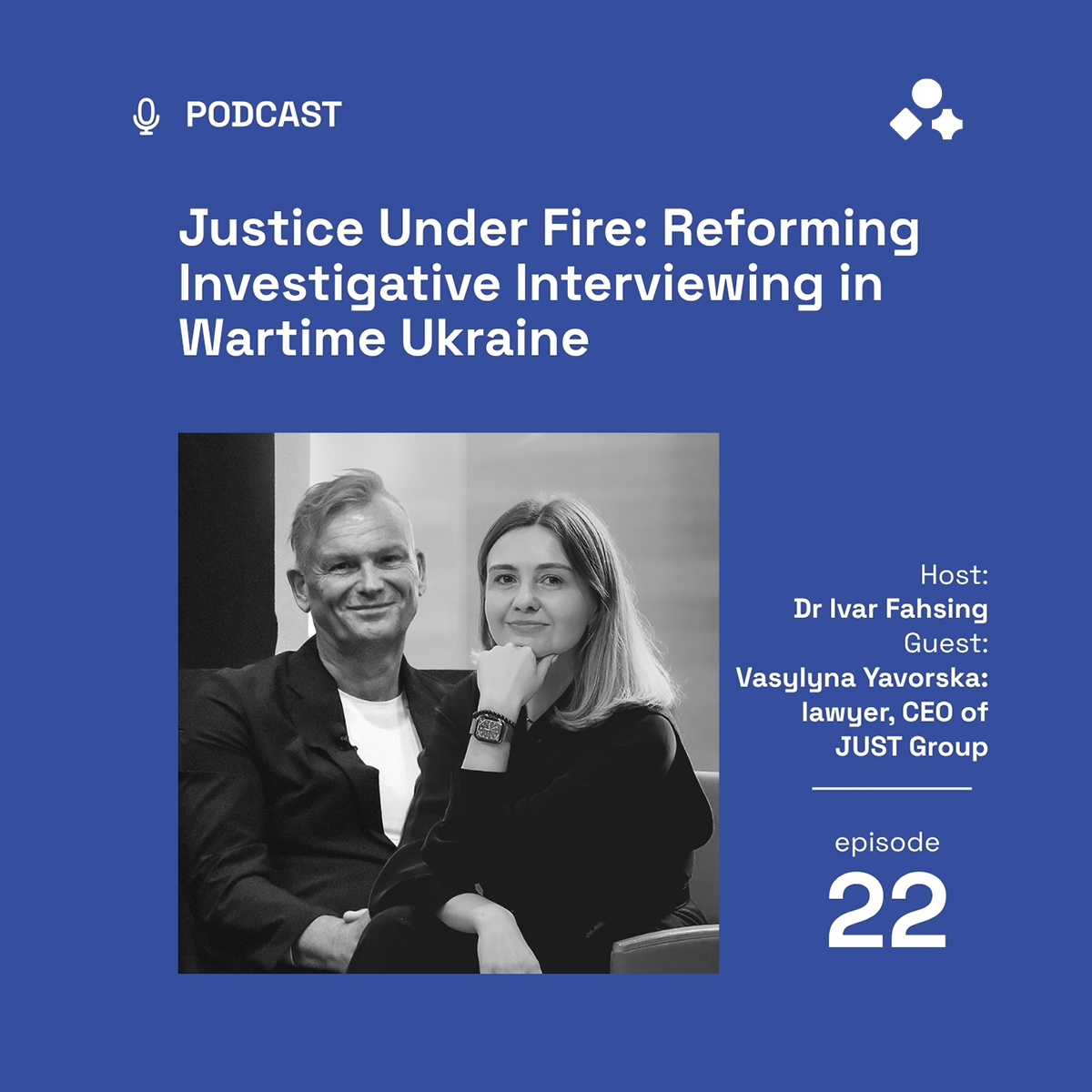
Episode 22. Justice Under Fire: Reforming Investigative Interviewing in Wartime Ukraine
Recorded live at the Davidhorn Police Interview Summit 2026, Manchester.
In this episode, Dr Ivar Fahsing is joined by Vasylyna Yavorska — lawyer, criminal justice reformer, and CEO of JustGroup, Ukraine’s leading NGO for criminal justice transformation.
Vasylyna has coordinated Ukraine’s national expert team on investigative interviewing since 2017. She speaks about the challenge of shifting a system away from confession-driven success metrics, building coalitions for change inside resistant institutions, and the pivotal moment in March 2022 when her team was asked to develop prisoner-of-war interview guidelines while Kyiv was still partly under occupation.
She also addresses the barriers to scaling investigative interviewing across a large multi-agency system, why mandatory recording is central to her advocacy work, and how she sees technology and human judgment combining to deliver justice more quickly in complex cases.
Beyond a Reasonable Doubt is a podcast series hosted by Dr Ivar Fahsing, exploring investigative interviewing across jurisdictions, cultures, and disciplines. Produced by Davidhorn.
Recorded live at the Davidhorn Police Interview Summit 2026 in Manchester, Dr Ivar Fahsing speaks with Vasylyna Yavorska — Ukrainian lawyer, criminal justice reformer, and CEO of JustGroup — about what it means to try to transform a criminal justice system in the middle of a war.
Vasylyna has coordinated Ukraine’s national team of investigative interviewing experts since 2017. In this conversation, she talks candidly about the challenge of shifting practitioners away from confession-focused thinking, the structural barriers to scaling investigative interviewing across a large and complex justice system, and the moment in March 2022 — Kyiv still partly occupied — when her team was asked to develop guidelines for interviewing prisoners of war.
Topics covered include: defining success in an interview; building internal champions for change; why mandatory recording is an advocacy priority; the impact of martial law on Ukraine’s approach to pre-trial testimony; and what Vasylyna would most want from technology to support investigators handling complex, high-volume cases.
Main topics:
- Investigative interviewing as an entry point for systemic criminal justice reform
- Shifting from confession-focused to information-focused practice
- The 2020 finding: 61% of Ukrainian investigators defined confession as success
- What systemic change requires: leadership, training, infrastructure, monitoring
- Why reform matters more, not less, during active conflict
- Developing prisoner-of-war interview guidelines in March 2022
- War crimes interviewing in practice — the Bucha unit, 2,000+ interviews
- Managing resistance and building internal champions
- Horizontal learning among practitioners
- Barriers to scaling across a large, multi-agency system
- Mandatory recording — legislation, martial law, and the case for reform
- Technology and human judgment in complex, high-volume cases
Investigative interviewing reform in wartime Ukraine — Vasylyna Yavorska on systemic change, mandatory recording, and justice under pressure.
About the guest
Vasylyna Yavorska
Vasylyna Yavorska is a Ukrainian lawyer and criminal justice reform specialist with over 15 years of experience designing systemic change in law enforcement. She is CEO of JustGroup, a national NGO focused on transforming Ukraine’s criminal justice system to be more effective, fair, and human-centred. Since 2017 she has coordinated Ukraine’s national team of experts on investigative interviewing, and has led work with the Office of the Prosecutor General and National Police on developing interviewing standards – including, from the first weeks of Russia’s full-scale invasion, guidelines for interviewing prisoners of war. She is currently active in scaling up investigative interviewing practice across Ukrainian law enforcement, including with war crimes units who have now conducted more than 2,000 interviews.
Related products


Transcript
Guest: Vasylyna Yavorska
Host: Dr Ivar Fahsing
Dr. Ivar Fahsing [00:10]
Vasylyna Yavorska, welcome to our live podcast, recorded here at the Radisson Hotel in Manchester, England.
[00:21]
I’m so happy to have you as a guest. How are you?
Vasylyna Yavorska [00:27]
I’m fine, thank you. Glad to be here.
Dr. Ivar Fahsing [00:30]
I don’t know how often you appear in live broadcasts.
Vasylyna Yavorska [00:33]
I have no experience of live broadcasts, but in Ukraine we have done such things. This is supposed to be a relaxing conversation between you and me. But of course we will try to go into topics that relate to investigative interviewing, fair trials, technology, and the wider implications of this.
Dr. Ivar Fahsing [00:56]
But before we dive in, I would like you to give a short introduction — who you are, what you do, and where you work.
Vasylyna Yavorska [01:04]
I will start by saying that I am a lawyer by degree, but for more than the last 15 years I have been working in my own country, Ukraine, in what I love to call ‘managing ideas’ — transforming the criminal justice system. I worked on many projects and initiatives, and what I love most of all is designing how we can achieve change within the criminal justice system. I have seen the system from very different perspectives.
[01:41]
The second role, which is probably very important for this podcast, is that I have been coordinator of the national team of experts on investigative interviewing since 2017. We were a small group of champions, enthusiastic about the need for this approach in our country — and we are still at it.
[02:05]
The third role is that I am now CEO of the JustGroup, a national non-governmental organisation focused on the transformation of the criminal justice system. We want to make our system more effective, fair, and human-centred. These are my different perspectives.
Dr. Ivar Fahsing [02:27]
I have been happy to be working quite closely with you for many years, and I am really impressed by what you are doing. Could you go a little deeper? What is investigative interviewing to you? What is the idea or the ethos behind it?
[02:46]
We have this season of the Davidhorn podcast, called Beyond a Reasonable Doubt, and we have a set of questions we try to ask different people from different contexts, jurisdictions, and cultures — just to see how similar and how different they are. So the first question is always: what is investigative interviewing to you?
Vasylyna Yavorska [03:12]
I personally tend to look at the criminal justice system from a human rights perspective, and I have had a rich background in human rights work in relation to law enforcement. But there was something — a gap I felt for many years. We very often spoke with law enforcement officials in the language of restriction: ‘you shouldn’t do this or that.’ And when investigative interviewing was introduced in Ukraine — actually by your colleague Alvin Radcliffe in 2017 — we got the idea that here was a methodology which could introduce a shift in mindset for practitioners: how they could be efficient and at the same time observe human rights and safeguards.
[04:16]
For me personally, I now look at investigative interviewing not only as a methodology, a standard, or an approach to gathering information, but also as a very good entry point for system transformation — when we talk about how the criminal justice system thinks, how practitioners make decisions, how they define success. For me, it is something like a transformative shift.
Dr. Ivar Fahsing [04:50]
Absolutely. Would you say it changes your mindset? What do you mean by that?
Vasylyna Yavorska [04:55]
The way we actually think, how we structure information, how we define our goals — what we want to achieve during the interview, or across the whole investigation.
[05:12]
Together with our friends in the region, we are more than happy to have a partnership with the Regional Centre for Human Rights on a national development programme on investigative interviewing for Ukrainian practitioners. And one question we ask at the very beginning of every programme is: how do you define the success of an interview?
[05:35]
For me, it is a very diagnostic question — how do you see that you achieved your goal? How do you define that goal? And in 2020, we conducted research together with colleagues. At that time, 61% of Ukrainian investigators indicated that a confession was what they perceived as success during an investigation. So probably we needed to change something. For me personally, it is exactly that shift we are trying to achieve — to become more focused on gathering reliable information rather than on achieving a confession.
Dr. Ivar Fahsing [06:22]
Couldn’t agree more. You also mentioned in the intro that you are actually trying to achieve systemic change. Does that mean you believe this mindset shift can have wider implications for your country?
Vasylyna Yavorska [06:39]
I think when we talk about systemic change, it is of course very important to shift the mindset of individual investigators and prosecutors. But I believe we need to do more. When we talk about systemic change, we need investigative interviewing — yes — but we also need to understand that it must be reflected in structural decisions, like standards embedded within the system, and infrastructure that supports a good environment for interviewing adults and children alike.
[07:29]
In our country we still face the problem of not having dedicated space for interviewing. It is very hard to talk about building rapport and good conversation when you are sharing a room with colleagues while trying to make contact with the person you are interviewing.
[07:50]
So I believe that systemic change is first about leadership and ownership — we need to reach the point where the leadership of the criminal justice system acknowledges: ‘We are moving in this direction. We want to achieve this as our core standard.’ The second is training — we must work on mindset, skills, and infrastructure. And I believe we also need monitoring and evaluation tools within the system, to understand where we are, to stop and observe, and to analyse the data to see whether we are moving in the right direction or not. That is something we are still working on.
Dr. Ivar Fahsing [08:46]
Ukraine is in the middle of a war. Why is this important for you right now?
Vasylyna Yavorska [08:53]
It is both a hard and a simple question at the same time. I think back to March 2022 — the full-scale invasion of the Russian Federation into my country began in February 2022, and Crimea had been occupied since 2014. I was in the western part of Ukraine in early 2022, together with my son, feeling somewhat safer.
[09:24]
I was trying not to disconnect from my work on the criminal justice system. At that moment, part of the Kyiv region was still under occupation by the Russian Federation. And our team of experts on investigative interviewing was contacted by the Office of the Prosecutor General — could we talk about interviewing? And we had a Zoom call in March, under very strange and complex circumstances for all of us.
[10:04]
And we discussed one thing: could we have guidelines for interviewing prisoners of war? I come back to that moment very often now. Because at that moment it became very clear to me that this was not about guidelines or instruments or training. It was about the choice of a country and a system — about values, about what we want to stand for as a country, as practitioners, as professionals. For me, it was a moment that gave me even more inspiration and strength to move on.
[10:53]
And after that we had many discussions with the Office of the Prosecutor General and the National Police — especially those units investigating war crimes. They were highly supportive of any approaches that would allow them to collect reliable information. Because they understand very clearly that the challenges are greater now, and they need somehow to document everything that is happening — not just for courts and investigations, but for the next generation.
[11:42]
And I believe that was a very important moment. After that, there was a very clear message from top leaders in the criminal justice system: we need to find a way to raise the standard of interviewing. We were not perfect then, and our investigators and prosecutors are still on the path — upskilling, developing, growing. But I believe it is important for the criminal justice system to make this choice and then to design a roadmap for how to move forward.
Dr. Ivar Fahsing [12:31]
I find that fascinating. I don’t know if you know that Sigmund Freud is supposed to have said something like this — that fair trials and a good criminal justice system are the first prerequisite for a good democracy. I think that is a really interesting parallel to what you are saying.
[12:57]
I have had the privilege of talking with many of your prosecutors and detectives — sometimes not in person, because of the situation, so mostly online. I have never been in the room to see that interaction directly. How is this message, this change, this training received? Do prosecutors and detectives take it in? Do they handle it?
Vasylyna Yavorska [13:33]
I must be honest — it is absolutely natural for adults to be resistant to something new, generally. We have our backgrounds, we know what to do, and we have been doing it for decades. And then suddenly someone comes along and tries to explain that you need to do things differently. We still feel some resistance. But I believe it is a very constructive dialogue. We try to find the right words and the right language to explain, and to find the right arguments. From my perspective, it is a question of dialogue — how we build this dialogue with practitioners and institutions.
[14:27]
Another element is building real partnership and trust, because we understand this is a long journey. We are not expecting to change things from Monday. We are ready to be partners — to be with you on this road, facing all the challenges and finding solutions together. That is actually how we act as an organisation, because we are very focused on the role of partner to criminal justice practitioners and institutions, to ensure we can find the right arguments for them and overcome the resistance that I believe every system has.
Dr. Ivar Fahsing [15:17]
I think all of us have that — it is probably rooted in the need to defend what you are already doing. If you change, do you have no honour in what you have already been doing?
Vasylyna Yavorska [15:37]
I would add that our approach is not to try to cover the whole system from the very beginning. It is to identify and engage the right people from within the system — those who are more ready for change. That is very important to me, because you can build links with the system and have allies inside it. It is much easier for an investigator to speak with their colleague and say: ‘Look, I tried this approach, I tried this instrument, here is my experience — let’s discuss that.’ I believe that works very well, especially in a criminal justice context, because horizontal learning among people is very important.
Dr. Ivar Fahsing [16:54]
Couldn’t agree more. And personally, I sometimes feel almost uncomfortable — I have to say — when I deliver these lectures in Ukraine, because I am, as you know, also psychologically touched by that war. It hurts. Of course it hurts all of us.
[17:16]
Sometimes I feel I am delivering a somewhat peripheral message when I talk about interviewing. But as you know, we had training in Kraków, almost two years ago now — around two years ago — and the CEO of Davidhorn was there, together with Alex Fawcett from Manchester and Ruth Underwood from the Met.
[17:43]
I have delivered these kinds of trainings all around the world for many years. There are some positives in that — the coin does not always drop during the three days of training. But I have never seen a group of detectives and prosecutors able to adapt and absorb this more quickly than that group we trained in Kraków. I was so impressed. My personal experience of that hands-on training was really, really good.
[18:21]
Also in Norway, when we started a similar process of change around 25 to 26 years ago — of course you should not spend all your time with people who resist. There are plenty of people who genuinely want this. Spend your time there and let it spread naturally.
Vasylyna Yavorska [18:44]
Yes, naturally. You cannot force some things to grow artificially. Sometimes it takes time, and you need to accept that and just move forward — step by step, not giving up, just looking for the next small step, but always moving forward.
[19:09]
And I believe that crisis can be the best motivator or the best driver, because when you are under pressure you try to find solutions, and you understand that you cannot continue working in the same way. For the Ukrainian system — across many different sectors — this crisis has actually become a driver, an additional motivation, an additional source of energy. Because you understand you need to defend yourself, your family, your values, your country.
Dr. Ivar Fahsing [19:57]
I told you a story yesterday — I have friends working for the Norwegian Navy Special Forces, the Norwegian SEALs, and they have been working quite closely with some of your divisions down there for some time. Officially, they are there to train you. But when we share a beer, they say: ‘Ivar, we are actually the ones who learned the most.’ So it is a very dualistic and valuable relationship for my friends in the Norwegian Defence Forces as well.
[20:32]
And the way I have come to know Ukrainians is that I feel quite certain it will not be long until you are teaching us how to implement investigative interviewing, because things move very slowly in many European countries.
[20:54]
I really would like to share a story. We were delivering training together with the UK in Lebanon some years ago, funded by the Council of Europe. Two high-level observers came to see how we were progressing — one retired Supreme Court judge from Paris and a very senior judge from Germany. They were very serious people, but after a night or two they liked what they saw, and we went out to dinner together on the last evening with some parliamentary members and politicians from Beirut.
[21:39]
When the others left, they said: ‘We are really impressed by this — we really like it.’ I said: ‘Here we have one German and one French person coming to Beirut to see how we are implementing investigative interviewing. Are you aware that this does not exist in your countries?’ ‘What?’ ‘No, there is absolutely nothing that even resembles this.’ In France there are some pockets. In Germany very few. I was shocked.
[22:32]
But then in the taxi home, the German said: ‘Ivar, you surely know why.’ I said no. ‘It’s British. We wouldn’t touch it with a stick.’ So there are cultural factors at play as well.
Vasylyna Yavorska [22:48]
That is probably true. But what we have is that our investigators and prosecutors are regularly practising — unfortunately, especially war crimes. I was just in Bucha last week, at a police unit that has a special war crimes team. Bucha, as you know, is a town near Kyiv — it was occupied during the early stages of the war and is unfortunately now a very well-known place. That unit has conducted around 2,000 interviews, and these are not easy interviews — they are typically with victims and witnesses of war crimes, and with prisoners of war.
[23:45]
I believe that this practice — interviewing, recording, and reflecting — combined with training, has allowed these professionals to grow. Unfortunately for us as a country. But we are practising, and I believe they will consolidate this expertise and experience and will be ready to share it with colleagues elsewhere, because we have very good people who are deeply committed to the core values of investigative interviewing.
Dr. Ivar Fahsing [24:23]
Really looking forward to that. And you mentioned that the French and Germans did not want it because it was British — well, that is why we are now trying to package it differently. The new UN standard, for instance, may help. But looking at Ukraine — are there particular barriers or issues that typically come up when you are implementing this?
Vasylyna Yavorska [25:02]
Thank you. The main challenge is probably — and it is a little bit of a joke — that we are still a big country. We have five investigative agencies and a large prosecutor service. We can be very optimistic that we will eventually cover all our investigators and prosecutors with training, monitoring and evaluation, upskilling, and so on. But I believe the biggest barrier is how to design the scaling-up properly.
[25:42]
We already have a national instructor team, a Community of Champions, practitioners, and recording in the war crimes unit. But there are still gaps in the system. The barrier I see is finding a way to extend training and practical support to the majority of investigators and prosecutors.
[26:18]
Another challenge is infrastructure. As I mentioned at the outset, we really need to create environments where professionals can practise investigative interviewing. We cannot require investigators and prosecutors to conduct investigative interviewing if they do not have appropriate facilities to do so.
[26:46]
We are actually quite optimistic about integrating standards into the system, because it is already embedded in the strategic documents of the Office of the Prosecutor General — there will be national guidelines on investigative interviewing, and we believe that will happen this year. But managing the restructuring of training programmes across different types of agencies is still a challenge.
[27:19]
And one more — monitoring and evaluation. I personally believe in this as a tool for learning, but there is still a perception that monitoring and evaluation are about control. That is also a cultural shift we need to introduce. We need to explain why and how we are doing it, and how to engage management and use peer-to-peer instruments to support each other — rather than simply checking whether requirements are met.
Dr. Ivar Fahsing [28:11]
No one wants to feel they are being made a fool of. I remember in Norway in the late 1990s — as has been said several times today — much of the innovation in this field was driven by miscarriages of justice. We had several serious ones surface in the 1990s, and the defence lawyers’ association publicly demanded the mandatory recording of all suspect interviews.
[28:46]
The Ministry of Justice responded by launching a trial project, which was run by Asbjørn Rachlew and me as secretaries. We were young detectives at the time. Digital recording was then very new, very expensive, and quite bulky — almost the size of a guitar case.
[29:16]
We distributed equipment to about five police forces around Norway and waited to collect interviews and see what was happening. But very few interviews came back. We had spent a lot of money, so we held a meeting in Oslo for a frank discussion — what was happening? Didn’t it work? No one said anything. So we went out for a beer, and I said: ‘It is not the equipment. It is just the fact that they do not know what to say.’ They were afraid to push the record button.
[29:58]
That was when we realised these people needed training. Of course they need training if they want to feel confident and do a good job in front of a camera. So that was when we realised we needed a national training programme for interviewing, and we started developing that.
[30:18]
So what about recording today in Ukraine?
Vasylyna Yavorska [30:21]
From my perspective, it is very connected with infrastructure. I am absolutely certain that we need mandatory recording — not only to collect reliable and accurate information, but also to have the opportunity to review and learn. We have recording for children’s interviews, and the war crimes department is now recording many of its interviews, but not all.
[30:59]
I believe we have some complications in our legislation. From a high-level perspective, I believe this is very connected with trust in the police. When the new Criminal Procedure Code was introduced in Ukraine more than ten years ago, our country was near the top of the European Court of Human Rights list for judgements on torture and ill-treatment. Because of that, a very strict standard was set in the legislation: no pre-trial testimony may be used during a court hearing. Judges must invite every witness and victim to give evidence at the hearing.
[32:04]
Now, under martial law, practitioners have more opportunity to use pre-trial testimony, because everyone understands that we may lose people, lose access to witnesses, and lose information. That is why practitioners are now trying and practising recording and introducing it to the courts. And at this moment we see that even judges and courts are more open to this entirely new approach.
[32:41]
In this regard, I believe that mandatory recording will be the strongest argument: if all safeguards are in place and the recording quality is good, a judge can rely on that testimony. Because we are currently also facing the problem of extremely long court proceedings — we are effectively shifting the burden of investigation from investigators to judges, asking them to conduct interviews during hearings. From my perspective, that is not an efficient way for a criminal justice system to operate.
[33:39]
We need very good investigative work by investigators and prosecutors, and then the judge should check — if there are questions, they have the opportunity to invite people to a court hearing. That is probably why mandatory recording will be a very important advocacy goal for the next stage as well.
Dr. Ivar Fahsing [34:05]
Exactly. You are here at a summit hosted by Davidhorn, a world-leading technology company focused on supporting better justice from the moment of first contact. If you could wish for something in terms of technological development, what would be highest on your list?
Vasylyna Yavorska [34:32]
I have one wish, but it is not directly about investigative interviewing — all Ukrainians wish the same thing. But I believe I should come back to the message I have already mentioned: the most important change we need in the criminal justice system is about people, and the level of qualification of investigators and prosecutors.
[35:12]
As a civil society organisation, we sometimes ask too much of them. That is why I believe that creating the space where their time and efforts can be used efficiently gives us more opportunity to achieve justice in society. When we talk about very complex cases — war crimes, high-profile corruption cases, cases with enormous volumes of information — I believe there is a need to find the right combination of technology’s capacity to analyse, collect, and preserve information, and the human intellect and cognitive capabilities of professionals in the system.
[36:13]
Because ultimately, everyone needs to feel that justice exists. But sometimes it takes too long to wait for it. I believe that this combination of human professionalism and technology can help give us the chance for justice sooner. That is probably my answer, and my wish.
Dr. Ivar Fahsing [36:38]
Yes — that tight interaction between the two. You are not talking about replacing human judgment, but about understanding more clearly where we can bring technology in, where we can assist, and where the decision must ultimately rest with the investigator or prosecutor. I believe that decisions should be taken by investigators and prosecutors. But where can technology assist them — and where do they simply need to say: ‘This is my decision. This is what I am here for.’
[37:18]
Vaselina, thank you so much for sharing your insights. I wish you a safe journey forward — for the future of Ukraine, but also for the future of a better, fairer, and more just society. Thank you so much for coming to the podcast.
Vasylyna Yavorska [37:48]
Thank you. It is so nice to be here.
Dr. Ivar Fahsing [37:50]
I know the efforts you made to come here, and I also know you are about to leave for Geneva for another important meeting. Thank you so much.
Vasylyna Yavorska [38:02]
Thank you so much.
END OF TRANSCRIPT
© 2026 Davidhorn. All rights reserved.