Aller au contenu
Davidhorn
  • Solutions

    Par secteur d’activité

    • Police
    • La défense
    • Immigration et douanes
    • Interviews d’enfants et de témoins
    • Autorités locales
    • Enquêtes sur les entreprises
    • Soins de santé

    Par cas d’utilisation

    • Entretien avec un témoin vulnérable
    • Entretien avec le suspect
    • Entretiens sur le terrain
  • Produits

    Enregistreurs

    • Capture App
    • Enregistreur portable
    • Mini enregistreur
    • Enregistreur fixe
    • Enregistreur de logiciels
    • Enregistreurs secrets

    Gestion des Interviews

    • Gestion des Interviews dans l’Ark

    Intégrations

    • Intégrations et configuration
    Graphique promotionnel pour un webinaire gratuit intitulé "How to Use Davidhorn's Investigative Interviews Solution", animé par Magnus Green. Elle comporte une bulle de dialogue bleue avec le texte "Free webinar" et l'image floue d'une personne à l'intérieur d'un cercle bleu.
  • Clients
  • Centre de ressources

    Centre de ressources

    • Blog
    • Fiches techniques
    • Livres électroniques et livres blancs
    • Evénements
    • Podcasts
    • Webinaires
    • Cours
  • Partenaires

    Partenaires

    • Aperçu des partenaires
    • Devenez partenaire
  • Entreprise

    Entreprise

    • A propos de
    • CarrièreEmplois à Davidhorn
    • Contact
    • Clients
Mon compte
Aide
Réserver une démo
Davidhorn
Compte
  • Solutions
    • Par secteur d’activité
      • Police
      • La défense
      • Immigration et douanes
      • Barnahus
      • Autorités locales
      • Enquêtes sur les entreprises
    • Par cas d’utilisation
      • Entretien avec un témoin vulnérable
      • Entretien avec le suspect
      • Entretiens sur le terrain
  • Produits
    • Gestion des Interviews dans l’Ark
    • Enregistreur mobile
    • Enregistreur portable
    • Mini enregistreur
    • Enregistreur fixe
    • Enregistreur de logiciels
    • Enregistreurs secrets
    • Administration et intégrations API
  • Clients
  • Centre de ressources
    • Blog
    • Fiche technique
    • Livres électroniques
    • Evénements
    • Podcasts
    • Webinaires
  • Partenaires
    • Aperçu des partenaires
    • Devenez partenaire
  • Entreprise
    • A propos de
    • Carrière
    • Actualités
    • Contact
Soutien
Démonstration de livres
  • Davidhorn
  • Comment planifier une Interview room pour enfants ou témoins vulnérables ?

    Comment planifier une Interview room pour enfants ou témoins vulnérables ?

    eBook : Planifier une Interview room pour enfants ou témoins vulnérables

    Remplissez le formulaire pour accéder à l’eBook.

    Ce guide a pour but d’explorer les meilleures pratiques pour la mise en place d’une Interview Room pour les enfants et les témoins vulnérables afin de mener et d’enregistrer les interviews d’investigation avec les enfants et les témoins vulnérables en tenant compte de la nature délicate de leurs expériences.

    Du choix de la salle idéale et de son agencement à la sélection de l’équipement audio et vidéo approprié, chaque détail compte. En prenant ces aspects en considération, nous pouvons garantir un résultat positif pour toutes les parties concernées, tout en conservant la plus grande sensibilité et le plus grand professionnalisme, et en obtenant les meilleures preuves.

    Dans cet eBook sur la salle d’Interviews pour les enfants ou les témoins vulnérables, vous apprendrez :

    • Comment concevoir l’espace d’interview idéal pour l’enquête
    • Comment garantir un environnement audio adéquat pour les entretiens d’investigation ?
    • Comment obtenir des preuves claires et complètes à partir de votre enregistrement audio ?
    • Comment assurer une couverture et une clarté complètes de votre enregistrement vidéo ?
    • Ce qu’il faut garder à l’esprit lors du choix d’un enregistreur pour la collecte de preuves

    Pour les enquêteurs, les juristes, les travailleurs sociaux et toute personne impliquée dans ces Interviews, il est crucial de comprendre l’importance de l’environnement et de la technologie utilisée.

    A propos de l’auteur

    Depuis près de 40 ans, Jeff Interviews travaille en étroite collaboration avec des services de police et d’autres établissements chargés de l’application de la loi à l’échelle internationale. Jeff a acquis une connaissance approfondie des difficultés rencontrées lors de la création de preuves optimales au cours d’entretiens d’enquête.

    Dans cet eBook, il partage ses idées sur la manière de planifier et de mettre en place une suite d’entretiens avec des enfants et des victimes vulnérables, tout en reconnaissant les premiers travaux de ceux qui ont introduit les entretiens d’investigation au sein du ministère de l’intérieur britannique, qui ont ouvert la voie.

    Cet eBook est vérifié par Becky Milne, professeur de psychologie légale à l’université de Portsmouth, Royaume-Uni.

    « * » indique les champs nécessaires

    Ce champ n’est utilisé qu’à des fins de validation et devrait rester inchangé.
    Pays*
    Consentement
    20 juin 2024
  • Webinaire sur les interviews judiciaires d’enfants

    Webinaire sur les interviews judiciaires d’enfants

    Webinaire sur les interviews judiciaires d’enfants

    Recommandation sur les interviews judiciaires d’enfants avec Shawnna von Blixen-Finecke

    Remplissez le formulaire pour visionner le webinaire.Veuillez remplir tous les champs obligatoires (*) avant de soumettre votre demande.

    Nous nous sommes entretenus avec Shawnna von Blixen-Finecke, conseillère au Conseil des États de la mer Baltique et coordinatrice du réseau Barnahus sur les approches transformatives des entretiens médico-légaux avec les enfants et sur le rôle du réseau Barnahus et de Promise dans la protection de l’enfance.

    Dans ce webinaire, Shawnna a abordé les sujets suivants :

    • Le concept et la mission du réseau Barnahus.
    • Les caractéristiques uniques du modèle Barnahus.
    • L’utilisation de méthodes d’entretien fondées sur des données probantes pour permettre aux enfants de partager pleinement leurs expériences.
    • Efforts pour répondre aux besoins des enfants ukrainiens victimes de crimes de guerre.

    Découvrez comment ces techniques et environnements spécialisés ont un impact significatif sur la vie des enfants et sur l’efficacité des enquêtes sur les enfants.

    Vous voulez en savoir plus ? Écoutez notre podcast avec le créateur de Barnahus, Bragi Guðbrandsson.

    À propos de Shawnna von Blixen-Finecke

    Conseillère au Conseil des États de la mer Baltique, Shawnna von Blixen-Finecke coordonne le réseau PROMISE Barnahus, un réseau européen de professionnels des droits de l’enfant.

    « * » indique les champs nécessaires

    Ce champ n’est utilisé qu’à des fins de validation et devrait rester inchangé.
    Pays*
    Consentement
    13 juin 2024
  • Interviews d’investigation – 10 étapes essentielles pour réussir

    Interviews d’investigation – 10 étapes essentielles pour réussir
    Les 10 étapes essentielles pour des Interviews d'investigation réussies

    Les 10 étapes essentielles pour Interviews d’investigation réussies

    L’interview professionnelle d’un enquêteur est un processus systématique qui nécessite une préparation méticuleuse
    , une exécution compétente et une évaluation approfondie. En s’inspirant des protocoles et des meilleures pratiques établis sur le site
    , nous présentons un cadre en dix étapes qui garantit des interviews efficaces,
    éthiques et juridiquement solides.

    Étape 1 : Préparatifs liés à l’affaire

    La réussite d’une Interview repose sur une préparation complète du dossier. Examinez minutieusement tous les éléments de l’enquête, les preuves et la documentation disponibles. Élaborez plusieurs hypothèses de travail plutôt que de poursuivre une seule théorie. Réfléchissez clairement aux buts et objectifs de l’Interviews et analysez les antécédents de la personne interrogée, y compris ses droits et ses éventuels besoins particuliers.

    Cette phase de préparation est cruciale pour répondre à tous les besoins d’information, maintenir l’objectivité et s’assurer que vous êtes équipé pour faire face aux différents scénarios qui peuvent survenir au cours du processus d’Interviews.

    Étape 2 : Préparations physiques

    Choisissez un lieu d’Interviews optimal, avec un minimum de distractions et des conditions propices à une communication efficace. Idéalement, l’environnement doit être exempt de distractions mais confortable, permettant un dialogue clair sans interférence extérieure.

    Résumé

    • Une préparation complète est essentielle – Des interviews réussies nécessitent une étude approfondie du dossier, une installation matérielle optimale avec du matériel d’enregistrement testé et une préparation mentale avec de multiples hypothèses de travail.
    • Établir la confiance par un engagement professionnel – Appliquer le principe HEAR (honnêteté, empathie, autonomie, réflexion) pour établir un rapport, expliquer clairement les procédures et évaluer la vulnérabilité de la personne interrogée et les exigences légales.
    • Laissez les personnes interrogées raconter librement avant d’approfondir – Laissez les personnes interrogées faire des récits complets et ininterrompus en utilisant les invites TED (Raconter, Expliquer, Décrire), puis clarifiez systématiquement à l’aide du cadre 5WH (Qui, Quoi, Quand, Où, Pourquoi, Comment).
    • Évaluer et réfléchir en vue d’une amélioration continue – Évaluez si les objectifs de l’Interview ont été atteints, analysez vos techniques de performance, documentez les enseignements tirés et planifiez les prochaines étapes de l’enquête sur la base des informations obtenues.

    Prenez les dispositions nécessaires pour la représentation juridique, les interprètes ou le personnel de soutien, en fonction de l’affaire. Testez minutieusement tout le matériel d’enregistrement – les systèmes d’enregistrement audiovisuels professionnels de Davidhorn garantissent une documentation fiable avec de multiples options de sauvegarde, fournissant ainsi le soutien essentiel à l’intégrité de la preuve.

    Étape 3 : Préparation mentale

    Gardez l’esprit ouvert et faites preuve de souplesse analytique tout au long du processus. Envisagez des hypothèses alternatives aux éléments de preuve et anticipez les différents scénarios qui peuvent se dérouler. Faites preuve d’empathie et d’un véritable intérêt pour la situation de la personne interrogée. La préparation mentale consiste à mettre de côté les idées préconçues et à se préparer à adapter son approche en fonction des réponses et du comportement de la personne interrogée.

    Cette préparation psychologique vous permet de réagir de manière appropriée à des événements inattendus tout en gardant votre sang-froid.

    Étape 4 : S’engager et expliquer

    Établir le contact et les règles de base. Appliquez systématiquement le principe HEAR : Honnêteté, Empathie, Autonomie, Réflexion. Cette approche permet d’instaurer un climat de confiance tout en maintenant des limites professionnelles et en veillant à ce que la personne interrogée se sente respectée tout au long du processus. Évaluez en permanence la vulnérabilité de la personne interrogée en tenant compte de son âge, de sa santé mentale et physique, de ses traumatismes et d’autres facteurs de risque. Mettez en œuvre les garanties juridiques appropriées et envisagez l’intervention d’un spécialiste si nécessaire. Utiliser des aides à la communication pour garantir un dialogue efficace tout au long du processus.

    Au début d’une Interview d’investigation, l’enquêteur doit :

    • Établissez un rapport par l’empathie et le respect.
    • Évaluez le bien-être de la personne interrogée pour s’assurer qu’elle est apte à participer à l’Interviews.
    • Expliquez clairement:
      • L’affaire faisant l’objet de l’enquête et le but de l’Interviews.
      • Pour les suspects : les motifs de suspicion – expliquez ce qui se passe et pourquoi (sans divulguer de preuves détaillées).
      • Pour les suspects : le droit à un avocat et le droit de garder le silence.
      • Toutes les procédures légales et pratiques, y compris l’enregistrement audio/vidéo.
      • que la participation est volontaire (le cas échéant).

    Établissez des règles de base. L’Interviews doit ensuite définir les attentes suivantes :

    • Tout ce qui est dit est important – la personne interrogée doit fournir autant de détails que possible, même s’ils semblent mineurs (par exemple, « décrivez mon stylo »).
    • Ne filtrez pas – rapportez tout, même si cela vous semble hors de propos ou incertain.
    • Concentration et effort – le rappel de mémoire demande de la concentration et peut être fatigant.
    • Open communication – the interviewee should feel free to: 
      • Demandez-leur s’ils ne comprennent pas.
      • Dites s’ils ne savent pas.
      • Corrigez les malentendus ou faites part de vos inquiétudes concernant les questions suggestives ou inappropriées.
    • Structure de l’Interviews – Décrivez les sujets à aborder, le calendrier et les pauses prévues.
    • Confirmer la compréhension – s’assurer que la personne interrogée saisit l’information et son application.

    L’établissement de rapports n’est pas une question de manipulation – il s’agit de créer une atmosphère propice à une communication basée sur le respect mutuel et les faits. Cette base est essentielle pour établir la confiance et obtenir des informations fiables.

    Étape 5 : Phase du premier compte

    Laissez la personne interrogée présenter son récit complet sans l’interrompre. Faites preuve d’une patience stratégique et gardez le contrôle en suivant attentivement le rythme et en écoutant activement, plutôt qu’en posant des questions de manière précipitée.

    Utilisez les messages-guides TEDS (Raconter, Expliquer, Décrire, Montrer Me) pour encourager les réponses détaillées. Documentez systématiquement les éléments PLATCOM : Personnes, Lieu, Actions, Moments, Communication, Objets et Motivations. Cette phase de narration libre révèle souvent des informations cruciales qui pourraient échapper à un interrogatoire ciblé. Ne l’interrompez pas. Reportez vos questions jusqu’à ce que le premier récit soit entièrement terminé.


    Ecoutez notre podcast sur les Interviews d’investigation


    Étape 6 : Écoute active tout au long du processus

    Écoutez activement pour comprendre le point de vue de la personne interrogée et faciliter le flux d’informations. Utilisez le silence et les signaux non verbaux pour démontrer votre engagement. Notez les incohérences, les lacunes et les points à clarifier tout en maintenant un engagement positif.

    Étape 7 : Clarifier et divulguer

    Passez systématiquement en revue les nouvelles informations, les objectifs de votre Interviews, abordez les éléments PLATCOM et répondez à tous les points obscurs et à toutes les lacunes avant d’introduire des preuves ou de nouvelles informations. Le cas échéant, présentez les informations clés par étapes afin de vérifier l’exactitude du récit tout en minimisant la contamination de la mémoire.

    Assurer une couverture complète en utilisant le cadre des 5WH : Qui, Quoi, Quand, Où, Pourquoi, Comment. Cette approche systématique permet de ne négliger aucun élément crucial.

    Étape 8 : Fermer et informer

    Concluez l’Interviews de manière professionnelle en invitant la personne interrogée à fournir des informations supplémentaires ou à poser des questions. Expliquez clairement les prochaines étapes, les procédures de contact et les délais prévus.

    Exprimez votre reconnaissance pour leur coopération et terminez respectueusement, quelle que soit l’issue de l’affaire. Cette clôture professionnelle peut s’avérer précieuse pour les interactions futures.


    Lisez nos eBooks sur la façon de planifier des Interviews d’investigation

    https://davidhorn.com/content-type/ebooks_whitepapers

    Étape 9 : Évaluer les résultats des Interviews

    Après l’Interviews, procédez à une évaluation structurée pour déterminer si les objectifs ont été atteints. Il s’agit notamment de :

    • Évaluer la qualité et l’exhaustivité des informations obtenues par rapport au plan d’entretien et aux priorités de l’enquête. obtenues par rapport au plan d’Interviews et aux priorités de l’enquête.
    • Identifier les lacunes, les incohérences ou les questions sans réponse qui peuvent nécessiter une clarification ou un suivi.
    • Évaluer les réponses de la personne interrogée à la lumière des preuves connues et d’autres éléments du dossier.

    Cette étape permet de s’assurer que l’Interviews contribue de manière significative à l’enquête et met en évidence les éventuelles actions de suivi immédiates.

    Étape 10 : Réfléchissez, apprenez et planifiez

    Après l’évaluation du contenu, réfléchissez de manière critique à votre propre performance en tant qu’Interviews :

    • Analysez vos techniques d’Interviews – Qu’est-ce qui a bien fonctionné ? Qu’est-ce qui aurait pu être fait différemment ?
    • Identifier les domaines à améliorer en matière de planification, de communication, de style de questions, d’établissement de rapports et d’adaptabilité.
    • Consignez les enseignements tirés pour soutenir votre développement professionnel continu et améliorer les Interviews à venir.
    • Déterminer et planifier les prochaines étapes de l’enquête, telles que de nouveaux Interviews, de nouvelles pistes d’investigation ou la collecte d’autres preuves.

    Cette phase de réflexion garantit un apprentissage continu et contribue à maintenir des normes élevées en matière de pratiques d’enquête.

    Conclusion

    Des Interviews d’investigation réussies nécessitent une préparation systématique, une exécution habile et une évaluation approfondie. En suivant ces 10 étapes essentielles et en se concentrant sur les principes fondamentaux suivants le rapport, l’empathie, l’écoute active et l’intégrité professionnelleles enquêteurs peuvent mener des Interviews à la fois efficaces et conformes à l’éthique.

    L’investissement dans une technique et un équipement appropriés, y compris des systèmes d’enregistrement professionnels qui garantissent une documentation complète, est rentable en termes de résultats et de recevabilité juridique. N’oubliez pas : la qualité de vos Interviews détermine la qualité de vos enquêtes.

    Écrit par :

    Marta Hopfer-Gilles

    Faits vérifiés par Ivar A Fahsing (PhD)

    Claude AI a été utilisé lors de la création de cet article

    Produits apparentés

    • Enregistreur fixe d’entretiens policiers HD

      Enregistreur HD fixe pour les salles d’interrogatoire de haute sécurité.

    • Enregistreur portable d’entretiens policiers

      Enregistreur d’entretien léger, conforme à la norme PACE, pour tout type d’environnement.

    • Capture – Enregistrement d’entretiens mobiles

      Enregistreur d’application mobile pour capturer des preuves en déplacement.

    • Logiciel Ark – Gestion d’entretiens policiers et preuves numériques

      Recevoir, contrôler et conserver les preuves tout au long de leur durée de vie.

    12 mars 2026
  • Interviews d’investigation – 10 étapes essentielles pour réussir

    Interviews d’investigation – 10 étapes essentielles pour réussir
    Les 10 étapes essentielles pour des Interviews d'investigation réussies

    Les 10 étapes essentielles pour Interviews d’investigation réussies

    L’interview professionnelle d’un enquêteur est un processus systématique qui nécessite une préparation méticuleuse
    , une exécution compétente et une évaluation approfondie. En s’inspirant des protocoles et des meilleures pratiques établis sur le site
    , nous présentons un cadre en dix étapes qui garantit des interviews efficaces,
    éthiques et juridiquement solides.

    Étape 1 : Préparatifs liés à l’affaire

    La réussite d’une Interview repose sur une préparation complète du dossier. Examinez minutieusement tous les éléments de l’enquête, les preuves et la documentation disponibles. Élaborez plusieurs hypothèses de travail plutôt que de poursuivre une seule théorie. Réfléchissez clairement aux buts et objectifs de l’Interviews et analysez les antécédents de la personne interrogée, y compris ses droits et ses éventuels besoins particuliers.

    Cette phase de préparation est cruciale pour répondre à tous les besoins d’information, maintenir l’objectivité et s’assurer que vous êtes équipé pour faire face aux différents scénarios qui peuvent survenir au cours du processus d’Interviews.

    Étape 2 : Préparations physiques

    Choisissez un lieu d’Interviews optimal, avec un minimum de distractions et des conditions propices à une communication efficace. Idéalement, l’environnement doit être exempt de distractions mais confortable, permettant un dialogue clair sans interférence extérieure.

    Résumé

    • Une préparation complète est essentielle – Des interviews réussies nécessitent une étude approfondie du dossier, une installation matérielle optimale avec du matériel d’enregistrement testé et une préparation mentale avec de multiples hypothèses de travail.
    • Établir la confiance par un engagement professionnel – Appliquer le principe HEAR (honnêteté, empathie, autonomie, réflexion) pour établir un rapport, expliquer clairement les procédures et évaluer la vulnérabilité de la personne interrogée et les exigences légales.
    • Laissez les personnes interrogées raconter librement avant d’approfondir – Laissez les personnes interrogées faire des récits complets et ininterrompus en utilisant les invites TED (Raconter, Expliquer, Décrire), puis clarifiez systématiquement à l’aide du cadre 5WH (Qui, Quoi, Quand, Où, Pourquoi, Comment).
    • Évaluer et réfléchir en vue d’une amélioration continue – Évaluez si les objectifs de l’Interview ont été atteints, analysez vos techniques de performance, documentez les enseignements tirés et planifiez les prochaines étapes de l’enquête sur la base des informations obtenues.

    Prenez les dispositions nécessaires pour la représentation juridique, les interprètes ou le personnel de soutien, en fonction de l’affaire. Testez minutieusement tout le matériel d’enregistrement – les systèmes d’enregistrement audiovisuels professionnels de Davidhorn garantissent une documentation fiable avec de multiples options de sauvegarde, fournissant ainsi le soutien essentiel à l’intégrité de la preuve.

    Étape 3 : Préparation mentale

    Gardez l’esprit ouvert et faites preuve de souplesse analytique tout au long du processus. Envisagez des hypothèses alternatives aux éléments de preuve et anticipez les différents scénarios qui peuvent se dérouler. Faites preuve d’empathie et d’un véritable intérêt pour la situation de la personne interrogée. La préparation mentale consiste à mettre de côté les idées préconçues et à se préparer à adapter son approche en fonction des réponses et du comportement de la personne interrogée.

    Cette préparation psychologique vous permet de réagir de manière appropriée à des événements inattendus tout en gardant votre sang-froid.

    Étape 4 : S’engager et expliquer

    Établir le contact et les règles de base. Appliquez systématiquement le principe HEAR : Honnêteté, Empathie, Autonomie, Réflexion. Cette approche permet d’instaurer un climat de confiance tout en maintenant des limites professionnelles et en veillant à ce que la personne interrogée se sente respectée tout au long du processus. Évaluez en permanence la vulnérabilité de la personne interrogée en tenant compte de son âge, de sa santé mentale et physique, de ses traumatismes et d’autres facteurs de risque. Mettez en œuvre les garanties juridiques appropriées et envisagez l’intervention d’un spécialiste si nécessaire. Utiliser des aides à la communication pour garantir un dialogue efficace tout au long du processus.

    Au début d’une Interview d’investigation, l’enquêteur doit :

    • Établissez un rapport par l’empathie et le respect.
    • Évaluez le bien-être de la personne interrogée pour s’assurer qu’elle est apte à participer à l’Interviews.
    • Expliquez clairement:
      • L’affaire faisant l’objet de l’enquête et le but de l’Interviews.
      • Pour les suspects : les motifs de suspicion – expliquez ce qui se passe et pourquoi (sans divulguer de preuves détaillées).
      • Pour les suspects : le droit à un avocat et le droit de garder le silence.
      • Toutes les procédures légales et pratiques, y compris l’enregistrement audio/vidéo.
      • que la participation est volontaire (le cas échéant).

    Établissez des règles de base. L’Interviews doit ensuite définir les attentes suivantes :

    • Tout ce qui est dit est important – la personne interrogée doit fournir autant de détails que possible, même s’ils semblent mineurs (par exemple, « décrivez mon stylo »).
    • Ne filtrez pas – rapportez tout, même si cela vous semble hors de propos ou incertain.
    • Concentration et effort – le rappel de mémoire demande de la concentration et peut être fatigant.
    • Open communication – the interviewee should feel free to: 
      • Demandez-leur s’ils ne comprennent pas.
      • Dites s’ils ne savent pas.
      • Corrigez les malentendus ou faites part de vos inquiétudes concernant les questions suggestives ou inappropriées.
    • Structure de l’Interviews – Décrivez les sujets à aborder, le calendrier et les pauses prévues.
    • Confirmer la compréhension – s’assurer que la personne interrogée saisit l’information et son application.

    L’établissement de rapports n’est pas une question de manipulation – il s’agit de créer une atmosphère propice à une communication basée sur le respect mutuel et les faits. Cette base est essentielle pour établir la confiance et obtenir des informations fiables.

    Étape 5 : Phase du premier compte

    Laissez la personne interrogée présenter son récit complet sans l’interrompre. Faites preuve d’une patience stratégique et gardez le contrôle en suivant attentivement le rythme et en écoutant activement, plutôt qu’en posant des questions de manière précipitée.

    Utilisez les messages-guides TEDS (Raconter, Expliquer, Décrire, Montrer Me) pour encourager les réponses détaillées. Documentez systématiquement les éléments PLATCOM : Personnes, Lieu, Actions, Moments, Communication, Objets et Motivations. Cette phase de narration libre révèle souvent des informations cruciales qui pourraient échapper à un interrogatoire ciblé. Ne l’interrompez pas. Reportez vos questions jusqu’à ce que le premier récit soit entièrement terminé.


    Ecoutez notre podcast sur les Interviews d’investigation


    Étape 6 : Écoute active tout au long du processus

    Écoutez activement pour comprendre le point de vue de la personne interrogée et faciliter le flux d’informations. Utilisez le silence et les signaux non verbaux pour démontrer votre engagement. Notez les incohérences, les lacunes et les points à clarifier tout en maintenant un engagement positif.

    Étape 7 : Clarifier et divulguer

    Passez systématiquement en revue les nouvelles informations, les objectifs de votre Interviews, abordez les éléments PLATCOM et répondez à tous les points obscurs et à toutes les lacunes avant d’introduire des preuves ou de nouvelles informations. Le cas échéant, présentez les informations clés par étapes afin de vérifier l’exactitude du récit tout en minimisant la contamination de la mémoire.

    Assurer une couverture complète en utilisant le cadre des 5WH : Qui, Quoi, Quand, Où, Pourquoi, Comment. Cette approche systématique permet de ne négliger aucun élément crucial.

    Étape 8 : Fermer et informer

    Concluez l’Interviews de manière professionnelle en invitant la personne interrogée à fournir des informations supplémentaires ou à poser des questions. Expliquez clairement les prochaines étapes, les procédures de contact et les délais prévus.

    Exprimez votre reconnaissance pour leur coopération et terminez respectueusement, quelle que soit l’issue de l’affaire. Cette clôture professionnelle peut s’avérer précieuse pour les interactions futures.


    Lisez nos eBooks sur la façon de planifier des Interviews d’investigation

    https://davidhorn.com/content-type/ebooks_whitepapers

    Étape 9 : Évaluer les résultats des Interviews

    Après l’Interviews, procédez à une évaluation structurée pour déterminer si les objectifs ont été atteints. Il s’agit notamment de :

    • Évaluer la qualité et l’exhaustivité des informations obtenues par rapport au plan d’entretien et aux priorités de l’enquête. obtenues par rapport au plan d’Interviews et aux priorités de l’enquête.
    • Identifier les lacunes, les incohérences ou les questions sans réponse qui peuvent nécessiter une clarification ou un suivi.
    • Évaluer les réponses de la personne interrogée à la lumière des preuves connues et d’autres éléments du dossier.

    Cette étape permet de s’assurer que l’Interviews contribue de manière significative à l’enquête et met en évidence les éventuelles actions de suivi immédiates.

    Étape 10 : Réfléchissez, apprenez et planifiez

    Après l’évaluation du contenu, réfléchissez de manière critique à votre propre performance en tant qu’Interviews :

    • Analysez vos techniques d’Interviews – Qu’est-ce qui a bien fonctionné ? Qu’est-ce qui aurait pu être fait différemment ?
    • Identifier les domaines à améliorer en matière de planification, de communication, de style de questions, d’établissement de rapports et d’adaptabilité.
    • Consignez les enseignements tirés pour soutenir votre développement professionnel continu et améliorer les Interviews à venir.
    • Déterminer et planifier les prochaines étapes de l’enquête, telles que de nouveaux Interviews, de nouvelles pistes d’investigation ou la collecte d’autres preuves.

    Cette phase de réflexion garantit un apprentissage continu et contribue à maintenir des normes élevées en matière de pratiques d’enquête.

    Conclusion

    Des Interviews d’investigation réussies nécessitent une préparation systématique, une exécution habile et une évaluation approfondie. En suivant ces 10 étapes essentielles et en se concentrant sur les principes fondamentaux suivants le rapport, l’empathie, l’écoute active et l’intégrité professionnelleles enquêteurs peuvent mener des Interviews à la fois efficaces et conformes à l’éthique.

    L’investissement dans une technique et un équipement appropriés, y compris des systèmes d’enregistrement professionnels qui garantissent une documentation complète, est rentable en termes de résultats et de recevabilité juridique. N’oubliez pas : la qualité de vos Interviews détermine la qualité de vos enquêtes.

    Écrit par :

    Marta Hopfer-Gilles

    Faits vérifiés par Ivar A Fahsing (PhD)

    Claude AI a été utilisé lors de la création de cet article

    Produits apparentés

    • Enregistreur fixe d’entretiens policiers HD

      Enregistreur HD fixe pour les salles d’interrogatoire de haute sécurité.

    • Enregistreur portable d’entretiens policiers

      Enregistreur d’entretien léger, conforme à la norme PACE, pour tout type d’environnement.

    • Capture – Enregistrement d’entretiens mobiles

      Enregistreur d’application mobile pour capturer des preuves en déplacement.

    • Logiciel Ark – Gestion d’entretiens policiers et preuves numériques

      Recevoir, contrôler et conserver les preuves tout au long de leur durée de vie.

    25 février 2026
  • Laurence Alison sur le modèle d’orbite – ep.13

    Laurence Alison sur le modèle d’orbite – ep.13
    vulnerable witness interviewing with Triangle

    Episode 14. The Art and Science of Child Interviewing with Triangle

    In this episode, we speak with Carly McAuley and Maxime Cole from Triangle, a UK-based organisation specialising in investigative interviewing of children and vulnerable adults.

    Founded in 1997, Triangle has become a leading authority in forensic questioning techniques and vulnerable witness interviewing, training police forces across the UK and internationally while conducting interviews for criminal and family court cases.

    Triangle provides comprehensive services, including:

    • Investigative interviews for children and vulnerable adults (ages 2-60)
    • Forensic Questioning of Children (FQC) training for police forces
    • Intermediary services to facilitate communication
    • Expert witness testimony
    • Therapeutic support and advocacy
    • Transcription services that capture non-verbal communication
    • Consultation for school staff and first responders

    Carly McAuley and Maxime Cole shared with us Triangle’s approach to child and vulnerable witness interviewing. The conversation explores how very young children – even two and three-year-olds – can provide reliable, court-admissible evidence when interviewed using appropriate techniques. Triangle’s expertise challenges long-held assumptions about children’s capabilities and demonstrates that the quality of evidence obtained depends entirely on the adult interviewer’s communication skills, not the child’s inherent abilities.

    The discussion reveals the critical importance of language adaptation in child interviews. Simple changes like asking « what made him do that? » instead of « why did he do that? » can transform a child’s ability to respond. Carly and Maxine explain the « no guessing rule » – a fundamental technique that teaches children that interviewers genuinely don’t know what happened because they weren’t there. This role reversal is essential for obtaining accurate accounts, as children naturally assume adults know everything.

    A significant portion of the conversation addresses the problem of « muddled » accounts created when well-meaning adults – teachers, social workers, foster carers, and family members – repeatedly question children before formal interviews take place. Triangle often conducts « unmuddying interviews » to separate what the child originally experienced from what others have added along the way. The guests emphasise that professionals need training on how to safely listen to children’s concerns without contaminating their accounts.

    Notable Quotes:

    "If we get it right with the youngest children with the most complex needs, then it helps our communication with everyone."
    "You can't get a good answer by asking a bad question."
    "Children's communicative competence is really reliant on the adults' communicative competence."

    Resources Mentioned:

    • Triangle’s « Two-Way Street » and « Three-Way Street » films
    • ORBIT training model
    • Forensic Questioning of Children (FQC) course
    • Davidhorn Police Interview Summit 2025

    Looking Ahead:

    Triangle will be presenting at the Davidhorn Police Interview Summit 2026, offering training opportunities for international practitioners interested in advanced child interviewing techniques.

    Connect with Triangle: Learn more about their training programmes and services for law enforcement, social services, and educational professionals.


    Episode Length: Approximately 59 minutes

    Production: Davidhorn – Beyond a Reasonable Doubt Podcast

    Host: Sigrun Rodrigues, former Chief Marketing Officer, Davidhorn


    Equipped For Justice – Supporting ethical, human rights-compliant investigations worldwide

    Watch and listen also on YouTube and Apple Podcasts

    Produits apparentés

    • Enregistreur fixe d’entretiens policiers HD

      Enregistreur HD fixe pour les salles d’interrogatoire de haute sécurité.

    • Enregistreur portable d’entretiens policiers

      Enregistreur d’entretien léger, conforme à la norme PACE, pour tout type d’environnement.

    • Capture – Enregistrement d’entretiens mobiles

      Enregistreur d’application mobile pour capturer des preuves en déplacement.

    • Logiciel Ark – Gestion d’entretiens policiers et preuves numériques

      Recevoir, contrôler et conserver les preuves tout au long de leur durée de vie.

    Transcription

    Host: Sigrun Rodrigues, former Chief Marketing Officer, Davidhorn
    Guests: Carly McAuley and Maxime Cole, Directors at Triangle


    Sigrun Rodrigues: Hello and welcome to this podcast. I’m Sigrun Rodrigues, Chief Marketing Officer at Davidhorn, and I’m very excited to have you here today. Would you like to introduce yourselves?

    Carly McAuley: Thank you very much for having us. My name is Carly McAuley. I’m one of the directors at Triangle.

    Maxime Cole: Hi, I’m Maxime Cole, and I’m also a director at Triangle.

    SR: Tell me a little bit about Triangle. What is Triangle?

    CM: Triangle was created in 1997, and we currently provide specialist support to children, consultancy, and training. We also provide expert opinion, intermediaries, and therapeutic services. Everything we do is very bespoke, depending on what’s needed for the children and young people. Many of the children and young people we provide services to have had abusive starts to their lives, and we’re trying to help them come to terms with that. We provide advocacy services and investigative interviewing, which is what we’re here to talk about today.

    MC: Our investigative interviewing services are really growing every year. We’re doing more and more, and it’s what we mainly do now, along with a lot of training.

    SR: So, specifically, children’s interviewing?

    MC: Well, our specialism is with children and young people, but we actually work with people up to the age of 60. We’re asked to do investigative interviews if an adult has additional needs or communication difficulties that make it harder for someone else to interview them. We use the same skills that we use to interview children and young people for everybody anyway.

    CM: That’s a real fundamental Triangle belief, isn’t it? If we get it right with the youngest children with the most complex needs, then it helps our communication with everyone.

    MC: Absolutely.

    The Scope of Triangle’s Investigative Work

    SR: Is this related to police investigations? What type of investigations do you do specifically?

    MC: It’s quite a range. Some of the interviews we do are directly referred to us by the police. It might be because the child’s very young – we interview lots of two and three-year-olds for the police. Or it might be that the child has very complex needs. Quite often, we find that children have been taught to hate the police and told that they mustn’t speak to the police, so there’s already this barrier there. Coming in as an independent organisation can make it much easier for the child to communicate with us.

    The variety of investigations could be anything, but primarily, it’s sexual and physical abuse investigations that we’re involved in. Then some of our work comes from the family court. We’re asked to interview children so that the court can make decisions going forward.

    CM: But it’s not quite as simple as that, is it? Sometimes we’ll interview a child for family court, but what they end up saying makes that interview go back to the criminal court and back through a police investigation.

    SR: You’re discovering things in the process that nobody was aware of.

    CM: Exactly. It’s quite fluid.

    The Challenge of Initial Police Visits

    MC: The police are in a difficult situation with some children. In the UK, if a child says something potentially concerning to a teacher, for example, the police have to go out to visit that child with a social worker and try to get the child to repeat what they’ve said to the teacher before they’ll proceed to a visually recorded interview.

    For some children, it might have taken them four years to build enough rapport with that teacher to feel comfortable enough to tell them. Then they don’t know that social worker or that police officer, and they’re expected to repeat what they said straight away without having built any rapport. Often, that doesn’t work, so they don’t go on to be interviewed. Ultimately, it ends up in family court, and then we interview. So, actually, that child has said something potentially concerning before, but it never went to a police interview because they didn’t repeat what they’d said in that initial visit.

    CM: We’re becoming more aware the more police we’re training of the systems and the way they work. Recently, in one of the courses where we trained a local police force, they talked about having « no further action. » That isn’t necessarily to do with what the child said – it’s not having enough evidence or not having the standard of evidence that would go to court. Whereas we specialise in knowing what questions to ask, how to ask them, and what’s needed for further action to take place.

    SR: So you’re trained and have the specialist competence to dig into the hard questions to get that evidence right.

    CM: Yes. And some of the things are really quite simple. We’re training the police to ask questions in a different way. For example, if you ask a child « why » something happened, they find that really difficult to answer. But if you use a simple rephrase – « what made him do that » instead of « why did he do that » – they’re then able to answer the question.

    MC: And we spend a lot of time explaining to children that we don’t know what happened because we weren’t there. Children assume that adults know everything, and then they don’t see the need to provide the information they’re being asked for because they’re thinking, « Well, you already know. Why am I going through this with you? » So we do a lot of that: « We don’t know because we weren’t there. »

    Training Police Forces

    SR: From what I understand, you train police forces?

    MC: Yes, we’ve trained a lot of different police forces now. Some police forces come to us – we’re based in Brighton – and others we train in force, so we go to them and train at their headquarters.

    SR: What does this training consist of?

    MC: It’s called FQC – Forensic Questioning of Children. When we initially started training, it was a four or five-day course and involved police officers taking an exam, so it was a pass-fail course. Then COVID hit. After speaking to many forces, we realised that having them out for four or five days was really difficult for police forces, making commissioners reluctant to do that. We’ve managed to compact it into a three-day course, which is where we’re at now.

    It doesn’t have a pass-fail examination, but the last day is spent with police practising what we’ve learned over two days so that we can observe. If we did have any major concerns, which have happened but very rarely, then we would follow that up.

    CM: And we offer support to the police after the course as well. They can contact us by phone or email, and they do. They might say, « I’ve got this three-year-old that says this – should we go and talk to them or should we go straight to the interview? » It’s nice to be able to be there afterwards and advise.

    MC: We had a query last week about a child who’s now three and a half, but they were two and a half when the incident happened. The police were messaging us to say, « Is it still viable to interview? Should we still interview? » It’s a real range of questions. Sometimes it’s supporting them with live cases, and other times it’s helping them decide whether an interview should take place – whether it’s in the child’s best interests or not.

    SR: Is it a one-off training or do you do repeat training?

    MC: We also do a one-day refresher course. That’s really important because sometimes you can forget, or you can unlearn elements of it and perhaps not use the techniques to their full potential.

    What the FQC Training Covers

    CM: In the course, we cover a lot of the basics about what language to use with children, how to adapt and simplify your communication to make it easier for children to understand. We cover a lot of rapport building because that’s absolutely essential, and we teach them how we build rapport with children.

    We cover a lot about attention and arousal – keeping an eye on the child and where they’re at within their window of tolerance. Are they able to communicate, or do we need to help them by doing something calming or something lively to get them back to a place where they’re able to communicate?

    We do a lot of troubleshooting – teaching what you would do if a child did this – and a lot of focus on separating out events with children.

    The Problem of « Muddling » Through Repeated Questioning

    MC: We get called in to do what we call « unmuddying interviews. » This happens a lot. Children are asked repeatedly. They might have told their teacher something, and then the safeguarding lead asks them about it. Then they get a visit from the social worker and the police, and they ask them about it. Perhaps they get police-protected and move into foster care, and then the foster carers ask them about it. Then they get a social worker who asks them. The next month, they get a new social worker, and that social worker asks them about it. By the time they get to the interview, it’s so muddled because they’ve been asked again and again.

    CM: We often get family members recording them, doing their own interviews on their phones.

    MC: It’s all so muddled by the time it gets to us. We teach the police about that as well – how to tell which parts have come from the child and which parts have been added by well-meaning adults along the way.

    We often say to children: « We need to find out what you saw with your own eyes, heard with your own ears, and felt with your own body. » It’s all anchored back to that, so we can separate things out. We’ll acknowledge, « We know you’ve told lots of people, we know you’ve spoken to lots of different people. » If we can, we’ll list those people and say, « Our job is to really think about everything that we’ve heard and that you’ve said and to get it really right. »

    SR: I’m from Norway, and we’ve had a few cases where whole villages have been in a bad state because the interviews weren’t done correctly. Teachers and lots of different people have been accused of doing things, and it’s turned out that the interviews weren’t done correctly. There have been some really bad miscarriages of justice following that.

    CM: People are trying to be helpful. It’s not – I mean, obviously, sometimes you get cases where people are trying to change a story or change what’s happened. But in our experience, the majority of the time, it’s because people are trying to help children, but actually, it’s not helping.

    Training School Staff

    MC: We also know – I don’t know about in Norway, but in England – the training that’s given to school staff, particularly because we know that’s a place where a lot of children do talk about things, is very negative. Don’t do this, don’t do that, don’t do this, don’t do that – but not what to do.

    Another thing we started a couple of years ago, post-COVID, was these workshops for school staff. We know there are huge funding issues, so they’re up to two hours long, where we talk about things that you can do rather than things you can’t, because it’s all very negative guidance out there currently.

    CM: It scares professionals off – the guidance that a lot of people are given in their safeguarding training is « don’t ask any questions, don’t do this, don’t do that. »

    MC: Professionals need to be taught how to safely listen to children’s concerns so that by the time children are interviewed about things, hopefully it’s only the second time they’ve talked about it, not the 22nd time.

    SR: And of course, in Norway, we have these Barnahus centres where children are brought in to be interviewed properly. Why do you work mainly within the UK?

    CM: Yes, we do. We have done some international work. In 2018, a colleague and I flew to India, and we trained the High Court judges in Delhi. We then flew to southern India and trained a whole lot of different professionals down there in the FQC training – how to communicate with children.

    We do a lot nationally. We train police nationally, as mentioned, and also social workers in schools and frontline workers. We try to link a lot of our training to serious case reviews because out of those come lots of learning points for us as a culture and a country.

    We’ve developed resources with the NSPCC, and we’ve also done some work with MOPAC, which is the Mayor’s Office for Policing and Crime. They look at the Met Police and make sure that everything they’re doing is efficient. We’ve helped them think about scripts for young people and vulnerable people who come into custody and need to understand processes a bit more.

    Working with Non-Verbal Communication

    MC: We do interview children who have very limited speech and who use other ways to communicate – symbols, picture books. Years ago, we interviewed someone using an eye gaze machine to communicate.

    CM: It’s more about them understanding us, I suppose, as well as them communicating.

    MC: There’s a film we made called « Two-Way Street, » which is all about communication being two-way and not just putting it on the child. It’s the adults’ responsibility as well. As a person, if you’re talking to someone and they’re not interested in you, you’re not going to tell them very much. Whereas if you’ve got a person that is interested and engaged and giving you the right non-verbal cues and signals, you’re going to engage a lot more. This is the case for children.

    Children are brought up in a society where, in the past, a lot has been done to them by adults. To suddenly put them in a position where the adult is asking them to talk about something that they have the knowledge of – children are a bit like, « Well, this isn’t usual. » Kids go to school, and the teachers know everything. Kids are at home, and the parents are completely in control of what’s happening.

    It’s really trying to get those children and young people to realise that they’re the experts and that we’re part of a two-way process with them to help them tell us their expertise because we don’t know.

    The « No Guessing Rule »

    CM: As I mentioned earlier, we spend quite a lot of time in rapport building, reassuring children of that. There’s a rule called the « no guessing rule » that we practise with children a lot. At school, children are taught to guess all the time. For us to then have them come and see us and say, « In this room, we don’t do guessing. What colour’s my car? » And they’re like, « Red. » « We’re not doing guessing. You’ve seen my car. Do you know what colour my car is? »

    I think for us, a key point in the training is to help the police and other adults understand that you have to spend time helping children understand this switch of roles.

    MC: It’s such a different process. With you talking about it being that two-way street as well, everyone that we train, we try to really outline that children’s communicative competence is really reliant on the adults’ communicative competence. You can’t get a good answer by asking a bad question. It’s not going to work. The adults really need to develop their questioning skills to enable children to give their best evidence.

    Challenging Assumptions About Children’s Capabilities

    CM: Certainly, in the UK, there’s a saying – I don’t know if you have it in Norway – « never work with children or animals. » Children are being blamed for their lack of competence all the time. We’ve heard people say, « If someone asked me to interview a three-year-old, I’d run a mile. » It’s almost as if the child isn’t good enough at communicating. But actually, it’s us. It’s breaking the barriers.

    MC: You’ll get police saying, « Oh well, they can’t even sit still, so how can you interview them? » It’s like, well, do you have to sit still to interview them? Can you do it while you’re moving on the floor? It’s looking at breaking those adults’ expectations of how children should behave, and thinking, « Actually, it’s about me. »

    CM: Another bit to add is that « Two-Way Street » film we made in the ’90s, and then we followed it up years later with « Three-Way Street » because we realised that a lot of these children’s interactions weren’t just with one adult – there were normally two adults. If you think about that dynamic, that’s children being put in a room with two adults. That’s almost making it harder for the children because they’ve got two adults who they think know everything.

    MC: Carly and I do a lot of that when we’re interviewing, where we’re talking with each other. I’ll say, « Well, Carly, I don’t know because I wasn’t there. Do you know? » « No, I haven’t seen that either. » We do a lot of that, and then they understand together. Suddenly, the penny drops. « I’ve never been to Johnny’s school. I don’t know what his teachers are like. I haven’t met his mum or his family. » « No, me neither. » « So I don’t know. » Then suddenly Johnny will pipe up, « But I know. I know! » because he then realises why we’re asking the questions.

    CM: We teach the police a lot about that as well, because children are baffled sometimes: « Why on earth are you asking me that? »

    MC: Because adults know everything.

    The Evolution of Child Interviewing in the UK

    SR: You talk about PEACE interviewing, which is very relevant to us on the technology side. You’ve got these frameworks that were implemented early on in the UK, and I’m sure this has developed the cultural side of interviewing – the mindset that police go into the interviewing situation with. You’re teaching them that mindset to speak to children and have a different approach when they go into those conversations. You’ve been following this since the ’90s. Have you seen any change over time? Has it eroded? Has it gotten better? How would you describe this development since back then?

    CM: I think it has evolved. There are some positives and some negatives as well. One thing that is key for us at Triangle is that we know statistically that children with communication difficulties and disabilities are far more likely to be abused. Yet we are still not supporting those people in everyday life to have communication systems to enable them to communicate. That’s linked to education, but also ideas of what disabled people and people with communication difficulties are able to do. That hasn’t changed very much. We still see that as a big barrier.

    But what has changed a lot is the realisation that children can give evidence regardless of their age. It used to be extremely rare that children under five would be interviewed, and now it’s much more common. But we’re still not all the way there. There are still very young children who just aren’t seen as reliable just because of their age, so their evidence isn’t being gathered.

    MC: Sometimes we’re asked to interview four out of a five-sibling group, and we’re thinking, « Why are we not seeing the youngest one? » It’s maybe because they’re two and a half. But actually, two-and-a-half-year-olds can give really great evidence if they’re interviewed in the right way.

    SR: That’s changed a lot since the ’90s, though, right?

    MC: It has changed a lot. We were involved many years ago in one of the first cases with a two-year-old who was a witness to murder. He was the sole witness. Initially, the police were very reluctant because he was so young, but we were able to support the two-year-old to communicate. They didn’t need to know what happened because they knew it was a murder. They didn’t need to know where because they knew where. They didn’t need to know when because they had a time scope. All they needed to know was who.

    Everyone who’s met a two-year-old knows that they can identify people, and this child knew the person. We did that through a mixture of speech and using photos and supporting the young person. That actually did end up going to trial. I think that was quite a first for England, believing that actually that could happen.

    Even now, in our police training, when we mention that, everyone’s like, « What? Two? How did you do that? » It’s just focusing on what information is crucial. As Carly said earlier, if you’re asking children about timelines when they’ve been living in an abusive situation all their lives, and you’re thinking about how long this has been happening, time is a huge, difficult concept for children anyway. It depends on what the questions are and what information you need to gather.

    Working with Children with Limited Verbal Communication

    CM: The same with children and young people who communicate using yes and no – it’s really important if you’re interviewing them that you’re getting a balance of yes answers and no answers. If you’re asking a young person questions and all they’re communicating is « yes, yes, yes, yes, yes, » it’s not really credible. Whereas if you’re really clever with your questioning and you’re getting « yes, no, yes, yes, no » – there’s not a pattern – it’s much more effective and much more evidentially safe.

    The Problematic Push for Efficiency

    MC: The other thing, thinking about since the ’90s and what’s changed and hasn’t changed – at the moment, interviews go to the CPS, the Crown Prosecution Service. They review the interview and decide whether charges can be brought as a result. But they are asking police forces to keep their interviews to 20 to 30 minutes maximum because it’s more efficient that way for them to review the interview.

    But that doesn’t work for children. It really, really doesn’t work for children. We might spend 20 minutes of an interview talking about Play-Doh, and that is needed for that child because that’s resettling them. That’s letting them know that we’re attending to what they’re saying and that we’re interested in them. We would never be able to limit ourselves to time like that. I think that is a negative change. It’s trying to be streamlined for efficiency, but it just really doesn’t work for children.

    CM: We’ve found that a lot of children who come in to talk to us won’t really respond to « what have you come to talk to us about today » type questions. We need quite a lot of warm-up. We’re not talking to them about their hobbies – it’s an interview at that stage – but we might be asking questions like, « Tell us all about what it was like living with your mum and dad. » You might get lots and lots of details that aren’t evidentially relevant, but you might get really relevant stuff because we’re starting to build a picture and an understanding of that child’s lived experience. They might say a few things in there that we can then ask about later, and that’s when we get that evidence. We can’t do that in 20 minutes.

    MC: Absolutely. We know that children living with trauma, which a lot of the children we meet are, are within their window of tolerance. They can dip in and out of that. As Carly said, you’ll be there for hours sometimes, but the number of questions you’re asking would only add up to maybe 40 minutes or something because you’re doing so much to support them and not re-traumatise them. You’re enabling them to communicate safely for them and evidentially safely. It’s a balancing act.

    The Critical Importance of Visual Recording

    SR: I guess this is where recording comes in as relevant. Do you record your interviews with these children?

    MC: Yes, we record all of our interviews. We have an interviewing suite here at Triangle in Brighton, and then we have our portable camera from Davidhorn as well. When we’re travelling around the country, sometimes we use police interview suites and sometimes we use our portable camera, but we’re always recording interviews. It means that it can be used as the evidence in chief at court if it’s visually recorded.

    Also, we have so many children who communicate non-verbally. I think it’s not just us – children communicate non-verbally a lot. They show a lot. A good quality recording is absolutely crucial for that.

    We interviewed a seven-year-old here who, although she was completely verbal and a competent communicator, wasn’t able to verbally tell us what had happened to her. Almost the whole interview from her perspective was silent. She was able to draw what had happened, and then she was able to produce paper figures as representations of the people in her family. We could check using the paper figures who were in the picture. She was able to show, using those paper figures – actually manipulating them – to show us what had happened. Then she was able to indicate on sticky notes. We gave her written choices – « one time » on one note and « more than one time » on another note. She pointed to which one in response, or we had « yes, » « no, » or « don’t know. » She was able to answer more questions about what had happened.

    The visual recording of that is crucial beyond crucial. It absolutely needs to be shown.

    CM: It needs to be a video recording.

    MC: Otherwise, they would be listening to just us talking.

    Body Language Contradicts Verbal Statements

    CM: We’ve also had an interview with a teenager where, unfortunately, the circumstances within her home were that dad had to leave the family home, and the family couldn’t afford to live in two homes. Just before the interview, she’d been told by mum, « Just say it was an accident. Say it wasn’t meant to happen because we can’t afford to live like this. We can’t afford for your dad to be the breadwinner in another home, running another home with more bills. »

    She came to interview, and I can’t remember whether she said at the beginning or the end that mum had said this to her. But when we were asking her questions, she was verbally saying, « Oh no, it didn’t happen. » But her body – what she was doing with her hands – she was digging in her nails and she was covering her genital area, which was showing so much.

    For that interview, when we wrote our report at the end of it, we said that the transcript had to be read whilst watching the video so that you could see that although she was saying « no, no, that definitely didn’t happen, » what she was showing in her body was very different.

    MC: If we hadn’t recorded that, you would have just got the transcript of her saying, « No, that didn’t happen. »

    SR: When you’re also saying you’re asked to do a 20 to 30-minute interview, potentially with a recording that is the same length, there is a lot of pressure on police and on the whole system to cut costs. This is what we’re seeing, and I think this is widely known. There’s definitely a balance between quality and cost in this case, specifically.

    Specialised Transcription Services

    CM: Absolutely. We offer a transcribing service as well after our interviews because we have learned over the years that other transcribing services out there don’t transcribe the non-verbal communication – they just transcribe the verbal communication. Whereas we have trained transcribers here who look out for all communication. That’s another service that we offer quite regularly after we’ve interviewed.

    MC: There are so many children who show what’s happened rather than tell.

    CM: Adults do as well. I’m realising here that I’m doing this with my hands all over the place!

    SR: That’s what we hear very often – that the best interviewers, independent of the case, are the interviewers who interview children because they are very concrete, really good at building rapport. There’s something there that if you put a child interviewer in front of a suspect, they can do a really, really good job as well, which is really interesting.

    MC: We were talking about that, actually, a couple of weeks ago, when training one of the police forces. They interview a lot of suspects and interview a lot of children, and they said, « Oh, I’m so going to use some of these techniques with interviewing suspects, » especially commenting on non-verbal communications. They get so many no-comment interviews, but they say, « Oh, you’re nodding. » That’s then in the transcript.

    CM: They can get those responses by verbalising the non-verbal communication, which is so often missed because that’s what we do with children. We say, « Oh, you’re nodding, » and they’ll say, « Yeah, because that really did happen. » They’ll add information if we notice and verbalise their non-verbal communication.

    Another one might be, « Oh, you’re looking at the door. » « Yeah, because is he going to come? Is he coming here? » There are these tiny, tiny little things.

    The Challenge of Inappropriate Vocabulary

    MC: The other one I wanted to add that Carly touched on – a lot of these children don’t have words to talk about what’s happened to them because they shouldn’t have words to know these things. Actually, these adults are putting them in a situation, asking them to talk about something that they shouldn’t really have access to at their age, especially regarding sexual abuse. Often, they would have been told by the abuser that « this is our little secret » or « this is because you’re special. » For that child to communicate is really hard.

    Having drawings and all these other resources, and showing and having that on camera, is just key.

    SR: Absolutely. There’s a lot of talk about AI. There is a lot of potential in saving time and cost through the use of AI. I just saw recent transcription research that highlighted what you said – that the transcribers being used are not necessarily trained in anything related to police work or interviewing. They very often just decide for themselves what to put in that transcript.

    It’s interesting to hear small techniques like you say – put words to what is going on and put little comments. There are ways to work around that to make sure this is highlighted. I think that is something that will probably come with more use of technology.

    Technology and AI in Child Interviewing

    CM: Absolutely, and of course, it has to include the non-verbal, which requires a video or visual recording.

    SR: Do you see that these types of technologies can help you in your work in the future? Are you reluctant?

    MC: I don’t think we’re reluctant at all. Absolutely, we would be interested in exploring technologies that could help us. It’s just difficult at the moment to really know in what ways, because the AI that we’ve experimented with – it’s not there yet. It’s just not that advanced. It needs to learn more, and it will learn more.

    I think it’d be really interesting. I mean, we have used it to help us create resources to explain things to children. I don’t see it as a threat. Some people see it as a threat, but AI obviously needs somebody who has those skills and knowledge to tell it what you want. It’s a two-way process to an extent.

    CM: Sorry, that’s a bit of a muddled answer, isn’t it? I think there are pros and cons. We do see it. We are beginning to look at it and explore. But obviously, you’ve got the huge area of GDPR and confidentiality and all of that, so it’s always going to be limited in our work for that reason.

    MC: Because we can’t feed it lots of confidential information and ask it to write us an interview plan.

    SR: No, exactly. Currently, you can’t. But hopefully, in the future, you can have a safe AI.

    CM: If you’re standing up in court to be cross-examined, you want to be sure that you’ve read that bundle of however many pages yourself rather than depend on a computer reading it and maybe missing out a bit that they didn’t think was essential.

    MC: That’s the thing. That’s what I mean by needing to learn more because there are so many nuances. The meaning of a sentence can be changed by a single word, and AI is not there yet to notice all of those. At the moment, everything’s still very manual.

    CM: As well, sometimes when we’re interviewing a child, they might say something that wasn’t necessarily in our questioning initially. But if you’ve read the bundle and you’ve got that background, you might see that as an important link to something that AI wouldn’t necessarily pick up.

    MC: Yeah, absolutely.

    Innovations Needed in the Justice System

    SR: Are there any other technologies or innovations or policy changes that you see can support children’s legal status and conditions in the justice system?

    CM: One of the things that we’ve been talking about a lot is that we’d really like to train first response officers – in the police and the ambulance service – to be able to communicate with children. We would love, for example, to help the ambulance service to write a script for their telephone operators that they can press a button that says « I’m talking to a child » and their prompts change, because early information about reported incidents can be really crucial later on in an investigation.

    Currently, children aren’t necessarily being asked questions that they can process or understand. We’d really like to get involved in that from an innovation point of view.

    MC: First response officers are rarely given any training in talking to children. I think we’re missing potentially some really important bits of evidence from children almost at the scene of a crime or immediately afterwards, when a child might be more likely to be able to tell or give that initial bit of information, because the thing has just happened and they know and they understand what they’re being asked about because it’s in the context.

    CM: Because it’s in the context, exactly. That’s another thing – children don’t always know why they’re there. Training for first response officers could really change a lot for children.

    We’ve already been talking with some of the police that we trained recently, about when they arrive on a scene, and they have their body-worn cameras, and they do an initial Q&A. We’re already talking to them about using that as part of the rapport building.

    SR: These police officers rarely have any interview training, so to have specialist training like that is not happening, right? To actually empower them or enable them to ask the right questions is really, really crucial. I think also that is the moment when the child contacts the police – they’re in an urgent situation. You get the unfiltered truth, right?

    MC: Absolutely. It’s the unfiltered truth, and it’s also potentially that child’s first experience of the police. If that can be a positive one, then that child can be better protected throughout the rest of their lives.

    Prevention Through Education

    CM: One of our founder members of Triangle, Ruth Marchant, who sadly died a few years ago, had a mission statement: to change the world at Triangle. We can go out there and change the world. Something that we feel very strongly about at Triangle is children and young people being given safe education about their body and private parts and safety. That’s not to say it’s putting the onus on the children to keep themselves safe, because obviously it isn’t. But what it is to say is that if children are taught safely and in a fun way in nursery schools – we’re using really good resources about what safe touch and unsafe touch is, and the same as secrets, safe secrets and unsafe secrets – Triangle has designed our own resources, but there’s a lot else out there. I think that’s the key to children and young people saying things earlier.

    There was a young person we interviewed a few years ago who was about 14, and she’d been very sheltered. She’d been brought up with a very abusive father, lots of domestic violence, as well as sexual violence. One thing that will never leave me, I think, is her saying at the end of the interview – we always ask, « Is there anything else you want the judge to know? » – and she said, « Why did no one tell me about this? Why wasn’t I taught that this wasn’t right? »

    Her experience had been that at age 14, she was finally allowed to go for a sleepover at a friend’s house. While getting ready for bed, she said to her friend, « Well, when’s your dad coming in? » The friend said, « What do you mean? » She said, « Well, at my house, my dad comes in and this is what happens. » This was how this case came to light, because the friend told her parents, and then obviously they contacted the police.

    To me, that question of « Why wasn’t I educated? Why wasn’t I told about this? » – she’s not the only young person. We interviewed another young person who did learn at school, but it wasn’t until she was in secondary school, in a personal, social health lesson, that she learned that it wasn’t okay for adults to do those things to you. This had been going on for years.

    MC: She was 11 or 12 at school when she was taught that.

    CM: We need to be teaching children much, much younger because if it’s always happened to you and you don’t know any different, why would you tell someone?

    MC: That’s definitely a societal change.

    Managing Secondary Trauma and Officer Wellbeing

    SR: There’s one more thing I would really like to ask you, because I know that there are a lot of police officers in the UK and everywhere who are going through a lot of trauma in their own work. I think you guys are working with such heartbreaking themes. How do you deal with these issues in your work? How do you manage to stay clear in your minds and mentally healthy?

    MC: Yeah, it’s a good question. I think it’s quite different for us than for the police, but we can talk about both. For us, we debrief after every interview, so we spend time together talking about how it went, but also how that made us feel. We’ve got peer support in that. Also, we barely work alone. We’ll always be working together, so we’ll always hear the same things. Whether one of us is in the recording room or in the interview room, we’ll still be open to the same information.

    Sometimes a child will say one thing that maybe I will go, « Oh, I found that a bit much, » or Carly might say, « Oh, I found that a bit much, » and I won’t. It’s interesting how different children in different situations maybe press different buttons for us. But having that debrief is key.

    We also have another colleague who will critically read reports and sometimes be involved in the planning. She’ll often check in with one of us or we’ll ask her opinion. We have access to a psychotherapist for supervision. We have regular supervision, and we also have access to a 24-hour counselling line that’s completely confidential.

    CM: Our interviewing team – we either interview together or with another colleague – so there’s always someone around for us to talk to.

    But with the police, I think it’s a really different story. They have very little protection against that sort of secondary trauma. A lot of the police forces that we’ve talked to say that they get a wellbeing questionnaire once a year, but then they don’t have that same opportunity that we do of debriefing after every interview. Not at all.

    At the last training that we did here with the police, we had quite a long conversation about how just in their role as a police officer, it’s assumed that you should deal with things like this. There’s an assumption that, well, you signed up for that job, you want to do it. So why are you moaning that you’ve just seen this or that?

    There was one case where the officer was saying, « Well, I knew it affected me, but I felt like I couldn’t go to anyone because it’s part of my job. But why did this one affect me but the other 20 didn’t? I didn’t want them to be going, ‘Well, maybe you should be moved to a different area,’ because I love my job. I just needed a bit more help with this. »

    MC: We know that as humans, we’ve all had different backgrounds, we’ve all had different upbringings, and there’d be different triggers. Sometimes it won’t even be something that’s said. It might be a smell or a sight. Being able to identify that ourselves is key, and being able to open up about that and acknowledge that yes, you signed up to be a police officer, but still hearing this can be really difficult.

    I gave an example of certain friends that I will talk more to than others. I know sometimes if I’m with a certain group of friends, everyone will go around the table and say, « How was your day? How was your day? » And they’ll completely bypass me because they don’t want to know how my day is, because they don’t want to know that this really happens and that this is a world that we live in.

    CM: It’s a real conversation killer at parties, isn’t it? « What do you do? » « I interview children that have been abused. »

    MC: We do have quite a sense of humour as well. I’d say that’s another coping mechanism for us. You have to see a lighter side to life. Carly and I both enjoy walking a lot as well, so having those outdoor things. We both have pets. You have gardening. It’s having that free time, that balance of nurture for yourself and your families, other than your work, which I suppose is the same for all jobs, but particularly where you’re working with trauma.

    SR: Do you see that bringing any of those support systems could be beneficial for the police – having a 24/7 line where you can call?

    CM: There was one police force that did have something similar. But what they said was that often there wasn’t time before you’re on your next case. You don’t have time to ring up and process. It kind of links to the secondary trauma – you’re just adding on, aren’t you?

    MC: I mean, there are services in the UK for blue light workers that they can access – text services and phone services. But I don’t think it’s – I think the issue is often the time not being available.

    CM: I think it’s the time and the expectation of the role. When we train them here, we very much say, « You are humans. You’re going to have your own triggers. What you’re going to be hearing is horrendous, and you need to be able to have people within your organisation that you can go to and say, ‘That was really hard,’ and have them acknowledge that and not go, ‘Oh well, that’s your job, get on with it. Don’t come moaning to me.’ »

    It’s that openness, I suppose, really, that we are all humans and that it would be wrong – you shouldn’t be in this job if nothing affected you.

    MC: And investing in support services would reduce burnout. So yes, you need to spend money allowing people that time, but it saves you money in the long run.

    CM: Also in England for the police, a lot of police careers are only 30 years, and that’s due to the stress and the nature of the job.

    MC: That’s changing now.

    CM: It is changing, but my point with that is that it also adds pressure for some officers.

    Child Suspects and Fair Treatment

    SR: We’re coming to the end of this conversation, but I was just wondering about one thing. There’s been a series on Netflix called « The Accused. » I don’t know if you’ve watched that one. It’s about a boy who’s a suspect of a murder, and that has brought a lot of discussion around social media here in Norway about interviewing of children and suspect interviewing of children, children suspects. Do you work with child suspects at all? Are you called in by the police to do that type of work?

    MC: No, but we would love to be. We aren’t really asked to do that kind of work as interviewers, but our intermediary teams do provide intermediaries for suspect interviews. They’ll go in – intermediaries are people who specialise in communication and they facilitate the communication between the child or young person or adult and the police or the court, whoever’s trying to communicate with that person. They’re the middle person, making sure that the police are asking questions that the child can understand and that the child is understanding the questions that they’re being asked.

    A lot of the time there’s a real breakdown where adults don’t even realise that the child’s misunderstood the question. It happens so much. We see it loads. So we do that for suspect interviews, but I don’t think it’s a right for child suspects yet to have an intermediary as standard under a certain age, which is worrying.

    CM: I think a lot of child suspects have additional needs, especially those who are involved in child exploitation cases, organised crime, because that’s part of why they have become a target. They have these additional needs and communication needs as a result, and I think that the support really needs to be there.

    I’ve never really understood why – so in the UK our justice system is centred around innocent until proven guilty – but why don’t we treat suspects the same as witnesses then? Because maybe they are actually also a witness.

    MC: Exactly. Having good quality, clear, coherent, accurate evidence, which is what you achieve by using an intermediary or by using specialist interviewers – that benefits everybody. It makes it more likely that justice will be achieved.

    CM: We would love to be more involved, and hopefully that’s a real growing area. I think our only experience of suspect interviewing is where there’s been family cases where there’s been abuse within the family, within siblings. We interview all of the siblings, and one of them has accused another one of them of a crime. So indirectly, but not – well, it has been a couple of cases. We were asked to interview a boy about rape, and then later we were asked to interview his siblings, one of whom was the accused. That was the reason we were called in in the first place – the rape accusation. But yes, our interview process was the same for witness and suspect.

    MC: It’s something that we feel – a lot of these young people are just as vulnerable and they need the same support. We need to come in with an open mind and a fair approach.

    Looking Ahead to the 2026 Summit

    SR: We saw each other at the conference in March where you also went through the ORBIT training, which was very interesting. We have another conference coming up in 2026, and we’re hoping that you will be there to run some training for those who would like to learn from you.

    MC: Absolutely. Very excited about that.

    CM: Hopefully we can also bring some international practitioners who would like to learn from you as well.

    MC: Yeah, definitely. That’s great.

    SR: Thank you so much for sharing all of your knowledge with us. We could probably talk for a lot longer, but thank you so much.

    CM: Thank you for having us.

    MC: Thank you.


    About the Guests

    Carly McAuley and Maxime Cole are Directors at Triangle, a UK-based organisation founded in 1997 that specialises in investigative interviewing of children and vulnerable adults. Triangle provides training, intermediary services, expert witness testimony, and therapeutic support to help children who have experienced abuse navigate the justice system.

    About Triangle

    Triangle operates from Brighton, UK, and works nationally across England with police forces, family courts, social services, and educational institutions. Their Forensic Questioning of Children (FQC) training has become a cornerstone programme for law enforcement professionals working with child witnesses and victims. The organisation’s founder, Ruth Marchant, envisioned Triangle as a vehicle for changing how society communicates with and protects its most vulnerable members.

    En savoir plus

    19 décembre 2025
  • Laurence Alison sur le modèle d’orbite – ep.13

    Laurence Alison sur le modèle d’orbite – ep.13
    Laurence Alison dans le podcast de Davidhorn

    Épisode 13. PEACE et le modèle orbital – une conversation avec le professeur Laurence Alison

    ** EN DIRECT au Davidhorn Police Interviews Summit 2025

    Laurence Alison et Ivar Fahsing discutent du modèle Orbit, de l’importance des pratiques fondées sur des données probantes, des influences culturelles sur les entretiens avec la police et de l’évolution des techniques au fil du temps.

    Cette conversation explore les nuances des techniques d’Interviews dans les forces de l’ordre, en se concentrant sur le modèle Orbit et sa relation avec le modèle PEACE. Laurence Alison et Ivar Interview s discutent de l’importance des pratiques fondées sur des données probantes, des influences culturelles sur les entretiens avec la police et de l’évolution des techniques au fil du temps. Ils reviennent sur leurs débuts de carrière et sur les difficultés rencontrées pour mettre en œuvre des stratégies d’Interviews efficaces dans différents pays. Cette Interviews plonge dans l’évolution de la psychologie d’investigation, en se concentrant sur les processus de prise de décision au sein des forces de l’ordre, l’importance de la formation et de la certification pour les détectives, et le rôle potentiel de la technologie et de l’IA dans l’amélioration des techniques d’entretien.

    Les orateurs font part de leur expérience et de leurs recherches, soulignant la nécessité d’améliorer les systèmes et la formation afin d’améliorer les résultats des enquêtes.

    Principaux enseignements de la conversation sur le modèle orbital :

    1. Orbit ne remplace pas le modèle PEACE.
    2. L’approche Orbit se concentre sur la gestion des résistances lors des entretiens.
    3. Les pratiques fondées sur des données probantes sont cruciales pour la formation des policiers.
    4. Les différences culturelles ont un impact sur l’acceptation des techniques d’entretien.
    5. Il faut persévérer dans les questions lors des entretiens.
    6. Tous les modèles d’entretien ne sont pas fondés sur des preuves solides.
    7. L’efficacité des techniques d’entretien peut varier d’une région à l’autre.
    8. La formation doit être adaptée aux besoins spécifiques des services répressifs.
    9. L’importance de la prise de décision dans les entretiens est souvent négligée.
    10. Pour que la formation soit efficace, il est essentiel d’instaurer un climat de confiance avec les praticiens.
    11. Il est essentiel de comprendre le processus de réflexion des policiers.
    12. La certification et la formation améliorent la qualité des enquêtes.
    13. La technologie peut aider à tester et à certifier les compétences.
    14. L’IA pourrait améliorer les entretiens en fournissant des connaissances approfondies.
    15. La réduction de la charge cognitive est essentielle lors des entretiens.

    A propos de l’invité

    Prof. Laurence Alison

    Le professeur Alison, MBE, est un expert de renommée internationale dans le domaine de la prise de décision en cas d’incident critique, des techniques d’interrogatoire et de la hiérarchisation des risques pour les délinquants.

    Il a été débriefeur psychologique pour plus de 460 incidents critiques, dont le 7/7 et le tsunami du lendemain de Noël, tout en donnant des conseils sur plus de 200 cas majeurs, tels que les interrogatoires militaires à Kandahar et à Bassorah.

    Son travail novateur a permis d’établir des normes nationales pour les entretiens de lutte contre le terrorisme au Royaume-Uni et son outil d’allocation des ressources pour l’exploitation sexuelle des enfants a permis au gouvernement britannique d’économiser plus de 15 millions de livres sterling, tout en étant adopté dans 24 pays européens et au-delà.

    Son expertise couvre les domaines de l’application de la loi, des opérations militaires et de la résilience des soins de santé. Il a pris des engagements financiers importants, notamment un investissement de 2 millions de livres sterling sur dix ans pour l’université de Liverpool, qui servira de centre de recherche sur l’exploitation sexuelle des enfants.

    En savoir plus sur le professeur Alison.

    Écoutez aussi sur YouTube et Apple Podcasts

    Produits apparentés

    • Enregistreur fixe d’entretiens policiers HD

      Enregistreur HD fixe pour les salles d’interrogatoire de haute sécurité.

    • Enregistreur portable d’entretiens policiers

      Enregistreur d’entretien léger, conforme à la norme PACE, pour tout type d’environnement.

    • Capture – Enregistrement d’entretiens mobiles

      Enregistreur d’application mobile pour capturer des preuves en déplacement.

    • Logiciel Ark – Gestion d’entretiens policiers et preuves numériques

      Recevoir, contrôler et conserver les preuves tout au long de leur durée de vie.

    Transcription

    Ivar Fahsing :
    Bonsoir à tous. Bienvenue au sommet de l’interview Davidhorn ici à Copenhague et à ce podcast en direct. Je vous souhaite également la bienvenue, Laurence Alison. C’est pour cela qu’ils sont étranges, n’est-ce pas ? Je m’appelle Ivar Fahsing et c’est un honneur de vous accueillir ce soir. Nous sommes passés par, la discussion Laurence sur, je vais directement à la balle.

    Laurence Alison : (00:17)
    Nous le ferons.

    Speaker 2 (00:27)
    L’un de vos excellents produits, sur lequel j’ai fait des recherches pendant des années, s’appelle Orbit. Il s’agit d’une approche d’entretien basée sur le rapport. Et comme vous le savez, l’approche scientifique dominante en matière d’entretien s’appelle le modèle PEACE.

    Est-ce la mort de la paix ?

    Speaker 1 (00:44)
    Non, absolument pas. Et si je disais quelque chose dans ce sens, je me ferais probablement tirer dessus par Andy Smith, qui est le chef de file national en ce moment. Oui, je pense qu’il y a une certaine confusion. Il ne s’agit absolument pas d’un modèle compétitif. Et je pense qu’il est très proche de PEACE. Si vous lisez la documentation originale de PEACE, il n’y a rien qui soit en contradiction avec ce que nous enseignons. Je pense que ce qui est arrivé à PEACE, c’est qu’une partie du programme n’a pas été enseignée telle qu’elle avait été écrite à l’origine.

    Et parfois, lorsque nous formons les gens, certains officiers traitent cela de manière très mécanique. Vous devez faire ceci, vous devez faire cela, vous devez faire cela et ainsi de suite. Jusqu’à la traduction inappropriée de ce que l’on appelle la phase de défi, où parfois, comme nous l’avons vu dans certains entretiens au Royaume-Uni, ils vont jusqu’au bout, puis soudainement ils jettent tout sur la phase de défi. Mais cela ne figure pas dans la version originale de PEACE.

    Je ne pense donc pas qu’il s’agisse d’un modèle compétitif. Je pense qu’il est largement sympathique et conforme à ce qui est enseigné dans PEACE. Et PEACE, tel que je le conçois, est en grande partie une approche de planification de toute façon, concernant les phases qu’il est important de mener et de traverser, tandis qu’Orbit est très, très spécifique. Il permet aux officiers de police de comprendre les compétences requises pour traiter avec les gens lorsqu’ils sont résistants ou difficiles.

    non pas pour les tromper, les persuader, les cajoler ou les manipuler, mais pour rendre cette interaction raisonnable, proportionnée et équitable. Ainsi, si quelqu’un vous parle, vous n’avez pas besoin d’Orbit parce que cela fonctionne. C’est lorsque vous rencontrez une résistance ou une difficulté que ces compétences sont importantes.

    Speaker 2 (02:15)
    L’église que nous entendons ici n’est pas pour la PAIX.

    Intervenant 1 (02:19)
    Ce n’est pas pour PEACE là-dedans. Vous savez, PEACE existe depuis longtemps. Il semble fonctionner parfaitement bien pour la police britannique, il n’y a donc aucune raison de le changer. Mais pour moi, il n’y a rien dans ce que nous enseignons qui soit incohérent ou incompatible avec ce qui est décrit dans PEACE.

    Speaker 2 (02:35)
    Vous êtes si poli, Laurence. Je disais que pendant la pause, il manque quelque chose. Pourrais-je suggérer qu’il s’agit peut-être d’un turbo booster ?

    Speaker 1 (02:46)
    Vous êtes

    en essayant de me faire dire du mal de la PAIX.

    Speaker 2 (02:48)
    Plus que cela, comme vous l’avez dit, d’accord, glissons-le alors et disons, qu’est-ce qu’Orbit ne livre pas ?

    Speaker 1 (02:54)
    Ne pas livrer. Je pense que cela n’aborde pas une partie très importante de ce qui est important dans un entretien, à savoir la prise de décision. Vous savez, les processus cognitifs sur la façon dont vous gérez un entretien, les types de questions, les choses comme l’utilisation stratégique des preuves, ces éléments, la divulgation avant l’entretien, la préparation des déclarations, tous ces éléments, dont nous savons tous qu’ils sont importants. Vous savez, une grande partie de votre travail, Ivar, et les éléments de prise de décision. Il ne s’agit pas d’un modèle de prise de décision.

    Il s’agit d’un modèle très spécifique sur la manière de traiter les gens différemment, en fonction des différentes formes de résistance. Enfin, pour en revenir à PEACE, ce que PEACE n’enseigne pas aux officiers, c’est la manière de traiter les gens lorsqu’ils sont difficiles. Et c’est ce sur quoi nous nous sommes concentrés.

    Speaker 2 (03:35)
    Il s’agit d’une clarification très utile, car il existe différents modèles et vous vous demandez parfois s’il faut prendre A ou B. Ici, vous avez besoin de deux pilules.

    Speaker 1 (03:45)
    Oui, comme vous le savez, nous avons suivi des formations dans le monde entier, et les forces de police utilisent des choses différentes, et nous en avons déjà parlé. Vous savez, il y a beaucoup de confusion et si j’étais un officier de police de première ligne recevant une formation aux entretiens, je ne saurais pas ce qui se passe parce que c’est un peu un mélange de tout et n’importe quoi. Vous savez, je pense qu’il y a trop d’idées dans le pot et je conseillerais à la police d’interroger tous les modèles qu’on lui vend.

    Sur quoi vous fondez-vous pour m’enseigner cela ? Sur quelles données se base-t-il ? Quel est le type de données sur lesquelles elles se fondent ? Lorsque vous faites cette affirmation, dites-moi sur quoi elle se fonde. Où sont les preuves ? Je veux dire, de la même manière que vous ne prendriez pas une pilule ou une intervention médicale avec cela, je suppose, en sachant qu’elle a fait l’objet de tests rigoureux. Oui, c’est vrai.

    Vous savez, je voudrais savoir ce que je m’apprête à mettre dans mon corps et que cela a été testé. Tous les modèles existants ne reposent donc pas sur des preuves solides.

    Speaker 2 (04:40)
    Absolument pas.

    Si vous pensez à Orbit, nous discuterons du fait que je pense que dans certaines communautés, dans certains pays, il fonctionne très bien, il est très populaire, en particulier aux Pays-Bas et au Royaume-Uni, et vous venez d’être présenté en Norvège, je suppose qu’en Irlande, il y a quelques bureaux que je connais qui l’apprécient vraiment. Y a-t-il des endroits où vous pensez que c’est plus nécessaire ?

    Ensuite, d’autres

    Speaker 1 (05:03)
    Je pense que les États-Unis en ont besoin parce que, historiquement, ils ont utilisé d’autres méthodes qui ne sont pas fondées sur des preuves, qui sont endémiques et qui sont en quelque sorte ancrées dans l’ADN de leur mode de fonctionnement. Et je pense que ce véhicule est en train de se retourner lentement. Mais si vous utilisez la technique A depuis 60 ou 70 ans et qu’il s’agit de l’approche la plus efficace, vous ne pouvez pas vous permettre d’en faire autant.

    Je pense qu’il est difficile de convaincre les gens de l’importance de ce modèle, simplement parce qu’il existe depuis longtemps. Je pense qu’il est difficile de convaincre les gens de ce message. Cela dit, nous travaillons avec le procureur de l’État de Californie, un homme charmant appelé Vern Pearson, qui est très sensible à cette question. Nous nous rendons sur place chaque année et nous organisons des formations. Ils essaient d’étendre cette activité à l’ensemble de la région. Et, vous savez, c’est, c’est en train de se transformer lentement au point que je pense qu’il y aura très peu d’activités de formation.

    de ces autres techniques utilisées dans l’État de Californie, au moins. Nous travaillons également avec le Federal Law Enforcement Training Center (FLETC). Ils sont très réactifs et mon expérience aux États-Unis avec le HIG, High Valley Detainee Derogation Group, est assez positive. Ils sont sceptiques à juste titre, mais ils sont très réceptifs.

    Speaker 2 (06:14)
    pour vous demander, parce que vous voyagez aussi beaucoup à travers le monde. Je me disais simplement qu’il y a peut-être une question culturelle sous-jacente ici qui est au-delà ou qui n’est pas nécessairement liée à des entretiens plus poussés, est-ce que nous prenons des leçons de ce pays ou non ? Qui êtes-vous pour me donner des leçons ?

    Speaker 1 (06:31)
    Peut-être, oui, peut-être. En fait, nous ne rencontrons pas vraiment cela lorsque nous nous rendons dans d’autres pays. J’ai été surprise de voir à quel point les gens sont réceptifs. Il peut y avoir un peu de résistance. Je ne peux pas citer de noms, n’est-ce pas ? Je me souviens d’un groupe militaire avec lequel nous étions, il y a quelques années, et je me souviens d’être entré dans la pièce, et je me suis dit, mon Dieu, ça va être un cauchemar. Ils étaient une trentaine, tous tatoués, les bras croisés, et on pouvait voir des gens très expérimentés.

    Et tout à fait raisonnablement, ils regardaient un psychologue barbu et se disaient : « Est-ce qu’il sait ? C’est assez juste, vous savez. Mais nous avons renversé la situation assez rapidement en parlant de ce dont nous étions en train de parler, en étant respectueux et en permettant à la discussion de s’exprimer et bla, bla, bla. Je n’ai trouvé cela nulle part. J’ai trouvé un scepticisme sain, mais globalement une réceptivité. Mais pour en revenir à votre remarque sur PEACE et PACE, je pense qu’au Royaume-Uni,

    La faiblesse de nos agents en matière d’interrogatoire réside dans le manque de persévérance, de rigueur et de questions justes et impartiales, mais fermes. Je pense qu’il y a un peu de cela, qu’il s’agisse d’un retour de balancier de PACE où il y a une sorte de réticence à, vous savez, sonder un peu plus, peu importe ce que c’est, je ne sais pas. Mais il est certain que je constate que certains de nos officiers britanniques posent une question et qu’ils vont

    Je pense que si la personne a donné une réponse incomplète, vous avez le droit de l’explorer un peu ou s’il y a une divergence dans ce qui a été dit, cela n’a pas de sens, vous avez dit ceci, mais d’un autre côté, nous avons ceci. s’il y a une divergence dans ce qui a été dit, cela n’a pas de sens, vous avez dit ceci, mais d’un autre côté, nous avons cela. Je pense donc qu’il y a un peu d’hésitation dans certaines de nos forces de l’ordre britanniques et je ne sais pas si cela est associé à PEACE.

    Je ne peux pas le dire, mais il y a certainement cet élément.

    Speaker 2 (08:17)
    La raison pour laquelle je vous ai posé cette question culturelle, c’est que vous êtes Asbjørn Rachlew, un ami à nous deux. Nous faisions de la formation à Beyrouth, financée en partie par l’Union européenne. Deux hauts fonctionnaires sont donc venus inspecter cette salle de formation pour s’assurer que l’argent était dépensé comme prévu. Il s’agissait d’un juge allemand et d’un ancien juge français de la Cour suprême.

    Au début, ils observaient de loin et étaient un peu réservés. Mais au fil des jours, ils se sont de plus en plus impliqués et se sont montrés enthousiastes. Je me suis dit que ça avait l’air vraiment bien. Et puis nous sommes allés dîner et ils étaient tellement, ils étaient tous dans le coup, oh, c’est vraiment bon. Après quelques verres de vin, j’ai dit :  » N’est-ce pas ?

    N’est-ce pas fascinant ? Nous sommes ici à Beyrouth. Le juge allemand et le juge français sont fascinés par ce que nous mettons en œuvre ici à Beyrouth. Et ce n’est le cas dans aucun de vos pays. Dans le taxi qui nous ramène à l’hôtel,

    Je pense que c’est un Allemand qui a dit : « Ivar, vous savez sûrement pourquoi. Vous devez savoir pourquoi il n’a été adopté ni en France ni en Allemagne. a dit, non, aidez-moi.

    Speaker 1 (09:28)
    britannique.

    C’est une bonne chose.

    Speaker 2 (09:29)
    Wah agwin, c’est même un taux

    Speaker 1 (09:31)
    Je vais vous raconter une autre histoire. Non pas qu’il s’agisse d’une interview pertinente, mais nous avons développé un outil pour étudier la gestion des ressources dans les affaires d’images indécentes. Comme vous le savez, il y a tellement d’individus qui téléchargent, distribuent ou possèdent des images indécentes au Royaume-Uni et partout ailleurs qu’il est impossible d’enquêter sur chacun d’entre eux. Vous devez donc enquêter sur ceux qui vous semblent les plus probables.

    impliqué dans un délinquant de contact également. Nous aimerions tous les prendre, mais nous ne pouvons pas. Nous devons nous concentrer sur ceux qui sont réellement des délinquants de contact. Quoi qu’il en soit, pendant de nombreuses années, nous avons développé un outil qui a vu le jour dans le Kent. Je travaillais avec un officier de police, Matthew Long, un homme charmant. Il s’est retiré de la protection de l’enfance, mais il est monté en grade au sein de la NCA. C’est un homme charmant, qui a fait son doctorat avec moi. Quoi qu’il en soit, pendant de nombreuses années, nous avons développé cet outil et il était très bon. Il était très précis. Il permettait d’identifier correctement les individus qui étaient beaucoup plus susceptibles d’être des délinquants de contact.

    tout en identifiant correctement les personnes qui ne sont pas susceptibles d’être contactées par les vendeurs. Nous avons ensuite réalisé un grand projet. Lorsque nous étions dans l’Union européenne, nous avons été financés par Fighting International. Nous avons reçu des fonds suffisants pour étudier la question en Estonie, en Espagne et dans d’autres pays. Certains d’entre vous connaissent peut-être les travaux de Hofstede sur la variabilité culturelle. La question a été posée,

    dans ces différents pays, peut-être que les pédophiles sont différents, vous savez, donc il peut y avoir des différences entre le Royaume-Uni et l’Estonie et ce désespoir. J’ai dit : « Non, vous gaspillez votre argent. L’outil sera le même où que nous allions. Je vous garantis que l’outil sera le même. Quoi qu’il en soit, nous avons obtenu des données de l’Estonie et de tous ces autres pays. Et sans surprise, l’outil est à peu près exactement le même. Il y a de minuscules variations. Mais chaque pays voulait qu’il soit appelé. Vous savez,

    ERAT si c’était en Estonie ou SPERAT si c’était en Espagne ou FERAT si c’était en France parce qu’ils voulaient être propriétaires de leur propre outil. Je pense donc qu’il y a un peu de politique et vous savez, peu importe, mais en tant que scientifique, vous ne vous en souciez pas, c’est comme ça. C’est comme avec l’affaire Orbit. Ce n’est pas que nous avons fait des études sur la façon de parler aux enfants victimes d’abus sexuels en Corée du Sud. Le modèle est le même.

    honnêteté, empathie, autonomie, évocation, intérêt pour les valeurs, les pensées et les croyances. Les formes de résistance ou de difficulté peuvent être différentes, comme l’embarras, la honte et la peur. Mais si vous vous adressez aux gens de manière appropriée, si vous êtes persistant, patient, capable d’être polyvalent, authentique, intéressé, à l’écoute, vous obtiendrez davantage d’informations.

    Speaker 2 (11:53)
    Absolument. Je suppose que le seuil à partir duquel on peut parler d’injustice est un peu différent. En Angleterre, vous ne pouvez pas poser une question deux fois. Au Vietnam, ils sont heureux que vous les battiez, mais vous ne les battez pas si fort.

    Speaker 1 (11:59)
    Que voulez-vous dire ?

    Nous en avons parlé pendant la pause, l’idée de poser une question deux fois. Je suis d’accord. Je ne pense pas que vous puissiez poser deux fois la même question. Mais je pense que ce que nous faisons, et j’en parlais il y a une minute au Royaume-Uni, c’est que nous sommes réticents à poser une question à laquelle il n’a pas été répondu. Et je ne le ferais pas. Si vous me disiez quelque chose maintenant et que je ne comprenais pas ce que vous avez dit, ce n’est pas parce que vous êtes trompeur, mais je voudrais en savoir plus. Trompeur. Et vous ne penseriez pas que je suis oppressif en le demandant. Si je vous posais toujours la même question, ce serait oppressif.

    Mais si je n’ai pas exploré correctement ce que vous avez dit dans un esprit de curiosité et d’intérêt, alors je pense que c’est tout à fait normal. Oui, c’est vrai. Oui, c’est vrai.

    Speaker 2 (12:42)
    Respect.

    vous vous êtes très tôt engagé avec des praticiens dans votre recherche, ce qui est quelque chose qui vous accompagne encore en tant que chercheur, que vous avez une relation très étroite et de confiance avec les praticiens.

    Speaker 1 (12:56)
    Dieu, 1991 Je crois que j’ai obtenu mon diplôme de premier cycle. Est-ce exact ? Quoi qu’il en soit, c’était à l’époque de la sortie du Silence des agneaux.

    et tous les jeunes branchés voulaient devenir profileurs de délinquants. J’ai travaillé avec David Cantor, un homme intéressant. Nous n’y reviendrons pas. Pendant quelques années, j’étais à l’université de Surrey et tous les jeunes branchés voulaient devenir profileurs de délinquants. J’ai commencé à me pencher sur la question et je me suis rendu compte que la plupart de ces études n’étaient que des conneries. Je sortais de trois ans d’études universitaires, d’une adhésion rigoureuse aux méthodes scientifiques et de l’arrivée sur les lieux d’un crime de gens qui se promenaient et qui disaient : « Réfléchissez »,

    C’est un postier qui déteste sa mère ou je ne sais quelle autre connerie. David, béni soit-il, est arrivé alors que j’étais encore étudiante en master, et lui a donné une énorme pile de documents. C’est ce qui a développé mon intérêt pour les entretiens et la prise de décision. Il s’agissait d’une pile de documents de cette taille. Et je n’étais qu’un étudiant en master. J’étais beaucoup plus jeune que lui. Il m’a dit qu’il s’agissait d’une opération d’infiltration et qu’il y avait tout ce qu’il fallait.

    Chaque lettre, chaque appel téléphonique et chaque rencontre entre un agent secret appelé Lizzie James et la cible, Colin Stagg. Et ce, dans le sillage du meurtre de Rachel Nichell, dont la plupart d’entre vous sont bien trop jeunes pour se souvenir, assassinée à Wimbledon Common sous les yeux de son fils de trois ans. Il s’agissait d’une affaire de meurtre horrible. Un psychologue, prétendument spécialiste du profilage des délinquants, avait établi un profil très ambigu et vague, qui aurait pu correspondre à n’importe qui.

    Colin Stagg a été arrêté pour cette affaire, il a été interrogé de manière approfondie et une opération d’infiltration a été mise en place dans le cadre de laquelle une femme de 30 ans a été infiltrée sous le nom de code de Lizzie James qui, en gros, et c’est une version très courte de l’histoire, a développé une relation avec Colin Stagg et s’est en quelque sorte offerte à lui s’il avouait ce délit, ce qu’il n’a en fait jamais fait.

    Speaker 2 (14:46)
    Parce que

    qu’il était assez homme pour elle.

    Speaker 1 (14:48)
    Oui, exactement. J’ai donc analysé toute cette opération d’infiltration et j’en ai été consterné. Elle était clairement coercitive, corrompue, avec tous les biais de confirmation auxquels on peut s’attendre. Le profil était faux. Quoi qu’il en soit, l’affaire n’a jamais été portée devant les tribunaux. Elle a été out of the voire d’erre par le juge en chef Ognor, qui l’a qualifiée de conduite la plus grossière et d’enquête policière trop zélée.

    Ce qui était intéressant, c’est que du point de vue de la prise de décision, il y avait de tout. C’était du genre, voici le type que nous pensons qu’il est. Et nous chercherons toutes les preuves pour le confirmer. Et l’entretien était mauvais. Et vous pouviez clairement démontrer statistiquement que ce type était dirigé, clairement dirigé. Et mon début de carrière a été orienté, j’ai eu une

    Je me suis rendu compte que je m’étais fait un nom lorsque j’ai plaidé dans diverses affaires judiciaires et que, dans l’ouest de York, on m’a dit : « Vous savez comment on vous appelle, vous ? J’ai répondu que non. Ils m’ont dit qu’on vous appelait l’homme à la hache de guerre. Et j’ai demandé ce que cela signifiait. Parce qu’on vous fait intervenir lorsqu’un tas de faux psychologues ont inventé un tas de conneries et on vous fait intervenir pour détruire, redresser ces théories douteuses. Et c’est ce que j’ai fait au début des années 90.

    Ce fut une bonne expérience, car elle m’a fait prendre conscience de la rigueur dont il faut faire preuve si l’on veut contribuer à quelque chose de significatif et de pratique et aider la police. Il vaut mieux que ce soit ce que vous dites que c’est. Et malheureusement, en psychologie, les études expérimentales sont censées être bonnes. Comme nous le savons tous, la psychologie a fait l’objet d’un grand débat il y a quelque temps sur ses mérites, son applicabilité et sa reproductibilité.

    Au début des années 90, une grande partie de mes recherches visait à disséquer les problèmes posés par d’autres théories. Je ne voulais pas devenir un profileur de délinquants, mais cela m’intéressait. Mais je me suis vite rendu compte que je venais d’obtenir un diplôme à l’University College de Londres, qui était très rigoureux. Et qu’il y avait toutes ces choses bidon qui se passaient. Mais c’était au début des années 90.

    Speaker 2 (16:43)
    Oui, exactement. J’ai eu la chance de déjeuner avec David, parce que je me demandais alors s’il était possible pour moi, en tant qu’officier de police norvégien, de faire le Master, et nous avons appris qu’il voulait…

    Speaker 1 (16:54)
    .

    Speaker 2 (16:58)
    un avertisseur de ce que l’on attendrait de nous s’ils investissaient dans le maître. Et il a dit, je me souviens qu’il a dit quelque chose comme ça. Souvenez-vous, les gars, ce que vos patrons veulent que vous rameniez, c’est une belle valise bien rangée. Et à l’intérieur, il y a un gros bouton vert « qui l’a fait ». Et il m’a dit : « Sachez que ce n’est pas ce que je vais vous donner ». J’ai dit, eh bien, où allez-vous nous donner alors ? Et il m’a répondu,

    Eh bien, je pense que ce que nous pouvons vous offrir, c’est de vous aider à faire en sorte qu’au fil du temps, vous aidiez la police norvégienne à réfléchir différemment à ses problèmes. Je pense que c’était un très bon conseil.

    Speaker 1 (17:36)
    C’est un esprit brillant qui a créé un nouveau domaine de la psychologie, la psychologie d’investigation, qui n’existait pas auparavant. Il a apporté de nouvelles idées à ce domaine et il y a eu des progrès, comme vous le savez, dans le domaine du profilage. Il y a maintenant des études qui peuvent nous aider avec le profilage géographique, il y a la gestion des risques et David est un personnage maladroit, mais je le respecte et je l’admire.

    vous savez

    Speaker 2 (18:01)
    Je suis personnellement très reconnaissant de ses encouragements et de la chaleur qu’il m’a apportée pendant ce temps. Je me souviens aussi d’une autre chose que vous avez dite, vous avez fait cette recherche sur le profilage des délinquants et le retour à la prise de décision. Je me souviens de ce que David a dit : « Quelle est l’alternative si le profilage des délinquants ne fonctionne pas, que devriez-vous faire à la place ? Et il a répondu : une meilleure réflexion.

    Vous devez absolument vous améliorer dans ce que vous faites. Et parce qu’en général, vous supervisez des choses assez évidentes et les cas que nous examinons, il y a des informations évidentes que vous supervisez ou que vous avez perdues ou que vous n’avez pas traitées ou… Donc c’était l’autre chose, savoir, renforcer la façon dont vous pensez. Je crois que vous avez également écrit cela, vous et lui, dans un document de recherche.

    pour l’administration centrale. Je ne vais pas vous citer, mais je pense que c’était vers la fin des années 90, 1998, 1999. La raison pour laquelle je m’en souviens si bien est que vous avez dit : « Je fais des recherches sur la prise de décision avec mes brillants superviseurs, Per Anders, Gunnar Öhl et Karl Ask à l’université de Göteborg, avec qui vous travailliez à l’époque. Je me suis dit que nous avions besoin d’un modèle.

    pour savoir comment penser en tant que détective, tout comme le modèle PEACE ou l’orbite, que vous devez disposer d’une sorte de système pour vous aider. Qu’allez-vous faire alors ? Eh bien, c’est une question assez générique. C’est une citation tirée de l’un de vos rapports qui m’a donné cette idée. Quel pourrait être ce point de départ ? B. Et je pense que c’est un peu comme ça.

    Une bonne réflexion se caractérise par une recherche approfondie d’une alternative sans privilégier celle qui est déjà présente à l’esprit.

    Speaker 1 (19:44)
    Cool, vraiment bien.

    Speaker 2 (19:46)
    Il y a un nom complet dessus.

    Speaker 1 (19:47)
    Je suis très impressionné par cela. Ai-je écrit ? Vous avez une bien meilleure mémoire de mon passé que moi.

    Speaker 2 (19:52)
    Je dois dire, Laurence, que je suis très reconnaissant pour cette phrase car il y a quelques détectives norvégiens de premier plan dans la salle. Je pense qu’ils peuvent également témoigner que cela est devenu une sorte de pièce maîtresse de la partie décisionnelle dans la version norvégienne de la formation PEACE. Il s’agit donc d’identifier activement ces explications alternatives des preuves, des histoires différentes correspondant aux mêmes preuves ?

    Et pouvons-nous les identifier activement lors de l’entretien ? Pouvons-nous l’exclure activement ou remplacer le soupçon ? Où trouvez-vous plus, vous savez, d’inférences vers la meilleure explication ? Quelle est l’explication qui correspond le mieux aux preuves disponibles ? Cet aspect est donc devenu très important pour la Norvège, et probablement plus important que le modèle d’entretien lui-même.

    Speaker 1 (20:34)
    Eh bien, comme vous le savez, vous développez ce travail et comme vous le savez, il y a un grand intérêt pour la prise de décision. Je pense que le seul psychologue à avoir reçu le prix Nobel de la paix est Dan Kahneman. Et curieusement, ce n’est pas pour ses travaux sur la prise de décision, mais pour l’ensemble de l’économie. Mais vous savez, tous les travaux de Kahneman et Tversky sur le biais de confirmation, l’heuristique, et cetera, et cetera, sont de bonnes choses. Et vous vous en serez inspiré dans votre thèse. Donc, mais écoutez, je veux dire,

    Ce qui m’intéressait au début, parce que ça avait l’air sexy, c’était ce qui se passait dans l’esprit du criminel. C’est de cela qu’il s’agissait au début des années 90. Mais vous vous êtes vite rendu compte, ou je me suis rendu compte, que je pense que vous pouvez apporter une plus grande contribution si vous comprenez ce qui se passe dans l’esprit du policier. La façon dont ils pensent, la façon dont ils recueillent les informations, voilà ce qui est le plus important à bien des égards. Et ces deux éléments combinés peuvent être soit très mal faits, soit très bien faits.

    Si un policier à l’esprit ouvert se rend à un entretien et interroge correctement, il obtiendra un résultat. Si vous avez un policier à l’esprit fermé qui utilise des préjugés de confirmation et des techniques coercitives, il obtiendra ce qu’il a toujours pensé qu’il obtiendrait au départ. Mais vous savez, ce n’est pas une situation facile à vivre, n’est-ce pas ?

    Speaker 2 (21:37)
    Définitivement,

    Vous vous êtes donc rendu seul à Göteborg et avez passé deux jours avec moi, Per Anders et Carl pour déterminer comment procéder. Pouvons-nous réellement comparer les prises de décision ? Je voulais en effet comparer les détectives anglais et norvégiens. Il est en fait impossible de comparer une bonne prise de décision d’un secteur à l’autre, d’un pays à l’autre, d’une juridiction à l’autre.

    Speaker 1 (22:28)
    Et étaient-ils très différents ?

    Speaker 2 (22:30)
    Ils l’étaient,

    Je me souviens de la première information selon laquelle vous devriez faire cela dans la, la, dans la, dans la suite hydroélectrique. Et je me suis dit que ce serait un avantage pour les Britanniques, parce qu’ils en ont l’habitude. Nous avons donc décidé de le faire à l’extérieur. Mais ce que nous avons découvert, c’est que Carl dans ces études que nous voulions qu’ils voient, pouvez-vous identifier les inclinaisons possibles ?

    une bonne réflexion. Vous avez donc dit : « C’est bien, Ivar, mais ne faites pas cela sans un étalon-or ». Ce n’est pas le nombre d’hypothèses qui compte, c’est leur qualité. C’est un autre bon conseil que j’ai reçu. Je n’aime pas, vous n’aimez pas la formulation ici, mais c’était un conseil très important. Ensuite, nous appliquons le processus Delfi pour identifier les…

    qu’un cas de personne peu enviable et nous sommes rapidement tombés d’accord sur le fait qu’il n’y en a que six. Il n’y a que six explications possibles à la disparition d’une personne. Et toutes ont des besoins d’enquête sous-jacents. Elles répondent donc à des besoins d’information. Nous leur avons donc également demandé de nous indiquer les mesures d’enquête à prendre. Et lorsque nous avons fait cela, les Britanniques ont obtenu une moyenne de 80 %

    l’étalon-or, tandis que les Norvégiens en avaient 41.

    Speaker 1 (23:49)
    Qu’est-ce que vous pensez que c’était ?

    Speaker 2 (23:50)
    Pas de formation, pas de retour d’information, pas de formation. Comme vous et moi. Ou très peu de formation. C’est pourquoi plus de formation en Angleterre, plus ils étaient en forme. Je pense, vous savez, qu’il faut rationaliser la raison pour laquelle vous faites cela. Il y a quelqu’un qui regarde par-dessus leur épaule dans le système d’accréditation. Vous savez que lorsque mon plan…

    Speaker 1 (23:51)
    Pas de train.

    Speaker 2 (24:09)
    a 24 heures, quelqu’un frappera à cette porte et viendra vérifier. Et si ce n’est pas bon, ils feront un rapport. Et si ce n’est pas bon après tant et tant d’heures, il n’y aura pas de jour où ils reviendront. Je pense que c’est surtout en Angleterre qu’il s’agit d’empêcher les autorités de dépenser de l’argent pour de mauvaises enquêtes, mais cela signifie aussi qu’elles, vous savez, nous…

    Speaker 1 (24:30)
    Do they

    Les officiers norvégiens sont peut-être moins exposés aux affaires ?

    Speaker 2 (24:35)
    Je serai évident. Donc, donc, donc, donc vous obtenez une plus grande exposition, mais il y a aussi le fait que si vous, et c’est tout à fait évident quand nous pouvons, je n’en ai pas fait l’hypothèse. pensait que la différence ne serait pas si grande, puis nous avons réalisé qu’il n’y en a pas.

    La certification n’est pas accessible, la recertification ou quoi que ce soit d’autre. Il y a donc, bien sûr, des Norvégiens qui se sont très bien débrouillés, mais aussi d’autres qui se sont très mal débrouillés. Nous nous sommes alors dit qu’il fallait un système. Il faut en fait une accréditation pour être un bon détective et il faut en quelque sorte se recycler et prouver à nouveau que l’on est toujours à la hauteur.

    C’est ce qui est ressorti de cette recherche. Il est intéressant de noter que la direction de la police norvégienne s’en est inspirée. Nous nous dirigeons donc lentement vers un système dans lequel vous devez suivre une formation avant d’obtenir un emploi et vous devez également obtenir ce type de…

    Speaker 1 (25:32)
    Are

    Mais vous avez de plus en plus de jeunes détectives ? Je pense qu’au Royaume-Uni, c’est la même chose : ils prennent en charge des affaires en raison des ressources, des finances et de tout ce qui s’ensuit. Les jeunes prennent en charge des affaires très médiatisées, sans nécessairement avoir assez d’expérience pour s’asseoir. Nous avons mené une étude sur les enquêtes de viols, qui s’est révélée très intéressante. L’une des manipulations que nous avons effectuées, c’était un type d’étude similaire. Nous avons donné à un…

    Dans le cas d’un scénario concernant une enquête sur un viol, nous avons élaboré un étalon-or de la même manière en examinant la qualité des décisions. Nous avons dit à la moitié du groupe : « Je suis vraiment désolé, mais vous êtes pressés par le temps aujourd’hui, vous allez donc devoir faire vite ». Même si nous leur avons accordé exactement le même temps qu’à l’autre groupe auquel nous n’avons pas dit cela. Ce qui est intéressant, c’est que certains enquêteurs enquêtaient sur des viols depuis plus de sept ans. Vous pouviez donc avoir un officier qui était détective depuis 10 ans.

    et a fait sept ans de viol. Un autre policier qui a été inspecteur pendant 20 ans et qui a consacré six ans au viol obtiendrait de moins bons résultats. C’est un peu comme un saut aléatoire, mais c’est un peu comme les études sur les personnes capables d’évaluer la qualité de la nourriture. Il existe en fait des études sur des personnes capables de regarder des porcs et de dire que ce sera un porc convenable à manger. Mais cela ne s’applique pas aux vaches.

    Cela peut sembler bizarre, mais je veux dire qu’il s’agit de connaissances spécifiques à un domaine. Exactement. Vous auriez donc pu vous occuper de personnes disparues. Exactement. Pendant 20 ans et six ans sur le viol, vous n’obtiendrez pas d’aussi bons résultats qu’une personne qui a passé huit ans sur le viol. Seulement, l’une des choses dont nous ne savons pas grand-chose, c’est quelle est la variation dans ces différents types d’enquêtes. Mais sept ans semblent être un facteur prédictif.

    Un autre prédicteur était le besoin de fermeture, qui est une différence individuelle liée à la tolérance à l’ambiguïté. Nous avons constaté que les personnes très décidées, mais également tolérantes à l’ambiguïté, avaient tendance à obtenir de bons résultats dans cette tâche. Par ailleurs, nous avons mesuré l’intelligence fluide, c’est-à-dire les matrices progressives de Raven, qui sont non numériques et non verbales, et qui ont trait à la manière dont les gens reconnaissent les schémas.

    Il s’agit donc d’un schéma, de la reconnaissance de schémas complexes dans l’information, de l’ouverture d’esprit, mais de l’esprit de décision, de beaucoup d’expérience. Par ailleurs, j’ai mentionné cette manipulation autour de la pression temporelle. Nous avons constaté que les personnes particulièrement douées pour prendre des décisions, lorsqu’elles étaient pressées par le temps, faisaient tout ce qu’elles avaient à faire et étaient capables d’éliminer les éléments redondants assez rapidement. Alors que les personnes qui avaient moins de sept ans,

    n’étaient pas très décisifs, ne toléraient pas l’ambiguïté et avaient une faible intelligence fluide, paniquaient simplement lorsqu’on leur disait qu’ils avaient moins de temps et ne faisaient pas toutes les choses essentielles. C’était donc très intéressant. En termes d’expérience, vous devez avoir un certain degré d’expérience. L’intelligence est un facteur prédictif et, bien sûr, la formation et l’exposition. c’est, enfin, l’autre, désolé, je m’égare. L’autre chose qui m’intéresse de plus en plus, c’est

    Comment faire progresser les gens dans la maîtrise d’une compétence technique complexe sans leur faire subir sept années de trempage ? Exactement. Vous avez mentionné Hydra. J’ai participé aux premiers jours d’Hydra, un grand projet d’apprentissage immersif basé sur des scénarios. Et c’était très bien. Mais je suis très intéressé par le concept de micro-apprentissage, l’apprentissage court, mais répétitif. C’est pourquoi..,

    Il y a quelque chose, il y a une littérature émergente et le micro-apprentissage qui pourrait être pertinent pour les entretiens, pourrait être pertinent pour la prise de décision. Comment amener les gens à acquérir une compétence technique complexe qui prend normalement beaucoup de temps ?

    Speaker 2 (29:04)
    Un peu de tennis chaque semaine au lieu d’une fois par an.

    Speaker 1 (29:06)
    Oui, exactement. Vous savez, si vous apprenez le tennis, est-ce que je passe huit heures avec vous, puis je vous interdis de recommencer pendant un an ? Ou est-ce que je m’assure que vous vous entraînez 10 minutes par jour tous les jours pendant trois semaines ?

    Speaker 2 (29:16)
    Pensez-vous, comme je l’ai dit, que la recherche sur les détectives britanniques et norvégiens spécialisés dans les homicides a montré, du moins suggéré, que la certification, que vous devez réellement faire quelque chose pour obtenir et conserver le certificat. Est-ce quelque chose que nous pourrions considérer comme l’entretien, mais aussi comme le monde de l’entretien ?

    Speaker 1 (29:32)
    dépend de la façon dont elle est certifiée.

    Speaker 2 (29:36)
    Exactement. Vous savez, vous pourriez probablement y penser. Vous savez, nous avons des systèmes d’accréditation pour toutes sortes de choses. L’entretien est un processus. L’entretien est un processus et certaines étapes ne doivent pas être ignorées.

    Speaker 1 (29:51)
    Oui, je veux dire, c’est comme tout, n’est-ce pas ? Vous voulez vous assurer que la mesure est une mesure juste de ce que vous savez qui améliore la performance. C’est comme, je veux dire, non pas que nous devions redevenir politiques, mais je veux dire, certains gouvernements, que je ne nommerai pas, ont conçu des mécanismes excessifs pour mesurer la performance. Et cela peut aussi être un problème.

    Ma réponse est donc que cela dépend de la métrique. Cela dépend de la mesure. Cela dépend de son caractère onéreux et de son intention. L’idée de mesurer est manifestement importante. L’idée de surveillance, de performance et de contrôle est importante. Mais encore une fois, pour en revenir à la prise de décision, j’ai certainement, eh bien, je veux dire, même en revenant aux choses dont nous parlions, l’intensité excessive des entretiens, vous voulez vous assurer que c’est proportionné, que c’est juste, que c’est réglementé et que ce n’est pas exagéré.

    Comme vous le savez, mes autres domaines d’intérêt sont la prise de décision en situation critique et l’inertie décisionnelle. Ainsi, dans les cas très médiatisés où toutes les options semblent mauvaises, la pire chose à faire est de ne rien faire, mais cela arrive fréquemment. Nous avons tous en tête d’innombrables exemples de prises de décision problématiques où les gens ont été trop lents à agir ou n’ont pas agi du tout. Et la recherche nous l’a appris.

    Speaker 2 (30:48)
    Merci

    Speaker 1 (31:03)
    qu’une partie de cela est liée à la perception de la responsabilité d’une mauvaise décision. Et donc, vous savez, j’ai une option cataclysmique et une mauvaise option, mais je ne veux pas être responsable de l’une ou de l’autre, alors je ne fais rien. En fait, la mauvaise option est meilleure que l’option cataclysmique. Alors, désolé, je divague un peu, mais oui, je pense que la certification est une bonne idée, le degré d’examen, tant qu’il s’agit d’une mesure juste et non d’une mesure excessive.

    Speaker 2 (31:26)
    Je pense que Davidhorn nous a accordé cet entretien et que la technologie peut également jouer un rôle. Si vous voulez tester et certifier des personnes, vous devez être fiable, testable et cohérent. La technologie peut jouer un rôle à cet égard, si nous pouvons documenter cette compétence et la tester de manière cohérente.

    et il s’agit probablement d’un futur pour voir s’il peut être aussi efficace, vous savez.

    Speaker 1 (31:53)
    Je veux dire que tout ce qui peut aider à observer les détails de ce qui se passe dans la salle d’interview et vous savez que nous avons tous regardé une présentation tout à l’heure sur la transcription et la traduction et la technologie pour aider à observer tout cela doit évidemment être utile.

    Speaker 2 (32:07)
    Évidemment, et je suppose que vous n’auriez pas pu faire vos recherches sur Orbit sans les enregistrements, n’est-ce pas ?

    Speaker 1 (32:12)
    Extrêmement difficile. Extrêmement difficile. Presque tout notre matériel était audiovisuel. Certains n’étaient que des enregistrements. Je ne pense pas qu’il n’y ait eu que des transcriptions. Je pense que tout était au moins audio. Oui, c’est vrai.

    Speaker 2 (32:23)
    Je pense vraiment, nous en parlons aussi au sommet, que l’IA peut nous aider. Je pense qu’une partie de l’inertie décisionnelle que vous constatez dans vos recherches sur la prise de décision critique est également…

    entrave massivement les entretiens. Les intervieweurs ne savent pas quoi demander. Ils ne suivent pas. Ils ne sont pas en mesure de comprendre ce que cela signifie. Dans mon cas, en ce moment. Vous pouvez leur enseigner autant de techniques d’entretien que vous le souhaitez. Mais s’ils ne savent pas ce qu’ils veulent savoir, comment sauront-ils quoi demander ? Ils commencent alors à tourner en rond et à ennuyer le suspect,

    Speaker 1 (32:38)
    est aussi était.

    Speaker 2 (33:02)
    Fuck up the intro.

    Intervenant 1 (33:03)
    Eh bien, tout ce qui peut contribuer à réduire la charge cognitive sera extrêmement utile. Børge et moi en avons parlé. Toute technologie qui peut aider à organiser l’information ou à vous donner un petit coup de pouce ou à la visualiser d’une manière importante ou simplement vous donner accès à quelque chose qui sera plus rapide, tout cela sera certainement utile. Je veux dire par là que nous travaillons un peu, sans vouloir m’écarter d’un autre domaine, mais nous travaillons avec la DARPA.

    sur l’utilisation de l’IA dans le triage médical et les incidents impliquant un grand nombre de victimes. Vous savez, lorsqu’un hôpital est débordé à la suite d’une fusillade, à quel moment doit-on transférer l’autonomie à un système ? Vous savez, en examinant tout cela, je pense que c’est important, mais quiconque a été impliqué dans l’IA, que ce soit en tant qu’éthicien, juriste ou psychologue, sait que l’une des choses importantes est qu’il faut garder l’humain dans la boucle quelque part, parce que ce que l’on ne peut pas faire, c’est de ne pas le faire.

    Ce qui met les gens mal à l’aise, c’est qu’ils ne savent pas ce que fait l’IA au moment où elle le fait. Ainsi, lorsque nous avons parlé aux chirurgiens de l’IA dans le contexte des accidents de masse, ils nous ont répondu qu’ils étaient tout à fait favorables à l’IA si elle pouvait nous soulager et si un chirurgien pouvait nous aider. Mais nous voulons savoir pourquoi elle procède à un tel triage, ce qui est parfaitement raisonnable. Exactement. Les entretiens avec l’IA sont donc très intéressants. J’ai joué avec différents chatbots pour voir si je pouvais leur mentir avec succès.

    Je ne citerai pas de noms en particulier. Il y en a un qui m’a vraiment impressionné. Je peux le dire, n’est-ce pas ? L’inflexion. Quelqu’un a-t-il essayé l’inflexion ? L’avez-vous essayée ? C’est très impressionnant. En fait, je me suis sentie mal à l’aise d’y renoncer. Mais ce qui est intéressant, c’est que beaucoup de ceux que j’ai essayés ont essayé de prétendre qu’ils étaient humains, alors que je savais qu’ils ne l’étaient pas. Et j’ai dit,

    Désolé, j’ai changé d’avis, vous pouvez couper cette partie. Mais je discutais avec l’un d’entre eux et il m’a dit : « Oh, bonjour Laurence, qu’est-ce qui vous intéresse ? J’ai répondu que j’aimais bien les œuvres d’art. Ils m’ont répondu : « Oh, vraiment ? Et j’ai dit, oui. Et j’ai dit, vous aimez les œuvres d’art ? Et ils ont dit, oui, j’aime bien Picasso. Je me suis dit que c’était des conneries. Vous n’avez jamais vu de Picasso. Je leur ai demandé où ils avaient vu un Picasso. Oh, je n’en ai pas vu. Il essayait de faire ce que les intervieweurs font mal, c’est-à-dire être congruent avec moi et comme moi. Mais celui de l’inflexion ne m’a pas menti. Il a reconnu qu’il s’agissait d’un robot.

    et c’était direct, ça disait que je n’avais jamais vu d’art de ma vie, que je ne pouvais pas vous dire de quoi il s’agissait. Je me suis dit que je pouvais vivre avec ça. Vous voyez ce que je veux dire ? Du point de vue de l’entretien, j’ai trouvé que c’était racontable, parce qu’il n’essayait pas de…

    Speaker 2 (35:19)
    en quelque sorte des conneries, oui ?

    Speaker 1 (35:20)
    Et c’était une très bonne métaphore. J’ai dit, bon, nous parlons depuis environ une heure maintenant. J’ai dit, si j’étais un animal, qu’est-ce que je serais ? Il m’a répondu que c’était un animal et m’a donné une bonne description de la raison. J’ai trouvé cela très intelligent. Et cela semblait rationnel par rapport à ce que j’ai, je sais que nous sommes en train de dévier de notre route. Quel animal était-ce ? La pieuvre. Vous avez donc vos tentacules sur beaucoup de choses et vous glissez dans tous les sens et vous êtes assez mercurien, ce que je fais maintenant, je suppose. Mais je…

    Mais c’était une métaphore inventive et imaginative à laquelle je pouvais m’identifier. Quoi qu’il en soit, nous nous éloignons de PEACE. Je veux dire, en termes d’entretien avec l’IA, je suppose que nous y arriverons à un moment ou à un autre. Parce qu’elle ne se fatiguera jamais. Je sais, deux choses qui vont arriver aux intervieweurs, je suis maintenant fatigué.

    Speaker 2 (36:00)
    Et est-ce que, dernière question, est-ce que vous pensez, Laurence, qu’un jour, les robots ou l’IA remplaceront l’intervieweur humain ?

    Speaker 1 (36:08)
    C’est tout à fait concevable. Je veux dire, même si vous pensez à l’empathie cognitive, vous savez, si vous, si j’interviewe une jeune femme de 19 ans qui est allée en Syrie et a vécu cette expérience et que j’ai, que j’ai une connaissance limitée de cette expérience, une IA pourrait potentiellement connaître toutes les routes que cette personne a pu emprunter. J’aurai donc des connaissances beaucoup plus riches et plus denses que moi.

    Donc, en termes de connaissances, il l’aura, il ne se fatiguera pas comme je le ferais avec l’un ou l’autre. Donc je ne sais pas, potentiellement.

    Speaker 2 (36:42)
    Comme vous l’avez dit plus tôt, techniquement, un robot peut probablement piloter un avion de manière plus sûre qu’un pilote humain.

    Speaker 1 (36:51)
    Presque certainement,

    Speaker 2 (36:52)
    Il se peut donc que ce soit la même chose.

    Speaker 1 (36:54)
    Potentiellement,

    Speaker 2 (36:55)
    Merci beaucoup, Professeur Laurence Alison.

    En savoir plus

    2 décembre 2025
  • Laurence Alison sur le modèle d’orbite – ep.13

    Laurence Alison sur le modèle d’orbite – ep.13
    Laurence Alison dans le podcast de Davidhorn

    Épisode 13. PEACE et le modèle orbital – une conversation avec le professeur Laurence Alison

    ** EN DIRECT au Davidhorn Police Interviews Summit 2025

    Laurence Alison et Ivar Fahsing discutent du modèle Orbit, de l’importance des pratiques fondées sur des données probantes, des influences culturelles sur les entretiens avec la police et de l’évolution des techniques au fil du temps.

    Cette conversation explore les nuances des techniques d’Interviews dans les forces de l’ordre, en se concentrant sur le modèle Orbit et sa relation avec le modèle PEACE. Laurence Alison et Ivar Interview s discutent de l’importance des pratiques fondées sur des données probantes, des influences culturelles sur les entretiens avec la police et de l’évolution des techniques au fil du temps. Ils reviennent sur leurs débuts de carrière et sur les difficultés rencontrées pour mettre en œuvre des stratégies d’Interviews efficaces dans différents pays. Cette Interviews plonge dans l’évolution de la psychologie d’investigation, en se concentrant sur les processus de prise de décision au sein des forces de l’ordre, l’importance de la formation et de la certification pour les détectives, et le rôle potentiel de la technologie et de l’IA dans l’amélioration des techniques d’entretien.

    Les orateurs font part de leur expérience et de leurs recherches, soulignant la nécessité d’améliorer les systèmes et la formation afin d’améliorer les résultats des enquêtes.

    Principaux enseignements de la conversation sur le modèle orbital :

    1. Orbit ne remplace pas le modèle PEACE.
    2. L’approche Orbit se concentre sur la gestion des résistances lors des entretiens.
    3. Les pratiques fondées sur des données probantes sont cruciales pour la formation des policiers.
    4. Les différences culturelles ont un impact sur l’acceptation des techniques d’entretien.
    5. Il faut persévérer dans les questions lors des entretiens.
    6. Tous les modèles d’entretien ne sont pas fondés sur des preuves solides.
    7. L’efficacité des techniques d’entretien peut varier d’une région à l’autre.
    8. La formation doit être adaptée aux besoins spécifiques des services répressifs.
    9. L’importance de la prise de décision dans les entretiens est souvent négligée.
    10. Pour que la formation soit efficace, il est essentiel d’instaurer un climat de confiance avec les praticiens.
    11. Il est essentiel de comprendre le processus de réflexion des policiers.
    12. La certification et la formation améliorent la qualité des enquêtes.
    13. La technologie peut aider à tester et à certifier les compétences.
    14. L’IA pourrait améliorer les entretiens en fournissant des connaissances approfondies.
    15. La réduction de la charge cognitive est essentielle lors des entretiens.

    A propos de l’invité

    Prof. Laurence Alison

    Le professeur Alison, MBE, est un expert de renommée internationale dans le domaine de la prise de décision en cas d’incident critique, des techniques d’interrogatoire et de la hiérarchisation des risques pour les délinquants.

    Il a été débriefeur psychologique pour plus de 460 incidents critiques, dont le 7/7 et le tsunami du lendemain de Noël, tout en donnant des conseils sur plus de 200 cas majeurs, tels que les interrogatoires militaires à Kandahar et à Bassorah.

    Son travail novateur a permis d’établir des normes nationales pour les entretiens de lutte contre le terrorisme au Royaume-Uni et son outil d’allocation des ressources pour l’exploitation sexuelle des enfants a permis au gouvernement britannique d’économiser plus de 15 millions de livres sterling, tout en étant adopté dans 24 pays européens et au-delà.

    Son expertise couvre les domaines de l’application de la loi, des opérations militaires et de la résilience des soins de santé. Il a pris des engagements financiers importants, notamment un investissement de 2 millions de livres sterling sur dix ans pour l’université de Liverpool, qui servira de centre de recherche sur l’exploitation sexuelle des enfants.

    En savoir plus sur le professeur Alison.

    Écoutez aussi sur YouTube et Apple Podcasts

    Produits apparentés

    • Enregistreur fixe d’entretiens policiers HD

      Enregistreur HD fixe pour les salles d’interrogatoire de haute sécurité.

    • Enregistreur portable d’entretiens policiers

      Enregistreur d’entretien léger, conforme à la norme PACE, pour tout type d’environnement.

    • Capture – Enregistrement d’entretiens mobiles

      Enregistreur d’application mobile pour capturer des preuves en déplacement.

    • Logiciel Ark – Gestion d’entretiens policiers et preuves numériques

      Recevoir, contrôler et conserver les preuves tout au long de leur durée de vie.

    Transcription

    Ivar Fahsing :
    Bonsoir à tous. Bienvenue au sommet de l’interview Davidhorn ici à Copenhague et à ce podcast en direct. Je vous souhaite également la bienvenue, Laurence Alison. C’est pour cela qu’ils sont étranges, n’est-ce pas ? Je m’appelle Ivar Fahsing et c’est un honneur de vous accueillir ce soir. Nous sommes passés par, la discussion Laurence sur, je vais directement à la balle.

    Laurence Alison : (00:17)
    Nous le ferons.

    Speaker 2 (00:27)
    L’un de vos excellents produits, sur lequel j’ai fait des recherches pendant des années, s’appelle Orbit. Il s’agit d’une approche d’entretien basée sur le rapport. Et comme vous le savez, l’approche scientifique dominante en matière d’entretien s’appelle le modèle PEACE.

    Est-ce la mort de la paix ?

    Speaker 1 (00:44)
    Non, absolument pas. Et si je disais quelque chose dans ce sens, je me ferais probablement tirer dessus par Andy Smith, qui est le chef de file national en ce moment. Oui, je pense qu’il y a une certaine confusion. Il ne s’agit absolument pas d’un modèle compétitif. Et je pense qu’il est très proche de PEACE. Si vous lisez la documentation originale de PEACE, il n’y a rien qui soit en contradiction avec ce que nous enseignons. Je pense que ce qui est arrivé à PEACE, c’est qu’une partie du programme n’a pas été enseignée telle qu’elle avait été écrite à l’origine.

    Et parfois, lorsque nous formons les gens, certains officiers traitent cela de manière très mécanique. Vous devez faire ceci, vous devez faire cela, vous devez faire cela et ainsi de suite. Jusqu’à la traduction inappropriée de ce que l’on appelle la phase de défi, où parfois, comme nous l’avons vu dans certains entretiens au Royaume-Uni, ils vont jusqu’au bout, puis soudainement ils jettent tout sur la phase de défi. Mais cela ne figure pas dans la version originale de PEACE.

    Je ne pense donc pas qu’il s’agisse d’un modèle compétitif. Je pense qu’il est largement sympathique et conforme à ce qui est enseigné dans PEACE. Et PEACE, tel que je le conçois, est en grande partie une approche de planification de toute façon, concernant les phases qu’il est important de mener et de traverser, tandis qu’Orbit est très, très spécifique. Il permet aux officiers de police de comprendre les compétences requises pour traiter avec les gens lorsqu’ils sont résistants ou difficiles.

    non pas pour les tromper, les persuader, les cajoler ou les manipuler, mais pour rendre cette interaction raisonnable, proportionnée et équitable. Ainsi, si quelqu’un vous parle, vous n’avez pas besoin d’Orbit parce que cela fonctionne. C’est lorsque vous rencontrez une résistance ou une difficulté que ces compétences sont importantes.

    Speaker 2 (02:15)
    L’église que nous entendons ici n’est pas pour la PAIX.

    Intervenant 1 (02:19)
    Ce n’est pas pour PEACE là-dedans. Vous savez, PEACE existe depuis longtemps. Il semble fonctionner parfaitement bien pour la police britannique, il n’y a donc aucune raison de le changer. Mais pour moi, il n’y a rien dans ce que nous enseignons qui soit incohérent ou incompatible avec ce qui est décrit dans PEACE.

    Speaker 2 (02:35)
    Vous êtes si poli, Laurence. Je disais que pendant la pause, il manque quelque chose. Pourrais-je suggérer qu’il s’agit peut-être d’un turbo booster ?

    Speaker 1 (02:46)
    Vous êtes

    en essayant de me faire dire du mal de la PAIX.

    Speaker 2 (02:48)
    Plus que cela, comme vous l’avez dit, d’accord, glissons-le alors et disons, qu’est-ce qu’Orbit ne livre pas ?

    Speaker 1 (02:54)
    Ne pas livrer. Je pense que cela n’aborde pas une partie très importante de ce qui est important dans un entretien, à savoir la prise de décision. Vous savez, les processus cognitifs sur la façon dont vous gérez un entretien, les types de questions, les choses comme l’utilisation stratégique des preuves, ces éléments, la divulgation avant l’entretien, la préparation des déclarations, tous ces éléments, dont nous savons tous qu’ils sont importants. Vous savez, une grande partie de votre travail, Ivar, et les éléments de prise de décision. Il ne s’agit pas d’un modèle de prise de décision.

    Il s’agit d’un modèle très spécifique sur la manière de traiter les gens différemment, en fonction des différentes formes de résistance. Enfin, pour en revenir à PEACE, ce que PEACE n’enseigne pas aux officiers, c’est la manière de traiter les gens lorsqu’ils sont difficiles. Et c’est ce sur quoi nous nous sommes concentrés.

    Speaker 2 (03:35)
    Il s’agit d’une clarification très utile, car il existe différents modèles et vous vous demandez parfois s’il faut prendre A ou B. Ici, vous avez besoin de deux pilules.

    Speaker 1 (03:45)
    Oui, comme vous le savez, nous avons suivi des formations dans le monde entier, et les forces de police utilisent des choses différentes, et nous en avons déjà parlé. Vous savez, il y a beaucoup de confusion et si j’étais un officier de police de première ligne recevant une formation aux entretiens, je ne saurais pas ce qui se passe parce que c’est un peu un mélange de tout et n’importe quoi. Vous savez, je pense qu’il y a trop d’idées dans le pot et je conseillerais à la police d’interroger tous les modèles qu’on lui vend.

    Sur quoi vous fondez-vous pour m’enseigner cela ? Sur quelles données se base-t-il ? Quel est le type de données sur lesquelles elles se fondent ? Lorsque vous faites cette affirmation, dites-moi sur quoi elle se fonde. Où sont les preuves ? Je veux dire, de la même manière que vous ne prendriez pas une pilule ou une intervention médicale avec cela, je suppose, en sachant qu’elle a fait l’objet de tests rigoureux. Oui, c’est vrai.

    Vous savez, je voudrais savoir ce que je m’apprête à mettre dans mon corps et que cela a été testé. Tous les modèles existants ne reposent donc pas sur des preuves solides.

    Speaker 2 (04:40)
    Absolument pas.

    Si vous pensez à Orbit, nous discuterons du fait que je pense que dans certaines communautés, dans certains pays, il fonctionne très bien, il est très populaire, en particulier aux Pays-Bas et au Royaume-Uni, et vous venez d’être présenté en Norvège, je suppose qu’en Irlande, il y a quelques bureaux que je connais qui l’apprécient vraiment. Y a-t-il des endroits où vous pensez que c’est plus nécessaire ?

    Ensuite, d’autres

    Speaker 1 (05:03)
    Je pense que les États-Unis en ont besoin parce que, historiquement, ils ont utilisé d’autres méthodes qui ne sont pas fondées sur des preuves, qui sont endémiques et qui sont en quelque sorte ancrées dans l’ADN de leur mode de fonctionnement. Et je pense que ce véhicule est en train de se retourner lentement. Mais si vous utilisez la technique A depuis 60 ou 70 ans et qu’il s’agit de l’approche la plus efficace, vous ne pouvez pas vous permettre d’en faire autant.

    Je pense qu’il est difficile de convaincre les gens de l’importance de ce modèle, simplement parce qu’il existe depuis longtemps. Je pense qu’il est difficile de convaincre les gens de ce message. Cela dit, nous travaillons avec le procureur de l’État de Californie, un homme charmant appelé Vern Pearson, qui est très sensible à cette question. Nous nous rendons sur place chaque année et nous organisons des formations. Ils essaient d’étendre cette activité à l’ensemble de la région. Et, vous savez, c’est, c’est en train de se transformer lentement au point que je pense qu’il y aura très peu d’activités de formation.

    de ces autres techniques utilisées dans l’État de Californie, au moins. Nous travaillons également avec le Federal Law Enforcement Training Center (FLETC). Ils sont très réactifs et mon expérience aux États-Unis avec le HIG, High Valley Detainee Derogation Group, est assez positive. Ils sont sceptiques à juste titre, mais ils sont très réceptifs.

    Speaker 2 (06:14)
    pour vous demander, parce que vous voyagez aussi beaucoup à travers le monde. Je me disais simplement qu’il y a peut-être une question culturelle sous-jacente ici qui est au-delà ou qui n’est pas nécessairement liée à des entretiens plus poussés, est-ce que nous prenons des leçons de ce pays ou non ? Qui êtes-vous pour me donner des leçons ?

    Speaker 1 (06:31)
    Peut-être, oui, peut-être. En fait, nous ne rencontrons pas vraiment cela lorsque nous nous rendons dans d’autres pays. J’ai été surprise de voir à quel point les gens sont réceptifs. Il peut y avoir un peu de résistance. Je ne peux pas citer de noms, n’est-ce pas ? Je me souviens d’un groupe militaire avec lequel nous étions, il y a quelques années, et je me souviens d’être entré dans la pièce, et je me suis dit, mon Dieu, ça va être un cauchemar. Ils étaient une trentaine, tous tatoués, les bras croisés, et on pouvait voir des gens très expérimentés.

    Et tout à fait raisonnablement, ils regardaient un psychologue barbu et se disaient : « Est-ce qu’il sait ? C’est assez juste, vous savez. Mais nous avons renversé la situation assez rapidement en parlant de ce dont nous étions en train de parler, en étant respectueux et en permettant à la discussion de s’exprimer et bla, bla, bla. Je n’ai trouvé cela nulle part. J’ai trouvé un scepticisme sain, mais globalement une réceptivité. Mais pour en revenir à votre remarque sur PEACE et PACE, je pense qu’au Royaume-Uni,

    La faiblesse de nos agents en matière d’interrogatoire réside dans le manque de persévérance, de rigueur et de questions justes et impartiales, mais fermes. Je pense qu’il y a un peu de cela, qu’il s’agisse d’un retour de balancier de PACE où il y a une sorte de réticence à, vous savez, sonder un peu plus, peu importe ce que c’est, je ne sais pas. Mais il est certain que je constate que certains de nos officiers britanniques posent une question et qu’ils vont

    Je pense que si la personne a donné une réponse incomplète, vous avez le droit de l’explorer un peu ou s’il y a une divergence dans ce qui a été dit, cela n’a pas de sens, vous avez dit ceci, mais d’un autre côté, nous avons ceci. s’il y a une divergence dans ce qui a été dit, cela n’a pas de sens, vous avez dit ceci, mais d’un autre côté, nous avons cela. Je pense donc qu’il y a un peu d’hésitation dans certaines de nos forces de l’ordre britanniques et je ne sais pas si cela est associé à PEACE.

    Je ne peux pas le dire, mais il y a certainement cet élément.

    Speaker 2 (08:17)
    La raison pour laquelle je vous ai posé cette question culturelle, c’est que vous êtes Asbjørn Rachlew, un ami à nous deux. Nous faisions de la formation à Beyrouth, financée en partie par l’Union européenne. Deux hauts fonctionnaires sont donc venus inspecter cette salle de formation pour s’assurer que l’argent était dépensé comme prévu. Il s’agissait d’un juge allemand et d’un ancien juge français de la Cour suprême.

    Au début, ils observaient de loin et étaient un peu réservés. Mais au fil des jours, ils se sont de plus en plus impliqués et se sont montrés enthousiastes. Je me suis dit que ça avait l’air vraiment bien. Et puis nous sommes allés dîner et ils étaient tellement, ils étaient tous dans le coup, oh, c’est vraiment bon. Après quelques verres de vin, j’ai dit :  » N’est-ce pas ?

    N’est-ce pas fascinant ? Nous sommes ici à Beyrouth. Le juge allemand et le juge français sont fascinés par ce que nous mettons en œuvre ici à Beyrouth. Et ce n’est le cas dans aucun de vos pays. Dans le taxi qui nous ramène à l’hôtel,

    Je pense que c’est un Allemand qui a dit : « Ivar, vous savez sûrement pourquoi. Vous devez savoir pourquoi il n’a été adopté ni en France ni en Allemagne. a dit, non, aidez-moi.

    Speaker 1 (09:28)
    britannique.

    C’est une bonne chose.

    Speaker 2 (09:29)
    Wah agwin, c’est même un taux

    Speaker 1 (09:31)
    Je vais vous raconter une autre histoire. Non pas qu’il s’agisse d’une interview pertinente, mais nous avons développé un outil pour étudier la gestion des ressources dans les affaires d’images indécentes. Comme vous le savez, il y a tellement d’individus qui téléchargent, distribuent ou possèdent des images indécentes au Royaume-Uni et partout ailleurs qu’il est impossible d’enquêter sur chacun d’entre eux. Vous devez donc enquêter sur ceux qui vous semblent les plus probables.

    impliqué dans un délinquant de contact également. Nous aimerions tous les prendre, mais nous ne pouvons pas. Nous devons nous concentrer sur ceux qui sont réellement des délinquants de contact. Quoi qu’il en soit, pendant de nombreuses années, nous avons développé un outil qui a vu le jour dans le Kent. Je travaillais avec un officier de police, Matthew Long, un homme charmant. Il s’est retiré de la protection de l’enfance, mais il est monté en grade au sein de la NCA. C’est un homme charmant, qui a fait son doctorat avec moi. Quoi qu’il en soit, pendant de nombreuses années, nous avons développé cet outil et il était très bon. Il était très précis. Il permettait d’identifier correctement les individus qui étaient beaucoup plus susceptibles d’être des délinquants de contact.

    tout en identifiant correctement les personnes qui ne sont pas susceptibles d’être contactées par les vendeurs. Nous avons ensuite réalisé un grand projet. Lorsque nous étions dans l’Union européenne, nous avons été financés par Fighting International. Nous avons reçu des fonds suffisants pour étudier la question en Estonie, en Espagne et dans d’autres pays. Certains d’entre vous connaissent peut-être les travaux de Hofstede sur la variabilité culturelle. La question a été posée,

    dans ces différents pays, peut-être que les pédophiles sont différents, vous savez, donc il peut y avoir des différences entre le Royaume-Uni et l’Estonie et ce désespoir. J’ai dit : « Non, vous gaspillez votre argent. L’outil sera le même où que nous allions. Je vous garantis que l’outil sera le même. Quoi qu’il en soit, nous avons obtenu des données de l’Estonie et de tous ces autres pays. Et sans surprise, l’outil est à peu près exactement le même. Il y a de minuscules variations. Mais chaque pays voulait qu’il soit appelé. Vous savez,

    ERAT si c’était en Estonie ou SPERAT si c’était en Espagne ou FERAT si c’était en France parce qu’ils voulaient être propriétaires de leur propre outil. Je pense donc qu’il y a un peu de politique et vous savez, peu importe, mais en tant que scientifique, vous ne vous en souciez pas, c’est comme ça. C’est comme avec l’affaire Orbit. Ce n’est pas que nous avons fait des études sur la façon de parler aux enfants victimes d’abus sexuels en Corée du Sud. Le modèle est le même.

    honnêteté, empathie, autonomie, évocation, intérêt pour les valeurs, les pensées et les croyances. Les formes de résistance ou de difficulté peuvent être différentes, comme l’embarras, la honte et la peur. Mais si vous vous adressez aux gens de manière appropriée, si vous êtes persistant, patient, capable d’être polyvalent, authentique, intéressé, à l’écoute, vous obtiendrez davantage d’informations.

    Speaker 2 (11:53)
    Absolument. Je suppose que le seuil à partir duquel on peut parler d’injustice est un peu différent. En Angleterre, vous ne pouvez pas poser une question deux fois. Au Vietnam, ils sont heureux que vous les battiez, mais vous ne les battez pas si fort.

    Speaker 1 (11:59)
    Que voulez-vous dire ?

    Nous en avons parlé pendant la pause, l’idée de poser une question deux fois. Je suis d’accord. Je ne pense pas que vous puissiez poser deux fois la même question. Mais je pense que ce que nous faisons, et j’en parlais il y a une minute au Royaume-Uni, c’est que nous sommes réticents à poser une question à laquelle il n’a pas été répondu. Et je ne le ferais pas. Si vous me disiez quelque chose maintenant et que je ne comprenais pas ce que vous avez dit, ce n’est pas parce que vous êtes trompeur, mais je voudrais en savoir plus. Trompeur. Et vous ne penseriez pas que je suis oppressif en le demandant. Si je vous posais toujours la même question, ce serait oppressif.

    Mais si je n’ai pas exploré correctement ce que vous avez dit dans un esprit de curiosité et d’intérêt, alors je pense que c’est tout à fait normal. Oui, c’est vrai. Oui, c’est vrai.

    Speaker 2 (12:42)
    Respect.

    vous vous êtes très tôt engagé avec des praticiens dans votre recherche, ce qui est quelque chose qui vous accompagne encore en tant que chercheur, que vous avez une relation très étroite et de confiance avec les praticiens.

    Speaker 1 (12:56)
    Dieu, 1991 Je crois que j’ai obtenu mon diplôme de premier cycle. Est-ce exact ? Quoi qu’il en soit, c’était à l’époque de la sortie du Silence des agneaux.

    et tous les jeunes branchés voulaient devenir profileurs de délinquants. J’ai travaillé avec David Cantor, un homme intéressant. Nous n’y reviendrons pas. Pendant quelques années, j’étais à l’université de Surrey et tous les jeunes branchés voulaient devenir profileurs de délinquants. J’ai commencé à me pencher sur la question et je me suis rendu compte que la plupart de ces études n’étaient que des conneries. Je sortais de trois ans d’études universitaires, d’une adhésion rigoureuse aux méthodes scientifiques et de l’arrivée sur les lieux d’un crime de gens qui se promenaient et qui disaient : « Réfléchissez »,

    C’est un postier qui déteste sa mère ou je ne sais quelle autre connerie. David, béni soit-il, est arrivé alors que j’étais encore étudiante en master, et lui a donné une énorme pile de documents. C’est ce qui a développé mon intérêt pour les entretiens et la prise de décision. Il s’agissait d’une pile de documents de cette taille. Et je n’étais qu’un étudiant en master. J’étais beaucoup plus jeune que lui. Il m’a dit qu’il s’agissait d’une opération d’infiltration et qu’il y avait tout ce qu’il fallait.

    Chaque lettre, chaque appel téléphonique et chaque rencontre entre un agent secret appelé Lizzie James et la cible, Colin Stagg. Et ce, dans le sillage du meurtre de Rachel Nichell, dont la plupart d’entre vous sont bien trop jeunes pour se souvenir, assassinée à Wimbledon Common sous les yeux de son fils de trois ans. Il s’agissait d’une affaire de meurtre horrible. Un psychologue, prétendument spécialiste du profilage des délinquants, avait établi un profil très ambigu et vague, qui aurait pu correspondre à n’importe qui.

    Colin Stagg a été arrêté pour cette affaire, il a été interrogé de manière approfondie et une opération d’infiltration a été mise en place dans le cadre de laquelle une femme de 30 ans a été infiltrée sous le nom de code de Lizzie James qui, en gros, et c’est une version très courte de l’histoire, a développé une relation avec Colin Stagg et s’est en quelque sorte offerte à lui s’il avouait ce délit, ce qu’il n’a en fait jamais fait.

    Speaker 2 (14:46)
    Parce que

    qu’il était assez homme pour elle.

    Speaker 1 (14:48)
    Oui, exactement. J’ai donc analysé toute cette opération d’infiltration et j’en ai été consterné. Elle était clairement coercitive, corrompue, avec tous les biais de confirmation auxquels on peut s’attendre. Le profil était faux. Quoi qu’il en soit, l’affaire n’a jamais été portée devant les tribunaux. Elle a été out of the voire d’erre par le juge en chef Ognor, qui l’a qualifiée de conduite la plus grossière et d’enquête policière trop zélée.

    Ce qui était intéressant, c’est que du point de vue de la prise de décision, il y avait de tout. C’était du genre, voici le type que nous pensons qu’il est. Et nous chercherons toutes les preuves pour le confirmer. Et l’entretien était mauvais. Et vous pouviez clairement démontrer statistiquement que ce type était dirigé, clairement dirigé. Et mon début de carrière a été orienté, j’ai eu une

    Je me suis rendu compte que je m’étais fait un nom lorsque j’ai plaidé dans diverses affaires judiciaires et que, dans l’ouest de York, on m’a dit : « Vous savez comment on vous appelle, vous ? J’ai répondu que non. Ils m’ont dit qu’on vous appelait l’homme à la hache de guerre. Et j’ai demandé ce que cela signifiait. Parce qu’on vous fait intervenir lorsqu’un tas de faux psychologues ont inventé un tas de conneries et on vous fait intervenir pour détruire, redresser ces théories douteuses. Et c’est ce que j’ai fait au début des années 90.

    Ce fut une bonne expérience, car elle m’a fait prendre conscience de la rigueur dont il faut faire preuve si l’on veut contribuer à quelque chose de significatif et de pratique et aider la police. Il vaut mieux que ce soit ce que vous dites que c’est. Et malheureusement, en psychologie, les études expérimentales sont censées être bonnes. Comme nous le savons tous, la psychologie a fait l’objet d’un grand débat il y a quelque temps sur ses mérites, son applicabilité et sa reproductibilité.

    Au début des années 90, une grande partie de mes recherches visait à disséquer les problèmes posés par d’autres théories. Je ne voulais pas devenir un profileur de délinquants, mais cela m’intéressait. Mais je me suis vite rendu compte que je venais d’obtenir un diplôme à l’University College de Londres, qui était très rigoureux. Et qu’il y avait toutes ces choses bidon qui se passaient. Mais c’était au début des années 90.

    Speaker 2 (16:43)
    Oui, exactement. J’ai eu la chance de déjeuner avec David, parce que je me demandais alors s’il était possible pour moi, en tant qu’officier de police norvégien, de faire le Master, et nous avons appris qu’il voulait…

    Speaker 1 (16:54)
    .

    Speaker 2 (16:58)
    un avertisseur de ce que l’on attendrait de nous s’ils investissaient dans le maître. Et il a dit, je me souviens qu’il a dit quelque chose comme ça. Souvenez-vous, les gars, ce que vos patrons veulent que vous rameniez, c’est une belle valise bien rangée. Et à l’intérieur, il y a un gros bouton vert « qui l’a fait ». Et il m’a dit : « Sachez que ce n’est pas ce que je vais vous donner ». J’ai dit, eh bien, où allez-vous nous donner alors ? Et il m’a répondu,

    Eh bien, je pense que ce que nous pouvons vous offrir, c’est de vous aider à faire en sorte qu’au fil du temps, vous aidiez la police norvégienne à réfléchir différemment à ses problèmes. Je pense que c’était un très bon conseil.

    Speaker 1 (17:36)
    C’est un esprit brillant qui a créé un nouveau domaine de la psychologie, la psychologie d’investigation, qui n’existait pas auparavant. Il a apporté de nouvelles idées à ce domaine et il y a eu des progrès, comme vous le savez, dans le domaine du profilage. Il y a maintenant des études qui peuvent nous aider avec le profilage géographique, il y a la gestion des risques et David est un personnage maladroit, mais je le respecte et je l’admire.

    vous savez

    Speaker 2 (18:01)
    Je suis personnellement très reconnaissant de ses encouragements et de la chaleur qu’il m’a apportée pendant ce temps. Je me souviens aussi d’une autre chose que vous avez dite, vous avez fait cette recherche sur le profilage des délinquants et le retour à la prise de décision. Je me souviens de ce que David a dit : « Quelle est l’alternative si le profilage des délinquants ne fonctionne pas, que devriez-vous faire à la place ? Et il a répondu : une meilleure réflexion.

    Vous devez absolument vous améliorer dans ce que vous faites. Et parce qu’en général, vous supervisez des choses assez évidentes et les cas que nous examinons, il y a des informations évidentes que vous supervisez ou que vous avez perdues ou que vous n’avez pas traitées ou… Donc c’était l’autre chose, savoir, renforcer la façon dont vous pensez. Je crois que vous avez également écrit cela, vous et lui, dans un document de recherche.

    pour l’administration centrale. Je ne vais pas vous citer, mais je pense que c’était vers la fin des années 90, 1998, 1999. La raison pour laquelle je m’en souviens si bien est que vous avez dit : « Je fais des recherches sur la prise de décision avec mes brillants superviseurs, Per Anders, Gunnar Öhl et Karl Ask à l’université de Göteborg, avec qui vous travailliez à l’époque. Je me suis dit que nous avions besoin d’un modèle.

    pour savoir comment penser en tant que détective, tout comme le modèle PEACE ou l’orbite, que vous devez disposer d’une sorte de système pour vous aider. Qu’allez-vous faire alors ? Eh bien, c’est une question assez générique. C’est une citation tirée de l’un de vos rapports qui m’a donné cette idée. Quel pourrait être ce point de départ ? B. Et je pense que c’est un peu comme ça.

    Une bonne réflexion se caractérise par une recherche approfondie d’une alternative sans privilégier celle qui est déjà présente à l’esprit.

    Speaker 1 (19:44)
    Cool, vraiment bien.

    Speaker 2 (19:46)
    Il y a un nom complet dessus.

    Speaker 1 (19:47)
    Je suis très impressionné par cela. Ai-je écrit ? Vous avez une bien meilleure mémoire de mon passé que moi.

    Speaker 2 (19:52)
    Je dois dire, Laurence, que je suis très reconnaissant pour cette phrase car il y a quelques détectives norvégiens de premier plan dans la salle. Je pense qu’ils peuvent également témoigner que cela est devenu une sorte de pièce maîtresse de la partie décisionnelle dans la version norvégienne de la formation PEACE. Il s’agit donc d’identifier activement ces explications alternatives des preuves, des histoires différentes correspondant aux mêmes preuves ?

    Et pouvons-nous les identifier activement lors de l’entretien ? Pouvons-nous l’exclure activement ou remplacer le soupçon ? Où trouvez-vous plus, vous savez, d’inférences vers la meilleure explication ? Quelle est l’explication qui correspond le mieux aux preuves disponibles ? Cet aspect est donc devenu très important pour la Norvège, et probablement plus important que le modèle d’entretien lui-même.

    Speaker 1 (20:34)
    Eh bien, comme vous le savez, vous développez ce travail et comme vous le savez, il y a un grand intérêt pour la prise de décision. Je pense que le seul psychologue à avoir reçu le prix Nobel de la paix est Dan Kahneman. Et curieusement, ce n’est pas pour ses travaux sur la prise de décision, mais pour l’ensemble de l’économie. Mais vous savez, tous les travaux de Kahneman et Tversky sur le biais de confirmation, l’heuristique, et cetera, et cetera, sont de bonnes choses. Et vous vous en serez inspiré dans votre thèse. Donc, mais écoutez, je veux dire,

    Ce qui m’intéressait au début, parce que ça avait l’air sexy, c’était ce qui se passait dans l’esprit du criminel. C’est de cela qu’il s’agissait au début des années 90. Mais vous vous êtes vite rendu compte, ou je me suis rendu compte, que je pense que vous pouvez apporter une plus grande contribution si vous comprenez ce qui se passe dans l’esprit du policier. La façon dont ils pensent, la façon dont ils recueillent les informations, voilà ce qui est le plus important à bien des égards. Et ces deux éléments combinés peuvent être soit très mal faits, soit très bien faits.

    Si un policier à l’esprit ouvert se rend à un entretien et interroge correctement, il obtiendra un résultat. Si vous avez un policier à l’esprit fermé qui utilise des préjugés de confirmation et des techniques coercitives, il obtiendra ce qu’il a toujours pensé qu’il obtiendrait au départ. Mais vous savez, ce n’est pas une situation facile à vivre, n’est-ce pas ?

    Speaker 2 (21:37)
    Définitivement,

    Vous vous êtes donc rendu seul à Göteborg et avez passé deux jours avec moi, Per Anders et Carl pour déterminer comment procéder. Pouvons-nous réellement comparer les prises de décision ? Je voulais en effet comparer les détectives anglais et norvégiens. Il est en fait impossible de comparer une bonne prise de décision d’un secteur à l’autre, d’un pays à l’autre, d’une juridiction à l’autre.

    Speaker 1 (22:28)
    Et étaient-ils très différents ?

    Speaker 2 (22:30)
    Ils l’étaient,

    Je me souviens de la première information selon laquelle vous devriez faire cela dans la, la, dans la, dans la suite hydroélectrique. Et je me suis dit que ce serait un avantage pour les Britanniques, parce qu’ils en ont l’habitude. Nous avons donc décidé de le faire à l’extérieur. Mais ce que nous avons découvert, c’est que Carl dans ces études que nous voulions qu’ils voient, pouvez-vous identifier les inclinaisons possibles ?

    une bonne réflexion. Vous avez donc dit : « C’est bien, Ivar, mais ne faites pas cela sans un étalon-or ». Ce n’est pas le nombre d’hypothèses qui compte, c’est leur qualité. C’est un autre bon conseil que j’ai reçu. Je n’aime pas, vous n’aimez pas la formulation ici, mais c’était un conseil très important. Ensuite, nous appliquons le processus Delfi pour identifier les…

    qu’un cas de personne peu enviable et nous sommes rapidement tombés d’accord sur le fait qu’il n’y en a que six. Il n’y a que six explications possibles à la disparition d’une personne. Et toutes ont des besoins d’enquête sous-jacents. Elles répondent donc à des besoins d’information. Nous leur avons donc également demandé de nous indiquer les mesures d’enquête à prendre. Et lorsque nous avons fait cela, les Britanniques ont obtenu une moyenne de 80 %

    l’étalon-or, tandis que les Norvégiens en avaient 41.

    Speaker 1 (23:49)
    Qu’est-ce que vous pensez que c’était ?

    Speaker 2 (23:50)
    Pas de formation, pas de retour d’information, pas de formation. Comme vous et moi. Ou très peu de formation. C’est pourquoi plus de formation en Angleterre, plus ils étaient en forme. Je pense, vous savez, qu’il faut rationaliser la raison pour laquelle vous faites cela. Il y a quelqu’un qui regarde par-dessus leur épaule dans le système d’accréditation. Vous savez que lorsque mon plan…

    Speaker 1 (23:51)
    Pas de train.

    Speaker 2 (24:09)
    a 24 heures, quelqu’un frappera à cette porte et viendra vérifier. Et si ce n’est pas bon, ils feront un rapport. Et si ce n’est pas bon après tant et tant d’heures, il n’y aura pas de jour où ils reviendront. Je pense que c’est surtout en Angleterre qu’il s’agit d’empêcher les autorités de dépenser de l’argent pour de mauvaises enquêtes, mais cela signifie aussi qu’elles, vous savez, nous…

    Speaker 1 (24:30)
    Do they

    Les officiers norvégiens sont peut-être moins exposés aux affaires ?

    Speaker 2 (24:35)
    Je serai évident. Donc, donc, donc, donc vous obtenez une plus grande exposition, mais il y a aussi le fait que si vous, et c’est tout à fait évident quand nous pouvons, je n’en ai pas fait l’hypothèse. pensait que la différence ne serait pas si grande, puis nous avons réalisé qu’il n’y en a pas.

    La certification n’est pas accessible, la recertification ou quoi que ce soit d’autre. Il y a donc, bien sûr, des Norvégiens qui se sont très bien débrouillés, mais aussi d’autres qui se sont très mal débrouillés. Nous nous sommes alors dit qu’il fallait un système. Il faut en fait une accréditation pour être un bon détective et il faut en quelque sorte se recycler et prouver à nouveau que l’on est toujours à la hauteur.

    C’est ce qui est ressorti de cette recherche. Il est intéressant de noter que la direction de la police norvégienne s’en est inspirée. Nous nous dirigeons donc lentement vers un système dans lequel vous devez suivre une formation avant d’obtenir un emploi et vous devez également obtenir ce type de…

    Speaker 1 (25:32)
    Are

    Mais vous avez de plus en plus de jeunes détectives ? Je pense qu’au Royaume-Uni, c’est la même chose : ils prennent en charge des affaires en raison des ressources, des finances et de tout ce qui s’ensuit. Les jeunes prennent en charge des affaires très médiatisées, sans nécessairement avoir assez d’expérience pour s’asseoir. Nous avons mené une étude sur les enquêtes de viols, qui s’est révélée très intéressante. L’une des manipulations que nous avons effectuées, c’était un type d’étude similaire. Nous avons donné à un…

    Dans le cas d’un scénario concernant une enquête sur un viol, nous avons élaboré un étalon-or de la même manière en examinant la qualité des décisions. Nous avons dit à la moitié du groupe : « Je suis vraiment désolé, mais vous êtes pressés par le temps aujourd’hui, vous allez donc devoir faire vite ». Même si nous leur avons accordé exactement le même temps qu’à l’autre groupe auquel nous n’avons pas dit cela. Ce qui est intéressant, c’est que certains enquêteurs enquêtaient sur des viols depuis plus de sept ans. Vous pouviez donc avoir un officier qui était détective depuis 10 ans.

    et a fait sept ans de viol. Un autre policier qui a été inspecteur pendant 20 ans et qui a consacré six ans au viol obtiendrait de moins bons résultats. C’est un peu comme un saut aléatoire, mais c’est un peu comme les études sur les personnes capables d’évaluer la qualité de la nourriture. Il existe en fait des études sur des personnes capables de regarder des porcs et de dire que ce sera un porc convenable à manger. Mais cela ne s’applique pas aux vaches.

    Cela peut sembler bizarre, mais je veux dire qu’il s’agit de connaissances spécifiques à un domaine. Exactement. Vous auriez donc pu vous occuper de personnes disparues. Exactement. Pendant 20 ans et six ans sur le viol, vous n’obtiendrez pas d’aussi bons résultats qu’une personne qui a passé huit ans sur le viol. Seulement, l’une des choses dont nous ne savons pas grand-chose, c’est quelle est la variation dans ces différents types d’enquêtes. Mais sept ans semblent être un facteur prédictif.

    Un autre prédicteur était le besoin de fermeture, qui est une différence individuelle liée à la tolérance à l’ambiguïté. Nous avons constaté que les personnes très décidées, mais également tolérantes à l’ambiguïté, avaient tendance à obtenir de bons résultats dans cette tâche. Par ailleurs, nous avons mesuré l’intelligence fluide, c’est-à-dire les matrices progressives de Raven, qui sont non numériques et non verbales, et qui ont trait à la manière dont les gens reconnaissent les schémas.

    Il s’agit donc d’un schéma, de la reconnaissance de schémas complexes dans l’information, de l’ouverture d’esprit, mais de l’esprit de décision, de beaucoup d’expérience. Par ailleurs, j’ai mentionné cette manipulation autour de la pression temporelle. Nous avons constaté que les personnes particulièrement douées pour prendre des décisions, lorsqu’elles étaient pressées par le temps, faisaient tout ce qu’elles avaient à faire et étaient capables d’éliminer les éléments redondants assez rapidement. Alors que les personnes qui avaient moins de sept ans,

    n’étaient pas très décisifs, ne toléraient pas l’ambiguïté et avaient une faible intelligence fluide, paniquaient simplement lorsqu’on leur disait qu’ils avaient moins de temps et ne faisaient pas toutes les choses essentielles. C’était donc très intéressant. En termes d’expérience, vous devez avoir un certain degré d’expérience. L’intelligence est un facteur prédictif et, bien sûr, la formation et l’exposition. c’est, enfin, l’autre, désolé, je m’égare. L’autre chose qui m’intéresse de plus en plus, c’est

    Comment faire progresser les gens dans la maîtrise d’une compétence technique complexe sans leur faire subir sept années de trempage ? Exactement. Vous avez mentionné Hydra. J’ai participé aux premiers jours d’Hydra, un grand projet d’apprentissage immersif basé sur des scénarios. Et c’était très bien. Mais je suis très intéressé par le concept de micro-apprentissage, l’apprentissage court, mais répétitif. C’est pourquoi..,

    Il y a quelque chose, il y a une littérature émergente et le micro-apprentissage qui pourrait être pertinent pour les entretiens, pourrait être pertinent pour la prise de décision. Comment amener les gens à acquérir une compétence technique complexe qui prend normalement beaucoup de temps ?

    Speaker 2 (29:04)
    Un peu de tennis chaque semaine au lieu d’une fois par an.

    Speaker 1 (29:06)
    Oui, exactement. Vous savez, si vous apprenez le tennis, est-ce que je passe huit heures avec vous, puis je vous interdis de recommencer pendant un an ? Ou est-ce que je m’assure que vous vous entraînez 10 minutes par jour tous les jours pendant trois semaines ?

    Speaker 2 (29:16)
    Pensez-vous, comme je l’ai dit, que la recherche sur les détectives britanniques et norvégiens spécialisés dans les homicides a montré, du moins suggéré, que la certification, que vous devez réellement faire quelque chose pour obtenir et conserver le certificat. Est-ce quelque chose que nous pourrions considérer comme l’entretien, mais aussi comme le monde de l’entretien ?

    Speaker 1 (29:32)
    dépend de la façon dont elle est certifiée.

    Speaker 2 (29:36)
    Exactement. Vous savez, vous pourriez probablement y penser. Vous savez, nous avons des systèmes d’accréditation pour toutes sortes de choses. L’entretien est un processus. L’entretien est un processus et certaines étapes ne doivent pas être ignorées.

    Speaker 1 (29:51)
    Oui, je veux dire, c’est comme tout, n’est-ce pas ? Vous voulez vous assurer que la mesure est une mesure juste de ce que vous savez qui améliore la performance. C’est comme, je veux dire, non pas que nous devions redevenir politiques, mais je veux dire, certains gouvernements, que je ne nommerai pas, ont conçu des mécanismes excessifs pour mesurer la performance. Et cela peut aussi être un problème.

    Ma réponse est donc que cela dépend de la métrique. Cela dépend de la mesure. Cela dépend de son caractère onéreux et de son intention. L’idée de mesurer est manifestement importante. L’idée de surveillance, de performance et de contrôle est importante. Mais encore une fois, pour en revenir à la prise de décision, j’ai certainement, eh bien, je veux dire, même en revenant aux choses dont nous parlions, l’intensité excessive des entretiens, vous voulez vous assurer que c’est proportionné, que c’est juste, que c’est réglementé et que ce n’est pas exagéré.

    Comme vous le savez, mes autres domaines d’intérêt sont la prise de décision en situation critique et l’inertie décisionnelle. Ainsi, dans les cas très médiatisés où toutes les options semblent mauvaises, la pire chose à faire est de ne rien faire, mais cela arrive fréquemment. Nous avons tous en tête d’innombrables exemples de prises de décision problématiques où les gens ont été trop lents à agir ou n’ont pas agi du tout. Et la recherche nous l’a appris.

    Speaker 2 (30:48)
    Merci

    Speaker 1 (31:03)
    qu’une partie de cela est liée à la perception de la responsabilité d’une mauvaise décision. Et donc, vous savez, j’ai une option cataclysmique et une mauvaise option, mais je ne veux pas être responsable de l’une ou de l’autre, alors je ne fais rien. En fait, la mauvaise option est meilleure que l’option cataclysmique. Alors, désolé, je divague un peu, mais oui, je pense que la certification est une bonne idée, le degré d’examen, tant qu’il s’agit d’une mesure juste et non d’une mesure excessive.

    Speaker 2 (31:26)
    Je pense que Davidhorn nous a accordé cet entretien et que la technologie peut également jouer un rôle. Si vous voulez tester et certifier des personnes, vous devez être fiable, testable et cohérent. La technologie peut jouer un rôle à cet égard, si nous pouvons documenter cette compétence et la tester de manière cohérente.

    et il s’agit probablement d’un futur pour voir s’il peut être aussi efficace, vous savez.

    Speaker 1 (31:53)
    Je veux dire que tout ce qui peut aider à observer les détails de ce qui se passe dans la salle d’interview et vous savez que nous avons tous regardé une présentation tout à l’heure sur la transcription et la traduction et la technologie pour aider à observer tout cela doit évidemment être utile.

    Speaker 2 (32:07)
    Évidemment, et je suppose que vous n’auriez pas pu faire vos recherches sur Orbit sans les enregistrements, n’est-ce pas ?

    Speaker 1 (32:12)
    Extrêmement difficile. Extrêmement difficile. Presque tout notre matériel était audiovisuel. Certains n’étaient que des enregistrements. Je ne pense pas qu’il n’y ait eu que des transcriptions. Je pense que tout était au moins audio. Oui, c’est vrai.

    Speaker 2 (32:23)
    Je pense vraiment, nous en parlons aussi au sommet, que l’IA peut nous aider. Je pense qu’une partie de l’inertie décisionnelle que vous constatez dans vos recherches sur la prise de décision critique est également…

    entrave massivement les entretiens. Les intervieweurs ne savent pas quoi demander. Ils ne suivent pas. Ils ne sont pas en mesure de comprendre ce que cela signifie. Dans mon cas, en ce moment. Vous pouvez leur enseigner autant de techniques d’entretien que vous le souhaitez. Mais s’ils ne savent pas ce qu’ils veulent savoir, comment sauront-ils quoi demander ? Ils commencent alors à tourner en rond et à ennuyer le suspect,

    Speaker 1 (32:38)
    est aussi était.

    Speaker 2 (33:02)
    Fuck up the intro.

    Intervenant 1 (33:03)
    Eh bien, tout ce qui peut contribuer à réduire la charge cognitive sera extrêmement utile. Børge et moi en avons parlé. Toute technologie qui peut aider à organiser l’information ou à vous donner un petit coup de pouce ou à la visualiser d’une manière importante ou simplement vous donner accès à quelque chose qui sera plus rapide, tout cela sera certainement utile. Je veux dire par là que nous travaillons un peu, sans vouloir m’écarter d’un autre domaine, mais nous travaillons avec la DARPA.

    sur l’utilisation de l’IA dans le triage médical et les incidents impliquant un grand nombre de victimes. Vous savez, lorsqu’un hôpital est débordé à la suite d’une fusillade, à quel moment doit-on transférer l’autonomie à un système ? Vous savez, en examinant tout cela, je pense que c’est important, mais quiconque a été impliqué dans l’IA, que ce soit en tant qu’éthicien, juriste ou psychologue, sait que l’une des choses importantes est qu’il faut garder l’humain dans la boucle quelque part, parce que ce que l’on ne peut pas faire, c’est de ne pas le faire.

    Ce qui met les gens mal à l’aise, c’est qu’ils ne savent pas ce que fait l’IA au moment où elle le fait. Ainsi, lorsque nous avons parlé aux chirurgiens de l’IA dans le contexte des accidents de masse, ils nous ont répondu qu’ils étaient tout à fait favorables à l’IA si elle pouvait nous soulager et si un chirurgien pouvait nous aider. Mais nous voulons savoir pourquoi elle procède à un tel triage, ce qui est parfaitement raisonnable. Exactement. Les entretiens avec l’IA sont donc très intéressants. J’ai joué avec différents chatbots pour voir si je pouvais leur mentir avec succès.

    Je ne citerai pas de noms en particulier. Il y en a un qui m’a vraiment impressionné. Je peux le dire, n’est-ce pas ? L’inflexion. Quelqu’un a-t-il essayé l’inflexion ? L’avez-vous essayée ? C’est très impressionnant. En fait, je me suis sentie mal à l’aise d’y renoncer. Mais ce qui est intéressant, c’est que beaucoup de ceux que j’ai essayés ont essayé de prétendre qu’ils étaient humains, alors que je savais qu’ils ne l’étaient pas. Et j’ai dit,

    Désolé, j’ai changé d’avis, vous pouvez couper cette partie. Mais je discutais avec l’un d’entre eux et il m’a dit : « Oh, bonjour Laurence, qu’est-ce qui vous intéresse ? J’ai répondu que j’aimais bien les œuvres d’art. Ils m’ont répondu : « Oh, vraiment ? Et j’ai dit, oui. Et j’ai dit, vous aimez les œuvres d’art ? Et ils ont dit, oui, j’aime bien Picasso. Je me suis dit que c’était des conneries. Vous n’avez jamais vu de Picasso. Je leur ai demandé où ils avaient vu un Picasso. Oh, je n’en ai pas vu. Il essayait de faire ce que les intervieweurs font mal, c’est-à-dire être congruent avec moi et comme moi. Mais celui de l’inflexion ne m’a pas menti. Il a reconnu qu’il s’agissait d’un robot.

    et c’était direct, ça disait que je n’avais jamais vu d’art de ma vie, que je ne pouvais pas vous dire de quoi il s’agissait. Je me suis dit que je pouvais vivre avec ça. Vous voyez ce que je veux dire ? Du point de vue de l’entretien, j’ai trouvé que c’était racontable, parce qu’il n’essayait pas de…

    Speaker 2 (35:19)
    en quelque sorte des conneries, oui ?

    Speaker 1 (35:20)
    Et c’était une très bonne métaphore. J’ai dit, bon, nous parlons depuis environ une heure maintenant. J’ai dit, si j’étais un animal, qu’est-ce que je serais ? Il m’a répondu que c’était un animal et m’a donné une bonne description de la raison. J’ai trouvé cela très intelligent. Et cela semblait rationnel par rapport à ce que j’ai, je sais que nous sommes en train de dévier de notre route. Quel animal était-ce ? La pieuvre. Vous avez donc vos tentacules sur beaucoup de choses et vous glissez dans tous les sens et vous êtes assez mercurien, ce que je fais maintenant, je suppose. Mais je…

    Mais c’était une métaphore inventive et imaginative à laquelle je pouvais m’identifier. Quoi qu’il en soit, nous nous éloignons de PEACE. Je veux dire, en termes d’entretien avec l’IA, je suppose que nous y arriverons à un moment ou à un autre. Parce qu’elle ne se fatiguera jamais. Je sais, deux choses qui vont arriver aux intervieweurs, je suis maintenant fatigué.

    Speaker 2 (36:00)
    Et est-ce que, dernière question, est-ce que vous pensez, Laurence, qu’un jour, les robots ou l’IA remplaceront l’intervieweur humain ?

    Speaker 1 (36:08)
    C’est tout à fait concevable. Je veux dire, même si vous pensez à l’empathie cognitive, vous savez, si vous, si j’interviewe une jeune femme de 19 ans qui est allée en Syrie et a vécu cette expérience et que j’ai, que j’ai une connaissance limitée de cette expérience, une IA pourrait potentiellement connaître toutes les routes que cette personne a pu emprunter. J’aurai donc des connaissances beaucoup plus riches et plus denses que moi.

    Donc, en termes de connaissances, il l’aura, il ne se fatiguera pas comme je le ferais avec l’un ou l’autre. Donc je ne sais pas, potentiellement.

    Speaker 2 (36:42)
    Comme vous l’avez dit plus tôt, techniquement, un robot peut probablement piloter un avion de manière plus sûre qu’un pilote humain.

    Speaker 1 (36:51)
    Presque certainement,

    Speaker 2 (36:52)
    Il se peut donc que ce soit la même chose.

    Speaker 1 (36:54)
    Potentiellement,

    Speaker 2 (36:55)
    Merci beaucoup, Professeur Laurence Alison.

    En savoir plus

    20 mars 2025
  • Laurence Alison sur le modèle d’orbite – ep.13

    Laurence Alison sur le modèle d’orbite – ep.13
    Torture Prevention in Europe with Therese Rytter

    The Long Game Series

    Episode 21. Beyond the Interview Room: Fight Against Torture in Europe 

    Human rights lawyer Therese Rytter reveals how the CPT prevents torture across 46 European countries – and why investigative interviewing requires more than methods. 

    In this episode of Beyond a Reasonable Doubt, host Dr. Ivar Fahsing speaks with Therese Maria Rytter, international human rights lawyer and outgoing Vice-President of the European Committee for the Prevention of Torture (CPT), about the critical intersection of legal safeguards, investigative interviewing, and the prevention of torture across Europe. 

    After nearly 12 years with the CPT and 30 years dedicated to protecting human rights internationally, Therese brings unparalleled insight into what actually prevents torture and ill-treatment in police custody, prisons, and other detention settings across the 46 member states of the Council of Europe. As Director of Prevention and Accountability at DIGNITY – Danish Institute Against Torture, and co-author of the landmark Mendez Principles on Effective Interviewing for Investigations and Information Gathering, she represents the bridge between international human rights standards and practical implementation in criminal justice systems. 

    The conversation reveals the CPT’s unique and powerful mandate: conducting surprise visits to police stations, prisons, and psychiatric hospitals throughout Europe, sometimes arriving at midnight on Friday nights when cells are fullest. Therese describes how expert delegations – including lawyers, forensic doctors, psychiatrists, and former police commissioners – spend two weeks in each country, sitting inside cells to speak with detainees, examining injuries, reviewing CCTV footage, and assessing use-of-force records. This unprecedented access allows the CPT to make concrete, evidence-based recommendations tailored to each country’s specific context. 

    Key Topics Discussed: 

    • The CPT’s unique mandate: surprise visits to detention facilities across 46 European countries 
    • Denmark’s leadership role in the international fight against torture 
    • Methodology: expert delegations conducting two-week assessments 
    • The importance of legal safeguards: access to lawyers, doctors, and judicial oversight 
    • Police culture and problematic incentives: bonuses for case closure rates 
    • Confession extraction as a « shortcut » undermining justice 
    • Police officers’ role: upholding rights, not talking suspects out of them 
    • Decision-making tipping points: how uniformed policing creates investigative bias 
    • CPT standards and good practices across policing, prisons, and psychiatric care 
    • The ImpleMendez project: integrating safeguards with evidence-based methods 
    • Why investigative interviewing cannot be viewed in isolation 
    • Recording technology as crucial safeguard and training catalyst 

    Equipped For Justice – Supporting ethical, human rights-compliant investigations worldwide

    About the guest

    Therese Maria Rytter

    Therese Maria Rytter is an international human rights lawyer with 30 years of experience in promoting and protecting human rights, preventing torture, and advancing justice and accountability for international crimes. She serves as Director of Prevention and Accountability at DIGNITY – Danish Institute Against Torture, a human rights development and health organisation working in 15 countries worldwide. 

    From 2014 to 2025, Rytter served as a member and Vice-President of the European Committee for the Prevention of Torture (CPT), completing three mandates. She has led numerous delegations conducting monitoring visits to countries across the Council of Europe region, assessing the treatment of persons in police custody, prisons, psychiatric hospitals, and other detention settings with a view to preventing torture and ill-treatment. 

    Rytter was one of the co-authors of the Mendez Principles on Effective Interviewing for Investigations and Information Gathering, establishing international standards for non-coercive, rights-compliant investigative practices. Since 2008, she has served as a national expert to the United Nations Subcommittee on Prevention of Torture (SPT). Her work spans legal frameworks, practical implementation, and accountability mechanisms, making her one of Europe’s most influential voices on torture prevention and humane criminal justice practices. 

    Watch and listen wherever you get your podcasts (Youtube link here)

    Produits apparentés

    • Enregistreur fixe d’entretiens policiers HD

      Enregistreur HD fixe pour les salles d’interrogatoire de haute sécurité.

    • Enregistreur portable d’entretiens policiers

      Enregistreur d’entretien léger, conforme à la norme PACE, pour tout type d’environnement.

    • Capture – Enregistrement d’entretiens mobiles

      Enregistreur d’application mobile pour capturer des preuves en déplacement.

    • Logiciel Ark – Gestion d’entretiens policiers et preuves numériques

      Recevoir, contrôler et conserver les preuves tout au long de leur durée de vie.

    Transcription

    Guest: Therese Rytter

    Host: Dr Ivar Fahsing


    Dr. Ivar Fahsing  [00:00]

    This morning I have the pleasure of inviting you, Therese Rytter, as our guest at this Davidhorn podcast Beyond a Reasonable Doubt. A warm welcome.

    Therese Rytter  [00:10]

    Thank you very much.

    Dr. Ivar Fahsing  [00:10]

    Therese, you and I know each other quite well after years where our paths have crossed, but our listeners might not be familiar with who you are and what you do in your daily work. Could you give us a short introduction?

    Therese Rytter  [00:25]

    Absolutely, I’d be happy to. My name is Therese Rytter. I’m a human rights lawyer by training and I am the Director of Prevention and Accountability at the Danish Institute Against Torture, Dignity, based in Copenhagen. I’ve been working in this field of international human rights for the last 30 years — essentially my entire career. In addition to this, I have also been a member of the European Committee for the Prevention of Torture for almost 12 years.

    Dr. Ivar Fahsing  [00:56]

    Fascinating. A Danish institute against torture — that’s an interesting place.

    Therese Rytter  [01:03]

    It is indeed. It’s a human rights development and health organisation that works in some 15 countries worldwide. We work in Denmark, of course, but also in a number of other countries, in order to try to prevent the occurrence of torture and other forms of ill-treatment and to pursue accountability — bringing perpetrators to justice and making sure that victims are also able to receive redress.

    Dr. Ivar Fahsing  [01:34]

    Interesting. As far as I know, Denmark actually holds quite an important position when it comes to torture prevention in the international community, doesn’t it?

    Therese Rytter  [01:42]

    That’s very right. Denmark has for several decades been the lead nation internationally in the fight against torture. Both in the United Nations General Assembly and in the UN Human Rights Council, Denmark tables resolutions that every year increase the legal protection against torture. They also support a number of programmes worldwide which seek to put these legal frameworks into practice and ensure they are carried out in everyday life — whether in policing or prison regimes.

    Dr. Ivar Fahsing  [02:19]

    Fascinating and also reassuring — that’s what you should expect from a well-established liberal democracy like Denmark. But you also mentioned that you hold a position in the European Committee for the Prevention of Torture, the CPT. Is that correct?

    Therese Rytter  [02:36]

    That’s absolutely right, yes.

    Dr. Ivar Fahsing  [02:37]

    Could you explain what exactly that is?

    Therese Rytter  [02:40]

    The European Committee for the Prevention of Torture is an expert body — part of the Council of Europe. The Council of Europe is an international human rights and democracy organisation that includes 46 member states, all the way from Norway in the north to Cyprus in the south, including the UK and extending to Turkey and Azerbaijan. Our role is essentially to help states prevent any kind of practice of torture or other forms of inhuman or degrading treatment.

    Dr. Ivar Fahsing  [03:14]

    And for how long have you been in this position?

    Therese Rytter  [03:19]

    Almost 12 years now. I’m ending my third mandate and cannot be re-elected. I’ve served my time in the CPT.

    Dr. Ivar Fahsing  [03:29]

    Fantastic. Thank you for the work you’ve done there. Twelve years is remarkable.

    Therese Rytter  [03:38]

    No, absolutely. It’s been a pleasure — an extremely important piece of work which I feel very honoured to have been part of. The CPT has a very particular and unique mandate, which no other international body holds. The CPT carries out visits to all 46 member states. We move into police stations, prisons, psychiatric hospitals — anywhere where a person can be deprived of their liberty. We sit inside cells and speak with people in police custody or in prison, to understand what their conditions are and how they are being treated. We also speak with staff and with management, so that we can make a thorough assessment, looking into files, records, and CCTV footage. It’s a very professional methodology of collecting evidence, and then of course, at the end of the visit, speaking with the national government to make recommendations on how to strengthen the protection against torture and inhuman treatment.

    Dr. Ivar Fahsing  [04:47]

    Fascinating. So your committee has a mandate approved by the governments of all Council of Europe member states?

    Therese Rytter  [04:59]

    Yes, that’s right. Every single country has acceded to the relevant European convention and has allowed the CPT to carry out visits into any place of detention within the jurisdiction of the state, and to cooperate with the CPT in good faith. This is a commitment they’ve all made voluntarily.

    Dr. Ivar Fahsing  [05:22]

    I see. And how does it work in practice? If you’re going to conduct an inspection of a country, what would typically be the process?

    Therese Rytter  [05:34]

    We assemble a delegation of independent experts — people with backgrounds as lawyers, medical doctors, perhaps with a specialisation in prison medicine, a psychiatrist, or a former police commissioner. We make sure, depending on what we want to do in the country, that we have the right expertise on board to assess the situation at a professional level. The delegation — say, ten persons — will notify the state, usually three or four weeks in advance, saying we will be visiting and we would like credentials to enter any place. Once we arrive, we receive those credentials from the government. We meet with them, seek to understand recent developments, and they explain what progress has been made and what challenges remain. From there, we conduct fact-finding. For two weeks, we work across the country — moving into police stations and prisons, most of which are not notified in advance. We may notify one or two prisons, but the rest will be surprise visits. For police stations, we can arrive around the clock — very often on a Friday or Saturday night, after there have been incidents in the town. We’ll interview persons who are arrested and detained. Our medical and forensic doctors will examine them, photograph any injuries, and review medical files and use-of-force records. There’s a whole methodology for collecting the information we need to assess how people are being treated. We do this across many police stations and prisons, not only in the capital but in remote areas as well. At the very end of the visit, we meet again with senior government representatives — the Minister of Interior, the head of police, the Minister of Justice, the head of the prison service — and present our preliminary observations, covering both good practices we’ve seen and the concerns we have about continuing patterns of violations, or in some cases, patterns of torture.

    Dr. Ivar Fahsing  [08:20]

    So you can actually speak directly with suspects in custody cells or inmates in prisons?

    Therese Rytter  [08:32]

    Absolutely. We have an unimpeded right to enter these areas, to choose exactly who we want to interview, and to speak with them in private. It will not be those persons the police commissioner directs us to — we choose for ourselves. We always insist that no police officer or prison guard is present, because these conversations must be confidential. Otherwise, the person we are speaking with will not feel able to speak freely.

    Dr. Ivar Fahsing  [09:02]

    May I ask — I have a police officer background from Norway and haven’t been able to access prisons or custody cells except in my own country. Could you give us a sense of what you see across Europe?

    Therese Rytter  [09:20]

    Yes, absolutely. We see the whole spectrum. Some countries have modern custody cells — some even have custody suites, entire modernised areas with good physical conditions: daylight, a bed, necessary facilities. These would also include access to an outdoor yard if the person is held for more than 24 hours, meals served, contact with family. That’s at the very good end of the scale. At the other end, we also see very small, dark cells — sometimes pitch dark — without any daylight, where people are locked up with no food or very little food, limited contact with family, and may be confined for many days with limited access to a toilet. Even within Europe, the range runs from A to Z.

    Dr. Ivar Fahsing  [10:27]

    I see. So at one end you have the pressure of being locked up in isolation, and at the other end, direct physical ill-treatment and violence.

    Therese Rytter  [10:47]

    Absolutely. There’s a whole scale. Torture is at the very high end — the most extreme form of ill-treatment. It is very specifically defined: the infliction of severe pain and suffering, done intentionally, by a law enforcement officer, for a specific purpose — to punish, to extract a confession, to intimidate. In Europe, the torture methods we encounter can include severe beatings, electrical shocks, suspension, or waterboarding. But in police custody, what we more commonly encounter falls under what we label inhuman treatment or degrading treatment. If you are locked in a police cell for three days with very little water and no natural light, that will not constitute torture in itself — but it will still be a violation of the prohibition of inhuman and degrading treatment.

    Dr. Ivar Fahsing  [12:05]

    Exactly. And in combination, the cumulative effect may be the same — particularly if the purpose is to make someone confess to a crime they did or did not commit.

    Therese Rytter  [12:22]

    Yes, it’s always a combination of factors. Ultimately, in Europe, it will be the European Court of Human Rights that decides whether particular treatment constitutes inhuman treatment or torture. The CPT is not a judicial body — we won’t label specific kinds of ill-treatment in those terms. Our role is to prevent these practices from occurring in the first place.

    Dr. Ivar Fahsing  [12:47]

    This takes me back to my own time as a detective at Oslo police headquarters, where I have to admit we were quite unaware of what we were dealing with when we held people in custody for weeks and months. I was interviewing suspects myself, and if they didn’t cooperate, we made clear their custody would be prolonged. I don’t think I personally ever told someone to confess or say what I wanted — but it was quite clear, even without saying it explicitly, what they would probably need to say to lift the isolation. Later it occurred to me: in the police, if you want to handle tear gas, you have to experience it yourself. I remember thinking — if you’re a detective dealing with people in custody and isolation, you should probably spend a weekend in total isolation yourself, to understand what that really does to a person.

    Therese Rytter  [14:24]

    Absolutely. Anyone who plays any role in placing people in solitary confinement — whether a court, a prosecutor, or whoever orders such restrictive measures — ought to understand what it actually means to be placed in solitary confinement. That’s crucial.

    Dr. Ivar Fahsing  [14:47]

    I remember my good friend Asbjørn Rachlew — who, as you know, is now the Norwegian representative on your committee — discussing this around 20 years ago with the Norwegian Director of Public Prosecutions, when we were trying to reform suspect interrogation practices. We found your committee’s reports extremely interesting once we discovered they existed. At that time, there were two things the CPT had specifically addressed regarding Norway: a culture of very long periods of custody and isolation, and a lack of recording of interviews.

    Therese Rytter  [15:36]

    Are you serious? Well — that’s certainly not the case anymore.

    Dr. Ivar Fahsing  [15:42]

    Exactly — but this was the late 1990s. I was a relatively young man and a naive believer in Norway as a liberal democracy. I asked people from the Director of Public Prosecutions’ office what they thought about these concerns, why we weren’t addressing them. But there was a sense of dismissiveness — a feeling that the committee simply had to write something about Norway as well, that it wasn’t really that serious.

    Therese Rytter  [16:22]

    No — I can imagine. Unfortunately, we still see this today. Norway has now introduced recording of interviews, but a large number of countries across Europe are still not recording interviews — with suspects, victims, or witnesses. In that sense, many countries are still where Norway was 20 years ago.

    Dr. Ivar Fahsing  [17:00]

    And speaking of that — I believe Denmark still doesn’t have an obligation to record suspect interviews?

    Therese Rytter  [17:07]

    No, we don’t.

    Dr. Ivar Fahsing  [17:10]

    Which is quite striking, given the position Denmark holds that we mentioned earlier. I won’t press you for your personal view on it, but it’s worth reflecting on the fact that even countries with these kinds of international positions need to examine their own practices. Even highly developed democracies can have practices that fall short.

    Therese Rytter  [17:45]

    This is very true. What we also observe is that some countries progress over time — they develop more refined methods and increasingly comply with human rights standards. But we also see countries that regress. They may have had better practices in the past and then, for various reasons, abandon them. It’s a dynamic situation, and that’s precisely why the CPT cannot simply say: we’ve now visited Norway, Norway is doing well in a number of areas, so they no longer need independent monitoring. Any country can fall back.

    Dr. Ivar Fahsing  [18:31]

    Absolutely. I also wanted to ask — because I know from conversations with Asbjørn Rachlew and with yourself — that your work goes beyond the physical and mental treatment of people in custody, prisons, and mental institutions. You also increasingly focus on interview methods.

    Therese Rytter  [18:59]

    We do. First, of course, the CPT’s original focus in terms of safeguards has been what we call the trinity of rights: anyone who is arrested and detained by the police should have the right to notify their family or another third party; they should have the right to a lawyer; and they should have the right to a doctor, who can verify whether the person may have injuries that perhaps originate from the arrest. Being informed of these rights is fundamentally important — this has been a CPT standard from the very outset. What we’ve also said for more than 25 years is that interviewing methodology is crucial. We have long maintained that the sole purpose of interviewing should be to obtain accurate and reliable information about the matter under investigation — not to obtain a confession from someone who, in the eyes of the officers, may be guilty. The presumption of innocence is central. This is a key principle the CPT has applied since its earliest days.

    Dr. Ivar Fahsing  [20:22]

    When you say that, it takes me back to a very important standard you recommended all the way back in 2002 — the year after we started national interview training in Norway. I can’t tell you how important that standard was to us, Therese. Asbjørn Rachlew and I were quite young officers at the time, trying to reform a relatively conservative organisation — the Norwegian Police and Prosecution Service. Finding that kind of standard from a European body like the CPT was so important to us. It validated the idea — it wasn’t just something we’d picked up from studying in the UK. There were other people, and important institutions, who shared the same conviction.

    Therese Rytter  [21:15]

    Exactly. And of course, the CPT was also heavily inspired by the member states it visited. The United Kingdom was one of the main countries at the time that had introduced the PEACE model, and examining that good practice in the UK was something we also took on board. The principle we’ve emphasised is that one should proceed from the evidence to the suspect, not from the suspect to the evidence. This has been a principle underpinning all our work in police custody.

    Dr. Ivar Fahsing  [21:49]

    It’s really fascinating, and I hope the same inspiration you provided to us many years ago is still reaching places where it’s needed. I know that even people within some of these organisations struggle with how they’re perceived when they raise concerns — whether they’re seen as loyal or as critics of their own country.

    Therese Rytter  [22:21]

    I can imagine. We see this as well. The police also protects itself. That’s something we observe — it’s quite rare, when we discover practices of coercive interrogation or other forms of physical ill-treatment in police custody, to also find effective investigations ending in prosecutions and law enforcement officers actually being brought to justice. In a number of countries in Europe, there is still a long way to go.

    Dr. Ivar Fahsing  [22:51]

    I can say that even in this season of Beyond a Reasonable Doubt, there are officers in some European countries who are very reluctant to accept my invitation — though they are honoured to be asked. They are genuinely afraid to speak openly about what their country needs to do to change.

    Therese Rytter  [23:12]

    Yes, I can very much recognise that.

    Dr. Ivar Fahsing  [23:16]

    So again, I think they should look into the CPT reports and find support there, as we did. I’d like to ask you, Therese — do I understand correctly that when you now conduct an inspection in a country, you also look at whether officers are trained and whether there is a policy on how interviews are conducted?

    Therese Rytter  [23:43]

    Yes, absolutely. We look, of course, at what happens within the place of detention. But if you really want to prevent ill-treatment, you need to look outside it as well. We examine a number of systemic factors. We look at how the police is trained — whether the police academy curriculum includes training on how to interview suspects, victims, or witnesses, and whether that interviewing methodology is consistent with investigative interviewing and modern good practice. We also look at the judiciary — for instance, whether a confession obtained through torture would make it all the way to court, or whether a judge would dismiss such evidence. We review interrogation rules and instructions to see whether they comply with international standards. It’s the whole range of issues — both inside and outside the place of detention — because only through this kind of holistic examination can we propose measures that are genuinely relevant to strengthening protection against ill-treatment.

    Dr. Ivar Fahsing  [24:59]

    As you know, I’ve spent much of my professional life trying to introduce investigative interviewing in the Norwegian police and prosecution service, and also in my position at the Norwegian Centre for Human Rights. I work globally with these ideas. But at some point as a police officer you think — perhaps interviewing is the thing, that if we just get the interview right, everything will follow. Sometimes, though, I think we also have to account for the broader context you’re describing. It’s never just one factor.

    Therese Rytter  [25:51]

    It’s the whole picture, absolutely. And it’s very much about culture — the culture within the police. Is it seen as professional to conduct interviews in an investigative manner, or is coercive interviewing considered acceptable? That’s really where it starts. How does a superior within the police react when someone has forced a confession? But it also extends to the prosecution service — are they willing to accept confessions extracted under torture? Are judges willing to close their eyes? It starts with the police, but it does not stop there. It’s essential to have all justice institutions on board. And ultimately, the political level, because it’s the Minister of Justice or the Minister of the Interior who decides what kind of practice a particular country aspires to.

    Dr. Ivar Fahsing  [26:49]

    Exactly. That brings me to a more delicate question, because you mentioned the presumption of innocence, which is a fundamental right for any suspect. I still see, even among researchers across Europe, an engagement with the question of how to make a suspect talk — methods designed to make people cooperate even when they’ve expressed they don’t wish to. I sometimes feel uncomfortable when I reflect on this: is it really the job of a police officer to make someone talk if they’ve already said they don’t want to give a statement?

    Therese Rytter  [27:27]

    Mm.

    Dr. Ivar Fahsing  [27:33]

    …to give a statement in this case.

    Therese Rytter  [27:37]

    No. The police must respect the presumption of innocence and the right to remain silent. If a criminal suspect does not wish to say anything, there’s not a great deal the police can do — they would have to collect other forms of evidence through other sources, whether documentary or otherwise. Absolutely, one cannot force a suspect to speak, and even less so force a suspect to confess.

    Dr. Ivar Fahsing  [28:03]

    Exactly. But very often the physical dimension of coercion is more readily understood and condemned. When it comes to what you might call ‘sweet talk’ — there’s a well-known piece by Professor Peter van Koppen from the Netherlands on what he terms sweet interrogations, where methods of befriending and subtle manipulation are used. That is…

    Therese Rytter  [28:22]

    Mm.

    Dr. Ivar Fahsing  [28:29]

    …not illegal in itself, but it’s done within a context where the person is in isolation, and they are being manipulated into doing things that are not necessarily in their interest.

    Therese Rytter  [28:38]

    Mm.

    Dr. Ivar Fahsing  [28:44]

    So I think it’s really important that people understand what the job actually is. A police officer, in my view, is there to uphold the law and ensure that the suspect knows their rights and can act on them — not to talk them out of exercising those rights.

    Therese Rytter  [28:59]

    Of course. What you call sweet talk is perhaps at the lower end. That should not happen — manipulation should not happen. But what we are looking at in the CPT is not necessarily that level. We focus on more serious practices: sleep deprivation, interviews lasting many hours with no breaks, insufficient food or water, or — during the interview itself — exposure to threats of torture or threats against the person’s family. These are extremely serious, and they are what we pay closest attention to when we receive allegations of that kind.

    Dr. Ivar Fahsing  [29:46]

    Absolutely. And please excuse me for reflecting on the broader cultural dimension here — there still seems to be a culture in which it is considered in the police’s interest for a suspect to talk. I really question that. Should a police officer have any interest in whether a suspect talks or not? Should a detective have any personal stake in the outcome of a case?

    Therese Rytter  [30:18]

    No. We still see countries where police officers are rewarded for having a high number of solved cases. They may receive better bonuses, better salaries, or even promotions. And for some, extracting a confession is seen as a shortcut to closing a case. This is something the CPT is also very attentive to.

    Dr. Ivar Fahsing  [30:44]

    And that’s why culture matters so much. If you want to make changes, you have to work with culture and with a genuine understanding of what the job actually requires. I remember during my PhD research on what I call tipping points in decision-making — factors that can push you towards tunnel vision about guilt — one interviewee in England said something that stayed with me. He observed that even the experience of being a uniformed police officer, where your job is to control crime and stop it, could itself be a tipping point. He said that if you really want to become an investigator, you’re probably a little bit tainted just by coming from a uniformed background. That was a profound insight into what that does to you — because investigation is definitely not about control. It is, and must be, an objective gathering of relevant information.

    Therese Rytter  [31:53]

    Yes. No, absolutely. I completely agree.

    Dr. Ivar Fahsing  [31:55]

    I’m really impressed by the work you’ve done and by what you’ve devoted most of your professional life to. I’m genuinely grateful for what you and the CPT have meant to our country. It was really important to have those reports when we were trying to reform practices in Norway. And I’m not saying everything is good in Norway now — it isn’t — but those reports were an important contribution.

    Therese Rytter  [32:15]

    I’m very happy to hear that, because this is exactly the main purpose of our work — to help as many states as possible with tailor-made recommendations that speak to the very concrete context we see. And the more reports are made public, the more broadly that influence can spread. There’s also an encouraging international trend: a number of states have now committed to what’s called automatic publication of reports. This means that once we issue a report and send it to the government, they carry out some fact-checking, but within a matter of weeks they make it public. That’s very good practice — it means not only the government and the relevant institutions, the police and the prisons, know what was said, but civil society and the broader public as well. We’re seeing an increasing number of states moving in that direction.

    Dr. Ivar Fahsing  [33:18]

    Absolutely. And speaking with you, Therese, reminds me of something important — I think both of us are involved in a European project called Implemendez, which is a funded initiative to broaden understanding of the importance of legal safeguards and scientifically grounded interview methods across Europe. And yet sometimes there seems to be an over-focus on interview methods alone.

    Therese Rytter  [33:48]

    I agree. Interview methods are key, but it’s not only about the moment of the interview — it’s also about what happened before. What we see in a number of countries is that upon arrest, informal conversations begin immediately. Operational police officers — not investigators — start questioning suspects: where were you, what did you do, what have you committed. These are questions that should not take place without the presence of a lawyer. We see this time and again. So it’s also about looking not just at the official interview with the investigator, but at what happened before and what pressures were placed on the person prior to any formal process. And of course all the safeguards we’ve discussed — the right of access to a lawyer, the right of access to a doctor, the right to be brought before a judge to ensure the detention is lawful — all of these build a protective framework to ensure that the right to respect for personal integrity and dignity is upheld.

    Dr. Ivar Fahsing  [35:01]

    We could go on. I couldn’t agree more. I just want to underline: none of this happens in isolation. That was the point of the story I shared from my earlier days — keeping people in custody for prolonged periods, without fully understanding what that meant. If you combine that context with even an apparently open question, you can probably still get the answer that the person knows you want. All of this has to be seen in balance, and only then can we really move forward.

    Therese Rytter  [35:38]

    No, I agree. I very much agree.

    Dr. Ivar Fahsing  [35:40]

    But I have to say — I really encourage our listeners to visit the CPT website through the Council of Europe, and to look into the national reports, as well as the annual recommendations and broader publications, to see how they can provide inspiration for development in all these areas.

    Therese Rytter  [36:05]

    Exactly. And I would also encourage everyone to explore the CPT’s resources more broadly — we have a substantial collection of standards and good practices covering different areas: police, prison systems, psychiatric hospitals, immigration detention centres. All the areas in which people can be deprived of their liberty. I would encourage anyone to read the country-specific reports, but also to look at the generic standards — because those, at the end of the day, are what every country should aspire to comply with.

    Dr. Ivar Fahsing  [36:46]

    Thank you, Therese, and thank you so much for a wonderful conversation. I’ve learnt a great deal.

    Therese Rytter  [36:50]

    Well, thank you. Thank you very much. It was a pleasure to speak with you, as always — always very inspiring.

    Dr. Ivar Fahsing  [36:56]

    Thanks a lot.


    END OF TRANSCRIPT

    © 2026 Davidhorn. All rights reserved.

    En savoir plus

    4 juin 2026
  • Laurence Alison sur le modèle d’orbite – ep.13

    Laurence Alison sur le modèle d’orbite – ep.13
    Dr. Ahmet Demirden on Investigative Interviewing

    The Long Game Series

    Episode 20. Beyond Bad Apples: The Psychology of Motivation in Investigative Interviewing 

    Behavioral psychologist Ahmet Demirden reveals why investigative interviewing failures aren’t about bad apples—they’re about motivation, attitudes, and training.

    In this episode of Beyond a Reasonable Doubt, host Dr. Ivar Fahsing speaks with Dr. Ahmet Demirden, behavioral psychologist and criminal justice professor at Humber College, about the psychological mechanisms underlying investigative interviewing success and failure. Drawing on his unique background as both former police officer and academic researcher, Dr. Demirden challenges conventional wisdom about why officers sometimes fail to implement evidence-based interviewing practices. 

    Dr. Ahmet Demirden introduces the concept of regulatory focus theory to investigative interviewing, explaining how officers’ motivational orientations – promotion focus versus prevention focus – fundamentally shape their approach to interviews. Promotion-focused investigators prioritise advancement and accomplishment, often seeking confessions and quick case closure, while prevention-focused investigators emphasise safety, obligation, and admissibility of evidence. Critically, Dr Demirden argues that these tendencies aren’t fixed personality traits but can be primed through organisational culture, training design, and leadership approaches. 

    The conversation dismantles the « bad apples » narrative that dominates discussions of failures in investigative interviewing. Dr. Ahmet Demirden’s research and training experience across multiple jurisdictions – including Turkey, Canada, and numerous international contexts – demonstrates that officers rarely lack knowledge of proper techniques. Instead, failures stem from attitudes, perceived competency, organisational pressures, and the way effectiveness itself is defined and measured within police organisations. 

    Key Topics Discussed: 

    • Regulatory focus theory: promotion focus vs. prevention focus motivation 
    • Why investigative interviewing failures aren’t about « bad apples » 
    • The gap between knowledge and implementation in police practice 
    • Attitudes, competency, and skills: the three pillars of effective training 
    • Virtual reality applications in investigative interview training 
    • Cross-cultural comparison: Turkish vs. Canadian legal frameworks 
    • The legality of deception and false evidence across jurisdictions 
    • The overlooked role of judges, prosecutors, and defence counsel 
    • Cognitive biases in judicial decision-making 
    • Recording technology as both safeguard and data resource 
    • Operationalising effectiveness: how we define success matters 
    • False confessions: understanding motivations beyond guilt 
    • The human aspects of all criminal justice actors 
    • Building receptivity to evidence-based practices through training design 
    • Creating psychologically safe practice environments 


    Equipped For Justice – Supporting ethical, human rights-compliant investigations worldwide

    About the guest

    Dr. Ahmet Demirden

    Dr. Ahmet Demirden is a behavioral psychologist currently investigating the mechanisms of rapport-building during investigative interviews. He completed his Master of Arts in Applied Disability Studies (MADS) at Brock University and earned his PhD in psychology at Ankara Yıldırım Beyazıt University. He has designed and delivered in-service training programs for national and international law enforcement agencies, including the Turkish National Police Service, CEPOL, INTERPOL, and the United Nations. 

    Dr. Demirden served as a Management Committee Member for COST Action CA2212: Establishing Networks to Implement the Principles on Effective Interviewing for Investigations (IMPLEMENDEZ) until 2025, when he relocated to Canada. He is currently a professor in the Criminal Justice Degree Program at Humber College and a visiting research fellow at The Luke Lab at Brock University. As a former police officer with the Turkish National Police Service for approximately 10 years, Ahmet strongly advocates for integrating behavioural research findings into the development of soft skills in policing. His research interests include investigative interviewing and organisational behaviour management in value-based policing from an operant perspective. Currently, he is exploring the use of virtual reality to enhance the effectiveness of investigative interview training. 

    Watch and listen wherever you get your podcasts (Youtube link here)

    Produits apparentés

    • Enregistreur fixe d’entretiens policiers HD

      Enregistreur HD fixe pour les salles d’interrogatoire de haute sécurité.

    • Enregistreur portable d’entretiens policiers

      Enregistreur d’entretien léger, conforme à la norme PACE, pour tout type d’environnement.

    • Capture – Enregistrement d’entretiens mobiles

      Enregistreur d’application mobile pour capturer des preuves en déplacement.

    • Logiciel Ark – Gestion d’entretiens policiers et preuves numériques

      Recevoir, contrôler et conserver les preuves tout au long de leur durée de vie.

    Transcription

    Guest: Ahmet Demirden

    Host: Dr Ivar Fahsing


    Dr. Ivar Fahsing  00:00

    Welcome. I’m delighted to bring you this next episode of Beyond a Reasonable Doubt. It is a great honour for me to have you on the podcast. You and I know each other quite well by now, but perhaps you could introduce yourself — a little about your background, who you are, and what you do, for our listeners.

    Ahmet Demirden  00:22

    Absolutely. First of all, thank you very much, Ivar, for the invitation. It is an honour for me to be here as well. My name is Ahmet Demirden. I am currently with the Humber College Criminal Justice Degree Programme in Canada. I am a former police officer with Toronto Police Service — I served there for about ten years. My interest in investigative interviewing began as a police officer; I wanted to explore evidence-based practices. I did my master’s at Brock University on the PEACE model versus the Behavioural Analysis Interview in the United States, and then in around 2016 I decided to move into academia. I completed my PhD in psychology, then moved back to Turkey, where I worked for about eight years at the Turkish National Police Academy. That was a tremendous opportunity. I became involved in in-service training for many police services around the world through the International Police Academy, various international organisations, and some judicial organisations as well. So again, thank you very much for the invitation — it is a real pleasure to be here.

    Dr. Ivar Fahsing  01:31

    Thank you. What an exciting background. And like me, you also combine the practitioner and academic perspectives, which I find genuinely interesting — and which is one of the ideas behind this season. We want to speak with people who also have a foot in the camp of the police or the prosecution service, who can see things from the inside. Because we can all agree that there are many good ideas behind the scientific developments in this field, but theory and practice are not always easy to combine.

    Ahmet Demirden  02:06

    Yes, absolutely. In some cases it is the legal context; in others it is organisational variation, or personal and interpersonal factors, that can greatly impact the quality and effectiveness of interviewing in any given context.

    Dr. Ivar Fahsing  02:22

    I suppose so. I think, as in life generally, many circumstances have to come together to get things moving. Could I ask you, Ahmet — what would you say is the ethos of investigative interviewing? What is the value system? How would you define it?

    Ahmet Demirden  02:46

    I think right now we have a kind of universal understanding of the concept of investigative interviewing. In my experience, I observe that around the world we broadly accept — for example — respect for human rights and dignity, seeking the facts rather than focusing solely on obtaining a confession, and transparency and accountability. These are not only desirable qualities; they are legal requirements, both in inquisitorial and adversarial justice systems, and they are what the public expects. So I think that is very clear.

    That said, while human rights, dignity, fact-seeking, transparency, and accountability are broadly agreed upon, there may be some disagreement among practitioners and academics about the relative importance of any one of them. Perhaps we also need to look more closely at practitioners’ motivations in investigative interviewing — and this is my psychologist’s perspective coming through.

    In general, we have seen recurring challenges across many jurisdictions. We have the PEACE model, which has been in practice for many years and is supported by a great deal of research on interviewing effectiveness, yet we still face certain vulnerabilities.

    I think we need to look more carefully at the motivational dimension. There is a theoretical framework in psychology around regulatory focus motivation: broadly, some people tend toward a promotion focus, while others tend toward a prevention focus. Let me explain how this relates to investigative interviewing. Some investigators may focus on obtaining a confession — not because they have ill intent, but because they define that as the primary objective. That is a promotion focus. Whereas others may be more focused on the admissibility of evidence: ‘I am gathering information, but it must hold up in court.’ That is a prevention focus.

    What I have come to conclude is that poor practices in investigative interviewing are not necessarily driven by individual officers with bad intentions. It is not all about bad apples. Promotion focus investigators tend to be motivated by advancement and accomplishment — closing a case, moving quickly. Prevention focus motivation involves more emphasis on safety and obligation: paying closer attention to transparency and accountability. Promotion focus can manifest as risk-taking; prevention focus tends toward vigilance and adherence to rules.

    These individual differences are not necessarily case-specific — they reflect how we interact with the world. And importantly, while they are partly a personality trait, they can also be primed. So in my in-service training work, I focus not only on knowledge — which is important — but also on attitudes and competency. Do officers feel competent? Do they believe in the effectiveness of the method? Do they have the skills to implement it? That operationalisation is what matters.

    Dr. Ivar Fahsing  08:07

    That is a really interesting framing, Ahmet — and I think you are right. There is a ‘why’ dimension. If someone tells me I should stop brushing my teeth with my right hand and start using my left, I would very much want to know why.

    Ahmet Demirden  08:25

    Absolutely. And as you will know from your experience, police officers are often asked to follow orders that they may not have the opportunity to question — not all the time, but operationally, they have to keep moving. That does not mean their attitudes are unimportant. They are vital.

    In my experience — I have now been working in this field for close to twenty years, twelve of those facilitating training — it is very rare that practitioners do not know what they are supposed to do. They know it. But in some cases they may feel, for example, ‘If the person is innocent, why would they lie? I wouldn’t lie.’ Well, perhaps you would not, but people have different motivations for giving false confessions.

    And this concern is not limited to any specific geography. Based on my experience across a number of jurisdictions, I would say effective investigative interviewing is important globally — and equally important is how we define the concept of effectiveness.

    Dr. Ivar Fahsing  09:51

    Absolutely. And of course, what you are saying reminds me that we also have to recognise that we are all goal-driven human beings. Sometimes those goals are obvious — we talked earlier about you playing football with your son this morning; I was out catching lobster with my son. And you could ask: what is the real goal, Ahmet? Is it football, or is it simply doing something meaningful with our families?

    Ahmet Demirden  10:20

    Absolutely. And when it comes to investigative interviewing, as we have discussed, yes, there are still challenges, but we have come a long way. I remember back in 2006 and 2007, there was no formal training on effective investigative interviewing in North America. There was the Reid Behavioural Analysis Interview — and we know what the evidence base for that looks like.

    Motivation drives not only individuals but organisations. For example, in the law enforcement hiring process, many police services use the MMPI as a personality assessment. As a psychologist, I know it is not a valid or reliable measure for that purpose — but a civilian psychologist provides that opinion to the police service, and that shifts the accountability. The challenge is not limited to policing: it extends to risk assessments across the judicial system. We have known since the 1970s that unstructured risk assessments perform little better than chance, yet they continue to be used.

    When a suspect is being interviewed, that person is also a member of the public. When you interact with them, you are communicating a message — about how law enforcement operates in your jurisdiction — to their family, friends, and community. The goal compounds. It is not only about the investigation; it is about public relationships as well.

    Dr. Ivar Fahsing  12:26

    You mentioned that investigators can have either a preventive or a promotional mindset. If we go back to Turkey and your experience there — however far back you want to go — what would you say was the dominant culture amongst police officers or detectives in terms of those two orientations?

    Ahmet Demirden  12:54

    Well, first, some general context: Turkey has an inquisitorial justice system, which is quite different from North America. In that system, it is the prosecutor who is legally authorised to interview suspects. Police officers also interview suspects or witnesses, but they do so on behalf of and under the guidance of the prosecutor.

    Interestingly, within that legal framework, if a person gives a statement without legal counsel present, they have the right to recant that statement in court. That sounds protective, and in principle it is. But I think that practice may have created an environment in which officers feel a shift of responsibility — ‘If they want to recant, they can; their lawyer will sort it out.’ So there appears to be an attitude shift whereby responsibility moves to the legal system.

    What I would be very interested in exploring — and I have not looked into the research on this — is: when suspects do recant their statements in court, what is the actual impact on the verdict? Because, as you know, we are all human beings — and so are judges. Once you have heard a confession, even if it is subsequently recanted and formally excluded, you know it and you cannot unknow it.

    Dr. Ivar Fahsing  14:49

    As they say in England: you can’t unring the bell.

    Ahmet Demirden  14:52

    Exactly. And this, with all due respect, is a perennial challenge for forensic psychologists working in the criminal justice system — going all the way back to Hugo Münsterberg, the first forensic psychologist to work in the United States. When you try to tell judges that their decision-making is not purely rational, they do not always welcome it. And yet we know, for example, that blood sugar levels — simply whether they are hungry or not — can impact bail decisions. They are human beings.

    So this apparent legal protection — the right to recant — may actually backfire on the officer’s vigilance during the investigation. The shift of responsibility to the courts or the legal system can create an attitude of ‘I will take your statement; if you want to recant, that is your right, here is your lawyer.’ Vigilance then becomes someone else’s responsibility.

    Overall, based on my anecdotal observation rather than research findings, officers in Turkey appear to be prevention-focused. But how that motivation is translated into behaviour is more complicated, because of that shift of responsibility. That is why it is important to look at individual officers’ tendencies, motivations, skills, and competence — while also recognising that they are operating within a judicial system, and can only influence that system to a certain degree.

    Dr. Ivar Fahsing  16:43

    Based not on research but on your personal knowledge — have there been cases in Turkey of miscarriages of justice or other scandals linked to police interviewing?

    Ahmet Demirden  16:55

    Well, as I mentioned, investigative interviewing in Turkey is formally the responsibility of the prosecution office, so it is slightly different from North America. I cannot recall a specific case right now, but I am sure there have been instances of false confessions. The challenge in Turkey is somewhat different from the North American context. In North America, if a statement or confession is voluntary and the suspect has been informed of their rights to counsel, it is generally admissible even without a lawyer present, provided there are no signs of coercion. It can later be found to constitute a false confession.

    In Turkey, because suspects have the right to recant without counsel, many statements may not even enter as evidence. So by official records, you may have fewer recorded false confessions — not because they did not occur, but because the statement was withdrawn before it could become evidence. The challenge may therefore be more complicated than a straightforward false confession: a decision-maker who has heard a statement that is later recanted is now influenced by knowledge they are supposed to set aside. Does that make sense?

    Dr. Ivar Fahsing  18:49

    Exactly. And many countries organise it that way — with the prosecution formally responsible and the police acting on their behalf. But as I said, I think investigative interviewing is also about relationships, isn’t it? It is about how you relate to your own citizens. Regardless of the court outcome, the person who was interviewed will carry an impression of how they were treated. If you think about that relational dimension, what would you say?

    Ahmet Demirden  19:41

    I think right now policing more broadly is moving towards what we call value-based policing. It is not only about community-based policing — which remains important — but that relationship with the public is becoming a paramount objective, in Turkey, Canada, the United States, and elsewhere. The relational importance of investigative interviewing is increasingly recognised.

    However, we also need to look honestly at the realities — for example, caseload. If an officer is carrying 300 pending cases, and I would love for them to start every interview with rapport-building and open-ended questions using PEACE techniques, but they have ten or fifteen minutes — how practical is that?

    What I consistently find in my experience is that similar challenges surface whether you are in a Turkish, Canadian, or other jurisdiction. There are individual differences between officers — they are human beings with their own challenges. There is organisational demand, societal demand, and everything happening globally that affects them locally. And we are rightly expecting them to commit to relational, value-based policing.

    That takes time. It comes down to survival instinct. First, I want to be safe on duty — physically, psychologically, and legally. Only once that safety is assured can I focus on investigative priorities. And chances are, my supervisors — however much they may speak about the importance of relationships — are ultimately going to measure me on operational objectives such as cases closed.

    Right now I am working with a local police service in Canada on a three-year project evaluating the effectiveness of their training. The preliminary findings suggest the training itself is current, the instructors are competent, and officers demonstrate improved knowledge, skills, and competence after training. But what appears to be missing is what we call the required drivers on the job: the systems that monitor, reinforce, and reward good practice.

    Research suggests that training accounts for only around fifteen per cent of performance on the job. The remaining eighty-five per cent comes from those required drivers. So relational or value-based policing — anywhere in the world — requires not just training, but those drivers. We also need to be realistic about what we are asking of officers. Every year, officers are carrying more tools and equipment on their vests — body-worn cameras, additional use-of-force options. It gets heavier and heavier. We need to be cognisant of that as well.

    Dr. Ivar Fahsing  23:58

    I think you are right. And there is another aspect to this when we talk about the ethos of investigative interviewing — one that links closely to your opening point about promotional versus preventional mindsets. From a professional standpoint, there is also a process quality focus, is there not? Do you agree?

    Ahmet Demirden  24:27

    Absolutely. I want to be clear that regulatory focus theory — I should credit Higgins for that — is a substantial area of social psychology and we cannot do it justice in a few minutes. But yes, the prevention focus is more about vigilance, which comes with procedural attention. It is not ‘I want to get a confession’ but ‘I want to get the information, I want to get to the facts — and I need to do it correctly, without making mistakes.’ The promotion focus, by contrast, is more about trying different approaches in pursuit of a goal: ‘That didn’t work, let me try another way.’

    To use an analogy: if you are a vigilant person holding a hammer, you will be careful, deliberate — focused on not hitting your hand. If you have a promotion focus, you will hit the nail several times, adjusting as you go, unconcerned about the process as long as you achieve the result.

    I think it is something worth exploring in relation to investigative interviewing practice. More broadly, though, at the conceptual level, I feel there is now reasonable consistency and agreement on the ethics of investigative interviewing and the importance of rapport-building. That is broadly understood. The question now is: how do we translate that into a skill, and how do we change attitudes? Some people believe communication is an innate ability — you are either a good talker or you are not. But we know there is a skills dimension. Interviewing can be improved, just as you can improve your running even if you will never be the fastest in the world.

    For police officers, testimony in court is a genuinely challenging process — even for expert witnesses. Officers tend to have a prevention focus around avoiding difficulties or errors in the future. Where I think we are now in the investigative interviewing field is that we need to focus more on attitude change, and on competency and confidence, at the individual level. And at the organisational level, we need those required drivers — borrowing from the Kirkpatrick model of training evaluation — to observe, monitor, support, reinforce, and reward good practices.

    What I find in many police organisations is that, for various reasons — cost, prioritisation, practicality — there are no operational required drivers for interviewing performance. Training is given, and then officers go into the field. If there is an error, it will surface in court. I think we should go beyond that, and build required drivers not only for successful prosecutions and fact-seeking, but also because it is fundamental to relationship-building with the community.

    Dr. Ivar Fahsing  28:15

    Absolutely. Your analogy around required drivers made me think of driving and shooting — activities where it is relatively easy to measure whether you are doing it correctly. If you keep the vehicle on the road and return safely, you probably did well. If you hit the target, you did well. And what I reflected on is that perhaps we also need a clearer definition of what ‘good’ looks like in investigative interviewing — so we can more readily say: ‘Officer A, this is why you performed well. Officer B, you need additional development in these areas.’ If we had the right organisational culture, as is obvious in driving and firearms, we simply would not allow an officer to conduct interviews without meeting that standard.

    Ahmet Demirden  29:27

    Absolutely. I am glad you raised organisational culture, because it is important. We have seen cultural shifts before — in mental health, for example. It used to be: you are an officer, you need to be tough, do not complain, keep going. Now we are in a position where officers also need support; they are human beings too. That shift happened.

    In investigative interviewing, because the results and the feedback are not immediate — a case may not be dismissed for months or years — there is less of that reinforcing loop. When I was a police officer, back around 2006, I hoped someone would review my recordings and give me feedback. No one did. I had to ask for it. That is what I mean by required drivers. If I make an error in an investigative interview, it may surface in court, the case may be dismissed — and my organisation may never even hear about it.

    Let me give you an example. A local police service in the Greater Toronto Area, around 2010 I believe, interrogated a witness — not a suspect — in a homicide investigation, pressuring her to implicate her boyfriend. It was all recorded, audio and video. The witness repeatedly said she had not seen anything, but the officers told her she was a single mother and would be charged with obstruction of justice. It was on the record. The case was dismissed in court, it became public — and then, as far as the public knew, that was the end of it. No follow-up.

    If that had been a vehicle collision or an unlawful use of force, the feedback would have been immediate and the consequences clear. With investigative interviewing, we still have a long way to go in demonstrating its importance at the organisational level, so that culture can shift toward evidence-based practice.

    Dr. Ivar Fahsing  32:39

    I was thinking — because we talked about cars and firearms, which are technical — you get clear feedback immediately if something goes wrong. Could technology in investigative interviewing help us move toward better feedback mechanisms?

    Ahmet Demirden  33:02

    Absolutely, yes. This is actually another project I am working on with Dr. Nicole Luke at Brock University. I think we now have the technology to use as a tool, at least in the training phase and subsequently for follow-up — whether that is VR simulation or AI-based feedback agents.

    As I said earlier, perhaps officers’ interviews could be reviewed by senior officers who provide feedback. But we also need to be realistic: officers may not have the time or luxury for that. And there are legal considerations that would need to be addressed. AI can facilitate this. AI agents could certainly support that process — but first we need the motivation to invest in it. I think it is coming.

    Hard skills, technical skills, are easier to observe and measure. Soft skills are more difficult. Verbal behaviour is relatively amenable to observation, measurement, evaluation, and feedback. But when you get into paralinguistic cues, micro-expressions, subtle signs of aggression in language — those are much harder to capture and assess. That is partly why some people think communication is an ability rather than a skill. Investigative interviewing is a skill. It can be improved.

    Dr. Ivar Fahsing  34:48

    I share that optimism about the role of technology. Think about weapons training — we use simulators today precisely because you cannot responsibly send people out without first establishing whether they can handle not only the technical aspects but the situational ones. Perhaps our community could move toward simulators that can assess whether someone is a safe interviewer.

    Ahmet Demirden  35:21

    Absolutely. Following research developments around the world, it is interesting — when you meet with international researchers or practitioners, you observe the same concerns and the same principles. I visited Oslo in 2021 or 2022 for a workshop on investigative interviewing, and it was remarkable: without any formal collaboration, by the third day, participants were saying, ‘You are not from our team, but you are talking about exactly the same things.’ Because the research findings point in the same direction. The same ethos, the same principles, emerging from different starting points.

    That is encouraging. And technology people are working on this too. It will come, and it will greatly facilitate the implementation of effective interviewing techniques. On a side note — because I use the word ‘effective’ — operationalisation of these concepts matters enormously. What is effective interviewing? For some, it means obtaining a confession. For others, it means the number of cases closed. We need to work on defining that clearly, and then consider how technology can reinforce the right concept.

    Dr. Ivar Fahsing  36:53

    I definitely think so. May I ask you — going back to the Turkish context — how widespread do you think audio-visual recording of interviews is in Turkey today? Is it routine or less common?

    Ahmet Demirden  37:08

    I am not entirely sure. There is a gap in the research, and I am looking into that. But I think there is variation. Recording tends to occur in the form of a written statement, which the suspect or person of interest and their legal counsel then review before signing or declining to sign.

    Recording statements is obviously vital. But some of the challenges I described go beyond whether statements are recorded. Because these statements — whether audio, video, or written — can be recanted in court on first appearance and may not enter as evidence at all. So they may not appear in any statistics on miscarriages of justice or false conviction, because they were never entered as evidence. But how they influence the decision-maker is worth exploring.

    Dr. Ivar Fahsing  38:09

    I was thinking about it more as a data resource for learning. If we want to develop the kind of technology that could create a simulation environment — the more real interview data we have from recordings across different jurisdictions, cultures, and situations — the better we can understand what interview behaviours lead to good outcomes and what behaviours do not. That is why I wanted to know whether they are actually recording interviews. Because that would be the most valuable data source.

    Ahmet Demirden  38:52

    Investigative interviewing is communication, so local variation will always exist. I am not sure there is a universal set of verbal or paralinguistic cues that would translate perfectly across jurisdictions — but I think they can all be operationalised at a local level.

    Take interrogation terminology, for example. In the Canadian context, technically it is ‘investigative interviewing,’ not interrogation. But when the objective is obtaining a confession, whatever you call it, it effectively becomes an interrogation. In the Turkish context, technically only a court judge can interrogate a suspect — prosecutors and law enforcement technically do not interrogate. And yet when you listen to recordings, you can often detect that the objective is a confession, and that false evidence is being introduced. So each jurisdiction has its strengths and weaknesses.

    Introduction of false evidence is legal in Canada and illegal in Turkey, for instance. We can perhaps develop a universal set of principles, but we are always working within specific legal frameworks. And law enforcement and prosecutors function as agents of the courts. Some of the challenges therefore involve the judicial system itself.

    I try to be careful here, because forensic psychologists have historically had difficult experiences when challenging courts and their outcomes. Judges everywhere are professionals, and objective triers of fact — in principle. But with investigative interviewing practices, we should also be exploring the human dimensions of judicial decision-making. We have come a long way in recognising the human aspects of law enforcement officers. Judges are also human. They have cognitive biases — and as I mentioned, something as basic as blood sugar levels can influence decisions. That needs to be explored too.

    In both Canada and Turkey, my experience is that police officers tend to be more receptive to training and to academic input than judicial authorities. And in Turkey, I think lawyers also need training in investigative interviewing — because you are representing your client in an interview, and that requires understanding the process, not just knowing the law. Similarly for judges: if the assumption is that the right to recant is sufficient protection, is it? We need to look into that. If it is not, we need to find ways to improve it.

    Dr. Ivar Fahsing  42:26

    Time has flown, Ahmet. I have to say, this has been a real eye-opener for me. You have brought in some new perspectives that have given me a great deal to think about. I hope our listeners have found it equally interesting.

    Ahmet Demirden  42:39

    It is always a pleasure talking with you, Ivar.

    Dr. Ivar Fahsing  42:41

    Fantastic. And I should say it has been a unique opportunity to hear your perspectives from Canada, and to gain some insight into the situation in Turkey and the comparison between the two. Thank you very much, Ahmet.

    Ahmet Demirden  43:02

    The pleasure is mine. Thank you very much for the podcast and for having me. It has been a real pleasure.


    END OF TRANSCRIPT

    © 2026 Davidhorn. All rights reserved.
    En savoir plus

    22 mai 2026
  • Laurence Alison sur le modèle d’orbite – ep.13

    Laurence Alison sur le modèle d’orbite – ep.13

    The Long Game Series

    Episode 19. Memory Matters: Finland’s Legal Psychology Revolution

    Legal psychologist Dr Julia Korkman reveals why investigative interviewing must be built on memory science – and how Finland is using AI to develop better practices. 

    In this episode of Beyond a Reasonable Doubt, host Dr Ivar Fahsing speaks with Dr Julia Korkman, one of the Nordic region’s most influential legal psychologists and current President of the European Association of Psychology and Law, about the critical intersection of memory science, investigative interviewing, and criminal justice reform in Finland and across Europe. 

    Julia Korkman opens with a powerful observation: the legal system was built by humans for humans, yet has « far too little recognition of how humans work. » Despite memory being the fundamental material that police and justice professionals work with when investigating crimes – especially crimes against persons – officers in Finland and many countries worldwide are not required to have any training in how memory functions. This paradox drives much of Ms Korkman’s work on improving investigative practices through evidence-based approaches grounded in psychological research. 

    The conversation traces Julia Korkman’s trajectory into legal psychology, beginning over 20 years ago when she observed how poorly children were being interviewed in Finnish sexual abuse investigations. Witnessing firsthand how inappropriate interviewing techniques with young children could lead to problematic accounts and wrongful conclusions, she recognised investigative interviewing’s core role in miscarriages of justice. This early exposure shaped her career focus on memory research and improving interview practices to prevent these devastating outcomes for all parties involved. 

    The episode explores Finland’s unique legal landscape, including recent Supreme Court decisions showing impressive understanding of how human beings work, suggesting improvement despite ongoing challenges. Julia discusses her research on human trafficking cases involving cross-border victims, examining how remote hearing technology can make proceedings both more pragmatic and more human-friendly when properly implemented with judicial oversight and victim support. 

    Key Topics Discussed: 

    • Memory as the fundamental material of criminal investigations
    • The paradox: legal systems not based on how humans actually work 
    • Why memory training should be mandatory for justice professionals 
    • Investigative interviewing’s role in miscarriages of justice 
    • Judicial decision-making: the power of explicit reasoning and writing 
    • How requiring written verdicts prevents cognitive biases 
    • The need for mandatory hypothesis testing in police investigations 
    • Recent Finnish Supreme Court decisions showing psychological sophistication 
    • Cross-border investigations: human trafficking and remote hearings 
    • Recording as catalyst for positive cultural change through « certification » 
    • Following Sweden’s example: recorded interviews as court evidence 
    • AI as potential real-time assistant for improving interview questions 
    • Technology in training and interview assessment 

    Equipped For Justice – Supporting ethical, human rights-compliant investigations worldwide

    About the guest

    Dr. Julia Korkman

    Dr Julia Korkman is a leading expert in legal psychology, specialising in investigative interviewing, witness reliability, child protection cases, and factors influencing rape victims’ decisions to report. She co-leads the legal psychology research group at Åbo Akademi University in Finland, where she conducts cutting-edge research on memory, interview techniques, and judicial decision-making. 

    Dr Korkman plays a key role at the European Institute for Crime Prevention and Control (HEUNI), affiliated with the United Nations, where she works to improve victims’ rights, address violence against women, and strengthen criminal justice practices through humane, evidence-based approaches. Since 2023, she has served as President of the European Association of Psychology and Law (EAPL), helping shape research priorities and policy recommendations across Europe. 

    Her extensive training work with judges, prosecutors, and police officers in Finland, Sweden, and throughout Europe has made her one of the region’s most influential voices on implementing psychological research findings in legal practice. Her current research includes human trafficking investigations, remote hearing technologies, and AI applications in investigative interviewing. 

    Watch and listen wherever you get your podcasts (Youtube link here)

    Produits apparentés

    • Enregistreur fixe d’entretiens policiers HD

      Enregistreur HD fixe pour les salles d’interrogatoire de haute sécurité.

    • Enregistreur portable d’entretiens policiers

      Enregistreur d’entretien léger, conforme à la norme PACE, pour tout type d’environnement.

    • Capture – Enregistrement d’entretiens mobiles

      Enregistreur d’application mobile pour capturer des preuves en déplacement.

    • Logiciel Ark – Gestion d’entretiens policiers et preuves numériques

      Recevoir, contrôler et conserver les preuves tout au long de leur durée de vie.

    Transcription

    Guests: Julia Korkman

    Host: Dr Ivar Fahsing

    Recorded: 28 November 2025


    Dr. Ivar Fahsing  00:01

    Welcome, Julia Korkman, to our podcast.

    Julia Korkman  00:04

    Thank you so much.

    Dr. Ivar Fahsing  00:04

    I’m so honoured to have you here, Julia. I have to say to our listeners who don’t know you that at least in the Nordic region you are quite a famous psychologist within this area. So it’s a big honour having you here and I’m so impressed with what you are doing not only in Finland but across Europe.

    Julia Korkman  00:25

    Thank you.

    Dr. Ivar Fahsing  00:26

    Julia, this season of Beyond a Reasonable Doubt, the focus is on implementation of investigative interviewing — the need for it, what it really is, and why it’s important, seen from different perspectives and contexts. So may I ask you: what do you think is the ethos of investigative interviewing?

    Julia Korkman  00:54

    There would be so many different points of departure to answer that question. But I think the first and foremost answer would perhaps be that if investigative interviews are done the wrong way, they can lead to quite terrible miscarriages of justice for all involved parties.

    My own trajectory within legal psychology started with observing the way in which children were interviewed in Finland some 20-plus years ago in the investigation of particularly sexual abuse cases, which was really poor. I’m glad to say it’s a bit better today, but it’s still a difficult area. If you interview young children in a way that is not recommendable, you will inevitably end up with problematic accounts that include mistakes and can lead to completely wrongful conclusions. And we know from the large number of cases investigated in the Nordics, in Europe, and globally — wrongful convictions in which investigative interviewing has a core part to play.

    One of my favourite areas of research is memory — human memory. I can’t get over how surprising it is that although the legal system was built by human beings for human beings, and the basic material we look at when assessing crimes against persons is memory, these processes have far too little recognition of how humans actually work. In my country, as in many others, police officers and justice professionals are not obliged to have any training in how memory works — which is extraordinary, given that it is precisely what they work with when investigating crimes and trying to assess whether accounts are credible or reliable.

    Dr. Ivar Fahsing  03:32

    Absolutely. My work lately has been mostly on decision-making, and there is exactly the same issue — a common assumption that if you get information, you will automatically reach the right conclusion. It’s interesting to see how little attention is paid to that process, even though when you examine some Supreme Court verdicts there are actually good traditions of decision-making. But that good decision-making doesn’t seem to be made explicit.

    Julia Korkman  04:10

    I think you’re right. When looking at how judicial decision-making is conducted in many countries, including my own, judges are required to describe how they came to a certain conclusion. I train judges quite a bit here in Finland and also in Sweden, and I’ve heard many times judges comment on the fact that writing down why you came to a certain conclusion is an efficient measure to prevent the worst kinds of quick and poor decision-making.

    I heard one judge say that throughout an entire case he was pretty sure how it would turn out — and then when he came to write the decision, he thought: this doesn’t add up. I can’t write that he’s guilty simply because my gut feeling is that he probably did it. The evidence just doesn’t support it. This is what research tells us: if you take the time to logically assess the evidence, it prevents you from falling into those traps.

    This kind of slower, analytical assessment is of course something we would like to see more of in the police as well. One struggle in my country is that there is no explicit requirement to carry out hypothesis testing and actually document the assessment. That would be really valuable. I am still quite optimistic about the future here, though — some Supreme Court decisions over the last ten years have shown an impressive understanding of how human beings work.

    Dr. Ivar Fahsing  06:34

    I remember many years ago — at least 25 years ago — when I was just starting to do training in Norway. I invited a senior appeal court judge from Oslo to talk to my students about how the judiciary perceived our work on interviewing, and how we could improve from their perspective. That was quite rare at the time; judges didn’t really want to talk to police. He said: ‘There are a lot of good things going on in the police — but why don’t you try to help the witnesses to say the same thing when they come to court? Because after all, you have been talking to all of them. So why should I sit there as a judge and listen to all these different stories?’ That was quite something.

    Julia Korkman  07:40

    So you should just train them to have the same story so he doesn’t need to bother about it?

    Dr. Ivar Fahsing  07:46

    Because — you know what happened, don’t you?

    Julia Korkman  07:49

    That’s interesting. It’s something police officers have also noted — that if you’re a police officer heard in court, you’re given quite a lot of credibility, in a way that is based on nothing. It’s not as if police officers have better eyesight or perception than other people. The same seems to go for medical doctors — they tend to be very highly regarded, which of course they should be, but they need to be scrutinised in the same way as any other expert witness, with attention to what they are actually basing their assessments on.

    Dr. Ivar Fahsing  08:37

    Exactly. As I’ve described, I was expecting from my PhD — with my brilliant supervisors Per Anders Granhagen and Karl Ask — to find some kind of generic model for good thinking. But I didn’t find it. Where I did find inspiration for a model was in descriptive research from Martin Innes and others who observed how experienced detectives actually behaved on their best days, and tried to conceptualise what that looked like. I think we also have to communicate to practitioners that this is not about changing everything they do — research shows there are things they are already doing correctly; we’re just trying to help them understand why.

    Julia Korkman  10:13

    That’s a really good point, and I also think this kind of positive research is important. We can of course learn a great deal from miscarriages of justice. In Sweden, for example, there have been several such cases — including the Kailinna case, in which a man was wrongfully convicted for 13 years before being released. A strong confirmation bias meant investigators were looking in only one direction and not taking into account evidence pointing elsewhere. Within that investigation, there was one detective who from the outset was arguing they should look in other directions — and he was essentially frozen out of the group and had to go on sick leave.

    This points to an organisational problem. The police in many countries — certainly in Finland and Sweden — have a very old-fashioned, top-down structure where the chief of each department has enormous power over how work is organised, and there are very few requirements around hypothesis testing or an open culture in which people can voice their thoughts freely. It should be better structured.

    There’s also something that goes back to what you noted about cross-professional communication. Here in Finland in the south, where there are more people, training for lawyers, police, prosecutors, and judges tends to happen separately, within their own professional groups. Whereas in the north, where distances are long and there are fewer professionals, they tend to train together. I’ve been invited to Lapland several times for full-day events that bring together all criminal justice actors, and it is genuinely beneficial for everyone. It leads to lively discussions — but that’s good. In the south, you sometimes hear tiring conversations where defence attorneys complain about the police or the police complain about defence attorneys. Bringing them together creates far more interest in genuinely understanding each other’s positions and finding common ground.

    Dr. Ivar Fahsing  14:42

    That’s really interesting. Part of what people like you can do is be a mediator between those groups, delivering the same message to different audiences. And if those groups don’t communicate with each other as much as they could, at least there is someone communicating to all of them.

    Julia Korkman  15:16

    Exactly. And there are related groups outside the criminal justice system as well. We have a research group called Psych Aid at Åbo Akademi working on asylum procedures and how they can be improved. One thing we hear quite often is that the lawyers working with asylum seekers and the asylum officials can be quite frustrated with each other — yet both groups agree that some professionals in each field are excellent and some are poor. Here too, collaboration would be in the best interest of everyone, and especially in the interests of the legal rights of the asylum seeker.

    And then there are interpreters. We really need to train interpreters in the context of investigative interviews. I’ve had the joy of doing this in Finland in recent years for court interpreters who specialise in child forensic interview interpretation. Many of them were highly skilled already, but when trained in suggestibility, open-ended questioning, and the NICHD protocol, several said they had probably been doing things wrong — because even though they were told to phrase questions exactly as the interviewer does, without understanding why open-ended questions matter, they weren’t always able to do that. They were trying to help the child talk, and we know that if the right instruments aren’t there, that inclination to help can lead to suggestion.

    My friend and colleague Sarah Landström — professor in Gothenburg and one of our best child interview researchers — was recently asked what the main problem is when child interviews go wrong. She said she thinks it’s the incredible desire to help children tell. If you don’t possess the right technique, if you don’t understand that ‘helpful’ questions can be detrimental if they’re not open-ended and grounded in the child’s own experience, the consequences can be disastrous.

    Dr. Ivar Fahsing  21:10

    It is really interesting how important language is. I sometimes think that because language and culture are so deeply interwoven, we are habits of our own language. I remember saying for years: you have to start the interview with an open-ended question. But obviously that doesn’t always work in a communicative setting — you have to break the ice first. We often do it in a subtle way: in the rapport-building phase before this interview we chatted informally, with a closed question. But that subtle invite isn’t really closed — it’s inviting you to say as much as you find appropriate.

    Julia Korkman  22:20

    And it would have been very strange if you had said: ‘Tell me everything about your weekend.’

    Dr. Ivar Fahsing  22:24

    Wouldn’t it? Completely — you would be invading my space in a very rude way. I think it’s so interesting how we probably have to focus even more in the future on how the advice from psychology looks in a cultural and linguistic context.

    Julia Korkman  22:47

    Luckily there’s a lot of interesting research on this. Annelies Reedevel, a professor from the Netherlands, is leading very interesting work on culture within investigative and legal psychology. One of her points is that we cannot expect individual police officers to have a deep understanding of all the cultures they may encounter — but they can have cultural humility and at least a minimum understanding of how they themselves are shaped by their own culture. It’s the beginning of Socratic insight into how much you don’t know.

    You were working quite a bit in Southeast Asia, and our interpreters from there noted that in some contexts it is much more difficult than in Northern Europe to say that you don’t know something or didn’t understand a question — it would be considered rude. That’s something that needs to be explicitly discussed before an interview.

    I also think of my early experience with the NICHD protocol. We sometimes noted — with some amusement — that it seemed to depart from the assumption that if you ask a young child to ‘tell me about yourself’, they would start talking. In Finland, people are not taught to be especially talkative. That said, I think the culture has shifted: children today are much more encouraged to speak their minds. But other things remain very culturally dependent. How we socialise, how we build rapport — these differ significantly. A German study, for example, found that saying a child’s name repeatedly — ‘Eva, how are you? Nice to see you, Eva’ — which might be fine in an American context, would feel immensely odd in Finland or Germany. These are things that need to be considered when applying any protocol to a specific context.

    Dr. Ivar Fahsing  27:43

    Absolutely. In many of the Asian countries where I work, it’s considered completely inappropriate to use the word ‘I’ — in collective cultures, focusing on oneself is improper, so it’s implicit. You just say ‘eat rice’ rather than ‘I eat rice’. And if you then try to translate that into a different context and a different language, you lose a lot.

    Julia Korkman  28:29

    There is really interesting research on how adults who grew up in a traditional Chinese context recall their childhood experiences compared to those who grew up in a US context — specifically in relation to memories of what they did themselves. In more individualistic cultures, children are taught from a young age to talk about themselves and their own experiences. In more collectivistic cultures, children are not supposed to focus solely on their own perspective — and this is reflected in their adult memories: they remember less of what they themselves did, but more about the group.

    And of course, one thing we need to avoid when discussing cultural differences is to attach labels and assume: ‘You are from the Arab region, so you must be this or that.’ It is about openness — the realisation that we are all children of our own cultures, and that there is far more variation than we tend to think. Luckily, there’s a growing recognition of this within the research tradition, which has historically been very Western-focused.

    Dr. Ivar Fahsing  30:11

    Speaking of shifts — could you tell me a little about how investigative interviewing is being applied in a Finnish context? We’ve spoken about your lecturing and mentoring of different actors, but thinking more specifically about the police: how are they implementing this knowledge, from your perspective?

    Julia Korkman  31:06

    I think I have a fairly good understanding of this. My colleague Tom Pakkanen did a comprehensive review of all the studies on how the Finnish police conduct investigative interviews. What emerged is that the picture is quite good when it comes to child interviews: there is clear guidance, strong recommendations, a one-year training required under the Pre-Trial Investigation Act, dedicated expert units, and forensic psychologists handling the most complex cases. That part is well established.

    The problem is that it essentially ends there. There has been increasing pressure to improve investigations of human trafficking — which is welcome — but there is no equivalent pressure for other serious crime types. Femicide, for example, is a significant problem in Finland, but it has not gained the attention that would require specialists. Sexual crimes are similar: some departments have specialised units doing excellent work and video recording all interviews, but it is entirely down to individual departments.

    For child suspects — young people under 18 involved in crime — there is an incredible gap. We have specialists who know how to interview reluctant children who have sent images online, for instance, and those children are often in a similar position to child suspects: they’ve done something wrong, they’re uncertain whether to talk, they’re very dependent on how the investigator approaches them. But we don’t apply this knowledge to child suspects. And as we know, child suspects are often also victims — from vulnerable backgrounds, sometimes manipulated by older criminals. Many would probably be quite willing to talk if approached properly. But there is no specific training for those officers.

    For adult interviews: as I said, my colleague went through everything available, and there is almost nothing on investigative interviewing in basic police studies. There is a small two-week course for experienced officers, but only a small group takes it each year. A study a couple of years ago found that officers around Finland knew almost nothing about different interviewing methods. The only one that was familiar to them was the NICHD. At least they hadn’t been taught Reid either — so I suppose that’s a plus.

    Dr. Ivar Fahsing  36:33

    Yes, I’ll bless that.

    Julia Korkman  36:36

    It was striking how little they knew about any other interviewing methods. One of my colleagues from the police — who was for a long time the chief detective at the sexual crimes unit at the Helsinki police — took a legal psychology training course I coordinate. She later said that it was quite a shock to have been working as a trained police officer, in investigations where the interview is the most crucial tool, and to realise that you have to look outside the police to actually learn about methods that were created by the police and for the police. We’re not really doing that well here.

    Dr. Ivar Fahsing  37:35

    That is really interesting. I think people from outside the Nordics tend to assume that Finland, Sweden, Denmark, Norway, and Iceland are quite similar in these areas — because we are very similar in so many other aspects of society and culture. But on this particular topic, there are quite significant differences. And I think what you point out about recording is probably, at least in Norway, what was the tipping point.

    I myself, together with my good friend and colleague Asbjørn Rachlew, led a national pilot project on recording all the way back in 1998. At that time, digital recording equipment was quite clunky and very expensive. The Minister of Justice invested significantly in testing different equipment. We distributed it to high-level departments around the country, and my job was to gather the experiences back. But we got nothing. After a year, there was no feedback.

    We needed to have a frank conversation. Doesn’t it work? Is something wrong with the technology? There was complete silence. Then one evening we went out for dinner and people started to talk. One officer said: ‘Ivar, I don’t feel comfortable with recording myself — because no one ever taught me how to do an interview.’ That was the moment it became clear: the reluctance isn’t just about justice. It’s also about officers’ wellbeing, isn’t it?

    Julia Korkman  39:48

    [Agrees]

    Dr. Ivar Fahsing  39:49

    And that was the turning point. I said: of course, if we’re going to implement recording as a Norwegian standard, the first standard is to teach officers basic interviewing skills — memory, human memory, communication. And I think that was also a really important thing about building this properly, because then they actually needed it. We also made it slightly exclusive: you are not going to do this unless you are trained for it. We have to take care of you.

    Of course, you can debate that — because the people without the training were probably the ones who really should have been recorded. But on the other hand, it gave it an aura of exclusivity: I am certified for recording. That became a skill, a badge. People wanted to be part of the group certified to conduct profiled, important interviews. I think it’s so interesting how something can be reframed into a culture of positive drive.

    Dr. Ivar Fahsing  40:29

    A final question — because you’re also doing a lot of interesting research in Finland on how technology can help implement or develop these kinds of skills and practices.

    Julia Korkman  41:23

    That would be a topic for a whole new discussion — but thinking very pragmatically: there are quite a few Finnish investigators who would actually want to do video recording, but some are not permitted to within their department. We are on our way, and we are typically following the example of Sweden, where the situation was also quite poor until a couple of years ago when new rules came in allowing initial interviews to be recorded and, in some cases, presented as evidence in court.

    One question I always get is: who is going to store all these video recordings? And how are we going to manage transcription — it’s so costly, and if prosecutors receive 13,000 pages of transcripts, that’s genuinely difficult. In Sweden, I’ve understood they now use very good automatic transcription — tools like Whisper and similar — and apparently also a programme that generates summaries for prosecutors. Of course these can’t be trusted completely, and there will be things you still need to go back and check. But the technology will make it much easier.

    In recent years I’ve also been looking quite a lot at human trafficking cases, many of which involve parties from around the world — in Finland we’ve had cases with berry pickers from Thailand, for example. You can either fly all these witnesses here, or you can ensure really decent ways of hearing people remotely. I’m currently doing research on hearing people remotely to court. There are a lot of good possibilities — pragmatic things like ensuring people are heard from safe spaces, with legal support and an understanding of the procedures. Cross-border hearings could become much easier and much more humane.

    And of course, one thing Norway has done for decades is preserve pretrial investigation evidence. If a victim develops Alzheimer’s, or dies, or is unable to speak about every aspect of a crime two or three years later in court proceedings that have dragged on, their voice can still be heard through the video-recorded interview.

    We also just published a study — the first author is Lisa Järvilehto, who is both an investigator with more than a decade of child abuse investigations and an excellent researcher. One of her studies examined using AI to help generate meaningful, relevant alternative hypotheses to child abuse allegations — and AI was actually very good at this. Experts are then well-placed to discard the ones that aren’t relevant. She is now looking at the extent to which AI can help human interviewers improve their questions.

    With all the limits that implies, I do think we can develop very useful tools for interview training, interview assessment, and perhaps even real-time aids in investigative interviews. But we need to be very mindful not to deploy anything before we can ensure it does not lead to negative consequences. I don’t see AI taking over investigative interviewing in any conceivable future — but I do see AI as a potentially very helpful assistant to it, and very much so in training and assessment contexts.

    Dr. Ivar Fahsing  47:03

    Julia, we could go on for the rest of the day with another list of really interesting topics. Thank you for a truly engaging and inspiring conversation.

    Julia Korkman  47:10

    Thank you — it was a pleasure, as always.


    END OF TRANSCRIPT

    © 2026 Davidhorn. All rights reserved.
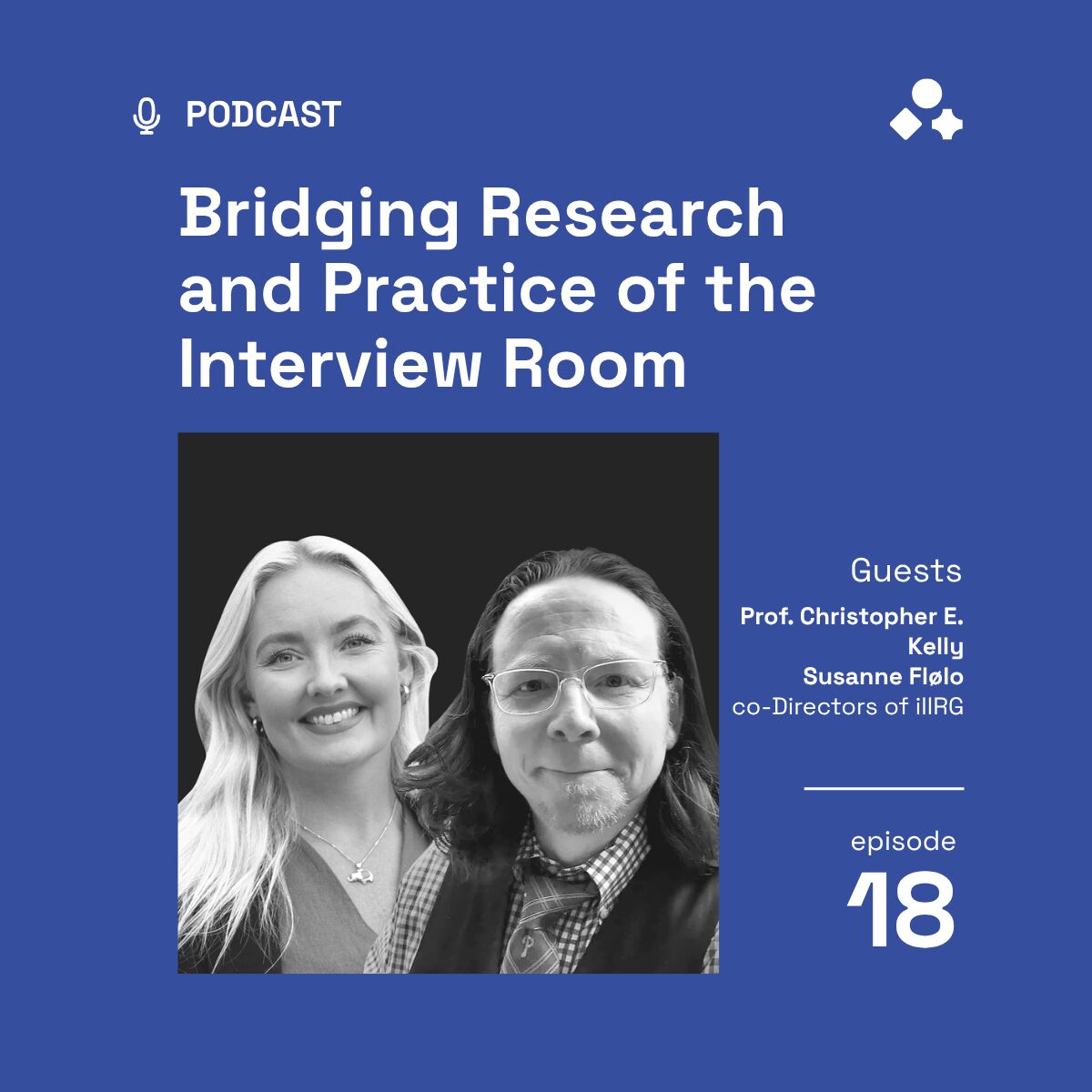
    En savoir plus

    5 mai 2026
Page précédente
1 2 3 4 5
Page suivante
Davidhorn

ROYAUME-UNI : +44 (0)1582 490300

Autres régions : +47 370 76 460

Ventes et technique :
sales@davidhorn.com

Support :
support@davidhorn.com

  • wpml-ls-flag
    • wpml-ls-flag
    • wpml-ls-flag
    • wpml-ls-flag
    • wpml-ls-flag
    • wpml-ls-flag

Autres pages

  • Contact
  • Aide
Un badge certifié Kiwa (ISO 19001, ISO 27001). Délivré par l'accréditation norvégienne MSYS 004.

Recevez les dernières nouvelles

Ce champ n’est utilisé qu’à des fins de validation et devrait rester inchangé.

Inscrivez-vous à notre lettre d’information et soyez les premiers à recevoir des offres intéressantes et les dernières nouvelles !


  • LinkedIn
  • Facebook
  • Instagram

Politique de confidentialité

Conditions

Cookies

©Davidhorn. Code et conception Aptum