


The Long Game Series
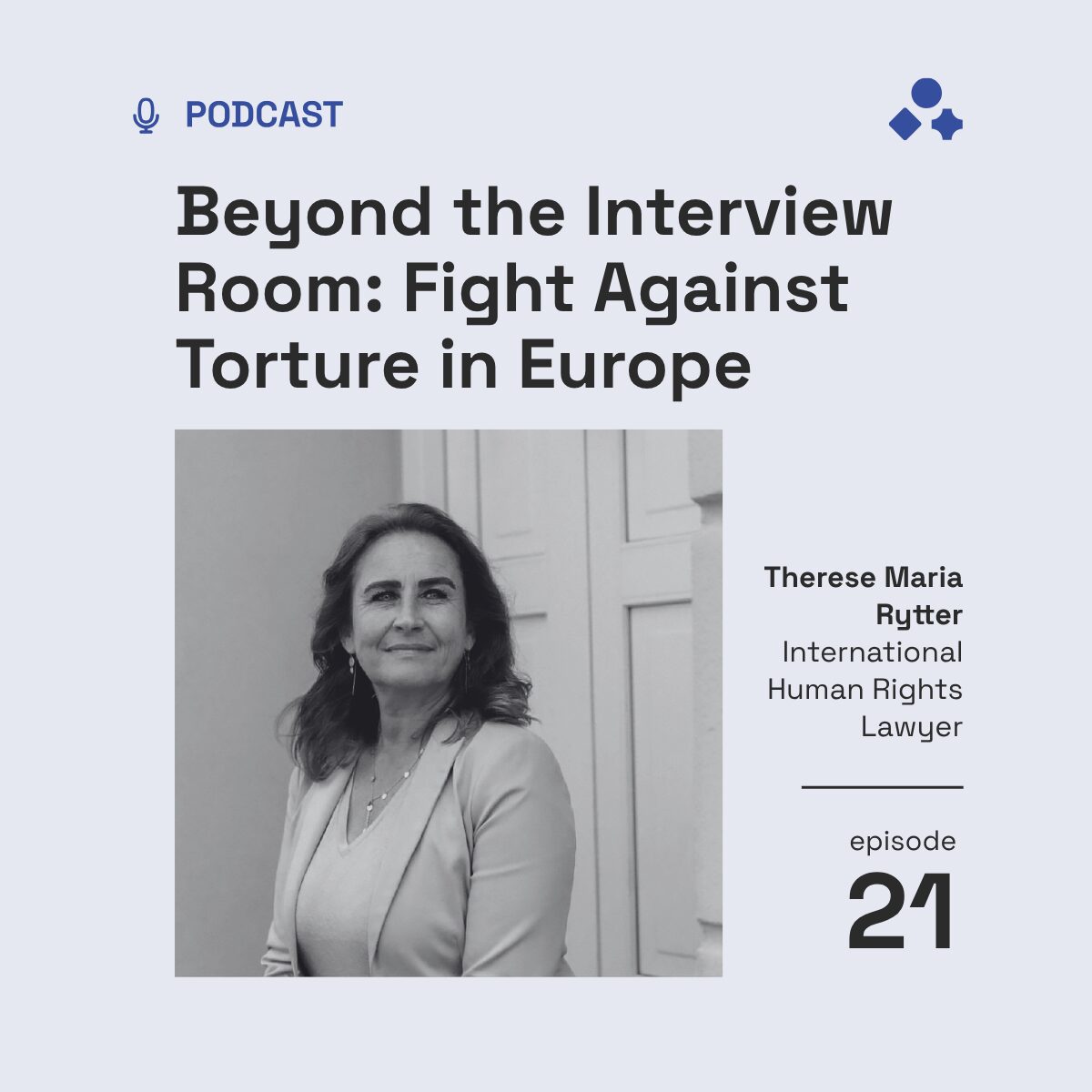
Episode 21. Beyond the Interview Room: Fight Against Torture in Europe
Human rights lawyer Therese Rytter reveals how the CPT prevents torture across 46 European countries – and why investigative interviewing requires more than methods.
In this episode of Beyond a Reasonable Doubt, host Dr. Ivar Fahsing speaks with Therese Maria Rytter, international human rights lawyer and outgoing Vice-President of the European Committee for the Prevention of Torture (CPT), about the critical intersection of legal safeguards, investigative interviewing, and the prevention of torture across Europe.
After nearly 12 years with the CPT and 30 years dedicated to protecting human rights internationally, Therese brings unparalleled insight into what actually prevents torture and ill-treatment in police custody, prisons, and other detention settings across the 46 member states of the Council of Europe. As Director of Prevention and Accountability at DIGNITY – Danish Institute Against Torture, and co-author of the landmark Mendez Principles on Effective Interviewing for Investigations and Information Gathering, she represents the bridge between international human rights standards and practical implementation in criminal justice systems.
The conversation reveals the CPT’s unique and powerful mandate: conducting surprise visits to police stations, prisons, and psychiatric hospitals throughout Europe, sometimes arriving at midnight on Friday nights when cells are fullest. Therese describes how expert delegations – including lawyers, forensic doctors, psychiatrists, and former police commissioners – spend two weeks in each country, sitting inside cells to speak with detainees, examining injuries, reviewing CCTV footage, and assessing use-of-force records. This unprecedented access allows the CPT to make concrete, evidence-based recommendations tailored to each country’s specific context.
Key Topics Discussed:
- The CPT’s unique mandate: surprise visits to detention facilities across 46 European countries
- Denmark’s leadership role in the international fight against torture
- Methodology: expert delegations conducting two-week assessments
- The importance of legal safeguards: access to lawyers, doctors, and judicial oversight
- Police culture and problematic incentives: bonuses for case closure rates
- Confession extraction as a «shortcut» undermining justice
- Police officers’ role: upholding rights, not talking suspects out of them
- Decision-making tipping points: how uniformed policing creates investigative bias
- CPT standards and good practices across policing, prisons, and psychiatric care
- The ImpleMendez project: integrating safeguards with evidence-based methods
- Why investigative interviewing cannot be viewed in isolation
- Recording technology as crucial safeguard and training catalyst
Equipped For Justice – Supporting ethical, human rights-compliant investigations worldwide
About the guest
Therese Maria Rytter
Therese Maria Rytter is an international human rights lawyer with 30 years of experience in promoting and protecting human rights, preventing torture, and advancing justice and accountability for international crimes. She serves as Director of Prevention and Accountability at DIGNITY – Danish Institute Against Torture, a human rights development and health organisation working in 15 countries worldwide.
From 2014 to 2025, Rytter served as a member and Vice-President of the European Committee for the Prevention of Torture (CPT), completing three mandates. She has led numerous delegations conducting monitoring visits to countries across the Council of Europe region, assessing the treatment of persons in police custody, prisons, psychiatric hospitals, and other detention settings with a view to preventing torture and ill-treatment.
Rytter was one of the co-authors of the Mendez Principles on Effective Interviewing for Investigations and Information Gathering, establishing international standards for non-coercive, rights-compliant investigative practices. Since 2008, she has served as a national expert to the United Nations Subcommittee on Prevention of Torture (SPT). Her work spans legal frameworks, practical implementation, and accountability mechanisms, making her one of Europe’s most influential voices on torture prevention and humane criminal justice practices.
Watch and listen wherever you get your podcasts (Youtube link here)
Related products


Transcript
Guest: Therese Rytter
Host: Dr Ivar Fahsing
Dr. Ivar Fahsing [00:00]
This morning I have the pleasure of inviting you, Therese Rytter, as our guest at this Davidhorn podcast Beyond a Reasonable Doubt. A warm welcome.
Therese Rytter [00:10]
Thank you very much.
Dr. Ivar Fahsing [00:10]
Therese, you and I know each other quite well after years where our paths have crossed, but our listeners might not be familiar with who you are and what you do in your daily work. Could you give us a short introduction?
Therese Rytter [00:25]
Absolutely, I’d be happy to. My name is Therese Rytter. I’m a human rights lawyer by training and I am the Director of Prevention and Accountability at the Danish Institute Against Torture, Dignity, based in Copenhagen. I’ve been working in this field of international human rights for the last 30 years — essentially my entire career. In addition to this, I have also been a member of the European Committee for the Prevention of Torture for almost 12 years.
Dr. Ivar Fahsing [00:56]
Fascinating. A Danish institute against torture — that’s an interesting place.
Therese Rytter [01:03]
It is indeed. It’s a human rights development and health organisation that works in some 15 countries worldwide. We work in Denmark, of course, but also in a number of other countries, in order to try to prevent the occurrence of torture and other forms of ill-treatment and to pursue accountability — bringing perpetrators to justice and making sure that victims are also able to receive redress.
Dr. Ivar Fahsing [01:34]
Interesting. As far as I know, Denmark actually holds quite an important position when it comes to torture prevention in the international community, doesn’t it?
Therese Rytter [01:42]
That’s very right. Denmark has for several decades been the lead nation internationally in the fight against torture. Both in the United Nations General Assembly and in the UN Human Rights Council, Denmark tables resolutions that every year increase the legal protection against torture. They also support a number of programmes worldwide which seek to put these legal frameworks into practice and ensure they are carried out in everyday life — whether in policing or prison regimes.
Dr. Ivar Fahsing [02:19]
Fascinating and also reassuring — that’s what you should expect from a well-established liberal democracy like Denmark. But you also mentioned that you hold a position in the European Committee for the Prevention of Torture, the CPT. Is that correct?
Therese Rytter [02:36]
That’s absolutely right, yes.
Dr. Ivar Fahsing [02:37]
Could you explain what exactly that is?
Therese Rytter [02:40]
The European Committee for the Prevention of Torture is an expert body — part of the Council of Europe. The Council of Europe is an international human rights and democracy organisation that includes 46 member states, all the way from Norway in the north to Cyprus in the south, including the UK and extending to Turkey and Azerbaijan. Our role is essentially to help states prevent any kind of practice of torture or other forms of inhuman or degrading treatment.
Dr. Ivar Fahsing [03:14]
And for how long have you been in this position?
Therese Rytter [03:19]
Almost 12 years now. I’m ending my third mandate and cannot be re-elected. I’ve served my time in the CPT.
Dr. Ivar Fahsing [03:29]
Fantastic. Thank you for the work you’ve done there. Twelve years is remarkable.
Therese Rytter [03:38]
No, absolutely. It’s been a pleasure — an extremely important piece of work which I feel very honoured to have been part of. The CPT has a very particular and unique mandate, which no other international body holds. The CPT carries out visits to all 46 member states. We move into police stations, prisons, psychiatric hospitals — anywhere where a person can be deprived of their liberty. We sit inside cells and speak with people in police custody or in prison, to understand what their conditions are and how they are being treated. We also speak with staff and with management, so that we can make a thorough assessment, looking into files, records, and CCTV footage. It’s a very professional methodology of collecting evidence, and then of course, at the end of the visit, speaking with the national government to make recommendations on how to strengthen the protection against torture and inhuman treatment.
Dr. Ivar Fahsing [04:47]
Fascinating. So your committee has a mandate approved by the governments of all Council of Europe member states?
Therese Rytter [04:59]
Yes, that’s right. Every single country has acceded to the relevant European convention and has allowed the CPT to carry out visits into any place of detention within the jurisdiction of the state, and to cooperate with the CPT in good faith. This is a commitment they’ve all made voluntarily.
Dr. Ivar Fahsing [05:22]
I see. And how does it work in practice? If you’re going to conduct an inspection of a country, what would typically be the process?
Therese Rytter [05:34]
We assemble a delegation of independent experts — people with backgrounds as lawyers, medical doctors, perhaps with a specialisation in prison medicine, a psychiatrist, or a former police commissioner. We make sure, depending on what we want to do in the country, that we have the right expertise on board to assess the situation at a professional level. The delegation — say, ten persons — will notify the state, usually three or four weeks in advance, saying we will be visiting and we would like credentials to enter any place. Once we arrive, we receive those credentials from the government. We meet with them, seek to understand recent developments, and they explain what progress has been made and what challenges remain. From there, we conduct fact-finding. For two weeks, we work across the country — moving into police stations and prisons, most of which are not notified in advance. We may notify one or two prisons, but the rest will be surprise visits. For police stations, we can arrive around the clock — very often on a Friday or Saturday night, after there have been incidents in the town. We’ll interview persons who are arrested and detained. Our medical and forensic doctors will examine them, photograph any injuries, and review medical files and use-of-force records. There’s a whole methodology for collecting the information we need to assess how people are being treated. We do this across many police stations and prisons, not only in the capital but in remote areas as well. At the very end of the visit, we meet again with senior government representatives — the Minister of Interior, the head of police, the Minister of Justice, the head of the prison service — and present our preliminary observations, covering both good practices we’ve seen and the concerns we have about continuing patterns of violations, or in some cases, patterns of torture.
Dr. Ivar Fahsing [08:20]
So you can actually speak directly with suspects in custody cells or inmates in prisons?
Therese Rytter [08:32]
Absolutely. We have an unimpeded right to enter these areas, to choose exactly who we want to interview, and to speak with them in private. It will not be those persons the police commissioner directs us to — we choose for ourselves. We always insist that no police officer or prison guard is present, because these conversations must be confidential. Otherwise, the person we are speaking with will not feel able to speak freely.
Dr. Ivar Fahsing [09:02]
May I ask — I have a police officer background from Norway and haven’t been able to access prisons or custody cells except in my own country. Could you give us a sense of what you see across Europe?
Therese Rytter [09:20]
Yes, absolutely. We see the whole spectrum. Some countries have modern custody cells — some even have custody suites, entire modernised areas with good physical conditions: daylight, a bed, necessary facilities. These would also include access to an outdoor yard if the person is held for more than 24 hours, meals served, contact with family. That’s at the very good end of the scale. At the other end, we also see very small, dark cells — sometimes pitch dark — without any daylight, where people are locked up with no food or very little food, limited contact with family, and may be confined for many days with limited access to a toilet. Even within Europe, the range runs from A to Z.
Dr. Ivar Fahsing [10:27]
I see. So at one end you have the pressure of being locked up in isolation, and at the other end, direct physical ill-treatment and violence.
Therese Rytter [10:47]
Absolutely. There’s a whole scale. Torture is at the very high end — the most extreme form of ill-treatment. It is very specifically defined: the infliction of severe pain and suffering, done intentionally, by a law enforcement officer, for a specific purpose — to punish, to extract a confession, to intimidate. In Europe, the torture methods we encounter can include severe beatings, electrical shocks, suspension, or waterboarding. But in police custody, what we more commonly encounter falls under what we label inhuman treatment or degrading treatment. If you are locked in a police cell for three days with very little water and no natural light, that will not constitute torture in itself — but it will still be a violation of the prohibition of inhuman and degrading treatment.
Dr. Ivar Fahsing [12:05]
Exactly. And in combination, the cumulative effect may be the same — particularly if the purpose is to make someone confess to a crime they did or did not commit.
Therese Rytter [12:22]
Yes, it’s always a combination of factors. Ultimately, in Europe, it will be the European Court of Human Rights that decides whether particular treatment constitutes inhuman treatment or torture. The CPT is not a judicial body — we won’t label specific kinds of ill-treatment in those terms. Our role is to prevent these practices from occurring in the first place.
Dr. Ivar Fahsing [12:47]
This takes me back to my own time as a detective at Oslo police headquarters, where I have to admit we were quite unaware of what we were dealing with when we held people in custody for weeks and months. I was interviewing suspects myself, and if they didn’t cooperate, we made clear their custody would be prolonged. I don’t think I personally ever told someone to confess or say what I wanted — but it was quite clear, even without saying it explicitly, what they would probably need to say to lift the isolation. Later it occurred to me: in the police, if you want to handle tear gas, you have to experience it yourself. I remember thinking — if you’re a detective dealing with people in custody and isolation, you should probably spend a weekend in total isolation yourself, to understand what that really does to a person.
Therese Rytter [14:24]
Absolutely. Anyone who plays any role in placing people in solitary confinement — whether a court, a prosecutor, or whoever orders such restrictive measures — ought to understand what it actually means to be placed in solitary confinement. That’s crucial.
Dr. Ivar Fahsing [14:47]
I remember my good friend Asbjørn Rachlew — who, as you know, is now the Norwegian representative on your committee — discussing this around 20 years ago with the Norwegian Director of Public Prosecutions, when we were trying to reform suspect interrogation practices. We found your committee’s reports extremely interesting once we discovered they existed. At that time, there were two things the CPT had specifically addressed regarding Norway: a culture of very long periods of custody and isolation, and a lack of recording of interviews.
Therese Rytter [15:36]
Are you serious? Well — that’s certainly not the case anymore.
Dr. Ivar Fahsing [15:42]
Exactly — but this was the late 1990s. I was a relatively young man and a naive believer in Norway as a liberal democracy. I asked people from the Director of Public Prosecutions’ office what they thought about these concerns, why we weren’t addressing them. But there was a sense of dismissiveness — a feeling that the committee simply had to write something about Norway as well, that it wasn’t really that serious.
Therese Rytter [16:22]
No — I can imagine. Unfortunately, we still see this today. Norway has now introduced recording of interviews, but a large number of countries across Europe are still not recording interviews — with suspects, victims, or witnesses. In that sense, many countries are still where Norway was 20 years ago.
Dr. Ivar Fahsing [17:00]
And speaking of that — I believe Denmark still doesn’t have an obligation to record suspect interviews?
Therese Rytter [17:07]
No, we don’t.
Dr. Ivar Fahsing [17:10]
Which is quite striking, given the position Denmark holds that we mentioned earlier. I won’t press you for your personal view on it, but it’s worth reflecting on the fact that even countries with these kinds of international positions need to examine their own practices. Even highly developed democracies can have practices that fall short.
Therese Rytter [17:45]
This is very true. What we also observe is that some countries progress over time — they develop more refined methods and increasingly comply with human rights standards. But we also see countries that regress. They may have had better practices in the past and then, for various reasons, abandon them. It’s a dynamic situation, and that’s precisely why the CPT cannot simply say: we’ve now visited Norway, Norway is doing well in a number of areas, so they no longer need independent monitoring. Any country can fall back.
Dr. Ivar Fahsing [18:31]
Absolutely. I also wanted to ask — because I know from conversations with Asbjørn Rachlew and with yourself — that your work goes beyond the physical and mental treatment of people in custody, prisons, and mental institutions. You also increasingly focus on interview methods.
Therese Rytter [18:59]
We do. First, of course, the CPT’s original focus in terms of safeguards has been what we call the trinity of rights: anyone who is arrested and detained by the police should have the right to notify their family or another third party; they should have the right to a lawyer; and they should have the right to a doctor, who can verify whether the person may have injuries that perhaps originate from the arrest. Being informed of these rights is fundamentally important — this has been a CPT standard from the very outset. What we’ve also said for more than 25 years is that interviewing methodology is crucial. We have long maintained that the sole purpose of interviewing should be to obtain accurate and reliable information about the matter under investigation — not to obtain a confession from someone who, in the eyes of the officers, may be guilty. The presumption of innocence is central. This is a key principle the CPT has applied since its earliest days.
Dr. Ivar Fahsing [20:22]
When you say that, it takes me back to a very important standard you recommended all the way back in 2002 — the year after we started national interview training in Norway. I can’t tell you how important that standard was to us, Therese. Asbjørn Rachlew and I were quite young officers at the time, trying to reform a relatively conservative organisation — the Norwegian Police and Prosecution Service. Finding that kind of standard from a European body like the CPT was so important to us. It validated the idea — it wasn’t just something we’d picked up from studying in the UK. There were other people, and important institutions, who shared the same conviction.
Therese Rytter [21:15]
Exactly. And of course, the CPT was also heavily inspired by the member states it visited. The United Kingdom was one of the main countries at the time that had introduced the PEACE model, and examining that good practice in the UK was something we also took on board. The principle we’ve emphasised is that one should proceed from the evidence to the suspect, not from the suspect to the evidence. This has been a principle underpinning all our work in police custody.
Dr. Ivar Fahsing [21:49]
It’s really fascinating, and I hope the same inspiration you provided to us many years ago is still reaching places where it’s needed. I know that even people within some of these organisations struggle with how they’re perceived when they raise concerns — whether they’re seen as loyal or as critics of their own country.
Therese Rytter [22:21]
I can imagine. We see this as well. The police also protects itself. That’s something we observe — it’s quite rare, when we discover practices of coercive interrogation or other forms of physical ill-treatment in police custody, to also find effective investigations ending in prosecutions and law enforcement officers actually being brought to justice. In a number of countries in Europe, there is still a long way to go.
Dr. Ivar Fahsing [22:51]
I can say that even in this season of Beyond a Reasonable Doubt, there are officers in some European countries who are very reluctant to accept my invitation — though they are honoured to be asked. They are genuinely afraid to speak openly about what their country needs to do to change.
Therese Rytter [23:12]
Yes, I can very much recognise that.
Dr. Ivar Fahsing [23:16]
So again, I think they should look into the CPT reports and find support there, as we did. I’d like to ask you, Therese — do I understand correctly that when you now conduct an inspection in a country, you also look at whether officers are trained and whether there is a policy on how interviews are conducted?
Therese Rytter [23:43]
Yes, absolutely. We look, of course, at what happens within the place of detention. But if you really want to prevent ill-treatment, you need to look outside it as well. We examine a number of systemic factors. We look at how the police is trained — whether the police academy curriculum includes training on how to interview suspects, victims, or witnesses, and whether that interviewing methodology is consistent with investigative interviewing and modern good practice. We also look at the judiciary — for instance, whether a confession obtained through torture would make it all the way to court, or whether a judge would dismiss such evidence. We review interrogation rules and instructions to see whether they comply with international standards. It’s the whole range of issues — both inside and outside the place of detention — because only through this kind of holistic examination can we propose measures that are genuinely relevant to strengthening protection against ill-treatment.
Dr. Ivar Fahsing [24:59]
As you know, I’ve spent much of my professional life trying to introduce investigative interviewing in the Norwegian police and prosecution service, and also in my position at the Norwegian Centre for Human Rights. I work globally with these ideas. But at some point as a police officer you think — perhaps interviewing is the thing, that if we just get the interview right, everything will follow. Sometimes, though, I think we also have to account for the broader context you’re describing. It’s never just one factor.
Therese Rytter [25:51]
It’s the whole picture, absolutely. And it’s very much about culture — the culture within the police. Is it seen as professional to conduct interviews in an investigative manner, or is coercive interviewing considered acceptable? That’s really where it starts. How does a superior within the police react when someone has forced a confession? But it also extends to the prosecution service — are they willing to accept confessions extracted under torture? Are judges willing to close their eyes? It starts with the police, but it does not stop there. It’s essential to have all justice institutions on board. And ultimately, the political level, because it’s the Minister of Justice or the Minister of the Interior who decides what kind of practice a particular country aspires to.
Dr. Ivar Fahsing [26:49]
Exactly. That brings me to a more delicate question, because you mentioned the presumption of innocence, which is a fundamental right for any suspect. I still see, even among researchers across Europe, an engagement with the question of how to make a suspect talk — methods designed to make people cooperate even when they’ve expressed they don’t wish to. I sometimes feel uncomfortable when I reflect on this: is it really the job of a police officer to make someone talk if they’ve already said they don’t want to give a statement?
Therese Rytter [27:27]
Mm.
Dr. Ivar Fahsing [27:33]
…to give a statement in this case.
Therese Rytter [27:37]
No. The police must respect the presumption of innocence and the right to remain silent. If a criminal suspect does not wish to say anything, there’s not a great deal the police can do — they would have to collect other forms of evidence through other sources, whether documentary or otherwise. Absolutely, one cannot force a suspect to speak, and even less so force a suspect to confess.
Dr. Ivar Fahsing [28:03]
Exactly. But very often the physical dimension of coercion is more readily understood and condemned. When it comes to what you might call ‘sweet talk’ — there’s a well-known piece by Professor Peter van Koppen from the Netherlands on what he terms sweet interrogations, where methods of befriending and subtle manipulation are used. That is…
Therese Rytter [28:22]
Mm.
Dr. Ivar Fahsing [28:29]
…not illegal in itself, but it’s done within a context where the person is in isolation, and they are being manipulated into doing things that are not necessarily in their interest.
Therese Rytter [28:38]
Mm.
Dr. Ivar Fahsing [28:44]
So I think it’s really important that people understand what the job actually is. A police officer, in my view, is there to uphold the law and ensure that the suspect knows their rights and can act on them — not to talk them out of exercising those rights.
Therese Rytter [28:59]
Of course. What you call sweet talk is perhaps at the lower end. That should not happen — manipulation should not happen. But what we are looking at in the CPT is not necessarily that level. We focus on more serious practices: sleep deprivation, interviews lasting many hours with no breaks, insufficient food or water, or — during the interview itself — exposure to threats of torture or threats against the person’s family. These are extremely serious, and they are what we pay closest attention to when we receive allegations of that kind.
Dr. Ivar Fahsing [29:46]
Absolutely. And please excuse me for reflecting on the broader cultural dimension here — there still seems to be a culture in which it is considered in the police’s interest for a suspect to talk. I really question that. Should a police officer have any interest in whether a suspect talks or not? Should a detective have any personal stake in the outcome of a case?
Therese Rytter [30:18]
No. We still see countries where police officers are rewarded for having a high number of solved cases. They may receive better bonuses, better salaries, or even promotions. And for some, extracting a confession is seen as a shortcut to closing a case. This is something the CPT is also very attentive to.
Dr. Ivar Fahsing [30:44]
And that’s why culture matters so much. If you want to make changes, you have to work with culture and with a genuine understanding of what the job actually requires. I remember during my PhD research on what I call tipping points in decision-making — factors that can push you towards tunnel vision about guilt — one interviewee in England said something that stayed with me. He observed that even the experience of being a uniformed police officer, where your job is to control crime and stop it, could itself be a tipping point. He said that if you really want to become an investigator, you’re probably a little bit tainted just by coming from a uniformed background. That was a profound insight into what that does to you — because investigation is definitely not about control. It is, and must be, an objective gathering of relevant information.
Therese Rytter [31:53]
Yes. No, absolutely. I completely agree.
Dr. Ivar Fahsing [31:55]
I’m really impressed by the work you’ve done and by what you’ve devoted most of your professional life to. I’m genuinely grateful for what you and the CPT have meant to our country. It was really important to have those reports when we were trying to reform practices in Norway. And I’m not saying everything is good in Norway now — it isn’t — but those reports were an important contribution.
Therese Rytter [32:15]
I’m very happy to hear that, because this is exactly the main purpose of our work — to help as many states as possible with tailor-made recommendations that speak to the very concrete context we see. And the more reports are made public, the more broadly that influence can spread. There’s also an encouraging international trend: a number of states have now committed to what’s called automatic publication of reports. This means that once we issue a report and send it to the government, they carry out some fact-checking, but within a matter of weeks they make it public. That’s very good practice — it means not only the government and the relevant institutions, the police and the prisons, know what was said, but civil society and the broader public as well. We’re seeing an increasing number of states moving in that direction.
Dr. Ivar Fahsing [33:18]
Absolutely. And speaking with you, Therese, reminds me of something important — I think both of us are involved in a European project called Implemendez, which is a funded initiative to broaden understanding of the importance of legal safeguards and scientifically grounded interview methods across Europe. And yet sometimes there seems to be an over-focus on interview methods alone.
Therese Rytter [33:48]
I agree. Interview methods are key, but it’s not only about the moment of the interview — it’s also about what happened before. What we see in a number of countries is that upon arrest, informal conversations begin immediately. Operational police officers — not investigators — start questioning suspects: where were you, what did you do, what have you committed. These are questions that should not take place without the presence of a lawyer. We see this time and again. So it’s also about looking not just at the official interview with the investigator, but at what happened before and what pressures were placed on the person prior to any formal process. And of course all the safeguards we’ve discussed — the right of access to a lawyer, the right of access to a doctor, the right to be brought before a judge to ensure the detention is lawful — all of these build a protective framework to ensure that the right to respect for personal integrity and dignity is upheld.
Dr. Ivar Fahsing [35:01]
We could go on. I couldn’t agree more. I just want to underline: none of this happens in isolation. That was the point of the story I shared from my earlier days — keeping people in custody for prolonged periods, without fully understanding what that meant. If you combine that context with even an apparently open question, you can probably still get the answer that the person knows you want. All of this has to be seen in balance, and only then can we really move forward.
Therese Rytter [35:38]
No, I agree. I very much agree.
Dr. Ivar Fahsing [35:40]
But I have to say — I really encourage our listeners to visit the CPT website through the Council of Europe, and to look into the national reports, as well as the annual recommendations and broader publications, to see how they can provide inspiration for development in all these areas.
Therese Rytter [36:05]
Exactly. And I would also encourage everyone to explore the CPT’s resources more broadly — we have a substantial collection of standards and good practices covering different areas: police, prison systems, psychiatric hospitals, immigration detention centres. All the areas in which people can be deprived of their liberty. I would encourage anyone to read the country-specific reports, but also to look at the generic standards — because those, at the end of the day, are what every country should aspire to comply with.
Dr. Ivar Fahsing [36:46]
Thank you, Therese, and thank you so much for a wonderful conversation. I’ve learnt a great deal.
Therese Rytter [36:50]
Well, thank you. Thank you very much. It was a pleasure to speak with you, as always — always very inspiring.
Dr. Ivar Fahsing [36:56]
Thanks a lot.
END OF TRANSCRIPT
© 2026 Davidhorn. All rights reserved.