


The Long Game Series
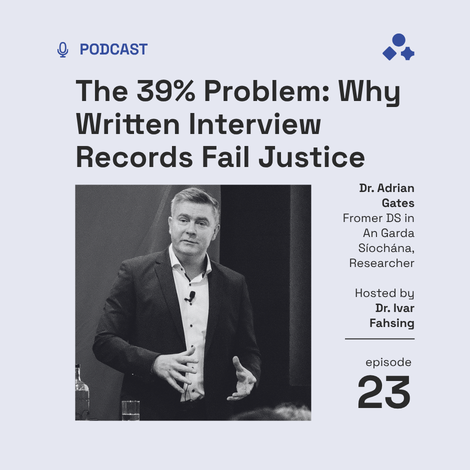
Episode 23. The 39% Problem: Why Written Interview Records Fail Justice
Interview documentation captures only 39% of what’s actually said. Dr. Adrian Gates reveals why written records undermine investigative interviewing and justice and why police interview recording
In this compelling episode of Beyond a Reasonable Doubt, host Dr. Ivar Fahsing speaks with Dr. Adrian Gates, former Detective Sergeant with An Garda Síochána and current CEO of Insight Interviewing Ltd, about a critical but overlooked problem in criminal investigations: the shocking gap between what happens in police interviews and what gets documented.
Dr. Gates’ doctoral research at the University of Portsmouth reveals that handwritten and typed interview statements capture only 39% of what suspects actually say during interviews. Analysing 26.5 hours of footage across 15 interviews, he found that 157,000 spoken words were reduced to just 28,000 written words, with 4,481 items omitted across all interviews.
This episode traces Dr. Adrian Gates’ evolution from a young detective immersed in “confession culture” to a leading voice for ethical, information-gathering approaches to investigative interviewing. He candidly shares his journey from prioritising confessions to understanding the operationalisation of the presumption of innocence, influenced by his studies with Professor Becky Milne and encounters with international experts.
He discusses the implementation of Ireland’s PEACE-inspired interview model (GSIM – Garda Síochána Interview Model), the challenges of changing police culture, and why the physical act of writing during interviews fundamentally undermines both the interview process and the accuracy of evidence. His research demonstrates that scribes interrupt suspects at critical moments, breaking rapport and preventing the free flow of information that ethical interviewing demands.
The conversation explores how recording technology – like Davidhorn’s A/V systems – offers the solution to this documentation crisis, enabling accurate transcripts while allowing interviewers to focus on building rapport and gathering comprehensive information rather than controlling the narrative through their pen.
Key Topics Discussed:
- The transition from “confession culture” to information-gathering approaches
- Implementation of the GSIM (Garda Síochána Interview Model) in Irish policing
- Research findings: only 39% accuracy in written interview records
- The impact of real-time writing on interview dynamics and suspect cooperation
- Why recording technology is essential for justice and the presumption of innocence
- The cognitive impossibility of accurate manual documentation (30 words/minute writing vs 150-200 words/minute speech)
- How scribing interruptions break rapport and prevent information disclosure
- The future of interview documentation in Irish criminal justice
About the guest
Dr. Adrian Gates
Adrian Gates is a former Detective and Sergeant in An Garda Síochána, Ireland’s national police service, where he specialised in serious and complex crimes. He led the development and implementation of investigative interview training and strategic interview policy in Ireland, introducing the Cognitive Interview to criminal investigations in the Republic. A member of the International Investigative Interviewing Research Group (IIIRG) and the Portsmouth University Centre of Forensic Interviewing, Mr. Gates has completed his doctorate at the University of Portsmouth, focusing on the evidential consistency of written records from suspect interviews. He is CEO of Mosney Unlimited Company and Managing Director of Insight Interviewing Ltd, providing scientifically-based, ethical investigative interviewing training and advice to public and private sectors.
Watch and listen wherever you get your podcasts (YouTube link here)
Related products


Transcript
Guest: Dr Adrian Gates, former Garda Síochána (Ireland), national lead on investigative interview training
Host: Dr Ivar Fahsing
Dr. Ivar Fahsing [00:05]
Welcome, Adrian Gates, to this episode of Beyond a Reasonable Doubt.
[00:12]
This season is all about the implementation of investigative interviewing — and we are going to talk about both the near and the far horizons. Thank you for being our guest today.
Adrian Gates [00:24]
Thank you, Ivar. It is my pleasure to be here. I am a fan of your podcast and I have listened to many very esteemed academics and practitioners. I consider myself very lucky to be here, and I look forward to our conversation.
Dr. Ivar Fahsing [00:40]
And to Adrian, and to our listeners who may not know you as well as I do — could you give a short introduction of who you are, where you come from, and what you currently do?
Adrian Gates [00:56]
Absolutely. I am no longer in the police — which in Ireland is An Garda Síochána, meaning ‘the guardians of the peace’. I joined originally in 1999, went through the Garda Training College in Templemore — which takes about 15 months before you become operational — and was then posted to a busy Dublin city centre station called Pearse Street.
[00:56]
We had very little training in interviewing or investigation, so a lot of it was based on what I observed and who I happened to be working with on any given day. Within about three and a half years I was posted to a busy Dublin station in Swords, where I was part of a crime task force driving around the north of Dublin city in response vehicles for two years. After that I moved into a local detective unit, where I spent a number of years investigating everything from ordinary crime to sexual assaults and murder.
[00:56]
It was around 2014 that I realised interviewing — suspects and witnesses — was something I was very interested in and quite good at. At that time there was very much what you or Asbjørn Rachlew would describe as a ‘cough culture’, where the whole plan was to get someone to confess. If a suspect was in front of us, we automatically assumed they were guilty — we engaged in confirmation bias and went looking for information that suited our case theory.
[00:56]
But as time went on I realised that I was not particularly skilful, and neither were those around me. So I started to look into the academic world and I found a book by Becky Milne and Ray Bull called Investigative Interviewing, and it made a lot of sense. Another book, Conversation Management by Eric Shepherd and Andy Griffiths. Having read both, I decided to go back to study. I had a previous degree in business and management, but I enrolled at the University of Portsmouth with Professor Becky Milne, who has been my mentor ever since.
[03:52]
It is funny — I was invited over by Becky to a conference, and I walked into the room, and there you were sitting there. I was this young detective from Ireland with a growing interest in investigative interviewing but really not knowing what I was talking about — I had read a couple of books and looked at a few things online. I think that was my first real introduction to you, Ivar, and also my first proper academic argument.
[03:52]
Because what you were saying at the time was very foreign to me. You were saying that everyone has the right to silence, to say what they want or say nothing at all — that it is not up to us to make them talk. I think what you were really pointing to was the operationalisation of the presumption of innocence. My counter-argument was: what about the victims of these crimes? What about their families? I was completely certain I was saying the right things, because in my mind the job of the police was to find the person who committed a crime and to find information to make them confess.
[03:52]
When I look back on that meeting — just over ten years ago now — it is quite embarrassing to think that was how I thought. But that is how I had learned it from everyone around me. I had been singled out to interview certain types of interviewee — suspects, witnesses, victims — because I was considered gentle in manner and good with people. And I think even my superiors at the time realised I was actually good at gathering information, though I still had that drive between my teeth. There was always a question waiting for me at the end of an interview: ‘Did you get it?’ — meaning the confession. And we always felt a little like failures if we did not.
[06:17]
After completing the master’s, I conducted a study with Becky Milne on the Garda Síochána Interview Model — GSIM — which is the investigative interviewing model used in Ireland. It originated around 2010, with formal rollout beginning after HQ Directive 20 of 2014. It is broadly similar to the PEACE model in the UK, with the same kinds of phases: plan and prepare; engage and explain (called ‘force contact rapport’ in GSIM); account, clarify and challenge; and closure.
[06:17]
I was sent on the course just over ten years ago, and I think those running it were a little wary of me because of my connection with Becky Milne. I have to credit my Detective Sergeant at the time, Adrian Murray, as a real mentor — he made sure I got onto the course. And there was a Sergeant called Marianne Cusack who did a huge amount of work to advance the process, because as you know, Ivar, a lot of these things are driven from the bottom — sometimes by just one or two people. It was Geraldine Noon who was really behind developing the model originally. After Geraldine left, Marianne stepped in as Sergeant in charge of investigative interviewing to keep it moving. Then I was brought in as a trainer and eventually became the national lead on investigative interview training in Ireland.
[06:17]
I was then moved into the National Bureau of Criminal Investigation — the NBCI — a national detective unit specialising in serious and complex crime across the country. At the same time I was working almost on a hybrid basis, spending about half my time teaching and lecturing at the Garda College on investigative interviewing, and the other half conducting interviews. From a development point of view it was excellent — it gave me a real opportunity to compare what we were doing in the field with what we were doing in training.
[06:17]
I was subsequently promoted to Sergeant and took over from Marianne Cusack as Sergeant in charge of the investigative interviewing section at the Garda College. It was there that I realised how much work remained to be done. A lot of that work was informed by my master’s research with Becky. Two things stood out clearly. The first was the lack of ongoing training and supervision. The PEACE model includes an evaluation phase — the GSIM did not, or at best it was implicit. The second was that there was a standalone rapport phase within the GSIM, and I believe — and my findings confirmed — that it caused problems.
[10:01]
The rapport building I observed was often perfunctory — interviewers were building rapport for the sake of it, because it was a stage in a model. And then it was almost Jekyll and Hyde: once they reached what they felt was the challenge phase, Mr Hyde appeared. The rapport stopped because they felt they had done the rapport stage and could move on. That was one of the areas we found was really lacking. The other was a lack of understanding of the Cognitive Interview and the Enhanced Cognitive Interview — how to actually conduct them.
[10:01]
The advanced interview course at Level 3 was three weeks — two weeks on suspect interviewing, one week on witness interviewing. With Becky, I identified that the training really needed to be rethought. She brought me over to the UK and I observed a number of sessions she ran with police organisations there. When I came back to Ireland I said: we need to change how we do this, because what we are doing is not cognitive interviewing. Even in how we train it, we were using a false scenario — someone reads a script and pretends to be an interviewee — and then you are teaching an interviewer to help a witness become comfortable and access memories that do not exist, because there were no real memories. We changed that, and started using simulated crimes so that trainees were working with real memories of real events.
[12:12]
At this point there had still never been an Enhanced Cognitive Interview conducted in Ireland. I remember calling Becky one day and saying: ‘Becky, the legislation supports this. I am going to do one.’ We had a local case — an attempted abduction of a young woman. I explained to my Detective Sergeant what I wanted to do. He gave me the go-ahead. I was building up to the context reinstatement, the interviewee was nicely relaxed — and then the door burst open. Someone walked in holding a cup of coffee and said: ‘Oh, sorry about that!’ and shut the door again. I thought: that is it, it is finished.
[12:12]
But we got it back on track. And when I handed the conversation over to the witness, I sat back — and she spoke for 32 minutes uninterrupted. I did not think it was possible. When other people learned what had happened, what was achievable, the amount of information that had come out — it started to spread. I began to gain a little credibility. I was invited to do seminars around the country, going from stations to divisions to districts. I started making quite a name for myself, which was never my intention.
[13:50]
Because as you know, detectives and investigators — it is, let us be honest, quite a sought-after position. Everyone wants to be the detective. And because investigative interviewing was relatively new, people believed it was somewhere between psychology and black magic. When we went into police stations to conduct Level 3 interviews with Level 4 interview advisors, there was this aura around us — everyone wanted to know how they could do it, how to get on the course and be part of this new movement. But for me there were always alarm bells. Sometimes I felt the wrong people were coming through.
[15:01]
One particular conference comes to mind. I went with a legendary Detective Sergeant called Peter Woods — not long retired, a really excellent interviewer and good man who had been involved in some very high-profile cases. It was a rainy afternoon. The Assistant Commissioner, the Chief Superintendent, the Detective Chief Superintendent who headed the NBCI — all were there to hear various talks on different areas of policing. Then Adrian Gates got up to talk on the Enhanced Cognitive Interview.
[15:01]
I always like to start by creating a false memory. I had this chart and I could see them all studying it. I said: ‘I can pretty much guarantee that half of you will recall words you did not even see.’ We went through the whole process and it worked, as it always does. I could see that my chief at the time was, if not impressed, certainly amused. And then at the end, a Detective Superintendent put his hand up and said — and I will never forget this, Ivar — ‘Adrian, are you telling me that we have been doing it wrong all this time?’
[15:01]
I had to think. And one thing I have never lacked is the courage to say what needs to be said. I simply said: yes. A number of them nearly fell off their chairs. Some found it very amusing. Some did not find it amusing at all. I thought: that is the end of me. But it was not. I went on to conduct many more Enhanced Cognitive Interviews in the field — real cases. Becky Milne came over and ran a train-the-trainer programme with eight of us, and it took off from there.
Dr. Ivar Fahsing [17:48]
That is a fascinating story. And I have to say it is remarkable to hear — there are points where I feel we have been on exactly the same path. The courage it takes to promote fundamental change in something that is seen as such a basic task.
[17:48]
I think one of the questions we said we would explore today is the ethos of investigative interviewing. You have been talking about the first research-based methodology — the Enhanced Cognitive Interview — but what would you say the ethos of investigative interviewing actually is?
Adrian Gates [18:42]
I am happy to answer this — and it should never be a simple answer. Ten years ago it would have been simple for me: I would have said it is about respect, empathy, rapport, and honesty. But that is not really what it is about.
[18:42]
For me, the ethos of investigative interviewing has to be — and I am repeating something you have said often, Ivar — operationalising the presumption of innocence. It cannot start from anything more or less than that. Because if you as an investigator are protecting the presumption of innocence, and you genuinely presume that the person in front of you is innocent, everything changes. You do not go in with a fixed mindset. You do not chase information that suits the case theory. That requires a huge mindset shift — talking about it is very cheap.
[18:42]
As Sergeant in charge of the investigative interviewing section, I reviewed hundreds of interviews. One of my initiatives was a training passport: interviewers would submit an interview with a suspect and the corresponding written statement. I could see in those interviews — people I had personally trained, whose performance I had watched — the difference between what they did directly after training at the college and what came back from the field. And those interviews coming back from the field were probably their best, the ones they felt most confident about. To say that some had reverted to type is an understatement.
[18:42]
That is why the question of what investigative interviewing is comes back to the presumption of innocence. Without that genuine mindset shift, I think a lot of the training is wasted.
Dr. Ivar Fahsing [21:30]
I think you are so right. It reminds me of a few years ago when we were fortunate enough to be invited to Fiji to train. The New Zealand Police had been introducing the PEACE model there over several years, but they said it just was not sticking. I think what had been missed is that this is something much deeper than a stage model. If you just deliver the stage model well, does it really change anything?
[21:30]
What we saw in Fiji is that it is a very tribal and intensely religious community — everything was seen through the lens of sin, even the mere suspicion of having done something. So punishment could begin before the interview. Someone being beaten just because they had become a suspect was almost seen as the duty of an elder. When we started to talk about the presumption of innocence and how easy it is to fall into these patterns — and how cultural and historical they are — that was so interesting to observe in that context. Investigative interviewing came about in the first place because of miscarriages of justice. Wrong people convicted. A cultural presumption of guilt. It was brought in to change something fundamental.
Adrian Gates [23:36]
I was involved in one very high-profile interview — quite an emotional experience, because it concerned the shooting and killing of one of our colleagues, whose brother worked with me and was my partner at the time. I ultimately moved on, but I was involved in the investigation and spent a great deal of time with one of the suspects. I had to check myself during those interviews — and I had an outstanding Level 4 interview advisor, Detective Sergeant Adrian Murray, giving me real-time feedback. He was telling me to slow down, helping me manage my performance. This kind of live supervision was not common. I said to him: I am the national lead, I know how to do this. But I was getting caught up.
[23:36]
What I can say is this: at the end of that interview process, the person in question shook my hand and left. About four months later I was walking in my hometown with my wife and three children, and the same person came walking down the same path. He looked at me, I looked at him. We recognised each other. And he simply nodded. I think that says a great deal about what it means to approach an interview as someone gathering information — not reaching a verdict. Because by doing that, I was able to maintain a relationship. Not friendship — just humanity. Real rapport does not mean talking about the football. It means meaning it. Meaning that you want to understand.
Dr. Ivar Fahsing [26:10]
That nod says a lot. And I think when we work in this field we become cynical over time. What detectives do every day — accusation — if you transferred that to ordinary life, to family life or friendship, imagine how rarely we actually accuse someone, and what impact that has on a relationship. We do it every day in this work and it becomes bread and butter. I do not think many people truly understand what it means to the person on the other side of that table.
[27:10]
You may remember a story I told you — it was the christening day of my middle boy. The party had finished, I was bathing my son, and I got a call from a friend who was supposed to be getting a bus back to Dublin. There was screaming — someone was attacking him. I handed the baby to my wife, jumped in the car, drove three or four minutes, found a gang of people around him, pulled him out and drove away. There was blood running down his face. I called the local station and said we needed to go in and report this. He told me: a man asked him for a cigarette, ran away, and then he noticed his wallet was gone. He chased the man, was screaming at him, and someone came out of a pub and started hitting him.
[27:10]
And then my phone rang. It was my friend’s father. He said: ‘Is such and such with you?’ Yes. ‘Oh good — I couldn’t get him on the phone. Will you tell him he left his wallet on the table?’ We stood the police cars down. And I think it is a perfect everyday example of how we form an idea in our heads and then find a way to prove it.
Adrian Gates [29:09]
It is compelling — I use a similar story with my students, which I call the Monster Story. A woman is late for her plane and stops to buy a bag of crisps and a drink. She puts them down at a table near her gate where a man is sitting, and then goes to the toilet. When she comes back she sees the man reach into her bag of crisps and eat one. She demonstratively turns the bag towards herself and starts eating. He turns it back and takes another. She grabs the bag, looks at him, and screams: ‘You bloody monster!’ Then boarding is called. She runs to the gate, hands over her ticket — and finds her own unopened bag of crisps in her handbag. Very similar to your story, but I think it captures something fundamental about how accusation and suspicion arise — and why we have to dare to dig deeper before we conclude anything.
Dr. Ivar Fahsing [30:44]
I could not agree more about the ethos of investigative interviewing. I will also ask you — you have already told us something about your work introducing investigative interviewing in Ireland. Did you meet barriers along the way?
Adrian Gates [31:05]
Yes. Anyone who is introducing or trying to advance something new within a hierarchical institution — and policing is as hierarchical as it gets — will meet the weight of tradition. The same as you always did, you get what you always got. The ECI conference I described was an example of that.
[31:05]
And then there was another side to it. Around 2016 to 2018, investigative interviewing was genuinely in vogue in Ireland. Every SIO, every Superintendent, every Detective Inspector wanted trained people on their teams — because the courts were starting to ask for the qualifications of the interviewer. But I do not think many of the more senior officers truly believed in it. They knew they had to go along with it and have certain numbers on paper. When it came to difficult cases — where there was scant evidence and a real hope of a confession — I saw them revert to their trusted disciples. On one hand supporting investigative interviewing, on the other hand putting someone in who would ask tough questions and might get the confession.
[31:05]
I have been away from the police for six years, and I do not really think that has changed. I spoke recently with someone who trained around the same time as me — over ten years ago — and they have still not been reviewed since, despite having conducted a very large number of interviews. By prioritising new Level 3 trainees and not investing in the ongoing training and review of existing Level 3 interviewers, we are, I believe, wasting the money and the effort.
Dr. Ivar Fahsing [35:07]
I have to be honest with you about something I have always found remarkable. Am I right that in Ireland, to this day, interviewers still have to write down by hand what is said during a suspect interview?
Adrian Gates [35:31]
Yes — and it is actually the basis of my doctoral research with Becky Milne. A lot of people find it very difficult to comprehend. In Ireland we have had audio-visual recording since 1997. But we are also mandated by the caution to write everything down. The caution states: ‘You are not obliged to say anything unless you wish to do so, but whatever you do say will be taken down in writing and may be given in evidence.’ So we record the interview on video and simultaneously write everything down.
[35:31]
I was a reasonably good interviewer. I was able to build relationships, leave my ego at the door, and people would start talking. And then I would realise — the pen cannot keep up with the mouth. In one high-profile murder investigation, the suspect had chosen to say nothing — as was his right. About 30 minutes into the interview he looked at me and said: ‘Adrian, you know why I was there. You all know why I was there.’ And at that precise moment the scribe put a hand up and said: ‘Whoa — can you not see I have to write everything down?’ It was not the first time something like that had happened. I did it myself earlier in my career.
[35:31]
The problem with that writing is fundamental. When you so demonstrably take control of someone’s story through your pen, it can easily become your narrative that dominates the room — and the interviewee’s memory. This connects to research by a Swedish researcher called Arne Trankell, who observed police interviews and described how both individuals in the room can lose the grasp of the real story. They become slaves to the task of producing a document. The interviewee wants to help — but you as the interviewer do not know the story. You know what it needs to look like in order to support a prosecution.
Dr. Ivar Fahsing [38:25]
Could you give us a short summary of what your research found?
Adrian Gates [38:28]
The research question was: to what extent do typed or handwritten statements from interviews with suspects actually reflect what was said in the interviews? I collected 15 interviews — equating to 26 and a half hours of footage — and transcribed every single one. That took me a year and a half.
[38:28]
At a macro level: the transcripts contained 157,000 words. The written statements contained 28,000 words. In the transcripts there were 2,667 questions asked; in the written statements, 1,244 questions were documented. The average interview transcript ran to 43 pages; the average written statement to 11 pages. The accuracy level was 39% — which gave a figure of 4,481 omitted items across the 15 interviews.
[38:28]
When you look at the underlying mechanics: the average writing speed is around 30 words per minute. The average rate of speech is between 150 and 200 words per minute. Even taking the lower figure of 150 and dividing by 30, you are at about 20%. So physically and cognitively, without any interruptions at all, we can capture around 20% of what is being said. A Swedish study from 2018 by March and colleagues found that approximately 24% of spoken words were captured, which is close to that theoretical limit.
[38:28]
But it was not just the inaccuracy of the written product. I also examined the interactional architecture of the interviews — the dynamics between interviewer and interviewee — and found that the writing was actively controlling behaviour. It manifested in frequent interruptions specifically designed to stop the person from talking. So the issue is not only what is captured inaccurately. It is also what is never captured at all because of those interruptions. The skill level — the process that should get you to the statement — is far lower than it should be, because interviewers cannot build rapport or ask appropriate questions while managing a pen. And it goes all the way back to the presumption of innocence and the goal of gathering as much reliable information as possible.
[43:43]
It is something that is on the radar. I am told that a change to the caution is imminent. There is already legislation — Section 57 of the Criminal Justice Act 2007 — which provides for recordings and transcripts to be used in evidence. So it can actually be done. But again: do what you always did, get what you always got.
Dr. Ivar Fahsing [44:04]
Adrian Gates, thank you for a wonderful conversation. And I urge all our listeners to get hold of that thesis when it is published — it really is essential reading.
Adrian Gates [44:14]
Thank you, Ivar. My pleasure. Thank you very much.
END OF TRANSCRIPT
© 2026 Davidhorn. All rights reserved.