


The Long Game Series
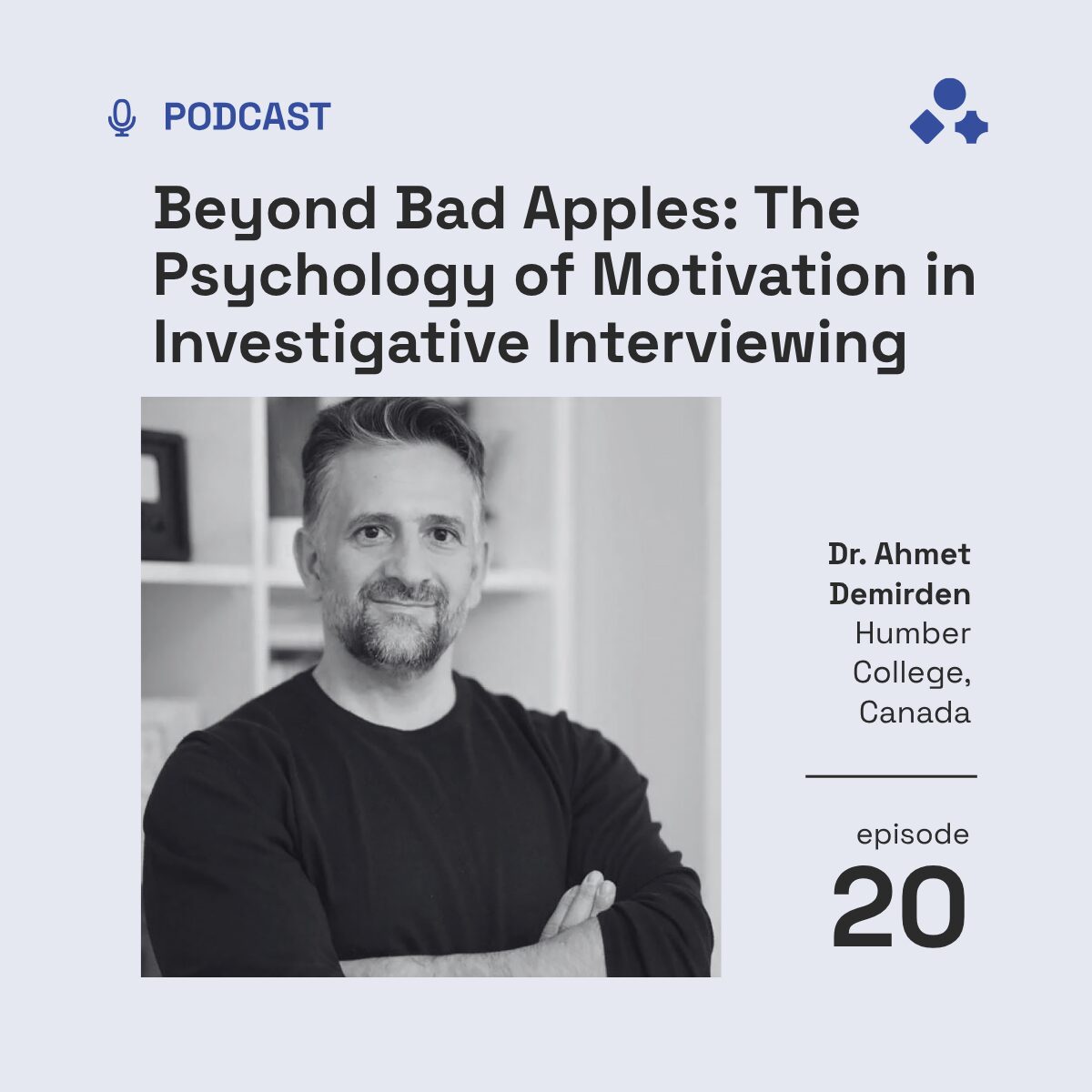
Episode 20. Beyond Bad Apples: The Psychology of Motivation in Investigative Interviewing
Behavioral psychologist Ahmet Demirden reveals why investigative interviewing failures aren’t about bad apples—they’re about motivation, attitudes, and training.
In this episode of Beyond a Reasonable Doubt, host Dr. Ivar Fahsing speaks with Dr. Ahmet Demirden, behavioral psychologist and criminal justice professor at Humber College, about the psychological mechanisms underlying investigative interviewing success and failure. Drawing on his unique background as both former police officer and academic researcher, Dr. Demirden challenges conventional wisdom about why officers sometimes fail to implement evidence-based interviewing practices.
Dr. Ahmet Demirden introduces the concept of regulatory focus theory to investigative interviewing, explaining how officers’ motivational orientations – promotion focus versus prevention focus – fundamentally shape their approach to interviews. Promotion-focused investigators prioritise advancement and accomplishment, often seeking confessions and quick case closure, while prevention-focused investigators emphasise safety, obligation, and admissibility of evidence. Critically, Dr Demirden argues that these tendencies aren’t fixed personality traits but can be primed through organisational culture, training design, and leadership approaches.
The conversation dismantles the “bad apples” narrative that dominates discussions of failures in investigative interviewing. Dr. Ahmet Demirden’s research and training experience across multiple jurisdictions – including Turkey, Canada, and numerous international contexts – demonstrates that officers rarely lack knowledge of proper techniques. Instead, failures stem from attitudes, perceived competency, organisational pressures, and the way effectiveness itself is defined and measured within police organisations.
Key Topics Discussed:
- Regulatory focus theory: promotion focus vs. prevention focus motivation
- Why investigative interviewing failures aren’t about “bad apples”
- The gap between knowledge and implementation in police practice
- Attitudes, competency, and skills: the three pillars of effective training
- Virtual reality applications in investigative interview training
- Cross-cultural comparison: Turkish vs. Canadian legal frameworks
- The legality of deception and false evidence across jurisdictions
- The overlooked role of judges, prosecutors, and defence counsel
- Cognitive biases in judicial decision-making
- Recording technology as both safeguard and data resource
- Operationalising effectiveness: how we define success matters
- False confessions: understanding motivations beyond guilt
- The human aspects of all criminal justice actors
- Building receptivity to evidence-based practices through training design
- Creating psychologically safe practice environments
Equipped For Justice – Supporting ethical, human rights-compliant investigations worldwide
About the guest
Dr. Ahmet Demirden
Dr. Ahmet Demirden is a behavioral psychologist currently investigating the mechanisms of rapport-building during investigative interviews. He completed his Master of Arts in Applied Disability Studies (MADS) at Brock University and earned his PhD in psychology at Ankara Yıldırım Beyazıt University. He has designed and delivered in-service training programs for national and international law enforcement agencies, including the Turkish National Police Service, CEPOL, INTERPOL, and the United Nations.
Dr. Demirden served as a Management Committee Member for COST Action CA2212: Establishing Networks to Implement the Principles on Effective Interviewing for Investigations (IMPLEMENDEZ) until 2025, when he relocated to Canada. He is currently a professor in the Criminal Justice Degree Program at Humber College and a visiting research fellow at The Luke Lab at Brock University. As a former police officer with the Turkish National Police Service for approximately 10 years, Ahmet strongly advocates for integrating behavioural research findings into the development of soft skills in policing. His research interests include investigative interviewing and organisational behaviour management in value-based policing from an operant perspective. Currently, he is exploring the use of virtual reality to enhance the effectiveness of investigative interview training.
Watch and listen wherever you get your podcasts (Youtube link here)
Related products


Transcript
Guest: Ahmet Demirden
Host: Dr Ivar Fahsing
Dr. Ivar Fahsing 00:00
Welcome. I’m delighted to bring you this next episode of Beyond a Reasonable Doubt. It is a great honour for me to have you on the podcast. You and I know each other quite well by now, but perhaps you could introduce yourself — a little about your background, who you are, and what you do, for our listeners.
Ahmet Demirden 00:22
Absolutely. First of all, thank you very much, Ivar, for the invitation. It is an honour for me to be here as well. My name is Ahmet Demirden. I am currently with the Humber College Criminal Justice Degree Programme in Canada. I am a former police officer with Toronto Police Service — I served there for about ten years. My interest in investigative interviewing began as a police officer; I wanted to explore evidence-based practices. I did my master’s at Brock University on the PEACE model versus the Behavioural Analysis Interview in the United States, and then in around 2016 I decided to move into academia. I completed my PhD in psychology, then moved back to Turkey, where I worked for about eight years at the Turkish National Police Academy. That was a tremendous opportunity. I became involved in in-service training for many police services around the world through the International Police Academy, various international organisations, and some judicial organisations as well. So again, thank you very much for the invitation — it is a real pleasure to be here.
Dr. Ivar Fahsing 01:31
Thank you. What an exciting background. And like me, you also combine the practitioner and academic perspectives, which I find genuinely interesting — and which is one of the ideas behind this season. We want to speak with people who also have a foot in the camp of the police or the prosecution service, who can see things from the inside. Because we can all agree that there are many good ideas behind the scientific developments in this field, but theory and practice are not always easy to combine.
Ahmet Demirden 02:06
Yes, absolutely. In some cases it is the legal context; in others it is organisational variation, or personal and interpersonal factors, that can greatly impact the quality and effectiveness of interviewing in any given context.
Dr. Ivar Fahsing 02:22
I suppose so. I think, as in life generally, many circumstances have to come together to get things moving. Could I ask you, Ahmet — what would you say is the ethos of investigative interviewing? What is the value system? How would you define it?
Ahmet Demirden 02:46
I think right now we have a kind of universal understanding of the concept of investigative interviewing. In my experience, I observe that around the world we broadly accept — for example — respect for human rights and dignity, seeking the facts rather than focusing solely on obtaining a confession, and transparency and accountability. These are not only desirable qualities; they are legal requirements, both in inquisitorial and adversarial justice systems, and they are what the public expects. So I think that is very clear.
That said, while human rights, dignity, fact-seeking, transparency, and accountability are broadly agreed upon, there may be some disagreement among practitioners and academics about the relative importance of any one of them. Perhaps we also need to look more closely at practitioners’ motivations in investigative interviewing — and this is my psychologist’s perspective coming through.
In general, we have seen recurring challenges across many jurisdictions. We have the PEACE model, which has been in practice for many years and is supported by a great deal of research on interviewing effectiveness, yet we still face certain vulnerabilities.
I think we need to look more carefully at the motivational dimension. There is a theoretical framework in psychology around regulatory focus motivation: broadly, some people tend toward a promotion focus, while others tend toward a prevention focus. Let me explain how this relates to investigative interviewing. Some investigators may focus on obtaining a confession — not because they have ill intent, but because they define that as the primary objective. That is a promotion focus. Whereas others may be more focused on the admissibility of evidence: ‘I am gathering information, but it must hold up in court.’ That is a prevention focus.
What I have come to conclude is that poor practices in investigative interviewing are not necessarily driven by individual officers with bad intentions. It is not all about bad apples. Promotion focus investigators tend to be motivated by advancement and accomplishment — closing a case, moving quickly. Prevention focus motivation involves more emphasis on safety and obligation: paying closer attention to transparency and accountability. Promotion focus can manifest as risk-taking; prevention focus tends toward vigilance and adherence to rules.
These individual differences are not necessarily case-specific — they reflect how we interact with the world. And importantly, while they are partly a personality trait, they can also be primed. So in my in-service training work, I focus not only on knowledge — which is important — but also on attitudes and competency. Do officers feel competent? Do they believe in the effectiveness of the method? Do they have the skills to implement it? That operationalisation is what matters.
Dr. Ivar Fahsing 08:07
That is a really interesting framing, Ahmet — and I think you are right. There is a ‘why’ dimension. If someone tells me I should stop brushing my teeth with my right hand and start using my left, I would very much want to know why.
Ahmet Demirden 08:25
Absolutely. And as you will know from your experience, police officers are often asked to follow orders that they may not have the opportunity to question — not all the time, but operationally, they have to keep moving. That does not mean their attitudes are unimportant. They are vital.
In my experience — I have now been working in this field for close to twenty years, twelve of those facilitating training — it is very rare that practitioners do not know what they are supposed to do. They know it. But in some cases they may feel, for example, ‘If the person is innocent, why would they lie? I wouldn’t lie.’ Well, perhaps you would not, but people have different motivations for giving false confessions.
And this concern is not limited to any specific geography. Based on my experience across a number of jurisdictions, I would say effective investigative interviewing is important globally — and equally important is how we define the concept of effectiveness.
Dr. Ivar Fahsing 09:51
Absolutely. And of course, what you are saying reminds me that we also have to recognise that we are all goal-driven human beings. Sometimes those goals are obvious — we talked earlier about you playing football with your son this morning; I was out catching lobster with my son. And you could ask: what is the real goal, Ahmet? Is it football, or is it simply doing something meaningful with our families?
Ahmet Demirden 10:20
Absolutely. And when it comes to investigative interviewing, as we have discussed, yes, there are still challenges, but we have come a long way. I remember back in 2006 and 2007, there was no formal training on effective investigative interviewing in North America. There was the Reid Behavioural Analysis Interview — and we know what the evidence base for that looks like.
Motivation drives not only individuals but organisations. For example, in the law enforcement hiring process, many police services use the MMPI as a personality assessment. As a psychologist, I know it is not a valid or reliable measure for that purpose — but a civilian psychologist provides that opinion to the police service, and that shifts the accountability. The challenge is not limited to policing: it extends to risk assessments across the judicial system. We have known since the 1970s that unstructured risk assessments perform little better than chance, yet they continue to be used.
When a suspect is being interviewed, that person is also a member of the public. When you interact with them, you are communicating a message — about how law enforcement operates in your jurisdiction — to their family, friends, and community. The goal compounds. It is not only about the investigation; it is about public relationships as well.
Dr. Ivar Fahsing 12:26
You mentioned that investigators can have either a preventive or a promotional mindset. If we go back to Turkey and your experience there — however far back you want to go — what would you say was the dominant culture amongst police officers or detectives in terms of those two orientations?
Ahmet Demirden 12:54
Well, first, some general context: Turkey has an inquisitorial justice system, which is quite different from North America. In that system, it is the prosecutor who is legally authorised to interview suspects. Police officers also interview suspects or witnesses, but they do so on behalf of and under the guidance of the prosecutor.
Interestingly, within that legal framework, if a person gives a statement without legal counsel present, they have the right to recant that statement in court. That sounds protective, and in principle it is. But I think that practice may have created an environment in which officers feel a shift of responsibility — ‘If they want to recant, they can; their lawyer will sort it out.’ So there appears to be an attitude shift whereby responsibility moves to the legal system.
What I would be very interested in exploring — and I have not looked into the research on this — is: when suspects do recant their statements in court, what is the actual impact on the verdict? Because, as you know, we are all human beings — and so are judges. Once you have heard a confession, even if it is subsequently recanted and formally excluded, you know it and you cannot unknow it.
Dr. Ivar Fahsing 14:49
As they say in England: you can’t unring the bell.
Ahmet Demirden 14:52
Exactly. And this, with all due respect, is a perennial challenge for forensic psychologists working in the criminal justice system — going all the way back to Hugo Münsterberg, the first forensic psychologist to work in the United States. When you try to tell judges that their decision-making is not purely rational, they do not always welcome it. And yet we know, for example, that blood sugar levels — simply whether they are hungry or not — can impact bail decisions. They are human beings.
So this apparent legal protection — the right to recant — may actually backfire on the officer’s vigilance during the investigation. The shift of responsibility to the courts or the legal system can create an attitude of ‘I will take your statement; if you want to recant, that is your right, here is your lawyer.’ Vigilance then becomes someone else’s responsibility.
Overall, based on my anecdotal observation rather than research findings, officers in Turkey appear to be prevention-focused. But how that motivation is translated into behaviour is more complicated, because of that shift of responsibility. That is why it is important to look at individual officers’ tendencies, motivations, skills, and competence — while also recognising that they are operating within a judicial system, and can only influence that system to a certain degree.
Dr. Ivar Fahsing 16:43
Based not on research but on your personal knowledge — have there been cases in Turkey of miscarriages of justice or other scandals linked to police interviewing?
Ahmet Demirden 16:55
Well, as I mentioned, investigative interviewing in Turkey is formally the responsibility of the prosecution office, so it is slightly different from North America. I cannot recall a specific case right now, but I am sure there have been instances of false confessions. The challenge in Turkey is somewhat different from the North American context. In North America, if a statement or confession is voluntary and the suspect has been informed of their rights to counsel, it is generally admissible even without a lawyer present, provided there are no signs of coercion. It can later be found to constitute a false confession.
In Turkey, because suspects have the right to recant without counsel, many statements may not even enter as evidence. So by official records, you may have fewer recorded false confessions — not because they did not occur, but because the statement was withdrawn before it could become evidence. The challenge may therefore be more complicated than a straightforward false confession: a decision-maker who has heard a statement that is later recanted is now influenced by knowledge they are supposed to set aside. Does that make sense?
Dr. Ivar Fahsing 18:49
Exactly. And many countries organise it that way — with the prosecution formally responsible and the police acting on their behalf. But as I said, I think investigative interviewing is also about relationships, isn’t it? It is about how you relate to your own citizens. Regardless of the court outcome, the person who was interviewed will carry an impression of how they were treated. If you think about that relational dimension, what would you say?
Ahmet Demirden 19:41
I think right now policing more broadly is moving towards what we call value-based policing. It is not only about community-based policing — which remains important — but that relationship with the public is becoming a paramount objective, in Turkey, Canada, the United States, and elsewhere. The relational importance of investigative interviewing is increasingly recognised.
However, we also need to look honestly at the realities — for example, caseload. If an officer is carrying 300 pending cases, and I would love for them to start every interview with rapport-building and open-ended questions using PEACE techniques, but they have ten or fifteen minutes — how practical is that?
What I consistently find in my experience is that similar challenges surface whether you are in a Turkish, Canadian, or other jurisdiction. There are individual differences between officers — they are human beings with their own challenges. There is organisational demand, societal demand, and everything happening globally that affects them locally. And we are rightly expecting them to commit to relational, value-based policing.
That takes time. It comes down to survival instinct. First, I want to be safe on duty — physically, psychologically, and legally. Only once that safety is assured can I focus on investigative priorities. And chances are, my supervisors — however much they may speak about the importance of relationships — are ultimately going to measure me on operational objectives such as cases closed.
Right now I am working with a local police service in Canada on a three-year project evaluating the effectiveness of their training. The preliminary findings suggest the training itself is current, the instructors are competent, and officers demonstrate improved knowledge, skills, and competence after training. But what appears to be missing is what we call the required drivers on the job: the systems that monitor, reinforce, and reward good practice.
Research suggests that training accounts for only around fifteen per cent of performance on the job. The remaining eighty-five per cent comes from those required drivers. So relational or value-based policing — anywhere in the world — requires not just training, but those drivers. We also need to be realistic about what we are asking of officers. Every year, officers are carrying more tools and equipment on their vests — body-worn cameras, additional use-of-force options. It gets heavier and heavier. We need to be cognisant of that as well.
Dr. Ivar Fahsing 23:58
I think you are right. And there is another aspect to this when we talk about the ethos of investigative interviewing — one that links closely to your opening point about promotional versus preventional mindsets. From a professional standpoint, there is also a process quality focus, is there not? Do you agree?
Ahmet Demirden 24:27
Absolutely. I want to be clear that regulatory focus theory — I should credit Higgins for that — is a substantial area of social psychology and we cannot do it justice in a few minutes. But yes, the prevention focus is more about vigilance, which comes with procedural attention. It is not ‘I want to get a confession’ but ‘I want to get the information, I want to get to the facts — and I need to do it correctly, without making mistakes.’ The promotion focus, by contrast, is more about trying different approaches in pursuit of a goal: ‘That didn’t work, let me try another way.’
To use an analogy: if you are a vigilant person holding a hammer, you will be careful, deliberate — focused on not hitting your hand. If you have a promotion focus, you will hit the nail several times, adjusting as you go, unconcerned about the process as long as you achieve the result.
I think it is something worth exploring in relation to investigative interviewing practice. More broadly, though, at the conceptual level, I feel there is now reasonable consistency and agreement on the ethics of investigative interviewing and the importance of rapport-building. That is broadly understood. The question now is: how do we translate that into a skill, and how do we change attitudes? Some people believe communication is an innate ability — you are either a good talker or you are not. But we know there is a skills dimension. Interviewing can be improved, just as you can improve your running even if you will never be the fastest in the world.
For police officers, testimony in court is a genuinely challenging process — even for expert witnesses. Officers tend to have a prevention focus around avoiding difficulties or errors in the future. Where I think we are now in the investigative interviewing field is that we need to focus more on attitude change, and on competency and confidence, at the individual level. And at the organisational level, we need those required drivers — borrowing from the Kirkpatrick model of training evaluation — to observe, monitor, support, reinforce, and reward good practices.
What I find in many police organisations is that, for various reasons — cost, prioritisation, practicality — there are no operational required drivers for interviewing performance. Training is given, and then officers go into the field. If there is an error, it will surface in court. I think we should go beyond that, and build required drivers not only for successful prosecutions and fact-seeking, but also because it is fundamental to relationship-building with the community.
Dr. Ivar Fahsing 28:15
Absolutely. Your analogy around required drivers made me think of driving and shooting — activities where it is relatively easy to measure whether you are doing it correctly. If you keep the vehicle on the road and return safely, you probably did well. If you hit the target, you did well. And what I reflected on is that perhaps we also need a clearer definition of what ‘good’ looks like in investigative interviewing — so we can more readily say: ‘Officer A, this is why you performed well. Officer B, you need additional development in these areas.’ If we had the right organisational culture, as is obvious in driving and firearms, we simply would not allow an officer to conduct interviews without meeting that standard.
Ahmet Demirden 29:27
Absolutely. I am glad you raised organisational culture, because it is important. We have seen cultural shifts before — in mental health, for example. It used to be: you are an officer, you need to be tough, do not complain, keep going. Now we are in a position where officers also need support; they are human beings too. That shift happened.
In investigative interviewing, because the results and the feedback are not immediate — a case may not be dismissed for months or years — there is less of that reinforcing loop. When I was a police officer, back around 2006, I hoped someone would review my recordings and give me feedback. No one did. I had to ask for it. That is what I mean by required drivers. If I make an error in an investigative interview, it may surface in court, the case may be dismissed — and my organisation may never even hear about it.
Let me give you an example. A local police service in the Greater Toronto Area, around 2010 I believe, interrogated a witness — not a suspect — in a homicide investigation, pressuring her to implicate her boyfriend. It was all recorded, audio and video. The witness repeatedly said she had not seen anything, but the officers told her she was a single mother and would be charged with obstruction of justice. It was on the record. The case was dismissed in court, it became public — and then, as far as the public knew, that was the end of it. No follow-up.
If that had been a vehicle collision or an unlawful use of force, the feedback would have been immediate and the consequences clear. With investigative interviewing, we still have a long way to go in demonstrating its importance at the organisational level, so that culture can shift toward evidence-based practice.
Dr. Ivar Fahsing 32:39
I was thinking — because we talked about cars and firearms, which are technical — you get clear feedback immediately if something goes wrong. Could technology in investigative interviewing help us move toward better feedback mechanisms?
Ahmet Demirden 33:02
Absolutely, yes. This is actually another project I am working on with Dr. Nicole Luke at Brock University. I think we now have the technology to use as a tool, at least in the training phase and subsequently for follow-up — whether that is VR simulation or AI-based feedback agents.
As I said earlier, perhaps officers’ interviews could be reviewed by senior officers who provide feedback. But we also need to be realistic: officers may not have the time or luxury for that. And there are legal considerations that would need to be addressed. AI can facilitate this. AI agents could certainly support that process — but first we need the motivation to invest in it. I think it is coming.
Hard skills, technical skills, are easier to observe and measure. Soft skills are more difficult. Verbal behaviour is relatively amenable to observation, measurement, evaluation, and feedback. But when you get into paralinguistic cues, micro-expressions, subtle signs of aggression in language — those are much harder to capture and assess. That is partly why some people think communication is an ability rather than a skill. Investigative interviewing is a skill. It can be improved.
Dr. Ivar Fahsing 34:48
I share that optimism about the role of technology. Think about weapons training — we use simulators today precisely because you cannot responsibly send people out without first establishing whether they can handle not only the technical aspects but the situational ones. Perhaps our community could move toward simulators that can assess whether someone is a safe interviewer.
Ahmet Demirden 35:21
Absolutely. Following research developments around the world, it is interesting — when you meet with international researchers or practitioners, you observe the same concerns and the same principles. I visited Oslo in 2021 or 2022 for a workshop on investigative interviewing, and it was remarkable: without any formal collaboration, by the third day, participants were saying, ‘You are not from our team, but you are talking about exactly the same things.’ Because the research findings point in the same direction. The same ethos, the same principles, emerging from different starting points.
That is encouraging. And technology people are working on this too. It will come, and it will greatly facilitate the implementation of effective interviewing techniques. On a side note — because I use the word ‘effective’ — operationalisation of these concepts matters enormously. What is effective interviewing? For some, it means obtaining a confession. For others, it means the number of cases closed. We need to work on defining that clearly, and then consider how technology can reinforce the right concept.
Dr. Ivar Fahsing 36:53
I definitely think so. May I ask you — going back to the Turkish context — how widespread do you think audio-visual recording of interviews is in Turkey today? Is it routine or less common?
Ahmet Demirden 37:08
I am not entirely sure. There is a gap in the research, and I am looking into that. But I think there is variation. Recording tends to occur in the form of a written statement, which the suspect or person of interest and their legal counsel then review before signing or declining to sign.
Recording statements is obviously vital. But some of the challenges I described go beyond whether statements are recorded. Because these statements — whether audio, video, or written — can be recanted in court on first appearance and may not enter as evidence at all. So they may not appear in any statistics on miscarriages of justice or false conviction, because they were never entered as evidence. But how they influence the decision-maker is worth exploring.
Dr. Ivar Fahsing 38:09
I was thinking about it more as a data resource for learning. If we want to develop the kind of technology that could create a simulation environment — the more real interview data we have from recordings across different jurisdictions, cultures, and situations — the better we can understand what interview behaviours lead to good outcomes and what behaviours do not. That is why I wanted to know whether they are actually recording interviews. Because that would be the most valuable data source.
Ahmet Demirden 38:52
Investigative interviewing is communication, so local variation will always exist. I am not sure there is a universal set of verbal or paralinguistic cues that would translate perfectly across jurisdictions — but I think they can all be operationalised at a local level.
Take interrogation terminology, for example. In the Canadian context, technically it is ‘investigative interviewing,’ not interrogation. But when the objective is obtaining a confession, whatever you call it, it effectively becomes an interrogation. In the Turkish context, technically only a court judge can interrogate a suspect — prosecutors and law enforcement technically do not interrogate. And yet when you listen to recordings, you can often detect that the objective is a confession, and that false evidence is being introduced. So each jurisdiction has its strengths and weaknesses.
Introduction of false evidence is legal in Canada and illegal in Turkey, for instance. We can perhaps develop a universal set of principles, but we are always working within specific legal frameworks. And law enforcement and prosecutors function as agents of the courts. Some of the challenges therefore involve the judicial system itself.
I try to be careful here, because forensic psychologists have historically had difficult experiences when challenging courts and their outcomes. Judges everywhere are professionals, and objective triers of fact — in principle. But with investigative interviewing practices, we should also be exploring the human dimensions of judicial decision-making. We have come a long way in recognising the human aspects of law enforcement officers. Judges are also human. They have cognitive biases — and as I mentioned, something as basic as blood sugar levels can influence decisions. That needs to be explored too.
In both Canada and Turkey, my experience is that police officers tend to be more receptive to training and to academic input than judicial authorities. And in Turkey, I think lawyers also need training in investigative interviewing — because you are representing your client in an interview, and that requires understanding the process, not just knowing the law. Similarly for judges: if the assumption is that the right to recant is sufficient protection, is it? We need to look into that. If it is not, we need to find ways to improve it.
Dr. Ivar Fahsing 42:26
Time has flown, Ahmet. I have to say, this has been a real eye-opener for me. You have brought in some new perspectives that have given me a great deal to think about. I hope our listeners have found it equally interesting.
Ahmet Demirden 42:39
It is always a pleasure talking with you, Ivar.
Dr. Ivar Fahsing 42:41
Fantastic. And I should say it has been a unique opportunity to hear your perspectives from Canada, and to gain some insight into the situation in Turkey and the comparison between the two. Thank you very much, Ahmet.
Ahmet Demirden 43:02
The pleasure is mine. Thank you very much for the podcast and for having me. It has been a real pleasure.
END OF TRANSCRIPT
© 2026 Davidhorn. All rights reserved.