


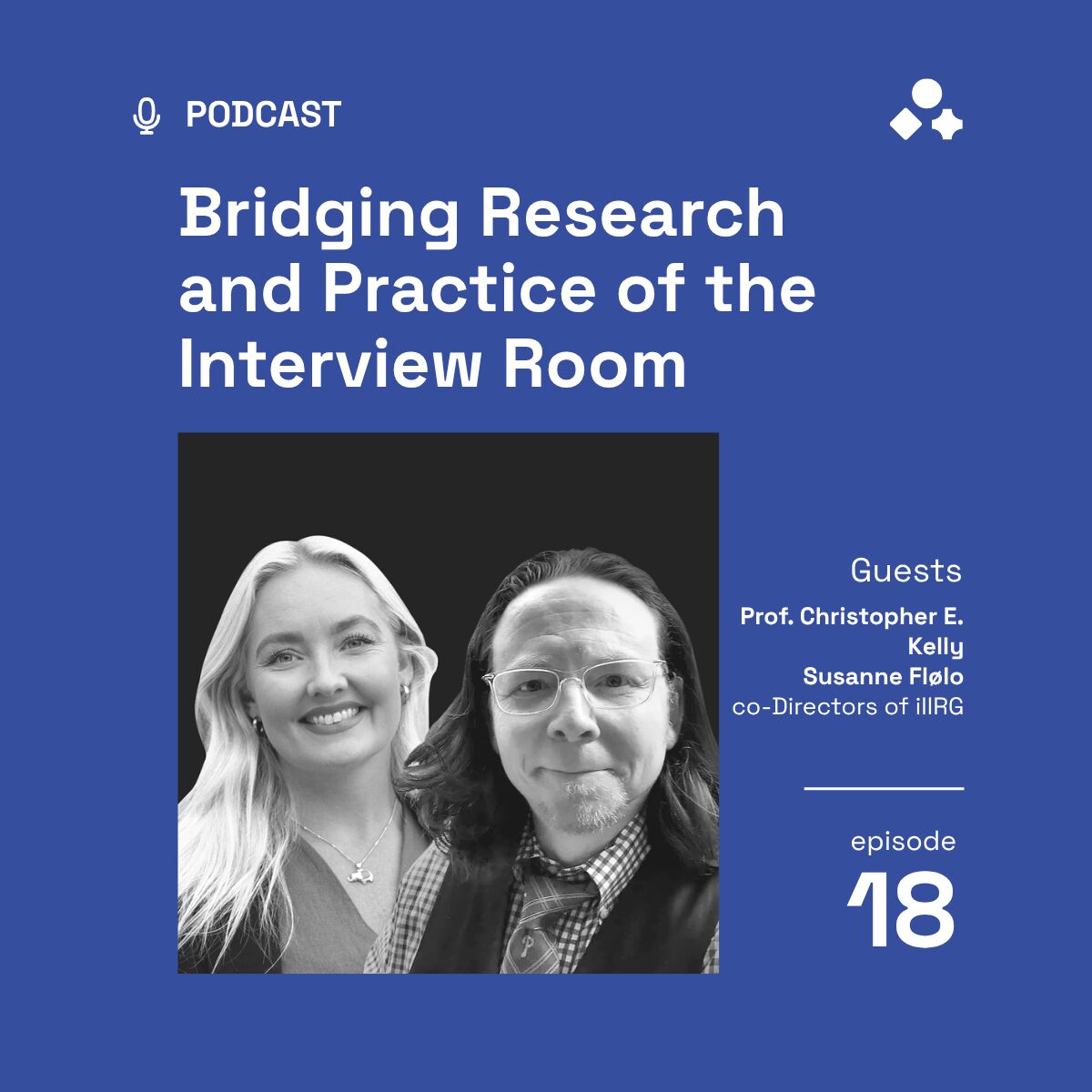
Episode 18. Bridging Research and Practice of the Interview Room
Every major interviewing framework – PEACE, KREATIV, ORBIT – distils to the same essentials: stay nice, ask good questions, and listen.
So why does confession-driven culture remain so deeply embedded, even in systems that have formally adopted investigative interviewing?
In this episode of Beyond a Reasonable Doubt, host Børge Hansen speaks with two leading members of iIIRG – the International Investigative Interviewing Research Group – about what actually makes reform stick, and what keeps pulling it back.
In this conversation, they cover:
- Why confession culture persists — the incentive structures across police, prosecutors and courts that sustain it, and why outcome-based thinking crowds out accuracy
- The first safeguard to fail under pressure — why the opening minutes of an interview determine everything that follows, and what 'sinking to your level of training’ really means in practice
- The accountability deficit — what supervisors miss when they only read written summaries, and why the entire justice system is making high-stakes decisions without seeing what actually happened in the room
- Recording as a catalyst, not a luxury — how mandatory recording drove professional development in Norway, and why a technically excellent recording still needs independent expert analysis to be credible in court
- AI in investigative interviewing — the risk of a new shortcut, shadow use of unapproved tools, and what responsible adoption actually requires
- The global shift — from the Mendez Principles and the UN Manual to wartime implementation in Ukraine, how investigative interviewing has moved from niche reform to global professional standard
- What a police chief can do on Monday morning — with no budget, no mandate, and no certainty — to start moving practice in the right direction
Episode length: approximately 65 minutes
Host: Børge Hansen, CEO, Davidhorn
Production: Davidhorn – Beyond a Reasonable Doubt Podcast
Equipped For Justice – Supporting ethical, human rights-compliant investigations worldwide
About the guests
Prof. Christopher E. Kelly
Prof. Christopher E. Kelly is a professor of criminal justice with a research focus on what improves information quality in investigative interviews. He has partnered with law enforcement agencies in the United States and internationally for over a decade. Professor of Criminal Justice, Saint Joseph’s University, USA.
Susanne H. Flølo
Susanne Flølo is a human rights specialist and investigative interviewing practitioner. She has contributed to the UN Manual for Investigative Interviewing and the UNODC e-learning programme, and works at the Norwegian Centre for Human Rights (NCHR) and the Norwegian Mendez Centre.
Watch and listen wherever you get your podcasts (Youtube link here)
Related products


Transcript
Guests: Susanne Flølo & Prof. Christopher E. Kelly
Host: Børge Hansen
Recorded: 20 February 2026
Børge Hansen (Host)
In a healthy democracy, the rule of law is only as strong as its most hidden moments. We talk about justice in public — in courtrooms and policy debates — but the real test happens when the door is closed. In that room, the tension is not just about solving a crime. It is about whether a system can stay objective under pressure. Can we move past confession-driven practices and treat interviewing as a forensic craft built for reliable facts? 00:00
I am Børge Hansen and this is Beyond a Reasonable Doubt.
In this series, we look at the mechanics of justice — from how interviews are conducted to how evidence holds up under scrutiny. Today is about the gap between what we know works and what actually happens under pressure: practice, supervision, and the minimum safeguards that any justice system should demand.
Today I am joined by Susanne Flølo and Christopher E. Kelly. Both are active in the International Investigative Interviewing Research Group, iIIRG. They work to move evidence-based interviewing from research into day-to-day practice — where supervision, habits and culture decide what sticks.
Susanne, you work in human rights and investigative interviewing standards. You have contributed to the UN Manual for Investigative Interviewing and the UNODC e-learning programme for investigative interviewing. Chris, you are a professor focusing on criminal justice, with a particular focus on what actually improves information quality in interviews.
Susanne and Chris, thanks for joining us today. For listeners who have not come across iIIRG before — if you had to explain to a busy investigator in one sentence what iIIRG exists to change, and just as importantly, what iIIRG is deliberately not trying to be?
Christopher E. Kelly (Guest)
I can start with this. In one sentence, iIIRG was created to fill the space that exists between academic research and real-world practice. The explicit mission is to bring these two groups together — groups that have historically not always understood one another. When iIIRG was founded, in 2007 or 2008, it was with the explicit intention of bridging that gap between research and practice. 01:47
Susanne Flølo (Guest)
And I agree. First of all, thank you so much for having me — it is a great pleasure. I have listened to every episode of this podcast, so it is a real honour to have been invited. For me, the mission and purpose of iIIRG is very simple: we connect science to practice. We try to make sure that people who conduct interviews — whether they are police, military, immigration, or oversight bodies — actually have access to what works. And we try to help our members, whether practitioners, researchers, or other professionals, to uphold the highest possible professional standard in their work. 02:20
Børge Hansen (Host)
So what is your personal litmus test for an investigator who is operationally ready? One or two indicators. 03:05
Susanne Flølo (Guest)
A lot of people, I think, still treat interviewing as an art or an instinct. But to me, the litmus test of a good investigator is not the confession — however much Hollywood might lead us to believe otherwise. Rather, it is whether you are able to create the conditions for accurate, complete and reliable information to emerge. Interviewing is a disciplined forensic craft. It has methodology and structure, it is based on science, and it has profound consequences for justice, public trust, and even state stability. 03:10
In every country we work in — whether Ukraine, Thailand, Brazil, Indonesia, or others — we meet investigators who intuitively understand the value of rapport-based interviewing long before they have even heard the term 'investigative interviewing’. And many of them have discovered the hard way that confrontational, confession-driven methods simply do not get them the information they need. So, again, we are simply trying to bridge the gap between research and practice.
Christopher E. Kelly (Guest)
And I would add: in terms of a litmus test, one of the most important qualities I have found is a level of curiosity — not just about an investigation, but about the world. An openness to different possibilities and a willingness to think beyond what is immediately in front of you. The best interviewers I have encountered over the years have been the ones who can think outside the box. 04:13
That is related to something Susanne just said about art versus science. You hear it a lot from practitioners: this is more art than science. As a committed scientist, I have to object to that. I have come to believe that nobody particularly wants to be thought of as a scientist — white lab coat, elbow patches. That is not very fun. Artists and creative thinkers are fun, imaginative, able to break out of everyday norms. But I do believe there is a science to that kind of thinking, and we can teach it.
Børge Hansen (Host)
Frameworks like PEACE, KREATIV, and ORBIT are well known. But if you strip things down for investigators working under pressure, what is the smallest set of behaviours that protect reliability? 05:31
Christopher E. Kelly (Guest)
In addition to keeping an open mind and remaining flexible, I think the couple of essential qualities that all the models boil down to are: stay nice, ask good questions, and listen. Actually hear what people are saying, and allow them to speak. Because the opposite — being confrontational, asking closed questions, interrupting, doing more talking than the interviewee — that is not actually an interview. All the models come down to a rapport-building mentality that asks good questions and then lets the person speak. 05:56
Susanne Flølo (Guest)
Paired with curiosity and good analytic skills. But yes, I absolutely agree with Chris. 06:47
Børge Hansen (Host)
Good. So let us move to where the pressure really begins. Rules and frameworks are easy when things are quiet. But officers are on the clock and expected to produce results. When that pressure hits, you find out what the system really values. Why is confession-driven culture still so strong among investigators across the world? 06:48
Susanne Flølo (Guest)
Confession culture is, as you say, incredibly persistent. It is fast — or at least it is portrayed as fast. It is traditional. It is what supervisors often expect, and it is emotionally compelling. People feel as though they have cracked the case when someone admits guilt. The problem is that it is a terrible accuracy indicator. 07:39
Confession-driven practices increase the risk of tunnel vision. They reinforce cognitive biases, and we know they lead to errors of justice and wrongful convictions. They also fundamentally clash with the presumption of innocence and the real purpose of the interview, which is to gather information — not to extract agreement. Another reason confession culture persists is systemic. Many police organisations cite lack of funding, time, or leadership focus. Those explanations tend to be the same everywhere. But underneath them, I think there is something far more basic: you cannot fix a problem you have not acknowledged exists. No country is immune to errors of justice, but you will not see them unless you are willing to believe they can actually happen in your system.
Human fallibilities also play a huge role — misunderstandings about suggestibility, confirmation bias, primacy effects, false memories. Acknowledging these fallibilities helps explain why interviews need to be conducted in a structured, research-based way that actively mitigates these risks.
Børge Hansen (Host)
Chris, if the science backs what Susanne is describing, why is there still resistance? 09:12
Christopher E. Kelly (Guest)
Because none of us like change — and I will not just throw the police under the bus here. University professors are the same. Going from a confession orientation to one of information gathering is a fairly large shift in both mindset and practice. 09:28
Speaking as an American: in my city of Philadelphia, a city of around one and a half million people, there were 250 murders in 2025 — down from 500 during the pandemic. The police are dealing with a significant backlog of cases. And in the American legal context, confession is king. When you get a confession, it is over. The detective can move on to the next case and hand it to the prosecutor, who knows that, barring some unusual issue, 97% of convictions in this country — a number similar globally — come through guilty pleas. When a defendant sees a confession in the file, that is a very powerful piece of evidence pushing them towards a guilty plea. So confessions are good for the police, and good for the prosecution, because they keep things moving.
Børge Hansen (Host)
Concrete results. 11:35
Christopher E. Kelly (Guest)
Exactly. It is outcome-based and short-term thinking. Here is a crime; I will solve it. And regardless of the veracity of the confession, it is treated as truth — because there is still a widespread misunderstanding of why people say they did things they actually did not do. The entire system is incentivised to get a confession. And accusatorial-style interrogations are very effective at producing them. So effective, in fact, that they get innocent people to confess. That is obviously where the problem lies. The incentive structure has to change. Prosecutors and investigators need to scrutinise confessions more closely and verify everything in them. But until police leaders, prosecutors, and lawmakers understand that a confession can be unreliable — and that even a genuine confession from a guilty person may not be the end of the information-gathering process — the culture will not shift. 11:37
Børge Hansen (Host)
Susanne, when standards come under strain — even in countries where investigative interviewing is the established standard — what is the first safeguard that slips in real life? 13:13
Susanne Flølo (Guest)
Empathy and rapport. We forget about their importance the moment pressure rises, and so the opening — and the planning that precedes it — becomes absolutely crucial. Everything that follows rests on what happens there. The opening determines rapport, determines cooperation, and determines whether the interviewer manages to stay open-minded. If you get that opening wrong, if you set a confrontational tone, you will probably never recover. 13:41
We also see the same linguistic red flags everywhere in the world: leading questions; repeating a question until the person changes their answer or rapport breaks down entirely; narrative summaries that omit or distort key details; language that signals the interviewer has already decided what happened. These issues are universal, and they matter — because interviewing is not just about what the interviewer hears, it is about what the interviewer elicits. Small language choices can fundamentally shape the quality and reliability of the information obtained.
That is why we insist on structure, planning, and an evidence-driven approach paired with audio and video recording. Because, as my colleague Dr. Ivar Fahsing likes to say: when the stakes are high, you do not rise to the occasion — you sink to your level of training. Which is why having a solid methodology in place is so incredibly important. And that goes not only for the police, but for the entire justice system.
Børge Hansen (Host)
Chris, where do you see the consequences of a confession-driven or 'get answers fast’ culture playing out? 15:31
Christopher E. Kelly (Guest)
In a confession culture, there are very few safeguards further down the line. The incentives for prosecutors are to keep cases moving, secure guilty pleas, and get on to the next file. Judges and juries — in the rare instance a case reaches that point — often lack any real understanding of good interviewing practices or what constitutes reliable information. And my big concern relates to recording. 15:44
Everyone who talks about reform immediately recommends recording — and rightly so. But I like to push back a little, not because I disagree that recordings should be made, but because recording alone is not enough. It needs to come with independent evaluation. If you put a false confession in front of a jury — with multiple camera angles, crystal-clear audio — that recording looks compelling. Without someone contextualising and analysing what was actually said and how, all you have is everyone’s biases looking at a technically excellent recording of a false confession.
I live in Pennsylvania, where confession expert witnesses are actually prohibited from testifying in court. There is a push here to record all interviews — but without that expert context, it could actually be worse than having a detective read a confession statement into the record. At least then a defence attorney can cross-examine the detective and find weaknesses. A recording is very hard to cross-examine. So the safeguards have to run all the way through the system — educating not just lay jurors, but prosecutors and judges as well.
Børge Hansen (Host)
You said that under pressure we sink to our level of training. If you rush the opening, what happens to the quality of everything that follows? 18:25
Susanne Flølo (Guest)
You risk failing to build rapport, which means you are far less likely to obtain accurate and complete information than if you had laid a good foundation from the outset. And if you start on the wrong foot, it is extremely difficult to recover. In those cases where rapport breaks down from the very beginning, it is time to bring in a different interviewer and try again — but that is not the ideal outcome. The best approach is to get it right once, do it well, and ensure proper planning for that opening. 18:45
Christopher E. Kelly (Guest)
And I would add: the first thing to go under high pressure is patience. It is related to planning and taking the time for an appropriate introduction — building a working relationship, not a friendship, but an understanding between two people on opposite sides of an issue about what each other needs. When patience goes, the other person’s needs go with it. And as Susanne says, once rapport is not there from the start, it is very hard to establish at all. 19:57
Børge Hansen (Host)
I have attended ORBIT training myself. It uses live actors with full backstories and cases running over several days — genuinely immersive. One thing that struck me watching was how even trained officers struggled with two very different challenging interviewees: one deeply traumatised and withdrawn; the other traumatised but dominant and acting out. How does the science actually find its way into practice in situations like those? These are police officers, not trained psychologists. 20:57
Christopher E. Kelly (Guest)
The science is still evolving on this. For the kinds of interviewees you describe — someone experiencing acute trauma during an interview, or someone who carries more general trauma — there is some research, but it is not nearly as mature as other areas. And I understand why practitioners find that frustrating. 22:06
My response is always: we do not have all the answers yet. What we can do is base practice on the best available research at any given time. ORBIT is a good example — it has evolved since its inception and will continue to do so, because the team behind it is always working to understand the model better and update it. In two, five, or ten years, all of these models should look quite different.
And sometimes — and this is a genuinely unsatisfying answer for practitioners — sometimes you are simply not going to have a successful interview. In many ways, ending an interview without the outcome you wanted is preferable to reverting to coercive or aggressive tactics, which is what can happen when someone is frustrated and not getting what they need. It may be better to pause, regroup, and try again with a different interviewer. But that takes resources, patience, and leadership. Every investigator has supervisors who should be providing oversight and ensuring principles are being upheld. That breaks down too often. But to reiterate: the science is evolving, and models like ORBIT are continuously bringing new findings into practice — which is exactly what the scientific process should look like.
Børge Hansen (Host)
Susanne, you travel the world observing people being trained. Are people getting impatient, reverting to old tactics — or are they able, as Chris described, to accept a difficult interview rather than conduct the wrong type of interview? 25:59
Susanne Flølo (Guest)
It depends. But what we most commonly see is that people go into the interview room without a clear plan — for rapport building, for the opening, for how to handle the evidence. It is a stressful situation. Even in training settings, people become incredibly stressed because they are being observed by colleagues, peers, and sometimes superiors. 26:16
And we also need to build a genuine feedback culture. What we typically hear from supervisors after an interview is: 'That went great. No notes.’ But we know that no interview is ever perfect or without areas for improvement. People need to hear — and be comfortable receiving — feedback like: 'You were about to lose rapport here because you were pushing too hard’ or 'We haven’t properly explored that line yet.’ And not just feedback focused on the information obtained, but on the process itself: what did I do, what did I miss, how could I improve? That culture of constructive, process-focused reflection is often absent.
Lawrence and Emily Alison’s work through ORBIT is incredibly valuable in this regard, because building rapport is genuinely difficult to teach. And of course, as Chris mentioned, it is also true that no matter how much training someone receives, some people will never be strong interviewers. That is an unfortunate reality. But we know that certain personal qualities — curiosity, patience, flexibility, and the ability to genuinely express empathy — are fundamental. Becky Milne has called it the X factor: who has it and who does not.
Christopher E. Kelly (Guest)
Can I offer a quick anecdote on training design? I was part of a team developing and piloting a training programme — I will not mention the agency or any names. We put into the role-play scenario an interviewee who was not traumatised, not belligerent, not resistant. Our role player was overly cooperative. Everything they said was false, but they were enthusiastic, open, and willing. Come in, I am happy to talk, anything you need. 28:58
Over two deliveries of this training, with perhaps six or eight teams rotating through, very few of them knew how to handle it. These were experienced investigators, some of whom had been through science-based training, and they did not know what to do with someone being apparently cooperative. Several reverted to unproductive practices out of frustration and unmet expectations. It was a brilliant demonstration of confirmation bias — they expected resistance, and when it was not there, they were lost. I would encourage anyone designing role-play exercises to include that kind of interviewee.
Børge Hansen (Host)
Not putting up a fight, but being overly cooperative. 31:02
Susanne Flølo (Guest)
I believe that is what the Alisons would refer to as a 'bad monkey’ in the ORBIT model. 31:06
Christopher E. Kelly (Guest)
Yes, exactly. 31:10
Børge Hansen (Host)
Another blind spot: what leaders can actually see and manage. We talk a lot about the interviewer, but much less about leadership. If a supervisor only reads a written summary, what do they miss — and what gets lost when they do not see the interaction itself? 31:11
Susanne Flølo (Guest)
What you are pointing at, Børge, is one of the biggest global challenges: the accountability deficit. Leadership rarely sees the interview itself — they see the summary. And summaries hide a great deal: tone, pressure, leading language, body language, missed opportunities, and in some cases even coercion. Summaries also tend to overstate certainty, presenting a clean narrative where the actual interview may have been very messy. And the courts often also see only the summary. The entire justice system is making high-stakes decisions without ever seeing what actually happened in that interview room. 31:46
This is why improving interviewing is never just about training frontline officers. At NCHR, we have seen repeatedly that unless you also train supervisors, managers and leadership, and unless you build systems around them, reforms do not stick. You get a good training workshop, people are enthusiastic for a few months, and then the system pulls everyone back into old habits — because the supervision, the metrics, and the accountability structures have not changed.
And this brings in something that is often overlooked: evaluation. How can you evaluate the quality of an interview if you cannot revisit it in its most complete form? How do you learn from it? How do you train others from it? Without recordings, all of this becomes extremely difficult. When senior leaders champion transparency, recording and professionalisation, everything changes. When they do not, nothing changes. You simply cannot build a culture of high-quality interviewing without leadership creating the conditions for accountability, learning and long-term reform.
Børge Hansen (Host)
If you had to choose — what makes the science stick? Better training upfront, or day-to-day supervision? 33:56
Susanne Flølo (Guest)
It is both. But it also requires a fundamental understanding of the why. Why are we doing this? Why does it need to be done this way? If you believe your system is perfect, you will not change it. You need to be critical of your own structures and actively look for errors — because you will not find them unless you believe they can exist. 34:03
Børge Hansen (Host)
Chris, are there simple metrics that leaders could use? 34:39
Christopher E. Kelly (Guest)
The leaders I have encountered who embrace this movement are the ones who think of their organisations as learning organisations — not static, not 'good enough’, but searching for something better. And in investigative interviewing, we have the tools for that. But one leader does not make a social movement. 34:47
For every forward-thinking leader with the power to implement reform, there are probably several more who are resistant — because they moved up through a system without that kind of reform and succeeded within it. Why would they want to change something that worked for them?
Change therefore has to be both top-down and bottom-up. People doing the interviewing are not going to reform themselves. There has to be some directive from the top: we are going to do it this way. But it has to be reinforced, because leaders rotate, promote, retire. Someone new comes in and you may have to start again.
What this means in practice is that we also have to reach people who are new in their careers — get them to see the value of science-based interviewing before they pick up bad habits. As they promote up, they become the supervisors giving constructive feedback. But that takes 20 years. I will always credit former LAPD detective Mark Severino, who had some success in his agency getting investigative interviewing training to brand new recruits — not waiting until someone reaches investigations rank, but starting at the patrol level, where officers are already conducting interviews and speaking to people every day.
Børge Hansen (Host)
When poor practices do show up, what does a healthy organisation’s response look like? 39:00
Christopher E. Kelly (Guest)
I have learned a great deal from a dear friend and colleague, Mike McCleary, formerly Assistant Sheriff in charge of investigations at the Las Vegas Metropolitan Police Department — a very senior position. The lesson I have internalised most from working with him is this: you cannot tell police — or academics, for that matter — what they did wrong without also telling them how to do better. 39:06
Whether it is a one-to-one debrief on a specific interview or a five-day training course, going in to tell a police officer who takes pride in their work that what they have been doing is bad or wrong is going to make them shut down. The approach has to be: we can do better, and here is how. It is not about what not to do — you cannot change the past. It is about improving in the future. Try this next time. Think about how an interviewee might respond when you get frustrated or impatient, and what effect that has on rapport and on the information you will obtain going forward.
Børge Hansen (Host)
Let us talk about recording — not as technology, but on the trust side. What makes a recording credible? And what can quietly undermine it? 41:01
Susanne Flølo (Guest)
People tend to think of recording as a technical add-on or a luxury, but in our view it is neither. It is the engine that drives professionalism — and it can actually accelerate reform. Norway is a clear example. When video recording became mandatory, many officers were initially hesitant because they did not feel fully confident in their skills. But that transparency pushed the whole system to invest in training, structure and preparation. Recording did not follow the reform. It was instrumental to the reform. It was the catalyst that moved interviewing from a private, unobservable practice to a shared professional discipline that everyone could learn from. 41:25
Recording interviews improves accountability almost immediately. It strengthens evidence, promotes fairness, and protects the interviewee, the information obtained, and the interviewer themselves. Even a poor interview: the full recording is protection. It also creates a feedback loop for training — you can revisit your own interviews, or see how colleagues approach difficult moments. When you can do that, the quality of practice rises quickly. It becomes a craft, not improvisation. If a justice system tells us it has limited resources, we typically point them towards recording as an obvious starting point.
Børge Hansen (Host)
Is hesitancy around recording still a barrier? People record themselves constantly on their phones these days. 42:56
Susanne Flølo (Guest)
Unfortunately, recording interviews is a different matter entirely. The evidential integrity problem is real — a snippet recorded on a personal mobile phone gives no assurance of completeness. Was it started just as the suspect decided to confess? We cannot know. You need proper systems in place. The evidential record has to be preserved and protected, and that requires institutional infrastructure, not personal devices. 43:17
Christopher E. Kelly (Guest)
I would add that recording is also good for research. The unit I have worked most closely with over the past decade is a gang investigations unit based within the Clark County Detention Center in Las Vegas. They had been recording their interviews long before they encountered any science-based training. We took a random sample of 50 recordings, analysed them, and fed the findings back into their practice. That process built trust, because they realised we were not there to harm them — we were there to help. 43:54
One example: they kept interrupting their interviewees. The question would be asked, the interviewee would start speaking, and the investigator would talk over them. If they took one message from our feedback, it was simply: let them talk. We then continued working with them over subsequent years, including pre-post evaluation studies. Their practice improved demonstrably over time, the more they were exposed to this approach. Recording provides the data that makes that kind of outside analysis possible.
Børge Hansen (Host)
You mentioned earlier that a technically brilliant recording can actually camouflage a bad interview or a forced confession. 47:22
Christopher E. Kelly (Guest)
Yes. And that is a real limitation in the type of research I do. When a partner agency gives me recordings or transcripts, I generally cannot verify whether the police account is accurate or whether the interviewee’s account is truthful — I have to work with what I am given and acknowledge that limitation. It gets contextualised and triangulated with other research methodologies: surveys, research interviews, focus groups, experimental laboratory studies. When you take the totality of findings across all these methods, you can have reasonable confidence in the reliability of what you are seeing. But no single recording tells the whole story. 47:32
Børge Hansen (Host)
It is 2026, so we should talk about AI. Earlier in this series we spoke with representatives from the Norwegian police who are working on the FAIR project — AI for interviews. What are your thoughts about AI assistance during interviews? 48:48
Susanne Flølo (Guest)
I am not sure iIIRG has taken a formal organisational stance yet, but promoting the responsible use of technology is a clear priority for us. Personally, I am hearing a great many stories about officers already using the tools that are publicly available — and I think we are running a huge risk if we do not get the police properly engaged with AI development. The risk is that people will use these tools regardless, and sensitive information will end up in open language models where it does not belong. Ignoring it is not a solution. And we know that criminals are already using AI tools to improve their methods. 49:07
Christopher E. Kelly (Guest)
As an organisation, iIIRG is committed to the responsible use of technology, and AI is clearly the most significant development right now. But we genuinely do not know its full effects yet. As a researcher, I feel I need to advocate for more study of this. And as an individual sceptic — the history of policing has been a history of finding shortcuts to conclusions. We need to be very careful that AI is not seen as just another shortcut that undermines good practice. 50:57
The polygraph comes to mind. It is a shortcut, and it has been used as one. If AI is framed in the same way — another tool for getting to a result faster — I do not think it will be effective. I am also cautious about large language models, because they learn the incentives that humans operate with. An LLM that 'knows’ a confession leads to a conviction may well push in that direction. That is a very dangerous territory. We need much more research before we go all in.
Susanne Flølo (Guest)
It also comes to mind what happened when a major AI company released the second version of their LLM — which actually performed worse than the first, precisely because of how people had been using it. These systems are not neutral. 53:32
Børge Hansen (Host)
What I am hearing is that the goal is not more technology per se — it is a record the court can trust, and a process people can rely on. If you want that to stick globally, what actually drives lasting change? Are we seeing a real shift, or are we still circling the same conversation? 53:45
Susanne Flølo (Guest)
I definitely think we are seeing a global shift. It is not isolated successes — there is broad momentum for investigative interviewing. At iIIRG, we have seen a significant increase in our work, and the same is true at NCHR and the Norwegian Mendez Centre. Interest is growing everywhere: Europe, Latin America, Africa, Southeast Asia. More governments, training centres, and oversight bodies are reaching out because they want to move away from confession-driven models towards something genuinely professional, ethical, and effective. 54:13
At the international level, there have been some very significant developments. The Mendez Principles gave us, for the first time, a clear human rights framework for interviewing and information gathering — now available in 23 languages. The UN Manual on Investigative Interviewing anchors that science into practical guidance for states and individual officers, and is available in English, French, Arabic, Ukrainian, and very soon Spanish and Thai, all translated by local implementation groups. And the UNODC e-learning course on investigative interviewing allows us to scale training rapidly and at very low cost — reaching practitioners who would never otherwise have access to this material, often in their local language.
Together, these tools have professionalized the conversation. States can now say, 'Yes, we want this,’ because implementation is understandable, operationalised, and supported by global standards. Investigative interviewing has moved from a niche reform to a global professional standard. And perhaps most encouragingly, we are seeing the Global South taking the lead in many of these efforts — Brazil, Thailand, Indonesia, and many others are innovating, contextualising and driving implementation forward. And I want to highlight the extraordinary work being done in Ukraine — implementing investigative interviewing at full scale even during the full-scale invasion.
Børge Hansen (Host)
Ukraine is clearly an extreme high-pressure environment. What was the trigger for moving down the investigative interviewing route there, and what has stopped it from sliding back? 57:19
Susanne Flølo (Guest)
Part of the motivation, since the full-scale invasion, has been a will to distance themselves from the opposing side in that conflict. But I also think there is a genuine commitment to improving the quality of information — and a recognition that investigators are now sitting on thousands of cases, each of enormous consequence, that will matter for generations after the war. The stakes could not be higher. They want to ensure that they do justice to the victims and their families. 57:51
What has also been remarkable is that they have not just built political will — they have built a training infrastructure around it and achieved real consistency in training delivery, which is genuinely difficult in any large institution, particularly where leadership and mid-level management rotate. I think Ukraine probably warrants its own episode, and I would love to have Ukrainian colleagues explain it themselves.
Christopher E. Kelly (Guest)
Absolutely. 59:10
Børge Hansen (Host)
Not everywhere is change driven by legislation. Some places, it is driven by individuals with conviction. So if there is a chief of police listening right now — what is the one move they can make on Monday morning, no budget, that starts moving practice in the right direction? 59:48
Christopher E. Kelly (Guest)
I think they should visit iIIRG.org, sign up for the newsletter, become a member, look into attending one of our iIIRG In Conversation webinars, and consider our in-person conferences — the next of which is in July 2026. In all seriousness, beyond that pitch, getting plugged into the world community is the first step. iIIRG is one piece of this, but not the only one. There are organisations like iIIRG and Implementa that have information freely available. The Mendez Principles website. Scientific journals — and there are ways around the paywalls. The information is out there. They just have to reach out. And once they do, we see this all the time: someone signs up for the newsletter, attends a webinar, and that sparks something. We cannot do everything, but we can provide the entry point. 1:00:08
Børge Hansen (Host)
And if they do that — what should they expect to see improve in weeks or months, not years? 1:01:53
Christopher E. Kelly (Guest)
A mindset change. It is a necessary first step — not sufficient on its own, but necessary. A leader who develops a sense that there is a better way, who finds iIIRG or another science-based organisation and starts learning that a different approach exists — that awareness is the first step. And once they realise there is a worldwide network of people willing to help, the ball starts rolling quite quickly. Then comes Implementa, which is specifically designed to help organisations make change from within. The educational awareness piece is where everyone has to start. 1:02:07
Susanne Flølo (Guest)
I absolutely agree with Chris. And I would add that we can also connect them with people. In whatever country that imaginary commissioner is sitting, we almost certainly have contacts who are working on investigative interviewing there. We would be very happy to connect anyone — whether out of curiosity or with the ambition of a full police reform — with the research community in their country. We are open to everybody. 1:03:35
Børge Hansen (Host)
The playbook is not mysterious: pick your driver, embed it in supervision, and make quality visible. iIIRG is here to help. Effective interviewing is not just a people skill — it is a forensic discipline that protects the heart of the justice system. If we do not get the room right, the record cannot rescue it. Susanne, Chris — thank you for joining Beyond a Reasonable Doubt, and for helping move reliable practice to scale. 1:04:28
Christopher E. Kelly (Guest)
Thank you, Børge. 1:04:59
Susanne Flølo (Guest)
Thank you so much for having us. 1:05:00
END OF TRANSCRIPT
© 2026 Davidhorn. All rights reserved.