


The Long Game Series
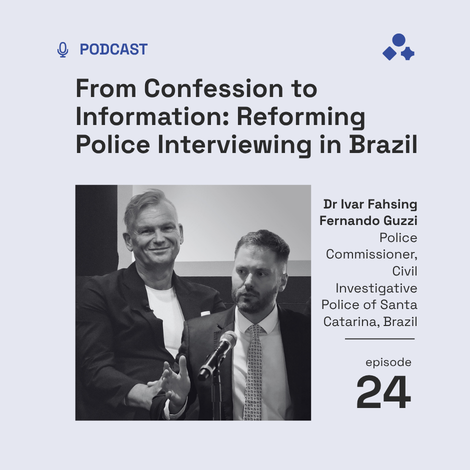
Episode 24. From Confession to Information: Reforming Police Interviewing in Brazil
Fernando Guzzi spent the first half of his career as what colleagues called a ‘good confession obtainer’. Then he was asked to teach police interrogation in the Brazilian police academy — and started reading the research. What he found changed everything.
In this episode of Beyond a Reasonable Doubt, Dr Ivar Fahsing speaks with Fernando Guzzi, a Police Commissioner from Santa Catarina, Brazil, about the journey from confession-centred policing to investigative interviewing — and what it means to make that shift inside a system still shaped by the legacy of military dictatorship.
They discuss what happens to trust when the interview dynamic breaks down; why public cooperation with police is an acute problem in Latin America; what 61% of investigators getting confessions right actually means for justice; and how recording technology is now transforming accountability in Brazil’s police stations — not just for evidence quality, but for the officers themselves.
Key Topics Discussed:
- Fernando Guzzi’s personal journey from confession-focused to information-focused interviewing
- The difference between confirming a hypothesis and gathering reliable information
- Investigative interviewing as a shift in understanding one’s democratic role
- Eyewitness identification, memory, and racial bias in Brazil
- What makes a trained detective different from an untrained person
- Brazil’s military dictatorship legacy and its impact on public trust in police
- Organised crime, the code of silence, and the case for cooperation
- Investigative interviewing as a tool for rebuilding institutional credibility
- Recording in Brazil — near-mandatory adoption, officer buy-in, and AI transcription
- Technology as part of professionalisation, not just evidence management
About the guest
Fernando Guzzi
Fernando Guzzi is a Police Commissioner in the Civil Investigative Police of Santa Catarina, Brazil, where he has served for nine years. Previously, he worked in the Paraná state police. Over a career spanning thousands of interviews — homicides, organised crime, feminicide, sexual offences, and white-collar crime — he underwent a significant professional transformation: from a practitioner focused on obtaining confessions to a specialist in evidence-based investigative interviewing. He now serves as an instructor at his state police academy, where he teaches investigative interviewing, eyewitness identification, and the psychology of memory. He holds a master’s degree focusing on eyewitness identification and racial bias. As both a local investigative manager and an educator, he is actively working to shift institutional culture across the Brazilian police — and has seen that shift begin to take hold.
Watch and listen wherever you get your podcasts (Youtube link here)
Related products


Transcript
Guest: Fernando Guzzi, Police Commissioner, Civil Investigative Police, Santa Catarina, Brazil
Host: Dr Ivar Fahsing
Dr. Ivar Fahsing [00:00]
Fernando Guzzi, welcome to this episode of Beyond a Reasonable Doubt, a podcast from Davidhorn. Welcome.
Fernando Guzzi [00:09]
Thank you, Ivar. It is an honour to be here. I am so glad that I can speak from my own experience, and I hope I can share some of what I have seen here in Brazil from the perspective of a police officer. Please — we can start.
Dr. Ivar Fahsing [00:30]
Thank you so much. Before we go anywhere, could you say a little more about who you are, your background, and your position, so that our listeners can get to know you a little better?
Fernando Guzzi [00:39]
Of course. I hold the position of Police Commissioner in the Civil Investigative Police in Brazil — not the Police Commissioner, but one of the police commissioners. I have been serving in this role for nine years now, currently in the state of Santa Catarina. Before that, I worked in the Paraná state police, another state in the south of Brazil.
[00:39]
Since my very first day in the police, I was already conducting interviews and investigating homicides and other serious crimes — organised crime-related offences — because that is how things work in our state police. I have probably conducted thousands of interviews across every type of crime we have here in Brazil.
[00:39]
What I find interesting — and I would like to share — is that for the first half of my career I did not know that investigative interviewing as a discipline even existed. I simply went with my instincts. And in my mind at the time, it was working, because I was getting a lot of confessions and solving cases. I started to become known as a ‘good confession obtainer’, something like that.
[00:39]
So the director of my academy called me in and said: ‘I’ve heard you are a good interrogator. Come and join the police academy and teach the new officers how to interview.’ What he was really saying, without saying it, was: teach them how to obtain confessions. I sat the test, passed, and became an instructor — at that time we called it ‘interrogation techniques’. Now we call it investigative interviewing.
[00:39]
I was not going to stand in front of 30 new police officers and just talk and talk until people confessed. So I began to study seriously, and I delved into the scientific research. I discovered the Kognitiv Interview — as we say here in Brazil, or Cognitive Interview as you say there. I discovered Lilian Stein, William C. Connell, and then I found the whole universe of investigative interviewing.
[00:39]
And studying all of this, I began to ask myself: what was I doing? All those confessions — all those people telling me, perhaps, what I wanted to hear, confirming my initial hypothesis. I started, in my mind, to revisit those old cases. They were probably guilty. But I could not be really sure. And I could not go back in time.
[00:39]
So I decided: from now on, I will do the right thing. Or not ‘the right thing’ — perhaps the better way to put it is: I will do professional work. I do not want interviewees to confirm my beliefs. I want to get information from them — not just any information, but reliable, detailed, valuable, and auditable information. I want to be professional.
[00:39]
I can say that for the last five years of my career I have been doing exactly this. And I can compare the old Fernando with this Fernando. I can testify that I feel so much better being this Fernando — trying to teach new and experienced police officers the technique and its advantages. My work as an investigator, a police officer, and a local manager feels like a different job entirely. I am not obtaining so many confessions, but we are still solving the cases. We are earning a better reputation from the judicial system. And there is no going back, because this way truly, truly works.
Dr. Ivar Fahsing [06:46]
What a really interesting story — thank you. It reminds me of my own early days. I shared an office with Asbjørn Rachlew, whom you have met several times. We were fortunate enough to be at the front of changing policy and practice in our own country.
[06:46]
I remember Asbjørn at that time — he was like you, the confession master. If they had a case with a suspect but no evidence, they came to Asbjørn. He was a former top athlete, so he wanted to win. He used every means available to him within the law — and sometimes stretching it — to achieve what he considered success, for himself personally and for the organisation.
[06:46]
Then I remember one case — a homicide, or attempted homicide, between two rival outlaw motorcycle gangs, the Hells Angels and a group called the Outlaws. I was interviewing the main suspect and we had a genuinely good conversation. I was never that confession-focused kind of investigator — I was simply interested in people and their stories. Can I test what they say? Can I not? A little like how we work now, though I was not trained either.
[06:46]
But Asbjørn and I had very different styles. He went to our boss and said: ‘Why are you letting Ivar sit there with this man? He is getting no results. Send me in and I’ll fix it.’ Our boss called me in and said, ‘Sorry — we have made a decision. Asbjørn will interview this suspect from now on.’ Asbjørn had not even told me he had spoken to her. I said: ‘If you think you can do it, do it then. I have a good relationship with him — respectful, he talks. I don’t know what more you want.’
[06:46]
The day after, Asbjørn went in. After fifteen minutes, the suspect banged his hand on the table and said: ‘You are a fucking arsehole. There will be no more interviews. I do not want to speak to you at all.’ And that also tainted me, Fernando, because the suspect assumed this was a classic good cop, bad cop routine. When I came back the next day and said I had no part in this plan, he did not believe me. The trust was gone. I think it is so interesting — even a member of an outlaw motorcycle gang wants to feel he can trust the police.
Fernando Guzzi [09:30]
Of course. He is a person.
Dr. Ivar Fahsing [09:42]
He had expectations of us. The way I met him, I think he felt those expectations were met. Then they were destroyed, and we could never restore that trust. You reminded me of that story. So — if we try to summarise: what is the ethos of investigative interviewing that was not there before? What is the difference?
Fernando Guzzi [10:10]
Before, the aim was different. Before adopting the technique, I thought of my role in the criminal justice system in a completely different way. Now I am starting to understand why I am here — why there is an investigative police, why there are democratic institutions. What is interesting is that I came to understand the role of my institution through interviewing — not through my law degree, which I needed to qualify for this position. In theory I should already have known. But I learned it in practice.
[10:10]
Investigative interviewing started for me as a strategy to get more information, because I knew something was not working — not enough detail, some arrests not holding up in court. Then I began to realise that the way I used to work — closed questions, suggestive or leading questions — meant I was not obtaining new information. I was only confirming my initial hypothesis. And when dealing with an uncooperative witness or suspect, I could not create an environment conducive to the flow of information without resorting to some form of coercion — even if I did not recognise it as such at the time.
[10:10]
As I got more deeply involved and applied investigative interviewing more effectively in practice, it became a new way of policing altogether — a new way of thinking about the police and its role in a democratic state. I finally understood — and I was already a law graduate, so this was overdue — that public security must coexist with individual freedoms. I learned it in practice. And investigative interviewing became more than a technical change or a personal mindset shift. It also became a tool for transforming the institutional culture of my police organisation as a whole.
[14:34]
As a local manager, I oversee investigations without always conducting them directly, and I can see this change from that vantage point. I am also an instructor at the police academy, and I have the opportunity to share this perspective — as both a manager and an investigator — with new officers and with officers who return to the academy for further learning. I can hear from those more experienced officers, compare our approaches, and mostly I can convince them. I can see this shift not just in one officer or another, but in the institution as a whole.
Dr. Ivar Fahsing [15:31]
It is so interesting to hear this, Fernando — a really thought-provoking way of putting it. It took me many years to arrive at the same realisation: what are we really doing here? Because it is so much more than the interviewing itself. I sometimes say that the problems in suspect interviews were just a symptom of something larger — you see the symptoms strongly there, but they appeared in other areas too.
[15:31]
I remember once, working in the National Homicide Unit — assisting local police forces with difficult cases — there was a witness who had observed the person most likely to be the perpetrator. They wanted to arrest him and have me interview him. I said: yes, but as soon as possible we need to conduct a line-up with that witness so she can help us confirm whether this is the right man.
[16:44]
And if we are going to arrest him tomorrow, we have to do this today — because tomorrow there is a risk his photo will be in the newspaper or on television, and the line-up will be worthless. My bosses went into a meeting, came back, and said: ‘We heard what you said, Ivar, but we are not going to do it. We are going to arrest him, and you are going to do the interview.’ I asked why. They said: ‘What if she does not pick him out? If she does not identify him, we will not get him into custody, and you will not have the same leverage in the interview.’
[17:26]
I said: if she does not recognise him, maybe it is not him. We had no forensic evidence — nothing. He simply owned the same motorbike as the suspect and had been in the area. I think that reflects so clearly how we were thinking at the time.
Fernando Guzzi [17:43]
Yes. That reminds me — I also teach eyewitness identification at my academy, and I have a master’s degree on this topic from the perspective of racial bias here in Brazil. A new police commissioner asked me, in front of a class of twenty or thirty students: ‘What if the witness does not choose our suspect? Can we simply not include it in the file?’ I took a breath and said: we do what we should do. We explain how memory works and why we want to avoid bias. His common-sense question was overcome — he was convinced. And yes, in 2025, people still think like this. It is natural. But in our roles as managers, officers, and instructors, I am glad we can change this mindset.
Dr. Ivar Fahsing [19:17]
Sometimes when I had a new class of detectives — I was a professor at the Norwegian Police University College for a long time — I would ask them: what is it about you that makes you special? Why should you be in this room for this specialist training? What is different about the way you think compared to, say, your neighbour or your grandmother?
[19:17]
And they could not answer it, Fernando. They did not know. And I think that is so important — that when you go into any skill, you have to be aware of the difficulties in it, which is what gives you humility. The more I read, the more I learn, the more complicated I see it is. Even the best Brazilian footballers can miss a penalty. Even Pelé missed penalties sometimes. Cristiano Ronaldo misses penalties in the most important competitions. It is technically a relatively simple action — but in that context, under that pressure, sometimes you simply cannot do it.
[19:17]
And I think that is comparable to what it sometimes means to interview a suspect. If you start thinking about your own goal — if I score now, we will be world champions — you focus on yourself rather than the process. How am I going to do this correctly? How am I going to be genuinely interested in the other person’s story? Investigative interviewing takes away the weight on your shoulders — the idea that it is your job to come out of that room with a confession. It is not.
[22:06]
It actually makes the job a bit easier in one way — you do not have to judge people. Your job is to try not to judge people. You can leave that to someone else, who is actually paid to do that. I think many police officers do not consider this. They think it is their job to judge as quickly as possible and determine: you did it.
Fernando Guzzi [22:37]
Yes, exactly. We grow up watching films and it is embedded in the culture.
Dr. Ivar Fahsing [22:50]
Fernando, you have been involved in this important work in Brazil and in other countries. Could you share some of your experiences — perhaps starting with Brazil — on how investigative interviewing is spreading? Is it spreading? Is it easy to build momentum? Do you meet resistance, and if so, what kind and why?
Fernando Guzzi [23:20]
In any country, I believe, there is a need to increase both the efficiency of criminal investigations and respect for human rights. We are never — and I say this from Brazil and Latin America, though probably anyone anywhere could say it — entirely free from authoritarian tendencies. We must always stay vigilant.
[23:20]
On the other hand, public security challenges — organised crime in Latin America, rising homicide rates, domestic violence, feminicide — demand a more professionalised police force capable of conducting effective investigations. But if I were to highlight what makes Brazil’s context distinctive, I would focus on how investigative interviewing can strengthen public trust in the police, and on the need to obtain information from people who do not trust us.
[23:20]
Two major factors have contributed to democratic erosion and institutional discredit here in Brazil — particularly regarding the police. First, we emerge from a military dictatorship during which torture became a systematic practice. Because of that legacy, many people still fear entering a police station as a victim or witness and ending up treated as a suspect — or not leaving at all. Second, we face a severe challenge with organised crime. It is estimated that around half of all homicides in Latin America are related to organised crime. Investigating these crimes is difficult not only from a technological or inter-agency perspective, but because of the code of silence typical of mafia-like organisations.
[26:05]
Public cooperation is essential for investigating these crimes. But how can we expect the public to provide information to the police if they do not trust the police? That is why I see investigative interviewing as one of the key means of rebuilding the public trust we genuinely need in this region. It is a technique where coercion and psychological manipulation no longer prevail, and where active listening and genuine interest in what the person has to say become central.
Dr. Ivar Fahsing [26:44]
That is so interesting. Excuse me, Fernando — I was looking at my phone, trying to find the name of the Brazilian footballer who led the famous protest. Sócrates.
Fernando Guzzi [27:02]
Sócrates, of course.
Dr. Ivar Fahsing [27:04]
Because I am not sure how many of our listeners know the history of Brazil’s authoritarian period. As a European, I will confess that I tend to think of Brazil in terms of samba, carnival, and football — a fantastic culture born of Latin, African, and European influences, represented by the most entertaining football in the world. When Sócrates led that protest, the world understood: these are the best footballers on earth, and things are not right in their country.
Fernando Guzzi [27:51]
Yes. We had the military dictatorship from 1964 to 1985 — so we are a young democracy. While the world was watching Sócrates, Zico, and others through the sixties, seventies, and eighties, people here in Brazil were being arrested without judicial orders and without rights. We left the dictatorship, but the practices do not simply disappear overnight. We had our constitution in 1988, but that was not a magic document that instantly made the police respect democracy and individual freedoms. Thank you for bringing Sócrates into the conversation — he was extraordinary.
Dr. Ivar Fahsing [28:56]
I still admire the way he played and the way he led — on the pitch, but also for so many more people across Brazil.
Fernando Guzzi [29:08]
Yes. He was a great person.
Dr. Ivar Fahsing [29:13]
And I think it is interesting that you connect this to what investigative interviewing can help us with — that kind of transformation where policing’s origins, its relationship with power, still shapes what happens inside the interview room. Even in systems where the law looks fine on paper — technically correct — what matters is how it operates in practice. Criminal justice systems exist for justice, but when they are also instruments of power, they can crush those who challenge that power. That is one of the deep problems with investigative powers around the world.
Fernando Guzzi [30:22]
Yes. I tell new officers: we could probably make almost anyone say almost anything. If you are really determined, you can sit in an interview room and convince a person to confess to something they never did — even something terrible — because you represent the full power of the state. You can persuade them that confessing is the better option. We have to make these young officers — who in Brazil are already carrying powerful modern firearms — understand the responsibility that comes with that. When they understand they could do almost anything, the hope is that they will also understand the weight of that responsibility, and choose to restrain that power.
Dr. Ivar Fahsing [32:16]
Fascinating. We could continue this conversation for much longer, but I want to ask you one final question. As you know, Davidhorn is a world leader in producing recording technology for investigative interviews. What role do you see technology playing in the development we have been talking about?
Fernando Guzzi [32:50]
Today, I personally record all of my interviews. As head of a police station, I handle administrative and legal responsibilities alongside investigative work, so I personally conduct only the more complex interviews — homicides, feminicides, organised crime, sexual offences, armed robbery, white-collar crime, serious domestic violence. In simpler cases, officers under my supervision are still relying on written statements in some instances. But that is coming to an end here in my state. Within a year, we expect nearly 100% of interviews to be recorded, even in straightforward cases.
[32:50]
Recording is essential, because only then can we verify how memory-dependent evidence was obtained. We have seen significant improvements in the maintenance of arrests and convictions since allegations of coercion or abuse are no longer raised, or even perceived, by defence attorneys. And police officers themselves are asking for their interviews to be recorded — because they feel safer with this approach.
[32:50]
As for technology, it is not expensive today. In my state, we have software that compresses video files so they can be uploaded directly to the electronic judicial system — essentially with a single click after the interview. Some other states are even recording interviews using mobile phones linked to official software. And the concern that some unit heads had about transcription — we have to write reports that reference interview content — is now being addressed by AI transcription tools. Some are freely available; if you want to keep information secure, there are tools provided by the police. It is not expensive.
[32:50]
Technology plays an important role in consolidating investigative interviewing. The only way to evaluate it, and to realise its full benefits, is by recording. Without recording, you cannot see how the evidence was collected. We are spreading quickly in Brazil, but we are still consolidating — not yet at 100%. And I see this as a real opportunity to demonstrate to the judiciary, to the press, and to all stakeholders that we are professionalising. It is not the gun or the badge that makes you different from your neighbour. It is the fact that you are studying psychology, understanding how memory works, and learning how to bring people into a conversation and obtain reliable, detailed information. Technology is part of all of this.
Dr. Ivar Fahsing [38:41]
It reminds me of a well-known saying from the British police about documentation: if it is not written down, it does not exist. The same applies here. If you cannot document how you did it, it does not exist — it can be disputed, twisted, rendered unreliable.
[38:41]
Fernando Guzzi, thank you so much for a wonderful conversation. I have learned a great deal, and I am sure our listeners have too. Thank you.
Fernando Guzzi [39:13]
Thank you so much, Ivar. I look forward to continuing to follow this amazing podcast. Congratulations — and I hope to see you again soon. and it is embedded in the culture.
END OF TRANSCRIPT
© 2026 Davidhorn. All rights reserved.