
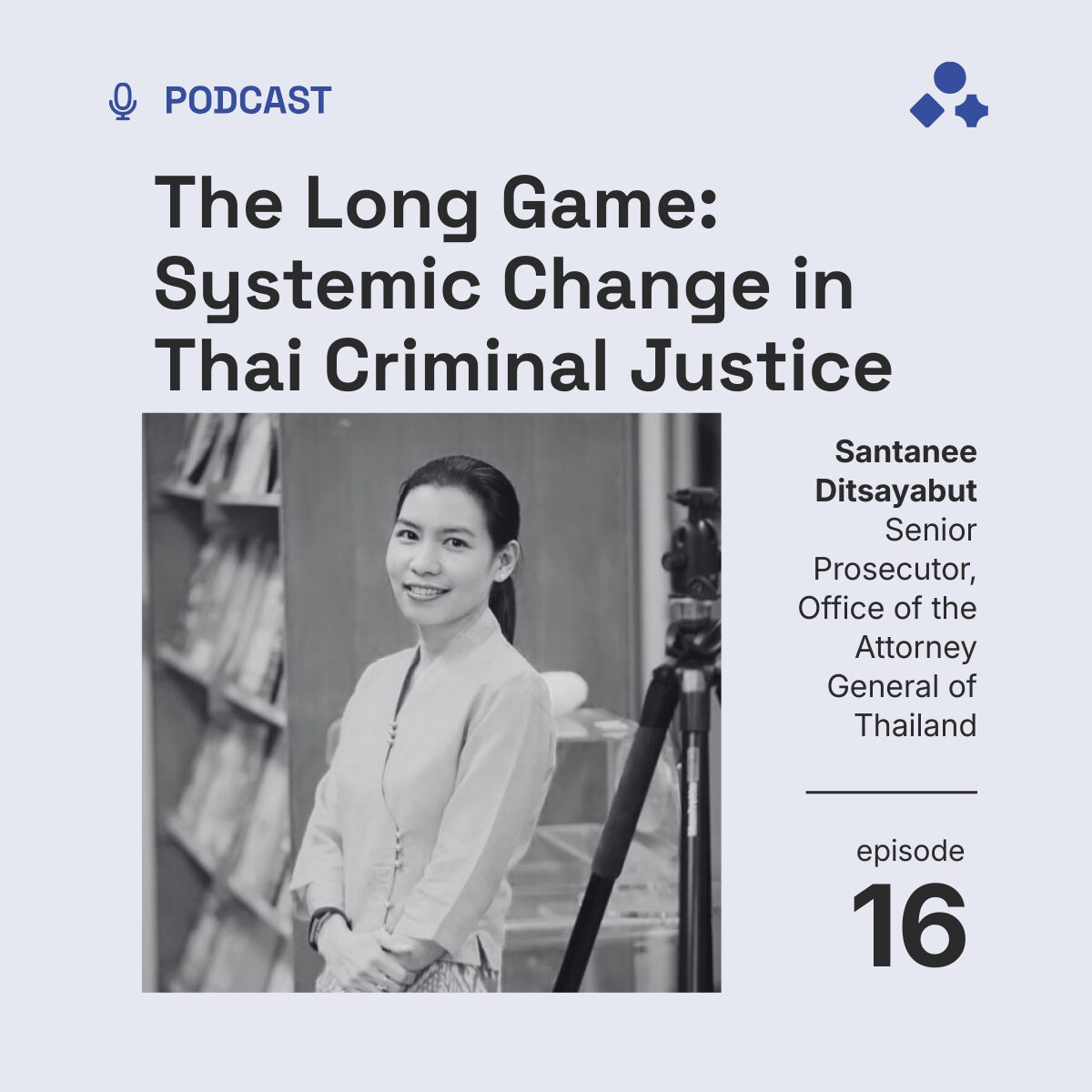
The Long Game Series
Episode 16. Systemic Change in Thai Criminal Justice
The Long Game Series: Thailand leads Asia in implementing investigative interviewing nationwide. Prosecutor Santanee Ditsayabut reveals how systematic training transforms justice.
In this episode of Beyond a Reasonable Doubt, recorded in Hua Hin, Thailand, Dr Ivar Fahsing speaks with Ms. Santanee Ditsayabut, senior prosecutor at the Office of the Attorney General of Thailand and director of the Secretariat of the Nitivajra Institute, about Thailand’s pioneering efforts to implement investigative interviewing across an entire nation’s criminal justice system.
The conversation explores the unique challenges and opportunities of implementing investigative interviewing in Thailand, where cultural values of respect and dignity naturally align with the ethos of ethical interviewing, yet practical concerns about time constraints and traditional practices create resistance. Ms. Ditsayabut candidly discusses how training reveals eye-opening moments for practitioners who discover cognitive biases like confirmation bias and tunnel vision they never knew affected their work, and how understanding brain function and memory science transforms their approach to gathering reliable evidence.
A key theme is the importance of patience and long-term strategic thinking in systemic change. Rather than expecting overnight transformation, Thailand’s approach involves training small groups intensively – including future policy makers and university students – who become champions spreading the principles throughout their organisations. The episode reveals how this methodical approach is creating sustainable change across Thailand’s criminal justice ecosystem.
Santanee Ditsayabut emphasises that investigative interviewing isn’t merely about following human rights principles – it’s about understanding the science behind why these approaches produce more reliable evidence and better case outcomes. She discusses the critical role of judges in understanding memory science to properly evaluate evidence, using powerful examples of how lack of this knowledge can lead to miscarriages of justice.
The episode culminates in celebrating a historic milestone: Thailand is certifying its first national trainers and champions for the PEACE program, positioning the country as a leader in Asia for evidence-based, human-rights-compliant investigative interviewing. Technology, including recording systems like Davidhorn’s solutions, plays a crucial role in supporting this transformation by enabling accurate documentation and evidence management.
Listen to the full conversation in Episode 16 of Beyond a Reasonable Doubt, where dr Ivar Fahsing talks with Santanee Ditsayabut.
Episode Length: Approximately 30 minutes
Production: Davidhorn – Beyond a Reasonable Doubt Podcast
Host: Dr. Ivar Fahsing
Equipped For Justice – Supporting ethical, human rights-compliant investigations worldwide
About the guest
Santanee Ditsayabut
Ms. Santanee Ditsayabut is a senior prosecutor at the Office of the Attorney General of Thailand and director of the Secretariat of the Nitivajra Institute, established to strengthen Thailand’s criminal justice system. She graduated LL.B. with first-class honours from Chulalongkorn University in 1995 and ranked first in the Thai Bar exam in 1996. She holds two LL.M. degrees from the University of Pennsylvania and the University of Wisconsin-Madison, funded by a Royal Thai Government scholarship. Since 2001, she has served as a public prosecutor with extensive experience in international legal cooperation.
Ms. Ditsayabut was part of the task force for the 11th UN Congress on Crime Prevention and Criminal Justice in 2005 and was seconded to UNODC as a regional expert for the Terrorism Prevention Branch, promoting implementation of counter-terrorism conventions in Asia and the Pacific. Her expertise covers transnational crime, particularly trafficking in persons, and combating violence against women and children. She chaired key consultations at the 22nd and 23rd sessions of the Commission on Crime Prevention and Criminal Justice, including negotiations leading to the 2014 UN Model Strategies on the Elimination of Violence against Children.
Ms. Ditsayabut serves on the Advisory Council drafting the Mendez Principles on effective interviewing for investigations and information gathering, and actively implements these principles among law enforcement practitioners in Thailand. She previously served as chief prosecutor of a provincial office and now leads Thailand’s national efforts to implement evidence-based, human-rights-compliant investigative interviewing practices.
Related products


Transcript
Host: Dr. Ivar Fahsing, CEO, Davidhorn
Guests: Santanee Ditsayabut
Dr. Ivar Fahsing (00:00)
Welcome to another episode of Beyond a Reasonable Doubt. Today we are in Hua Hin, Thailand, and our guest is Santanee Ditsayabut. Welcome.
Santanee Ditsayabut (00:13)
Welcome to Thailand, and welcome to Hua Hin.
Dr. Ivar Fahsing (00:16)
Thank you so much. Santanee, you are not only a dear friend, but you are also a senior expert prosecutor at the Attorney General’s Office here in Thailand, and you are the Director of the Secretariat of the Nitivajra Institute, which promotes effectiveness and quality in the criminal justice system. It is an honour to have you as a guest on our podcast today.
Santanee Ditsayabut (00:39)
It is an honour for me to be your guest too. Welcome to Hua Hin — it is so nice to have a chance to talk with you.
Dr. Ivar Fahsing (00:47)
Thank you so much. The theme of this year’s season of Beyond a Reasonable Doubt is “Implementing Investigative Interviewing: The Near and Far Horizons.” My first question is for you, because I know you are leading a project in Thailand called the PEACE Program Informity, where you bring together people from different agencies across the criminal justice system to systematically implement investigative interviewing across your country. Before we dive into that, I would like you to reflect on what you believe is the true ethos of investigative interviewing, and why you think it can promote quality in the justice system here in Thailand.
Santanee Ditsayabut (01:33)
When I first learned about investigative interviewing, perhaps five years ago, I came to think of it as a way to find the truth without unintentionally assuming the facts. It is, I believe, the best way to apply the principle of presumption of innocence — a principle we as law enforcement officers are taught from day one when we enter the legal world, but one that we sometimes forget in practice.
So I think investigative interviewing is more than just questioning. You need to look at it as a whole process, not just the questioning step — that is only one step. You need to view it as a process of discovering the truth, which begins with planning and preparation. That is everything. It is also a process of gathering reliable evidence, and it truly benefits the prosecutor: if evidence is gathered from a reliable source, we can prove it beyond reasonable doubt in court.
Learning about investigative interviewing also helps you understand how the brain works, how it functions, and how to respond to that systematically in order to achieve the best results from the inquiry process. That is the fascinating thing — not only following the principles of human rights, but understanding the research behind why you should respect those rights, because it affects the behaviour of the person you are questioning, and ultimately produces the most effective outcome.
Dr. Ivar Fahsing (03:31)
I couldn’t agree more. As you know, I have been involved in a similar pioneering project in my own country, for very much the same reasons — it all sounds very familiar. Are there any particular challenges in Thailand that you think we need to address, and why is investigative interviewing particularly relevant here?
Santanee Ditsayabut (03:56)
I think the challenges can feel almost impossible at first. In the past, we approached questioning very simply: you ask, and another person answers. But investigative interviewing requires more than just walking into a room and asking questions. It requires a process of planning and preparation, of thinking thoroughly. Some officers say they simply do not have the time. When a criminal case comes in, you need to act quickly — there is no time for such a process, they say. And they do not immediately see how respecting human rights will affect the outcome of the case. They see it as an international standard, but not as something that will improve their results.
So the challenge in Thailand is twofold: is it possible given our time constraints, and will it actually be effective — or is it just an unnecessary burden imposed by international standards? That is what we need to address.
Dr. Ivar Fahsing (05:07)
If I may add — I have been fortunate enough to visit Thailand many times over more than 30 years. In my personal view, Thai culture is a very respectful and polite culture. I would say that the respectful, dignified approach to interviewing that lies at the heart of this ethos should actually fit very well with Thai culture.
Santanee Ditsayabut (05:37)
Yes, indeed. We do not practise torture or use force in interviewing — that is simply not acceptable in Thailand. But I think there are still some misunderstandings and blind spots. For example, a simple one I often see: some police officers believe that if you are interviewing a suspect, you need to be patient and persistent. So they may question someone for three hours straight, six hours, sometimes overnight — because to them, that is what patience means. But they do not realise it is not effective. If you keep questioning a person who is already exhausted, they may say things they do not mean to say.
It is not that they intentionally violate anyone’s rights — they simply do not know it does not work. I think investigative interviewing helps practitioners become aware of cognitive biases like confirmation bias and tunnel vision. Once you learn about them, you can keep yourself aware before entering the interview room. It also opens your eyes to memory science — for example, two people who describe an event differently are not necessarily lying. Both may be telling the truth. And our brains do not store memories in chronological order, even though we are often taught to ask questions in a neat step-by-step sequence. These are the kinds of things that make investigative interviewing so fascinating and eye-opening for us.
Dr. Ivar Fahsing (07:29)
Together with Santanee, and with support from my centre at the Norwegian Centre for Human Rights — where I hold my guest professorship — alongside the Thailand Institute of Justice and the Association for the Prevention of Torture (APT), we have been fortunate to conduct quite a number of training sessions across Thailand over the past years. We have trained prosecutors, special investigators from the DSI, officers at the Royal Police Cadet Academy, and personnel from the Ministry of Interior and other agencies. I also recall that judges attended the summer training.
What is the general impression among your participants? Is investigative interviewing catching on in Thailand? Are people responding well?
Santanee Ditsayabut (08:33)
Yes. From what I have observed, once people learn about investigative interviewing they love it — because it unlocks something they never quite understood before. All our participants are law enforcement officers from different organisations — we have even had a soldier in one session — and they exchange a great deal with each other. They begin to recognise what they may have been doing wrong and what they can improve.
And investigative interviewing is not just something you study — you need to practise it. In the training, participants have the chance to try things for themselves. They discover from the inside what works and what does not. The feedback I consistently receive is that it is eye-opening. It is engaging, because it is not just sitting and listening — they discover things for themselves. For example, they watch a video clip and try to recall what they saw, and they discover that even they cannot remember everything, and that different people watching the same clip remember it differently. That is very striking for them. Many say they can apply these principles not only in their work but in their daily lives.
Many participants come back and say they want to introduce the principles of investigative interviewing — especially the PEACE model — to their colleagues. They are keen to do more training. They understand that this is not something you can learn from a book; it requires investment in the right kind of training: intensive workshops, not just lectures. My concern is that because these workshops are intensive, we can only accommodate small numbers at a time. But all those participants can spread the word, and the network grows.
I now hear from many participants that they had come across investigative interviewing before but could not grasp it from a single lecture. Once they train with us, they understand it far more deeply — and they return to the very first question I mentioned: is it possible in Thailand? But this time, with the confidence to say yes, it is.
Dr. Ivar Fahsing (11:32)
These are challenges we face everywhere. You have to understand the philosophy behind it, the connection to international legal and human rights standards — that is the process quality of interviewing. But also, as you say, the psychology, the theory of memory, and the importance of not contaminating your evidence. And ultimately, as you put it so well —
Santanee Ditsayabut (12:02)
That is exactly the right word: skill.
Dr. Ivar Fahsing (12:04)
A skill that you lose if you do not practise. You have to keep at it to become truly good — it is hard work, and you need honest feedback to improve. But I would also like to acknowledge what you have been doing for so many years, Santanee. Last week, that work was recognised in a very meaningful way — I was personally invited to meet the Minister of Justice in Thailand. His Excellency was clearly aware of the developments in the country and asked me to continue assisting. He wanted to expand the training programme as widely as possible.
We also had the company of Davidhorn CEO Børge Hansen, and the Minister was particularly interested in how technology connected to investigative interviewing could improve the quality and effectiveness of Thai investigative procedure. I think that is clear evidence that your work is spreading — and reaching the very highest levels of Thai society.
Santanee Ditsayabut (13:28)
Thank you for mentioning that. It reminds me that to make investigative interviewing work, you need more than practitioner training — you need support at the policy level, and you need the right equipment. The Nitivajra Institute is at the front line of awareness about investigative interviewing in Thailand, and we are working to bridge the policy level and the practitioners.
For example, for our second cohort training here in Hua Hin, my supervisor also met with senior leadership to discuss exactly what you described — how to embed this at the policy level, and how technology can support it. One important element of investigative interviewing is that interviews should be recorded. In Thailand today, we only routinely record in high-profile cases and interviews involving children. But we are beginning to see the broader benefits of recording, and with modern technology it need not be a burden.
Yesterday I was speaking with one of our participants who had just completed her first simulation exercise — she had interviewed a simulated suspect in under 40 minutes. I asked her how long the same interview would typically take in her day-to-day work. She said perhaps two hours. I asked why. She explained that in the traditional approach, she first has to speak with the witness to gather background on the incident, and only then begin the actual interview. But with investigative interviewing, you record from the start, and technology can transcribe it afterwards. It is actually less work than what officers are doing now. If you can help people see that, you can dispel the myth that this approach is too time-consuming.
Dr. Ivar Fahsing (16:22)
You are absolutely right. In the beginning it may seem more resource-intensive, but when done properly it is actually more efficient. As you say, thorough planning means you do not enter the interview without knowing what you are looking for — wandering without direction is what truly wastes time. And when transcription is automated, the investigator can focus entirely on being present during the interview, and handle the administrative work afterwards.
This is also one of the technological projects we have planned to develop here in Thailand. We intend to use recordings from your training sessions — which are less sensitive from a GDPR perspective — to build and test AI transcription tools, to see how accurate and reliable we can make the automated output. That will move us quickly toward both higher quality and higher efficiency.
Based on all of this — and knowing you well enough to notice when you are concerned — when you look at the future of investigative interviewing in Thailand, what are your worries? What do you think could be the main barrier to progress?
Santanee Ditsayabut (18:02)
My worry is mindset — including at the policy level. As I said, once practitioners are trained they see the benefits for themselves. I am not worried about practitioners. But we cannot simply put senior officers through a training course. So the question is: how do we demonstrate to high-level decision-makers that this is genuinely useful and that it can enhance the effectiveness of the criminal justice system — so that they will give it their political support?
Once practitioners are trained, their mindset shifts. But if they walk out of the training room and back into an environment where their supervisors do not understand what they are doing, their capacity is limited. That is why I believe three things need to come together: political will, practitioner mindset, and the right technology. If you can achieve all three, the future will be bright.
Dr. Ivar Fahsing (19:41)
I couldn’t agree more. And there is something I think is genuinely rare about Thailand’s development compared to other projects I have seen around the world — you have been able to bring together experienced practitioners from many different agencies, more or less reflecting the entire chain of justice. That is a great strength, and it is quite uncommon.
My own background is in the Norwegian development, and when we were doing this we did not think carefully enough about how the changes would ripple through not only police work, but also the work of prosecutors, defence lawyers, and ultimately judges. If you do not change the whole chain, how can you achieve a real effect?
So what would you say is the next step for Thailand?
Santanee Ditsayabut (20:37)
I think the next step is to do more of what we are doing now — but with greater reach. As you mentioned, pulling together organisations toward the same goal is key. Our participants from the first cohort have already spread the word so effectively that recruiting for the second cohort was straightforward. The interest has even extended beyond the criminal justice system to the military. When the military asks to join, that underlines how the practitioner community, once it understands investigative interviewing, naturally spreads the network.
So we invite people we believe will become champions in the future, and the network keeps growing. The challenge is how to keep that network active and supported, while continuing to demonstrate the concrete benefits to supervisors. And as you said, investigative interviewing is a skill — you need to keep practising. It cannot be a one-time event. You need to keep the network alive, support its members, help them grow, and make the case to their leadership. That is how we make it sustainable.
Dr. Ivar Fahsing (22:21)
I think you are right. And I find it fascinating that your approach here reflects something in the wider culture — an intuitive understanding that processes like this must take time.
Santanee Ditsayabut (22:36)
Of course it takes time. We have moved on from ancient practices — methods that relied on oaths, rituals, or coercion to obtain information. Now we have a criminal justice system, and I believe it can and should continue to move forward. I would also add something I forgot to mention: sometimes, to fully support investigative interviewing, we will need to amend the law to complement the process.
Dr. Ivar Fahsing (23:08)
What about judges?
Santanee Ditsayabut (23:09)
The involvement of judges is absolutely essential, because the judge is the one who decides. If a judge does not understand how evidence is gathered, they may overlook critical context. As a prosecutor, I have seen judgements that reflected confirmation bias.
Let me give a specific example: a witness was raped by her stepbrother and did not want to believe it was real. Her testimony was inconsistent as a result. If the judge understands that there is an alternative explanation — that the victim may be speaking differently from the facts because she cannot bring herself to accept what happened — the outcome of the case might be very different.
Dr. Ivar Fahsing (24:04)
That is so important, because this is fundamentally about evidence evaluation. For those of us who have had the opportunity to study psychology, we understand that the brain’s real function is not to produce a realistic, accurate memory. Its function is to process experience in a way that allows you to keep living.
Santanee Ditsayabut (24:27)
Yes.
Dr. Ivar Fahsing (24:28)
Sometimes memory is there to help you construct a life you can bear.
Santanee Ditsayabut (24:34)
Yes, exactly.
Dr. Ivar Fahsing (24:36)
And if you do not understand that as a prosecutor or a judge, you may be unable to make sense of what you are hearing — and you might automatically dismiss a victim as unreliable, when in fact she is simply undergoing a very normal psychological process.
Santanee Ditsayabut (24:50)
Yes. And at the end of the day, that leads to a miscarriage of justice — which is precisely what we must avoid.
Dr. Ivar Fahsing (24:58)
So this tells us that investigative interviewing is far more than a model or a set of steps. It is a science-based framework for understanding and collecting evidence from human beings and human memory.
Santanee Ditsayabut (25:16)
I have one final question for you. This is, in one sense, a year to celebrate — a very important milestone for investigative interviewing in Thailand. This week, we are in the process of certifying the first national trainers and champions for the PEACE programme. It is exciting that we have come this far.
But we still need strategic investment to sustain this. How can we get the attention of decision-makers and make them willing to commit to that investment?
Dr. Ivar Fahsing (26:13)
I think we need to help them see the benefits of investigative interviewing for themselves — through evidence, or through first-hand experience. Learning from countries that have already implemented this successfully, and seeing the outcomes with their own eyes.
Santanee Ditsayabut (26:41)
I completely agree. Perhaps a study visit to a country where investigative interviewing is fully integrated across the justice chain. And technology may well have a role to play there too.
Dr. Ivar Fahsing (26:49)
Yes — technology, study visits, or access to trusted, authoritative voices. Not just one person making the case, but evidence that senior leaders find credible. That requires careful thinking about how we build that kind of influence.
Santanee Ditsayabut (27:13)
Absolutely. And I know that you are engaged on another front as well — you have your own lectures at Chulalongkorn University, where you are teaching the next generation of lawyers. As you said earlier in this conversation, the long-term perspective is everything. You need to be patient.
Dr. Ivar Fahsing (27:23)
Yes. You need to be patient, and you need to prepare the ground for future officers to grow up with investigative interviewing as a given. This brings us back to the composition of participants in the PEACE model course — we bring together not only young practitioners and mid-level officers, but also the prospective policymakers of tomorrow. That mix creates the conditions and momentum to carry investigative interviewing forward in Thailand.
Santanee Ditsayabut (28:15)
I couldn’t have said it better myself. Santanee, thank you for a wonderful conversation, and for joining us on the podcast today.
Santanee Ditsayabut (28:24)
And I would like to thank the Norwegian Centre for Human Rights for supporting us in implementing investigative interviewing in Thailand from the very beginning. Our partnerships are growing — with APT, the Thailand Institute of Justice, and many more — because we all see the benefit of investigative interviewing in enhancing the effectiveness of justice systems, not only in Thailand but around the world. Thank you very much.
Dr. Ivar Fahsing (28:54)
Thank you, Santanee. I think this goes beyond Thailand. I think Thailand is leading the way in Asia — not just Southeast Asia, but Asia as a whole. The way you and your colleagues have led this project, the seniority of the people who have invested in it, the commitment from across the system — I believe Thailand is going to be one of the truly leading nations in Asia on this.
Santanee Ditsayabut (29:20)
Thank you very much. Let us make it a universal commitment.
Dr. Ivar Fahsing (29:26)
Thank you so much.
END OF TRANSCRIPT
© 2026 Davidhorn. All rights reserved.