


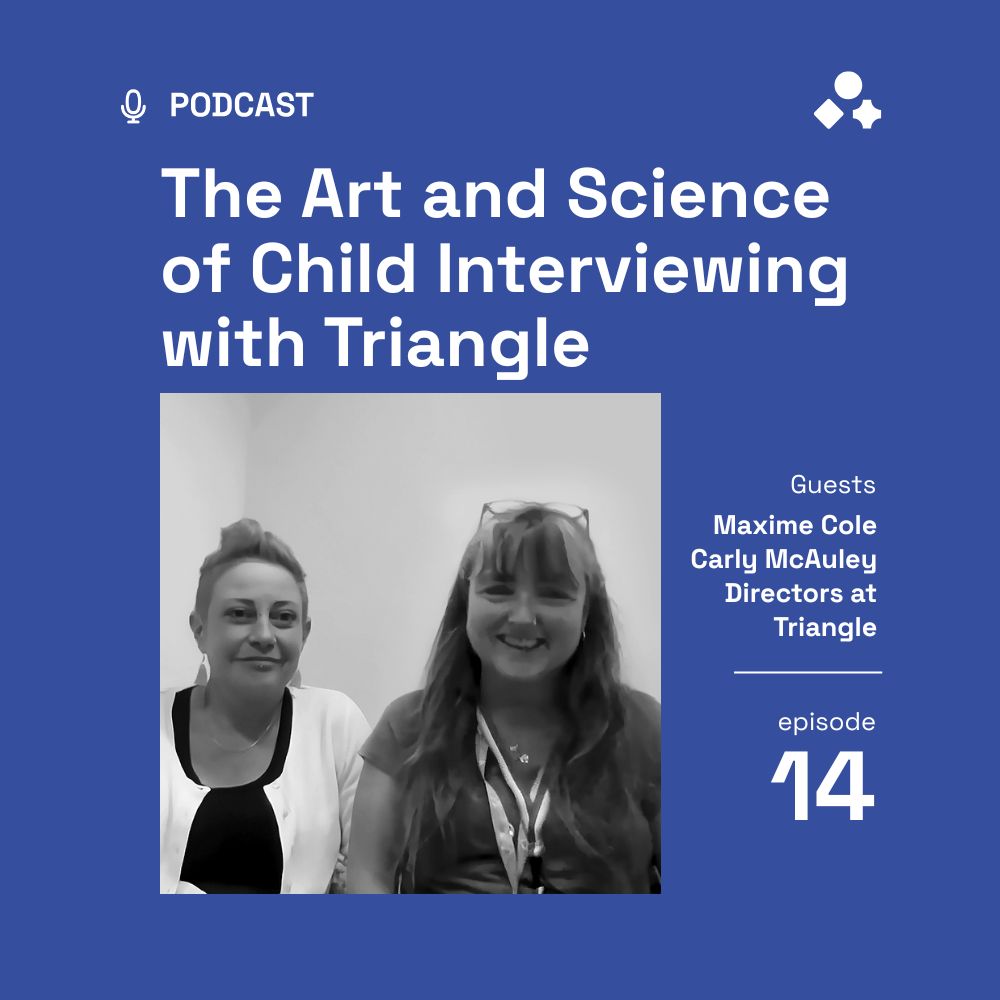
Episode 14. The Art and Science of Child Interviewing with Triangle
In this episode, we speak with Carly McAuley and Maxime Cole from Triangle, a UK-based organisation specialising in investigative interviewing of children and vulnerable adults.
Founded in 1997, Triangle has become a leading authority in forensic questioning techniques and vulnerable witness interviewing, training police forces across the UK and internationally while conducting interviews for criminal and family court cases.
Triangle provides comprehensive services, including:
- Investigative interviews for children and vulnerable adults (ages 2-60)
- Forensic Questioning of Children (FQC) training for police forces
- Intermediary services to facilitate communication
- Expert witness testimony
- Therapeutic support and advocacy
- Transcription services that capture non-verbal communication
- Consultation for school staff and first responders
Carly McAuley and Maxime Cole shared with us Triangle’s approach to child and vulnerable witness interviewing. The conversation explores how very young children – even two and three-year-olds – can provide reliable, court-admissible evidence when interviewed using appropriate techniques. Triangle’s expertise challenges long-held assumptions about children’s capabilities and demonstrates that the quality of evidence obtained depends entirely on the adult interviewer’s communication skills, not the child’s inherent abilities.
The discussion reveals the critical importance of language adaptation in child interviews. Simple changes like asking “what made him do that?” instead of “why did he do that?” can transform a child’s ability to respond. Carly and Maxine explain the “no guessing rule” – a fundamental technique that teaches children that interviewers genuinely don’t know what happened because they weren’t there. This role reversal is essential for obtaining accurate accounts, as children naturally assume adults know everything.
A significant portion of the conversation addresses the problem of “muddled” accounts created when well-meaning adults – teachers, social workers, foster carers, and family members – repeatedly question children before formal interviews take place. Triangle often conducts “unmuddying interviews” to separate what the child originally experienced from what others have added along the way. The guests emphasise that professionals need training on how to safely listen to children’s concerns without contaminating their accounts.
Notable Quotes:
"If we get it right with the youngest children with the most complex needs, then it helps our communication with everyone."
"You can't get a good answer by asking a bad question."
"Children's communicative competence is really reliant on the adults' communicative competence."
Resources Mentioned:
- Triangle’s “Two-Way Street” and “Three-Way Street” films
- ORBIT training model
- Forensic Questioning of Children (FQC) course
- Davidhorn Police Interview Summit 2025
Looking Ahead:
Triangle will be presenting at the Davidhorn Police Interview Summit 2026, offering training opportunities for international practitioners interested in advanced child interviewing techniques.
Connect with Triangle: Learn more about their training programmes and services for law enforcement, social services, and educational professionals.
Episode Length: Approximately 59 minutes
Production: Davidhorn – Beyond a Reasonable Doubt Podcast
Host: Sigrun Rodrigues, former Chief Marketing Officer, Davidhorn
Equipped For Justice – Supporting ethical, human rights-compliant investigations worldwide
Watch and listen also on YouTube and Apple Podcasts
Related products


Transcript
Host: Sigrun Rodrigues, former Chief Marketing Officer, Davidhorn
Guests: Carly McAuley and Maxime Cole, Directors at Triangle
Sigrun Rodrigues: Hello and welcome to this podcast. I’m Sigrun Rodrigues, Chief Marketing Officer at Davidhorn, and I’m very excited to have you here today. Would you like to introduce yourselves?
Carly McAuley: Thank you very much for having us. My name is Carly McAuley. I’m one of the directors at Triangle.
Maxime Cole: Hi, I’m Maxime Cole, and I’m also a director at Triangle.
SR: Tell me a little bit about Triangle. What is Triangle?
CM: Triangle was created in 1997, and we currently provide specialist support to children, consultancy, and training. We also provide expert opinion, intermediaries, and therapeutic services. Everything we do is very bespoke, depending on what’s needed for the children and young people. Many of the children and young people we provide services to have had abusive starts to their lives, and we’re trying to help them come to terms with that. We provide advocacy services and investigative interviewing, which is what we’re here to talk about today.
MC: Our investigative interviewing services are really growing every year. We’re doing more and more, and it’s what we mainly do now, along with a lot of training.
SR: So, specifically, children’s interviewing?
MC: Well, our specialism is with children and young people, but we actually work with people up to the age of 60. We’re asked to do investigative interviews if an adult has additional needs or communication difficulties that make it harder for someone else to interview them. We use the same skills that we use to interview children and young people for everybody anyway.
CM: That’s a real fundamental Triangle belief, isn’t it? If we get it right with the youngest children with the most complex needs, then it helps our communication with everyone.
MC: Absolutely.
The Scope of Triangle’s Investigative Work
SR: Is this related to police investigations? What type of investigations do you do specifically?
MC: It’s quite a range. Some of the interviews we do are directly referred to us by the police. It might be because the child’s very young – we interview lots of two and three-year-olds for the police. Or it might be that the child has very complex needs. Quite often, we find that children have been taught to hate the police and told that they mustn’t speak to the police, so there’s already this barrier there. Coming in as an independent organisation can make it much easier for the child to communicate with us.
The variety of investigations could be anything, but primarily, it’s sexual and physical abuse investigations that we’re involved in. Then some of our work comes from the family court. We’re asked to interview children so that the court can make decisions going forward.
CM: But it’s not quite as simple as that, is it? Sometimes we’ll interview a child for family court, but what they end up saying makes that interview go back to the criminal court and back through a police investigation.
SR: You’re discovering things in the process that nobody was aware of.
CM: Exactly. It’s quite fluid.
The Challenge of Initial Police Visits
MC: The police are in a difficult situation with some children. In the UK, if a child says something potentially concerning to a teacher, for example, the police have to go out to visit that child with a social worker and try to get the child to repeat what they’ve said to the teacher before they’ll proceed to a visually recorded interview.
For some children, it might have taken them four years to build enough rapport with that teacher to feel comfortable enough to tell them. Then they don’t know that social worker or that police officer, and they’re expected to repeat what they said straight away without having built any rapport. Often, that doesn’t work, so they don’t go on to be interviewed. Ultimately, it ends up in family court, and then we interview. So, actually, that child has said something potentially concerning before, but it never went to a police interview because they didn’t repeat what they’d said in that initial visit.
CM: We’re becoming more aware the more police we’re training of the systems and the way they work. Recently, in one of the courses where we trained a local police force, they talked about having “no further action.” That isn’t necessarily to do with what the child said – it’s not having enough evidence or not having the standard of evidence that would go to court. Whereas we specialise in knowing what questions to ask, how to ask them, and what’s needed for further action to take place.
SR: So you’re trained and have the specialist competence to dig into the hard questions to get that evidence right.
CM: Yes. And some of the things are really quite simple. We’re training the police to ask questions in a different way. For example, if you ask a child “why” something happened, they find that really difficult to answer. But if you use a simple rephrase – “what made him do that” instead of “why did he do that” – they’re then able to answer the question.
MC: And we spend a lot of time explaining to children that we don’t know what happened because we weren’t there. Children assume that adults know everything, and then they don’t see the need to provide the information they’re being asked for because they’re thinking, “Well, you already know. Why am I going through this with you?” So we do a lot of that: “We don’t know because we weren’t there.”
Training Police Forces
SR: From what I understand, you train police forces?
MC: Yes, we’ve trained a lot of different police forces now. Some police forces come to us – we’re based in Brighton – and others we train in force, so we go to them and train at their headquarters.
SR: What does this training consist of?
MC: It’s called FQC – Forensic Questioning of Children. When we initially started training, it was a four or five-day course and involved police officers taking an exam, so it was a pass-fail course. Then COVID hit. After speaking to many forces, we realised that having them out for four or five days was really difficult for police forces, making commissioners reluctant to do that. We’ve managed to compact it into a three-day course, which is where we’re at now.
It doesn’t have a pass-fail examination, but the last day is spent with police practising what we’ve learned over two days so that we can observe. If we did have any major concerns, which have happened but very rarely, then we would follow that up.
CM: And we offer support to the police after the course as well. They can contact us by phone or email, and they do. They might say, “I’ve got this three-year-old that says this – should we go and talk to them or should we go straight to the interview?” It’s nice to be able to be there afterwards and advise.
MC: We had a query last week about a child who’s now three and a half, but they were two and a half when the incident happened. The police were messaging us to say, “Is it still viable to interview? Should we still interview?” It’s a real range of questions. Sometimes it’s supporting them with live cases, and other times it’s helping them decide whether an interview should take place – whether it’s in the child’s best interests or not.
SR: Is it a one-off training or do you do repeat training?
MC: We also do a one-day refresher course. That’s really important because sometimes you can forget, or you can unlearn elements of it and perhaps not use the techniques to their full potential.
What the FQC Training Covers
CM: In the course, we cover a lot of the basics about what language to use with children, how to adapt and simplify your communication to make it easier for children to understand. We cover a lot of rapport building because that’s absolutely essential, and we teach them how we build rapport with children.
We cover a lot about attention and arousal – keeping an eye on the child and where they’re at within their window of tolerance. Are they able to communicate, or do we need to help them by doing something calming or something lively to get them back to a place where they’re able to communicate?
We do a lot of troubleshooting – teaching what you would do if a child did this – and a lot of focus on separating out events with children.
The Problem of “Muddling” Through Repeated Questioning
MC: We get called in to do what we call “unmuddying interviews.” This happens a lot. Children are asked repeatedly. They might have told their teacher something, and then the safeguarding lead asks them about it. Then they get a visit from the social worker and the police, and they ask them about it. Perhaps they get police-protected and move into foster care, and then the foster carers ask them about it. Then they get a social worker who asks them. The next month, they get a new social worker, and that social worker asks them about it. By the time they get to the interview, it’s so muddled because they’ve been asked again and again.
CM: We often get family members recording them, doing their own interviews on their phones.
MC: It’s all so muddled by the time it gets to us. We teach the police about that as well – how to tell which parts have come from the child and which parts have been added by well-meaning adults along the way.
We often say to children: “We need to find out what you saw with your own eyes, heard with your own ears, and felt with your own body.” It’s all anchored back to that, so we can separate things out. We’ll acknowledge, “We know you’ve told lots of people, we know you’ve spoken to lots of different people.” If we can, we’ll list those people and say, “Our job is to really think about everything that we’ve heard and that you’ve said and to get it really right.”
SR: I’m from Norway, and we’ve had a few cases where whole villages have been in a bad state because the interviews weren’t done correctly. Teachers and lots of different people have been accused of doing things, and it’s turned out that the interviews weren’t done correctly. There have been some really bad miscarriages of justice following that.
CM: People are trying to be helpful. It’s not – I mean, obviously, sometimes you get cases where people are trying to change a story or change what’s happened. But in our experience, the majority of the time, it’s because people are trying to help children, but actually, it’s not helping.
Training School Staff
MC: We also know – I don’t know about in Norway, but in England – the training that’s given to school staff, particularly because we know that’s a place where a lot of children do talk about things, is very negative. Don’t do this, don’t do that, don’t do this, don’t do that – but not what to do.
Another thing we started a couple of years ago, post-COVID, was these workshops for school staff. We know there are huge funding issues, so they’re up to two hours long, where we talk about things that you can do rather than things you can’t, because it’s all very negative guidance out there currently.
CM: It scares professionals off – the guidance that a lot of people are given in their safeguarding training is “don’t ask any questions, don’t do this, don’t do that.”
MC: Professionals need to be taught how to safely listen to children’s concerns so that by the time children are interviewed about things, hopefully it’s only the second time they’ve talked about it, not the 22nd time.
SR: And of course, in Norway, we have these Barnahus centres where children are brought in to be interviewed properly. Why do you work mainly within the UK?
CM: Yes, we do. We have done some international work. In 2018, a colleague and I flew to India, and we trained the High Court judges in Delhi. We then flew to southern India and trained a whole lot of different professionals down there in the FQC training – how to communicate with children.
We do a lot nationally. We train police nationally, as mentioned, and also social workers in schools and frontline workers. We try to link a lot of our training to serious case reviews because out of those come lots of learning points for us as a culture and a country.
We’ve developed resources with the NSPCC, and we’ve also done some work with MOPAC, which is the Mayor’s Office for Policing and Crime. They look at the Met Police and make sure that everything they’re doing is efficient. We’ve helped them think about scripts for young people and vulnerable people who come into custody and need to understand processes a bit more.
Working with Non-Verbal Communication
MC: We do interview children who have very limited speech and who use other ways to communicate – symbols, picture books. Years ago, we interviewed someone using an eye gaze machine to communicate.
CM: It’s more about them understanding us, I suppose, as well as them communicating.
MC: There’s a film we made called “Two-Way Street,” which is all about communication being two-way and not just putting it on the child. It’s the adults’ responsibility as well. As a person, if you’re talking to someone and they’re not interested in you, you’re not going to tell them very much. Whereas if you’ve got a person that is interested and engaged and giving you the right non-verbal cues and signals, you’re going to engage a lot more. This is the case for children.
Children are brought up in a society where, in the past, a lot has been done to them by adults. To suddenly put them in a position where the adult is asking them to talk about something that they have the knowledge of – children are a bit like, “Well, this isn’t usual.” Kids go to school, and the teachers know everything. Kids are at home, and the parents are completely in control of what’s happening.
It’s really trying to get those children and young people to realise that they’re the experts and that we’re part of a two-way process with them to help them tell us their expertise because we don’t know.
The “No Guessing Rule”
CM: As I mentioned earlier, we spend quite a lot of time in rapport building, reassuring children of that. There’s a rule called the “no guessing rule” that we practise with children a lot. At school, children are taught to guess all the time. For us to then have them come and see us and say, “In this room, we don’t do guessing. What colour’s my car?” And they’re like, “Red.” “We’re not doing guessing. You’ve seen my car. Do you know what colour my car is?”
I think for us, a key point in the training is to help the police and other adults understand that you have to spend time helping children understand this switch of roles.
MC: It’s such a different process. With you talking about it being that two-way street as well, everyone that we train, we try to really outline that children’s communicative competence is really reliant on the adults’ communicative competence. You can’t get a good answer by asking a bad question. It’s not going to work. The adults really need to develop their questioning skills to enable children to give their best evidence.
Challenging Assumptions About Children’s Capabilities
CM: Certainly, in the UK, there’s a saying – I don’t know if you have it in Norway – “never work with children or animals.” Children are being blamed for their lack of competence all the time. We’ve heard people say, “If someone asked me to interview a three-year-old, I’d run a mile.” It’s almost as if the child isn’t good enough at communicating. But actually, it’s us. It’s breaking the barriers.
MC: You’ll get police saying, “Oh well, they can’t even sit still, so how can you interview them?” It’s like, well, do you have to sit still to interview them? Can you do it while you’re moving on the floor? It’s looking at breaking those adults’ expectations of how children should behave, and thinking, “Actually, it’s about me.”
CM: Another bit to add is that “Two-Way Street” film we made in the ’90s, and then we followed it up years later with “Three-Way Street” because we realised that a lot of these children’s interactions weren’t just with one adult – there were normally two adults. If you think about that dynamic, that’s children being put in a room with two adults. That’s almost making it harder for the children because they’ve got two adults who they think know everything.
MC: Carly and I do a lot of that when we’re interviewing, where we’re talking with each other. I’ll say, “Well, Carly, I don’t know because I wasn’t there. Do you know?” “No, I haven’t seen that either.” We do a lot of that, and then they understand together. Suddenly, the penny drops. “I’ve never been to Johnny’s school. I don’t know what his teachers are like. I haven’t met his mum or his family.” “No, me neither.” “So I don’t know.” Then suddenly Johnny will pipe up, “But I know. I know!” because he then realises why we’re asking the questions.
CM: We teach the police a lot about that as well, because children are baffled sometimes: “Why on earth are you asking me that?”
MC: Because adults know everything.
The Evolution of Child Interviewing in the UK
SR: You talk about PEACE interviewing, which is very relevant to us on the technology side. You’ve got these frameworks that were implemented early on in the UK, and I’m sure this has developed the cultural side of interviewing – the mindset that police go into the interviewing situation with. You’re teaching them that mindset to speak to children and have a different approach when they go into those conversations. You’ve been following this since the ’90s. Have you seen any change over time? Has it eroded? Has it gotten better? How would you describe this development since back then?
CM: I think it has evolved. There are some positives and some negatives as well. One thing that is key for us at Triangle is that we know statistically that children with communication difficulties and disabilities are far more likely to be abused. Yet we are still not supporting those people in everyday life to have communication systems to enable them to communicate. That’s linked to education, but also ideas of what disabled people and people with communication difficulties are able to do. That hasn’t changed very much. We still see that as a big barrier.
But what has changed a lot is the realisation that children can give evidence regardless of their age. It used to be extremely rare that children under five would be interviewed, and now it’s much more common. But we’re still not all the way there. There are still very young children who just aren’t seen as reliable just because of their age, so their evidence isn’t being gathered.
MC: Sometimes we’re asked to interview four out of a five-sibling group, and we’re thinking, “Why are we not seeing the youngest one?” It’s maybe because they’re two and a half. But actually, two-and-a-half-year-olds can give really great evidence if they’re interviewed in the right way.
SR: That’s changed a lot since the ’90s, though, right?
MC: It has changed a lot. We were involved many years ago in one of the first cases with a two-year-old who was a witness to murder. He was the sole witness. Initially, the police were very reluctant because he was so young, but we were able to support the two-year-old to communicate. They didn’t need to know what happened because they knew it was a murder. They didn’t need to know where because they knew where. They didn’t need to know when because they had a time scope. All they needed to know was who.
Everyone who’s met a two-year-old knows that they can identify people, and this child knew the person. We did that through a mixture of speech and using photos and supporting the young person. That actually did end up going to trial. I think that was quite a first for England, believing that actually that could happen.
Even now, in our police training, when we mention that, everyone’s like, “What? Two? How did you do that?” It’s just focusing on what information is crucial. As Carly said earlier, if you’re asking children about timelines when they’ve been living in an abusive situation all their lives, and you’re thinking about how long this has been happening, time is a huge, difficult concept for children anyway. It depends on what the questions are and what information you need to gather.
Working with Children with Limited Verbal Communication
CM: The same with children and young people who communicate using yes and no – it’s really important if you’re interviewing them that you’re getting a balance of yes answers and no answers. If you’re asking a young person questions and all they’re communicating is “yes, yes, yes, yes, yes,” it’s not really credible. Whereas if you’re really clever with your questioning and you’re getting “yes, no, yes, yes, no” – there’s not a pattern – it’s much more effective and much more evidentially safe.
The Problematic Push for Efficiency
MC: The other thing, thinking about since the ’90s and what’s changed and hasn’t changed – at the moment, interviews go to the CPS, the Crown Prosecution Service. They review the interview and decide whether charges can be brought as a result. But they are asking police forces to keep their interviews to 20 to 30 minutes maximum because it’s more efficient that way for them to review the interview.
But that doesn’t work for children. It really, really doesn’t work for children. We might spend 20 minutes of an interview talking about Play-Doh, and that is needed for that child because that’s resettling them. That’s letting them know that we’re attending to what they’re saying and that we’re interested in them. We would never be able to limit ourselves to time like that. I think that is a negative change. It’s trying to be streamlined for efficiency, but it just really doesn’t work for children.
CM: We’ve found that a lot of children who come in to talk to us won’t really respond to “what have you come to talk to us about today” type questions. We need quite a lot of warm-up. We’re not talking to them about their hobbies – it’s an interview at that stage – but we might be asking questions like, “Tell us all about what it was like living with your mum and dad.” You might get lots and lots of details that aren’t evidentially relevant, but you might get really relevant stuff because we’re starting to build a picture and an understanding of that child’s lived experience. They might say a few things in there that we can then ask about later, and that’s when we get that evidence. We can’t do that in 20 minutes.
MC: Absolutely. We know that children living with trauma, which a lot of the children we meet are, are within their window of tolerance. They can dip in and out of that. As Carly said, you’ll be there for hours sometimes, but the number of questions you’re asking would only add up to maybe 40 minutes or something because you’re doing so much to support them and not re-traumatise them. You’re enabling them to communicate safely for them and evidentially safely. It’s a balancing act.
The Critical Importance of Visual Recording
SR: I guess this is where recording comes in as relevant. Do you record your interviews with these children?
MC: Yes, we record all of our interviews. We have an interviewing suite here at Triangle in Brighton, and then we have our portable camera from Davidhorn as well. When we’re travelling around the country, sometimes we use police interview suites and sometimes we use our portable camera, but we’re always recording interviews. It means that it can be used as the evidence in chief at court if it’s visually recorded.
Also, we have so many children who communicate non-verbally. I think it’s not just us – children communicate non-verbally a lot. They show a lot. A good quality recording is absolutely crucial for that.
We interviewed a seven-year-old here who, although she was completely verbal and a competent communicator, wasn’t able to verbally tell us what had happened to her. Almost the whole interview from her perspective was silent. She was able to draw what had happened, and then she was able to produce paper figures as representations of the people in her family. We could check using the paper figures who were in the picture. She was able to show, using those paper figures – actually manipulating them – to show us what had happened. Then she was able to indicate on sticky notes. We gave her written choices – “one time” on one note and “more than one time” on another note. She pointed to which one in response, or we had “yes,” “no,” or “don’t know.” She was able to answer more questions about what had happened.
The visual recording of that is crucial beyond crucial. It absolutely needs to be shown.
CM: It needs to be a video recording.
MC: Otherwise, they would be listening to just us talking.
Body Language Contradicts Verbal Statements
CM: We’ve also had an interview with a teenager where, unfortunately, the circumstances within her home were that dad had to leave the family home, and the family couldn’t afford to live in two homes. Just before the interview, she’d been told by mum, “Just say it was an accident. Say it wasn’t meant to happen because we can’t afford to live like this. We can’t afford for your dad to be the breadwinner in another home, running another home with more bills.”
She came to interview, and I can’t remember whether she said at the beginning or the end that mum had said this to her. But when we were asking her questions, she was verbally saying, “Oh no, it didn’t happen.” But her body – what she was doing with her hands – she was digging in her nails and she was covering her genital area, which was showing so much.
For that interview, when we wrote our report at the end of it, we said that the transcript had to be read whilst watching the video so that you could see that although she was saying “no, no, that definitely didn’t happen,” what she was showing in her body was very different.
MC: If we hadn’t recorded that, you would have just got the transcript of her saying, “No, that didn’t happen.”
SR: When you’re also saying you’re asked to do a 20 to 30-minute interview, potentially with a recording that is the same length, there is a lot of pressure on police and on the whole system to cut costs. This is what we’re seeing, and I think this is widely known. There’s definitely a balance between quality and cost in this case, specifically.
Specialised Transcription Services
CM: Absolutely. We offer a transcribing service as well after our interviews because we have learned over the years that other transcribing services out there don’t transcribe the non-verbal communication – they just transcribe the verbal communication. Whereas we have trained transcribers here who look out for all communication. That’s another service that we offer quite regularly after we’ve interviewed.
MC: There are so many children who show what’s happened rather than tell.
CM: Adults do as well. I’m realising here that I’m doing this with my hands all over the place!
SR: That’s what we hear very often – that the best interviewers, independent of the case, are the interviewers who interview children because they are very concrete, really good at building rapport. There’s something there that if you put a child interviewer in front of a suspect, they can do a really, really good job as well, which is really interesting.
MC: We were talking about that, actually, a couple of weeks ago, when training one of the police forces. They interview a lot of suspects and interview a lot of children, and they said, “Oh, I’m so going to use some of these techniques with interviewing suspects,” especially commenting on non-verbal communications. They get so many no-comment interviews, but they say, “Oh, you’re nodding.” That’s then in the transcript.
CM: They can get those responses by verbalising the non-verbal communication, which is so often missed because that’s what we do with children. We say, “Oh, you’re nodding,” and they’ll say, “Yeah, because that really did happen.” They’ll add information if we notice and verbalise their non-verbal communication.
Another one might be, “Oh, you’re looking at the door.” “Yeah, because is he going to come? Is he coming here?” There are these tiny, tiny little things.
The Challenge of Inappropriate Vocabulary
MC: The other one I wanted to add that Carly touched on – a lot of these children don’t have words to talk about what’s happened to them because they shouldn’t have words to know these things. Actually, these adults are putting them in a situation, asking them to talk about something that they shouldn’t really have access to at their age, especially regarding sexual abuse. Often, they would have been told by the abuser that “this is our little secret” or “this is because you’re special.” For that child to communicate is really hard.
Having drawings and all these other resources, and showing and having that on camera, is just key.
SR: Absolutely. There’s a lot of talk about AI. There is a lot of potential in saving time and cost through the use of AI. I just saw recent transcription research that highlighted what you said – that the transcribers being used are not necessarily trained in anything related to police work or interviewing. They very often just decide for themselves what to put in that transcript.
It’s interesting to hear small techniques like you say – put words to what is going on and put little comments. There are ways to work around that to make sure this is highlighted. I think that is something that will probably come with more use of technology.
Technology and AI in Child Interviewing
CM: Absolutely, and of course, it has to include the non-verbal, which requires a video or visual recording.
SR: Do you see that these types of technologies can help you in your work in the future? Are you reluctant?
MC: I don’t think we’re reluctant at all. Absolutely, we would be interested in exploring technologies that could help us. It’s just difficult at the moment to really know in what ways, because the AI that we’ve experimented with – it’s not there yet. It’s just not that advanced. It needs to learn more, and it will learn more.
I think it’d be really interesting. I mean, we have used it to help us create resources to explain things to children. I don’t see it as a threat. Some people see it as a threat, but AI obviously needs somebody who has those skills and knowledge to tell it what you want. It’s a two-way process to an extent.
CM: Sorry, that’s a bit of a muddled answer, isn’t it? I think there are pros and cons. We do see it. We are beginning to look at it and explore. But obviously, you’ve got the huge area of GDPR and confidentiality and all of that, so it’s always going to be limited in our work for that reason.
MC: Because we can’t feed it lots of confidential information and ask it to write us an interview plan.
SR: No, exactly. Currently, you can’t. But hopefully, in the future, you can have a safe AI.
CM: If you’re standing up in court to be cross-examined, you want to be sure that you’ve read that bundle of however many pages yourself rather than depend on a computer reading it and maybe missing out a bit that they didn’t think was essential.
MC: That’s the thing. That’s what I mean by needing to learn more because there are so many nuances. The meaning of a sentence can be changed by a single word, and AI is not there yet to notice all of those. At the moment, everything’s still very manual.
CM: As well, sometimes when we’re interviewing a child, they might say something that wasn’t necessarily in our questioning initially. But if you’ve read the bundle and you’ve got that background, you might see that as an important link to something that AI wouldn’t necessarily pick up.
MC: Yeah, absolutely.
Innovations Needed in the Justice System
SR: Are there any other technologies or innovations or policy changes that you see can support children’s legal status and conditions in the justice system?
CM: One of the things that we’ve been talking about a lot is that we’d really like to train first response officers – in the police and the ambulance service – to be able to communicate with children. We would love, for example, to help the ambulance service to write a script for their telephone operators that they can press a button that says “I’m talking to a child” and their prompts change, because early information about reported incidents can be really crucial later on in an investigation.
Currently, children aren’t necessarily being asked questions that they can process or understand. We’d really like to get involved in that from an innovation point of view.
MC: First response officers are rarely given any training in talking to children. I think we’re missing potentially some really important bits of evidence from children almost at the scene of a crime or immediately afterwards, when a child might be more likely to be able to tell or give that initial bit of information, because the thing has just happened and they know and they understand what they’re being asked about because it’s in the context.
CM: Because it’s in the context, exactly. That’s another thing – children don’t always know why they’re there. Training for first response officers could really change a lot for children.
We’ve already been talking with some of the police that we trained recently, about when they arrive on a scene, and they have their body-worn cameras, and they do an initial Q&A. We’re already talking to them about using that as part of the rapport building.
SR: These police officers rarely have any interview training, so to have specialist training like that is not happening, right? To actually empower them or enable them to ask the right questions is really, really crucial. I think also that is the moment when the child contacts the police – they’re in an urgent situation. You get the unfiltered truth, right?
MC: Absolutely. It’s the unfiltered truth, and it’s also potentially that child’s first experience of the police. If that can be a positive one, then that child can be better protected throughout the rest of their lives.
Prevention Through Education
CM: One of our founder members of Triangle, Ruth Marchant, who sadly died a few years ago, had a mission statement: to change the world at Triangle. We can go out there and change the world. Something that we feel very strongly about at Triangle is children and young people being given safe education about their body and private parts and safety. That’s not to say it’s putting the onus on the children to keep themselves safe, because obviously it isn’t. But what it is to say is that if children are taught safely and in a fun way in nursery schools – we’re using really good resources about what safe touch and unsafe touch is, and the same as secrets, safe secrets and unsafe secrets – Triangle has designed our own resources, but there’s a lot else out there. I think that’s the key to children and young people saying things earlier.
There was a young person we interviewed a few years ago who was about 14, and she’d been very sheltered. She’d been brought up with a very abusive father, lots of domestic violence, as well as sexual violence. One thing that will never leave me, I think, is her saying at the end of the interview – we always ask, “Is there anything else you want the judge to know?” – and she said, “Why did no one tell me about this? Why wasn’t I taught that this wasn’t right?”
Her experience had been that at age 14, she was finally allowed to go for a sleepover at a friend’s house. While getting ready for bed, she said to her friend, “Well, when’s your dad coming in?” The friend said, “What do you mean?” She said, “Well, at my house, my dad comes in and this is what happens.” This was how this case came to light, because the friend told her parents, and then obviously they contacted the police.
To me, that question of “Why wasn’t I educated? Why wasn’t I told about this?” – she’s not the only young person. We interviewed another young person who did learn at school, but it wasn’t until she was in secondary school, in a personal, social health lesson, that she learned that it wasn’t okay for adults to do those things to you. This had been going on for years.
MC: She was 11 or 12 at school when she was taught that.
CM: We need to be teaching children much, much younger because if it’s always happened to you and you don’t know any different, why would you tell someone?
MC: That’s definitely a societal change.
Managing Secondary Trauma and Officer Wellbeing
SR: There’s one more thing I would really like to ask you, because I know that there are a lot of police officers in the UK and everywhere who are going through a lot of trauma in their own work. I think you guys are working with such heartbreaking themes. How do you deal with these issues in your work? How do you manage to stay clear in your minds and mentally healthy?
MC: Yeah, it’s a good question. I think it’s quite different for us than for the police, but we can talk about both. For us, we debrief after every interview, so we spend time together talking about how it went, but also how that made us feel. We’ve got peer support in that. Also, we barely work alone. We’ll always be working together, so we’ll always hear the same things. Whether one of us is in the recording room or in the interview room, we’ll still be open to the same information.
Sometimes a child will say one thing that maybe I will go, “Oh, I found that a bit much,” or Carly might say, “Oh, I found that a bit much,” and I won’t. It’s interesting how different children in different situations maybe press different buttons for us. But having that debrief is key.
We also have another colleague who will critically read reports and sometimes be involved in the planning. She’ll often check in with one of us or we’ll ask her opinion. We have access to a psychotherapist for supervision. We have regular supervision, and we also have access to a 24-hour counselling line that’s completely confidential.
CM: Our interviewing team – we either interview together or with another colleague – so there’s always someone around for us to talk to.
But with the police, I think it’s a really different story. They have very little protection against that sort of secondary trauma. A lot of the police forces that we’ve talked to say that they get a wellbeing questionnaire once a year, but then they don’t have that same opportunity that we do of debriefing after every interview. Not at all.
At the last training that we did here with the police, we had quite a long conversation about how just in their role as a police officer, it’s assumed that you should deal with things like this. There’s an assumption that, well, you signed up for that job, you want to do it. So why are you moaning that you’ve just seen this or that?
There was one case where the officer was saying, “Well, I knew it affected me, but I felt like I couldn’t go to anyone because it’s part of my job. But why did this one affect me but the other 20 didn’t? I didn’t want them to be going, ‘Well, maybe you should be moved to a different area,’ because I love my job. I just needed a bit more help with this.”
MC: We know that as humans, we’ve all had different backgrounds, we’ve all had different upbringings, and there’d be different triggers. Sometimes it won’t even be something that’s said. It might be a smell or a sight. Being able to identify that ourselves is key, and being able to open up about that and acknowledge that yes, you signed up to be a police officer, but still hearing this can be really difficult.
I gave an example of certain friends that I will talk more to than others. I know sometimes if I’m with a certain group of friends, everyone will go around the table and say, “How was your day? How was your day?” And they’ll completely bypass me because they don’t want to know how my day is, because they don’t want to know that this really happens and that this is a world that we live in.
CM: It’s a real conversation killer at parties, isn’t it? “What do you do?” “I interview children that have been abused.”
MC: We do have quite a sense of humour as well. I’d say that’s another coping mechanism for us. You have to see a lighter side to life. Carly and I both enjoy walking a lot as well, so having those outdoor things. We both have pets. You have gardening. It’s having that free time, that balance of nurture for yourself and your families, other than your work, which I suppose is the same for all jobs, but particularly where you’re working with trauma.
SR: Do you see that bringing any of those support systems could be beneficial for the police – having a 24/7 line where you can call?
CM: There was one police force that did have something similar. But what they said was that often there wasn’t time before you’re on your next case. You don’t have time to ring up and process. It kind of links to the secondary trauma – you’re just adding on, aren’t you?
MC: I mean, there are services in the UK for blue light workers that they can access – text services and phone services. But I don’t think it’s – I think the issue is often the time not being available.
CM: I think it’s the time and the expectation of the role. When we train them here, we very much say, “You are humans. You’re going to have your own triggers. What you’re going to be hearing is horrendous, and you need to be able to have people within your organisation that you can go to and say, ‘That was really hard,’ and have them acknowledge that and not go, ‘Oh well, that’s your job, get on with it. Don’t come moaning to me.’”
It’s that openness, I suppose, really, that we are all humans and that it would be wrong – you shouldn’t be in this job if nothing affected you.
MC: And investing in support services would reduce burnout. So yes, you need to spend money allowing people that time, but it saves you money in the long run.
CM: Also in England for the police, a lot of police careers are only 30 years, and that’s due to the stress and the nature of the job.
MC: That’s changing now.
CM: It is changing, but my point with that is that it also adds pressure for some officers.
Child Suspects and Fair Treatment
SR: We’re coming to the end of this conversation, but I was just wondering about one thing. There’s been a series on Netflix called “The Accused.” I don’t know if you’ve watched that one. It’s about a boy who’s a suspect of a murder, and that has brought a lot of discussion around social media here in Norway about interviewing of children and suspect interviewing of children, children suspects. Do you work with child suspects at all? Are you called in by the police to do that type of work?
MC: No, but we would love to be. We aren’t really asked to do that kind of work as interviewers, but our intermediary teams do provide intermediaries for suspect interviews. They’ll go in – intermediaries are people who specialise in communication and they facilitate the communication between the child or young person or adult and the police or the court, whoever’s trying to communicate with that person. They’re the middle person, making sure that the police are asking questions that the child can understand and that the child is understanding the questions that they’re being asked.
A lot of the time there’s a real breakdown where adults don’t even realise that the child’s misunderstood the question. It happens so much. We see it loads. So we do that for suspect interviews, but I don’t think it’s a right for child suspects yet to have an intermediary as standard under a certain age, which is worrying.
CM: I think a lot of child suspects have additional needs, especially those who are involved in child exploitation cases, organised crime, because that’s part of why they have become a target. They have these additional needs and communication needs as a result, and I think that the support really needs to be there.
I’ve never really understood why – so in the UK our justice system is centred around innocent until proven guilty – but why don’t we treat suspects the same as witnesses then? Because maybe they are actually also a witness.
MC: Exactly. Having good quality, clear, coherent, accurate evidence, which is what you achieve by using an intermediary or by using specialist interviewers – that benefits everybody. It makes it more likely that justice will be achieved.
CM: We would love to be more involved, and hopefully that’s a real growing area. I think our only experience of suspect interviewing is where there’s been family cases where there’s been abuse within the family, within siblings. We interview all of the siblings, and one of them has accused another one of them of a crime. So indirectly, but not – well, it has been a couple of cases. We were asked to interview a boy about rape, and then later we were asked to interview his siblings, one of whom was the accused. That was the reason we were called in in the first place – the rape accusation. But yes, our interview process was the same for witness and suspect.
MC: It’s something that we feel – a lot of these young people are just as vulnerable and they need the same support. We need to come in with an open mind and a fair approach.
Looking Ahead to the 2026 Summit
SR: We saw each other at the conference in March where you also went through the ORBIT training, which was very interesting. We have another conference coming up in 2026, and we’re hoping that you will be there to run some training for those who would like to learn from you.
MC: Absolutely. Very excited about that.
CM: Hopefully we can also bring some international practitioners who would like to learn from you as well.
MC: Yeah, definitely. That’s great.
SR: Thank you so much for sharing all of your knowledge with us. We could probably talk for a lot longer, but thank you so much.
CM: Thank you for having us.
MC: Thank you.
About the Guests
Carly McAuley and Maxime Cole are Directors at Triangle, a UK-based organisation founded in 1997 that specialises in investigative interviewing of children and vulnerable adults. Triangle provides training, intermediary services, expert witness testimony, and therapeutic support to help children who have experienced abuse navigate the justice system.
About Triangle
Triangle operates from Brighton, UK, and works nationally across England with police forces, family courts, social services, and educational institutions. Their Forensic Questioning of Children (FQC) training has become a cornerstone programme for law enforcement professionals working with child witnesses and victims. The organisation’s founder, Ruth Marchant, envisioned Triangle as a vehicle for changing how society communicates with and protects its most vulnerable members.