The Long Game Series
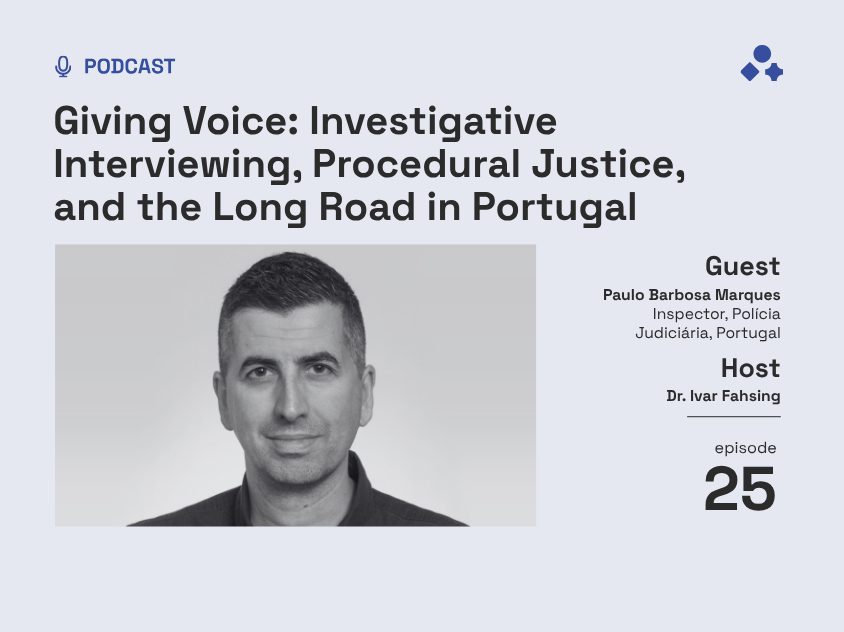
Episode 25. Giving Voice: Investigative Interviewing, Procedural Justice, and the Long Road in Portugal
Paulo Barbosa Marques has a simple way of describing the ethos of investigative interviewing: it is about giving voice. Giving the person in front of you — whether suspect, witness, or victim — the genuine opportunity to tell their own story, without it being contaminated by the investigator’s interests or assumptions.
In this episode of Beyond a Reasonable Doubt, Dr Ivar Fahsing speaks with Paulo Barbosa Marques — Inspector at Portugal’s Polícia Judiciária, forensic psychologist, and one of Portugal’s leading advocates for science-based investigative interviewing — about what it takes to implement that ethos in a country without a national training framework, without published interviewing guidelines, and without systematic recording of suspect interviews.
They discuss the difference between a confession culture and a culture that simply has not caught up with the science; what it means to help a suspect make a genuinely informed decision about whether to speak; why the macho culture in policing costs far more than it gains; and what Portuguese judges and prosecutors say about the value of recorded interviews — even before recording is mandated. And they debate honestly: on a scale of zero to ten, where is Portugal today?
About the guest
Paulo Barbosa Marques
Paulo Barbosa Marques is an Inspector at the Polícia Judiciária — Portugal’s Criminal Police — and a licensed clinical and forensic psychologist. His career has spanned three law enforcement agencies: the Polícia de Segurança Pública, the Immigration and Border Service (SEF), and the Polícia Judiciária, where he works in serious criminal investigation. He is a former second lieutenant in the Portuguese Army Special Operations Force.
Paulo Barbosa Marques holds a master’s degree in law and security from NOVA University of Lisbon and is currently a Legal and Forensic Psychology PhD student at the University of Santiago de Compostela. He is an associated researcher at BSAFE LAB (Universidade da Beira Interior), a founding member of the Portuguese Society of Psychiatry and Psychology of Justice, and the iIIRG Regional Champion for Portugal. He is a member of the Management Committee of the COST Action CA22128 — IMPLEMENDEZ — establishing networks to implement the Méndez Principles on effective interviewing globally.
He is the co-editor, with Mário Paulino, of Police Psychology: New Trends in Forensic Psychological Science and Psychopathy and Criminal Behavior: Current Trends and Challenges, both published by Elsevier. His research spans investigative interviewing, crisis intervention, hostage negotiation, and the application of communication science to law enforcement and public order policing.
Watch and listen wherever you get your podcasts (YouTube link here)
Related products


Transcript
Guest: Paulo Barbosa Marques, Inspector, Polícia Judiciária, Portugal
Host: Dr Ivar Fahsing
Dr. Ivar Fahsing [00:00]
A warm welcome to you, Paulo Barbosa Marques from Portugal, to this episode of Beyond a Reasonable Doubt. We are so happy to have you on our podcast.
Paulo Barbosa Marques [00:19]
Thank you so much for your invitation, Ivar. This is like a conversation between good friends, isn’t it? An opportunity to exchange some of our ideas and some of our previous conversations on this topic — and, as you know I am always saying, to practise my English with you. I see it as a good conversation. Thank you for the invitation and for letting me be part of this amazing podcast. I love it.
Dr. Ivar Fahsing [00:57]
Yes, Paulo, I am so happy that you are here. The topic of this season is the implementation of investigative interviewing around the world, seen from different perspectives — especially from a practitioner’s point of view. You and I know each other quite well now and can consider each other good friends. But our listeners may not know you that well, so perhaps you could give a short introduction to your background and your interests.
Paulo Barbosa Marques [01:35]
Of course. As you said, my name is Paulo Barbosa Marques, from Portugal. I am a police inspector at the Polícia Judiciária — the Criminal Police. I should say that I am here speaking in my own capacity and do not necessarily represent the views of my organisation. This is a conversation between friends.
[01:35]
As a police officer I have worked in three law enforcement agencies. Currently I am at the Polícia Judiciária. Previously I was at the Serviço de Estrangeiros e Fronteiras — the Immigration and Border Service. Before that, I served in the Polícia de Segurança Pública, which is the public security police responsible for safety in cities, public order policing, and community policing — a large organisation. That is where I began my law enforcement career. And before policing, I was a second lieutenant in the Portuguese Army Special Operations Force.
[01:35]
My academic background is in psychology. I am a licensed clinical and forensic psychologist and I have kept my licence current because I want to remain involved in bringing psychological science to our police forces. I also conduct research — not only on investigative interviewing but also on crisis intervention, the application of human communication concepts to law enforcement, hostage negotiation, and the use of communication models in public order policing. My aim is always to bring psychological science to practice, to improve practice, and to improve police legitimacy and public trust.
Dr. Ivar Fahsing [04:01]
And you are also, as far as I know — because I have been lucky enough to contribute to it — the editor of the book Police Psychology: New Trends in Forensic Psychological Science, together with Mário Paulino.
Paulo Barbosa Marques [04:15]
Yes — Police Psychology, and also Psychopathy and Criminal Behavior. Both were published by Elsevier. When I first had the opportunity to work on Police Psychology it felt like something very precious to me. That is where I met you, by inviting you to write a chapter. I thought: this cannot be just me and Mário writing about such a broad field. We need to invite the people who can genuinely contribute to each topic. I believe we assembled a remarkable group of authors. Police psychology is more established in the United States — we do not talk about it nearly enough in Europe. The idea was to reflect on the extraordinary contribution psychology has to make to law enforcement, to police officers and their families, to communities, and to mental health. Psychology has so much to give to our police academies, where the syllabus is heavily weighted towards law. We need to bring more psychological science into those curricula.
Dr. Ivar Fahsing [06:36]
I share your view entirely. I just wanted to mention the book because it is quite a rare thing — our listeners should definitely look it up. It is available as an e-book as well as in hard copy, I believe?
Paulo Barbosa Marques [06:52]
Yes — you can find Police Psychology as an e-book or in hard copy through Elsevier and Amazon. And Psychopathy and Criminal Behavior is also a very interesting book — it even includes a chapter on investigative interviewing with psychopaths.
Dr. Ivar Fahsing [07:38]
Excellent recommendations. Both are well worth reading. The topic of today’s conversation, Paulo, is the impact of investigative interviewing on police practice — and we will see if there is time to go into some of the easier things to implement and some of the harder ones. But before we get to the Portuguese context specifically, I would like to hear your personal view: what would you say is the ethos of investigative interviewing? What does it really mean to you?
Paulo Barbosa Marques [08:25]
When I think about the ethos of investigative interviewing, I think about procedural justice. I think about giving voice — giving someone who is accused of a crime, or who has witnessed a crime, the genuine opportunity to provide their own account: their perceptions, what their senses registered at the scene, their own story of what happened. It is not only about the application of a technique or a framework. The ethics behind it are really important. It is about the pillars of procedural justice, and it is connected to the perception of legitimacy. Everyone should have the opportunity to provide their own view of what happened and how it happened — without the contamination of others, including the investigator.
Dr. Ivar Fahsing [10:04]
Exactly. That is a very interesting perspective — that everyone should have their voice heard in a way that is contaminated as little as possible by the view or the interests of someone else, including the officer. You are the first guest this season to frame it quite in those terms, and I think it is really interesting. I would like our listeners to reflect on how many different perspectives there can be on what investigative interviewing actually is. Let me take it a little further, Paulo: moving this to a Portuguese context, why do you think it is important to implement investigative interviewing in Portugal?
Paulo Barbosa Marques [11:01]
I think it is important to implement evidence-based, science-based procedures. We can have a long discussion about terminology — ‘evidence-based investigative interviewing’, ‘science-based investigative interviewing’, different frameworks, PEACE and others. What I really believe is that if we want to reflect on accountability — accountability in the courtroom — we need to be able to explain how we gathered that testimonial evidence. Just as with physical evidence, we have to respect the chain of evidence. When we are talking about listening to people, that same accountability must be present in our work. And to be accountable, we need to bring psychological knowledge into our practice — what we have learned from memory research.
[11:01]
That is why when we begin any training in investigative interviewing, we need a module on memory, of course, and a module on law and ethics. Nowadays we also need to reflect on the Méndez Principles. We cannot just conduct interviews and say: ‘That’s how we always did it. That’s what I learned from my older colleague.’ We need a framework. Should it be tiered, with levels? Should it be PEACE or KREATIV? I am less concerned about which framework than that it be genuinely evidence-based, and that the training be scenario-based and professional — because we are talking about evidence that will be used in court and can determine a person’s life.
[11:01]
It may also determine public trust in the institution. In a major case, with journalists covering proceedings, if someone is challenged in court — ‘How did you obtain that evidence? How was that conducted?’ — and if an expert witness such as Dr Ivar Fahsing is called to explain what professional practice looks like, it becomes very difficult for the other side if they cannot demonstrate they followed established standards. That is why I believe we need to bring science-based investigative interviewing to all our law enforcement agencies. We do not need to wait for high-profile miscarriages of justice. The science is there for us to use.
Dr. Ivar Fahsing [15:57]
When it comes to Portugal specifically — would you say Portugal has, or has had, a confession culture?
Paulo Barbosa Marques [16:08]
I do not think we have a confession culture. Not at all. Portugal has a strong tradition of respect for human rights — it was one of the first countries to abolish the death penalty, for example. We have significant legal safeguards. You cannot easily convict someone on the basis of a confession alone; there needs to be corroborating evidence on the case file. I believe some officers from the 1980s and 1990s were influenced by the Reid Technique, but that is quite normal — not only in Portugal. Police organisations around the world looked at the United States approach and assumed that if it was done there, it must be the right way. The same happened in negotiation and other fields. That change of mindset needs to come from within, from people who are both police officers and researchers, who can look at the evidence and say: we have done it this way for four decades because we thought it was correct, but when I look at the research and at countries like the UK, Norway, and New Zealand, I can see there are better ways. So let us change.
[16:08]
We do not have a confessional culture, but in our training across different organisations we are working on it — at least in my own organisation. But we need to do it systematically across all organisations. The mindset is the critical thing. I do not conduct a suspect interview for the purpose of obtaining a confession. I want the person to talk. And in Portugal, even a confession obtained at the investigation stage is not evidence in chief — all evidence must be given again in court. A person may confess to the police and then say in court: ‘I said what I said because I was under pressure, they kept me in the room for six hours.’ What happens in court is what really counts. So why would I conduct an interview to obtain a confession? I want the person to talk, and that may open new lines of investigation. I am not looking for a confession.
Dr. Ivar Fahsing [20:10]
What do you do then when a suspect does not want to talk?
Paulo Barbosa Marques [20:14]
That is the hardest question. That is where we talk about building platforms, isn’t it? They have the right to remain silent, and many exercise that right with their lawyer present. What I always try to do — and I have to remind myself not to drift towards the approaches that talk about using influence to obtain confessions — is to be as neutral as possible while ensuring the person can make a genuinely informed decision.
[20:14]
I tell them: yes, that is your right. But perhaps this is the first time someone is here to listen to your side of the story. Before the trial, it may be your only opportunity. Your lawyer is here and I respect their advice, but I am not here to judge you. I think it is important to give you the chance to provide your explanation of what happened. I invite you to do that if you wish — you will not be judged. I try to build real rapport and make the person feel that this can be a genuine conversation. But I completely respect procedural safeguards and train officers to do the same.
[20:14]
What I find difficult is when a lawyer arrives, the suspect immediately says nothing, and the lawyer does not even take two minutes to understand what happened. They were appointed, they are being paid for their time, and their immediate instruction is: do not say anything. I want the person to make an informed personal decision — not a decision made for them by someone who has not even engaged with the facts. I do not try to condition them. I just want them to know: these facts may benefit from your version of events. Make your own choice.
Dr. Ivar Fahsing [22:19]
I completely understand. I am pushing a little philosophically here, but I think it goes to the core of investigative interviewing. In Norway, we have moved towards a model where the interview training is essentially the same regardless of who you are interviewing — suspect, witness, or victim. I think that has been an important change. It takes away the pressure and the expectations from the officer. And it sends a message to the person in the room: you are in safe hands. No one is trying to manipulate you or pretending to be your friend in order to get something back. For me, that is probably the most important shift — what I often call the operationalisation of the presumption of innocence.
Paulo Barbosa Marques [30:22]
Exactly. And there is another layer to what you are saying when you train officers to interview in the same way regardless of who is in front of them — it sends a very clear message about what the mindset should be. And that is where real change begins: when we are able to change the mindset. In many jurisdictions, the problem is also a macho culture — the idea that to do it well is to do it the hard way. We see this in public order policing too: why use communication when you could use force? But when you look at the liaison-based models — officers communicating with crowds, facilitating people’s legitimate interests, identifying those causing trouble — the results speak for themselves. We need that same mindset inside the interview room. And if an officer’s thinking is conditioned by an armour of tough culture, you can bring the best trainers in the world, but if the ears are not open, the mindset will not shift. That is why it is also important to bring more women into this space — they contribute enormously.
Dr. Ivar Fahsing [32:49]
Can you say something more about that? It is a really interesting perspective, and I appreciate you sharing it so openly. When we were implementing KREATIV — the Norwegian version of PEACE — in the Norwegian Police, there was considerable resistance. People said: we don’t have time for planning. You come from a major crime unit, you have time — we are the real police. And there were always arguments about needing to be tough with suspects, bang the table, demand the truth. But I remember vividly, after one of my lectures for a force south of Oslo, a woman came up to me — very experienced, she had worked at the National Homicide Squad and was now back at her local force, a forensic child interviewer. She said: thank you. Because now, finally, what you are describing makes me want to do suspect interviewing again. For ten years I have felt this was a macho arena where you are expected to go in hard and judgmental. But you are telling me the opposite — that my skills as a patient, empathetic, good-listening child interviewer are probably also the best skills for interviewing suspects. Thank you for opening that door. And that was almost thirty years ago. What I see now in the toughest homicide squads in Oslo is that the majority of the best suspect interviewers are women.
Paulo Barbosa Marques [35:43]
What I want is better gender balance — because I believe men can learn from women how to take off the body armour and be a little more vulnerable. Not only in policing, but in life. I come from the Special Forces — that is something I carry with genuine pride. And yet I know from my whole career that being operational is not the same as being macho. I know colleagues who have spent their careers in intervention units and been brought before courts for malpractice, and if I ask them to name one genuinely good piece of work — one arrest where skill and ethics carried the day — I struggle to find an answer. Using force is not the same as being professional. You can be kind, respectful, ethical, and vulnerable, and be an outstanding operational police officer. Society is not black and white. There are more colours. We cannot go into the streets or the interview room thinking that life, or a case file, or a crowd, is black and white.
[35:43]
Our officers are also struggling — with low salaries, with being posted far from home for twenty years, with burnout, with losing sight of why they came into the profession. They need good colleagues, good teachers, someone to remind them of the passion behind this job. Because somewhere along the way, some of them lost it. They fell into the tough culture, into using force as the default, and forgot that the real beauty of policing is to resolve the hardest situations with words alone. We will learn a great deal from women in this field.
Dr. Ivar Fahsing [41:14]
Paulo, if I ask you on a scale of zero to ten — where zero is no implementation of investigative interviewing and the ethos we have been discussing, and ten is full implementation — where would you say Portugal is today?
Paulo Barbosa Marques [41:50]
You are bringing numbers into this — as society does. Let me be clear that I am speaking about the Portuguese context as a whole, not only my own organisation. Portugal does not have a national training framework covering all investigative organisations. We do not have one for prosecutors either. We have only four or five researchers working on this topic. We do not have published guidelines on how to interview vulnerable witnesses, children, autistic children, or suspects. What saves us is our strong procedural safeguards and the rule of law — a legal tradition that is deeply secular and deeply respectful of rights. Without those safeguards, I believe we would have seen miscarriages of justice. And I would add: miscarriages of justice do not only happen in criminal proceedings. Denying someone asylum because an interviewer failed to gather their full narrative is a miscarriage of justice. The implementation of investigative interviewing has implications well beyond criminal investigation — forced returns interviews, asylum interviews, disciplinary interviews within police organisations.
[41:50]
If you push me for a number — I would say six, because I can see the opportunities. I can see good people and good leadership trying to bring this forward. We held a major event this year at the Polícia Judiciária, which was well received. I can see people engaging with international research. If we needed to produce operational guidelines tomorrow, we have the people to do it — we just need someone to say: let’s do it, let’s set up the working group. But I understand if you think six sounds too high.
Dr. Ivar Fahsing [47:35]
I am perhaps being rude, but I think six sounds too high. If you do not have mandatory training, if you do not have a system that defines who receives what level of training, and if you do not have national guidelines, I would probably put Norway at six or seven — and we still have significant room for improvement in follow-up training and accreditation. When you say six, I think you are describing the potential rather than the current reality.
Paulo Barbosa Marques [48:25]
Yes — potential, you are right. And I understand completely. You are at a stage in Norway where you can focus on specific refinements and each one will represent a meaningful step forward. In Portugal, if we were to establish a training framework and publish national guidelines, it would be like a decade’s worth of progress in a single step. I brought Professor Becky Milne to Portugal in 2014 — my first conference talk on cognitive interviewing was in 2013, more than ten years ago. We have been editing books, inviting authors, running conferences, workshops, training events. And we still have not secured the systematic attention we need — from an interior ministry or equivalent — to say: let’s see how the UK and Norway do this and apply it here. On so many topics, politicians look to other jurisdictions and copy. But some subjects, regardless of what researchers and practitioners say, simply do not attract that attention. And if we look at what has driven change in other countries, it does seem as though a high-profile miscarriage of justice is often what finally triggers action. I do not want that to be what it takes. I do not want to wait for that.
Dr. Ivar Fahsing [51:03]
No. And that is precisely what happened in Norway — a couple of very high-profile miscarriages of justice that became the tipping point. We woke up from our comfortable assumptions about ourselves and said: perhaps Norway is not so innocent after all. Perhaps this small country near the North Pole needs to act to bring its self-image into line with reality.
Paulo Barbosa Marques [51:43]
We should prevent that from becoming our story too.
Dr. Ivar Fahsing [52:22]
Since we are making this podcast for Davidhorn — a company committed not only to technology but to better justice — what is the current practice in Portugal when it comes to recording suspect interviews?
Paulo Barbosa Marques [52:51]
Definitely not all interviews are recorded — not even in serious cases like homicides or sexual crimes. We also need project managers who can apply for European funding — Horizon Europe and similar programmes — to secure the equipment. After investment in equipment would come investment in training, and then we can genuinely start. We do not currently have the equipment at scale.
[52:51]
My position is clear: we should be recording all interviews. And we should be thinking about possibilities like what Davidhorn offers — automatic transcription, which gives the investigator the freedom to be fully present in the conversation. Because rapport is not only about establishing it — it is about maintaining it. If you are constantly looking down at what you are writing, asking the person to stop and repeat themselves so you can catch up, it is impossible to maintain rapport. Impossible.
Dr. Ivar Fahsing [54:33]
I would go further and say it is impossible to maintain free, uncontaminated recall. I have been analysing interviews conducted by the Norwegian Immigration Service, where they write during the interview — which we generally do not do in the police. What I see is that the interviewee becomes a slave to the interviewer’s report. Not free to follow their own memory. The interviewer decides when to start and when to stop. The witness’s account is shaped by the pace of someone else’s pen. And that is highly problematic for how memory actually works.
Paulo Barbosa Marques [55:37]
In my view, those kinds of transcripts are not even evidence of what the person said — because they are not what the person said. They are an interpretation. ‘When asked if he was there, he said that he was there.’ You are speaking in the third person. I try to avoid that by using direct quotation wherever possible — writing exactly what was said, including if the person uses strong language. I have had suspects ask me: ‘Are you going to write that down?’ And I say: imagine there is a camera here. I am writing exactly what you say. I use a lot of direct quotation to avoid turning testimony into interpretation. It is not perfect — it is not a recording. But at least it tries to represent what the person actually said.
[59:21]
Recording is about reliability. And when I asked judges and prosecutors about this in a training session in Portugal, the response was very clear: even knowing that recorded interviews are not evidence in chief under our current law, judges said they would give significantly more weight to testimony from a recorded interview. They also said — and I heard this repeatedly — ‘record your interviews, because we do not know what happens inside that room, and these written transcripts tell us very little.’
Dr. Ivar Fahsing [01:01:13]
Our conversation could go on all day. Thank you, Paulo — for a genuinely open, honest, and thoughtful discussion. And please forgive me for the leading questions along the way.
Paulo Barbosa Marques [01:01:42]
Thank you so much, Ivar. And please don’t forget to show me the transcript before I sign it — I want to read it first. Thank you so much. It is always my pleasure.
END OF TRANSCRIPT
© 2026 Davidhorn. All rights reserved.