“Whatever You Say Will Be Taken Down in Writing”: What Handwritten Records of Suspect Interviews Leave Out
(Webinar with Dr. Adrian Gates.)
Fill out the form to watch the webinar. Please fill in all required fields (*) before submitting your inquiry.
In this keynote, Dr. Adrian Gates presents findings from his doctoral research into a question most justice systems rarely ask: how accurately do handwritten records capture what’s being said during suspect interviews? Ireland makes the question testable, because suspect interviews there are both audio-visually recorded and written down. Dr. Gates compared 15 real-world recorded suspect interviews with the written statements produced from them. The results raise serious questions about the evidential weight given to handwritten statements. They also build an evidence-based case for putting the recording first.
What the webinar covers:
Lessons from miscarriages of justice: How cases in England and Ireland led to legislative reform
A unique real-world dataset: 15 suspect interviews covering offences from burglary and fraud to sexual assault and murder
The maths of the interview room and what goes missing: Suspects in custody speak at an estimated 150–200 words per minute, while interviewers write at around 30
Inverting the evidential hierarchy: The case for treating the audio-visual record as primary evidence, with handwritten notes serving only as a navigational aid.
About the guest:
Dr. Adrian Gates is a former detective and sergeant in An Garda Síochána, Ireland’s national police service, where he specialised in serious and complex crime. He led the development and implementation of investigative interview training and strategic interview policy in Ireland, and he introduced the Cognitive Interview to criminal investigations in the Republic. Dr. Gates completed his doctorate at the University of Portsmouth, researching the evidential consistency of written records from suspect interviews. He is a member of the International Investigative Interviewing Research Group (iIIRG) and the University of Portsmouth’s Centre of Forensic Interviewing. He is CEO of Mosney Unlimited Company and Managing Director of Insight Interviewing Ltd, which provides scientifically based, ethical investigative interviewing training and advice to the public and private sectors.
Innovation in Policing: AI, Crime Scene Technology and the Future of Investigative Work.
(Webinar with Dr. Bente Skattør, Kjeld Hendrik Helland-Hansen and Oddvar Moldestad.)
Fill out the form to watch the webinar. Please fill in all required fields (*) before submitting your inquiry.
This webinar brings together three of Norway’s leading voices on innovation in policing — working at the intersection of AI, crime scene investigation, and investigative interviewing. The conversation covers what’s actually changing on the ground: from voice-to-text in the interview room to hands-free documentation at the crime scene, and the cultural and organisational challenges of scaling innovation inside a large public institution.
What the webinar covers (bullet points for the page):
AI for investigative interviews — How Oslo Police District is deploying speech-to-text technology to reduce manual transcription across Norway’s 150,000 annual investigative interviews, and what that means for investigator focus and case quality
Crime scene documentation, reimagined — How West Police District’s CSI team is using smart headsets, voice-controlled logging and AI-assisted report generation to cut documentation time and free up capacity across the forensic workforce
From proof of concept to scale — The challenge of moving fast in a bureaucratic institution: why sandboxed, task-focused innovation works better than waiting for whole-platform solutions
Accountability and the human in the loop — Who is responsible when AI transcription gets something wrong, and how the team has built review and verification into their workflows from the start
Innovation under pressure — What a Norwegian Navy crisis exercise revealed about how these tools perform when stakes are high and time is short
International reach — How Norwegian innovation is now influencing police forces across Europe, including in Germany, the Netherlands, the UK, Switzerland and beyond, and why cross-border knowledge-sharing matters
"*" señala los campos obligatorios
Dr. Bente Skattør is Project Lead and Innovation Lead for AI for Interviews at Oslo Police District. She leads one of Norway’s most recognised police innovation programmes — recognised with a Europol Innovation Award, a National Digitalisation Award nomination, and a Global Innovation Prize in Brazil. Bente is a regular contributor to international discussions on responsible AI in law enforcement.
Kjeld Hendrik Helland-Hansen is a forensic investigator at West Police District with over 20 years of experience at crime scenes. He is co-lead on the CSI Innovation Project, which is developing hands-free documentation tools for crime scene investigation, and has presented the project to police forces across Europe.
Oddvar Moldestad is a forensic investigator and long-standing CSI innovator at West Police District. He has been central to field-testing and expanding the headset-based documentation system, including at the Norwegian Navy crisis exercise and at a climbing-site pilot with Swiss mountain police.
This conversation is a candid look at what innovation looks like from the inside — built by practitioners, tested in the field, and shaped by a belief that technology should serve investigators, not the other way around. It is essential viewing for anyone working at the intersection of law enforcement, technology and justice.
When an Interview Decides a Future: Why Recording Process Matters in Asylum Interviews
Personal interviews with immigration and asylum seekers often determine the outcome of a case. What is said, how it is said and how it is interpreted may later be reviewed in appeals or audits. Recording these interviews is therefore not only a regulatory requirement. It is a safeguard for fairness, transparency and institutional credibility in the asylum procedure.
Recording immigration interviews as a foundation
In-person immigration and asylum interviews are central to every immigration process. Decisions rely on detailed and sometimes life-defining testimony. Accurate documentation is, therefore, not just technical; it is procedural integrity.
Under EU Pact on Migration and Asylum rules, personal interviews in asylum procedures must be audio recorded. This includes the main interview where the applicant explains why they are seeking protection (the substantive interview), as well as interviews used to determine which EU state is responsible for handling the case: for example, based on where the person first entered the EU, was registered, or has family connections.
However, recording the interview is not enough. The recording must also be clear, secure and able to withstand legal review.
Summary
Asylum interviews are high-stakes — recordings must be accurate, secure, and legally robust to protect both applicants and authorities across appeals and audits.
EU regulations (EUAA guidance, EU Pact on Migration and Asylum) require audio recording of personal asylum interviews, but the quality, security, and handling of those recordings are equally critical.
Davidhorn’s solutions — built to police and judicial standards — bring tamper-proof storage, clear audio capture, structured workflows, and AI-assisted transcription to immigration settings, reducing post-interview workload while reinforcing procedural fairness.
Why immigration interview recording matters
An immigration interview recording provides an objective record of what was said and how it was said. Applicants may be in a vulnerable or emotionally sensitive state during these interviews, which makes accurate and complete documentation particularly important. Tone, pauses, silences, emotional expressions and interpreter translations are preserved. This reduces the risk of inconsistencies in the written record.
High-quality refuge interview recording should:
Safeguard procedural rights
Support first and second-instance decision-making
Strengthen trust in sensitive immigration proceedings
Protect both applicants and authorities
Legal requirements in asylum interviewing
Multilingual interview recording in asylum environments requires more than pressing “record”. EUAA guidance emphasises that recordings must be accurate, clear and intact and how the audio file is handled afterwards is critical. Authorities must ensure to have in place:
Professional microphone and suitable acoustics
Clear start, pause and stop procedures
Automatic or continuous saving to prevent data loss
Structured naming and metadata
Accessible file formats for appeal review
Integration with case management systems
Secure storage with encryption, access logs and audit trails
Defined retention management and governance procedures
In short, an evidential interview recorder used in this context must meet the same standards expected in police and judicial environments: tamper-evident, secure, and legally robust. Corrupted files, missing segments or unclear audio can undermine the entire process. This is where technology becomes part of procedural fairness.
Davidhorn solutions for immigration and asylum authorities
Davidhorn’srecording solutions were developed for police and investigative interviews, where chain of custody and legal scrutiny are standard expectations.
For immigration and asylum authorities, this means having an interview recording solution that aligns with EU standards, while ensuring operational simplicity. Clear audio capture, structured workflows and tamper-proof file governance make sure that recordings can withstand legal review, while AI-assisted transcripts and searchable timestamps reduce post-interview workload. This creates a predictable, lower-stress interview environment for both interviewees and the officers handling sensitive and often complex cases.
Davidhorn interview recording tools offer:
High-clarity multi-microphone configurations
Time-stamping and bookmarking for efficient review
Pause and resume functionality without file disruption
Automated naming, structured metadata and automatic backup
Interoperable record and file formats that integrate with centralized evidence systems
Encrypted storage with permission-based access and full audit logging
Configurable retention policies
Reliable recording for in-person interviews
When every word matters, the interview recording tools for immigration and asylum seekers must do their job accurately, securely, and without doubt.
High-integrity audio recording captured on Davidhorn interview tools does not replace procedural fairness. It reinforces it.
Norway’s Justice Reforms: A Global Benchmark for Evidence-Led Investigation
Principles recognised as essential to justice integrity are systematic documentation, transparent investigative reasoning, and clear audit trails. The landmark Norwegian inquiry NOU 2026:3 validates this vision – and points to a future where structured, evidence-led practices should become a global standard.
As Børge Hansen, CEO of Davidhorn, observes: “ The handling of the Baneheia case demonstrates the need for reform. As highlighted by the independent committee behind the NOU 2026:3 report, there is a clear and present need to support justice integrity by building robust and systematic documentation, transparent investigative reasoning and clear audit trails. It also emphasises the need for a ‘second pair of eyes’ and greater competence and standardisation, particularly around technical evidence.”
The report’s recommendations shows that investigative technology must do more than simply record – it must actively support rigorous, transparent reasoning that can withstand independent scrutiny. NOU 2026:3 sets out precisely what that scrutiny demands.
Summary
Norwegian inquiry NOU 2026:3 calls for a fundamental shift from suspicion-based investigations to systematic testing of competing explanations
Report identifies confirmation bias as central risk and recommends structured documentation of multiple hypotheses and investigative reasoning
Børge Hansen links reforms to Baneheia case, emphasising need for robust documentation, transparent reasoning and “second pair of eyes” approach
Technology must actively support rigorous, transparent reasoning that withstands independent scrutiny – not just record events
If implemented, reforms could place Norway at forefront of international efforts towards transparent, evidence-led justice systems
A major government inquiry into wrongful convictions might transform how criminal investigations are conducted in Norway, carrying implications far beyond its borders.
The report, NOU 2026:3, calls for a fundamental shift in investigative practice – from building cases around suspicion to systematically testing competing explanations. Investigators must actively challenge their own assumptions, document their reasoning, and ensure that their conclusions can be independently scrutinised.
The inquiry identifies confirmation bias – the tendency to favour information that supports an existing belief – as a central risk to investigative accuracy. It recommends structured methods that require investigators to formulate, test, and document multiple hypotheses and to clearly record how conclusions were reached.
The report also emphasises the need for increased transparency and accountability. Stronger documentation of investigative reasoning, it concludes, is essential to ensure that courts and oversight bodies can properly evaluate the reliability of evidence.
Built on decades of reform
These recommendations build on reforms that began roughly 25 years ago with the introduction of the KREATIV investigative interviewing model in Norway. Developed to move police work away from confession-driven approaches, the model emphasised open-minded inquiry and systematic evaluation of evidence.
Since then, these principles have been further developed through research, professional training, and national police education, leading to a gradual shift towards more structured, evidence-led investigative practices.
The inquiry also highlights the growing role of technology in strengthening investigative reliability. Beyond recording court proceedings, it recommends digital systems that can document investigative reasoning, organise complex evidence, and create clear audit trails showing how conclusions were reached. Such tools, the report suggests, could help investigators test competing hypotheses more systematically, reduce the risk of bias, and ensure that decisions remain transparent and reviewable.
From national tragedy to international example
The inquiry follows a series of tragic miscarriages of justice that have profoundly affected those involved and shaken confidence in the justice system. Yet observers suggest the reforms could turn those failures into a driver for progress.
If implemented, the recommendations may place Norway at the forefront of international efforts to create more transparent, reliable, and evidence-led justice systems.
Dr Ivar Fahsing, who, together with Dr Asbjørn Rachlew and Prof. Karl Ask, submitted an expert opinion to the commission on investigative practice and the evaluation of evidence, says the report represents an important milestone.
“I am impressed by the clearness and ambition of the recommendations,” he said. “If they are implemented, this could lead to a significantly safer and more evidence-led justice process.”
He added that the report demonstrates a deeper intellectual shift in how investigations and the evaluation of evidence are understood.
“It reflects a crucial convergence of philosophy, psychology and law – recognising that once an accusation is made, it becomes a knowledge claim that must be rigorously and transparently tested. In today’s highly complex information society, more structured methods and the responsible use of new technologies are essential to ensure that the reasoning behind criminal justice decisions is clearly documented and open to scrutiny. This requires all actors – from investigators to prosecutors – to demonstrate how alternative explanations consistent with innocence have been carefully examined and excluded. By making the pathway to proof explicit, this approach strengthens the burden of proof and reaffirms a foundational principle of justice, rooted in early Roman law, that the responsibility to prove guilt rests entirely with the accuser. Its full implementation would place Norway at the forefront of international legal reform, setting a new benchmark for transparency, accountability and evidential integrity in criminal justice.”
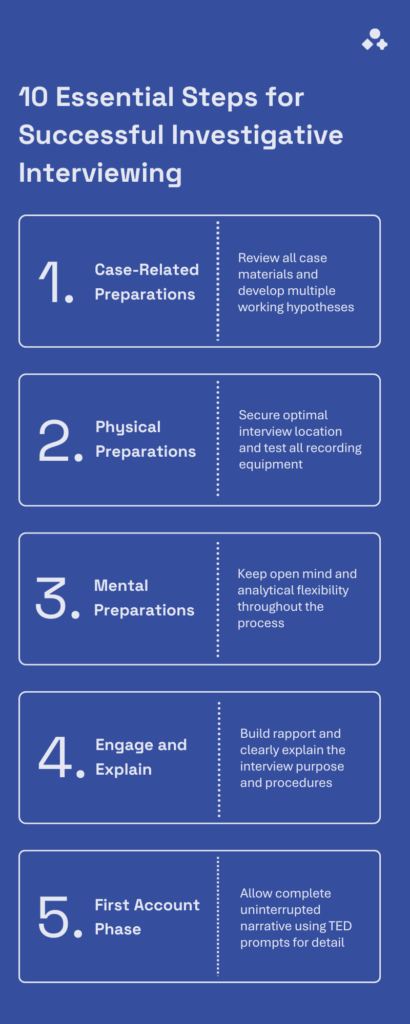
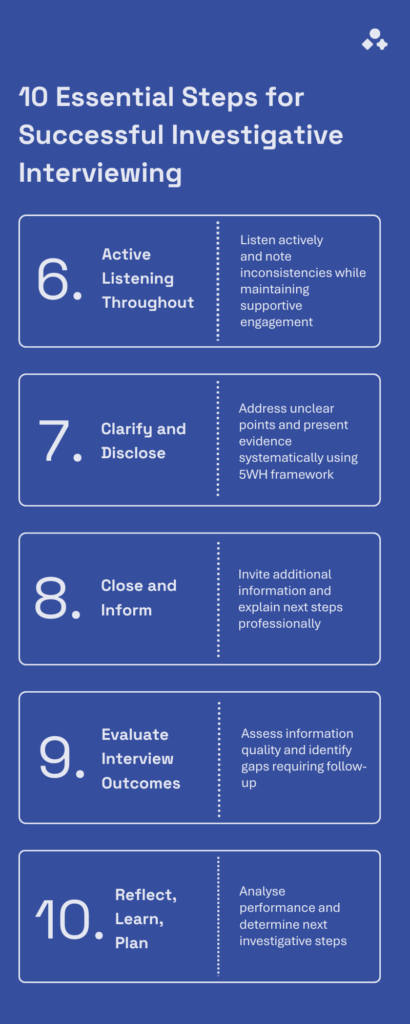
The 10 Essential Steps for Successful Investigative Interviewing
Professional investigative interviewing is a systematic process that requires meticulous preparation, skilled execution, and thorough evaluation. Drawing from established protocols and best practices, we present a 10-step framework that ensures effective, ethical, and legally sound interviews.
Step 1: Case-Related Preparations
The foundation of any successful interview lies in comprehensive case preparation. Review all available investigation materials, evidence, and documentation thoroughly. Develop multiple working hypotheses rather than pursuing a single theory. Consider the interview’s aims and objectives clearly, and analyse the interviewee’s background, including their rights and any particular needs they may have.
This preparation phase is crucial for addressing all information needs, maintaining objectivity and ensuring you’re equipped to handle various scenarios that may arise during the interview process.
Step 2: Physical Preparations
Secure an optimal investigative interview location with minimal distractions and suitable conditions for effective communication. Ideally, the environment should be distraction-free yet comfortable, enabling clear dialogue without external interference.
Summary
Comprehensive Preparation is Essential – Successful interviews require thorough case review, optimal physical setup with tested recording equipment, and mental readiness with multiple working hypotheses.
Build Trust Through Professional Engagement – Apply the HEAR principle (Honesty, Empathy, Autonomy, Reflection) to establish rapport, explain procedures clearly, and assess interviewee vulnerability and legal requirements.
Allow Free Narrative Before Probing – Let interviewees provide complete uninterrupted accounts using TED prompts (Tell, Explain, Describe), then systematically clarify using the 5WH framework (Who, What, When, Where, Why, How).
Evaluate and Reflect for Continuous Improvement – Assess whether interview objectives were met, analye your performance techniques, document lessons learned, and plan next investigative steps based on obtained information.
Make necessary arrangements for legal representation, interpreters, or support personnel as appropriate to the case. Test all recording equipment thoroughly – Davidhorn’s professional A/V recording systems ensure reliable documentation with multiple backup options, providing the support essential for evidential integrity.
Step 3: Mental Preparations
Maintain an open mind and analytical flexibility throughout the process. Consider alternative hypotheses to the evidence and anticipate different scenarios that may unfold. Show empathy and genuine interest in the interviewee’s situation. Mental preparation involves setting aside preconceptions and preparing to adapt your approach based on the interviewee’s responses and demeanour.
This psychological readiness enables you to respond appropriately to unexpected developments whilst maintaining professional composure.
Step 4: Engage and Explain
Initiating Contact and Establishing Ground Rules. Apply the HEAR principle consistently: Honesty, Empathy, Autonomy, Reflection. This approach builds trust whilst maintaining professional boundaries and ensuring the interviewee feels respected throughout the process. Continuously assess interviewee vulnerability considering age, mental and physical health, trauma, and other risk factors. Implement appropriate legal safeguards and consider specialist involvement when necessary. Utilise communication aids to ensure effective dialogue throughout the process.
At the beginning of an investigative interview, the interviewer should:
Build rapport through empathy and respect.
Assess the interviewee’s well-being to ensure they are fit for the interview.
Clearly explain:
The case under investigation and the purpose of the interview.
For suspects: the grounds for suspicion – explain what and why (without disclosing detailed evidence).
For suspects: the right to legal counsel and the right to remain silent.
All legal and practical procedures, including audio/video recording.
That participation is voluntary (where applicable).
Establish Ground Rules. The interviewer should then set the following expectations:
Everything said matters – the interviewee should provide as much detail as possible, even if it seems minor (e.g., “describe my pen”).
Don’t filter – report everything, even if it seems irrelevant or uncertain.
Focus and effort – memory recall takes concentration and may be tiring.
Open communication – the interviewee should feel free to:
Ask if they don’t understand.
Say if they don’t know.
Correct misunderstandings or raise concerns about leading/inappropriate questions.
Interview structure – outline the topics to be covered, timing, and planned breaks.
Confirm understanding – ensure the interviewee grasps the information and how it applies.
Rapport building isn’t about manipulation – it’s about creating an atmosphere where communication based on mutual respect and facts can occur. This foundation is crucial for establishing trust and obtaining reliable information.
Step 5: First Account Phase
Allow the interviewee to present their complete account without interruption. Exercise strategic patience and maintain control by carefully pacing and actively listening, rather than jumping into questioning.
Use TEDS prompts (Tell, Explain, Describe, Show Me) to encourage detailed responses. Document PLATCOM elements systematically: People, Location, Actions, Times, Communication, Objects and Motives. This free narrative phase often reveals crucial information that targeted questioning might miss. Do not interrupt. Postpone your probing until the first account is entirely over.
Listen to our podcast on Investigative Interviewing
Step 6: Active Listening Throughout
Listen actively to understand the interviewee’s perspective and facilitate the flow of information. Use silence and non-verbal cues to demonstrate engagement. Note inconsistencies, gaps, and areas requiring clarification whilst maintaining supportive engagement.
Step 7: Clarify and Disclose
Systematically review new information, your interview objectives, address PLATCOM elements and address all unclear points and gaps before introducing evidence or new information. If applicable, present key information stepwise to test account accuracy whilst minimising memory contamination.
Ensure comprehensive coverage using the 5WH framework: Who, What, When, Where, Why, How. This systematic approach ensures no crucial elements are overlooked.
Step 8: Close and Inform
Conclude the interview professionally by inviting the interviewee to provide additional information or ask questions. Clearly explain next steps, contact procedures, and timeline expectations.
Express appreciation for their cooperation and end respectfully, regardless of case outcomes. This professional closure may prove valuable for future interactions.
Read our eBooks on how to plan Investigative Interviews
After the interview, conduct a structured evaluation to determine whether the objectives were achieved. This includes:
Assessing the quality and completeness of the information obtained in relation to the interview plan and investigative priorities.
Identifying gaps, inconsistencies, or unanswered questions that may require clarification or follow-up.
Evaluating the interviewee’s responses in light of known evidence and other case material.
This step helps ensure that the interview contributes meaningfully to the investigation and highlights any immediate follow-up actions.
Step 10: Reflect, Learn, and Plan Ahead
Following the evaluation of the content, reflect critically on your own performance as an interviewer:
Analyse your interview techniques – What worked well? What could have been done differently?
Identify areas for improvement in planning, communication, question style, rapport-building, and adaptability.
Document lessons learned to support your ongoing professional development and improve future interviews.
Determine and plan next steps in the investigation, such as re-interviews, new lines of inquiry, or further evidence collection.
This reflective phase ensures continuous learning and helps maintain high standards of investigative practice.
Conclusion
Successful investigative interviewing requires systematic preparation, skilled execution, and thorough evaluation. By following these 10 essential steps and maintaining focus on the core principles of Rapport, Empathy, Active Listening, and Professional Integrity, investigators can conduct interviews that are both effective and ethically sound.
The investment in proper technique and equipment, including professional recording systems that ensure complete documentation, pays dividends in terms of case outcomes and legal admissibility. Remember: the quality of your interviews determines the quality of your investigations.
Fill out the form to watch the webinar. Please fill in all required fields (*) before submitting your inquiry.
Our latest webinar, recorded during the Davidhorn Police Interview Summit 2025, was hosted by Magnus Green, Chief Technology Officer at Davidhorn.
Magnus provided an exclusive hands-on demonstration of our comprehensive investigative interview solution, showcasing over 40 years of research and development in action.
In this practical walkthrough, Magnus explored:
Complete interview workflow management – From initial planning through to post-interview analysis, demonstrating how technology supports the entire investigative process
Real-time interview demonstration – Live recording session showing seamless integration between planning, conducting, and monitoring interviews
Digital evidence integrity – How Digital Fingerprint SHA-256 and encryption protect evidence from tampering while maintaining court admissibility
Advanced transcription and AI assistance – Automated speech-to-text transcription capabilities with human oversight to ensure accuracy and reliability
Secure sharing capabilities – Controlled access systems for sharing evidence with legal representatives while maintaining audit trails and security
Flexible deployment options – Browser-based solutions that work across devices while respecting data sovereignty requirements
Magnus’s demonstration highlighted how modern interview management technology streamlines investigative workflows while maintaining the highest standards of evidence integrity. Built with input from practitioners to solve real-world problems, this solution enhances efficiency without compromising the quality or admissibility of evidence.
Discover how this proven technology transforms investigative interviewing from planning to courtroom presentation, supporting justice through innovation.
Fill out the form to watch the webinar. Please fill in all required fields (*) before submitting your inquiry.
Our latest webinar, recorded during the Davidhorn Police Interview Summit 2025, was hosted by Jeff Horn, General Manager of Davidhorn UK. Jeff brought decades of specialised expertise in ensuring that crucial investigative work translates into admissible evidence in court. In this comprehensive technical presentation, Jeff explored:
Scientific foundations of police interview recording – Drawing from the original UK trials that established PACE legislation and the lessons learned from historical cases like the Guildford Four
Audio as primary evidence – Understanding why clear, audible audio takes precedence over video, and the technical requirements for court admissibility
Room design and environmental considerations – Practical guidance on acoustic treatment, camera positioning, and creating optimal recording environments for both suspect interviews and vulnerable witness suites
Technology standards for tamper-proof police interview recording – The critical role of Digital Fingerprint (SHA-256), AES-256 encryption, and maintaining chain of evidence integrity
Specialised considerations for vulnerable witnesses – Technical adaptations needed for child interview suites and trauma-informed recording approaches
"*" señala los campos obligatorios
Jeff’s presentation highlighted how proper technical implementation of recording systems directly impacts the admissibility and quality of evidence, ensuring that the vital work of investigators and the courage of witnesses translates effectively into the courtroom. Discover how these evidence-based technical standards and proven methodologies support justice while protecting the integrity of both the investigative process and those who participate in it.
The birth of Barnahus: How Iceland revolutionised child protection
Behind the conversation
In a recent episode of “Beyond a Reasonable Doubt,” host Dr. Ivar Fahsing sat down with Bragi Guðbrandsson in Reykjavik to discuss one of the most significant innovations in child protection services. Their conversation revealed the fascinating story of how a small Nordic nation pioneered a model that would transform how Europe handles cases of child abuse.
Summary
System in Crisis: In the mid-1990s, Iceland discovered its child protection system was severely fragmented across 180 local committees, with children facing multiple interviews and re-traumatisation through the legal process, prompting a need for systemic change.
Revolutionary Solution: Bragi Guðbrandsson developed Barnahus (“Children’s House”), a revolutionary concept that united all child protection services under one roof, providing a child-friendly environment for forensic interviews, medical examinations, and therapy, despite initial resistance from medical and legal professionals.
International Impact: The Barnahus model has since spread to 28 European states, with each country adapting it to their specific cultural and legal frameworks while maintaining its core principle of child-centered protection, demonstrating how fundamental systemic change can lead to better outcomes for vulnerable children.
In the mid-1990s, Iceland faced a startling revelation. A groundbreaking research study showed that child sexual abuse was far more prevalent than anyone had imagined. The system meant to protect these vulnerable children was fragmented across 180 local committees, many serving populations of less than 300 people. Children were being interviewed multiple times, facing their alleged abusers in court, and experiencing profound re-traumatisation through the very process meant to help them.
The vision for change
Enter Bragi Guðbrandsson, who would become the architect of one of the most significant reforms in child protection services.
“We had over 100 cases per year being dealt with in different sectors – child protection, police, medical profession – but there was complete failure of the system to deal with these cases,” Guðbrandsson explains. The research revealed a disturbing lack of collaboration between agencies, an absence of professional guidelines, and children being subjected to repeated interviews.
Building the children’s house
The solution? Barnahus – literally “Children’s House” – a revolutionary concept that brought all services under one roof. But creating this haven for vulnerable children wasn’t without its challenges. The medical profession initially resisted, preferring to conduct examinations in hospitals. The legal community worried about neutrality, arguing that courthouses were more appropriate venues for taking testimony.
Proving its worth
Yet Guðbrandsson’s vision persisted. By creating a child-friendly environment where forensic interviews, medical examinations, and therapy could all take place, Barnahus dramatically improved both the experience of children and the quality of evidence gathered.
The impact was immediate and measurable. Research comparing children’s experiences in courthouses versus Barnahus showed stark differences. While children often encountered their alleged abusers in courthouse lifts or corridors, Barnahus provided a safe, non-intimidating environment that helped children share their experiences more fully.
A model that crossed borders
What began in Iceland has now spread across Europe, with 28 states adopting the model. But perhaps most fascinating is how Barnahus has evolved. As Guðbrandsson notes, “Barnahus is not a recipe for the cookshop of the future. Rather, you have in Barnahus the ingredients to make something that aligns with your culture, your legal framework, and your professional traditions.”
Adapting to local needs
This flexibility has been key to its success. Each country has adapted the model to fit its own legal and cultural context while maintaining the core principle: putting children’s needs at the centre of the process.
A legacy of change
The spread of Barnahus across Europe represents more than just the adoption of a new system – it represents a fundamental shift in how we think about protecting vulnerable children. It shows that when we prioritise the experience of those we’re trying to help, we often end up with better outcomes for everyone involved.
From that first centre in Reykjavik to dozens across Europe, Barnahus stands as a testament to what can be achieved when we’re willing to fundamentally rethink our established systems. It reminds us that sometimes the most effective solutions come not from incremental improvements to existing processes, but from daring to imagine an entirely new approach.
Transforming interrogation: A journey towards ethical interviewing
In the latest episode of “Beyond a Reasonable Doubt,” we had the privilege of hosting Professor Eric Shepherd, a towering figure in the field of investigative interviewing. This episode wasn’t just a discussion; it was a revelation of the profound shifts that have transformed interrogation practices from coercion to ethical interviewing.
Summary
From Coercion to Conversation: Professor Eric Shepherd highlights the historical shift from a “confession culture,” focused on coercion, to ethical interviewing, which prioritises respect, dignity, and open dialogue.
The Power of Respect: Shepherd underscores how treating interviewees with empathy and respect fosters trust and yields more truthful, comprehensive information during investigations.
Overcoming challenges: While ethical interviewing has gained traction, entrenched “confession culture” practices persist. Progress relies on continuous training, education, and a commitment to global standards of ethical investigative practices.
Professor Shepherd took us back to a time when interrogation was synonymous with coercion, a time when obtaining a confession was the goal, regardless of the means. He vividly describes a “confession culture” where the success of an interrogation was measured by its ability to extract a confession swiftly and efficiently. This approach, deeply ingrained in the culture of policing, prioritised results over the rights and dignity of the interviewee.
A paradigm shift in policing
The turning point came when ethical considerations started to infiltrate these traditional methods. Shepherd recalls the resistance he faced when introducing concepts of ethical interviewing in the 1980s. His work was initially met with scepticism and dismissal, seen as an academic ideal that was out of touch with the “real” world of policing. However, these ideas slowly gained traction, illustrating a growing recognition of the need for change.
Ethical interviewing: the new standard
Ethical interviewing, as Shepherd articulates, places respect for the interviewee at the forefront. It’s about seeing the person across from you not as a suspect to be broken, but as a human being worthy of dignity and respect. This approach isn’t just about being morally sound; it’s about effectiveness. Shepherd argues that respect fosters a more open dialogue, which is more likely to yield truthful and comprehensive information.
The role of respect
One of the most compelling moments in the episode comes when Shepherd discusses the transformative power of respect in the interrogation room. He emphasises that respecting the interviewee can lead to more than just ethical compliance; it can change the entire dynamic of the interaction. This respect translates into a more empathetic approach, where the interviewer seeks to understand rather than dominate the conversation.
Challenges and resistance
Despite the progress made, Shepherd acknowledges that the journey towards fully ethical investigative interviewing is far from complete. Challenges remain, particularly in shifting the “confession culture” that still pervades many policing environments. Overcoming these challenges requires continuous education, training, and a commitment to change at all levels of law enforcement.
Looking forward
The episode ends on a hopeful note, with Shepherd outlining the future of investigative interviewing. He envisions a global standard of practice where ethical interviewing is not just an ideal but a fundamental aspect of all law enforcement training and operations. The ultimate goal is a criminal justice system where integrity, respect, and truth are the pillars of every interaction.
Implementing the Mendez Principles: The Power of Training and Practice in Investigative Interviewing
In a rapidly globalising world, the quest for uniform standards in law enforcement practices, especially in investigative interviewing, has never been more pressing. This and a question if Mendez Principles could serve that role, was the focus of a recent discussion with Professor Dave Walsh on the “Beyond a Reasonable Doubt” podcast, hosted by Dr. Ivar Fahsing.
The ImpleMendez Initiative: A global collaboration uniting law, psychology, and criminology experts to improve investigative interviewing practices and promote ethical standards.
Training and Adaptation: Rigorous, ongoing training empowers investigators to refine and evolve their skills, ensuring techniques remain effective and fair.
The Mendez Principles: A framework for ethical investigative interviewing that upholds dignity, fairness, and human rights while preventing miscarriages of justice.
The ImpleMendez Initiative: A Collaborative Approach
Professor Walsh introduced the ImpleMendez initiative, a global network that brings together professionals from law, psychology, and criminology to enhance justice outcomes. By fostering collaboration and partnership, the initiative aims to refine investigative interviewing practices and promote ethical and effective methods globally.
Training as the Cornerstone of Excellence
At the heart of the ImpleMendez initiativeis a focus on rigorous training. Walsh highlighted the importance of not only learning skills but also continuously applying and refining them. Regular practice challenges investigators to critically evaluate and adapt their techniques, ensuring interviewing evolves with experience and exposure.
Upholding Human Rights Through the Mendez Principles
The Mendez Principles serve as a global framework for ethical investigative interviewing. By prioritising dignity, fairness, and respect for human rights, these principles aim to prevent miscarriages of justice and establish trust in the investigative process.
Navigating Challenges to Implementation of Mendez Principles
Adopting global standards is not without its difficulties. Legal systems, cultural contexts, and resource disparities pose challenges to the implementation of the Mendez Principles. However, dialogue about these barriers is driving evolution and adaptation, ensuring that these standards remain relevant across diverse regions.
Fostering Continuous Learning for Justice
Professor Walsh emphasised the importance of creating a culture of continuous learning within law enforcement. Robust training combined with adherence to global standards like the Mendez Principles equips investigators to contribute to a fairer and more equitable legal system.