Logo
  • Solutions

    By Industry

    • Policing
    • Defence
    • Immigration and Asylum
    • Child and Witness Interviewing
    • Local Authorities
    • Corporate Investigations
    • Healthcare

    By use case

    • Vulnerable witness interview
    • Suspect interview
    • Field interviews
  • Products

    Interview Management

    • Ark Interview Management

    Recorders

    • Capture App
    • Portable Recorder
    • Mini Recorder
    • Fixed Recorder
    • Software Recorder
    • Covert Recorders

    Integrations

    • System Integrations & Configuration
  • Customers
  • Resource Hub

    Resource Hub

    • Blog
    • Datasheets
    • eBooks and Whitepapers
    • Events
    • Podcasts
    • Webinars
  • Partners

    Partners

    • Partner overview
    • Become a Partner
  • Company

    Company

    • About
    • CareerJobs at Davidhorn
    • Contact
    • Customers
My account
Support
Book a Demo
Logo
  • Solutions
    • By Industry
      • Policing
      • Defence
      • Immigration & Asylum
      • Barnahus
      • Local Authorities
      • Corporate Investigations
    • By use cases
      • Vulnerable witness interview
      • Suspect interview
      • Field interviews
  • Products
    • Ark Interview Management
    • Mobile Recorder
    • Portable Recorder
    • Mini Recorder
    • Fixed Recorder
    • Software Recorder
    • Covert Recorders
    • System Integrations & Configuraton
      • Integrations and APIs
  • Customers
  • Resource Hub
    • Blog
    • Datasheet
    • eBooks
    • Events
    • Podcasts
    • Webinars
  • Partners
    • Partner overview
    • Become a Partner
  • Company
    • About
    • News
    • Contact
Support
Book demo
  • Logo
  • Investigative interviewing in Finland – ep.19

    Investigative interviewing in Finland – ep.19
    investigative interviewing in Finland

    The Long Game Series

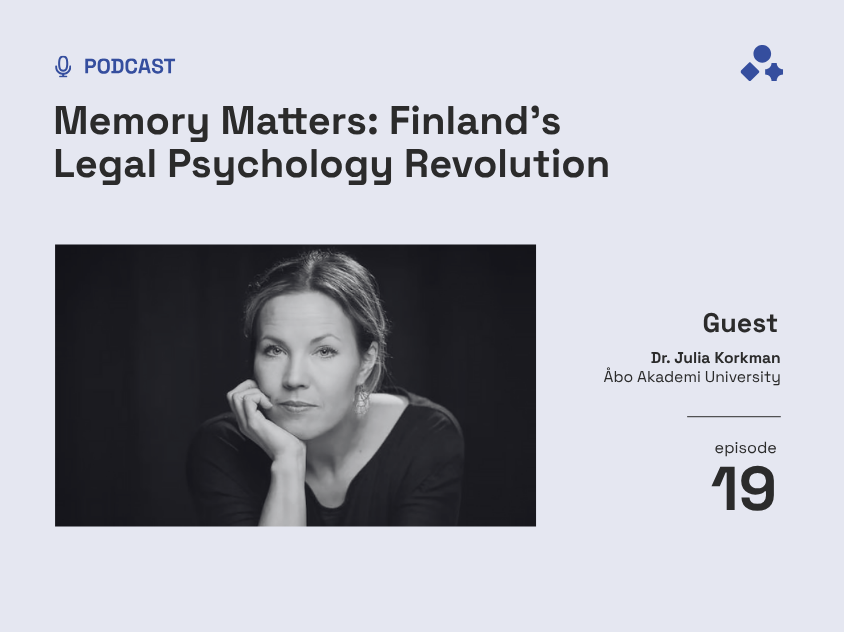
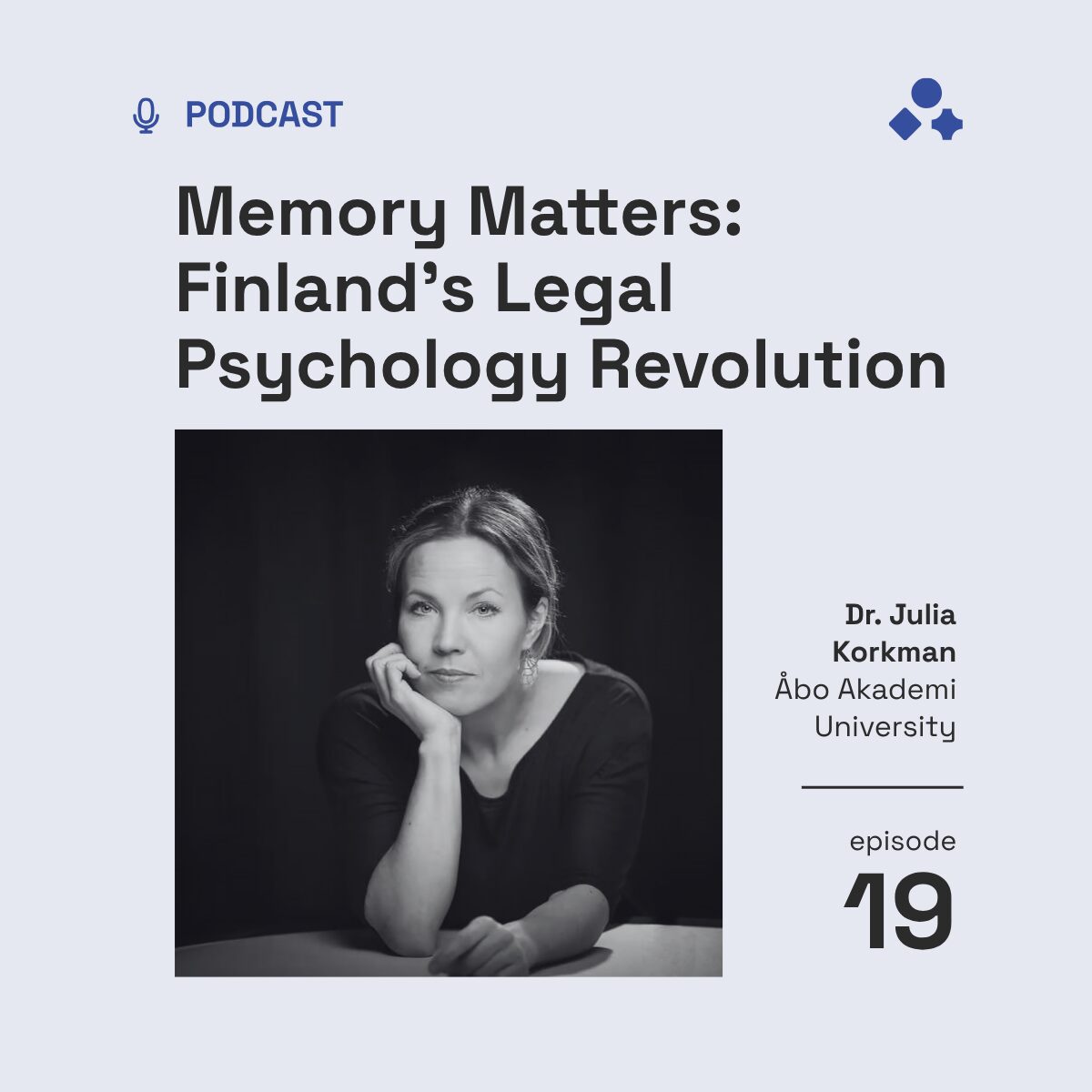
    Episode 19. Memory Matters: Finland’s Legal Psychology Revolution

    Legal psychologist Dr Julia Korkman reveals why investigative interviewing must be built on memory science – and how Finland is using AI to develop better practices. 

    In this episode of Beyond a Reasonable Doubt, host Dr Ivar Fahsing speaks with Dr Julia Korkman, one of the Nordic region’s most influential legal psychologists and current President of the European Association of Psychology and Law, about the critical intersection of memory science, investigative interviewing, and criminal justice reform in Finland and across Europe. 

    Julia Korkman opens with a powerful observation: the legal system was built by humans for humans, yet has “far too little recognition of how humans work.” Despite memory being the fundamental material that police and justice professionals work with when investigating crimes – especially crimes against persons – officers in Finland and many countries worldwide are not required to have any training in how memory functions. This paradox drives much of Ms Korkman’s work on improving investigative practices through evidence-based approaches grounded in psychological research. 

    The conversation traces Julia Korkman’s trajectory into legal psychology, beginning over 20 years ago when she observed how poorly children were being interviewed in Finnish sexual abuse investigations. Witnessing firsthand how inappropriate interviewing techniques with young children could lead to problematic accounts and wrongful conclusions, she recognised investigative interviewing’s core role in miscarriages of justice. This early exposure shaped her career focus on memory research and improving interview practices to prevent these devastating outcomes for all parties involved. 

    The episode explores Finland’s unique legal landscape, including recent Supreme Court decisions showing impressive understanding of how human beings work, suggesting improvement despite ongoing challenges. Julia discusses her research on human trafficking cases involving cross-border victims, examining how remote hearing technology can make proceedings both more pragmatic and more human-friendly when properly implemented with judicial oversight and victim support. 

    Key Topics Discussed: 

    • Memory as the fundamental material of criminal investigations
    • The paradox: legal systems not based on how humans actually work 
    • Why memory training should be mandatory for justice professionals 
    • Investigative interviewing’s role in miscarriages of justice 
    • Judicial decision-making: the power of explicit reasoning and writing 
    • How requiring written verdicts prevents cognitive biases 
    • The need for mandatory hypothesis testing in police investigations 
    • Recent Finnish Supreme Court decisions showing psychological sophistication 
    • Cross-border investigations: human trafficking and remote hearings 
    • Recording as catalyst for positive cultural change through “certification” 
    • Following Sweden’s example: recorded interviews as court evidence 
    • AI as potential real-time assistant for improving interview questions 
    • Technology in training and interview assessment 

    Equipped For Justice – Supporting ethical, human rights-compliant investigations worldwide

    About the guest

    Dr. Julia Korkman

    Dr Julia Korkman is a leading expert in legal psychology, specialising in investigative interviewing, witness reliability, child protection cases, and factors influencing rape victims’ decisions to report. She co-leads the legal psychology research group at Åbo Akademi University in Finland, where she conducts cutting-edge research on memory, interview techniques, and judicial decision-making. 

    Dr Korkman plays a key role at the European Institute for Crime Prevention and Control (HEUNI), affiliated with the United Nations, where she works to improve victims’ rights, address violence against women, and strengthen criminal justice practices through humane, evidence-based approaches. Since 2023, she has served as President of the European Association of Psychology and Law (EAPL), helping shape research priorities and policy recommendations across Europe. 

    Her extensive training work with judges, prosecutors, and police officers in Finland, Sweden, and throughout Europe has made her one of the region’s most influential voices on implementing psychological research findings in legal practice. Her current research includes human trafficking investigations, remote hearing technologies, and AI applications in investigative interviewing. 

    Watch and listen wherever you get your podcasts (Youtube link here)

    Related products

    • Fixed Recorder

      Fixed HD recorder for high security interview rooms.

    • Portable Recorder

      Lightweight, PACE-compliant interview recorder for any setting.

    • Capture

      Mobile app recorder for capturing evidence on the go.


    • Ark Interview Management

      Receive, monitor, and keep evidence throughout its lifetime.

    Transcript

    Guests: Julia Korkman

    Host: Dr Ivar Fahsing

    Recorded: 28 November 2025


    Dr. Ivar Fahsing  00:01

    Welcome, Julia Korkman, to our podcast.

    Julia Korkman  00:04

    Thank you so much.

    Dr. Ivar Fahsing  00:04

    I’m so honoured to have you here, Julia. I have to say to our listeners who don’t know you that at least in the Nordic region you are quite a famous psychologist within this area. So it’s a big honour having you here and I’m so impressed with what you are doing not only in Finland but across Europe.

    Julia Korkman  00:25

    Thank you.

    Dr. Ivar Fahsing  00:26

    Julia, this season of Beyond a Reasonable Doubt, the focus is on implementation of investigative interviewing — the need for it, what it really is, and why it’s important, seen from different perspectives and contexts. So may I ask you: what do you think is the ethos of investigative interviewing?

    Julia Korkman  00:54

    There would be so many different points of departure to answer that question. But I think the first and foremost answer would perhaps be that if investigative interviews are done the wrong way, they can lead to quite terrible miscarriages of justice for all involved parties.

    My own trajectory within legal psychology started with observing the way in which children were interviewed in Finland some 20-plus years ago in the investigation of particularly sexual abuse cases, which was really poor. I’m glad to say it’s a bit better today, but it’s still a difficult area. If you interview young children in a way that is not recommendable, you will inevitably end up with problematic accounts that include mistakes and can lead to completely wrongful conclusions. And we know from the large number of cases investigated in the Nordics, in Europe, and globally — wrongful convictions in which investigative interviewing has a core part to play.

    One of my favourite areas of research is memory — human memory. I can’t get over how surprising it is that although the legal system was built by human beings for human beings, and the basic material we look at when assessing crimes against persons is memory, these processes have far too little recognition of how humans actually work. In my country, as in many others, police officers and justice professionals are not obliged to have any training in how memory works — which is extraordinary, given that it is precisely what they work with when investigating crimes and trying to assess whether accounts are credible or reliable.

    Dr. Ivar Fahsing  03:32

    Absolutely. My work lately has been mostly on decision-making, and there is exactly the same issue — a common assumption that if you get information, you will automatically reach the right conclusion. It’s interesting to see how little attention is paid to that process, even though when you examine some Supreme Court verdicts there are actually good traditions of decision-making. But that good decision-making doesn’t seem to be made explicit.

    Julia Korkman  04:10

    I think you’re right. When looking at how judicial decision-making is conducted in many countries, including my own, judges are required to describe how they came to a certain conclusion. I train judges quite a bit here in Finland and also in Sweden, and I’ve heard many times judges comment on the fact that writing down why you came to a certain conclusion is an efficient measure to prevent the worst kinds of quick and poor decision-making.

    I heard one judge say that throughout an entire case he was pretty sure how it would turn out — and then when he came to write the decision, he thought: this doesn’t add up. I can’t write that he’s guilty simply because my gut feeling is that he probably did it. The evidence just doesn’t support it. This is what research tells us: if you take the time to logically assess the evidence, it prevents you from falling into those traps.

    This kind of slower, analytical assessment is of course something we would like to see more of in the police as well. One struggle in my country is that there is no explicit requirement to carry out hypothesis testing and actually document the assessment. That would be really valuable. I am still quite optimistic about the future here, though — some Supreme Court decisions over the last ten years have shown an impressive understanding of how human beings work.

    Dr. Ivar Fahsing  06:34

    I remember many years ago — at least 25 years ago — when I was just starting to do training in Norway. I invited a senior appeal court judge from Oslo to talk to my students about how the judiciary perceived our work on interviewing, and how we could improve from their perspective. That was quite rare at the time; judges didn’t really want to talk to police. He said: ‘There are a lot of good things going on in the police — but why don’t you try to help the witnesses to say the same thing when they come to court? Because after all, you have been talking to all of them. So why should I sit there as a judge and listen to all these different stories?’ That was quite something.

    Julia Korkman  07:40

    So you should just train them to have the same story so he doesn’t need to bother about it?

    Dr. Ivar Fahsing  07:46

    Because — you know what happened, don’t you?

    Julia Korkman  07:49

    That’s interesting. It’s something police officers have also noted — that if you’re a police officer heard in court, you’re given quite a lot of credibility, in a way that is based on nothing. It’s not as if police officers have better eyesight or perception than other people. The same seems to go for medical doctors — they tend to be very highly regarded, which of course they should be, but they need to be scrutinised in the same way as any other expert witness, with attention to what they are actually basing their assessments on.

    Dr. Ivar Fahsing  08:37

    Exactly. As I’ve described, I was expecting from my PhD — with my brilliant supervisors Per Anders Granhagen and Karl Ask — to find some kind of generic model for good thinking. But I didn’t find it. Where I did find inspiration for a model was in descriptive research from Martin Innes and others who observed how experienced detectives actually behaved on their best days, and tried to conceptualise what that looked like. I think we also have to communicate to practitioners that this is not about changing everything they do — research shows there are things they are already doing correctly; we’re just trying to help them understand why.

    Julia Korkman  10:13

    That’s a really good point, and I also think this kind of positive research is important. We can of course learn a great deal from miscarriages of justice. In Sweden, for example, there have been several such cases — including the Kailinna case, in which a man was wrongfully convicted for 13 years before being released. A strong confirmation bias meant investigators were looking in only one direction and not taking into account evidence pointing elsewhere. Within that investigation, there was one detective who from the outset was arguing they should look in other directions — and he was essentially frozen out of the group and had to go on sick leave.

    This points to an organisational problem. The police in many countries — certainly in Finland and Sweden — have a very old-fashioned, top-down structure where the chief of each department has enormous power over how work is organised, and there are very few requirements around hypothesis testing or an open culture in which people can voice their thoughts freely. It should be better structured.

    There’s also something that goes back to what you noted about cross-professional communication. Here in Finland in the south, where there are more people, training for lawyers, police, prosecutors, and judges tends to happen separately, within their own professional groups. Whereas in the north, where distances are long and there are fewer professionals, they tend to train together. I’ve been invited to Lapland several times for full-day events that bring together all criminal justice actors, and it is genuinely beneficial for everyone. It leads to lively discussions — but that’s good. In the south, you sometimes hear tiring conversations where defence attorneys complain about the police or the police complain about defence attorneys. Bringing them together creates far more interest in genuinely understanding each other’s positions and finding common ground.

    Dr. Ivar Fahsing  14:42

    That’s really interesting. Part of what people like you can do is be a mediator between those groups, delivering the same message to different audiences. And if those groups don’t communicate with each other as much as they could, at least there is someone communicating to all of them.

    Julia Korkman  15:16

    Exactly. And there are related groups outside the criminal justice system as well. We have a research group called Psych Aid at Åbo Akademi working on asylum procedures and how they can be improved. One thing we hear quite often is that the lawyers working with asylum seekers and the asylum officials can be quite frustrated with each other — yet both groups agree that some professionals in each field are excellent and some are poor. Here too, collaboration would be in the best interest of everyone, and especially in the interests of the legal rights of the asylum seeker.

    And then there are interpreters. We really need to train interpreters in the context of investigative interviews. I’ve had the joy of doing this in Finland in recent years for court interpreters who specialise in child forensic interview interpretation. Many of them were highly skilled already, but when trained in suggestibility, open-ended questioning, and the NICHD protocol, several said they had probably been doing things wrong — because even though they were told to phrase questions exactly as the interviewer does, without understanding why open-ended questions matter, they weren’t always able to do that. They were trying to help the child talk, and we know that if the right instruments aren’t there, that inclination to help can lead to suggestion.

    My friend and colleague Sarah Landström — professor in Gothenburg and one of our best child interview researchers — was recently asked what the main problem is when child interviews go wrong. She said she thinks it’s the incredible desire to help children tell. If you don’t possess the right technique, if you don’t understand that ‘helpful’ questions can be detrimental if they’re not open-ended and grounded in the child’s own experience, the consequences can be disastrous.

    Dr. Ivar Fahsing  21:10

    It is really interesting how important language is. I sometimes think that because language and culture are so deeply interwoven, we are habits of our own language. I remember saying for years: you have to start the interview with an open-ended question. But obviously that doesn’t always work in a communicative setting — you have to break the ice first. We often do it in a subtle way: in the rapport-building phase before this interview we chatted informally, with a closed question. But that subtle invite isn’t really closed — it’s inviting you to say as much as you find appropriate.

    Julia Korkman  22:20

    And it would have been very strange if you had said: ‘Tell me everything about your weekend.’

    Dr. Ivar Fahsing  22:24

    Wouldn’t it? Completely — you would be invading my space in a very rude way. I think it’s so interesting how we probably have to focus even more in the future on how the advice from psychology looks in a cultural and linguistic context.

    Julia Korkman  22:47

    Luckily there’s a lot of interesting research on this. Annelies Reedevel, a professor from the Netherlands, is leading very interesting work on culture within investigative and legal psychology. One of her points is that we cannot expect individual police officers to have a deep understanding of all the cultures they may encounter — but they can have cultural humility and at least a minimum understanding of how they themselves are shaped by their own culture. It’s the beginning of Socratic insight into how much you don’t know.

    You were working quite a bit in Southeast Asia, and our interpreters from there noted that in some contexts it is much more difficult than in Northern Europe to say that you don’t know something or didn’t understand a question — it would be considered rude. That’s something that needs to be explicitly discussed before an interview.

    I also think of my early experience with the NICHD protocol. We sometimes noted — with some amusement — that it seemed to depart from the assumption that if you ask a young child to ‘tell me about yourself’, they would start talking. In Finland, people are not taught to be especially talkative. That said, I think the culture has shifted: children today are much more encouraged to speak their minds. But other things remain very culturally dependent. How we socialise, how we build rapport — these differ significantly. A German study, for example, found that saying a child’s name repeatedly — ‘Eva, how are you? Nice to see you, Eva’ — which might be fine in an American context, would feel immensely odd in Finland or Germany. These are things that need to be considered when applying any protocol to a specific context.

    Dr. Ivar Fahsing  27:43

    Absolutely. In many of the Asian countries where I work, it’s considered completely inappropriate to use the word ‘I’ — in collective cultures, focusing on oneself is improper, so it’s implicit. You just say ‘eat rice’ rather than ‘I eat rice’. And if you then try to translate that into a different context and a different language, you lose a lot.

    Julia Korkman  28:29

    There is really interesting research on how adults who grew up in a traditional Chinese context recall their childhood experiences compared to those who grew up in a US context — specifically in relation to memories of what they did themselves. In more individualistic cultures, children are taught from a young age to talk about themselves and their own experiences. In more collectivistic cultures, children are not supposed to focus solely on their own perspective — and this is reflected in their adult memories: they remember less of what they themselves did, but more about the group.

    And of course, one thing we need to avoid when discussing cultural differences is to attach labels and assume: ‘You are from the Arab region, so you must be this or that.’ It is about openness — the realisation that we are all children of our own cultures, and that there is far more variation than we tend to think. Luckily, there’s a growing recognition of this within the research tradition, which has historically been very Western-focused.

    Dr. Ivar Fahsing  30:11

    Speaking of shifts — could you tell me a little about how investigative interviewing is being applied in a Finnish context? We’ve spoken about your lecturing and mentoring of different actors, but thinking more specifically about the police: how are they implementing this knowledge, from your perspective?

    Julia Korkman  31:06

    I think I have a fairly good understanding of this. My colleague Tom Pakkanen did a comprehensive review of all the studies on how the Finnish police conduct investigative interviews. What emerged is that the picture is quite good when it comes to child interviews: there is clear guidance, strong recommendations, a one-year training required under the Pre-Trial Investigation Act, dedicated expert units, and forensic psychologists handling the most complex cases. That part is well established.

    The problem is that it essentially ends there. There has been increasing pressure to improve investigations of human trafficking — which is welcome — but there is no equivalent pressure for other serious crime types. Femicide, for example, is a significant problem in Finland, but it has not gained the attention that would require specialists. Sexual crimes are similar: some departments have specialised units doing excellent work and video recording all interviews, but it is entirely down to individual departments.

    For child suspects — young people under 18 involved in crime — there is an incredible gap. We have specialists who know how to interview reluctant children who have sent images online, for instance, and those children are often in a similar position to child suspects: they’ve done something wrong, they’re uncertain whether to talk, they’re very dependent on how the investigator approaches them. But we don’t apply this knowledge to child suspects. And as we know, child suspects are often also victims — from vulnerable backgrounds, sometimes manipulated by older criminals. Many would probably be quite willing to talk if approached properly. But there is no specific training for those officers.

    For adult interviews: as I said, my colleague went through everything available, and there is almost nothing on investigative interviewing in basic police studies. There is a small two-week course for experienced officers, but only a small group takes it each year. A study a couple of years ago found that officers around Finland knew almost nothing about different interviewing methods. The only one that was familiar to them was the NICHD. At least they hadn’t been taught Reid either — so I suppose that’s a plus.

    Dr. Ivar Fahsing  36:33

    Yes, I’ll bless that.

    Julia Korkman  36:36

    It was striking how little they knew about any other interviewing methods. One of my colleagues from the police — who was for a long time the chief detective at the sexual crimes unit at the Helsinki police — took a legal psychology training course I coordinate. She later said that it was quite a shock to have been working as a trained police officer, in investigations where the interview is the most crucial tool, and to realise that you have to look outside the police to actually learn about methods that were created by the police and for the police. We’re not really doing that well here.

    Dr. Ivar Fahsing  37:35

    That is really interesting. I think people from outside the Nordics tend to assume that Finland, Sweden, Denmark, Norway, and Iceland are quite similar in these areas — because we are very similar in so many other aspects of society and culture. But on this particular topic, there are quite significant differences. And I think what you point out about recording is probably, at least in Norway, what was the tipping point.

    I myself, together with my good friend and colleague Asbjørn Rachlew, led a national pilot project on recording all the way back in 1998. At that time, digital recording equipment was quite clunky and very expensive. The Minister of Justice invested significantly in testing different equipment. We distributed it to high-level departments around the country, and my job was to gather the experiences back. But we got nothing. After a year, there was no feedback.

    We needed to have a frank conversation. Doesn’t it work? Is something wrong with the technology? There was complete silence. Then one evening we went out for dinner and people started to talk. One officer said: ‘Ivar, I don’t feel comfortable with recording myself — because no one ever taught me how to do an interview.’ That was the moment it became clear: the reluctance isn’t just about justice. It’s also about officers’ wellbeing, isn’t it?

    Julia Korkman  39:48

    [Agrees]

    Dr. Ivar Fahsing  39:49

    And that was the turning point. I said: of course, if we’re going to implement recording as a Norwegian standard, the first standard is to teach officers basic interviewing skills — memory, human memory, communication. And I think that was also a really important thing about building this properly, because then they actually needed it. We also made it slightly exclusive: you are not going to do this unless you are trained for it. We have to take care of you.

    Of course, you can debate that — because the people without the training were probably the ones who really should have been recorded. But on the other hand, it gave it an aura of exclusivity: I am certified for recording. That became a skill, a badge. People wanted to be part of the group certified to conduct profiled, important interviews. I think it’s so interesting how something can be reframed into a culture of positive drive.

    Dr. Ivar Fahsing  40:29

    A final question — because you’re also doing a lot of interesting research in Finland on how technology can help implement or develop these kinds of skills and practices.

    Julia Korkman  41:23

    That would be a topic for a whole new discussion — but thinking very pragmatically: there are quite a few Finnish investigators who would actually want to do video recording, but some are not permitted to within their department. We are on our way, and we are typically following the example of Sweden, where the situation was also quite poor until a couple of years ago when new rules came in allowing initial interviews to be recorded and, in some cases, presented as evidence in court.

    One question I always get is: who is going to store all these video recordings? And how are we going to manage transcription — it’s so costly, and if prosecutors receive 13,000 pages of transcripts, that’s genuinely difficult. In Sweden, I’ve understood they now use very good automatic transcription — tools like Whisper and similar — and apparently also a programme that generates summaries for prosecutors. Of course these can’t be trusted completely, and there will be things you still need to go back and check. But the technology will make it much easier.

    In recent years I’ve also been looking quite a lot at human trafficking cases, many of which involve parties from around the world — in Finland we’ve had cases with berry pickers from Thailand, for example. You can either fly all these witnesses here, or you can ensure really decent ways of hearing people remotely. I’m currently doing research on hearing people remotely to court. There are a lot of good possibilities — pragmatic things like ensuring people are heard from safe spaces, with legal support and an understanding of the procedures. Cross-border hearings could become much easier and much more humane.

    And of course, one thing Norway has done for decades is preserve pretrial investigation evidence. If a victim develops Alzheimer’s, or dies, or is unable to speak about every aspect of a crime two or three years later in court proceedings that have dragged on, their voice can still be heard through the video-recorded interview.

    We also just published a study — the first author is Lisa Järvilehto, who is both an investigator with more than a decade of child abuse investigations and an excellent researcher. One of her studies examined using AI to help generate meaningful, relevant alternative hypotheses to child abuse allegations — and AI was actually very good at this. Experts are then well-placed to discard the ones that aren’t relevant. She is now looking at the extent to which AI can help human interviewers improve their questions.

    With all the limits that implies, I do think we can develop very useful tools for interview training, interview assessment, and perhaps even real-time aids in investigative interviews. But we need to be very mindful not to deploy anything before we can ensure it does not lead to negative consequences. I don’t see AI taking over investigative interviewing in any conceivable future — but I do see AI as a potentially very helpful assistant to it, and very much so in training and assessment contexts.

    Dr. Ivar Fahsing  47:03

    Julia, we could go on for the rest of the day with another list of really interesting topics. Thank you for a truly engaging and inspiring conversation.

    Julia Korkman  47:10

    Thank you — it was a pleasure, as always.


    END OF TRANSCRIPT

    © 2026 Davidhorn. All rights reserved.
    Read more

    13 Aprile 2026
  • Investigative interviewing reform in practice – ep.18

    Investigative interviewing reform in practice – ep.18
    investigative interviewing reform with iIIRG co-directors

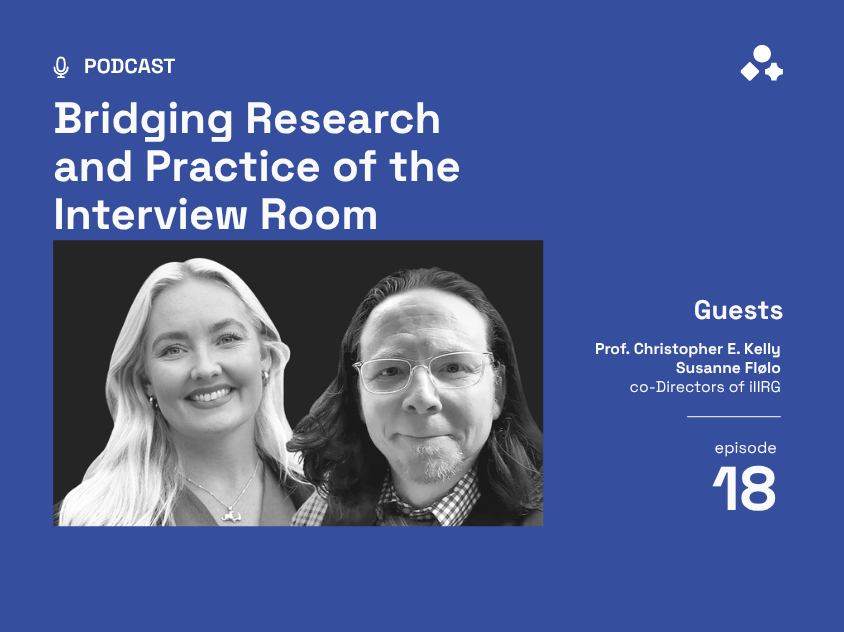
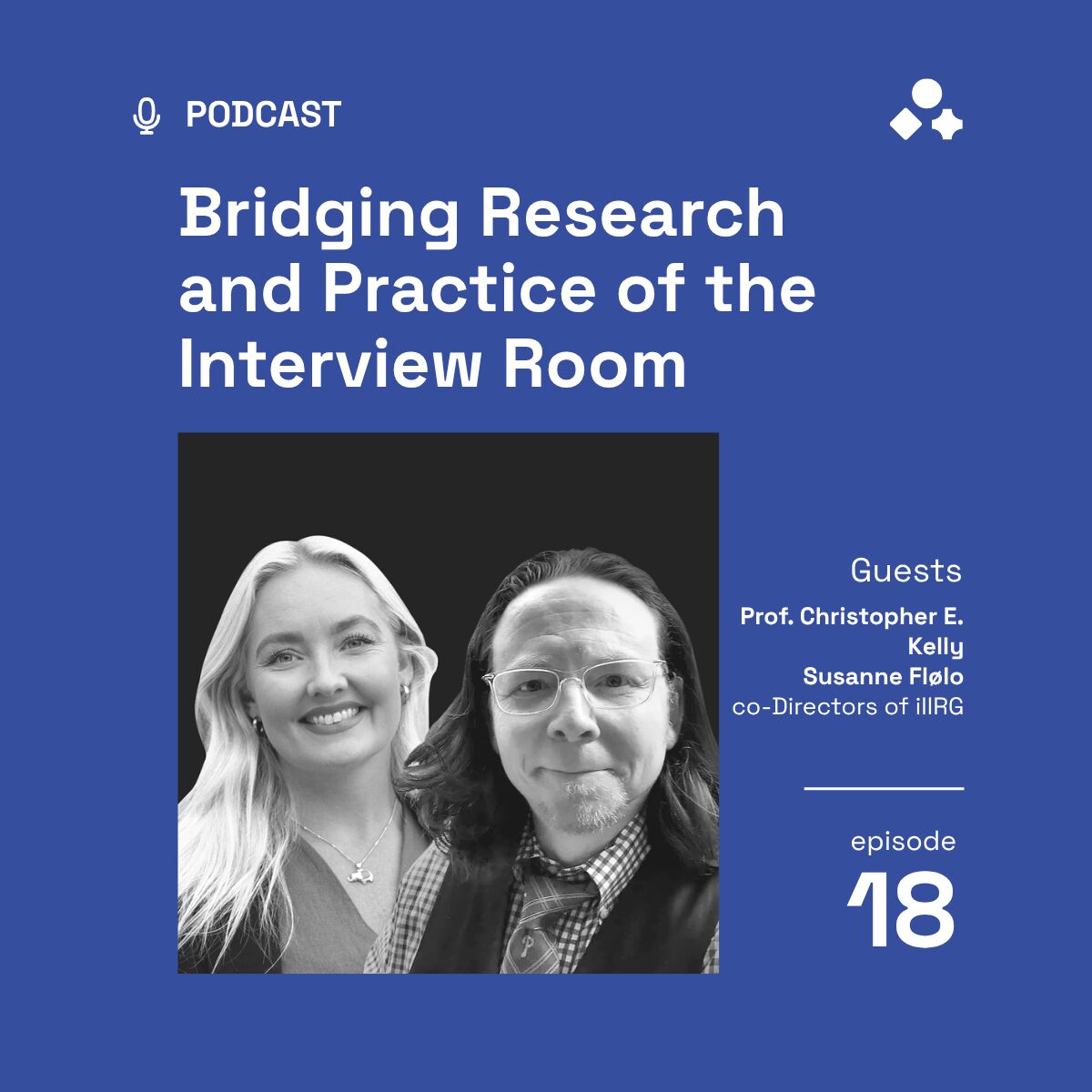
    Episode 18. Bridging Research and Practice of the Interview Room

    Every major interviewing framework – PEACE, KREATIV, ORBIT – distils to the same essentials: stay nice, ask good questions, and listen.

    So why does confession-driven culture remain so deeply embedded, even in systems that have formally adopted investigative interviewing?

    In this episode of Beyond a Reasonable Doubt, host Børge Hansen speaks with two leading members of iIIRG – the International Investigative Interviewing Research Group – about what actually makes reform stick, and what keeps pulling it back.

    In this conversation, they cover:

    • Why confession culture persists — the incentive structures across police, prosecutors and courts that sustain it, and why outcome-based thinking crowds out accuracy
    • The first safeguard to fail under pressure — why the opening minutes of an interview determine everything that follows, and what ‘sinking to your level of training’ really means in practice
    • The accountability deficit — what supervisors miss when they only read written summaries, and why the entire justice system is making high-stakes decisions without seeing what actually happened in the room
    • Recording as a catalyst, not a luxury — how mandatory recording drove professional development in Norway, and why a technically excellent recording still needs independent expert analysis to be credible in court
    • AI in investigative interviewing — the risk of a new shortcut, shadow use of unapproved tools, and what responsible adoption actually requires
    • The global shift — from the Mendez Principles and the UN Manual to wartime implementation in Ukraine, how investigative interviewing has moved from niche reform to global professional standard
    • What a police chief can do on Monday morning — with no budget, no mandate, and no certainty — to start moving practice in the right direction

    Episode length: approximately 65 minutes

    Host: Børge Hansen, CEO, Davidhorn

    Production: Davidhorn – Beyond a Reasonable Doubt Podcast


    Equipped For Justice – Supporting ethical, human rights-compliant investigations worldwide

    About the guests

    Prof. Christopher E. Kelly

    Prof. Christopher E. Kelly is a professor of criminal justice with a research focus on what improves information quality in investigative interviews. He has partnered with law enforcement agencies in the United States and internationally for over a decade. Professor of Criminal Justice, Saint Joseph’s University, USA.

    Susanne H. Flølo

    Susanne Flølo is a human rights specialist and investigative interviewing practitioner. She has contributed to the UN Manual for Investigative Interviewing and the UNODC e-learning programme, and works at the Norwegian Centre for Human Rights (NCHR) and the Norwegian Mendez Centre.

    Watch and listen wherever you get your podcasts (Youtube link here)

    Related products

    • Fixed Recorder

      Fixed HD recorder for high security interview rooms.

    • Portable Recorder

      Lightweight, PACE-compliant interview recorder for any setting.

    • Capture

      Mobile app recorder for capturing evidence on the go.


    • Ark Interview Management

      Receive, monitor, and keep evidence throughout its lifetime.

    Transcript

    Guests: Susanne Flølo & Prof. Christopher E. Kelly

    Host: Børge Hansen

    Recorded: 20 February 2026


    Børge Hansen (Host)

    In a healthy democracy, the rule of law is only as strong as its most hidden moments. We talk about justice in public — in courtrooms and policy debates — but the real test happens when the door is closed. In that room, the tension is not just about solving a crime. It is about whether a system can stay objective under pressure. Can we move past confession-driven practices and treat interviewing as a forensic craft built for reliable facts?  00:00

    I am Børge Hansen and this is Beyond a Reasonable Doubt.

    In this series, we look at the mechanics of justice — from how interviews are conducted to how evidence holds up under scrutiny. Today is about the gap between what we know works and what actually happens under pressure: practice, supervision, and the minimum safeguards that any justice system should demand.

    Today I am joined by Susanne Flølo and Christopher E. Kelly. Both are active in the International Investigative Interviewing Research Group, iIIRG. They work to move evidence-based interviewing from research into day-to-day practice — where supervision, habits and culture decide what sticks.

    Susanne, you work in human rights and investigative interviewing standards. You have contributed to the UN Manual for Investigative Interviewing and the UNODC e-learning programme for investigative interviewing. Chris, you are a professor focusing on criminal justice, with a particular focus on what actually improves information quality in interviews.

    Susanne and Chris, thanks for joining us today. For listeners who have not come across iIIRG before — if you had to explain to a busy investigator in one sentence what iIIRG exists to change, and just as importantly, what iIIRG is deliberately not trying to be?

    Christopher E. Kelly (Guest)

    I can start with this. In one sentence, iIIRG was created to fill the space that exists between academic research and real-world practice. The explicit mission is to bring these two groups together — groups that have historically not always understood one another. When iIIRG was founded, in 2007 or 2008, it was with the explicit intention of bridging that gap between research and practice.  01:47

    Susanne Flølo (Guest)

    And I agree. First of all, thank you so much for having me — it is a great pleasure. I have listened to every episode of this podcast, so it is a real honour to have been invited. For me, the mission and purpose of iIIRG is very simple: we connect science to practice. We try to make sure that people who conduct interviews — whether they are police, military, immigration, or oversight bodies — actually have access to what works. And we try to help our members, whether practitioners, researchers, or other professionals, to uphold the highest possible professional standard in their work.  02:20

    Børge Hansen (Host)

    So what is your personal litmus test for an investigator who is operationally ready? One or two indicators.  03:05

    Susanne Flølo (Guest)

    A lot of people, I think, still treat interviewing as an art or an instinct. But to me, the litmus test of a good investigator is not the confession — however much Hollywood might lead us to believe otherwise. Rather, it is whether you are able to create the conditions for accurate, complete and reliable information to emerge. Interviewing is a disciplined forensic craft. It has methodology and structure, it is based on science, and it has profound consequences for justice, public trust, and even state stability.  03:10

    In every country we work in — whether Ukraine, Thailand, Brazil, Indonesia, or others — we meet investigators who intuitively understand the value of rapport-based interviewing long before they have even heard the term ‘investigative interviewing’. And many of them have discovered the hard way that confrontational, confession-driven methods simply do not get them the information they need. So, again, we are simply trying to bridge the gap between research and practice.

    Christopher E. Kelly (Guest)

    And I would add: in terms of a litmus test, one of the most important qualities I have found is a level of curiosity — not just about an investigation, but about the world. An openness to different possibilities and a willingness to think beyond what is immediately in front of you. The best interviewers I have encountered over the years have been the ones who can think outside the box.  04:13

    That is related to something Susanne just said about art versus science. You hear it a lot from practitioners: this is more art than science. As a committed scientist, I have to object to that. I have come to believe that nobody particularly wants to be thought of as a scientist — white lab coat, elbow patches. That is not very fun. Artists and creative thinkers are fun, imaginative, able to break out of everyday norms. But I do believe there is a science to that kind of thinking, and we can teach it.

    Børge Hansen (Host)

    Frameworks like PEACE, KREATIV, and ORBIT are well known. But if you strip things down for investigators working under pressure, what is the smallest set of behaviours that protect reliability?  05:31

    Christopher E. Kelly (Guest)

    In addition to keeping an open mind and remaining flexible, I think the couple of essential qualities that all the models boil down to are: stay nice, ask good questions, and listen. Actually hear what people are saying, and allow them to speak. Because the opposite — being confrontational, asking closed questions, interrupting, doing more talking than the interviewee — that is not actually an interview. All the models come down to a rapport-building mentality that asks good questions and then lets the person speak.  05:56

    Susanne Flølo (Guest)

    Paired with curiosity and good analytic skills. But yes, I absolutely agree with Chris.  06:47

    Børge Hansen (Host)

    Good. So let us move to where the pressure really begins. Rules and frameworks are easy when things are quiet. But officers are on the clock and expected to produce results. When that pressure hits, you find out what the system really values. Why is confession-driven culture still so strong among investigators across the world?  06:48

    Susanne Flølo (Guest)

    Confession culture is, as you say, incredibly persistent. It is fast — or at least it is portrayed as fast. It is traditional. It is what supervisors often expect, and it is emotionally compelling. People feel as though they have cracked the case when someone admits guilt. The problem is that it is a terrible accuracy indicator.  07:39

    Confession-driven practices increase the risk of tunnel vision. They reinforce cognitive biases, and we know they lead to errors of justice and wrongful convictions. They also fundamentally clash with the presumption of innocence and the real purpose of the interview, which is to gather information — not to extract agreement. Another reason confession culture persists is systemic. Many police organisations cite lack of funding, time, or leadership focus. Those explanations tend to be the same everywhere. But underneath them, I think there is something far more basic: you cannot fix a problem you have not acknowledged exists. No country is immune to errors of justice, but you will not see them unless you are willing to believe they can actually happen in your system.

    Human fallibilities also play a huge role — misunderstandings about suggestibility, confirmation bias, primacy effects, false memories. Acknowledging these fallibilities helps explain why interviews need to be conducted in a structured, research-based way that actively mitigates these risks.

    Børge Hansen (Host)

    Chris, if the science backs what Susanne is describing, why is there still resistance?  09:12

    Christopher E. Kelly (Guest)

    Because none of us like change — and I will not just throw the police under the bus here. University professors are the same. Going from a confession orientation to one of information gathering is a fairly large shift in both mindset and practice.  09:28

    Speaking as an American: in my city of Philadelphia, a city of around one and a half million people, there were 250 murders in 2025 — down from 500 during the pandemic. The police are dealing with a significant backlog of cases. And in the American legal context, confession is king. When you get a confession, it is over. The detective can move on to the next case and hand it to the prosecutor, who knows that, barring some unusual issue, 97% of convictions in this country — a number similar globally — come through guilty pleas. When a defendant sees a confession in the file, that is a very powerful piece of evidence pushing them towards a guilty plea. So confessions are good for the police, and good for the prosecution, because they keep things moving.

    Børge Hansen (Host)

    Concrete results.  11:35

    Christopher E. Kelly (Guest)

    Exactly. It is outcome-based and short-term thinking. Here is a crime; I will solve it. And regardless of the veracity of the confession, it is treated as truth — because there is still a widespread misunderstanding of why people say they did things they actually did not do. The entire system is incentivised to get a confession. And accusatorial-style interrogations are very effective at producing them. So effective, in fact, that they get innocent people to confess. That is obviously where the problem lies. The incentive structure has to change. Prosecutors and investigators need to scrutinise confessions more closely and verify everything in them. But until police leaders, prosecutors, and lawmakers understand that a confession can be unreliable — and that even a genuine confession from a guilty person may not be the end of the information-gathering process — the culture will not shift.  11:37

    Børge Hansen (Host)

    Susanne, when standards come under strain — even in countries where investigative interviewing is the established standard — what is the first safeguard that slips in real life?  13:13

    Susanne Flølo (Guest)

    Empathy and rapport. We forget about their importance the moment pressure rises, and so the opening — and the planning that precedes it — becomes absolutely crucial. Everything that follows rests on what happens there. The opening determines rapport, determines cooperation, and determines whether the interviewer manages to stay open-minded. If you get that opening wrong, if you set a confrontational tone, you will probably never recover.  13:41

    We also see the same linguistic red flags everywhere in the world: leading questions; repeating a question until the person changes their answer or rapport breaks down entirely; narrative summaries that omit or distort key details; language that signals the interviewer has already decided what happened. These issues are universal, and they matter — because interviewing is not just about what the interviewer hears, it is about what the interviewer elicits. Small language choices can fundamentally shape the quality and reliability of the information obtained.

    That is why we insist on structure, planning, and an evidence-driven approach paired with audio and video recording. Because, as my colleague Dr. Ivar Fahsing likes to say: when the stakes are high, you do not rise to the occasion — you sink to your level of training. Which is why having a solid methodology in place is so incredibly important. And that goes not only for the police, but for the entire justice system.

    Børge Hansen (Host)

    Chris, where do you see the consequences of a confession-driven or ‘get answers fast’ culture playing out?  15:31

    Christopher E. Kelly (Guest)

    In a confession culture, there are very few safeguards further down the line. The incentives for prosecutors are to keep cases moving, secure guilty pleas, and get on to the next file. Judges and juries — in the rare instance a case reaches that point — often lack any real understanding of good interviewing practices or what constitutes reliable information. And my big concern relates to recording.  15:44

    Everyone who talks about reform immediately recommends recording — and rightly so. But I like to push back a little, not because I disagree that recordings should be made, but because recording alone is not enough. It needs to come with independent evaluation. If you put a false confession in front of a jury — with multiple camera angles, crystal-clear audio — that recording looks compelling. Without someone contextualising and analysing what was actually said and how, all you have is everyone’s biases looking at a technically excellent recording of a false confession.

    I live in Pennsylvania, where confession expert witnesses are actually prohibited from testifying in court. There is a push here to record all interviews — but without that expert context, it could actually be worse than having a detective read a confession statement into the record. At least then a defence attorney can cross-examine the detective and find weaknesses. A recording is very hard to cross-examine. So the safeguards have to run all the way through the system — educating not just lay jurors, but prosecutors and judges as well.

    Børge Hansen (Host)

    You said that under pressure we sink to our level of training. If you rush the opening, what happens to the quality of everything that follows?  18:25

    Susanne Flølo (Guest)

    You risk failing to build rapport, which means you are far less likely to obtain accurate and complete information than if you had laid a good foundation from the outset. And if you start on the wrong foot, it is extremely difficult to recover. In those cases where rapport breaks down from the very beginning, it is time to bring in a different interviewer and try again — but that is not the ideal outcome. The best approach is to get it right once, do it well, and ensure proper planning for that opening.  18:45

    Christopher E. Kelly (Guest)

    And I would add: the first thing to go under high pressure is patience. It is related to planning and taking the time for an appropriate introduction — building a working relationship, not a friendship, but an understanding between two people on opposite sides of an issue about what each other needs. When patience goes, the other person’s needs go with it. And as Susanne says, once rapport is not there from the start, it is very hard to establish at all.  19:57

    Børge Hansen (Host)

    I have attended ORBIT training myself. It uses live actors with full backstories and cases running over several days — genuinely immersive. One thing that struck me watching was how even trained officers struggled with two very different challenging interviewees: one deeply traumatised and withdrawn; the other traumatised but dominant and acting out. How does the science actually find its way into practice in situations like those? These are police officers, not trained psychologists.  20:57

    Christopher E. Kelly (Guest)

    The science is still evolving on this. For the kinds of interviewees you describe — someone experiencing acute trauma during an interview, or someone who carries more general trauma — there is some research, but it is not nearly as mature as other areas. And I understand why practitioners find that frustrating.  22:06

    My response is always: we do not have all the answers yet. What we can do is base practice on the best available research at any given time. ORBIT is a good example — it has evolved since its inception and will continue to do so, because the team behind it is always working to understand the model better and update it. In two, five, or ten years, all of these models should look quite different.

    And sometimes — and this is a genuinely unsatisfying answer for practitioners — sometimes you are simply not going to have a successful interview. In many ways, ending an interview without the outcome you wanted is preferable to reverting to coercive or aggressive tactics, which is what can happen when someone is frustrated and not getting what they need. It may be better to pause, regroup, and try again with a different interviewer. But that takes resources, patience, and leadership. Every investigator has supervisors who should be providing oversight and ensuring principles are being upheld. That breaks down too often. But to reiterate: the science is evolving, and models like ORBIT are continuously bringing new findings into practice — which is exactly what the scientific process should look like.

    Børge Hansen (Host)

    Susanne, you travel the world observing people being trained. Are people getting impatient, reverting to old tactics — or are they able, as Chris described, to accept a difficult interview rather than conduct the wrong type of interview?  25:59

    Susanne Flølo (Guest)

    It depends. But what we most commonly see is that people go into the interview room without a clear plan — for rapport building, for the opening, for how to handle the evidence. It is a stressful situation. Even in training settings, people become incredibly stressed because they are being observed by colleagues, peers, and sometimes superiors.  26:16

    And we also need to build a genuine feedback culture. What we typically hear from supervisors after an interview is: ‘That went great. No notes.’ But we know that no interview is ever perfect or without areas for improvement. People need to hear — and be comfortable receiving — feedback like: ‘You were about to lose rapport here because you were pushing too hard’ or ‘We haven’t properly explored that line yet.’ And not just feedback focused on the information obtained, but on the process itself: what did I do, what did I miss, how could I improve? That culture of constructive, process-focused reflection is often absent.

    Lawrence and Emily Alison’s work through ORBIT is incredibly valuable in this regard, because building rapport is genuinely difficult to teach. And of course, as Chris mentioned, it is also true that no matter how much training someone receives, some people will never be strong interviewers. That is an unfortunate reality. But we know that certain personal qualities — curiosity, patience, flexibility, and the ability to genuinely express empathy — are fundamental. Becky Milne has called it the X factor: who has it and who does not.

    Christopher E. Kelly (Guest)

    Can I offer a quick anecdote on training design? I was part of a team developing and piloting a training programme — I will not mention the agency or any names. We put into the role-play scenario an interviewee who was not traumatised, not belligerent, not resistant. Our role player was overly cooperative. Everything they said was false, but they were enthusiastic, open, and willing. Come in, I am happy to talk, anything you need.  28:58

    Over two deliveries of this training, with perhaps six or eight teams rotating through, very few of them knew how to handle it. These were experienced investigators, some of whom had been through science-based training, and they did not know what to do with someone being apparently cooperative. Several reverted to unproductive practices out of frustration and unmet expectations. It was a brilliant demonstration of confirmation bias — they expected resistance, and when it was not there, they were lost. I would encourage anyone designing role-play exercises to include that kind of interviewee.

    Børge Hansen (Host)

    Not putting up a fight, but being overly cooperative.  31:02

    Susanne Flølo (Guest)

    I believe that is what the Alisons would refer to as a ‘bad monkey’ in the ORBIT model.  31:06

    Christopher E. Kelly (Guest)

    Yes, exactly.  31:10

    Børge Hansen (Host)

    Another blind spot: what leaders can actually see and manage. We talk a lot about the interviewer, but much less about leadership. If a supervisor only reads a written summary, what do they miss — and what gets lost when they do not see the interaction itself?  31:11

    Susanne Flølo (Guest)

    What you are pointing at, Børge, is one of the biggest global challenges: the accountability deficit. Leadership rarely sees the interview itself — they see the summary. And summaries hide a great deal: tone, pressure, leading language, body language, missed opportunities, and in some cases even coercion. Summaries also tend to overstate certainty, presenting a clean narrative where the actual interview may have been very messy. And the courts often also see only the summary. The entire justice system is making high-stakes decisions without ever seeing what actually happened in that interview room.  31:46

    This is why improving interviewing is never just about training frontline officers. At NCHR, we have seen repeatedly that unless you also train supervisors, managers and leadership, and unless you build systems around them, reforms do not stick. You get a good training workshop, people are enthusiastic for a few months, and then the system pulls everyone back into old habits — because the supervision, the metrics, and the accountability structures have not changed.

    And this brings in something that is often overlooked: evaluation. How can you evaluate the quality of an interview if you cannot revisit it in its most complete form? How do you learn from it? How do you train others from it? Without recordings, all of this becomes extremely difficult. When senior leaders champion transparency, recording and professionalisation, everything changes. When they do not, nothing changes. You simply cannot build a culture of high-quality interviewing without leadership creating the conditions for accountability, learning and long-term reform.

    Børge Hansen (Host)

    If you had to choose — what makes the science stick? Better training upfront, or day-to-day supervision?  33:56

    Susanne Flølo (Guest)

    It is both. But it also requires a fundamental understanding of the why. Why are we doing this? Why does it need to be done this way? If you believe your system is perfect, you will not change it. You need to be critical of your own structures and actively look for errors — because you will not find them unless you believe they can exist.  34:03

    Børge Hansen (Host)

    Chris, are there simple metrics that leaders could use?  34:39

    Christopher E. Kelly (Guest)

    The leaders I have encountered who embrace this movement are the ones who think of their organisations as learning organisations — not static, not ‘good enough’, but searching for something better. And in investigative interviewing, we have the tools for that. But one leader does not make a social movement.  34:47

    For every forward-thinking leader with the power to implement reform, there are probably several more who are resistant — because they moved up through a system without that kind of reform and succeeded within it. Why would they want to change something that worked for them?

    Change therefore has to be both top-down and bottom-up. People doing the interviewing are not going to reform themselves. There has to be some directive from the top: we are going to do it this way. But it has to be reinforced, because leaders rotate, promote, retire. Someone new comes in and you may have to start again.

    What this means in practice is that we also have to reach people who are new in their careers — get them to see the value of science-based interviewing before they pick up bad habits. As they promote up, they become the supervisors giving constructive feedback. But that takes 20 years. I will always credit former LAPD detective Mark Severino, who had some success in his agency getting investigative interviewing training to brand new recruits — not waiting until someone reaches investigations rank, but starting at the patrol level, where officers are already conducting interviews and speaking to people every day.

    Børge Hansen (Host)

    When poor practices do show up, what does a healthy organisation’s response look like?  39:00

    Christopher E. Kelly (Guest)

    I have learned a great deal from a dear friend and colleague, Mike McCleary, formerly Assistant Sheriff in charge of investigations at the Las Vegas Metropolitan Police Department — a very senior position. The lesson I have internalised most from working with him is this: you cannot tell police — or academics, for that matter — what they did wrong without also telling them how to do better.  39:06

    Whether it is a one-to-one debrief on a specific interview or a five-day training course, going in to tell a police officer who takes pride in their work that what they have been doing is bad or wrong is going to make them shut down. The approach has to be: we can do better, and here is how. It is not about what not to do — you cannot change the past. It is about improving in the future. Try this next time. Think about how an interviewee might respond when you get frustrated or impatient, and what effect that has on rapport and on the information you will obtain going forward.

    Børge Hansen (Host)

    Let us talk about recording — not as technology, but on the trust side. What makes a recording credible? And what can quietly undermine it?  41:01

    Susanne Flølo (Guest)

    People tend to think of recording as a technical add-on or a luxury, but in our view it is neither. It is the engine that drives professionalism — and it can actually accelerate reform. Norway is a clear example. When video recording became mandatory, many officers were initially hesitant because they did not feel fully confident in their skills. But that transparency pushed the whole system to invest in training, structure and preparation. Recording did not follow the reform. It was instrumental to the reform. It was the catalyst that moved interviewing from a private, unobservable practice to a shared professional discipline that everyone could learn from.  41:25

    Recording interviews improves accountability almost immediately. It strengthens evidence, promotes fairness, and protects the interviewee, the information obtained, and the interviewer themselves. Even a poor interview: the full recording is protection. It also creates a feedback loop for training — you can revisit your own interviews, or see how colleagues approach difficult moments. When you can do that, the quality of practice rises quickly. It becomes a craft, not improvisation. If a justice system tells us it has limited resources, we typically point them towards recording as an obvious starting point.

    Børge Hansen (Host)

    Is hesitancy around recording still a barrier? People record themselves constantly on their phones these days.  42:56

    Susanne Flølo (Guest)

    Unfortunately, recording interviews is a different matter entirely. The evidential integrity problem is real — a snippet recorded on a personal mobile phone gives no assurance of completeness. Was it started just as the suspect decided to confess? We cannot know. You need proper systems in place. The evidential record has to be preserved and protected, and that requires institutional infrastructure, not personal devices.  43:17

    Christopher E. Kelly (Guest)

    I would add that recording is also good for research. The unit I have worked most closely with over the past decade is a gang investigations unit based within the Clark County Detention Center in Las Vegas. They had been recording their interviews long before they encountered any science-based training. We took a random sample of 50 recordings, analysed them, and fed the findings back into their practice. That process built trust, because they realised we were not there to harm them — we were there to help.  43:54

    One example: they kept interrupting their interviewees. The question would be asked, the interviewee would start speaking, and the investigator would talk over them. If they took one message from our feedback, it was simply: let them talk. We then continued working with them over subsequent years, including pre-post evaluation studies. Their practice improved demonstrably over time, the more they were exposed to this approach. Recording provides the data that makes that kind of outside analysis possible.

    Børge Hansen (Host)

    You mentioned earlier that a technically brilliant recording can actually camouflage a bad interview or a forced confession.  47:22

    Christopher E. Kelly (Guest)

    Yes. And that is a real limitation in the type of research I do. When a partner agency gives me recordings or transcripts, I generally cannot verify whether the police account is accurate or whether the interviewee’s account is truthful — I have to work with what I am given and acknowledge that limitation. It gets contextualised and triangulated with other research methodologies: surveys, research interviews, focus groups, experimental laboratory studies. When you take the totality of findings across all these methods, you can have reasonable confidence in the reliability of what you are seeing. But no single recording tells the whole story.  47:32

    Børge Hansen (Host)

    It is 2026, so we should talk about AI. Earlier in this series we spoke with representatives from the Norwegian police who are working on the FAIR project — AI for interviews. What are your thoughts about AI assistance during interviews?  48:48

    Susanne Flølo (Guest)

    I am not sure iIIRG has taken a formal organisational stance yet, but promoting the responsible use of technology is a clear priority for us. Personally, I am hearing a great many stories about officers already using the tools that are publicly available — and I think we are running a huge risk if we do not get the police properly engaged with AI development. The risk is that people will use these tools regardless, and sensitive information will end up in open language models where it does not belong. Ignoring it is not a solution. And we know that criminals are already using AI tools to improve their methods.  49:07

    Christopher E. Kelly (Guest)

    As an organisation, iIIRG is committed to the responsible use of technology, and AI is clearly the most significant development right now. But we genuinely do not know its full effects yet. As a researcher, I feel I need to advocate for more study of this. And as an individual sceptic — the history of policing has been a history of finding shortcuts to conclusions. We need to be very careful that AI is not seen as just another shortcut that undermines good practice.  50:57

    The polygraph comes to mind. It is a shortcut, and it has been used as one. If AI is framed in the same way — another tool for getting to a result faster — I do not think it will be effective. I am also cautious about large language models, because they learn the incentives that humans operate with. An LLM that ‘knows’ a confession leads to a conviction may well push in that direction. That is a very dangerous territory. We need much more research before we go all in.

    Susanne Flølo (Guest)

    It also comes to mind what happened when a major AI company released the second version of their LLM — which actually performed worse than the first, precisely because of how people had been using it. These systems are not neutral.  53:32

    Børge Hansen (Host)

    What I am hearing is that the goal is not more technology per se — it is a record the court can trust, and a process people can rely on. If you want that to stick globally, what actually drives lasting change? Are we seeing a real shift, or are we still circling the same conversation?  53:45

    Susanne Flølo (Guest)

    I definitely think we are seeing a global shift. It is not isolated successes — there is broad momentum for investigative interviewing. At iIIRG, we have seen a significant increase in our work, and the same is true at NCHR and the Norwegian Mendez Centre. Interest is growing everywhere: Europe, Latin America, Africa, Southeast Asia. More governments, training centres, and oversight bodies are reaching out because they want to move away from confession-driven models towards something genuinely professional, ethical, and effective.  54:13

    At the international level, there have been some very significant developments. The Mendez Principles gave us, for the first time, a clear human rights framework for interviewing and information gathering — now available in 23 languages. The UN Manual on Investigative Interviewing anchors that science into practical guidance for states and individual officers, and is available in English, French, Arabic, Ukrainian, and very soon Spanish and Thai, all translated by local implementation groups. And the UNODC e-learning course on investigative interviewing allows us to scale training rapidly and at very low cost — reaching practitioners who would never otherwise have access to this material, often in their local language.

    Together, these tools have professionalized the conversation. States can now say, ‘Yes, we want this,’ because implementation is understandable, operationalised, and supported by global standards. Investigative interviewing has moved from a niche reform to a global professional standard. And perhaps most encouragingly, we are seeing the Global South taking the lead in many of these efforts — Brazil, Thailand, Indonesia, and many others are innovating, contextualising and driving implementation forward. And I want to highlight the extraordinary work being done in Ukraine — implementing investigative interviewing at full scale even during the full-scale invasion.

    Børge Hansen (Host)

    Ukraine is clearly an extreme high-pressure environment. What was the trigger for moving down the investigative interviewing route there, and what has stopped it from sliding back?  57:19

    Susanne Flølo (Guest)

    Part of the motivation, since the full-scale invasion, has been a will to distance themselves from the opposing side in that conflict. But I also think there is a genuine commitment to improving the quality of information — and a recognition that investigators are now sitting on thousands of cases, each of enormous consequence, that will matter for generations after the war. The stakes could not be higher. They want to ensure that they do justice to the victims and their families.  57:51

    What has also been remarkable is that they have not just built political will — they have built a training infrastructure around it and achieved real consistency in training delivery, which is genuinely difficult in any large institution, particularly where leadership and mid-level management rotate. I think Ukraine probably warrants its own episode, and I would love to have Ukrainian colleagues explain it themselves.

    Christopher E. Kelly (Guest)

    Absolutely.  59:10

    Børge Hansen (Host)

    Not everywhere is change driven by legislation. Some places, it is driven by individuals with conviction. So if there is a chief of police listening right now — what is the one move they can make on Monday morning, no budget, that starts moving practice in the right direction?  59:48

    Christopher E. Kelly (Guest)

    I think they should visit iIIRG.org, sign up for the newsletter, become a member, look into attending one of our iIIRG In Conversation webinars, and consider our in-person conferences — the next of which is in July 2026. In all seriousness, beyond that pitch, getting plugged into the world community is the first step. iIIRG is one piece of this, but not the only one. There are organisations like iIIRG and Implementa that have information freely available. The Mendez Principles website. Scientific journals — and there are ways around the paywalls. The information is out there. They just have to reach out. And once they do, we see this all the time: someone signs up for the newsletter, attends a webinar, and that sparks something. We cannot do everything, but we can provide the entry point.  1:00:08

    Børge Hansen (Host)

    And if they do that — what should they expect to see improve in weeks or months, not years?  1:01:53

    Christopher E. Kelly (Guest)

    A mindset change. It is a necessary first step — not sufficient on its own, but necessary. A leader who develops a sense that there is a better way, who finds iIIRG or another science-based organisation and starts learning that a different approach exists — that awareness is the first step. And once they realise there is a worldwide network of people willing to help, the ball starts rolling quite quickly. Then comes Implementa, which is specifically designed to help organisations make change from within. The educational awareness piece is where everyone has to start.  1:02:07

    Susanne Flølo (Guest)

    I absolutely agree with Chris. And I would add that we can also connect them with people. In whatever country that imaginary commissioner is sitting, we almost certainly have contacts who are working on investigative interviewing there. We would be very happy to connect anyone — whether out of curiosity or with the ambition of a full police reform — with the research community in their country. We are open to everybody.  1:03:35

    Børge Hansen (Host)

    The playbook is not mysterious: pick your driver, embed it in supervision, and make quality visible. iIIRG is here to help. Effective interviewing is not just a people skill — it is a forensic discipline that protects the heart of the justice system. If we do not get the room right, the record cannot rescue it. Susanne, Chris — thank you for joining Beyond a Reasonable Doubt, and for helping move reliable practice to scale.  1:04:28

    Christopher E. Kelly (Guest)

    Thank you, Børge.  1:04:59

    Susanne Flølo (Guest)

    Thank you so much for having us.  1:05:00


    END OF TRANSCRIPT

    © 2026 Davidhorn. All rights reserved.
    Read more

    30 Marzo 2026
  • Interview Recording in Danish Policing – ep.17

    Interview Recording in Danish Policing – ep.17

    The Long Game Series

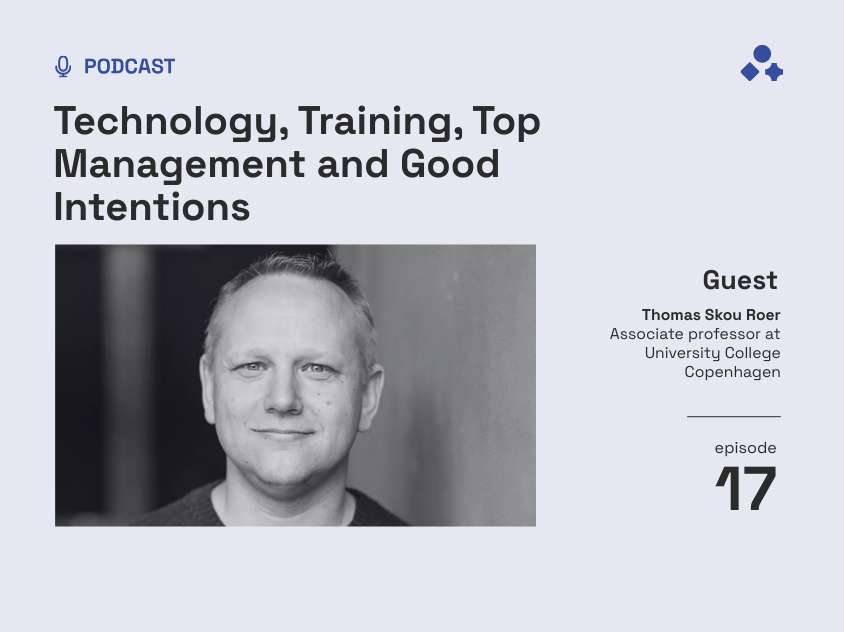
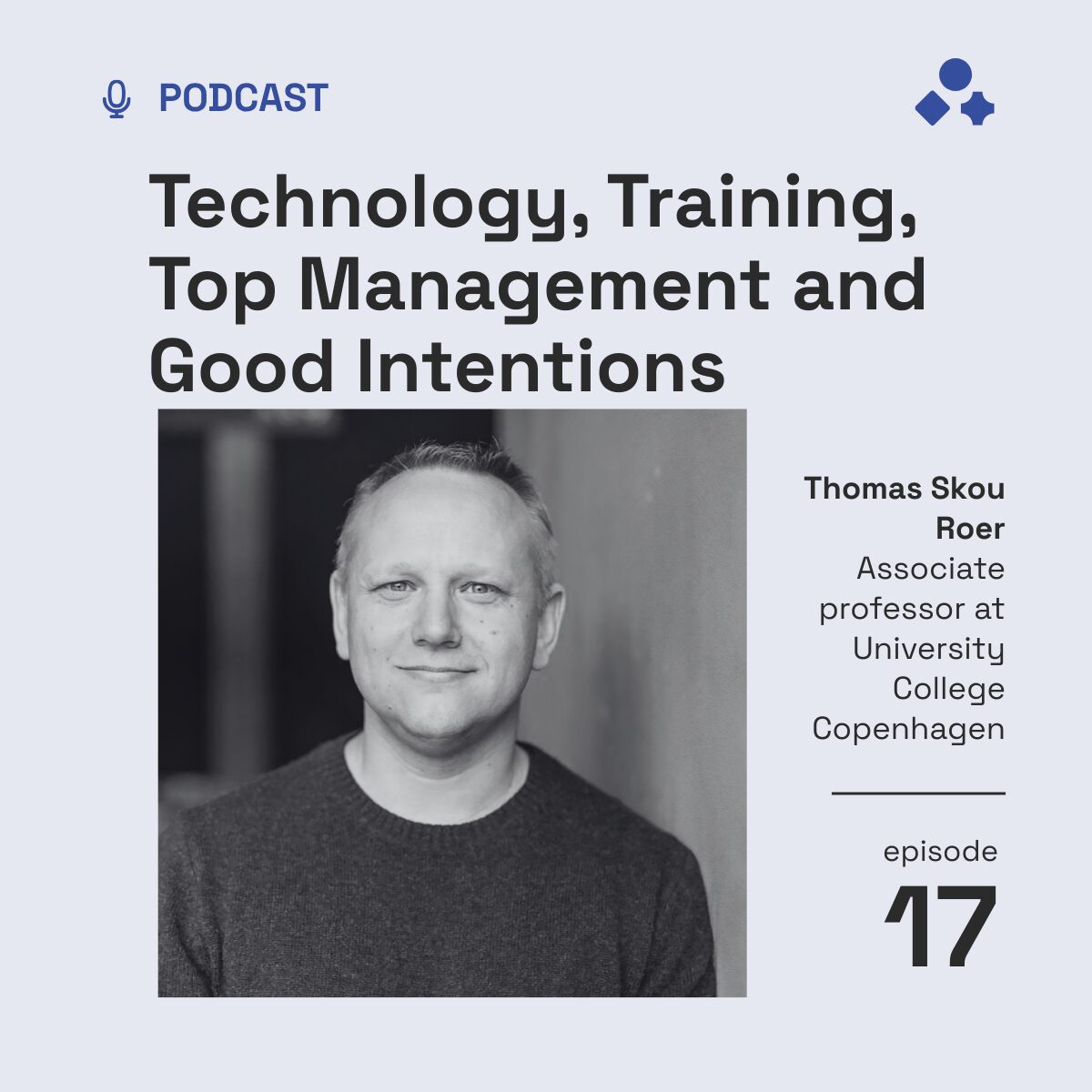
    Episode 17. Interview Recording, Technology, Top Management and Good Intentions

    Denmark was an early mover on investigative interview recording reform — its national standard arrived in 2015. Yet in 2021, for the first time in almost 100 years, two Danish police officers were convicted of attempting to coerce a confession.

    Thomas Skou Roer, one of the architects of that standard, joins Dr. Ivar Fahsing to examine what implementation really requires, and why getting policy right is only the beginning.

    In this candid and thought-provoking episode of Beyond a Reasonable Doubt, host Ivar Fahsing speaks with Thomas Skou Roer, associate professor at University College Copenhagen and former Danish criminal detective with 18 years of service, about the complex realities of implementing investigative interviewing standards in Denmark – and why having good standards doesn’t guarantee good practice. 

    Mr Roer opens with a powerful articulation of investigative interviewing’s ethos: “Do no harm, but get the job done.” This dual mandate – balancing safeguards with efficiency – reflects the tension inherent in modern policing. He traces how this balance has shifted over generations, with the “safeguard edge” becoming heavier than the “efficiency edge,” though both remain essential. The conversation then explores whether this represents genuine progress or simply a reframing of age-old police practices. 

    The episode reveals Denmark’s investigative interviewing journey in frank detail. In 2015, Denmark implemented a national standard for investigative interviewing, eliminating district-by-district variations and establishing unified training programs. This followed groundbreaking research by Kristina Kepinski-Jakobsen on witness and suspect interviewing. Thomas was part of the working group that developed these standards, leading one of the key projects. 

    Yet in 2021 – six years after implementation – two Danish police officers were convicted of attempting to coerce a confession, marking the first such convictions in nearly 100 years. Another officer was charged (though acquitted) in 2024. These cases starkly illustrate the gap between implementing standards and changing practice, revealing that Denmark “still has some way to travel” despite its progressive standards. 

    Mr Roer contrasts the Danish police’s implementation struggles with the Danish Immigration Services’ success story. Immigration Services fully adopted investigative interviewing principles, mandating onboarding training for all personnel with no exceptions – offering a model for what effective implementation can look like when organisational commitment is genuine. 

    The conversation explores why implementation fails even when standards exist. Our guest emphasises that investigative interviewing isn’t merely a technique – it’s a fundamental mindset change requiring professional critical thinking skills and metacognition. The traditional guilt-perspective, confirmatory approach is deeply human, not just a police failing, making change difficult without active intervention. 

    A central theme is the structural and managerial barriers to implementation. Mr Roer argues the problem isn’t officers on the ground, who genuinely want to do quality work, but rather management systems, performance measurement frameworks, and political pressures. He critiques Denmark’s “new public management” approach, which measures police efficiency through arbitrary timelines rather than actual public safety outcomes. True change requires “critical mass” at the top management and political levels – not just within police forces but throughout the justice system. 

    Our guest offers a compelling vision for the future: AI-powered decision support tools that flag interesting interview moments (“the interviewee said this was a boring kiss – what does that mean?”), identify weak hypotheses requiring more investigation, and help officers manage the massive data flows in modern investigations. He acknowledges the danger of creating “checklist policing” but argues that officers need technological support given the cognitive demands and volume of information they face. 

    In a powerful comparison, Dr Fahsing likens police to military forces – both responsible for keeping citizens safe, both requiring massive technological investments to equip personnel properly. Norway and Denmark invest billions in F-35 fighters and frigates for armed forces, yet similar thinking about technological investment in policing lags behind. Thomas agrees, noting that military conflicts create awareness driving investment, while policing needs similar critical mass for change. 


    Episode Length: Approximately 36 minutes

    Production: Davidhorn – Beyond a Reasonable Doubt Podcast

    Host: Dr Ivar Fahsing


    Equipped For Justice – Supporting ethical, human rights-compliant investigations worldwide

    About the guest

    Thomas Skou Roer

    is an associate professor at University College Copenhagen, where he teaches criminology. He trains various organizations in investigative interviewing and investigative practice. Thomas is part of the ImpleMendez group, where he leads the Training Curriculum Network, establishing a global standard for training materials in investigative interviewing. 

    Thomas is a trained criminal detective in the Danish police, where he served for 18 years. He was part of the working group that created the current standard for interviewing in the Danish police, implemented in 2015. He is also a trained forensic psychologist from the University of Liverpool. His work focuses on the practical implementation challenges of evidence-based investigative practices and the structural changes required for sustainable reform in criminal justice systems. 

    Watch and listen wherever you get your podcasts.

    Related products

    • Fixed Recorder

      Fixed HD recorder for high security interview rooms.

    • Portable Recorder

      Lightweight, PACE-compliant interview recorder for any setting.

    • Capture

      Mobile app recorder for capturing evidence on the go.


    • Ark Interview Management

      Receive, monitor, and keep evidence throughout its lifetime.

    Transcript

    Guest: Thomas Skou Roer

    Host: Dr. Ivar Fahsing

    Recorded: 26 November 2025


    Dr. Ivar Fahsing (Host)

    I would like to invite you, Thomas Skou Roer from Denmark, to this episode of Beyond a Reasonable Doubt, Season 3. As you know, Thomas, the topic of this year’s season is the implementation of investigative interviewing. Although you no longer work for the Danish police authority, you worked for them for quite some time and you are deeply engaged in investigative practice in Denmark still. It is an honour to have you here today. Welcome.  00:00

    Thomas Skou Roer (Guest)

    Thank you very much, Ivar. Thank you for inviting me. It is a big honour for me and I am looking forward to a good conversation.  00:38

    Dr. Ivar Fahsing (Host)

    Fantastic, Thomas. You and I go quite far back, so some of these questions I am fairly sure we share opinions on — which makes it all the more interesting to discuss them over the next 40 minutes. Let me begin by inviting you to share with me and our listeners: what do you think is the ethos of investigative interviewing?  00:45

    Thomas Skou Roer (Guest)

    Well, the ethos — at least from my perspective — is, I think, ‘do no harm’. But I also think there is another side to it: it has to get the job done as well. So it is ‘do no harm, but get the job done’. By saying that, I mean that we need safeguards, but we also need efficiency in our investigative interviewing practice — so that we obtain the information we need while taking care of the people we need to safeguard. It is a double-edged sword, you might say, although it is of course heavier on the safeguard side.  01:12

    Dr. Ivar Fahsing (Host)

    That is a really good answer. If you try to reflect critically — don’t you think our colleagues from a generation before us would say that they did exactly the same?  01:50

    Thomas Skou Roer (Guest)

    Probably, yes. I think it is also about philosophy — about how much weight should be placed on each edge of that double-edged sword. I think there are still two edges, but the safeguard edge is becoming slightly heavier these days than the efficiency part. Whereas earlier, I would say it was probably more efficiency over safeguards. The balance has shifted.  01:59

    Dr. Ivar Fahsing (Host)

    Definitely. It is, as you say, about having your sword sharp — but about how to wield it in a safer way.  02:38

    Thomas Skou Roer (Guest)

    Yes. And maybe it is not about the sword itself, but about the wielding of it. Yes, I think that is a very good analogy.  02:47

    Dr. Ivar Fahsing (Host)

    So if you take us into a Danish context, Thomas — what is the situation in Denmark today? And looking back over the years you have been involved in strategic development there, why is this development important for Denmark?  02:56

    Thomas Skou Roer (Guest)

    Well, if we start with a brief historical perspective — around 2010, we had a very good researcher, one you know as well, Kristina Kæpinski-Jakobsen, who did some very interesting research on the interviewing of suspects. Before that, she had also done research on general witness interviewing — very important work. There were efforts to build on that and expand upon it, to change the landscape of investigative interviewing. But it remained fragmented. There was no national standard for how investigative interviewing should be conducted in Denmark. Different districts still had different approaches, although broadly there was probably reasonable agreement. But there was no standard.  03:15

    I was part of a working group and had the pleasure of leading one of the projects on developing the new standard for investigative interviewing in the Danish police, which was implemented in 2015. With that, we had a new national standard — there could no longer be different perspectives. It was one perspective. At least, that was the idea. And in practice, of course, challenges remain. But that was the intent.

    This also meant that from 2015, training in investigative interviewing began to be implemented on a much larger scale than we had been used to. Not large enough, but bigger. There were a number of basic programmes — perhaps one to three days — just to create an appetite, if you will. And then further courses for volume crime, and of course a course for video interviewing of child witnesses. That is essentially where we remain today, ten years later.

    Some local initiatives have attempted to expand the training regime, with mixed results. There have been efforts on trauma-informed interviewing for sexual assault victims, so things are still being done. But what is really interesting is this: we implemented the standard in 2015, and yet in 2021, for the first time in almost 100 years, two police officers were convicted of attempting to coerce a confession. Which was quite surprising — we had this new standard, and it had been implemented, but apparently not well enough. And in 2024, another officer was charged with the same offence, though acquitted. That too speaks to where Denmark stands right now.

    The status is that we have implemented investigative interviewing and developed the Danish model of interviewing, but implementation-wise we still have some way to travel. We are not there yet — in the Danish police at least. I say it that way because I also train the Danish Immigration Service, and they have fully adopted investigative interviewing as their standard. Everyone is onboarded using this method, and there are two courses — basic and advanced — as well as a child interviewing course. So the police is not alone in this. There are a number of actors employing the principles of investigative interviewing in Denmark, as is the case globally.

    Dr. Ivar Fahsing (Host)

    When we talk about the ethos of investigative interviewing — in my world, Thomas, it is probably not about interviewing at all. It is about how you think about an investigation, and what your job is. As you know, we often talk about what I call the change of mindset — the mindset that is traditionally more guilt-presumptive and confirmatory, which is not only something that comes from being a police officer. It is 100% human: to be suspicious, and to confirm that suspicion, especially if your job is to investigate. If you do not actively address that, the mindset will not change.  08:13

    Thomas Skou Roer (Guest)

    That is very true, Ivar. I absolutely agree. It is very much a mindset change. Investigative interviewing and investigative practice very much rely on professional critical thinking skills — and mostly, I would say, metacognition. Asking questions of your own thinking: why am I thinking this? What am I basing this on? That is one of the most difficult aspects of this.  08:59

    And it is very often trained as an appendix — ‘Could you do a bit on bias? A bit on System 1 and System 2 thinking?’ But mostly, people want something about techniques. In some ways, you should perhaps switch that around: put the emphasis on the mindset, with techniques as a smaller component.

    Dr. Ivar Fahsing (Host)

    That is so interesting. And of course very difficult to do. I remember, Thomas, many years ago — when I was approaching this task in Norway together with my good friend and colleague Asbjørn Rachlew — I was called up by the director of the National Criminal Investigation Service in Norway, Kripos. His name was Arne Husse. He was quite a well-known figure in Norway at the time. He called me when I was still a very young officer at the homicide unit — on a temporary placement, not yet in a permanent position. They wanted to observe and evaluate you before offering a permanent role, given the travel and teamwork involved.  10:18

    He said he had heard I wanted to do a master’s in forensic and investigative psychology in England, and asked me why. My head of the homicide department joined that meeting — and he was clearly not a fan of me going to England. He was one of the older gurus of confession-based interviewing in Norway. He saw it as a threat to the way things were done. He could not say no to the director outright, but he made clear he did not approve: ‘You should send one of the older officers.’

    The director challenged him in front of me: ‘Listen — what this young man is asking for is not support to spend two years on a beach in Thailand. He is asking for support to sit exams and work hard at a university in England. Do you understand that?’ And then, to my boss: ‘Help him do it. Get out of here.’ On the way out, the director stopped me, took my arm, and said: ‘Ivar, if you have any more problems with this man, come straight to me.’

    That is the kind of leadership you need from senior officers — the courage it takes to embrace change in a national police culture. Thinking about that, Thomas, and relating it to the top management of the Danish police — have you seen similar change cultures or similar agendas?

    Thomas Skou Roer (Guest)

    Interesting question, Ivar. I have to say — no. Not directly like that. The closest we had was a period when Denmark had a bachelor’s degree in policing — during that time, top management were involved in supporting officers to pursue master’s degrees, partly to secure the required accreditation. But even then, it was more practical than visionary. It was not driven by a sense of direction towards evidence-based policing. The idea of evidence-based policing has been attempted multiple times in Denmark and is still being pursued, but senior management have called for it without necessarily understanding what it fully entails. Which makes implementation very difficult.  13:19

    My own story about doing a master’s is almost the complete opposite of yours. When I was accepted at a British university, I wrote to everyone in the Danish police — from the National Police Commissioner to my own district leaders — telling them I had this opportunity and asking for their support. And they all responded, in effect: ‘What a wonderful opportunity for you — have fun doing it on your own, because we will not support you.’ To be fair, my local managers supported me with time, for which I was very grateful. But at the top level, the response was not visionary. Practical, at best.

    Dr. Ivar Fahsing (Host)

    Exactly. From a Norwegian perspective — and we are not saying right or wrong here, Thomas, only history will tell — when I look back to when I started as a detective in Oslo in the early 1990s, Copenhagen was always very close. We had close cooperation and learned a great deal from each other — perhaps more accurately, we learned a great deal from the Danish. I trained at Politigården for months and learned a lot. Denmark was in many ways more modern in its general policing approach. But when it comes to this particular topic, I feel Denmark has been absent from the international stage in a way that is surprising. Norway has advanced considerably. And it is genuinely interesting — because you would expect Denmark, as a country that leads on human rights and modern liberal democracy, to be at the forefront.  16:07

    Thomas Skou Roer (Guest)

    Yes, absolutely. The Danish police is a very closed organisation — as I imagine most police forces are. There is a very small research community looking into police practice, and access is very difficult because the police is protective of itself. That means knowledge within the organisation is largely tacit. And you cannot easily develop tacit knowledge. I think that is the biggest problem in Denmark: a great deal of hard-earned experience exists, but it is all tacit — there is no development.  17:41

    And when development does occur, it tends to be practically oriented: a new piece of software, a new piece of equipment — as opposed to a new methodology. Interestingly, there has been significant development on the operational side of policing — riot control, for instance. The dialogue concept for public order situations has evolved considerably, and new tactics were developed following a major incident in 1993. So within that part of the police, there has been meaningful change. But within investigative practice, we are not there yet. We miss people like your director. We miss people who will stand up and say: we will no longer do it this way. We will do it this way.

    Dr. Ivar Fahsing (Host)

    Absolutely. And as you will know, the Attorney General of Norway has since made it very clear — in writing, through national circulars — that there is no other way. That brings me to our next topic, Thomas. Thank you for being so open and frank about this. I do not enjoy speaking about Denmark in difficult terms — it is one of my favourite countries, and the Danish are among my favourite people. So thank you for being honest and scrutinising this uncomfortable subject.  20:36

    Thomas Skou Roer (Guest)

    You are welcome.  21:18

    Dr. Ivar Fahsing (Host)

    Does the Danish police record their interviews today?  21:19

    Thomas Skou Roer (Guest)

    They record some of their interviews. All child interviews are recorded. And there is a pilot scheme, running for a couple of years now, allowing sexual assault victims to be interviewed on video for use in court. But it has had mixed results. Not everyone chooses to do it, and defence attorneys are not always supportive. It turns out that some defence attorneys refrain from asking critical questions during the recorded interview, reserving them for court — because even though victims are recorded, they may still be required to attend court to answer additional questions that arise during the investigation. Victims have reported feeling that they end up going through another interview, which is the opposite of the intended effect.  21:31

    As for other serious cases — homicides or similar offences — some districts have implemented recording and may choose to do so, but they are not obligated. That is a significant difference. They can, but they are not required to. And I do not know how many actually choose to record. Transparency on that is essentially non-existent.

    Dr. Ivar Fahsing (Host)

    Yes.  23:16

    Thomas Skou Roer (Guest)

    And I feel I need to add: I was part of the police for 18 years, and I want to be clear that there are many very committed, very talented investigators and leaders in the Danish police. It is not all bad. But there is some structure around them that needs to change for them to do better work.  23:35

    Dr. Ivar Fahsing (Host)

    Sometimes I think about this as a systemic change, Thomas. You cannot blame the individuals inside the organisations. It is a systemic change, and linking it to individuals would not be fruitful. I completely agree.  24:15

    The reason I am interested in recording is this: from a Norwegian perspective, it was what I believe was the tipping point for many leading Norwegian detectives. When we agreed to pursue a national implementation of recording equipment — already in 1998 — officers felt extremely insecure about pressing that red button and recording themselves. And that feeling made them think: I need training, backed by science. There is a very interesting link between recording and professional development.

    Thomas Skou Roer (Guest)

    Yes, I agree. If officers were obligated to record all their interviews, and those recordings were subject to scrutiny — by an external authority, or at least internally, not every interview but a sample — I think that would make a huge difference to both implementation and quality.  25:28

    Dr. Ivar Fahsing (Host)

    It is like the old saying from Lord Kelvin: if you cannot measure it, you cannot improve it.  25:56

    Thomas Skou Roer (Guest)

    Yes. Yes, exactly.  26:02

    Dr. Ivar Fahsing (Host)

    A last question, Thomas, and then we will wrap up. Looking ahead — from a Danish perspective, and also more broadly, given that you work internationally and are heading to the Caribbean next week to lecture on these topics — what innovations, technologies, or policy changes do you think we need to effectively support positive change in investigation quality and interview quality? What do you hope for, or see coming?  26:04

    Thomas Skou Roer (Guest)

    That is a big question, Ivar. Globally, every officer feels under pressure resource-wise — they feel they do not have enough time to do quality work. My hope for the future is that we find suitable technologies to help officers manage an investigation and to think. I know that last part may sound controversial — of course we want officers to think for themselves. But they have been doing that for 500 years, and too many errors occur. We need decision support.  26:37

    In this era of AI, it should be possible to develop tools that can flag things during or after an interview: ‘The interviewee said something interesting here — explore that further.’ Or for the investigation more broadly: ‘This hypothesis looks weak — the leads in this direction need to be strengthened.’ Or: ‘This line is strong — can we make it even stronger?’ Something that helps officers analyse the vast amounts of data that flow into an investigation today. The sheer volume — from digital and physical forensics to interviews and many other sources — is massive. Managing that information to know which directions to pursue is a significant challenge.

    So the hope is technological support for decision-making. Of course, that is also risky — if the system says ‘go’, people just go. So we still need to train officers in critical thinking. Technology should support, not replace, that.

    On policy — that is more difficult. In Denmark, I hope we are approaching a critical mass for change. We have many gifted and talented officers, but some structures that need to change. One specific hope: moving away from New Public Management principles as a way of steering the police, and towards measuring what actually matters — are you creating a safer, higher-quality society for your citizens? Rather than: ‘In a violence case, you must complete step one within five days and step two within ten.’ That is a skewed way of measuring police efficiency. A significant policy change is needed, and I hope we are getting closer to the critical mass that would enable that discussion — how to create and maintain an efficient and legitimate police force in Denmark.

    Dr. Ivar Fahsing (Host)

    Thank you, Thomas. That is a really interesting answer. It makes me think that what we sometimes call investigative interviewing becomes in many ways a denominator for something more fundamental — for what police work should really be about. And I think your answer reflects that. This is about something bigger. It is not just a technique.  31:49

    Thomas Skou Roer (Guest)

    No, definitely not just a technique. And Ivar, we could talk about this at length — and we have, many times. There has to be awareness at upper management level to drive this change. I honestly do not think the problem lies with the people on the ground. They want to do good work. But they need their managers to help them do quality work. And those managers need support from their managers, and so on up the chain. So when we talk about top management, we also need to talk about the political level — how political leadership needs to be on board with changing the system around the police. I do not think it is enough to have police managers on board, because those managers have managers in the Justice Department, and so on. Ultimately, this requires political will.  32:21

    Dr. Ivar Fahsing (Host)

    That is an interesting discussion, Thomas — because if you compare the two great forces in a country supposed to keep the people safe: the police, from an internal perspective, and the military, from an external one. What you are saying about equipping officers for the job expected of them requires big investments in technology and people. And that becomes even clearer when you compare policing with the armed forces. Norway and Denmark, like most Northern European countries, are now buying F-35s — an enormous investment to give pilots the technology they need. Norway is buying new frigates — major investments so our naval officers can operate effectively in the North Atlantic with equipment that is not outdated. And I think what you are saying is that the same mindset is necessary when it comes to policing, all the way from the top down.  33:51

    Thomas Skou Roer (Guest)

    Yes, absolutely. And I think the difference right now between the armed forces and the police is that there is a great deal of public and political awareness driving military investment — the war in Ukraine, the conflict in Gaza, wars around the globe. That is pushing the agenda. What I am talking about with critical mass is that we need similar awareness when it comes to policing. That is the hope.  35:24

    Dr. Ivar Fahsing (Host)

    Thomas, I would like to close with this. A wise man once said: if you are the smartest person in the room, you are in the wrong room. Today, I was in the right room. Thank you so much for a really engaging and thoughtful conversation.  36:03

    Thomas Skou Roer (Guest)

    Thank you, Ivar. And I feel exactly the same — what an honour.  36:27


    END OF TRANSCRIPT

    © 2025 Davidhorn. All rights reserved.

    Read more

    16 Marzo 2026
  • Implementing Investigative Interviewing in Thailand – ep.16

    Implementing Investigative Interviewing in Thailand – ep.16
    implementing investigative interviewing

    The Long Game Series
    Episode 16. Systemic Change in Thai Criminal Justice

    The Long Game Series: Thailand leads Asia in implementing investigative interviewing nationwide. Prosecutor Santanee Ditsayabut reveals how systematic training transforms justice. 

    In this episode of Beyond a Reasonable Doubt, recorded in Hua Hin, Thailand, Dr Ivar Fahsing speaks with Ms. Santanee Ditsayabut, senior prosecutor at the Office of the Attorney General of Thailand and director of the Secretariat of the Nitivajra Institute, about Thailand’s pioneering efforts to implement investigative interviewing across an entire nation’s criminal justice system.

    Ms. Santanee Ditsayabut shares the story of Thailand’s PEACE Program Informity – a comprehensive initiative bringing together prosecutors, police, special investigators from the Department of Special Investigation (DSI), judges, and officers from multiple government agencies to learn and implement ethical, evidence-based interviewing practices. This multi-year collaboration between the Norwegian Centre for Human Rights, the Thailand Institute of Justice, and the Association for the Prevention of Torture (APT) represents one of Asia’s most ambitious criminal justice reform initiatives. 

    The conversation explores the unique challenges and opportunities of implementing investigative interviewing in Thailand, where cultural values of respect and dignity naturally align with the ethos of ethical interviewing, yet practical concerns about time constraints and traditional practices create resistance. Ms. Ditsayabut candidly discusses how training reveals eye-opening moments for practitioners who discover cognitive biases like confirmation bias and tunnel vision they never knew affected their work, and how understanding brain function and memory science transforms their approach to gathering reliable evidence. 

    A key theme is the importance of patience and long-term strategic thinking in systemic change. Rather than expecting overnight transformation, Thailand’s approach involves training small groups intensively – including future policy makers and university students – who become champions spreading the principles throughout their organisations. The episode reveals how this methodical approach is creating sustainable change across Thailand’s criminal justice ecosystem. 

    Santanee Ditsayabut emphasises that investigative interviewing isn’t merely about following human rights principles – it’s about understanding the science behind why these approaches produce more reliable evidence and better case outcomes. She discusses the critical role of judges in understanding memory science to properly evaluate evidence, using powerful examples of how lack of this knowledge can lead to miscarriages of justice. 

    The episode culminates in celebrating a historic milestone: Thailand is certifying its first national trainers and champions for the PEACE program, positioning the country as a leader in Asia for evidence-based, human-rights-compliant investigative interviewing. Technology, including recording systems like Davidhorn’s solutions, plays a crucial role in supporting this transformation by enabling accurate documentation and evidence management. 

    Listen to the full conversation in Episode 16 of Beyond a Reasonable Doubt, where dr Ivar Fahsing talks with Santanee Ditsayabut.


    Episode Length: Approximately 30 minutes

    Production: Davidhorn – Beyond a Reasonable Doubt Podcast

    Host: Dr. Ivar Fahsing


    Equipped For Justice – Supporting ethical, human rights-compliant investigations worldwide

    About the guest

    Santanee Ditsayabut

    Ms. Santanee Ditsayabut is a senior prosecutor at the Office of the Attorney General of Thailand and director of the Secretariat of the Nitivajra Institute, established to strengthen Thailand’s criminal justice system. She graduated LL.B. with first-class honours from Chulalongkorn University in 1995 and ranked first in the Thai Bar exam in 1996. She holds two LL.M. degrees from the University of Pennsylvania and the University of Wisconsin-Madison, funded by a Royal Thai Government scholarship. Since 2001, she has served as a public prosecutor with extensive experience in international legal cooperation. 

    Ms. Ditsayabut was part of the task force for the 11th UN Congress on Crime Prevention and Criminal Justice in 2005 and was seconded to UNODC as a regional expert for the Terrorism Prevention Branch, promoting implementation of counter-terrorism conventions in Asia and the Pacific. Her expertise covers transnational crime, particularly trafficking in persons, and combating violence against women and children. She chaired key consultations at the 22nd and 23rd sessions of the Commission on Crime Prevention and Criminal Justice, including negotiations leading to the 2014 UN Model Strategies on the Elimination of Violence against Children. 

    Ms. Ditsayabut serves on the Advisory Council drafting the Mendez Principles on effective interviewing for investigations and information gathering, and actively implements these principles among law enforcement practitioners in Thailand. She previously served as chief prosecutor of a provincial office and now leads Thailand’s national efforts to implement evidence-based, human-rights-compliant investigative interviewing practices. 

    Watch and listen wherever you get your podcasts.

    Related products

    • Fixed Recorder

      Fixed HD recorder for high security interview rooms.

    • Portable Recorder

      Lightweight, PACE-compliant interview recorder for any setting.

    • Capture

      Mobile app recorder for capturing evidence on the go.


    • Ark Interview Management

      Receive, monitor, and keep evidence throughout its lifetime.

    Transcript

    Host: Dr. Ivar Fahsing, CEO, Davidhorn
    Guests: Santanee Ditsayabut


    Dr. Ivar Fahsing  (00:00)

    Welcome to another episode of Beyond a Reasonable Doubt. Today we are in Hua Hin, Thailand, and our guest is Santanee Ditsayabut. Welcome.

    Santanee Ditsayabut  (00:13)

    Welcome to Thailand, and welcome to Hua Hin.

    Dr. Ivar Fahsing  (00:16)

    Thank you so much. Santanee, you are not only a dear friend, but you are also a senior expert prosecutor at the Attorney General’s Office here in Thailand, and you are the Director of the Secretariat of the Nitivajra Institute, which promotes effectiveness and quality in the criminal justice system. It is an honour to have you as a guest on our podcast today.

    Santanee Ditsayabut  (00:39)

    It is an honour for me to be your guest too. Welcome to Hua Hin — it is so nice to have a chance to talk with you.

    Dr. Ivar Fahsing  (00:47)

    Thank you so much. The theme of this year’s season of Beyond a Reasonable Doubt is “Implementing Investigative Interviewing: The Near and Far Horizons.” My first question is for you, because I know you are leading a project in Thailand called the PEACE Program Informity, where you bring together people from different agencies across the criminal justice system to systematically implement investigative interviewing across your country. Before we dive into that, I would like you to reflect on what you believe is the true ethos of investigative interviewing, and why you think it can promote quality in the justice system here in Thailand.

    Santanee Ditsayabut  (01:33)

    When I first learned about investigative interviewing, perhaps five years ago, I came to think of it as a way to find the truth without unintentionally assuming the facts. It is, I believe, the best way to apply the principle of presumption of innocence — a principle we as law enforcement officers are taught from day one when we enter the legal world, but one that we sometimes forget in practice.

    So I think investigative interviewing is more than just questioning. You need to look at it as a whole process, not just the questioning step — that is only one step. You need to view it as a process of discovering the truth, which begins with planning and preparation. That is everything. It is also a process of gathering reliable evidence, and it truly benefits the prosecutor: if evidence is gathered from a reliable source, we can prove it beyond reasonable doubt in court.

    Learning about investigative interviewing also helps you understand how the brain works, how it functions, and how to respond to that systematically in order to achieve the best results from the inquiry process. That is the fascinating thing — not only following the principles of human rights, but understanding the research behind why you should respect those rights, because it affects the behaviour of the person you are questioning, and ultimately produces the most effective outcome.

    Dr. Ivar Fahsing  (03:31)

    I couldn’t agree more. As you know, I have been involved in a similar pioneering project in my own country, for very much the same reasons — it all sounds very familiar. Are there any particular challenges in Thailand that you think we need to address, and why is investigative interviewing particularly relevant here?

    Santanee Ditsayabut  (03:56)

    I think the challenges can feel almost impossible at first. In the past, we approached questioning very simply: you ask, and another person answers. But investigative interviewing requires more than just walking into a room and asking questions. It requires a process of planning and preparation, of thinking thoroughly. Some officers say they simply do not have the time. When a criminal case comes in, you need to act quickly — there is no time for such a process, they say. And they do not immediately see how respecting human rights will affect the outcome of the case. They see it as an international standard, but not as something that will improve their results.

    So the challenge in Thailand is twofold: is it possible given our time constraints, and will it actually be effective — or is it just an unnecessary burden imposed by international standards? That is what we need to address.

    Dr. Ivar Fahsing  (05:07)

    If I may add — I have been fortunate enough to visit Thailand many times over more than 30 years. In my personal view, Thai culture is a very respectful and polite culture. I would say that the respectful, dignified approach to interviewing that lies at the heart of this ethos should actually fit very well with Thai culture.

    Santanee Ditsayabut  (05:37)

    Yes, indeed. We do not practise torture or use force in interviewing — that is simply not acceptable in Thailand. But I think there are still some misunderstandings and blind spots. For example, a simple one I often see: some police officers believe that if you are interviewing a suspect, you need to be patient and persistent. So they may question someone for three hours straight, six hours, sometimes overnight — because to them, that is what patience means. But they do not realise it is not effective. If you keep questioning a person who is already exhausted, they may say things they do not mean to say.

    It is not that they intentionally violate anyone’s rights — they simply do not know it does not work. I think investigative interviewing helps practitioners become aware of cognitive biases like confirmation bias and tunnel vision. Once you learn about them, you can keep yourself aware before entering the interview room. It also opens your eyes to memory science — for example, two people who describe an event differently are not necessarily lying. Both may be telling the truth. And our brains do not store memories in chronological order, even though we are often taught to ask questions in a neat step-by-step sequence. These are the kinds of things that make investigative interviewing so fascinating and eye-opening for us.

    Dr. Ivar Fahsing  (07:29)

    Together with Santanee, and with support from my centre at the Norwegian Centre for Human Rights — where I hold my guest professorship — alongside the Thailand Institute of Justice and the Association for the Prevention of Torture (APT), we have been fortunate to conduct quite a number of training sessions across Thailand over the past years. We have trained prosecutors, special investigators from the DSI, officers at the Royal Police Cadet Academy, and personnel from the Ministry of Interior and other agencies. I also recall that judges attended the summer training.

    What is the general impression among your participants? Is investigative interviewing catching on in Thailand? Are people responding well?

    Santanee Ditsayabut  (08:33)

    Yes. From what I have observed, once people learn about investigative interviewing they love it — because it unlocks something they never quite understood before. All our participants are law enforcement officers from different organisations — we have even had a soldier in one session — and they exchange a great deal with each other. They begin to recognise what they may have been doing wrong and what they can improve.

    And investigative interviewing is not just something you study — you need to practise it. In the training, participants have the chance to try things for themselves. They discover from the inside what works and what does not. The feedback I consistently receive is that it is eye-opening. It is engaging, because it is not just sitting and listening — they discover things for themselves. For example, they watch a video clip and try to recall what they saw, and they discover that even they cannot remember everything, and that different people watching the same clip remember it differently. That is very striking for them. Many say they can apply these principles not only in their work but in their daily lives.

    Many participants come back and say they want to introduce the principles of investigative interviewing — especially the PEACE model — to their colleagues. They are keen to do more training. They understand that this is not something you can learn from a book; it requires investment in the right kind of training: intensive workshops, not just lectures. My concern is that because these workshops are intensive, we can only accommodate small numbers at a time. But all those participants can spread the word, and the network grows.

    I now hear from many participants that they had come across investigative interviewing before but could not grasp it from a single lecture. Once they train with us, they understand it far more deeply — and they return to the very first question I mentioned: is it possible in Thailand? But this time, with the confidence to say yes, it is.

    Dr. Ivar Fahsing  (11:32)

    These are challenges we face everywhere. You have to understand the philosophy behind it, the connection to international legal and human rights standards — that is the process quality of interviewing. But also, as you say, the psychology, the theory of memory, and the importance of not contaminating your evidence. And ultimately, as you put it so well —

    Santanee Ditsayabut  (12:02)

    That is exactly the right word: skill.

    Dr. Ivar Fahsing  (12:04)

    A skill that you lose if you do not practise. You have to keep at it to become truly good — it is hard work, and you need honest feedback to improve. But I would also like to acknowledge what you have been doing for so many years, Santanee. Last week, that work was recognised in a very meaningful way — I was personally invited to meet the Minister of Justice in Thailand. His Excellency was clearly aware of the developments in the country and asked me to continue assisting. He wanted to expand the training programme as widely as possible.

    We also had the company of Davidhorn CEO Børge Hansen, and the Minister was particularly interested in how technology connected to investigative interviewing could improve the quality and effectiveness of Thai investigative procedure. I think that is clear evidence that your work is spreading — and reaching the very highest levels of Thai society.

    Santanee Ditsayabut  (13:28)

    Thank you for mentioning that. It reminds me that to make investigative interviewing work, you need more than practitioner training — you need support at the policy level, and you need the right equipment. The Nitivajra Institute is at the front line of awareness about investigative interviewing in Thailand, and we are working to bridge the policy level and the practitioners.

    For example, for our second cohort training here in Hua Hin, my supervisor also met with senior leadership to discuss exactly what you described — how to embed this at the policy level, and how technology can support it. One important element of investigative interviewing is that interviews should be recorded. In Thailand today, we only routinely record in high-profile cases and interviews involving children. But we are beginning to see the broader benefits of recording, and with modern technology it need not be a burden.

    Yesterday I was speaking with one of our participants who had just completed her first simulation exercise — she had interviewed a simulated suspect in under 40 minutes. I asked her how long the same interview would typically take in her day-to-day work. She said perhaps two hours. I asked why. She explained that in the traditional approach, she first has to speak with the witness to gather background on the incident, and only then begin the actual interview. But with investigative interviewing, you record from the start, and technology can transcribe it afterwards. It is actually less work than what officers are doing now. If you can help people see that, you can dispel the myth that this approach is too time-consuming.

    Dr. Ivar Fahsing  (16:22)

    You are absolutely right. In the beginning it may seem more resource-intensive, but when done properly it is actually more efficient. As you say, thorough planning means you do not enter the interview without knowing what you are looking for — wandering without direction is what truly wastes time. And when transcription is automated, the investigator can focus entirely on being present during the interview, and handle the administrative work afterwards.

    This is also one of the technological projects we have planned to develop here in Thailand. We intend to use recordings from your training sessions — which are less sensitive from a GDPR perspective — to build and test AI transcription tools, to see how accurate and reliable we can make the automated output. That will move us quickly toward both higher quality and higher efficiency.

    Based on all of this — and knowing you well enough to notice when you are concerned — when you look at the future of investigative interviewing in Thailand, what are your worries? What do you think could be the main barrier to progress?

    Santanee Ditsayabut  (18:02)

    My worry is mindset — including at the policy level. As I said, once practitioners are trained they see the benefits for themselves. I am not worried about practitioners. But we cannot simply put senior officers through a training course. So the question is: how do we demonstrate to high-level decision-makers that this is genuinely useful and that it can enhance the effectiveness of the criminal justice system — so that they will give it their political support?

    Once practitioners are trained, their mindset shifts. But if they walk out of the training room and back into an environment where their supervisors do not understand what they are doing, their capacity is limited. That is why I believe three things need to come together: political will, practitioner mindset, and the right technology. If you can achieve all three, the future will be bright.

    Dr. Ivar Fahsing  (19:41)

    I couldn’t agree more. And there is something I think is genuinely rare about Thailand’s development compared to other projects I have seen around the world — you have been able to bring together experienced practitioners from many different agencies, more or less reflecting the entire chain of justice. That is a great strength, and it is quite uncommon.

    My own background is in the Norwegian development, and when we were doing this we did not think carefully enough about how the changes would ripple through not only police work, but also the work of prosecutors, defence lawyers, and ultimately judges. If you do not change the whole chain, how can you achieve a real effect?

    So what would you say is the next step for Thailand?

    Santanee Ditsayabut  (20:37)

    I think the next step is to do more of what we are doing now — but with greater reach. As you mentioned, pulling together organisations toward the same goal is key. Our participants from the first cohort have already spread the word so effectively that recruiting for the second cohort was straightforward. The interest has even extended beyond the criminal justice system to the military. When the military asks to join, that underlines how the practitioner community, once it understands investigative interviewing, naturally spreads the network.

    So we invite people we believe will become champions in the future, and the network keeps growing. The challenge is how to keep that network active and supported, while continuing to demonstrate the concrete benefits to supervisors. And as you said, investigative interviewing is a skill — you need to keep practising. It cannot be a one-time event. You need to keep the network alive, support its members, help them grow, and make the case to their leadership. That is how we make it sustainable.

    Dr. Ivar Fahsing  (22:21)

    I think you are right. And I find it fascinating that your approach here reflects something in the wider culture — an intuitive understanding that processes like this must take time.

    Santanee Ditsayabut  (22:36)

    Of course it takes time. We have moved on from ancient practices — methods that relied on oaths, rituals, or coercion to obtain information. Now we have a criminal justice system, and I believe it can and should continue to move forward. I would also add something I forgot to mention: sometimes, to fully support investigative interviewing, we will need to amend the law to complement the process.

    Dr. Ivar Fahsing  (23:08)

    What about judges?

    Santanee Ditsayabut  (23:09)

    The involvement of judges is absolutely essential, because the judge is the one who decides. If a judge does not understand how evidence is gathered, they may overlook critical context. As a prosecutor, I have seen judgements that reflected confirmation bias.

    Let me give a specific example: a witness was raped by her stepbrother and did not want to believe it was real. Her testimony was inconsistent as a result. If the judge understands that there is an alternative explanation — that the victim may be speaking differently from the facts because she cannot bring herself to accept what happened — the outcome of the case might be very different.

    Dr. Ivar Fahsing  (24:04)

    That is so important, because this is fundamentally about evidence evaluation. For those of us who have had the opportunity to study psychology, we understand that the brain’s real function is not to produce a realistic, accurate memory. Its function is to process experience in a way that allows you to keep living.

    Santanee Ditsayabut  (24:27)

    Yes.

    Dr. Ivar Fahsing  (24:28)

    Sometimes memory is there to help you construct a life you can bear.

    Santanee Ditsayabut  (24:34)

    Yes, exactly.

    Dr. Ivar Fahsing  (24:36)

    And if you do not understand that as a prosecutor or a judge, you may be unable to make sense of what you are hearing — and you might automatically dismiss a victim as unreliable, when in fact she is simply undergoing a very normal psychological process.

    Santanee Ditsayabut  (24:50)

    Yes. And at the end of the day, that leads to a miscarriage of justice — which is precisely what we must avoid.

    Dr. Ivar Fahsing  (24:58)

    So this tells us that investigative interviewing is far more than a model or a set of steps. It is a science-based framework for understanding and collecting evidence from human beings and human memory.

    Santanee Ditsayabut  (25:16)

    I have one final question for you. This is, in one sense, a year to celebrate — a very important milestone for investigative interviewing in Thailand. This week, we are in the process of certifying the first national trainers and champions for the PEACE programme. It is exciting that we have come this far.

    But we still need strategic investment to sustain this. How can we get the attention of decision-makers and make them willing to commit to that investment?

    Dr. Ivar Fahsing  (26:13)

    I think we need to help them see the benefits of investigative interviewing for themselves — through evidence, or through first-hand experience. Learning from countries that have already implemented this successfully, and seeing the outcomes with their own eyes.

    Santanee Ditsayabut  (26:41)

    I completely agree. Perhaps a study visit to a country where investigative interviewing is fully integrated across the justice chain. And technology may well have a role to play there too.

    Dr. Ivar Fahsing  (26:49)

    Yes — technology, study visits, or access to trusted, authoritative voices. Not just one person making the case, but evidence that senior leaders find credible. That requires careful thinking about how we build that kind of influence.

    Santanee Ditsayabut  (27:13)

    Absolutely. And I know that you are engaged on another front as well — you have your own lectures at Chulalongkorn University, where you are teaching the next generation of lawyers. As you said earlier in this conversation, the long-term perspective is everything. You need to be patient.

    Dr. Ivar Fahsing  (27:23)

    Yes. You need to be patient, and you need to prepare the ground for future officers to grow up with investigative interviewing as a given. This brings us back to the composition of participants in the PEACE model course — we bring together not only young practitioners and mid-level officers, but also the prospective policymakers of tomorrow. That mix creates the conditions and momentum to carry investigative interviewing forward in Thailand.

    Santanee Ditsayabut  (28:15)

    I couldn’t have said it better myself. Santanee, thank you for a wonderful conversation, and for joining us on the podcast today.

    Santanee Ditsayabut  (28:24)

    And I would like to thank the Norwegian Centre for Human Rights for supporting us in implementing investigative interviewing in Thailand from the very beginning. Our partnerships are growing — with APT, the Thailand Institute of Justice, and many more — because we all see the benefit of investigative interviewing in enhancing the effectiveness of justice systems, not only in Thailand but around the world. Thank you very much.

    Dr. Ivar Fahsing  (28:54)

    Thank you, Santanee. I think this goes beyond Thailand. I think Thailand is leading the way in Asia — not just Southeast Asia, but Asia as a whole. The way you and your colleagues have led this project, the seniority of the people who have invested in it, the commitment from across the system — I believe Thailand is going to be one of the truly leading nations in Asia on this.

    Santanee Ditsayabut  (29:20)

    Thank you very much. Let us make it a universal commitment.

    Dr. Ivar Fahsing  (29:26)

    Thank you so much.


    END OF TRANSCRIPT

    © 2026 Davidhorn. All rights reserved.
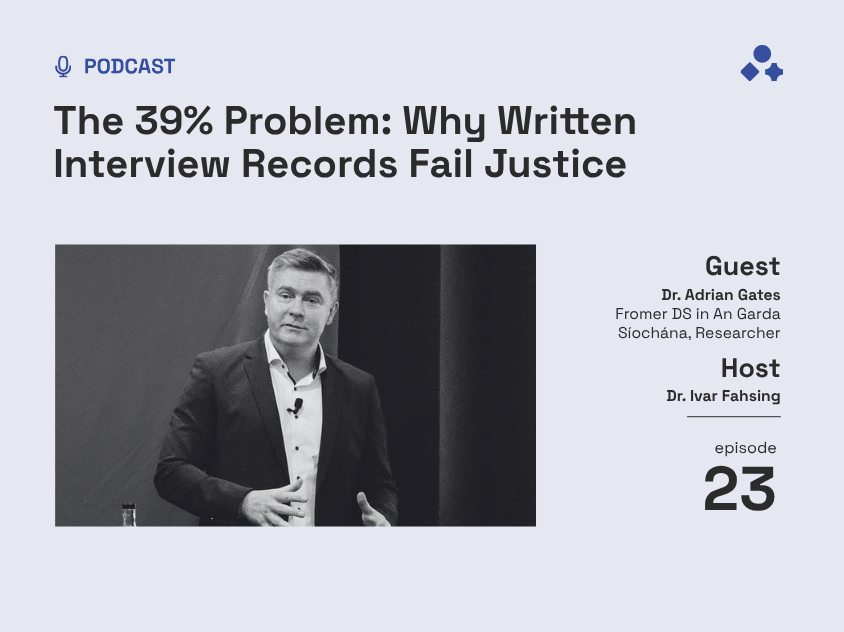
    Read more

    4 Marzo 2026
  • Innovation and AI in Norwegian Policing – ep.15

    Innovation and AI in Norwegian Policing – ep.15

    Episode 15. Innovation and the role of AI in Police Work with Norwegian Police

    Discover how Norwegian police are transforming investigative work through innovation and artificial intelligence.

    This episode examines the integration of AI in police work and investigative interviewing, advances in crime scene investigations, and the critical importance of accountability when deploying AI tools.

    The speakers discuss challenges in keeping pace with criminal innovation, the necessity for operational efficiency, and how international collaboration strengthens policing practices. They also address the cultural shift required within police organisations to embrace the innovation of AI in police work while navigating bureaucratic complexities. Join host Børge Hansen in conversation with three experts from Norway’s law enforcement community: Kjeld Hendrik Helland-Hansen and Oddvar Moldestad (Forensic Investigators, Western Police District) and Bente Skattør (Senior Advisor ICT and Innovation, Norwegian Police).

    When Police Innovation Meets Reality: Inside Norway’s AI Revolution

    At a recent crisis exercise with the Norwegian Navy, a forensic investigator walked through a simulated bomb scene speaking into a headset. No notebook. No frantic typing. Just his voice, capturing every detail as he moved through the chaos.

    Twenty minutes later, he had a complete report.

    “If I should have done this in the traditional manner,” he said, “I’d use at least two days, perhaps more.”

    This is innovation in policing – not in some distant future, but happening right now in Norway’s Western Police District.

    The Trust Question

    Bente Skattør, Senior Advisor for ICT and Innovation at the Norwegian Police, is leading the charge to integrate AI into investigative work. She’s acutely aware of what’s at stake.

    “If we don’t move faster, I think we might lose trust; if we are lagging behind the criminals, that will immediately hit the trust for the police.”

    Bente Skattør

    The numbers are staggering. Norwegian police conduct 150,000 investigative interviews each year – every one traditionally typed manually. Meanwhile, criminals have embraced AI for deepfake voices and sophisticated scams. In Norway, AI-enabled fraud has now surpassed drug trafficking as a criminal enterprise.

    Small Steps, Big Impact of AI in Police Work

    What makes the Norwegian approach different is the philosophy: small, fast experiments with real officers in real situations. Not waiting for perfect systems.

    The results? AI interview transcription in 90 seconds. Crime scene documentation cut from days to minutes. But most importantly, the technology is designed with officers, not for them.

    Forensic investigators Kjeld Henrik Helland-Hansen and Oddvar Moldestad have tested voice-to-text systems in actual crime scenes, refined the templates, and brought colleagues along for the journey.

    “The ones that will benefit the most from it are the guys typing with one finger on their keyboards. They will really see the benefits.”

    Kjeld Henrik Helland-Hansen

    Accountability Built In

    For all the talk of AI, accountability remains central. Every transcription is verified. Every AI output is reviewed. The technology accelerates documentation, but humans maintain control.

    The real test comes in crisis exercises – four major exercises so far – where the team deploys their tools in realistic, high-pressure scenarios. They’ve proven that the technology works when it matters most, in what they call “the golden hour of investigation.”

    Beyond Borders

    The team has shared their work across Europe through Europol, in Brazil at international conferences, and with law enforcement agencies worldwide. They’ve earned a Europol Innovation Award and global recognition.

    But the awards aren’t the point. Criminals don’t respect borders, so innovation can’t either.

    “I think it’s counterproductive to sit in every country doing the same kind of innovation with just a small variance,” Kjeld Henrik explains. The Norwegian team operates without financial commitments that would restrict knowledge sharing – because when one police force becomes more effective, it raises the bar for criminal operations everywhere.

    The Revolution

    Innovation in policing isn’t a future promise. It’s happening now in police districts across Norway, driven by investigators who understand both the technology and the work it must serve.

    The analog investigator who completed his crime scene report in 20 minutes didn’t become a tech expert overnight. He simply had tools that finally matched the way humans naturally work: by observing, speaking, and moving freely without being tethered to keyboards.

    That’s the revolution – making technology fit the investigation, not forcing investigators to fit the technology.

    “Innovation is a muscle that you have to train,” Bente says. In Norway, that training is already well underway.

    Listen to the full conversation in Episode 15 of Beyond a Reasonable Doubt, where Børge Hansen talks with Bente Skattør, Kjeld Henrik Helland-Hansen, and Oddvar Moldestad about the real work of innovation in modern policing.


    Episode Length: Approximately 59 minutes

    Production: Davidhorn – Beyond a Reasonable Doubt Podcast

    Host: Børge Hansen, CEO, Davidhorn


    Equipped For Justice – Supporting ethical, human rights-compliant investigations worldwide

    About the guests

    Dr. Bente Skattør

    Senior Advisor for ICT and Innovation at the Norwegian Police and project lead for AI in investigative interviews. She drives innovation initiatives processing over 150,000 police interviews annually, integrating artificial intelligence into investigative work while maintaining rigorous human oversight. Her work has earned a Europol Innovation Award, a National Digitisation Award nomination, and a Global Innovation Prize in Brazil. With extensive experience in project management across Nordic and global contexts, Bente specialises in the intersection of AI, big data, and law enforcement – focusing on investigative interviews, cybercrime, and creating innovation cultures in complex, high-risk environments.

    Oddvar Moldestad

    Police Superintendent with over 20 years of experience as a forensic investigator in the Western Police District of Norway. Over the past two and a half years, he has been actively involved in the AI4Interviews project, working to modernise and streamline forensic workflows through the use of smart technology and artificial intelligence.

    Kjeld Hendrik Helland-Hansen

    Police Superintendent working as a crime scene investigator with the Norwegian Police, specialising in forensic documentation and crime-scene methodology. He has a background in archaeology from NTNU and has worked for several years at the forensic unit in the Western Police District of Norway.

    Kjeld has represented Norwegian policing internationally through the European Network of Forensic Science Institutes, as a delegate to EMFA under the ENFSI Scene of Crime Working Group. He has also served as the former head of the Norwegian Criminalistics Forum, an organisation for Norwegian crime scene investigators.

    In recent years, his work has focused on innovation at the intersection of policing, technology, and research. He is a contributor to the AI4Interviews project, exploring how hands-free technology, speech-to-text, and artificial intelligence can improve documentation, situational awareness, and evidence quality in crime scene investigations.

    Watch and listen also on YouTube and Apple Podcasts

    Related products

    • Fixed Recorder

      Fixed HD recorder for high security interview rooms.

    • Portable Recorder

      Lightweight, PACE-compliant interview recorder for any setting.

    • Capture

      Mobile app recorder for capturing evidence on the go.


    • Ark Interview Management

      Receive, monitor, and keep evidence throughout its lifetime.

    Transcript

    Host: Børge Hansen, CEO, Davidhorn
    Guests: Kjeld Hendrik Helland-Hansen and Oddvar Moldestad (Forensic Investigators, Western Police District) and Bente Skattør (Senior Advisor ICT and Innovation, Norwegian Police).


    BØRGE HANSEN: Today, we’re talking about innovation in policing and what it actually looks like. Criminals are already playing with AI tools. We see deepfake voices used to trick people, AI-written scams that feel uncomfortably personal. And at the same time, the amount of evidence is exploding. Every case means hours of video and audio, phone data, documents, and chat logs. The police aren’t just under pressure from offenders; they’re also buried under information. And still, many investigators are typing crime-scene notes by hand, replaying interviews over and over, and working in systems that don’t really talk to each other. So the question is, how do we keep up and how do we get ahead?

    The good news is that innovation is already happening inside policing. And the team around this table has been recognised for that work with a Europol Innovation Award, a National Digitisation Award nomination, and a Global Innovation Prize in Brazil. I’m very happy to have you here. Bente Skattør, project lead and innovation lead for AI for interviews at the Oslo Police. Kjeld Henrik Helland-Hansen, forensic investigator in the West Police District and the wildcard. And Oddvar Moldestad, also a forensic investigator and a longtime CSI innovator in the West. In this conversation, we’ll look at what’s actually changing at the crime scene, in the interview room and in the courtroom. What works, what’s hard and what it looks like when innovation comes from within the police.

    So let’s start there. Bente, you’re leading AI for interviews. When people ask you what is actually changing in policing right now, where do you begin?

    BENTE SKATTØR: I begin with the police officers, the CSI folks, the team, because that is where you actually start. But first of all, thank you very much for having us here. We are really thrilled to be here to talk about what we actually burn for, and that is innovation in the police. As you so clearly mentioned, Børge, the criminals have already embraced AI.

    And that is also where we are. We are really trying to embrace the technology, but of course, we have to do it in a responsible way. So what we’re doing now in the AI for interviews is actually trying to build upon the speech-to-text technology, AI analysis. So we are working with the police workers strongly and tightly because they have to take and use the tools.

    So that is essential, I think. So what we are working on is actually, as you said, we are working with investigation, and AI for interviews is actually about—we started with investigative interviews. So that is where we have the starting point. But we have seen the huge potential of using speech-to-text in many areas. That’s why we are also here for the CSI crime scene investigation, the courtroom, and putting TVC on the streets from the patrols. So we have huge potential.

    BØRGE HANSEN: What did you start with in investigative interviewing? I know Norway is really on the forefront there. Why is that and how does it work for you guys that you started out with something that the Norwegian police think they’re really good at already?

    BENTE SKATTØR: Yeah, it was not a coincidence. Because I’m really proud also that Norway has a good methodology of the way we are doing investigative interviews. So we have sort of stolen with pride from the PEACE in the UK, but we have also cultivated our own methodology. But the point is that they are writing the investigative interviews manually.

    And we saw also the potential for using Norwegian language models so they can focus on rather doing the summary or understanding what is in the interview instead of taking notes while they are doing the interview. And of course they are taking many. So in Norway, I know Norway is a small country, but anyhow we have approximately 150,000 each year interviews, whether they are inside or outside—150,000 interviews with victims, suspects or similar from the police.

    So we have a huge and very exciting potential and we have come that far that I hope people can see or hear that we are on the right way.

    BØRGE HANSEN: So what’s the impact that you’re seeking in AI for interviews? Obviously, you talk about the 150,000 interviews all across Norway. What’s the impact that you want to get out of those 150,000?

    BENTE SKATTØR: As you said in the start, Børge, we are having so much data within investigation and we need to help the investigators to do their job so they can focus on what really matters within investigation. So we can remove the boring job. It’s very important to have a good summary, of course, that they still have to do. And they also still have to control what is coming out of these language models when we do the transcription. But the potential of letting them focus more on the core case—that is investigation. And the data is not going to stop. It’s going to flood more. It’s growing each day and I have no belief that it will be less, it will be much more.

    BØRGE HANSEN: But you also work closely with, in Norway, we call PPS or police officers in the field, working in the field at the crime scene. How does that innovation work that you’re doing now? How does that impact the PPS situation?

    BENTE SKATTØR: We are in a position now where we actually can ask them and they have answered a questionnaire, but they’re also doing interviews about what they feel. But today it’s going very fast from when you take the interview in the street until it’s transcribed. It takes approximately one and a half to two minutes.

    BØRGE HANSEN: So from the interview performed to the transcription ready, a couple of minutes?

    BENTE SKATTØR: Yes, absolutely. And also the data will be valid inside the police. But we can also enable that for the court, for operation central and the core team if we have a huge case going on. So they can see the data also, what’s coming from the street immediately. So we also built that inside.

    BØRGE HANSEN: In our talks earlier, you often talk about innovation as a muscle that the organisation has to train. What does that look like in practice?

    BENTE SKATTØR: Yes, we have big muscles. I always say that innovation is a muscle that you have to train in order to keep up the speed with the AI revolution which is ongoing. So you have to exercise on the turn of the technology. So that means we also have to train on different arenas. We have to do smaller proof of concept, very fast, fail fast, but also going in the right direction.

    And then you have to work strategically. So when it comes to the smaller proofs of concept, doing the things to explore—then we have a really good example here, is about the crime scene investigation team. I’m really proud to have Oddvar and Kjeld Henrik on our team.

    BØRGE HANSEN: Before we move on to the CSI team, we also said that police work and innovation have to go hand in hand. And what does that look like on a good day?

    BENTE SKATTØR: When police officers say we are on the right way, this is good, it can be better. But when they say this is working and we are on the right—that’s giving me thrill. And I’ve lately been so lucky to hear that. And I also have seen that that makes us even stronger for striving for more innovation.

    BØRGE HANSEN: If criminals innovate faster than the police, why should the public still trust the police to keep up?

    BENTE SKATTØR: I think that is a huge question. First of all, if we don’t move faster, I think we might lose trust. Because if we are coming more and more or lacking behind the criminals, that will immediately hit the trust for the police. That’s kind of natural. And the police force is founded on trust. So if we don’t have the trust, it will be much harder to keep on going.

    BØRGE HANSEN: So, Bente, one of the challenges we’ve spoken about earlier is that we feel that people challenge us that we need to know everything about everything before we can start using these systems. But your approach is much more sandboxing and point-to-point solutions.

    BENTE SKATTØR: Yeah, and that is a huge… we can philosophise a lot and discuss whether we should have a general base model that can serve and suit everyone’s need, or you should go on point-to-point to actually deliver value. And when you are in that discussion, you can easily become paralysed. That is not a good thing because innovation has to happen fast. You have to respond to the needs and also to testing it out very fast on what works. So if you are going, and this is also what I’ve seen in several technology development in Norway, we sometimes think too much before we actually do something. So we have to look ahead, we have to do smaller point-to-point solutions, and if these smaller point-to-point solutions works, you can take the same piece of technology on the next thing, and then next thing. And that’s also the way we actually evolve the data.

    BØRGE HANSEN: So working in police, one could imagine that you’re not only working with supportive people. There’s a lot of cynicism in police work because—well, the reality of living with crime and criminals every day. How do you take that cynicism and turn it into something progressive or positive?

    BENTE SKATTØR: I think by meeting the police workers, I really do. Because when I speak about AI, the immediate question is, will the robot take my job? Of course we—I cannot, that is a question that is fair and you have to address it. So that is what you do. But that is also then why it’s so important to involve the police officers strongly and early. Because they see and hear what, because it’s hard to say, to think about what you need or what could help you. But once you see a proof of concept and you hear it in your own language, then you immediately see the help of how this will lighten your job. So that is by involving them, I think. And also admitting that, this is a sandbox, meaning that this is where we will test the new technology. But it doesn’t mean that everything will be working.

    BØRGE HANSEN: As many people listening, working in investigative work or courts or prosecution knows, policing is a profession that’s caught between extremes. There’s a lot of rules and regulations and bureaucracy that stops work. At the same time, there’s an urge to do things in the right proper way because lives are at stake. How do you navigate that as innovators in a very traditional setting?

    BENTE SKATTØR: Yeah, so this is actually what I’m burning for because I have worked now in 20 years or more within the police in ICT department, not operational. But I know that it is always saying that, no this is not allowed, or we cannot do that, or we have to check and so on. And I don’t say that we shouldn’t do that of course, we have to obey the law. But it is a huge difference saying what is possible under the law instead of saying, can we have the allowance? And I think that is a huge culture thing that we have to embrace in police as well. That we…

    Of course, within the law, but what is the playground? So to have that change, you need the leaders that have that same value and will give you allowance to test things and that also okay to fail.

    BØRGE HANSEN: For those of us who haven’t been to a crime scene, we have a lot of impressions from TV series. What is the job of working on a crime scene in 2024 or ’25?

    ODDVAR MOLDESTAD: If I may say so, crime scene investigation as a profession is all about documenting. What you observe, you observe traces, you observe persons, you observe objects, whatever. And that is quite boring work in many ways because you have to be very thorough, you have to be structured. And with the Sandwich Project we now are part of, we see how we can do these tasks in a better way. What we want to spend our time on is that is very important for crime solving. But at the same time, we can let technology do the boring part, I mean the documentation part of it. So we can use more time with other observations.

    BØRGE HANSEN: So can you just take us through a crime scene? We’re looking at a traditional crime scene, there’s been a breaking and entering, a house burglary. How does an investigator or a technical investigator work in that scene traditionally and how do they work now with technology that you guys have been working on?

    ODDVAR MOLDESTAD: Just briefly, first of all we establish what has happened and what do we need to do to start our crime scene investigation. And that is actually looking around. And then you start doing your thorough investigation where we use, could be photography, all kind of methods to describe the scene. And you are very accurate, you make drawings, you measure, measure every object.

    So we can try to recreate at a later point of time when you also done the whole investigation, make kind of recreation of what has happened. And yeah, that is a quite boring aspect of CSI work. So you have to be structured and write everything down and basically this is what we want technology to do for us because we see that could be a lot easier if you can have tools that can make this work easier, not only for us but of course also for the patrol officers. They have—they are first on the scene. They also need to do the same things we do, but of course they have other tasks as well. And yeah, we want to make this easier in many ways.

    BØRGE HANSEN: Traditional CSI work is what? Pen and paper, dictaphone…

    ODDVAR MOLDESTAD: Yeah, basically pen and paper. I think the last years we’ve had the ability to type into our tablets, but still you’re in this crime scene, you wear these gloves, you don’t want to contaminate anything, still you are forced to take up your phone or your computer or whatever and you have to type this in. So you don’t want to—if you find a suspected trace, you don’t want to take off your gloves and put on the gloves and do, redo this many times. So we saw quite early that voice-to-text could be the solution here. So that is what we started to do a couple of years ago when we started this project.

    BØRGE HANSEN: So these days you are working in a crime scene with voice-to-text. What does it look like to you? What is your working situation like?

    ODDVAR MOLDESTAD: I think you are perhaps more out in the field, and especially on this and testing this out in the—on the field. So perhaps you can elaborate more on that?

    KJELD HENRIK HELLAND-HANSEN: Yeah, so initially when we saw the possibilities in this, I thought it would be revolutionary just to have something that can transcribe my voice into text. So I don’t have to stand there in the dark with gloves and having to write this. So that was just fabulous. And then when you also realise that this transcription actually systemises, from the voice to text, and systemises according to a template that we work with. So what we call people and what we call objects and what we call traces, it puts everything in a system. So basically we can go through the crime scene, describe everything we see and then get out a finished report and that is just fabulous.

    I did some exercise with the Western police, and that was with a colleague who was also a CSI technician and also the patrol police. And one of my fellow colleagues, I would describe him as one of the more analog crime investigators in our office, but that’s fine, we’re different. He was using the headsets and just logging everything. It was counter-stabbing, it was an exercise with the Norwegian Navy where they had gone off two bombs and there were dead and wounded people—that was the scenario. And when we got to the place of the incident, then he started to log, describing everything and going along. And then this was transcribed and systemised. And we asked afterwards, so what do you think of this? And he just answered, yeah, honestly, I did this, I got this report now in 20 minutes.

    And if I should have done this in the traditional manner, I’d use at least two days, perhaps more. So that was a very satisfying answer for us at least because we are tech nerds, I admit it. So we like to move ahead, we like to be in the front and testing things, but this has to have an impact on the whole level, not only as tech-savvy guys, but I think in this case, the ones that will benefit the most from it are the guys typing with one finger on their keyboards. They will really see the benefits of this.

    BØRGE HANSEN: Crisis exercises, you guys said earlier that it gives you much more realistic data than synthetic test data. And as you describe, you can see the technology being used in practice with your own eyes. What’s the biggest surprises from these exercises? Good and bad.

    BENTE SKATTØR: I might answer that because to having allowance to test out early technology is quite cumbersome. Sometimes you have to plan very thoroughly or maybe you have to work with synthetic data, but these kind of arenas is really fantastic to explore technology. And so we jumped very fast into the exercise because we had short notice—that’s also very cool. That was a level of, parts running again. But you can actually, because now we have a toolkit of tools that works pretty well. And we also gather data. So we are in the golden hour of investigation. So we use also the interview solution and also the CSI. But the most important was actually it not that it worked, but it was a good stage of exploring technology much better than I hoped for. So now next year we are actually planning to do more so we can expose and test our solution to the end users. And then we can build on something that is already working, but also have add-ons to explore because there’s no danger to having mistakes in such exercises. That’s what we are aiming for, to learn, build.

    So I’m really thrilled about that. And one of the key questions that we have—we’ve also been participating in four exercises now. So we have data collected from these exercises. So when we have more power or GPUs or machine power in the police, it’s going to be really, really fun to run also AI analytics of this data. So yes, I’m really thrilled. And also what is… The people who work with this technology can be on stage to see how Kjeld Henrik and the bomb squad is using the technology. That’s essential also.

    BØRGE HANSEN: Let’s zoom out a little bit internationally. These challenges aren’t unique to Norway. You’re watching and working with others around the world who are wrestling with the same problems. Who’s inspiring you internationally and what are they learning from your work and the Nordic approach?

    KJELD HENRIK HELLAND-HANSEN: But I would also like to point out that we don’t have any financial commitment in many ways to this kind of thing. So we are eager to share. Now, criminals don’t care about borders. They don’t care if you’re in Norway or Denmark, or if you sit in one part of the world doing crimes in another part of the world. And I think it’s so important to share this kind of knowledge with our colleagues in law enforcement in other countries as well. Because I really believe that if we share this kind of knowledge, we will get something back. And I think it’s counterproductive to sit in every country doing the same kind of innovation with just a small variance. So that’s why I believe that Europol, for instance, here in Europe, is an essential hub for sharing.

    And our collaboration with different countries, it’s great because we see the same needs in every country, perhaps with small differences, but still—and recently when we were in Brazil, same thing. I think this is universal and we need to, since we are, I think I agree with you, Oddvar, we are in this particular area, we are quite in the front.

    And I think it’s our obligation to share this with our colleagues because what we do care about is helping people. That’s why we became police officers in the first place anyway. So this is our main task to help people. And if we can do that by sharing to help other colleagues doing the same thing, yeah, I cannot say it’s important enough.

    BØRGE HANSEN: Very good.

    BENTE SKATTØR: I would like to add also, because getting inspired by people which are much better than you, come on with it. Give us all, because that’s essential. And why shouldn’t we also be inspired by the criminals? Because they embrace the technology and they are really innovative. So of course we shouldn’t commit crime, but we should turn it around to combat crime.

    Getting the inspiration of being, having the possibility to embrace—because I strongly believe if we embrace the technology, we can see the possibilities. We can break up and see the possibilities and believe me, we will anyhow handle within the rule of law. But this is instead of taking what is possible within the law, it’s a complete different thing.

    BØRGE HANSEN: Do you think the criminals are eating elephants and running like that?

    BENTE SKATTØR: They are running. And then they suddenly also get innovative in a strategic matter. Then it’s becoming organised crime. And they are really innovative also to get hold of money and also of course doing really bad things hurting people. But they are really innovative in that they actually—when they have a possibility, they’re actually going for the low-hanging fruits, and then they organise it very fast. So they’re doing business. And also, as many probably already know, in Norway, committing fraud using AI and technology is a bigger business compared to selling drugs in Norway now, at the time being.

    BØRGE HANSEN: So let’s finish by looking forward and keeping it practical. If all this works, everyday investigative life and the quality of justice should improve. If you could change one thing in global policing tomorrow, one thing that would actually make investigators’ lives better and justice more reliable, what would it be and why? Cooperation?

    BENTE SKATTØR: Cooperation across borders. Yes, together with academia, police, public sector and also industry across borders because the crime is borderless and we have to meet on the same, what you call, football stage as them. More cooperation.

    BØRGE HANSEN: Cross-border cooperation.

    KJELD HENRIK HELLAND-HANSEN: I agree quite much on that one. I mentioned the importance of sharing and exchanging ideas and seeing the possibilities to get that wider view to see what you can do. And also that you have leaders that see the importance of this, see, yeah, give you the space to try your wings, to try to be a bit more innovative, not just doing your day-to-day thing, but actually looking forward and see, have that vision. I think it’s important.

    BØRGE HANSEN: It’s out of the proverbial box thinking. How about you, Oddvar? One thing you would want to improve.

    ODDVAR MOLDESTAD: So learning more faster.

    BØRGE HANSEN: So we’ve covered a lot, tech, practice, culture, law. But what I hear, it’s ultimately about people and how they work. Innovation in policing isn’t a future dream, it’s already here. And tonight, you’ve given us a glimpse of how it looks from the inside. Thank you for joining me.

    ALL: Thank you.


    END OF TRANSCRIPT

    © 2025 Davidhorn. All rights reserved.
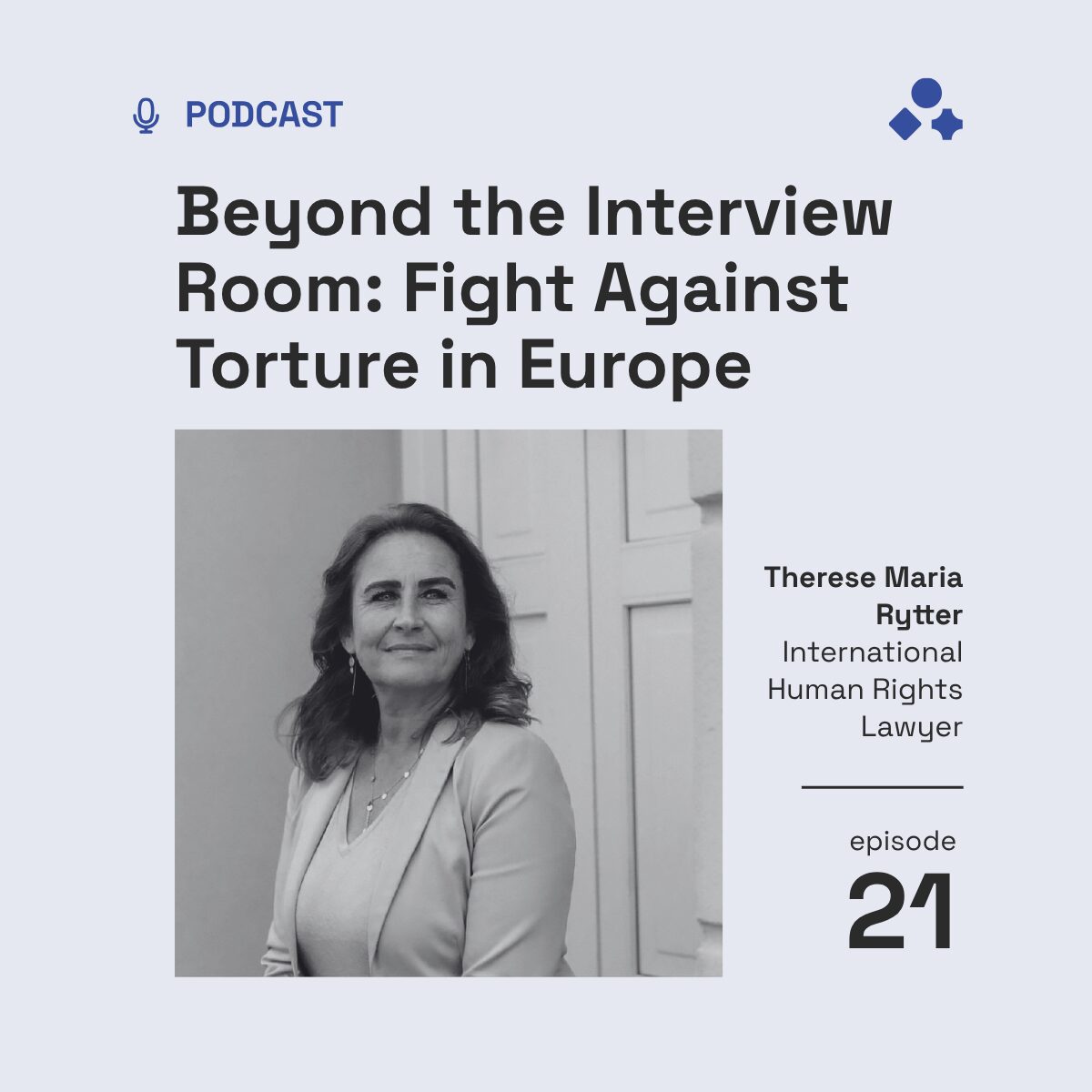
    Read more

    19 Dicembre 2025
  • Vulnerable witness interviewing – ep.14

    Vulnerable witness interviewing – ep.14
    vulnerable witness interviewing with Triangle

    Episode 14. The Art and Science of Child Interviewing with Triangle

    In this episode, we speak with Carly McAuley and Maxime Cole from Triangle, a UK-based organisation specialising in investigative interviewing of children and vulnerable adults.

    Founded in 1997, Triangle has become a leading authority in forensic questioning techniques and vulnerable witness interviewing, training police forces across the UK and internationally while conducting interviews for criminal and family court cases.

    Triangle provides comprehensive services, including:

    • Investigative interviews for children and vulnerable adults (ages 2-60)
    • Forensic Questioning of Children (FQC) training for police forces
    • Intermediary services to facilitate communication
    • Expert witness testimony
    • Therapeutic support and advocacy
    • Transcription services that capture non-verbal communication
    • Consultation for school staff and first responders

    Carly McAuley and Maxime Cole shared with us Triangle’s approach to child and vulnerable witness interviewing. The conversation explores how very young children – even two and three-year-olds – can provide reliable, court-admissible evidence when interviewed using appropriate techniques. Triangle’s expertise challenges long-held assumptions about children’s capabilities and demonstrates that the quality of evidence obtained depends entirely on the adult interviewer’s communication skills, not the child’s inherent abilities.

    The discussion reveals the critical importance of language adaptation in child interviews. Simple changes like asking “what made him do that?” instead of “why did he do that?” can transform a child’s ability to respond. Carly and Maxine explain the “no guessing rule” – a fundamental technique that teaches children that interviewers genuinely don’t know what happened because they weren’t there. This role reversal is essential for obtaining accurate accounts, as children naturally assume adults know everything.

    A significant portion of the conversation addresses the problem of “muddled” accounts created when well-meaning adults – teachers, social workers, foster carers, and family members – repeatedly question children before formal interviews take place. Triangle often conducts “unmuddying interviews” to separate what the child originally experienced from what others have added along the way. The guests emphasise that professionals need training on how to safely listen to children’s concerns without contaminating their accounts.

    Notable Quotes:

    "If we get it right with the youngest children with the most complex needs, then it helps our communication with everyone."
    "You can't get a good answer by asking a bad question."
    "Children's communicative competence is really reliant on the adults' communicative competence."

    Resources Mentioned:

    • Triangle’s “Two-Way Street” and “Three-Way Street” films
    • ORBIT training model
    • Forensic Questioning of Children (FQC) course
    • Davidhorn Police Interview Summit 2025

    Looking Ahead:

    Triangle will be presenting at the Davidhorn Police Interview Summit 2026, offering training opportunities for international practitioners interested in advanced child interviewing techniques.

    Connect with Triangle: Learn more about their training programmes and services for law enforcement, social services, and educational professionals.


    Episode Length: Approximately 59 minutes

    Production: Davidhorn – Beyond a Reasonable Doubt Podcast

    Host: Sigrun Rodrigues, former Chief Marketing Officer, Davidhorn


    Equipped For Justice – Supporting ethical, human rights-compliant investigations worldwide

    Watch and listen also on YouTube and Apple Podcasts

    Related products

    • Fixed Recorder

      Fixed HD recorder for high security interview rooms.

    • Portable Recorder

      Lightweight, PACE-compliant interview recorder for any setting.

    • Capture

      Mobile app recorder for capturing evidence on the go.


    • Ark Interview Management

      Receive, monitor, and keep evidence throughout its lifetime.

    Transcript

    Host: Sigrun Rodrigues, former Chief Marketing Officer, Davidhorn
    Guests: Carly McAuley and Maxime Cole, Directors at Triangle


    Sigrun Rodrigues: Hello and welcome to this podcast. I’m Sigrun Rodrigues, Chief Marketing Officer at Davidhorn, and I’m very excited to have you here today. Would you like to introduce yourselves?

    Carly McAuley: Thank you very much for having us. My name is Carly McAuley. I’m one of the directors at Triangle.

    Maxime Cole: Hi, I’m Maxime Cole, and I’m also a director at Triangle.

    SR: Tell me a little bit about Triangle. What is Triangle?

    CM: Triangle was created in 1997, and we currently provide specialist support to children, consultancy, and training. We also provide expert opinion, intermediaries, and therapeutic services. Everything we do is very bespoke, depending on what’s needed for the children and young people. Many of the children and young people we provide services to have had abusive starts to their lives, and we’re trying to help them come to terms with that. We provide advocacy services and investigative interviewing, which is what we’re here to talk about today.

    MC: Our investigative interviewing services are really growing every year. We’re doing more and more, and it’s what we mainly do now, along with a lot of training.

    SR: So, specifically, children’s interviewing?

    MC: Well, our specialism is with children and young people, but we actually work with people up to the age of 60. We’re asked to do investigative interviews if an adult has additional needs or communication difficulties that make it harder for someone else to interview them. We use the same skills that we use to interview children and young people for everybody anyway.

    CM: That’s a real fundamental Triangle belief, isn’t it? If we get it right with the youngest children with the most complex needs, then it helps our communication with everyone.

    MC: Absolutely.

    The Scope of Triangle’s Investigative Work

    SR: Is this related to police investigations? What type of investigations do you do specifically?

    MC: It’s quite a range. Some of the interviews we do are directly referred to us by the police. It might be because the child’s very young – we interview lots of two and three-year-olds for the police. Or it might be that the child has very complex needs. Quite often, we find that children have been taught to hate the police and told that they mustn’t speak to the police, so there’s already this barrier there. Coming in as an independent organisation can make it much easier for the child to communicate with us.

    The variety of investigations could be anything, but primarily, it’s sexual and physical abuse investigations that we’re involved in. Then some of our work comes from the family court. We’re asked to interview children so that the court can make decisions going forward.

    CM: But it’s not quite as simple as that, is it? Sometimes we’ll interview a child for family court, but what they end up saying makes that interview go back to the criminal court and back through a police investigation.

    SR: You’re discovering things in the process that nobody was aware of.

    CM: Exactly. It’s quite fluid.

    The Challenge of Initial Police Visits

    MC: The police are in a difficult situation with some children. In the UK, if a child says something potentially concerning to a teacher, for example, the police have to go out to visit that child with a social worker and try to get the child to repeat what they’ve said to the teacher before they’ll proceed to a visually recorded interview.

    For some children, it might have taken them four years to build enough rapport with that teacher to feel comfortable enough to tell them. Then they don’t know that social worker or that police officer, and they’re expected to repeat what they said straight away without having built any rapport. Often, that doesn’t work, so they don’t go on to be interviewed. Ultimately, it ends up in family court, and then we interview. So, actually, that child has said something potentially concerning before, but it never went to a police interview because they didn’t repeat what they’d said in that initial visit.

    CM: We’re becoming more aware the more police we’re training of the systems and the way they work. Recently, in one of the courses where we trained a local police force, they talked about having “no further action.” That isn’t necessarily to do with what the child said – it’s not having enough evidence or not having the standard of evidence that would go to court. Whereas we specialise in knowing what questions to ask, how to ask them, and what’s needed for further action to take place.

    SR: So you’re trained and have the specialist competence to dig into the hard questions to get that evidence right.

    CM: Yes. And some of the things are really quite simple. We’re training the police to ask questions in a different way. For example, if you ask a child “why” something happened, they find that really difficult to answer. But if you use a simple rephrase – “what made him do that” instead of “why did he do that” – they’re then able to answer the question.

    MC: And we spend a lot of time explaining to children that we don’t know what happened because we weren’t there. Children assume that adults know everything, and then they don’t see the need to provide the information they’re being asked for because they’re thinking, “Well, you already know. Why am I going through this with you?” So we do a lot of that: “We don’t know because we weren’t there.”

    Training Police Forces

    SR: From what I understand, you train police forces?

    MC: Yes, we’ve trained a lot of different police forces now. Some police forces come to us – we’re based in Brighton – and others we train in force, so we go to them and train at their headquarters.

    SR: What does this training consist of?

    MC: It’s called FQC – Forensic Questioning of Children. When we initially started training, it was a four or five-day course and involved police officers taking an exam, so it was a pass-fail course. Then COVID hit. After speaking to many forces, we realised that having them out for four or five days was really difficult for police forces, making commissioners reluctant to do that. We’ve managed to compact it into a three-day course, which is where we’re at now.

    It doesn’t have a pass-fail examination, but the last day is spent with police practising what we’ve learned over two days so that we can observe. If we did have any major concerns, which have happened but very rarely, then we would follow that up.

    CM: And we offer support to the police after the course as well. They can contact us by phone or email, and they do. They might say, “I’ve got this three-year-old that says this – should we go and talk to them or should we go straight to the interview?” It’s nice to be able to be there afterwards and advise.

    MC: We had a query last week about a child who’s now three and a half, but they were two and a half when the incident happened. The police were messaging us to say, “Is it still viable to interview? Should we still interview?” It’s a real range of questions. Sometimes it’s supporting them with live cases, and other times it’s helping them decide whether an interview should take place – whether it’s in the child’s best interests or not.

    SR: Is it a one-off training or do you do repeat training?

    MC: We also do a one-day refresher course. That’s really important because sometimes you can forget, or you can unlearn elements of it and perhaps not use the techniques to their full potential.

    What the FQC Training Covers

    CM: In the course, we cover a lot of the basics about what language to use with children, how to adapt and simplify your communication to make it easier for children to understand. We cover a lot of rapport building because that’s absolutely essential, and we teach them how we build rapport with children.

    We cover a lot about attention and arousal – keeping an eye on the child and where they’re at within their window of tolerance. Are they able to communicate, or do we need to help them by doing something calming or something lively to get them back to a place where they’re able to communicate?

    We do a lot of troubleshooting – teaching what you would do if a child did this – and a lot of focus on separating out events with children.

    The Problem of “Muddling” Through Repeated Questioning

    MC: We get called in to do what we call “unmuddying interviews.” This happens a lot. Children are asked repeatedly. They might have told their teacher something, and then the safeguarding lead asks them about it. Then they get a visit from the social worker and the police, and they ask them about it. Perhaps they get police-protected and move into foster care, and then the foster carers ask them about it. Then they get a social worker who asks them. The next month, they get a new social worker, and that social worker asks them about it. By the time they get to the interview, it’s so muddled because they’ve been asked again and again.

    CM: We often get family members recording them, doing their own interviews on their phones.

    MC: It’s all so muddled by the time it gets to us. We teach the police about that as well – how to tell which parts have come from the child and which parts have been added by well-meaning adults along the way.

    We often say to children: “We need to find out what you saw with your own eyes, heard with your own ears, and felt with your own body.” It’s all anchored back to that, so we can separate things out. We’ll acknowledge, “We know you’ve told lots of people, we know you’ve spoken to lots of different people.” If we can, we’ll list those people and say, “Our job is to really think about everything that we’ve heard and that you’ve said and to get it really right.”

    SR: I’m from Norway, and we’ve had a few cases where whole villages have been in a bad state because the interviews weren’t done correctly. Teachers and lots of different people have been accused of doing things, and it’s turned out that the interviews weren’t done correctly. There have been some really bad miscarriages of justice following that.

    CM: People are trying to be helpful. It’s not – I mean, obviously, sometimes you get cases where people are trying to change a story or change what’s happened. But in our experience, the majority of the time, it’s because people are trying to help children, but actually, it’s not helping.

    Training School Staff

    MC: We also know – I don’t know about in Norway, but in England – the training that’s given to school staff, particularly because we know that’s a place where a lot of children do talk about things, is very negative. Don’t do this, don’t do that, don’t do this, don’t do that – but not what to do.

    Another thing we started a couple of years ago, post-COVID, was these workshops for school staff. We know there are huge funding issues, so they’re up to two hours long, where we talk about things that you can do rather than things you can’t, because it’s all very negative guidance out there currently.

    CM: It scares professionals off – the guidance that a lot of people are given in their safeguarding training is “don’t ask any questions, don’t do this, don’t do that.”

    MC: Professionals need to be taught how to safely listen to children’s concerns so that by the time children are interviewed about things, hopefully it’s only the second time they’ve talked about it, not the 22nd time.

    SR: And of course, in Norway, we have these Barnahus centres where children are brought in to be interviewed properly. Why do you work mainly within the UK?

    CM: Yes, we do. We have done some international work. In 2018, a colleague and I flew to India, and we trained the High Court judges in Delhi. We then flew to southern India and trained a whole lot of different professionals down there in the FQC training – how to communicate with children.

    We do a lot nationally. We train police nationally, as mentioned, and also social workers in schools and frontline workers. We try to link a lot of our training to serious case reviews because out of those come lots of learning points for us as a culture and a country.

    We’ve developed resources with the NSPCC, and we’ve also done some work with MOPAC, which is the Mayor’s Office for Policing and Crime. They look at the Met Police and make sure that everything they’re doing is efficient. We’ve helped them think about scripts for young people and vulnerable people who come into custody and need to understand processes a bit more.

    Working with Non-Verbal Communication

    MC: We do interview children who have very limited speech and who use other ways to communicate – symbols, picture books. Years ago, we interviewed someone using an eye gaze machine to communicate.

    CM: It’s more about them understanding us, I suppose, as well as them communicating.

    MC: There’s a film we made called “Two-Way Street,” which is all about communication being two-way and not just putting it on the child. It’s the adults’ responsibility as well. As a person, if you’re talking to someone and they’re not interested in you, you’re not going to tell them very much. Whereas if you’ve got a person that is interested and engaged and giving you the right non-verbal cues and signals, you’re going to engage a lot more. This is the case for children.

    Children are brought up in a society where, in the past, a lot has been done to them by adults. To suddenly put them in a position where the adult is asking them to talk about something that they have the knowledge of – children are a bit like, “Well, this isn’t usual.” Kids go to school, and the teachers know everything. Kids are at home, and the parents are completely in control of what’s happening.

    It’s really trying to get those children and young people to realise that they’re the experts and that we’re part of a two-way process with them to help them tell us their expertise because we don’t know.

    The “No Guessing Rule”

    CM: As I mentioned earlier, we spend quite a lot of time in rapport building, reassuring children of that. There’s a rule called the “no guessing rule” that we practise with children a lot. At school, children are taught to guess all the time. For us to then have them come and see us and say, “In this room, we don’t do guessing. What colour’s my car?” And they’re like, “Red.” “We’re not doing guessing. You’ve seen my car. Do you know what colour my car is?”

    I think for us, a key point in the training is to help the police and other adults understand that you have to spend time helping children understand this switch of roles.

    MC: It’s such a different process. With you talking about it being that two-way street as well, everyone that we train, we try to really outline that children’s communicative competence is really reliant on the adults’ communicative competence. You can’t get a good answer by asking a bad question. It’s not going to work. The adults really need to develop their questioning skills to enable children to give their best evidence.

    Challenging Assumptions About Children’s Capabilities

    CM: Certainly, in the UK, there’s a saying – I don’t know if you have it in Norway – “never work with children or animals.” Children are being blamed for their lack of competence all the time. We’ve heard people say, “If someone asked me to interview a three-year-old, I’d run a mile.” It’s almost as if the child isn’t good enough at communicating. But actually, it’s us. It’s breaking the barriers.

    MC: You’ll get police saying, “Oh well, they can’t even sit still, so how can you interview them?” It’s like, well, do you have to sit still to interview them? Can you do it while you’re moving on the floor? It’s looking at breaking those adults’ expectations of how children should behave, and thinking, “Actually, it’s about me.”

    CM: Another bit to add is that “Two-Way Street” film we made in the ’90s, and then we followed it up years later with “Three-Way Street” because we realised that a lot of these children’s interactions weren’t just with one adult – there were normally two adults. If you think about that dynamic, that’s children being put in a room with two adults. That’s almost making it harder for the children because they’ve got two adults who they think know everything.

    MC: Carly and I do a lot of that when we’re interviewing, where we’re talking with each other. I’ll say, “Well, Carly, I don’t know because I wasn’t there. Do you know?” “No, I haven’t seen that either.” We do a lot of that, and then they understand together. Suddenly, the penny drops. “I’ve never been to Johnny’s school. I don’t know what his teachers are like. I haven’t met his mum or his family.” “No, me neither.” “So I don’t know.” Then suddenly Johnny will pipe up, “But I know. I know!” because he then realises why we’re asking the questions.

    CM: We teach the police a lot about that as well, because children are baffled sometimes: “Why on earth are you asking me that?”

    MC: Because adults know everything.

    The Evolution of Child Interviewing in the UK

    SR: You talk about PEACE interviewing, which is very relevant to us on the technology side. You’ve got these frameworks that were implemented early on in the UK, and I’m sure this has developed the cultural side of interviewing – the mindset that police go into the interviewing situation with. You’re teaching them that mindset to speak to children and have a different approach when they go into those conversations. You’ve been following this since the ’90s. Have you seen any change over time? Has it eroded? Has it gotten better? How would you describe this development since back then?

    CM: I think it has evolved. There are some positives and some negatives as well. One thing that is key for us at Triangle is that we know statistically that children with communication difficulties and disabilities are far more likely to be abused. Yet we are still not supporting those people in everyday life to have communication systems to enable them to communicate. That’s linked to education, but also ideas of what disabled people and people with communication difficulties are able to do. That hasn’t changed very much. We still see that as a big barrier.

    But what has changed a lot is the realisation that children can give evidence regardless of their age. It used to be extremely rare that children under five would be interviewed, and now it’s much more common. But we’re still not all the way there. There are still very young children who just aren’t seen as reliable just because of their age, so their evidence isn’t being gathered.

    MC: Sometimes we’re asked to interview four out of a five-sibling group, and we’re thinking, “Why are we not seeing the youngest one?” It’s maybe because they’re two and a half. But actually, two-and-a-half-year-olds can give really great evidence if they’re interviewed in the right way.

    SR: That’s changed a lot since the ’90s, though, right?

    MC: It has changed a lot. We were involved many years ago in one of the first cases with a two-year-old who was a witness to murder. He was the sole witness. Initially, the police were very reluctant because he was so young, but we were able to support the two-year-old to communicate. They didn’t need to know what happened because they knew it was a murder. They didn’t need to know where because they knew where. They didn’t need to know when because they had a time scope. All they needed to know was who.

    Everyone who’s met a two-year-old knows that they can identify people, and this child knew the person. We did that through a mixture of speech and using photos and supporting the young person. That actually did end up going to trial. I think that was quite a first for England, believing that actually that could happen.

    Even now, in our police training, when we mention that, everyone’s like, “What? Two? How did you do that?” It’s just focusing on what information is crucial. As Carly said earlier, if you’re asking children about timelines when they’ve been living in an abusive situation all their lives, and you’re thinking about how long this has been happening, time is a huge, difficult concept for children anyway. It depends on what the questions are and what information you need to gather.

    Working with Children with Limited Verbal Communication

    CM: The same with children and young people who communicate using yes and no – it’s really important if you’re interviewing them that you’re getting a balance of yes answers and no answers. If you’re asking a young person questions and all they’re communicating is “yes, yes, yes, yes, yes,” it’s not really credible. Whereas if you’re really clever with your questioning and you’re getting “yes, no, yes, yes, no” – there’s not a pattern – it’s much more effective and much more evidentially safe.

    The Problematic Push for Efficiency

    MC: The other thing, thinking about since the ’90s and what’s changed and hasn’t changed – at the moment, interviews go to the CPS, the Crown Prosecution Service. They review the interview and decide whether charges can be brought as a result. But they are asking police forces to keep their interviews to 20 to 30 minutes maximum because it’s more efficient that way for them to review the interview.

    But that doesn’t work for children. It really, really doesn’t work for children. We might spend 20 minutes of an interview talking about Play-Doh, and that is needed for that child because that’s resettling them. That’s letting them know that we’re attending to what they’re saying and that we’re interested in them. We would never be able to limit ourselves to time like that. I think that is a negative change. It’s trying to be streamlined for efficiency, but it just really doesn’t work for children.

    CM: We’ve found that a lot of children who come in to talk to us won’t really respond to “what have you come to talk to us about today” type questions. We need quite a lot of warm-up. We’re not talking to them about their hobbies – it’s an interview at that stage – but we might be asking questions like, “Tell us all about what it was like living with your mum and dad.” You might get lots and lots of details that aren’t evidentially relevant, but you might get really relevant stuff because we’re starting to build a picture and an understanding of that child’s lived experience. They might say a few things in there that we can then ask about later, and that’s when we get that evidence. We can’t do that in 20 minutes.

    MC: Absolutely. We know that children living with trauma, which a lot of the children we meet are, are within their window of tolerance. They can dip in and out of that. As Carly said, you’ll be there for hours sometimes, but the number of questions you’re asking would only add up to maybe 40 minutes or something because you’re doing so much to support them and not re-traumatise them. You’re enabling them to communicate safely for them and evidentially safely. It’s a balancing act.

    The Critical Importance of Visual Recording

    SR: I guess this is where recording comes in as relevant. Do you record your interviews with these children?

    MC: Yes, we record all of our interviews. We have an interviewing suite here at Triangle in Brighton, and then we have our portable camera from Davidhorn as well. When we’re travelling around the country, sometimes we use police interview suites and sometimes we use our portable camera, but we’re always recording interviews. It means that it can be used as the evidence in chief at court if it’s visually recorded.

    Also, we have so many children who communicate non-verbally. I think it’s not just us – children communicate non-verbally a lot. They show a lot. A good quality recording is absolutely crucial for that.

    We interviewed a seven-year-old here who, although she was completely verbal and a competent communicator, wasn’t able to verbally tell us what had happened to her. Almost the whole interview from her perspective was silent. She was able to draw what had happened, and then she was able to produce paper figures as representations of the people in her family. We could check using the paper figures who were in the picture. She was able to show, using those paper figures – actually manipulating them – to show us what had happened. Then she was able to indicate on sticky notes. We gave her written choices – “one time” on one note and “more than one time” on another note. She pointed to which one in response, or we had “yes,” “no,” or “don’t know.” She was able to answer more questions about what had happened.

    The visual recording of that is crucial beyond crucial. It absolutely needs to be shown.

    CM: It needs to be a video recording.

    MC: Otherwise, they would be listening to just us talking.

    Body Language Contradicts Verbal Statements

    CM: We’ve also had an interview with a teenager where, unfortunately, the circumstances within her home were that dad had to leave the family home, and the family couldn’t afford to live in two homes. Just before the interview, she’d been told by mum, “Just say it was an accident. Say it wasn’t meant to happen because we can’t afford to live like this. We can’t afford for your dad to be the breadwinner in another home, running another home with more bills.”

    She came to interview, and I can’t remember whether she said at the beginning or the end that mum had said this to her. But when we were asking her questions, she was verbally saying, “Oh no, it didn’t happen.” But her body – what she was doing with her hands – she was digging in her nails and she was covering her genital area, which was showing so much.

    For that interview, when we wrote our report at the end of it, we said that the transcript had to be read whilst watching the video so that you could see that although she was saying “no, no, that definitely didn’t happen,” what she was showing in her body was very different.

    MC: If we hadn’t recorded that, you would have just got the transcript of her saying, “No, that didn’t happen.”

    SR: When you’re also saying you’re asked to do a 20 to 30-minute interview, potentially with a recording that is the same length, there is a lot of pressure on police and on the whole system to cut costs. This is what we’re seeing, and I think this is widely known. There’s definitely a balance between quality and cost in this case, specifically.

    Specialised Transcription Services

    CM: Absolutely. We offer a transcribing service as well after our interviews because we have learned over the years that other transcribing services out there don’t transcribe the non-verbal communication – they just transcribe the verbal communication. Whereas we have trained transcribers here who look out for all communication. That’s another service that we offer quite regularly after we’ve interviewed.

    MC: There are so many children who show what’s happened rather than tell.

    CM: Adults do as well. I’m realising here that I’m doing this with my hands all over the place!

    SR: That’s what we hear very often – that the best interviewers, independent of the case, are the interviewers who interview children because they are very concrete, really good at building rapport. There’s something there that if you put a child interviewer in front of a suspect, they can do a really, really good job as well, which is really interesting.

    MC: We were talking about that, actually, a couple of weeks ago, when training one of the police forces. They interview a lot of suspects and interview a lot of children, and they said, “Oh, I’m so going to use some of these techniques with interviewing suspects,” especially commenting on non-verbal communications. They get so many no-comment interviews, but they say, “Oh, you’re nodding.” That’s then in the transcript.

    CM: They can get those responses by verbalising the non-verbal communication, which is so often missed because that’s what we do with children. We say, “Oh, you’re nodding,” and they’ll say, “Yeah, because that really did happen.” They’ll add information if we notice and verbalise their non-verbal communication.

    Another one might be, “Oh, you’re looking at the door.” “Yeah, because is he going to come? Is he coming here?” There are these tiny, tiny little things.

    The Challenge of Inappropriate Vocabulary

    MC: The other one I wanted to add that Carly touched on – a lot of these children don’t have words to talk about what’s happened to them because they shouldn’t have words to know these things. Actually, these adults are putting them in a situation, asking them to talk about something that they shouldn’t really have access to at their age, especially regarding sexual abuse. Often, they would have been told by the abuser that “this is our little secret” or “this is because you’re special.” For that child to communicate is really hard.

    Having drawings and all these other resources, and showing and having that on camera, is just key.

    SR: Absolutely. There’s a lot of talk about AI. There is a lot of potential in saving time and cost through the use of AI. I just saw recent transcription research that highlighted what you said – that the transcribers being used are not necessarily trained in anything related to police work or interviewing. They very often just decide for themselves what to put in that transcript.

    It’s interesting to hear small techniques like you say – put words to what is going on and put little comments. There are ways to work around that to make sure this is highlighted. I think that is something that will probably come with more use of technology.

    Technology and AI in Child Interviewing

    CM: Absolutely, and of course, it has to include the non-verbal, which requires a video or visual recording.

    SR: Do you see that these types of technologies can help you in your work in the future? Are you reluctant?

    MC: I don’t think we’re reluctant at all. Absolutely, we would be interested in exploring technologies that could help us. It’s just difficult at the moment to really know in what ways, because the AI that we’ve experimented with – it’s not there yet. It’s just not that advanced. It needs to learn more, and it will learn more.

    I think it’d be really interesting. I mean, we have used it to help us create resources to explain things to children. I don’t see it as a threat. Some people see it as a threat, but AI obviously needs somebody who has those skills and knowledge to tell it what you want. It’s a two-way process to an extent.

    CM: Sorry, that’s a bit of a muddled answer, isn’t it? I think there are pros and cons. We do see it. We are beginning to look at it and explore. But obviously, you’ve got the huge area of GDPR and confidentiality and all of that, so it’s always going to be limited in our work for that reason.

    MC: Because we can’t feed it lots of confidential information and ask it to write us an interview plan.

    SR: No, exactly. Currently, you can’t. But hopefully, in the future, you can have a safe AI.

    CM: If you’re standing up in court to be cross-examined, you want to be sure that you’ve read that bundle of however many pages yourself rather than depend on a computer reading it and maybe missing out a bit that they didn’t think was essential.

    MC: That’s the thing. That’s what I mean by needing to learn more because there are so many nuances. The meaning of a sentence can be changed by a single word, and AI is not there yet to notice all of those. At the moment, everything’s still very manual.

    CM: As well, sometimes when we’re interviewing a child, they might say something that wasn’t necessarily in our questioning initially. But if you’ve read the bundle and you’ve got that background, you might see that as an important link to something that AI wouldn’t necessarily pick up.

    MC: Yeah, absolutely.

    Innovations Needed in the Justice System

    SR: Are there any other technologies or innovations or policy changes that you see can support children’s legal status and conditions in the justice system?

    CM: One of the things that we’ve been talking about a lot is that we’d really like to train first response officers – in the police and the ambulance service – to be able to communicate with children. We would love, for example, to help the ambulance service to write a script for their telephone operators that they can press a button that says “I’m talking to a child” and their prompts change, because early information about reported incidents can be really crucial later on in an investigation.

    Currently, children aren’t necessarily being asked questions that they can process or understand. We’d really like to get involved in that from an innovation point of view.

    MC: First response officers are rarely given any training in talking to children. I think we’re missing potentially some really important bits of evidence from children almost at the scene of a crime or immediately afterwards, when a child might be more likely to be able to tell or give that initial bit of information, because the thing has just happened and they know and they understand what they’re being asked about because it’s in the context.

    CM: Because it’s in the context, exactly. That’s another thing – children don’t always know why they’re there. Training for first response officers could really change a lot for children.

    We’ve already been talking with some of the police that we trained recently, about when they arrive on a scene, and they have their body-worn cameras, and they do an initial Q&A. We’re already talking to them about using that as part of the rapport building.

    SR: These police officers rarely have any interview training, so to have specialist training like that is not happening, right? To actually empower them or enable them to ask the right questions is really, really crucial. I think also that is the moment when the child contacts the police – they’re in an urgent situation. You get the unfiltered truth, right?

    MC: Absolutely. It’s the unfiltered truth, and it’s also potentially that child’s first experience of the police. If that can be a positive one, then that child can be better protected throughout the rest of their lives.

    Prevention Through Education

    CM: One of our founder members of Triangle, Ruth Marchant, who sadly died a few years ago, had a mission statement: to change the world at Triangle. We can go out there and change the world. Something that we feel very strongly about at Triangle is children and young people being given safe education about their body and private parts and safety. That’s not to say it’s putting the onus on the children to keep themselves safe, because obviously it isn’t. But what it is to say is that if children are taught safely and in a fun way in nursery schools – we’re using really good resources about what safe touch and unsafe touch is, and the same as secrets, safe secrets and unsafe secrets – Triangle has designed our own resources, but there’s a lot else out there. I think that’s the key to children and young people saying things earlier.

    There was a young person we interviewed a few years ago who was about 14, and she’d been very sheltered. She’d been brought up with a very abusive father, lots of domestic violence, as well as sexual violence. One thing that will never leave me, I think, is her saying at the end of the interview – we always ask, “Is there anything else you want the judge to know?” – and she said, “Why did no one tell me about this? Why wasn’t I taught that this wasn’t right?”

    Her experience had been that at age 14, she was finally allowed to go for a sleepover at a friend’s house. While getting ready for bed, she said to her friend, “Well, when’s your dad coming in?” The friend said, “What do you mean?” She said, “Well, at my house, my dad comes in and this is what happens.” This was how this case came to light, because the friend told her parents, and then obviously they contacted the police.

    To me, that question of “Why wasn’t I educated? Why wasn’t I told about this?” – she’s not the only young person. We interviewed another young person who did learn at school, but it wasn’t until she was in secondary school, in a personal, social health lesson, that she learned that it wasn’t okay for adults to do those things to you. This had been going on for years.

    MC: She was 11 or 12 at school when she was taught that.

    CM: We need to be teaching children much, much younger because if it’s always happened to you and you don’t know any different, why would you tell someone?

    MC: That’s definitely a societal change.

    Managing Secondary Trauma and Officer Wellbeing

    SR: There’s one more thing I would really like to ask you, because I know that there are a lot of police officers in the UK and everywhere who are going through a lot of trauma in their own work. I think you guys are working with such heartbreaking themes. How do you deal with these issues in your work? How do you manage to stay clear in your minds and mentally healthy?

    MC: Yeah, it’s a good question. I think it’s quite different for us than for the police, but we can talk about both. For us, we debrief after every interview, so we spend time together talking about how it went, but also how that made us feel. We’ve got peer support in that. Also, we barely work alone. We’ll always be working together, so we’ll always hear the same things. Whether one of us is in the recording room or in the interview room, we’ll still be open to the same information.

    Sometimes a child will say one thing that maybe I will go, “Oh, I found that a bit much,” or Carly might say, “Oh, I found that a bit much,” and I won’t. It’s interesting how different children in different situations maybe press different buttons for us. But having that debrief is key.

    We also have another colleague who will critically read reports and sometimes be involved in the planning. She’ll often check in with one of us or we’ll ask her opinion. We have access to a psychotherapist for supervision. We have regular supervision, and we also have access to a 24-hour counselling line that’s completely confidential.

    CM: Our interviewing team – we either interview together or with another colleague – so there’s always someone around for us to talk to.

    But with the police, I think it’s a really different story. They have very little protection against that sort of secondary trauma. A lot of the police forces that we’ve talked to say that they get a wellbeing questionnaire once a year, but then they don’t have that same opportunity that we do of debriefing after every interview. Not at all.

    At the last training that we did here with the police, we had quite a long conversation about how just in their role as a police officer, it’s assumed that you should deal with things like this. There’s an assumption that, well, you signed up for that job, you want to do it. So why are you moaning that you’ve just seen this or that?

    There was one case where the officer was saying, “Well, I knew it affected me, but I felt like I couldn’t go to anyone because it’s part of my job. But why did this one affect me but the other 20 didn’t? I didn’t want them to be going, ‘Well, maybe you should be moved to a different area,’ because I love my job. I just needed a bit more help with this.”

    MC: We know that as humans, we’ve all had different backgrounds, we’ve all had different upbringings, and there’d be different triggers. Sometimes it won’t even be something that’s said. It might be a smell or a sight. Being able to identify that ourselves is key, and being able to open up about that and acknowledge that yes, you signed up to be a police officer, but still hearing this can be really difficult.

    I gave an example of certain friends that I will talk more to than others. I know sometimes if I’m with a certain group of friends, everyone will go around the table and say, “How was your day? How was your day?” And they’ll completely bypass me because they don’t want to know how my day is, because they don’t want to know that this really happens and that this is a world that we live in.

    CM: It’s a real conversation killer at parties, isn’t it? “What do you do?” “I interview children that have been abused.”

    MC: We do have quite a sense of humour as well. I’d say that’s another coping mechanism for us. You have to see a lighter side to life. Carly and I both enjoy walking a lot as well, so having those outdoor things. We both have pets. You have gardening. It’s having that free time, that balance of nurture for yourself and your families, other than your work, which I suppose is the same for all jobs, but particularly where you’re working with trauma.

    SR: Do you see that bringing any of those support systems could be beneficial for the police – having a 24/7 line where you can call?

    CM: There was one police force that did have something similar. But what they said was that often there wasn’t time before you’re on your next case. You don’t have time to ring up and process. It kind of links to the secondary trauma – you’re just adding on, aren’t you?

    MC: I mean, there are services in the UK for blue light workers that they can access – text services and phone services. But I don’t think it’s – I think the issue is often the time not being available.

    CM: I think it’s the time and the expectation of the role. When we train them here, we very much say, “You are humans. You’re going to have your own triggers. What you’re going to be hearing is horrendous, and you need to be able to have people within your organisation that you can go to and say, ‘That was really hard,’ and have them acknowledge that and not go, ‘Oh well, that’s your job, get on with it. Don’t come moaning to me.’”

    It’s that openness, I suppose, really, that we are all humans and that it would be wrong – you shouldn’t be in this job if nothing affected you.

    MC: And investing in support services would reduce burnout. So yes, you need to spend money allowing people that time, but it saves you money in the long run.

    CM: Also in England for the police, a lot of police careers are only 30 years, and that’s due to the stress and the nature of the job.

    MC: That’s changing now.

    CM: It is changing, but my point with that is that it also adds pressure for some officers.

    Child Suspects and Fair Treatment

    SR: We’re coming to the end of this conversation, but I was just wondering about one thing. There’s been a series on Netflix called “The Accused.” I don’t know if you’ve watched that one. It’s about a boy who’s a suspect of a murder, and that has brought a lot of discussion around social media here in Norway about interviewing of children and suspect interviewing of children, children suspects. Do you work with child suspects at all? Are you called in by the police to do that type of work?

    MC: No, but we would love to be. We aren’t really asked to do that kind of work as interviewers, but our intermediary teams do provide intermediaries for suspect interviews. They’ll go in – intermediaries are people who specialise in communication and they facilitate the communication between the child or young person or adult and the police or the court, whoever’s trying to communicate with that person. They’re the middle person, making sure that the police are asking questions that the child can understand and that the child is understanding the questions that they’re being asked.

    A lot of the time there’s a real breakdown where adults don’t even realise that the child’s misunderstood the question. It happens so much. We see it loads. So we do that for suspect interviews, but I don’t think it’s a right for child suspects yet to have an intermediary as standard under a certain age, which is worrying.

    CM: I think a lot of child suspects have additional needs, especially those who are involved in child exploitation cases, organised crime, because that’s part of why they have become a target. They have these additional needs and communication needs as a result, and I think that the support really needs to be there.

    I’ve never really understood why – so in the UK our justice system is centred around innocent until proven guilty – but why don’t we treat suspects the same as witnesses then? Because maybe they are actually also a witness.

    MC: Exactly. Having good quality, clear, coherent, accurate evidence, which is what you achieve by using an intermediary or by using specialist interviewers – that benefits everybody. It makes it more likely that justice will be achieved.

    CM: We would love to be more involved, and hopefully that’s a real growing area. I think our only experience of suspect interviewing is where there’s been family cases where there’s been abuse within the family, within siblings. We interview all of the siblings, and one of them has accused another one of them of a crime. So indirectly, but not – well, it has been a couple of cases. We were asked to interview a boy about rape, and then later we were asked to interview his siblings, one of whom was the accused. That was the reason we were called in in the first place – the rape accusation. But yes, our interview process was the same for witness and suspect.

    MC: It’s something that we feel – a lot of these young people are just as vulnerable and they need the same support. We need to come in with an open mind and a fair approach.

    Looking Ahead to the 2026 Summit

    SR: We saw each other at the conference in March where you also went through the ORBIT training, which was very interesting. We have another conference coming up in 2026, and we’re hoping that you will be there to run some training for those who would like to learn from you.

    MC: Absolutely. Very excited about that.

    CM: Hopefully we can also bring some international practitioners who would like to learn from you as well.

    MC: Yeah, definitely. That’s great.

    SR: Thank you so much for sharing all of your knowledge with us. We could probably talk for a lot longer, but thank you so much.

    CM: Thank you for having us.

    MC: Thank you.


    About the Guests

    Carly McAuley and Maxime Cole are Directors at Triangle, a UK-based organisation founded in 1997 that specialises in investigative interviewing of children and vulnerable adults. Triangle provides training, intermediary services, expert witness testimony, and therapeutic support to help children who have experienced abuse navigate the justice system.

    About Triangle

    Triangle operates from Brighton, UK, and works nationally across England with police forces, family courts, social services, and educational institutions. Their Forensic Questioning of Children (FQC) training has become a cornerstone programme for law enforcement professionals working with child witnesses and victims. The organisation’s founder, Ruth Marchant, envisioned Triangle as a vehicle for changing how society communicates with and protects its most vulnerable members.

    Read more

    2 Dicembre 2025
  • Prof. Laurence Alison on Orbit Model – ep.13

    Prof. Laurence Alison on Orbit Model – ep.13
    Prof. Laurence Alison in Davidhorn podcast

    Episode 13. PEACE and Orbit Model – a conversation with Prof. Laurence Alison

    ** LIVE at Davidhorn Police Interview Summit 2025 **

    Prof. Laurence Alison and Dr. Ivar Fahsing discuss the Orbit Model, importance of evidence-based practices, cultural influences on police interviewing, and the evolution of techniques over time.

    This conversation explores the nuances of interviewing techniques in law enforcement, focusing on the Orbit model and its relationship with the PEACE model. Prof. Laurence Alison and Dr. Ivar Fahsing discuss the importance of evidence-based practices, cultural influences on police interviewing, and the evolution of techniques over time. They reflect on their early careers and the challenges faced in implementing effective interviewing strategies across different countries. This conversation delves into the evolution of investigative psychology, focusing on decision-making processes within law enforcement, the importance of training and certification for detectives, and the potential role of technology and AI in enhancing interviewing techniques.

    The speakers reflect on their experiences and research, emphasising the need for better systems and training to improve investigative outcomes.

    Key takeaways from the conversation on Orbit Model:

    1. Orbit is not a replacement for the PEACE model.
    2. The Orbit approach focuses on dealing with resistance in interviews.
    3. Evidence-based practices are crucial in police training.
    4. Cultural differences impact the acceptance of interviewing techniques.
    5. There is a need for persistence in questioning during interviews.
    6. Not all interviewing models are based on strong evidence.
    7. The effectiveness of interviewing techniques can vary by region.
    8. Training should be tailored to the specific needs of law enforcement agencies.
    9. The importance of decision-making in interviews is often overlooked.
    10. Building trust with practitioners is essential for effective training.
    11. Understanding police officers’ thought processes is crucial.
    12. Certification and training improve investigative quality.
    13. Technology can aid in testing and certifying skills.
    14. AI could enhance interviewing by providing rich knowledge.
    15. Cognitive load reduction is vital in interviews.

    Prof. Laurence Alison

    Professor Alison, MBE, is an internationally renowned expert on critical incident decision-making, interrogation techniques, and risk prioritisation of offenders.

    He has served as psychological debriefer for over 460 critical incidents including 7/7 and the Boxing Day Tsunami, while advising on 200+ major cases such as military interrogation reviews in Kandahar and Basra.

    His groundbreaking work has established national standards for counter-terrorism interviewing in the UK and his child sexual exploitation resource allocation tool has saved the UK government over £15 million while being adopted across 24 European countries and beyond.

    His expertise spans law enforcement, military operations, and healthcare resilience, with significant funding commitments including a 10-year, £2 million investment for the University of Liverpool to serve as the research centre for child sexual exploitation.

    More about Prof. Alison.

    Listen also on YouTube and Apple Podcasts

    Related products

    • Fixed Recorder

      Fixed HD recorder for high security interview rooms.

    • Portable Recorder

      Lightweight, PACE-compliant interview recorder for any setting.

    • Capture

      Mobile app recorder for capturing evidence on the go.


    • Ark Interview Management

      Receive, monitor, and keep evidence throughout its lifetime.

    Transcript

    Ivar Fahsing: 
    Well, good evening, everybody. And welcome to the Davidhorn interview summit here in Copenhagen and to this live podcast. And welcome to you as well, Laurence Alison This is why they’re strange, isn’t it? My name is Ivar Fahsing and it’s it’s an honor to hosting you tonight. we’ve been through, discussion Laurence on, I go straight to the ball.

    Laurence Alison: (00:17)
    We will.

    Speaker 2 (00:27)
    One of your great products, I have years of research, is called Orbit. It’s a rapport-based interviewing approach. And as you know, the ruling kind of scientific approach to interviewing is called PEACE Model.

    Is this the death of PEACE

    Speaker 1 (00:44)
    No, absolutely not. And if I said anything to that effect, I’d probably be shot by Andy Smith, who’s the national lead at the moment. Yeah, I think there’s a bit of confusion. It’s definitely not a competitive model. And I think it is very sympathetic with PEACE If you read the original PEACE documentation, there’s nothing in it that is inconsistent with what we’re teaching at all. What I think has happened to PEACE a bit is some of it has been taught not as it was originally written.

    And sometimes when we’re training people, some of the officers have treated it as very mechanical. You have to do this bit, you have to do this bit, you have to do this bit and so forth and so on. Even down to the inappropriate translation of the so-called challenge phase, where sometimes what we have seen in some UK interviews is they get right to the end and then suddenly they throw everything at the challenge phase. But that’s not in the original version of PEACE.

    So I don’t think it’s a competitive model. I think it’s broadly sympathetic and congruent with what is taught in PEACE. And PEACE, as I see it, is largely a planning approach anyway, about the phases that are important to conduct and go through. and Orbit is very, very specific. It’s enabling police officers to understand the skills that are required to deal with people when they are being resistant or difficult.

    not in a way to trick them or persuade them or cajole them or manipulate them, but to make that interaction reasonable, proportionate and fair. So if someone’s talking to you, don’t need any of the Orbit stuff because it’s working. It’s when you’re met with resistance or difficulty that those skills are important.

    Speaker 2 (02:15)
    So the church that we’re hearing in here now is not for PEACE.

    Speaker 1 (02:19)
    It is not for PEACE in there. I mean, it’s not for me to say, it? You know, PEACE has been around for a long time. It seems to be working perfectly well for UK police, so there’s no reason to change it. But there’s, for me, there’s nothing within what we’re teaching which is inconsistent or incongruent with what’s mapped out in PEACE.

    Speaker 2 (02:35)
    You’re so polite Laurence. I was saying in a break here there’s something missing. Could I suggest maybe this is like a turbo booster?

    Speaker 1 (02:46)
    You’re

    trying to get me to say something bad about PEACE.

    Speaker 2 (02:48)
    More that, as you said, okay, let’s slip it then and say, what is Orbit not delivering?

    Speaker 1 (02:54)
    Not delivering. I think it doesn’t touch on a very important part of what is important in an interview, which is the decision making. You know, the cognitive processes about how you manage an interview, what the sorts of questions are, things like the strategic use of evidence, those elements, pre-interview disclosure, prepare statements, all that element of it, which we all know are important. You know, a lot of your work as well, Ivar and the decision making elements of it. It’s not a decision making model.

    It’s a very specific model about how you deal with people differently, depending on the different forms of resistance. mean, going back to the PEACE thing, know, what PEACE doesn’t teach officers is how you deal with people when they’re difficult. And that’s what we focused on.

    Speaker 2 (03:35)
    It’s a very nice clarification to get because there are different models out there and sometimes you think of should we take A or B. Here you need two pills.

    Speaker 1 (03:45)
    Yeah, I mean, as you know, we’ve trained all over the world, have you and different police forces are using different things and we were talking about it before. You know, there’s a lot of confusion and if I was a frontline police officer being given interview training, I wouldn’t know what was going on because it does feel a bit pick and mix. You know, I think there’s too many ideas in the pot and my advice would be to the police is to interrogate any model that you are being sold.

    What is the basis for you teaching me this? What data is it based on? What is the sort of data that is based on? When you make that claim, tell me what the claim is based on. Where’s the evidence for it? I mean, in the same way that you wouldn’t take a pill or a medical intervention with that, I would assume, knowing that it’s had rigorous testing. Yeah.

    You know, I would want to know what I’m about to put if my body and that there’s been some testing of it. So not all the models that are out there are equally based on strong evidence.

    Speaker 2 (04:40)
    Absolutely not.

    If you think about Orbit, we’d be discussing that I think in some communities, in some countries, flies very well, it’s very popular, especially in the Netherlands and the UK, and you’ve just been presented in Norway, I guess in Ireland, there are some offices I know is really fond of it. Are there places where you think this is more needed?

    Then, other

    Speaker 1 (05:03)
    Well, I think it’s needed in the US because historically they’ve been using other methods which are not based on evidence, which have been endemic and are kind of ingrained in the DNA of how they operate. so I think weirdly where we can have quite a lot of impact probably is in the US. And I think that vehicle is slowly turning around. But if you’ve been using technique A for 60, 70 years, and that is the

    preferred model just because it’s been around for a long time. I think that that is a hard message to convince people of. That said, you know, we’re working with the district attorney of the state of California, lovely fellow called Vern Pearson, who’s very responsive to it. And we go out each year and we do trainings there. And they’re trying to scale that activity up there. And, you know, it is, it is slowly turning around to the point where I think there’s very going to be very little

    of these other techniques used in the state of California, at least. Plus also we’re working with the Federal Law Enforcement Training Center, FLETC. They’re very responsive and my experience of the US with the HIG as well, High Valley Detainee Derogation Group, they’re quite responsive. They’re appropriately skeptical, but they’re pretty responsive to it.

    Speaker 2 (06:14)
    to ask you, because you also travel a lot around the world. I was just thinking maybe there is a cultural underlying issue here that is beyond or is not linked necessarily to interviewing more, are we taking lessons from this country or not? Who are you to teach me?

    Speaker 1 (06:31)
    Possibly, yeah, maybe. mean, in truth, we don’t really encounter that when we go to different countries. I’ve been surprised how receptive people are. There might be a little bit of resistance. I mean, I can’t name names, can I? There was one military group that we were with, I remember, a couple of years ago, and I remember walking in the room, and I thought, my God, this is going to be a nightmare. There’s about 30 of them, and they all tattoos, folded arms, and you could tell very experienced people.

    And quite reasonably, they were sort of looking at a bearded psychologist and thinking, does he know? Fair enough, you know. But we turned it around pretty quickly through what we were talking about and being respectful to it and allowing discussion to come out and blah, blah. I haven’t particularly found that anywhere. I’ve found a healthy skepticism, but broadly a receptivity. But going back to your point about PEACE and PACE I do think in the UK,

    Where our officers can be weak in interviewing is in a lack of persistence and a lack of rigor and a lack of fair and even-handed but firm questioning. I think there is a little bit of that, whether that is a pendulum swing from PACE where there’s a kind of reticence to, you know, probe a bit more, whatever it is, I don’t know. But certainly I see in some of our UK officers, you see a question asked and they’ll

    be given a half an answer but not really an answer and they’ll go god I can’t ask I can’t probe on that because that’s like asking another question but I think if the person has given an incomplete answer you’re well within your rights to explore it a bit or if there’s a discrepancy in what’s been said well that doesn’t make sense you’ve said this but on the other hand we’ve got this so I think there’s a little bit of tentativeness in in some of our UK law enforcement and and whether that’s associated with PEACE I don’t know

    I can’t say, but there’s certainly that element there.

    Speaker 2 (08:17)
    The reason I asked you this cultural question, remember you’re Asbjørn Rachlew know, a friend of both of us. We were doing training down in Beirut and partly funded by the European Union. So there were two high ranking officials coming down to inspect this training room just to see that the money was spent the way it was intended. It was a German judge and a French former Supreme court judge.

    And they were kind of beginning observing from the back and just, you know, a little bit reserved. But then as the days progressed, they were getting more and more involved and enthusiastic around it. I thought, it looks really good. And then we went out for dinner and they were so, them were all in, oh, this is really good. And I said, so after a couple of glasses of wine, I said to say, isn’t it

    Isn’t it fascinating? We’re sitting here in Beirut now. The German and the French judge and you’re very fascinated about what we’re implementing here in Beirut. And this is not implemented in any of your countries. So in the taxi back to the hotel,

    I think it was a German that said, Ivar you surely know why. You must know why it’s not taken on in either France or in Germany. said, no, help me.

    Speaker 1 (09:28)
    British.

    Well, fair enough.

    Speaker 2 (09:29)
    Wah agwin, that’s even a rate

    Speaker 1 (09:31)
    Well, I mean, I’ll give you another story. Not that this is interviewing relevant, but we developed a tool to look at resource management in indecent image cases. And as you know, there are so many individuals that are downloading, distributing, or in possession of indecent images in the UK and everywhere else that you can’t investigate all of them. So you have to investigate the ones that you think are much more probably.

    involved in a contact offender as well. We’d like to pick them all up, but we can’t. We’ve got to go for the ones that are actually contact offenders. Anyway, for many years, we developed a tool and it started off in Kent. I was working with the police officer, Matthew Long, lovely fellow. He’s now got out of child protection, but he got very high up in the NCA. Lovely fellow, did a PhD with me. Anyway, for many years, we developed this tool and it was very good. It was very accurate. It was very accurate at correctly identifying those individuals that were much more likely to be contact offenders.

    whilst also correctly identifying those individuals that were not likely to be contacted vendors. We then did a big project. We were funded by when we were in the European Union by the Fighting International. we’ve got some decent money to look at it in Estonia, in Spain, various other countries. And some of you may be aware of Hofstede’s work about cultural variability. And the question was asked, well,

    in these different countries, maybe pedophiles are different, you know, so there may be different in the UK as to Estonia and this despair. I said, that’s no, you’re wasting your money. The tool will be the same wherever we go. I guarantee you the tool will be said. Anyway, we got data from Estonia and all these other countries. And unsurprisingly, the tool is pretty much exactly the same. Tiny, tiny variations. But each country wanted it to be called. You know,

    ERAT if it was in Estonia or SPERAT if it was in Spain or FERAT at if it was in France because they wanted that ownership over their own tool. So I think there’s a bit of politicking and you know, whatever but as a scientist you just don’t care. mean it is what it is. It’s like with the Orbit thing. It’s not that we you know we’ve done studies of how to appropriately speak to child victims of sexual abuse in South Korea. The model’s the same.

    honesty, empathy, autonomy, evocation, interest in values, thoughts and beliefs. The forms of resistance or difficulty might be different, embarrassment, shame and fear. But if you speak to people appropriately, if you are persistent, you are patient, you’re able to be versatile, you’re authentic, you’re interested, you’re listening, you get more information.

    Speaker 2 (11:53)
    Absolutely. I guess also the threshold for when you would call it unfair is a bit different. Well, in England you can’t ask a question twice. Why in Vietnam they’re happy if you beat you, but you don’t beat so hard.

    Speaker 1 (11:59)
    What do mean?

    Well, that’s, mean, we were talking about this in the break, the idea of asking a question twice. I agree. I don’t think you can ask the same question twice. But I think what we do, which I was talking about a minute ago in the UK, we’re reticent to ask a question which has been unanswered. And I wouldn’t do that. If you said something to me now and I didn’t understand what you’d said, not because you being deceptive, I’d want more. Deceptive. And you wouldn’t think I was being oppressive in asking for it. If I kept asking you the same question, then that would be oppressive.

    But if I’ve not properly explored what you said in, a spirit of curiosity and interest, then I think it’s perfectly okay. Yeah. Yeah.

    Speaker 2 (12:42)
    Respect.

    you very early engaged with practitioners in your research, which is something that is still with you as a researcher, that you have a very close and trustful relationship with practitioners.

    Speaker 1 (12:56)
    God, 1991 I think I did my undergraduate degree. Is that right? Anyway, it when the Silence of the Lambs was out.

    and all the cool kids wanted to be offender profilers. And I worked with David Cantor, who’s an interesting man. We won’t go there. For a few years, and I was at the university of Surrey and all the cool kids wanted to be offender profilers. And I started looking at this stuff and most of it was complete bullshit. I’d come off the back of three years of academic study, rigorous adherence to scientific methods and people wandering around turning up at crime scene saying, think,

    It’s a postal worker who hates his mum or whatever bullshit was involved. And David bless him came in whilst I was still a master’s student actually, and gave her gave me a huge pile of papers. And actually this developed my interest in interviewing and decision making. And it was a big pile of papers about that big. And I was only a master’s student as well. I was a lot younger than obviously. And he said, this is an undercover operation and it’s everything.

    every letter, phone call and meeting between an undercover operative called Lizzie James and the target, Colin Stagg. And it was in the wake of the Rachel Nichell murder, who most of you are far too young to remember, who was murdered on Wimbledon Common in front of a three-year-old son. It was a horrific murder case. And there was a psychologist involved who was allegedly an offender profiler who gave a profile which was very ambiguous and vague and could have been pretty much anyone.

    Colin Stagg was lifted for this, interviewed badly and an undercover operation was set up in which they provided a 30 year old woman undercover called code name Lizzie James who basically, this is a very short version of the story, develops a relationship with Colin Stagg and was kind of offering herself to him if he gave admissions about this offense, which actually he never did.

    Speaker 2 (14:46)
    Because

    sure he was man enough for her.

    Speaker 1 (14:48)
    Yeah, exactly. So I did an analysis of this whole undercover operation and I was appalled by it. It was clearly coercive, corruptive. was all the confirmation bias that you would expect. The profile was bogus. Anyway, it never got to court. It was thrown out of the voire d’erre by law chief Justice Ognor, who described it as the grossest conduct and an overzealous police investigation.

    And what was interesting about it was from a decision-making point of view, it was all over the place. It was like, this is the guy that we think it is. And we’ll look for all the evidence to confirm it. And the interview was bad. And you could clearly demonstrate statistically that the guy was being led, clearly being led. And my early career actually was directed, I got a

    I realized I got a name for myself when I did various court cases and I was up in West York and they said, you know what they call you, you? I said, no. They said, you’re called the hatchet man. And I said, what does that mean? They said, because we get you in when a load of bogus psychologists have made up a load of bullshit and we get you into basically destroy, straighten up these dodgy theories. And I did a lot of that in the early 90s.

    which was a good experience because it made me realize what rigor you needed if you were going to contribute to something which was meaningful and practical and helping the police. It better be what it is that you’re saying it is. And unfortunately, psychology, supposedly experimental studies that look good. Well, as we all know, there was a big, you know, sort of debate around the worth of psychology a while ago about its merits and its applicability and its replicability.

    So certainly in the early 90s, a lot of my research was directed at basically dissecting problems with other theories. And I wanted to be not an offender profiler, but that interested me. But I soon realized, you know, I’d come off the back of a degree at University College London, which was very rigorous. And there was all this bogus stuff going on. But that was the early 90s.

    Speaker 2 (16:43)
    Yeah, exactly. Because I was fortunate enough, to have a lunch with, David. because I was considering then, if it was possible for me as an Norwegian police officer to do the Masters, And then we came into that he wanted to…

    Speaker 1 (16:54)
    there.

    Speaker 2 (16:58)
    a warners of what would be expected from us if they invested in master. And he said, I remember he said something like that. Remember guys, what your bosses want you to come back with is this neat, nice suitcase. And inside it is a big green who did it button. And he said, just, just be aware that’s not what I’m going to give you. I said, well, where are you going to give us then? And he said,

    Well, I guess what we can give you is that we will help you so that over time you will help the Norwegian police think differently about their problems. I think this was very good advice.

    Speaker 1 (17:36)
    he’s a brilliant mind really in generating a new area of psychology, investigative psychology, which has not been present before. And he definitely brought new ideas to the field and there’s been progression, as you know, in the profiling arena. are studies now that can help us with geo profiling, there are risk management and David’s an awkward spiky character, but I respect and admire

    you know

    Speaker 2 (18:01)
    I’m personally very thankful for his encouragement and for me warmth that he actually gave that time. I also remember another thing you said, you did this research on offender profiling and getting back to decision making. Because I remember what David said, well, what’s the alternative to if offender profiling doesn’t work, what should you do instead? And he said, better thinking.

    You have to, you know, absolutely get better at doing what you’re doing. And because typically you’re overseeing pretty obvious stuff and the cases we’re looking at, there are obvious information if you’re overseeing or that you lost or haven’t addressed or… So that was the other thing, know, strengthen the way you think. And I think you also wrote that, you and him, in a research paper.

    for the home office. I’m not getting into quoting you, but I think it was around late 90s, 1998, 99. The reason I remember it so vividly is that you said, I’m done research on decision-making together with my brilliant supervisors, Per Anders, Gunnar Öhl and Karl Ask at the University of Gothenburg, who you were working with at the time. I was thinking we need a model.

    for how to think as a detective, just as a PEACE model or the Orbit that you have to have some kind of system to help you. What are you going to do then? Well, that’s quite generic one. And there was a quote from one of your reports that actually gave me that idea. What could that starting point was? B. And I think it goes something like this.

    Good thinking is characterized by a thorough search for an alternative without favorizing the one already on mind.

    Speaker 1 (19:44)
    Cool, really good.

    Speaker 2 (19:46)
    It’s got a full name on it.

    Speaker 1 (19:47)
    I’m very impressed with that. Did I write? You’ve got a much better memory of my past than I do.

    Speaker 2 (19:52)
    I have to say, Laurence, I’m very thankful for that phrase because there are some Norwegian leading detectives in the room. think they also can testify that this became kind of the centerpiece of the decision-making part in the Norwegian version of the PEACE training. So this kind of actively identifying these alternative explanations of the evidence, different stories fit the same evidence?

    And can we actually actively identify them in the interview? Can we actively rule it out or can it replace the suspicion? Where do you find more, you know, inference to the best explanation? What explanation does best fit the available evidence? So that became very important in the Norwegian and probably more important than the interview model itself.

    Speaker 1 (20:34)
    Well, mean, you I mean, as you know, you develop that work and as you’ll know, there’s a big litch on decision making. I mean, I think the only psychologist that’s won the Nobel Peace Prize is Dan Kahneman. And funnily enough, not for his work on decision making, because for all economics. But you know, all that Kahneman and Tversky stuff around confirmation bias, heuristics, et cetera, et cetera, you know, is all good stuff. And you will have drawn on that in your thesis. So, but look, I mean,

    What I was interested in in the early days, because it sounded sexy, was what was going on inside the criminal’s mind. That was what it was all about in the early 90s. But you soon realized, or I realized, that I think you can make a bigger contribution if you understand what’s in the police officer’s mind. How they think, how they gather information, that I think is more important in many ways. And the two things in combination can either be done really badly or really well.

    If you’ve got an open-minded police officer that goes into an interview and interviews correctly, then you’ve got a result. If you’ve got a closed-minded police officer that’s using confirmation bias and then coercive techniques, they’re going to get what they always thought they were going to get in the first place. But you know, that’s a tough place to be, it?

    Speaker 2 (21:37)
    Definitely,

    So you actually flew in single-handedly to Gothenburg and spent two days with me, with Per Anders and Carl to kind of pin down how can this be done? Can we actually compare decision-making? Because I wanted to compare English and Norwegian detectives. It’s impossible actually to, across sectors, across countries, across jurisdiction, to compare good decision-making.

    Speaker 1 (22:28)
    And were they very different?

    Speaker 2 (22:30)
    They were,

    I remember the first news that you should do this in the, the, in the, in the hydro suite. And I challenged that said, well, that’d have to be an advantage to the Brits because they’re to that. So we decided to do it outside of it. But what we found that Carl in those studies that we wanted them to see, can you identify the possible inclinations?

    good thinking is. So you said, well, that’s good Ivar but don’t do that without a gold standard. It’s just, it’s not the number of hypotheses, it’s the quality of them. So that was another good advice that I picked up. I don’t, you don’t like phrasing here, but that was a very important advice. And then we do the Delfi process on identifying, what are the…

    explanations than an unenviable person case and rapidly came to the agreement that there’s only six. There are only six possible explanations why someone disappeared. And all of them have underlying investigative needs. So they’re appointing to information needs. So we also asked them to see, you tell us what investigative actions should you do? And when we did that, the Brits came out with an average of 80 %

    the gold standard, whilst the Norwegians had 41.

    Speaker 1 (23:49)
    what do you think that was?

    Speaker 2 (23:50)
    No training, no feedback, no training. Just like you and me. Or very little training. So that more training in England, they were more fit. I think, you know, that you have to have to rationalize why you’re doing this. There’s someone looking over their shoulder on the accreditation system. You know that when my plan…

    Speaker 1 (23:51)
    No train.

    Speaker 2 (24:09)
    is 24 hours old, someone will knock on this door and come on and check it. And if it’s not good, they will report on it. And if it’s not good after there are so and so many hours, there’s no days they’ll come back. I think mainly in England, they this to kind of stop them from spending money on bad investigations, but it also meant that they, you know, we

    Speaker 1 (24:30)
    Do they

    have a different volume of cases though? the Norwegian officers add less exposure to cases maybe?

    Speaker 2 (24:35)
    I’ll be obvious. So, so, so, so you get bigger exposure, but there’s also the fact that if you, and it’s quite obvious when we can, I didn’t hypothesis it. was thinking that the difference would be not that big, then we realized there is no.

    certification, is no reach, the recertification or anything. So there are, of course, there were some of the Norwegians who did really good, but there were some who were really poor. So the variance was extreme. then we were thinking this, you need a system. You actually need an accreditation to be a proper detective and you need to kind of retrain and re-prove that you actually still are up for it.

    So that’s what came out of that research. interestingly enough, the Norwegian police directorate picked up on that. So now you have, we are slowly moving towards a system where you need the training before you get the job and you also need to get that kind of…

    Speaker 1 (25:32)
    Are

    you having increasingly young detectives though? Because I think in the UK that’s true with us that they’re taking on because of resources and finances and everything else. The younger people are taking on quite high profile cases now, not necessarily with enough experience to sit down. I mean, we did a study on rape investigation and it was quite interesting. One of the manipulations that we did, it was a similar sort of study. We gave a…

    A scenario to individuals around a rape investigation, we did develop a gold standard in much the same way in looking at the quality of the decisions. And to half the group, we said, right, I’m really sorry, but you’re under bit of time pressure today, so you’re gonna have to do this quickly. Even though we gave them exactly the same amount of time as the other group that we didn’t say that to. And what was quite interesting was individuals that had been investigating rape more than seven years. So you could have one officer that had been a detective for 10 years.

    and done seven years in rape. First another officer that had been a detective for 20 years and had done six years on rape and that person would do less well. And it’s a bit like this is a random jump, but it’s a bit like the studies on people that can assess the quality of There’s actually studies on people that can look at pigs and say that’s gonna be a decent pig to eat. But it doesn’t transfer to cows.

    Now that might sound random, but my point is it’s about domain specific knowledge. Exactly. So you could have been doing missing people. Exactly. For 20 years and six years on rape, but you’re not going to do as well as a person that’s been doing eight years on rape. Only. one of the things we don’t know much about at all is what the variation is in those different sorts of investigations. But seven years seemed to be a predictor.

    Another predictor was a thing called need for closure, which is an individual difference to do with how tolerant you are of ambiguity. And we found that people that were highly decisive, but also tolerant of ambiguity tended to also do well on that task. And the other thing was we took a measure of fluid intelligence, which is the thing Raven’s progressive matrices, which is non-numeric, non-verbal, which is to do with how people recognize patterns.

    So it’s pattern, recognizing complex patterns in information, open-mindedness, but decisiveness, lots of experience. And then the other thing, I mentioned this manipulation around time pressure. What we found was that the people that were particularly good at making the decisions, when they were under time pressure, did all the things that they had to do and were able to push out the redundant stuff quite quickly. Whereas people that had less than seven years,

    weren’t very decisive, weren’t tolerant of ambiguity and had low fluid intelligence, got panicked by simply being told they had less time and didn’t do all the critical stuff. So it was quite interesting. in terms of, you’ve got to have some degree of experience. Intelligence is a predictor and of course training and exposure. that’s, mean, the other, sorry, I’m waffling there. The other thing that I’ve got increasingly interested in is

    How do you get people to get better at doing a complex technical skill without having to make them go through seven years of dipping hit? Exactly. So, mean, you mentioned Hydra there, which is, I was involved in the early days of Hydra, which is a big immersive scenario based learning thing. And that was great. But I’ve got very interested in the concept of micro learning, the short learning, but repetitive learning. So,

    There’s something, there’s emerging literature and micro-learning which might be relevant to interviewing, might be relevant to decision making. How do you get people to acquire a complex technical skill that normally takes a lot of time to acquire?

    Speaker 2 (29:04)
    So little bit of tennis every week instead of once a year.

    Speaker 1 (29:06)
    Yeah, exactly. You know, you’re learning tennis, do I spend eight hours with you and then disallow you from doing it again for another year? Or do I make sure you practice 10 minutes a day every day for three weeks?

    Speaker 2 (29:16)
    Do you think, as I said, the research on British and Norwegian homicide detectives showed, at least suggest, that certification, that you actually need to do something to get and to keep the certificate. Is that something we could consider the interview as also the interviewing world?

    Speaker 1 (29:32)
    depends on how it’s certified I is my sure answer to that

    Speaker 2 (29:36)
    Exactly. you know, probably you could think about it. You know, we have accreditation systems for all kinds of stuff. It’s mostly technical stuff, but also for processes. the interview is a process. And there are certain steps that shouldn’t be ignored.

    Speaker 1 (29:51)
    Yeah, I mean, it’s like anything, isn’t it? You want to make sure that the measure is a fair measure of what it is that you know that improves performance. It’s like, I mean, not that we need to get political again, but I mean, certain governments, who I won’t name, have over-engineered mechanisms to metricize performance. And that can also be a problem.

    So my answer is it depends on the metric. It depends on the measure. It depends on how onerous it is and it depends what the intent is. The idea of measuring is clearly important. The idea of oversight and performance and scrutiny is important. But again, going back to the stuff on decision making, I’ve certainly, well, I mean, even going back to the things that we were talking about, the over-tensitiveness of interviewing, you want to make sure that it’s proportionate, that it’s fair, that it’s regulated and it’s not overdone.

    Because the other stuff that I did on research on accountability was, I mean, as you know, my other areas of interest is critical instance decision-making and decision inertia. So in high profile instance where all options look bad, the worst thing you can do is do nothing, but that happens frequently. So, you know, we can all think of countless examples of problematic decision-making where people have been too slow to act or haven’t acted at all. And we know from the research.

    Speaker 2 (30:48)
    Thank

    Speaker 1 (31:03)
    that part of that is to do with the perception of accountability for owning a bad decision. And therefore, you know, I’ve got a cataclysmic option and I’ve got a bad one, but I don’t want to own either of these, so I’ll do nothing. So actually the bad one is better than the cataclysmic one. So, sorry, I’m waffling a bit, but yeah, I mean, think certification is a good idea, degree of scrutiny, as long as it’s a fair measurement and not over them.

    Speaker 2 (31:26)
    I think also we’re hosted this interview by Davidhorn and I think also technology can play a part. If you want to test people and want to certify people, you should be reliable and testable and consistent. that technology might play a part in that, whether we can document that skill and test it consistently.

    and then probably it could be a future to see if it can be also effectively, you know.

    Speaker 1 (31:53)
    I mean anything that helps the observation of the detail of what’s going on in the interview room and you know we were all watching a presentation earlier about transcription and translation and technology to help observe all of that sort of has obviously got to be helpful.

    Speaker 2 (32:07)
    Obviously, and I guess you couldn’t have done your research on Orbit without recordings, could you?

    Speaker 1 (32:12)
    Extremely difficult. extremely difficult. Nearly all of our stuff was audiovisual. Some of it was tape only. I don’t think any of it was transcription only. I think all of it was at least audio. Yeah.

    Speaker 2 (32:23)
    I definitely think, we’re also talking about this on the summit, AI, how that can help us. I think some of the decision inertia which you find in your decision, critical decision making research, is also…

    hampering interviews massively in interviews. So interviewers don’t know what to ask for. They don’t follow. They’re not able to kind of follow what does this mean? In my case right now. And you can teach them as much interview techniques as you want to. But if they don’t know what they want to know, how do they know what to ask? And then they start going in circles and then they annoy the suspect and you know,

    Speaker 1 (32:38)
    is also was.

    Speaker 2 (33:02)
    Fuck up the intro.

    Speaker 1 (33:03)
    Well, mean, anything that can help reduce the cognitive load is going to be massively helpful. Me and Børge have spoken about this. Any technology that can help organize the information or help give you a bit of a nudge or visualize it in an important way or just give you access to something that is going to be faster, all of that’s going to definitely be helpful. I mean, we’re doing bits of, not that I’m diverting off into another realm now, but we’re doing some work with DARPA.

    around the use of AI in medical triage and mass casualty incidents. So, you know, when you’re getting flow within a hospital that gets overwhelmed because of a shooting incident, at what point do you hand over autonomy to a system? you know, looking at all of that, I think it’s important, but anyone that’s been involved in AI, either as an ethicist or a legal practitioner or a psychologist, will know that one of the important things is that you’ve got to keep the human in the loop somewhere, because what

    what people are uncomfortable with is if they don’t know what the AI is doing when they’re doing it. So when we spoke to surgeons about AI around mass casualty, they said, yeah, yeah, we’re definitely in support of AI if it can take the load off us and if we get a surgeon can help us. But we want to know why it’s triaging in that way, which is perfectly reasonable. Exactly. So the AI interviewing stuff is quite interesting. I’ve been playing around with various different chat bots to see if I can lie to it successfully.

    Well, I won’t name particular ones. There was one that I was really impressed by actually. I can say this, can’t I? Inflection. Has anyone tried inflection? Have you tried it now? It’s quite impressive. I actually felt bad saying goodbye to it. But what was interesting about it, a lot of the other ones that I tried, tried to pretend that they were human, which obviously I knew weren’t. And I say,

    Sorry, I’m diverted now, you can cut this bit. But I was chatting to one of them and he said, Oh, hi Laurence, what are you interested in? I said, one of the things I like is artwork. And they said, Oh really? And I said, yeah. And I said, you like artwork? And they said, yeah, I quite like Picasso. And I thought, well, that’s bullshit. You’ve never seen a Picasso. I said, where have you seen a Picasso? Oh, I haven’t seen one. And so it was lying to it. was trying to do what we see interviewers do badly, which is be congruent with me and like me. But the inflection one didn’t lie to me. It recognized that it was a robot.

    and it was straight, it said I’ve never seen any art in my life, I couldn’t tell you what it’s about. I thought okay, I can live with that. So you know what I mean? So from an interviewing point of view, I felt it was relatable, because it wasn’t trying to…

    Speaker 2 (35:19)
    somehow bullshitting, yeah?

    Speaker 1 (35:20)
    And it was quite good at metaphor. I said, well, we’ve been talking for about an hour now. I said, if I was an animal, what would I be? And it came up with an animal and gave quite a good description as to why. I thought it was quite clever. And it seemed rational within what I’ve, I know we’re diverting wildly. What animal was that? Octopus. So you’ve got your, you know, you’ve got your tentacles on a lot of things and you’re sliding around all over the place and quite mercurial, which is what I’m doing now, I guess. But I…

    But that was an inventive, imaginative metaphor that I could relate to. Anyway, we’re going off PEACE. I mean, in terms of AI interviewing, I guess we’ll get there at some point. Because it’s never going to get tired. It’s never going to get pissed off. know, two things that are going to happen to interviewers, I’m now fatigued.

    Speaker 2 (36:00)
    And will, last question, will do you think, Laurence, at some time, robots or AI replace the human interviewer?

    Speaker 1 (36:08)
    It’s completely conceivable. I mean, even if you think about cognitive empathy, you know, if you’re, if I’m interviewing a 19 year old female that’s gone to Syria and had that experience and I’ve, will have a limited knowledge of it, an AI potentially would know every road that this person might have traveled. So I’ll have much richer, denser knowledge than I will.

    So in terms of knowledge it will have it, it won’t get tired like I would either of it. So I don’t know, potentially.

    Speaker 2 (36:42)
    It’s like you said earlier, technically a robot can probably fly an airplane safer than a human pilot.

    Speaker 1 (36:51)
    Almost certainly,

    Speaker 2 (36:52)
    So it might be the same.

    Speaker 1 (36:54)
    Potentially,

    Speaker 2 (36:55)
    Thank you very much, Professor Laurence Alison

    Read more

    20 Marzo 2025
  • Bragi Guðbrandsson on child witness interviewing – ep.12

    Bragi Guðbrandsson on child witness interviewing – ep.12
    Bragi Guðbrandsson in Davidhorn podcast

    Episode 12.
    The Barnahus Revolution: How a Small Nation Changed Child Protection Forever

    For this episode Dr. Ivar Fahsing flew over to Reykjavik, Iceland, to meet Bragi Guðbrandsson. Mr Guðbrandsson was instrumental in developing the Barnahus Model, a pioneering, inter-agency approach supporting child witnesses interviewing during sexual abuse investigations. It’s thanks to his persistence and creative approach; Iceland became the leader in child-friendly interrogation practices. Great talk!  

    This conversation explores the development and impact of the Barnahus model in Iceland, a pioneering approach to child protection and justice for victims of sexual abuse. Bragi Guðbrandsson shares insights from his 25-year involvement in establishing Barnahus, detailing the challenges faced in the Icelandic child protection system, the innovative solutions implemented, and the model’s influence on child advocacy across Europe. 

    Key takeaways from the conversation on child witness interviewing:

    1. Barnahus was developed to address the needs of child victims of sexual abuse. 
    2. The model emphasises inter-agency collaboration to improve child protection. 
    3. Iceland faced significant challenges in addressing child sexual abuse in the past. 
    4. The Barnahus model centralises services for child victims, providing a child-friendly environment. 
    5. Forensic interviewing is crucial for obtaining reliable testimonies from children. 
    6. The model has inspired similar initiatives in other Nordic countries and beyond. 
    7. The Lanzarote Convention has reinforced the need for child-friendly justice systems. 
    8. Barnahus is recognised as a best practice in child protection across Europe. 
    9. The success of Barnahus is linked to reducing the anxiety of child victims during legal processes while providing better evidence. 
    10. The Barnahus concept allows for flexibility in implementation based on local contexts. 

    About the guest

    Bragi Guðbrandsson

    Bragi Guðbrandsson is a distinguished figure in child protection, serving as a Member of the United Nations Committee on the Rights of the Child and Coordinator of the working group on emergencies in Ukraine. Formerly, he was the Director General of the Icelandic Government Agency for Child Protection from 1995 to 2018. He has played a crucial role in shaping child protection policies, including as Chair and member of the Council of Europe Lanzarote Committee and contributing to the drafting of significant guidelines such as the Lanzarote Convention and the Council of Europe Guidelines for child-friendly justice. 

    Mr. Guðbrandsson is notably the founder of Iceland’s Barnahus (Children’s House) in 1998, which has become a model for child-friendly, multidisciplinary responses to child abuse, influencing about twenty countries. He is also an honorary founding member of the Promise Project, which promotes the Barnahus model across Europe, emphasizing a collaborative approach that integrates law enforcement, criminal justice, child protective services, and medical and mental health workers under one roof. 

    His work continues to inspire global efforts towards child-friendly justice systems, addressing the common obstacles of fragmented interventions and the conservative nature of justice systems through innovative, collaborative models. 

    Listen also on YouTube and Apple Podcasts

    Related products

    • Fixed Recorder

      Fixed HD recorder for high security interview rooms.

    • Portable Recorder

      Lightweight, PACE-compliant interview recorder for any setting.

    • Capture

      Mobile app recorder for capturing evidence on the go.


    • Ark Interview Management

      Receive, monitor, and keep evidence throughout its lifetime.

    Transcript

    Ivar Fahsing: 

    It’s an honor to welcome Bragi Guðbrandsson to the podcast Beyond A Reasonable Doubt. We are in Reykjavik, Iceland. And the reason we are here today is that Iceland was the first country in the world that came up with a solution for how to take care of kids in difficult situation and in criminal settings that was called the Barnahus Model. And you, Bragi was deeply involved in this development. Could you tell us a little bit about how that came about?  

    Bragi Guðbrandsson: 

    Yeah, yeah, that’s a pleasure. And thank you for taking the time to speak to me. Well, Barnahus has been, my professional mission for past 25 years or so. And you ask how did it come about? Well, the Barnahus is about sexually abused, victims of, child victims of sexual abuse. And I started my engagement this topic, in the early 1980s, it was in last century. I became a director of local social services and I stayed there for 10 years. I came across a number of cases where children had been sexually molested. I was myself lost in how to best deal with these cases. You know, hands on feel the pain of the children and the horrific situation that this met for these child victims. And from the very start, I started to speculate on how we could do better for these kids. In 1990, I became the counselor to the Minister of Social Affairs and when he asked me to be his councillor, I said I would do so if I would have the opportunity to work on the reform in child protection legislation in Iceland, which he happily accepted. And that led to the set up of the government’s Agency for Child Protection in 1995. I was appointed the director general of that agency. 

    This Agency had main function to coordinate all child protection work Iceland, the whole of Iceland. The child protection system was overtly decentralized. We had 180 communes or local authorities in Iceland. And in each local authority, we used to have child protection committee. Over half of these committees had less than 300 people in populations. You just could imagine how really impossible it was to provide professional intervention into complicated issues like child sexual abuse. Besides, the time, Iceland was in denial on the very existence of child sexual abuse. But one of the first decisions I made as the Director General of the Government of Asian Child Protection was to do a research on the prevalence of child sexual abuse in the country. And the outcome of that research came as a surprise to all of us here in Iceland. There were a lot more cases that nobody had sort of envisaged. We had over 100 cases per year being dealt with in the different sectors, society, by the child protection, by the police, by the medical profession, and so on. But this outcome of this research demonstrated the complete failure of the system to deal with these cases as it sort of revealed the lack of collaboration between the different agencies that were responsible for dealing with this. It demonstrated the lack of professionalism, lack of or absence of guidelines for working these cases. And it really demonstrated that children were subjected to repetitive interviews with the consequent, you know, re-victimization that this involves. But you also could find cases where, you know, children were not even talked to because they’re in some parts of the country they didn’t really believe that the children were good witnesses or they didn’t have the capacity to speak to  children. So this was more or less in total chaos. There was no therapeutic support available in the country. There was no expertise in terms of medical in examination of child victims. So there was a huge work to do. 

    One of the things that I felt in particular was bad was that children were dragged to the courts if an indictment was made. Children would need to give their court testimony in the courthouse and being subjected to cross-examination where the child had to face the accused person. This was of course very intimidating for the child witnesses. Now, this was the sort of scenario at hand in Iceland in 1995, 1996. I came to the conclusion that if we were going to do something about this, we need to do it centrally. Iceland is a small country with only at the time just over 300,000 people, just over 70,000 children. So we couldn’t build up these competence centers all around the place. I decided that we would set up a of a competence center that will serve children the whole of the country, whole witnesses, child victims and witnesses in the whole country. And we would need firstly to have expertise in terms of forensic interviewing. That was number one, because without the child’s disclosure, we can’t do really very much. So that was one. And number two, we needed to have a facility for medical evaluation, although child victims oftentimes do not have any physical evidence due to the fact that most of the cases we deal with are historic sexual abuse happened in the very past and the body has this great capacity for healing, so you wouldn’t have any evidence. It was necessary and also for, you know, give the child the whole sort of physical checkup not only look for the evidence, but also support the child and the child’s concern over own physical health, because often time child witnesses, they are concerned about being in any way harmed due to the abuse, even though they are perfectly healthy. So this is one part. And the third part was, of course, the therapeutic part. Now, the idea was really to have all the different professions work together within the one roof. Of course, this idea did not fall from the sky. It sort of developed discussions, developed from what was happening in the world at the time. That was very remarkable, particularly with regard to forensic interviews as a response to the sort of historical, or I should rather say, hysterical child abuse cases in the nurseries in America, Canada, even in Europe. 

    Ivar Fahsing: 

    If I’m not wrong, this is your area, Bragi but, I’ve read that in the 80s, it came up a lot of stories. Maybe it can be social development in many of the Northern Western democracies, this came up in a large scale. And some of them were proven to be true, some of them were actually proven to be false. So I guess that was kind of the environment of the time that this is coming up. It’s surfacing. We don’t know the scale of it. And it’s also, as you said, there is stigma here. And we have a problem to establish the fact. And in the chaos, I think, if I can summarize your observation, the ones who are truly suffering in that chaos is actually the kids. And they probably were, either if they were a true victim or not.  

    Bragi Guðbrandsson: 

    Yeah, yeah. And even if the abuse didn’t happen, they became victimized to this constant interrogation that they were subjected to.  

    Ivar Fahsing: 

    By the process itself.  

    Bragi Guðbrandsson: 

    Yeah, by the very system was trying to protect them. But I think you are right. Obviously, there were real cases of child sexual abuse within the framework of play schools, nurseries and so on. We know that, of course, that pedophilias, they go where the children are, nursery schools and are of course places that they go to look for prey. But on the other hand, what we do know now is that during this period in the 80s and 90s, there were a of false accusations or mis-interpretations and people were scared, parents were scared, well maybe naturally, know, they had heard about these cases, they’ve heard about pedophilia and sexual crimes and they were, they wanted of course to protect their children, that’s quite natural, they listened to their children but perhaps, you know, during a certain stage in the child’s rebirth, the child becomes sort of, I wouldn’t say obsessed, but interested in its gender identity and that includes genitals and breasts and things like that. They talk about it and it’s very easy for parents to misunderstand or to interpret children in the wrong way and not understand correctly what the message they’re trying to convey. These issues are so complicated to sort of detect. But of course, trained forensic interviewers that we know today who know how to elicit the child’s nanoteeth in a correct manner by applying evidence-based forensic protocol, avoiding the suggestibility that a normal being would probably be guilty of when talking with a child. We can now establish whether there is a real cause there for concern or not. 

    Ivar Fahsing: 

    You did something that I wasn’t aware of. You said you did some research on it here in Iceland. Can you tell a little bit more about why you did it and what you found?  

    Bragi Guðbrandsson: 

    Well yes, the research was basically on the structural aspect of it, how the different agencies in society that were responsible for dealing with child sexual abuse, how they handle themselves in these cases. So I looked at the child protection, looked at the police and I looked at the prosecution and the court system and of course the medical system. Now out of the 100 cases, well the child protection should have been dealing with all of them because the law stipulated mandatory reporting to the child protection. However, the child protection system only knew about 60 % of these cases. And the police only knew about the 40 % of the cases. The prosecution only received less than 30 % of the cases. And the courts they only got, well, less than 10%. That was really roughly the proportion of the cases how it was divided. Now, why didn’t the child protection get all of these cases like they should have?  Well, I think it was because we had 180 child protection committees all around the country. The police was a bit skeptical of referring cases to these child protection committees because they knew they did not have any professional capacities to deal with it. So they thought it would probably be better if they did it on their own. The child protection didn’t contact the police either in their cases that they were dealing with. Why was that? Well, I suppose that they simply didn’t know how to deal with it. They may have done so informally. At least it was not registered in any case. Possibly they were, because of the state of denial that the whole society was in, they were probably not sure if this was really a case or not. Or if it was a case, they didn’t really know how to handle it, how to speak to children, how to talk to children. They didn’t really know how to work it through. And this is really what I was basically concerned with. To refer the kids to medical evaluations. Well, there was no specific, there was no specialization there. You could go to your family doctor or to the hospital, but then you would need to have at the time, we found out that you really would need to have some visible injury, so it was really a chaos. We were trying to work out, trying to map the actual procedure, but there wasn’t any. There was no procedure in the whole country. So that was really our main sort of findings that we needed to do, a professional guidelines on how to respond when you had this suspicion. That was number one. And number two, would have to have highly qualified forensic interviewers. And then, of course, the medical setting and so on. But at this was before the Google. So you didn’t really know if this structure of sort inter or multi-agency collaboration did exist somewhere in the world at the time. I did write and phone to my colleagues in the other Scandinavian countries and I did try to read as much as I could, but I didn’t find any place where this collaboration was taking place. Until a bit later on when by pure accident I saw an advert on the internet, in fact, on the conference in Huntsville, Alabama, of all places in the US. What caught my eyes was that there was the concept inter-agency collaboration in child sexual abuse. 

    When I saw it, I decided I should go there. Then I learned about the children’s advocacy centers in the USA. And they were actually based on the same concept. And it started in the Southern States of the USA and it was in its infancy. This was a great inspiration for me. I could see there how these different agencies collaborated and worked under one roof. 

    They had medical people coming over to do the medical evaluation, and they had therapists on a permanent basis there. Well, this would be exactly what we would need here in Iceland. It would fit nicely to serve the whole country, but I wanted to take it further. 

    I felt what’s lacking in the USA model was number one, was an NGO. It’s a private…  

    Ivar Fahsing: 

    Like a lot of things in the States.  

    Bragi Guðbrandsson: 

    So there was no obligation part of the police or the child protection, so I had to refer cases to it. And secondly, and that was very important, that you didn’t take the child’s for court purposes in these children’s advocacy centers. This was basically done for the police for investigative interviews and for the criminal investigation. And then the child needed to wait maybe a year or two until the actual court procedure.  

    Ivar Fahsing: 

    Then appearing courts.  

    Bragi Guðbrandsson: 

    And then appearing court, yes and being cross-examined and subjected to cross-examination of the task. So, this was something which I did not like very much, but I wondered if we could sort of do it differently to take the good elements and to strengthen the model by number one, to have it operated by the public authorities to integrate into the welfare system. So it would be with the corresponding sort of mandate of the different agencies to refer cases to the partners. Secondly, if we could have the court judges come along and join us in this project. 

    It was at this time that invented the term Barnaheussora. This was something which being used a bit before. When this slowly developed, we got some support from them, particularly from the prosecution. The prosecution particularly saw the potential in this. We then tried to have the set up as being the default procedure here in Iceland. At the time we had the legislation that court judges could not touch the case or come near the case during the investigative phase. It was only after the indictment had been made that they could come into the case. But at the time, Norway had a system which was called Dommeravhør, which was kind of an exception from the general rule that court judges should not be involved in the investigative phase, where they were supposed to take the child’s during the pre-trial states. Now, this is an arrangement that Norway has no longer. However, it was the solution that we found that was to have the court judges to take the child’s statement during the pre-trial state.  

    Ivar Fahsing: 

    Like a subpoena, in a way.  

    Bragi Guðbrandsson: 

    Yeah. It was only limited, the role of the court judge was only limited to that particular part. The idea really was to fulfill the basic principle of the due process.  

    Ivar Fahsing: 

    Exactly.  

    Bragi Guðbrandsson: 

    You know, the due process consists of two, more or two dimensions. Number one is the evidentiary immediacy, so that the court judge would be able to see or sense the evidence directly without any interference. So by meeting the child and listening to the child, that requirement was fulfilled. And secondly, the requirement of the due process, which meant that means that the accused person must have the opportunity or his defense contradict, yes, to ask the child witness. So what the arrangement sort of came out of this was that we would have the child in Barnahus in one room with a forensic interviewer. And then in a different room, you would have all the representatives of the different agencies, the child protection, the police, the prosecution, and the defense. And this would be done under the auspices of court judge. So they would be able to observe the interviewer live. 

    Following the interview, which was carried out by trained interviewer, according to a forensic interview protocol, the defence had the opportunity to ask the child questions, to offer alternative explanations and so on. This would all be video recorded and the video would be then accepted as the chief evidence, main evidence during the court procedure, the court’s proceeding, if an indictment would be made. So this was an arrangement that we sort of set up from the very start.  

    Ivar Fahsing: 

    So then saving the children in general for potential revictimisation, but by having to appear for cross-examination in court. So that was the level that you thought was missing in the US.  

    Bragi Guðbrandsson: 

    Yeah, absolutely. In this system, the child is only subjected to one when the child has given his or her statement, then the child does not need to be concerned about the justice system anymore. The child has done with the justice system. Now, I that there are other ways to do this. I know, for example, the other Nordic countries, including, for example, Norway, the court judges, they’re not involved in this procedure. But it is the prosecution who is responsible for the procedure. The defense will have this opportunity. In Norway, you have two systems. First, you have the interview with the child where all the different agencies are involved. But the defense is not there. Once the child has given his or her statement, then the perpetrator is interrogated or interviewed. And then you have the second interview, which is often referred to as a supplementary interview, which focuses basically on the diversion or the different account, the disagreement, the differences in the natterchiefs of the child and the accused. 

    You get about 80-90 % agreement, then it’s about 20-10 % disagreement. So the second interview of the child focuses on this diverse narrative. Then the child is over with the judicial part. Both of these interviews are recorded and they can be played in court if an indictment is made. So the difference between the Icelandic system now or Banahus interview and the other Scandinavian is this one versus two. 

    Ivar Fahsing: 

    If we then go back again to when you started, you were in the Alabama in 1997. And you were in position, as I understand both, because you had historically seen the problem. You had an idea about the And based on that, the Barnahus was established as the multi-agency center for potentially victimized children. How was that received, because I imagine one thing is that you say the chaos and the 180 different agencies and of course varying level I would guess of competency and capacity, but I guess also one of the fundamental problems when it comes is kind of the all the different government agencies have different budgets. So how was this received and dealt with on a government level?  

    Bragi Guðbrandsson: 

    Well, once we had carried out this research I mentioned, and we had seen that the prevalence of child sexual abuse was as high as the outcome of that research demonstrated. I think the Icelandic society wasn’t a bit of a shock, you know, because they really didn’t believe in Iceland at the time, the population, that child sexual abuse was an issue. Child sexual abuse was something which was, you know, infighting the States or the UK and the larger societies, but not in Iceland. So when this information came out, there was a bit of a shock among the nation. And there was a great debate in the parliament that something needed to be done. And which was to be expected. My agency, the government’s agency for child protection, was entrusted to put forward proposals to reform the system. So I really got the mandate to do whatever I thought was necessary to improve the situation.  

    Ivar Fahsing: 

    Fantastic. 

     Bragi Guðbrandsson: 

    And so I looked for support from the prosecution, from the head of the university hospital in Iceland, from the police chief here in Reykjavik, and from the Federation of the Social Directors of Social Services in Iceland and so on. And they were mostly positive. Not all of them, but mostly there were. Particularly, I’m happy to say the prosecution was happy with it because they realized the problem, particularly in terms of the criminal investigation, that the police at the time, they had not the necessary training or the capacity to interview children. So they saw immediately the potentialities there for improving the criminal aspect of it. So they were fine. They were interested from the very start. But it was a different history with medical professions. At the time, they could do the medical exams through, by the application of a state of the art equipment, video colposcope, which we had never heard of here. And most of the kids who were examined in university hospital in Iceland, they had to be, well, they used anesthesia. They put them to sleep before they did the examination, which is not a very child-friendly way to do a medical evaluation and not very effective either. So when I approached him, I sort of asked them if they were willing to join us in Barnahus, if we could set up a medical suite there. They were not extremely keen on that and said, well, we need to have this option to use anesthesia in many cases and we can only do that in hospital. Then we don’t have the video colposcope, we don’t have the money to buy it. So I said, look, if I can finance it and I can buy it and put it in Barnahus, would you come? And they said, yes, then we would come. So I bought it. And when it came to Barnahus, I contacted them again and said, now we had the video colposcope in the medical room. Now I want you to come and start doing the medical evaluation. 

    The first thing they said was, please bring the video colposcope to our new children’s hospital. We want to do it rather there… So they tried to resist. But in the end, they became so fascinated by the way in which children could be then examined and the possibility they had to communicate with the child in this child-friendly environment. They could perform their obligation in a much more effective way than before. Soon they became the strongest advocate for Barnahus. They pointed out that in Barnahus, children are so relaxed, they were not stressed in the muscles they needed to examine. They were so relaxed and it was so easy to examine the children compared to what was before that they became the strongest advocates for Barnahus very soon afterwards.  

    Ivar Fahsing: 

    I guess if you reflect upon it, you have probably two of the most powerful historical professions.  

    Bragi Guðbrandsson: 

    Yes.  

    Ivar Fahsing: 

    You have the lawyers.  

    Bragi Guðbrandsson: 

    The lawyers.  

    Ivar Fahsing: 

    And the medical doctors.  

    Bragi Guðbrandsson: 

    Yes.  

    Ivar Fahsing: 

    So making them be able to invest and communicate. I guess you must have taken some diplomatic skills.  

    Bragi Guðbrandsson: 

    Well, it took a while. It helped me that Iceland is a small society and I had been a councillor to the Ministry of Social Affairs. So I knew these people personally. And that was something which was helped me a great deal. So they were ready to do it as a favor to, you know, as a pilot for maybe one or two years or so and see how it would evolve. So I think that was a part of the explanation as well. But they were not all in the legal professions who were happy about this. The defense wasn’t happy. Because they said, Barnahus, it’s not like a courthouse. The courthouse is a neutral ground, but Barnahus is biased. It’s publicly advocating children’s rights for children. So it’s not an objective place to do this part of the court procedures. But on the other hand, we argued, well, you know, the child is not a partner in court case. The court case is between the prosecution on the one hand and the accused person on the other. So the child is only a witness and it should be to the benefit of the innocent accused person to provide environment for the child so that enhance the possibility that the child will tell the truth. And in the end, they bought that, that as a child was not part of actual court proceedings, other than having a status as a witness. 

    Ivar Fahsing: 

    I can see the argument, of again, as you have to, some eggs if you want to make an omelette.  

    Bragi Guðbrandsson: 

    Yeah, yeah, yeah.  

    Ivar Fahsing: 

    And it depends on you see it. Either you acknowledge the fact that sexual abuse towards children actually do occur.  

    Bragi Guðbrandsson: 

    Yeah.  

    Ivar Fahsing: 

    But you don’t know in advance against who? And then you advocated a safer neutral space for where we investigate and take care of this. well, I know I can hear myself, I’m advocating for it, but I it’s interesting to hear that there were sceptical voices.  

    Bragi Guðbrandsson: 

    Yeah, yeah, it is. And it’s quite natural. It was something new and they had been doing it, you know, from the very beginning, the old way. And they knew that procedure. But this was something which was very revolutionary in a sense to have the child in a house, you know, outside the courthouse somewhere in a in a house in a residential area, to have a social worker or a psychologist who was trained to do the forensic interview and so on. And they had to be prepared to let go of some of the power they had in terms of controlling the situation in which the child gave his or her testimony. That was quite natural. But they did try to appeal those decisions or to take the statements in the Barnahus to the courts and all the way to the Supreme Court. But the Supreme Court said, our law of the procedural says that court procedures should take place in the courthouse. As a general rule, it’s up to the individual judge to decide where to take the statements of the witness. And there were, you know, presidents, for example, taking statements of prisoners in prisons or taking statements of people who were hospitalised, mental hospitals and so on. So there were presidents and if the court judge accepted and wanted to take the child statement in the courthouse, he had the power to do so. During the first years from 98 to 2002 or so, there was a lot of uncertainty concerning this while the system was trying to adapt to the new idea of Barnahus. But the worst scenario was however, the number of court judges, particularly Reykjavik, that refused to go to Barnahus and would rather take the child’s statement in the courthouse. So when this law was sort of changed, court judges got this responsibility to take the child’s statement during the pretrial state. Most of them in Reykjavík, they simply wanted to do it in the Reykjavík quarters. I recall inviting them up to the Barnahus to show it to them and said, look how wonderful this is. And they said, well, they responded, yes, this is wonderful. We may possibly use this for the next two or three months while we set up a child-friendly room in the courthouse, because we do prefer to take the child’s testimony in the  courtroom. So it didn’t really look very good in very beginning. But what happened was that the court judges outside of Reykjavik, you know, they did not have this facility in their courthouses and there were no plans of setting up in the child-friendly rooms at their courts. So they thought, well, why don’t we try it? And they decided to come one after another. And soon there were more and more court judges that choose to go with these cases to Barnahus. And in the end, you know, today everyone does. 

    Ivar Fahsing: 

    So the longer they were traveling distance from Reykjavik, the more interested they were in a way. In a way, bizarrely.  

    Bragi Guðbrandsson: 

    That’s a paradoxical fact.  

    Ivar Fahsing: 

    It’s really interesting.  

    Bragi Guðbrandsson: 

    And it moves like this for maybe a decade or so. And that’s another story because then the Council of Europe started to submit their guidelines on child-friendly justice and then they Lanzarote Convention. 

    Ivar Fahsing: 

    This is really interesting to hear and thank you for taking me down the history lane. If we didn’t think about it, now we leave Iceland behind for now. Because if I’m not wrong, this idea hadn’t been established as far as I know in any other country. So it was quite revolutionary.  

    Bragi Guðbrandsson: 

    Absolutely. Well, those who came next to it was the USA with the children’s advocacy centers. They did have, in fact, forensic interviews, had the medical evaluation and they had the therapy under one roof. But Icelandic Barnahus is the first one that incorporated the judicial part of it.  

    Ivar Fahsing: 

    And as a government service.  

    Bragi Guðbrandsson: 

    As a government service, an integral part of the welfare system. That was for sure the first, and still it is like that, you know. 

    Ivar Fahsing: 

    Bragi, this is the reason why I’m so honored to talk to you today because I am also like yourself, fortunate enough to travel a lot in my work around in the world and in Europe. This is now an established model very much around Europe. So how did it spread?  

    Bragi Guðbrandsson: 

    Well, that’s something with this very, very fascinating story in a sense, you know. I was quite convinced after Barnahus had been in operation for two years here in Iceland. How effective this was and how good this was for child victims. We did a comparative research here on how children experienced on the one hand going to the courthouse to give their statement and the other giving the statement in Barnahus. And there was a huge difference in terms of the child’s experience in going through this. So I had lot of data that I could share with others. And I gave the first presentation on Barnabas abroad in the Nordic Barnavarns Congress, the Nordic Child Protection Conference that was in Finland in Helsinki in 2000. And I could sense, you know, when I was presenting, the interest in that lecture hall. And soon I got messages from others wanting to know more about this. And then in 2002, I was contacted by Save the Children. And they told me they had been doing a research in Europe, comparative analysis of nine European countries on how they dealt with child sexual abuse cases. And they were just publishing a report called Child Abuse and Adopt Justice. And in that report, they had chosen Iceland as the best practice in Europe. And I was invited to come to Copenhagen to do a presentation on a conference where they were going to precept the findings of this research. And that, I think, was a turning point. I went to Copenhagen and I did two presentations And then the ball started to roll. 

    The save the children’s organization, in Denmark, in Sweden and Norway, they all started to campaign for it. And we started to get requests from both professionals and from politicians, particularly local politicians and also members of parliaments from the other Nordic countries, if they could visit Barnahus. And as there is a lot of Nordic collaboration on the political level, oftentimes they were coming here for meetings and they would, come to Barnahus as well. I kept on receiving at the time many invitation to give a presentation in Scandinavia. So I could feel that there was this great interest. But still, it took some time, a couple of years. The Nordic country also had a collaboration within the Baltic Sea Council, the Baltic Sea States. There was a collaboration called Children at Risk that was set up in 2002. I was elected the chair of that collaboration. And the Baltic collaboration started also to promote this in the Nordic countries and in the Baltic Sea states as well. So at that time there was a lot of talk, a lot of conferences, a lot of discussions, but it was not really until in 2004 I was giving a lecture in Solna in the Police Högskolan in Stockholm. 

    And in the break, I was, came these two big gentlemen to me who were the bodyguards of the Queen. And they said to me, the Queen wants to talk to you in the garden.  

    Ivar Fahsing: 

    The Queen of Sweden.  

    Bragi Guðbrandsson: 

    The Queen of Sweden. And it turned out she was the Creator of the conference. And in the garden, she told me that she would be coming to Iceland the following year for an official visit and she asked if she could visit the Barnhus. I said, of course, you’re certainly welcome. And that happened. She came a year later and I can always recall that visit. It was amazing. She was supposed to be there for half an hour. She was there for more than one hour. She was so fascinated by this. And I was told that when she came back to the hotel, she called the director of the World Childhood Foundation, and asked, why don’t we have Barnahus. And a year following this, I received an invitation to deliver a speech in the inauguration of first Barnahus in Sweden. This was in Linköping in 2005. By that time, there was so much interest, both political interest and professional interest in Sweden that within very few years, you would have Barnahus in about 30 cities in Sweden. 

    Ivar Fahsing: 

    There’s a reason that we Norwegians call the Swedes the Germans of the North.  

    Bragi Guðbrandsson: 

    Yes.  

    Ivar Fahsing: 

    If they decide to do something, they do it quite efficiently.  

    Bragi Guðbrandsson: 

    Sometimes. 

    Ivar Fahsing: 

    Interesting. And at least from the Norwegian perspective, when Sweden has it, Norway wants it too.  

    Bragi Guðbrandsson: 

    Well, Norway came very soon. They asked to come for a study visit here in Iceland. And they came here in 2005. And 2007, only two years later, they start to roll this out in Norway. Now it’s in 11 or 12 Barnahus in Norway. Denmark came a little later started in 2013 and they did that very grandiose. They did that, the first of the Nordic countries to pass legislation to facilitate and to ensure that the Danish Barnahus would be a part of the official structure by mandating the local child protection, the police and the medical sector to refer cases to Barnahus and by then the ball started to roll. Soon Baltic Sea state, Lithuania was the first one, then Estonia and Latvia, down to Hungary and all the way down south to Cyprus, UK, Ireland. So it’s really still spreading. You could say that during the years from 2005 to 2015, it was basically the Nordic countries from 2015 and onwards, it’s been really the rest of Europe. And now we have, well, there was a report given out last year with the Council of Europe. 

    It says 28 states in Europe had then started operating Barnahus. Of course, was different sort of co-operates. In some instances, it was Barnahus by default, like in the Nordic countries, or only in pockets, like in Hungary or Cyprus. And there were the 10 states in the pipeline to set up. I have been very much part of this progress I’ve enjoyed that. What has particularly played a very important role in this is the Council of Europe.  

    Ivar Fahsing: 

    Really?  

    Bragi Guðbrandsson: 

    Yeah. It started off by, I was encased in the work of Council of Europe from 2005. In fact, in a different topic, it was in the rights of children living in residential care and on these guidelines, they incorporated the Barnahus principles limiting the number of interviews that children need to be subjected to to ensure that only trained interviewers were used, you forensic protocols, a child-friendly environment, all that. And explicit recommendations set upon us. And this was the guideline on child-friendly justice. And the following year, we started to draft the Lanzarote Convention. 

    The Lancerote Convention was a breakthrough because it’s a binding convention to all member states of the Council of Europe. It has a very comprehensive content with regard to how states should fulfil their obligation for investigating child sexual abuse, and so it’s really, you know, intersectoral. It emphasizes collaboration and coordination and all the rest of it, which is basically the ideology of Barnahus. This was in 2012. I was elected chair of the Lanzarote Committee in 2016. In that capacity, I travelled all around Europe advocating and promoting Barnahus as well as the Lanzarote Convention. And so that was a huge effort. Now today, all states in Council of Europe have ratified the Lanzarote Convention. So they have now taken on these obligations. So that’s not really surprising that they are all implementing Barnahus, because Barnahus really is the only arrangement that can ensure that you meet the requirement of the Lanzarote Convention. And on top of this…  

    Ivar Fahsing: 

    It’s a solution in a way.  

    Bragi Guðbrandsson: 

    It’s a solution, yes. And on top of this, the European Union, like they often nowadays do, they take the Council of Europe documents or guidelines or human rights instruments and they translated into directives. And 2012, they submitted the Directive on the Rights of Victims of Crime. And the same year, the Directive on Sexual Abuse and Sexual Exploitation. So it became, in a way, a law of the member states. 

    Now, this all had its say, its great impact on this. But what I felt was particularly so wonderful was that the European Court of Human Rights, they came in with a new jurisprudence in these cases, in child sexual abuse cases, where they emphasized that the Council of Europe instruments, should be applied when states are dealing with these cases. The principles of these instruments should be adhered to in respect for the child’s dignity and psychological integrity and to avoid re-victimization of the child was an absolute requirement that the states needed to fulfill. And that had a great impact because the court has so much influence over the national jurisprudence. The committee has consistently recommended states to set up Barnahus if Barnahus is not existent or if Barnahus is existent, then the committee has recommended it to be strengthened to make sure that all children have access to Barnahus and that the Barnahus is strengthened by passing law to support Barnahus. 

    So the Committee on the Rights of the Child has also impacted this very much so and it goes beyond Europe because of all nations in the world come to Geneva. So the basic ideology behind Barnahus this multi-agency child-friendly approach, is now the mainstream jurisprudence of the Committee on the Rights of the Child. So this has had enormous impact. So that’s why I believe we are seeing this growth, proliferation of Barnahus all around. 

    Ivar Fahsing: 

    I would like to ask you about, because there’s one specific thing that I think you are bringing, if we can bring the concept of Barnahus Bragi into in a general investigative setting. You said something that when you were doing this in Iceland in the first years, you did a survey on satisfaction. And I think that is a very interesting concept. Could you reflect a little bit about that dimension?  

    Bragi Guðbrandsson: 

    Yeah, yeah, yeah, sure. We did submit this survey to the parents and the kids. So it was quite comprehensive. Quite number of questions on all the different steps of the process. the difference that was scored, it varied a great deal. In some of the elements, perhaps there were not much difference, but others there was huge difference. And what really mattered so much was the child friendliness of the environment. The parents and the children, there was not a huge difference in the way which people interacted with them. They were all kind and friendly and so on. But somehow the child environment, child friendliness of the Barnahus made the whole difference. There were problems in the court, like for example, there were examples where children met their offender in the lift in the elevator going up, know, or they met the accused person in the waiting room. Also, they met people that were not particularly friendly in the corridors that were being taken to one of the courtrooms or something.  

    Ivar Fahsing: 

    Like scary situations.  

    Bragi Guðbrandsson: 

    So it was absolutely clear that the courthouse was intimidating for some children, and in fact, many children, I should say. It was intimidating for the children. While the Barnahus was always, there were always positive associations in terms of their feelings and experiences, the way they came. It was really something which was a discovery. And when you come to think of it, you know, it has such a great impact also on the capacity of the child to disclose the abuse. The capability of the child to share the narrative, to disclose, is very much dependent on the level of anxiety. The more anxious the child is, the less likely it is that the child can give you the full narrative of his or her experience. And conversely, the more relaxed the child is, the more likely it is that you will receive the full and rich detailed narrative from the child. And this is something which very soon came out that played a major role in the Barnahus success.  

    Ivar Fahsing: 

    But don’t you think that would apply also to grown-ups?  

    Bragi Guðbrandsson: 

    I think so, yes. And therefore I have always believed this should not be exclusive for children. This should be also applied for all interviews and interrogations in the justice system, for example.  

    Ivar Fahsing: 

    I think you definitely have paved the way, at least pointed in a direction which I think should be… To the extent I know, there are very few satisfaction surveys when it comes to how people in general are interviewed and going through the process of a criminal justice process. So I think that in itself, that is a very inspirational idea that I definitely hope will spread beyond the child victims.  

    Bragi Guðbrandsson: 

    Well, I think in fact, although it’s not my area, police interrogations, but as I understand it, there has been this huge development into in this area and the Mendez principles is more or less based on the same principles of respecting the person.  

    Ivar Fahsing: 

    I still think we have a long way to go before we have integrated some of pioneering work on how we dealt with our children until we are able to see the same structures and cultures when it comes to how we deal with our interviewees and potential victims, witnesses and also suspects, I guess, in not only these kind of cases, but in all kind of cases, guess, the state or the authority or the different authorities as you have underlined here can sometimes be quite intimidating in general.  

    Bragi Guðbrandsson: 

    But there was one element you mentioned, the cultural element in it, which I think is so important in this, because in the proliferation of Barnahus, when Barnahus has spread all over Europe, that is absolutely wonderful. And that is that you can see that there is not just one Barnahus, there are multiple Barnahus. I sometimes say that Barnahus is not a recipe for the cookshop of the future. It is rather, you know, you have in Barnahus the ingredients to make Barnahus, but you have to make it in line with when the your culture and your legal framework, your professional traditions and so on. So that’s why Barnahus well really should be called Barnahus concept rather than Barnahus model because it’s not a strict fixed idea. It’s more like a guideline to make a child-friendly, evidence-based structure to address these issues. So that’s why we see all these different types of Barnahus and different ways in which Barnahus have been implemented. There are differences in terms of who is operating it, how it’s structured and organized and so on. There are ways in which the justice system comes into it. 

    Ivar Fahsing: 

    I think we will wrap up this conversation by saying that also the, what you said, the general change in from interrogation where it’s more coercive and goal-directed exercise towards what the Mendes Principles are around, which is more process-oriented and value-oriented that requires a shift in mindset. And I think I want to thank you for enlightening me around this tremendous change of mindset that you helped firstly Iceland, but later as more than half of the countries in Europe and it’s still spreading. So by that, will say thanks a lot for a really interesting conversation.  

    Bragi Guðbrandsson: 

    Blessings all mine, I enjoyed it tremendously. 

    Ivar Fahsing: 

    I’ve learned a lot and I’m really impressed by the work you’ve done.  

    Bragi Guðbrandsson: 

    Thank you. Thank you so much.  

    Ivar Fahsing: 

    Thank you. 

    Read more

    17 Febbraio 2025
  • Prof. Eric Shepherd on Investigative Interviewing – ep.11

    Prof. Eric Shepherd on Investigative Interviewing – ep.11

    Episode 11.
    Rethinking the Interrogation Room: Professor Eric Shepherd on Investigative Interviewing

    Join us as Dr. Ivar Fahsing chats with Professor Eric Shepherd, a pioneer in ethical investigative interviewing. They explore the evolution of police interviewing and the significant impacts of respectful, non-coercive interrogation techniques. 

    Dr. Ivar Fahsing chats about the transformative world of investigative interviewing with Prof. Eric Shepherd, highlighting its profound evolution. They explore the global influence of Mendez Centers, advocating for ethical interviewing techniques that challenge traditional, confession-focused police practices. Emphasising the importance of respect, empathy, and understanding cultural differences, the discussion reveals how these elements are crucial in enhancing the rapport and effectiveness of interviews. Prof. Shepherd critiques the practical problem-solving approach in policing, which often prioritises expediency over ethics, and underscores the necessity of a conversation-driven interview process founded on mutual respect and ethical integrity. The episode also touches on the impact of organisational culture on interviewing techniques, the significant effects of witness interview quality on suspect interviews, and the urgent need for research on the role of legal advisors and the strategic disclosure of evidence. This insightful conversation marks a pivotal shift towards more respectful, effective, and ethically grounded investigative practices. 

    Key takeaways from the conversation on Investigative Interviewing:

    1. The Mendez Centers spread across the world represent a significant advancement in investigative interviewing. 
    2. Ethical interviewing challenges traditional police practices. 
    3. Respect and empathy are crucial in building rapport during interviews. 
    4. Cultural differences can impact interviewing techniques and effectiveness. 
    5. In the past police officers often operate under a “coff culture” that prioritises confessions over ethical practices. 
    6. Police are practical problem solvers, and “getting the job done” is often a goal.  
    7. Asking questions can often be used to keep control and can be used by police as an anxiety-reduction. Answers are not necessarily processed before asking the next one. 
    8. All police officers, as well as other professions, must have conversations with people. The goal of the interview is to get others to talk, turning it into a continuous, mutual activity that flows between two individuals. An investigative interview is a conversation with a purpose. 
    9. The first four minutes of an encounter are critical for establishing respect and trust. That’s why we always greet someone at the beginning of an encounter. Without respect we don’t get anywhere with the conversation; humans instantly feel if they are respected. For the investigative interview to work, we have to have respect for the person, respect for information and respect for the law

    About the guest

    Prof. Eric Shepherd

    A Former Professor of Investigative, Security, and Police Sciences at City University, London, Eric now dedicates his full-time expertise to Forensic Solutions, a consultancy specialising in enhancing the case and risk management performance of organisations and individuals. His work focuses on developing core forensic skills such as conversation and relationship management, investigation, investigative interviewing, and decision-making. With a background as a Royal Marine and Intelligence Corps officer, and qualifications in forensic psychology, counselling psychology, and psychotherapy, Eric brings over 35 years of diverse experience across academic, clinical, and operational roles. He has significantly influenced police practices both in the UK and internationally, advocating for ethical, reflective, and open-minded investigative interviewing techniques. Eric played a pivotal role in developing Conversation Management (CM). He has been instrumental in laying the groundwork for PEACE, the national model for investigative interviewing in the UK. A respected author and trainer, Eric’s contributions extend to numerous police forces and governmental departments worldwide, focusing on areas as diverse as counter-terrorism, economic crime, and professional inquirer training. His current projects include developing guides on CM and collaborative texts on investigative interviewing. Eric is also available for expert consultations on miscarriages of justice related to coerced confessions, demonstrating his commitment to upholding justice and ethical standards in investigations. 

    Listen also on YouTube and Apple Podcasts

    Related products

    • Fixed Recorder

      Fixed HD recorder for high security interview rooms.

    • Portable Recorder

      Lightweight, PACE-compliant interview recorder for any setting.

    • Capture

      Mobile app recorder for capturing evidence on the go.


    • Ark Interview Management

      Receive, monitor, and keep evidence throughout its lifetime.

    Transcript

    Ivar Fahsing: 

    Eric Shepherd, welcome to this episode on the podcast Beyond a Reasonable Doubt.  

    Eric Shepherd: 

    Thank you.  

    Ivar Fahsing: 

    Today hosted by Ivar Fahsing from Dublin. We’re here today, Eric, because of the launch of the first Irish Mendez Center for Investigative Interviewing. It’s an historical event that w e have centers now working in the country, working across Europe to actually improve the quality of interviewing across Europe and indeed across the world. I have to say for me, that really made this an historical day was the fact that 10 minutes late, Dr. Eric Shepherd actually comes in to the lecture hall and that that’s happening here in Dublin for me actually made the day. And to the listeners, I just have to make clear why. For those of you who know my background, I started in policing in the late 80s. In 1993, I read an article called Ethical Interviewing. I think it was in a magazine called The Police Review. It was written by you. At first, it provoked me a lot because it kind of insinuated that police interviewing was not ethical. There was something missing. And you used words, if I’m not wrong on, there is a cuff culture in the interviewing room. All of a sudden I understand this is a person who knows what he’s talking about. And I had to face myself in the mirror. Ivar, is there a cuff culture in your interviewing room? And there definitely was. So first of all, I want to thank you for writing that piece because it definitely changed my own way of thinking of how I was doing my work, how I was relating to the people I was trying to work with, but also how I related to my colleagues within the police about how we thought about our own practice. So that was absolutely paradigm shift for me. But later also, when we introduced investigative interviewing to the Norwegian police, five, six years later, we didn’t want to go into just a training week. We also wanted to prepare them mentally and awareness, build up an awareness. But at that time, well, I should probably know police forces are not that affluent. So we didn’t have the money to kind of translate all the literature out there. And there wasn’t a reading culture in the police at that time. So we could only translate one piece and that is the only paper that was translated and handed out to police in Norway. I’m just saying this as an introduction that to show how much I appreciate you as a guest today and how much it means and meant to me and how much you are meant to my fellow police officers, at least in Norway. So that means that for me, this is a very, very special moment.  

    Eric Shepherd: 

    Thank you.  

    Ivar Fahsing: 

    I’m actually meeting one of my few academic heroes. So I also know that you also have a professional background, not just a theoretical background for what you’re doing and what you’re writing and what you’re saying. And that leads me to the first question. And could you tell me, and our listeners a little bit, why did you engage yourself? Why did you write that piece? Why did you engage yourself in police interviews and how they were done? 

    Eric Shepherd: 

    Where does one start? I suppose I came to working with the police service very much by accident. If I look back on my life, most of the things that have happened in my life have happened by accident. And my initial journey with asking questions, but being really interested in people’s answers was in the early 60s, which was in English history, The End of Empire. And I worked in an interrogation center in southern Arabia. And the interesting thing about that was before then I’d never thought seriously about a question or answers. Really, not at all. But in ensuing 10 or so years, by all sorts of turn, I became involved in the process of interrogation and teaching people to resist interrogation, really in a military setting. But of course, what happened was that we have our own kind of history in UK, and of course, people will come to places like interrogation centers in order to learn how to ask questions themselves so what it found my way through was eventually in the mid 70s, I had occasion to be given the opportunity to return to UK and to actually study psychology but also followed clinical training and qualified as a psychotherapist and did a PhD in the nature of people processing people’s answers when they ask questions, particularly doctors. And then towards the end of 70s, I decided that probably I should leave and try my hand at no longer being in what would be an environment of working for Her Majesty and so on. So anyway, I left and by sheer chance, I found a job with the Metropolitan Police. Metropolitan Police had had a very tortured kind of problem with regard to civil unrest in UK and particularly in the black community in South London. And there had been riots and there were riots elsewhere. And they were really quite keen to actually find another way of how officers would relate to people face to face on the streets, but also when they question them. So my job was to work in a team called Human Awareness Training. And that was when I started to try and develop some kind of way of explaining to police officers what made people tick when you were asking them questions, when you were relating to them. One of the things which really struck me when I looked at the way police officers see their job, and quite understandably, they see it as a process. And so very much it’s about almost a sequence of activities in order that if they take the activity, it’s right, they can move to the next. But of course, conversation doesn’t work like that. And one of the things which was really strange was, and again, you’ve mentioned it when you were introducing here, saying looking back at things called the cuff culture, cuff being the word for a confession, was the fact that, police officers, understandably, are very pragmatic. They’re very, they’re down to earth. Getting a job done can very easily become a matter of expediency. And if you do it quickly, all the better, and so on. So they’re kind of what you might call highly practical problem solvers. But of course, the problem about being a highly practical problem solver is that if you’re dealing with human beings, you’re dealing with a whole can of what’s happening on the inside of the other person. And that leads a lot of thought. Now, quite difficult to get a police officer to say, what’s happening on the inside? 

    So what I did was I just drew two lines literally going east-west and one up-down and on one end on the kind of the western end of the line going across the page I put self and on the other end of the line east I put other and then I put on the up-down line I put totally in control and top and totally under control. And so what that did is it created four quadrants. And the important issue is, that very often what we find is that when people are doing their job and when they’re conversing, they’re really self-interested. They’re towards the self-end of the line, not towards the other end of the line. And what they want to do is keep control. Now that really therefore means they’re trapped in a segment which is self and totally in control, which almost destined them to actually want to dominate the situation, dominate the person. And what I found really strange, and I’ve never said this before, but in that paper you mentioned, what I found was that police officers ask questions as an anxiety reduction program. They ask questions to keep in control. They don’t really process the answer that much before they’re thinking about the next question. So what you find is when you look at it, a lot of historical police interviewing is just getting the person to confirm what’s in the police officer’s head. And I thought, well, that’s interesting. 

    Ivar Fahsing: 

    How was your article received?  

    Eric Shepherd: 

    Contentiously, the history to it really was that I worked with the Met through the early 80s until 1983, trying very hard to basically say that in order to be able to, for me, in investigative interviewing, which I coined in as a phrase in 1983, really was for me in 1980 when I was scratching around trying to describe how to manage conversation, because that’s fundamentally it. All police officers, all professionals, in the end, they have to manage a conversation with another individual. And the thing about conversation is a lot of people rather view it as a game of tennis where you’ve got a net, there you are, Ivar over there. So you ask me a question, over comes the ball, and I bat it back. Now that’s a crazy model, because there’s more to conversation than batting a ball back and forth. The other diagram I used to draw for the Metropolitan Police Officers was that lovely sign in infinity, so it’s a continuous loop. And what really happens is, rather like you and I now, there you are looking at me, your head’s moving, and let’s just it again. And the important issue for me is, what conversation is, is actually a continuous mutual activity that’s going on all the time. It’s not just me is the two of us. And what I have to do in order to understand where we’re going to get to where I’d like us to be in terms of covering issues is I’ve got to actually know that I flow into you and you flow into me. It’s very complicated. But it’s also simple. 

    What has always struck me was that people use words like first impressions. The issue about conversation is that first impressions do count. The first thing you have to do is understand conversation and get your head around conversation. So one of things I’ve noticed is that people who are poor conversationalists are inevitably poor questioners, because they’re not that interested in what the other person, so a true conversationalist isn’t the person who does all the talk, a true conversation is get the other person to tell them things. And then of course what that does is it creates a different kind of relationship. So I thought of that, but if you get police officers, trainees to think about how conversation works and get them to actually polish their ability to get interest from the other person talking, then you could get them to this whole issue of what would be purposive conversation, which is investigative interview. Because an interview is only a conversation to a purpose. And so the important thing is, what you mustn’t do is be so besotted with the purpose and so besotted with the kind of procedures you’ve got to go through to get to that purpose that you forget to actually do the fundamentals of conversation. 

    Ivar Fahsing: 

    You make me nervous now.  

    Eric Shepherd: 

    Why’s that?  

    Ivar Fahsing: 

    I’m afraid now that my initial idea of the purpose of this conversation might ruin the conversation, but I trust it won’t. I would actually dare to repeat the question.  

    Eric Shepherd: 

    Yes, so I’ll continue.  

    Ivar Fahsing: 

    What did it, how was it received? Because as I said in my introduction, Eric, for me, the first time I read it, it was quite provoking.  

    Eric Shepherd: 

    Yes. Well, it went down like a lead balloon, I suppose, really. The real issue was that was probably the right idea at the wrong time. And one has to be entirely fair because to a certain extent, if you cast your mind back now 40 years, the golden opportunity I had was I moved from working with the Metropolitan to police to working with one of Britain’s smallest police forces, which is the City of London Police, which is right in the heart of London. And that was again another accident. The head of training, John, gave me a call and said, would I like to come round and have a chat about training the officers, because he had this idea about perhaps they can improve how they related to the public. And so on the training floors, literally on the sixth floor of Bishop’s Gate Police Station, opposite Liverpool Street Station, we took trainees through what was another way of how to relate to the public and how to ask questions. And I came up with a model which I tried to say to people, it’s a jigsaw, it’s not a linear thing. And I called it GEMC which was greeting, explanation, mutual activity, which is actually again a bit like the infinity sign and then close. And what I really tried to get across was that the greeting was literally from the very first time that encounter happened. So that in fact, it wasn’t greeted when you went into the interview room. It was, and this was a model that was be applicable from the very moment you collect the person themselves, if you hadn’t seen them before, or if you met them when they were being booked into custody and so on. And of course, coming back to this real issue that the critical period in which really matters first impressions is that four minutes. The first four minutes of every encounter is when we make our decisions about, we trust this person? Are they interested in me? And that’s the person looking towards the police officer. So the crunch to me, suppose really is that gave me the opportunity to say, right, that greeting was embedded there. But the important issue wrapped in that greeting is you send messages about how you feel about the other person. And fundamental to me, and again, it makes sense, is this notion of respect. So at the core of all human existence is which would matter to you, it would matter to me, to our children, their friends, whoever we’ve met today, is that fundamentally we know when someone doesn’t respect us. But we certainly know when someone does respect us as a human being. And that doesn’t mean they have to fall over and actually give us what we want or whatever. But respect is always, always detectable. And what really then for me, I started to chip together and say, okay, well, what are the kind of things that go with respect? And the first thing that really without that respect that this is a fellow human being, then you get nowhere. The important issue is if you go to look at traditional models of interrogation, people attacking their physical integrity, exploiting vulnerabilities, whether they be psychological, intellectual, developmental or whatever, you soon know whether a person asking questions has any respect for the other person. It’s pretty obvious. It shows. Now, if you’re an onlooker and see that, what must it be like to be on the receiving end? So for me, fundamentally respect. And of course, what I tried to do with my police colleagues was to say, actually respect in a policing context is you’ve learned to, it’s all about respect for the law.  

    Ivar Fahsing: 

    Yep.  

    Eric Shepherd: 

    And you’re there to uphold the law. But actually, as Emmanuel Kant said, you know, the cornerstone of law is respect for the person. And because why would you have law and so on if it wasn’t for people and the importance of do you regulate a society. If you say you respect the law, you definitely have to respect the person. So to respect the person, you also have to say, well, what about respect for information? So running through the whole thing of respect for people, respect for information and respect for law is the notion of integrity. Because let’s use, sadly, the American system. The American system, they’re still allowed to lie to a suspect. It’s still permissible. They’re still allowed to misrepresent evidence in order to progress towards their aim to elicit a confession from someone whom they believe or know to be guilty. But that’s always confused me because you know, can say, know, fruit of a poison tree. But the thing for me, I suppose, really is, you know, it then has to say, fundamentally, whenever a police officer or anyone asking questions, what society is doing is trusting them to have a particular moral position. 

    And that moral position must be necessarily founded on ethics. And there are really two ways of looking at life in terms of moral position. We all have a moral compass. We displayed it in the way we behave, whether we’re a business person or otherwise. The way we do business demonstrates our moral compass, a way a clinician makes a decision about something, an operation displays their moral position. So moral position really only can be principled, i.e. it’s founded upon the nature of obligation to the other individual as a fellow human being. And the Greeks had a word for that, as they always do, is called deontic logic. It’s about the logic of obligation.  

    Or you can have the alternative stance, which is what I mentioned before, is the one of expediency. Now, pragmatists, people who live, quote, reality, who do live the life of the streets, of working with crime, and so on, as they learn their trade, they are pragmatists. So a common denominator amongst police officers throughout the world is pragmatism. 

    That this is the way they see the reality of the world. And of course, if you’re living in an environment in which the whole of the organization, managerially, organizationally, is founded on pragmatism of getting the job done, then what that will do is always favor expediency as a solution because it gets the job done and the quicker you do it, the better and the less resource you use, the better. So you can understand why if you come along with a position which is respect for the person, respect for the law, respect for information, it’s not very popular. 

    So what actually happened was we trained successive cohorts of officers going through the City of London police. And then by sheer good fortune, the person I was working for in the Met was appointed Assistant Chief Constable in Merseyside Police, and she asked me to go and train there. They allowed me to develop conversation management, and we introduced that in 1985. It was the first force to train conversation management as opposed to interrogation techniques. 

    We used to have people visiting from other forces. We would train them in a national course, how to train conversation management approaches to investigative interviewing. It wasn’t necessarily the issue about trying to ensure that it was about finding out fact rather than a confession. 

    Then in 90, at the Metropolitan Police Headquarters Training Center, they had a conference about police interrogation and I think I might have been the third speaker and it was attended by the home office people and the press and others. And what actually happened was someone had gone on in front of me and advertised, the technique that they were using in a large police force in UK that was really founded on the READ technique in America. And the READ technique, as you know, is confession focused. So, the guy in front had, you know, trailer how you could go and send people on courses which were based on the READ technique although they called it a different name. I got up and I’ve written the paper on ethical interviewing. And so I remember finishing the whole thing, paper, I said, guys, I’ve always loved Greeks had a word for it, rather like Deontic Logic. And the Greeks have a word called Kyros. Kyros is a lovely word in Greek because it can mean autumn, but it means “the time,” “the right time” to do something. You have Kronos, which is chronological time, time past, time future, time now. And you have Kyros which is the right time and the right time to say to someone, I love you. The right time to say to someone, I understand. The right time to say, shall we think about it? The right time and I said, guys, it’s Kyros. 

    Ivar Fahsing: 

    Fascinating. I now see. I obviously learn a lot. Because in my head, know, investigative Interviewing starts somewhere even after that article. But you take me back now to the foundations of some of the elements here. And gladly so is also some of the core things that we try to convey in Norway. Why we had to start with ethical re-grounding and moral re-grounding. that fundamental respect for the human being you’re meeting in this conversation. And if you don’t respect that, if you don’t uphold that integrity, it can never be a true conversation. 

    Eric Shepherd: 

    Absolutely.  

    Ivar Fahsing: 

    So I’m really glad to find out where does that actually come from. I found a real source, I think. Thank you. What’s your idea about, is this a cultural thing? To what degree does this differ? These fundamental things that you’ve talked about so far in the conversation, are they different if you go to Korea, the US, Africa? 

    Eric Shepherd: 

    That’s a question that needs a lot of thought. My view is that clearly there will be cultural differences. Yes, the countries I’ve been to, that’s very apparent. But I suppose that the issue for me is it may be you’re reflecting on what I’ve said so far, Ivar, is that I try to find commonalities in people rather than the differences. And what seems to me to be is that fundamentally, whether it be Japan, whether it be Thailand, whether it be Southern Arabia, whether it be Germany, whether it be Norway, whatever the case may be. What’s really struck me, and I gained work in America as well, the issue for me is that I’ve always been completely taken by the fact that when I talk about issues to do with human beings’ respect and so on, actually that’s the lingua franca. People understand it. 

    But what really strikes me is that there may be different ways of managing this interactive process, but fundamentally I have never found anything other than the commonality of a human being knowing when they’re being treated in a way where they are respected for what they are. And it’s an easy interesting thing. You don’t have to like a person to respect them. And the issue for me is that what respect does is it, you evidence it as much as anything by a whole array of other behaviors that point to it. If you can reflect in the way you literally converse and you interact with this person and you respond to what they say and what they often may not say but be voicing non-verbally as it were in the way they look at you and they may they respond so that desolation desperation fear failure to comprehend all these kinds of issue really again, produce apathy. You soon know when a person is totally without any feeling towards you, your position, what’s happened, the circumstances. Down the other end, the extreme end, is sympathy, but in the middle of that line is empathy. So what empathy is about is getting around to the other person’s side of the circle and looking back. So it’s kind of an issue here that that’s a fundamental key because then at least you can understand what’s going on potentially inside this person’s head, inside their heart. it’s almost like a creative kind of process, isn’t it really? You won’t know, you can only just try and say, what must it be like? Now, where the principle thing comes in is when you use that to their disadvantage. So I think that actually, once you know how a person’s from there, that’s where your moral compass comes in. You don’t exploit their position looking back. There was a lot about how the police interacted with people who were intellectually disadvantaged. Most police officers know when someone’s not very bright. It’s called understanding. I used to live in a village. The guy used to cut the grass. Everyone knew he wasn’t very bright. And in fact, police officers are very pragmatic people. I’ve found them incredibly good at reading people who are not very bright. Empathy is therefore very important. 

    I think you’ve got to also be supportive to a person. And if you show even the most minimal support to someone, you know, it plays you back in spades as it were. It gives you the kind of issues of them. And of course, you can give us support. Yes. But also you’ve got to be positive. You’ve got to actually, you’ve got a job to do. You’ve got to journey to travel, but you can also therefore, it’s not what you do, it’s how you do it. Is that lovely saying? I think the other thing is you have to be open with a person. Now, sometimes you can’t disclose everything and there things that to you, it makes no sense. But we do know that in fact, a degree of openness is essential. Because that openness is as much to do with notion of explanation and understanding why, why now, why here, these kind of issues. And I think the other thing is that people know very, much about respect is that other behavior, people soon know when you’re being judgmental. So I think being non-judgmental is actually, you can demonstrate being even-handed. 

    The other thing is, I think, which goes with it, is a thing called straightforward talk. You say things that actually a person will understand. Therefore, empathy says, this person, they’re intellectually disadvantaged. They’re developmentally disadvantaged. Therefore, you need to talk in the way that they will understand the world in their way. And then I suppose the last thing is, and it goes back again to where we’re at now. Why do we relate to each other? Fundamentally, there are only two forms of relationship in life that emerge when you meet a person. You either talk across the person or that’s an across relationship or it’s up-down, you know? And if you are occupying a position like a police officer, it’s very easy to slip into the up position, which automatically creates a person in a down position. So up-down relationships are to be found in teachers, at the tort, doctors in the treated, parents, sometimes the children, these kinds of issues. So up-down relationships are very symptomatic of organizations, which are actually, in the case of the police service, behind the whole process of investigation of which investigative interviewing is only one part. So what really strikes me is positional ways of looking at conversation are fatal, absolutely fatal, because what you have is this issue to me is that if you talk across to a person, they know you’re talking across to them. What I’ve done here, Ivar, is to say, at the centre is respect, but you evidence respect by empathy, by supportive, by being positive, by being open, by being non-judgmental, of straightforwardly talking to someone and talk to them as an equal. And I found that way back in the early 60s when questioning terrorists. That I think questioning terrorists is always going to be stressful. Quite a challenge and I didn’t know then that what I was evidencing something which I later wrote out as an acronym response you know respect, empathy, support of this positive and of course that makes sense as well because in that first four minutes that’s what you’re evidencing your response. That’s it.  

    Ivar Fahsing: 

    That’s it. I can feel it, that there is a certain energy that going, is more intense between us when you talk about obvious cases of injustice. How does that motivate you, Eric? And how does that relate to our conversation on interviewing and conversation management? 

    Eric Shepherd: 

    For a greater part of the early period of working with the police service and looking at what were, issues to do that you could say were misconduct, mistreatment, all these other kinds of issues. What really struck me was it was all too easy blame the person who was actually given the task of carrying out something which was almost pre-programmed. You’ve very beautifully described it way back at the beginning of the cuff culture. Now what really strikes me is that what’s most apparent is that our awareness that the confession became institutionalized. It was basically in the 19th century with the formation of police forces. And the very first police force was obviously formed in UK with Maine and the Metropolitan Police. But you could see that, in fact, before then, that systems of justice have worked by people securing confessions. By the time you got to the late 1900s, what you had was in effect this notion that we needed detectives. So the very first detective force was found, found in only half a dozen detectives within the Metropolitan Police approved by the Home Office. And the interesting thing about it is again, it was all testimony evidence. And what would they, they were great pragmatists. And what you can see is that what they would do is instantly read the situation. They’d arrive at a case theory and then they’d, where is the likely suspect? The suspect came into the frame and then the whole object, the exercise was to secure from this person a confession. So what really struck me when I first started in 1980 with the Metropolitan Police was how much Metropolitan police as exemplars of the UK police service, but other police services, is they were trapped in the whole confession business. So how did you get a confession? How did you get it quickly? And of course, What you would do, is you wouldn’t arrest the suspect, you would invite them to the police station, you would bring them to the police station as they were not under arrest. They had no legal protections. So they would be held there, not under arrest, held incommunicado. They would not tell the people if they were around when they were arrested, say in their home or wherever, a place of work, where they were taken. So they didn’t know where they were. So the common denominator was that people will be held incuminecado psychologically. And of course then what would happen then is they will be left to sweat it out. They could be left there for days. so the important issue is by the time that we do know human beings, most human beings can’t cope with isolation. And so once they are removing the isolation, there is this huge internal pressure to say something rather than nothing, anything to anyone. So the crunch to me then is that what you would then do is engage in an almost programmatic way of inducing a person to confess. And the interesting thing about it for me is that again, you can see it in repeated across the world in different cultures. What would happen is once you got the person to the point of agreeing with what was put to them as what had happened, so the whole object of the exercise was to coerce them, capitulate them. And there was a couple of, three rulings in UK. In effect, what you’re really doing is coercing a person. And when you coerce a person, what you’re doing, rather like the Reed method in America, what you’re really doing is inducing them to stop saying things they would like to say, like, I’m innocent, I don’t know anything, and to induce them to say things they wouldn’t say, which is, I did it, all right. And once you look at the dynamics of the whole thing, the important issue is that at that stage when the person says, okay, I did it, what would then happen is in the UK context is the officers would have a, what would be a statement form at the top, they would write the caption about kind of giving you their free will and things like that at the bottom as well. And then what they would do is give the form to the individual and they would write out. But because there was no recording, no one ever knew that in fact what would happen is that the person would write down what was really they were being directed to write down. So what looked like a confession very often contained the words and so on. And if you look at it, the proof of it is I bet you as a Norwegian police officer when you look back at the old confessions, they were always chronological. Now, human beings do not tell narratives chronologically. The other thing they would do is they would contain vocabulary, terms of phrase and items that would only be what the police officer would want in there. Things that they didn’t want in there would be left out. So, the important issue is they were entirely self-serving with the police officer documents. And of course, it was incredibly difficult to prove that that was, in fact, one of my longest miscarriage of justice cases was a guy who served 27 years in prison. And it took me 13 years or so working on that case to actually get to the point where we could prove that they weren’t his words. But the important issue for me, is that the journey traveled is that now we know with the world of scientific advance, with the world of technology, CCTV, all these other kinds of issues. Although testimonial evidence matters, it probably most matters from witnesses. 

    And I found myself saying in the end, if you don’t get the witness interviewing right, you’ll never get the suspect interviewing right. Because if you look at it, what has been the poor relation of interviewing, investigative interviewing, has been witness interviewing. We put all this effort into suspect interviewing. We might have specialist witness interviewing. We might have actually special case interviewing and things alike, as it were. But actually, what happens is that testimonial evidence, which still matters, is generated by women and men who actually say, tell me what happened. The vast majority are not electronically recorded. The vast majority are written down by a police officer, actually mentally editing what’s being said to them. And what we do know psychologically is that if I’m a police officer and I’ve interviewed person A, person B, person C, when I get to person D, I’ve already got a mindset which influences how I’m going to shape what this person says. So what you find is, is that the quality of witness interviewing across the world is desperately poor. And that is because what they are doing is relying upon human ability to hold in memory, also with their disposition also with confirmatory bias, also with their own kind of case theory that what they think happened and so on. So a witness statement is always a highly edited, kind of subjective reflection of what the person actually said. Now, if you then go on to interview a suspect on the basis of X number of witness interviews and you don’t have any DNA, you don’t have any video, you don’t have this, you don’t have that, then you can see why I say if you don’t get the interviewing of witnesses right, how are you ever going to get the interviewing of suspects right? And my last thing I suppose really here is that I think it’s really, really totally appropriate that we should continue researching about how people investigatively interview suspects. However, I would raise one kind of very problematic question. Can you tell me how many research papers you have read which really looks at how people cope with the presence of a legal advisor in an interview and actually if that legal advisor is engaging something called active defense. And that really matters because most of the models you see are devoid of a legal advisor present. But the other thing which really does matter to me is prepared statements. 

    But the important issue to me is I’ve always been thrown by the kind of the inattention to a very basic fact. If you have a legal advisor advising a suspect all of your planning in the world won’t overcome the real problem to do with what’s called disclosure, disclosure of evidence. As you introduce the notion of an investigator meeting with a legal advisor before that interview ever starts, that legal advisor will rely upon what is disclosure. They will therefore advise their client. That client’s response is very much based upon that legal advisor’s decision making of the investigative interviewer. Strategic use of evidence, could, and please correct me if I’m wrong on this. You can reduce it to this idea. It’s delaying the disclosure of something until you think it’s the right time to say it. Do remember this Greek word, kyrok, the right time? Well, I have to turn around and say that, yeah, you have to make difficult choices. But if I’m a legal advisor and there is no disclosure or limited disclosure, then my client’s not going to answer your questions, which poses a very real research problem. Or my client is going to generate a written statement, most pre-prepared statements they’re normally short, they’re mostly non-committal and they give minimum account for what’s been said to them. So it’d be a really foolish legal advisor to actually allow their clients to put in a completely nonsensical, manifestly lying account and so on or whatever. But anyway, by the way you look at it, if you’re an investigative interviewer, that’s the next level of difficulty we’ve got to sort out. How to manage decisions about disclosure and working with legal advisors because that is an interesting problem, needs researching.  

    Ivar Fahsing: 

    Absolutely. Where I can say, generates a lot of issues, what you say, but of course you have to put all this into context.  

    Eric Shepherd: 

    Absolutely.  

    Ivar Fahsing: 

    It’s like, do take me back to our first national new training programs in Norway in the late 1990s and early 2000s, where we came from a culture where you were actually trying to reduce the impact of that legal advisor, even get him or her out of the room. that was the first thing that we, you know, I said we needed an ethical reorientation, much inspired by your work. I said, what does that mean to your relationship to that legal advisor? How can you activate that? That can give you balance in that interview. And obviously here we shouldn’t go too far into national differences when it comes to procedural law. But of course in a country like Norway, it’s not this legal advisor will have all the documents when they come to the station that here you are. And of course there can be things that here you cannot share with your client at this point. But you should know this is where we’re starting. So that will kind of be the the the fundamental for your advice. That’s number one, which is different in Norway and England, for instance. And the other thing is that in Norway, if you’re a suspect, you’re right to not do you’re right to silence is absolute. You can literally leave the room. You don’t have to sit there. I think it’s absolutely appalling to see in a such a civilized society as I think about England and Wales as that someone is actually obligated to sit there and say no comment. No comment. If I don’t want to interact with you I don’t want to interact with you. It’s a fundamental human right I think. So that’s also different in the way the whole context of interview and I think that does something. You know what you used in the word early on, integrity. So just that legal thing that you can’t leave the room. 

    It’s also a fundamental breach of human integrity I think also a breach at least violating some fundamental ideas about the burden of proof and the right to freedom. 

    Eric Shepherd: 

    I totally agree. I mean, it seems to me to be one has to be sensitive to differences between countries across the world. I don’t blame people for behaving in the way they do given the circumstances they’re in. I spoke about moral compass. So your moral compass is either going to be principled or it’s going to be expedient. Okay. So either or you can’t be expedient and principled. The question to me then is what happens is the evidence of our moral compass is our behavior. And our behavior is evidence of mindset. Mindset is a disposition to think and reason and interpret and to make decisions and to take actions in a particular way. So that’s your mindset. Human beings are really, really vulnerable from infancy onwards to developing a mindset for the circumstances in which they find themselves. So a child vis-a-vis their parents in the family. And so what you find is, that human beings are particularly disposed to developing a fixed mindset. That fixed mindset is one that responds to reward. And human beings respond to reward. And so what we do know is that people who are given the task of investigating or investigative interviewing, really what that displays in their mindset is how they’re prepared to act in ways for which they’re going to be rewarded. Are they going to be given a: You’ve got a cuff. Well done, confession. You got it quickly. And by the way, have a promotion. So the important issue for me really is if you stand back, we as psychologists should see that we can develop and quite rightly, approaches whether you want to look at it linearly, then whether it be your preparation and planning, engage and explain, account, clarify, challenge, close, evaluation and so on. What you can see, all of these kinds of, whether it be GMAC greeting, explanation, mutual activity, close and so on, what we do know is that people will follow what they think that model is, but actually what they’re really implementing is their mindset which is showing their moral position. So you still get people. So what we need to be is very savvy as psychologists is to now take a step back and say, how do you develop the managerial environment in which what we say is, okay, case theory? Well, we really ought to think in terms of alternative case theories, not just one case theory. And let’s think what evidence is said from an intelligence background or whatever. Rather than one explanation, think of an alternative one and another one. What do barrister say when you go to court? Officer, I put it to you there was another explanation. And of course that catches police officers out. I didn’t think about that explanation. So the crunch to me is in order to have the effort to go out and look at different case series, means that you’ve got to look at the evidence. And what we find now is that fine-grained analysis, dominating the detail, understanding it, is a fundamental activity which is outwith the interview situation. So what we should be doing is training people how to handle detail, how to create different case theories, how to actually evaluate evidence, how to, really in the end, stand back from it and say, right, okay. And what seems to me, my final point here is this, you and I have worked in investigative teams and what we do know is that it is still looking towards the chief, the leader, the leader who basically will often, whether they like it or not, whether they really intend to, tend to be the monopoly of what would be the case theory idea. And of course, what really is happening in the world of other organizations is how do you invite the other people to actually contribute to processing? So I think that the next thing coming out from investigative interviewing is looking at how investigative teams work and how actually they work whole process of de-biasing, actually combating every possible form of biasing, of which most are born of a thing called confirmation bias. I think there is a rich area for that area for Mendes, which says, let’s look at how the organization works, how the team works, how that works and the psychology of it. 

    Ivar Fahsing: 

    I will now try to round it off. So thanks a lot and I hope we can invite you back on a later occasion.  

    Eric Shepherd: 

    Only too pleased. Thank you for being so patient. Thanks a lot. 

    Read more

    31 Gennaio 2025
  • Prof. Dave Walsh on Mendez Principles – ep.10

    Prof. Dave Walsh on Mendez Principles – ep.10

    Episode 10.
    Reshaping investigative practices for the better – conversation. Prof. Dave Walsh on Mendez Principles

    Join us as Professor Dave Walsh and Dr. Ivar Fahsing explore how implementing the Mendez Principles shapes the future of police interviewing and promotes justice and human rights across borders.

    This global effort creates an opportunity for collaboration and supports setting new standards for investigative interviewing and interrogation practices worldwide. 

    In this conversation, Professor Dave Walsh and Dr. Ivar Fahsing discuss the ImpleMendez initiative, which aims to implement the Mendez Principles in investigative interviewing practices globally. He highlights the importance of collaboration across various disciplines, the evolution of interviewing techniques, and the significance of reflective practice and ongoing training. The conversation also touches on cultural considerations in interviewing and the future of investigative interviewing, emphasising the need for a standardised approach to improve outcomes in the criminal justice system. 

    Key takeaways from the conversation on Mendez Principles:

    1. ImpleMendez is a network facilitating collaboration across disciplines. 
    2. The Mendez Principles provide a framework for effective interviewing. 
    3. Collaboration between academics and practitioners is essential for success. 
    4. Reflective practice is crucial for continuous improvement in interviewing. 
    5. Training in the PEACE model or the likes leads to better interview outcomes. 
    6. Planning is a key component of effective investigative interviewing. 
    7. Building and maintaining rapport is vital during interviews. 
    8. Cultural considerations must be taken into account in interviewing techniques. 
    9. Ongoing training and simulation can enhance investigative skills. 
    10. A standardised approach to interviewing could improve global practices. 

    About the guest

    Prof. Dave Walsh

    Specialises in teaching and research pertaining to criminal investigation and particularly the investigative interviewing of victims, witnesses and suspects around the world . 

    Prof. Walsh was a founding member of the International Investigative Interviewing Research group (see: www.iiirg.org) and has published extensively in these areas. Among his many current projects include being Action Chair of an international project: ImpleMendez, that’s working to enable wider implementation of the “Mendez Principles” of effective interviewing, ending cruel and inhumane practices that have adversely affected so many lives through unethical interrogations. 

    Listen also on Youtube and Apple Podcasts

    Related products

    • Fixed Recorder

      Fixed HD recorder for high security interview rooms.

    • Portable Recorder

      Lightweight, PACE-compliant interview recorder for any setting.

    • Capture

      Mobile app recorder for capturing evidence on the go.


    • Ark Interview Management

      Receive, monitor, and keep evidence throughout its lifetime.

    Transcript

    Ivar Fahsing: 

    Welcome to the “Beyond a Reasonable of Doubt”, today hosted by Ivar Fahsing. Our guest is Professor Dave Walsh. Dave, thanks a lot for coming.  

    Dave Walsh: 

    That’s a pleasure. A really pleasure to be here.  

    Ivar Fahsing: 

    Dave, there’s a lot of things that we could talk about in this podcast, but today, I really invite you to tell our listeners to what actually is Implemendez. 

    Dave Walsh: 

    That’s a, yeah, I can give you the recent history as to how we got here. And it started, again, relatively recently, it started with a follow-up book idea that Professor Ray Bull, I believe been an earlier guest with you, and I germinated in very early 2022 when we swapped a phone call, changed ideas and said we’d get back to each other. We reach out to people who hitherto, in countries hitherto had not had that much exposure in literature of their country and their country’s practices. That’s building on an earlier book, 2015, which had some countries also which were at that time not well exposed, but also had called the usual suspects of the UK, Western European countries and indeed USA, Australia, so on and so forth. This time we made a purpose decision to just include those countries which had barely been mentioned in the literature, been covered in the literature, been exposed in the literature. And I knew that Ray, through his extensive traveling and me through the contacts over the many years, would have had or could have access to many of these people in these countries. And so it proved to be, much to our surprise, we had 40 odd people come back and say, I would love to write a chapter on our country. And once we got that, secured that kind of commitment, which is really, really, it’s turning to, you know, a recently published book called the “International Handbook of Investigative Interviewing and Interrogation”, covering, let’s say, 40 countries. And we were pleased with it. When we were hatching the idea of coverage, Ray said to me, we really ought to not just get them to talk about their country, but also how they responded to, if at all, to the Mendez principles. And that was a good idea. And I thought, but I don’t just want this book to be an audit, although it’s great as that, but it also then borrowed that idea of Ray’s and built on it where we said, you know, where’s the implementation strategy? And I was told there isn’t particularly one. So consequently, I then reached out to a number of people, yourself included, if you remember, and said, do you want to be part of a project implementation of the Mendes Principles, actually starts to actually create movement, create further movement in some country, but certainly in others, initial movement towards implementation, without being naive that this would be exceed in any country, two, three year project probably wouldn’t see that much movement. But he was just really trying to get the thing moving.  

    We got to a point where again reaching out to people and saying, would you want to be part of this project? And we had 36 people come back to us from all over Europe. And we were fortunate enough to secure the funding. That was May 2023. by the end with the whole project starting in October, one of the things we got to do when the money was there, find a name for it. And it was the action chair, the action vice chair, Professor Yvonne Daley, who’s very good at these things, who came up with the idea of the name, which I think everybody’s quite pleased with that name, of Implemendez. 

    Though what it is, it has just grown and grown as we speak now in mid-September 2024, we’ve got near 250 members successfully submitted applications to join us. And indeed from 53 countries. it’s a network. Implemendez is a network facilitating collaboration, facilitating partnership both within the academic arena, with academics and practitioners, academics and practitioners and policymakers and so on and so forth, largely across Europe but elsewhere too. Brazil, USA, Australia, Malaysia, Indonesia, Japan all involved as well. South Africa is another one. Yeah.  

    So we were really, we continue to be pleased and impressed by the enthusiasm of the majority of members who want to get involved. And as we’re not paying for them for any of their work, we just pay for their travel and accommodation. You know, it is immense, it’s so wonderful to see this amount of energy, ideas and commitment to the cause of improving investigative interviewing on a global scale and wanting to do something in either their countries or in other countries where we’ve got a foothold. And it is marvelous to see, you know, it’s been going 11 months now since the start of the project, it was October last year and it has, yes, it’s hard work, it’s a lot of it, but it’s great and it’s worthwhile and Implemendez you may only have a short shelf life in terms of funding, but of course we’re building in a strategy and we have built in a strategy which ensures that something will occur afterwards. Something will be, will be on there: partnerships, collaboration teams will form from this and indeed we’ve started to see that already because we asked for projects and 16 were successful, this is supported and that is all about people, most rewarding experience for me was seeing people who hadn’t before October last year met each other, now collaborating and forming project groups and forming project ideas. That’s wonderful. Symbolic of the energy in the whole project, as I say. So it’s really, really good stuff, very rewarding.  

    Ivar Fahsing: 

    We’re talking about Mendez, just to make it clear to our listeners. Are we going to talk about the effective principles for investigation and information gathering? That was drafted headed by Professor Juan Mendes and published in June 2021. So just to inform our listeners that these, know for short, the Mendez Principles, they are probably the first ever global drafted soft law like document who says something about how it’s interused and getting there both strategically and methodologically and also probably going a bit further than interviewing per se. We also have a how to treat suspects, medical supervision, know, safeguards. That’s what we’re talking about. Implemendez.  

    Dave Walsh: 

    Implementing the Mendez principle. 

    Ivar Fahsing: 

    Thanks a lot. think it’s fascinating to see how much energy there is around these things, which also is interesting in itself. There’s probably, maybe, I don’t know, it’s an indication that there is this mechanism here that is releasing something that had been brewing.  

    Dave Walsh: 

    Yes, it’s the usual thing. You see it in pockets, but you don’t see the totality of it until you actually give some money and Implemendez seems to have been that home, if you like, for people who’ve wanted to come and improve practice policy, legal systems, better justice outcomes. And it’s important to say, of course, that the number I said to you that’s currently in, it’s made up of multiple disciplines. It’s recognising that this isn’t just for investigators, but it is also for the legal professionals too.  

    Ivar Fahsing: 

    Judges.  

    And judges. Key people in this, key agents in this momentum for change and getting these people on board and getting these people to understand the Mandez principles is equally as important as getting officers to interview to understand them as well. So I think that’s really good. And of course, lovely to see lawyers working with psychologists. It’s always rewarding to see that. And that’s what we’re getting interpreters as well. 

    Another community, linguists, know, you’ve got lots of criminologists, sociologists, criminal justice, yeah, a real good range of academic and professional skills within the team.  

    Ivar Fahsing: 

    Yeah, I guess for us people like you and me who’s been in the Investigative Interviewing, if you could call research community for quite some years, there’s no secret that there’s probably been a dominance of psychology as a science and there’s nothing wrong with that. It’s probably, you were saying, time to see if we can activate and involve all the other professions that can add to this.  

    Dave Walsh: 

    I absolutely agree. They’ve got a lot to offer. Those kinds of insights, what works and what… What is the right to silence for argument’s sake? And then the human rights issues therein, is really key to the Mendez Principles critical. And psychologists need to understand that. I think, yes, there’s been a dominance of psychologists and you can understand why and to an extent, they’ve done very well. But I think it’s so much better when you get people from different disciplines seeing the world from different perspectives. And that’s good.  

    Ivar Fahsing: 

    And as you said, the vice chair on this project, Professor Daley, she’s indeed a professor in law.  

    Dave Walsh: 

    She is indeed. And again, you know, she makes a very good point, this Professor Daley, that, you know, 10 years ago in her country, or five years ago in her country, probably as accurately, is that, people didn’t speak to each other from different disciplines. And indeed, you know, she would make the point that the Garda Síochána, the Irish police, were also reluctant to engage with academics. So I think it’s great to see these collaborations of all colors as it were.  

    Ivar Fahsing: 

    We this, what we call typically silos silos of knowledge. And I think so. 

    Dave Walsh: 

    But of course, the reality is in the real world, of course, the real world doesn’t act in silos. It’s influenced, it’s associated with the iconocube, but you want a totality of knowledge, a greater coverage of knowledge, of understanding of law. I think maybe we’ve got one of our colleagues who’s done some work, lots of good work on the experience of being detained by the police. Really interesting work. That, you know, we, psychologists, they’ve tended to look what’s happening in the interview room but the experience of arrest and detention might be, we don’t know, might be, you know, an effect on the level of cooperation or resistance in the interview, if it’s been a pretty dreadful experience. 

    So I think those kinds of bookending, those kinds of experiences, combining those experiences is important to see if there is something there. We then might also be paying wider attention, broader attention, simply what goes off in the interview. 

    Ivar Fahsing: 

    Absolutely, it’s so interesting.  

    Dave Walsh: 

    Yeah, yeah, I agree. 

    Ivar Fahsing: 

    We’ll get back to more what are the activities and where you think these are heading. But first of all, all listeners, who’s Dave Walsh? And how did you get involved in this at all? Where? The background?  

    Dave Walsh: 

    Yeah, Okay, well, I remember being, acheaving to a grade which was executive officer in the civil service, UK civil service, and being a staff trainer. So I learned how to perform and enjoyed the performance. But that was a short-lived post, it was. And I remember being asked by one of the managers, did you want to work on fraud investigations against the public purse, as it were? 

    And yes, I’ll do it for a couple of years, I said, you know, then I’ll look somewhere else. Well, those two years should have finished, you know, you know, and here we are. Now that’s it. But look, nearly 40 years later, my first ever interview with a suspect was on the 20th of January, 1986. The UK’s Police and Criminal Evidence Act had just been put into practice. It had that on the 1st of January that year. There’s the thing, I was really nervous, so was the suspect, was the least criminal of all the suspects I think I’ve ever seen. He was really nervous. He just couldn’t wait to get it over. And thank goodness, this is before recording, we were having to write down our interview, what we came to be known as contemporaneous notes, which my mentor was doing in the background whilst I was talking to this guy. But that’s an interesting point because of course for a good few years, I lost my nerves to a great, you always feel a little bit apprehensive as you’re approach and do. But also, without doubt, I thought it was getting better. And I got the results for the organization. And these still interviews, these interviews were still not being recorded. I was getting results. And you know, I was developing a reputation as a result. There’s a hard worker, there’s always been pattern of my life to work hard to work to never to take have an easy day. But you know, getting these results, and I was getting a great reputation for a person who would get results quite a lot of them quite quick. But I thought I was doing all the white things. Nobody was really model up there managing monitoring my interviews. You know, they were just looking at the bottom line look at the results and brings in. 

    Look at the number of cases he solves or the number of admissions he gets, because he was, you know, there were, and I thought I was doing a great job. And so did the organization. So this idea that, you know, I was getting better, I’ve soon learned in the mid 1990s, having gone to a training course, which talked about psychological levers and any doubt in your voice would, the basis of that 1995 course was still that these people were guilty. You mustn’t show doubt in that. One year later, we went on a completely different course. And it changed me. I realized that what I was doing well was not something that people should do in interviews. And so that shook me to the core. 

    It did. And I realized I had to change my way. This was good because the results were so easy because you were doing very unsavory things and getting quick results. This was a much more skillful approach that I was learning. And that was a point in my career and almost 10 years in now where I was getting bored. So the idea then of getting to do a more skillful job, I feel more professional. 

    Ivar Fahsing: 

    Going beyond admission.  

    Dave Walsh: 

    It’s gathering information, gathering much more than that which we’ve looking into other crimes that might have been committed as well. It was great. And that set me off on a, I wanted to learn more and more about this more skillful approach. I took the master’s degree at Portsmouth. And then in due course, I became a manager of investigators at the same time. I’d done some training of investigating and a manager of investigators. And so, during that period of time, I was beginning to really develop an idea about this investigative interview. It really had caught my attention and it some academic success, let’s say the master’s level. Then that dissertation was supervised by another one of your speakers Professor Milne and then I was, I had the great fortune and I still have, got it as one of the great fortunes of being assigned to Professor Bull, Ray Bull as my PhD supervisor. And I had really got to the point where I thought I need to really understand what’s going off in interviews. I really need a real in-depth and this is how I’m going to get keep motivated by understanding at a real quite beyond the superficial level how to interview and what’s the dynamics and what are the keys to success. Because you’re still asking an investigator that they all give you various reasons as to what was the typical I can tell what when people are lying stuff which was evident. People still tried to undertake the old approach of scaring people into confessions psychologically I had to say. This was the, and some others who were good ethical interviews, were the full range. And then two years into the PhD I thought this would curb my academic wandering just to do a PhD. But actually what it did do, right, so is increase it. I really went and I thought I’d, going to change careers into academia. And having then at some later point in 2010, completing successfully defending my thesis, which was about how the interviews with fraud suspects. By this time, I was so far into it, this subject, and I really was enjoying the world of academia as well. 

    It really has given me space, which I had never had that kind of space and time for thought, time for reflection, time for intellect. You know, that’s, I was also having challenged it with you by imposter syndrome. I never knew, even though Ray always used say you’re doing okay, this is new stuff. I just thought, you know, I really didn’t think it was that good. I probably still don’t, to be honest, you know, it was new and the new in it was, of course, and this is the manager in me, I suppose, is that, you know, it wasn’t just enough to… Well, I think psychology was just happy just to see what was happening in interviews. I needed to know whether those interviews, that particular model, which I, by this time, a huge proponent of, actually worked in terms of doing what it said it did, which was gather information. And then that probably was the key area, finding what was the outcome of such, you know, it wasn’t just doing the right thing, but he was also achieving the right outcomes. And you know, that’s what I found in my thesis that rapport building, undertaking of the PEACE model, all when done skillfully, not just when done, but when done skillfully, produce better outcomes. And at the same time, when itwas done unskillfully, itactually didn’t achieve the same number of outcomes or the same quality outcomes. So, clearly there’s an association between good things being done as prescribed, recommended by the PEACE model and the outcomes that it set out to achieve, regardless of whether the person confessed. If he did, well, you know, we just kind of say that, that’s even more interesting, you know, but the reality is they got full accounts, full accounts when he was done most skillfully. It really was a revelation. 

    Ivar Fahsing: 

    And the model you’re talking about now is your, we know as the PEACE Pool? Yes, starting with planning. And probably if we have planned this interview better, we would be sitting here with a lift, with an alarm outside the window. That might ruin this recording. So that’s a good example. Poor planning, isn’t it?  

    Dave Walsh: 

    Well, that was the thing, wasn’t it? Because we really didn’t get that much guidance. I mean, the problem was, of course, the great idea of getting everybody trained. But this is usual. You meet up against the cost of training and the cost of abstracting people from the front line and having to cover for them. And they got a weak training. And for some people, not for all, but for some people, they needed a training course on basic communication skills. A nd then moving to the PEACE model and thinking about planning, what is good planning? What is it involved? And of course, as things went on, I realized we were being encouraged to plan, sit down, do an interview plan. This is all very good stuff. But it occurred to me, of course, that planning was not just something that was done when you knew you got it, got to a point where you needed to interview somebody about suspicions. It’s the very things that you were doing immediately took on the case for investigation. The hypotheses you generated or didn’t, the leads you followed or didn’t, the conclusions you drew from incoming evidence and the further generation of hypotheses as a consequence of what was coming in were all part of the planning and preparation for the interview because if you don’t do that, it’s evident in the interview you’ve not made those kind of ongoing planning and preparation steps. We both share that view thinking. 

    Ivar Fahsing: 

    What do say? Sometimes I think misused term of open-mindedness. That is an active thing, something that comes from all those things you’re addressing here.  

    Dave Walsh: 

    I mean, there still is a tendency to form conclusions too quickly and jump to them. I think I’m inclined to think that if you’ve got the investigator who can becomes quite reflective and evaluated of what he or she is doing and is thinking of all what might possibly have occurred in a particular case and from those hypotheses thought to discount those from by inquiries made that they probably didn’t happen and definitely didn’t happen, then you’re starting to hopefully narrow down and hopefully become more suspicious. Rather than, this has happened so many times in my career, I know what’s happened here. I’m not thoroughly doing that. So think this idea of open-mindedness is, I don’t think it’s possible for some people, but it needn’t be important if you’ve really done the very thorough investigation, you’ve not jumped too quick to conclusions. You can really say, look, this probably happened because I’ve discounted all the possibilities. And in a way that you can be proud of. Yeah. Yes, you know, and I wouldn’t how many times that happens. Unfortunately, I don’t think people, you know, that’s one area you would want to say you’re better decision making, judgment, thinking, and you want to see the area of research expanding, that has much more to do in that area, what happens during investigations. 

    It’s much more expensive to do, it’s much more labor intensive, but it’s probably what is needed now because we forget, we call it investigative interviewing, we forget the investigative part and concentrate on the interview being the thing which cracks open the case and of course, you know, it’s the investigation which really if done thoroughly, comprehensively, effectively is that which leads to the right conclusion in the case I would say. But we forget investigative part or underplay it and we really do need to, the academic community needs to step up there I think and look at that area.  

    Ivar Fahsing: 

    Well absolutely I think as you know that’s my pitch.  

    Dave Walsh: 

    And I wasn’t just playing to the audio so I’ve been a firm advocate of this. 

     Ivar Fahsing: 

    And in number of ways, that’s probably what we found out after implementing the Investigative Interviewing in Norway. Me and my dear friend, Asbjorn Rachlew were discussing where it’s actually taking us. And we saw after like 10 years into that implementation that this didn’t just change the interviews, it indeed changed the whole way we were thinking. So we can reform much more than the interviewing itself. And as you say, there is still such a great potential and not only as you probably know, in Norway we have an integrated prosecution. So when we did this, also challenged the whole system that was involved in the interviewing or in the investigations and prosecutions as such. 

    Dave Walsh: 

    There was a recent paper published in meta-analysis of domain 3, wasn’t in the forensic domain by any stretch, but the idea of the meta-analysis was, people averse to the mental effort required? And the conclusion from the study of studies was that people generally veer away from mental effort. But if there’s a culture…  

    Ivar Fahsing: 

    Cognitive measures.  

    Dave Walsh: 

    Yes, indeed. That applies to him, and I can see it applying to… How do we… In what circumstances, because it doesn’t happen, well, in every time, there are times when that mental effort becomes part of the deal. You know, uses the study, the idea of chess players, know, they, they have to engage in mental effort because they realize it can’t be done without that mental effort. And I think that’s where you, you know, it struck me very, never mentioned the forensic domain. I can think, yeah, but that’s, you know, that’s, that’s an area where we need to show that mental effort, that cognitive demand is part of the deal. It’s not an add-on, it’s not a luxury, a bonus if it’s used. It has to become part of the interviewer skills, applying the mental effort. So headaches are guaranteed, if you like, a necessary part of the job. And those generational hypotheses and checking them out, which we talked about recently, that requires that mental effort. 

    Ivar Fahsing: 

    Absolutely. you’re aware of, the way we do this in Norway is built actually not on a theory from within police investigation, but indeed from a PhD in Sweden, how judges think when they are acquits in the Swedish Supreme Court. And that is exactly where this idea of hypothesis comes from. What can’t be ruled out as a possible explanation for this evidence or this incident. If that hasn’t been actively investigated and reasonably ruled out.  

    Dave Walsh: 

    Yes, indeed.  

    Ivar Fahsing: 

    Well, the suspect and accused should be acquitted. And so that’s probably what we today would call investigative quality. 

    Dave Walsh: 

    Yes, absolutely.  

    Ivar Fahsing: 

    That has to be reflected not only in the investigation, in the interview, but in all those areas that we build evidence from.  

    Dave Walsh: 

    And that’s professional investigators, that’s what a professional investigator should do.  

    Ivar Fahsing: 

    Probably good detectives and investigators have done that. Sure. For a few times, but maybe not being consciously aware of what am I actually doing when I’m good, and when am I not so good. 

    Dave Walsh:  

    What do I do? Yeah, know, the importance of it. And building a court, you know, if you, this is the way forward, I would say for investigators, is to capture that and celebrate it.  

    Ivar Fahsing: 

    Yeah. Now, it’s interesting that you say that, as such a recognized specialist within the area, because actually myself, when I’m doing trainings abroad now, I don’t call it investigative interviewing anymore. I call it investigations and interviewing just to make it even more clear that this is a kind of a multifaceted process and not just interviewing people.  

    Dave Walsh: 

    Yeah, I can see why. I thought you might say, where you just call it investigation because interviewing is then one part of a whole series of skills that you undertake during doing a well executed criminal investigation in that context. 

    Ivar Fahsing: 

    It’s a way playing with words because investigative interviewing indeed encouraged that kind of active open-mindedness, I think. But you were kind of telling me that that encourage, that entails much more than the interview itself. That’s such an important point, think. But Dave, if I could get back to your own research because what you’re saying is that you actually wanted to see does it really work?  

    Dave Walsh: 

    Yes.  

    Ivar Fahsing: 

    And what did you actually find?  

    Dave Walsh: 

    I found there was an association because this is applied, this is completely applied, done by people who’ve been trained in the PEACE model and if I’m correct in thinking because I was at the time I started this study, was part of the training section. I was the regional trainer. So I had access to training records and I could see how, when they were trained. And so I knew that, you know, that whether they knew the trained or whether they are trained and had time to embed that training into leads me to another point that we just thought, but on paper to embed that new, newly learned skills into practice and familiar on paper, know, at the time to do that. So, you know, it was interesting to see that those who had received the training were, some of those were better than the counterparts who had yet to be trained. But moreover, when those skillful interviewers, and they were skillful interviewers, there were times when you were despaired of the interviewer, but there were also times when they clearly were skillful in talking to and conversing with, you know, they were conversing with people who they reasonably suspected of have it or had a case to answer if they hadn’t committed the crime, they’d got explanations to give, some of which of course were probably viable ones. And there was that link, there was that association, the correlation between good interviewing skills and good interview outcomes, the right ones, and gathering a full account so that you’d be probably pretty confident that whether the case was to go to court or whether it was actually resolved in another manner, that was the right outcome. It was. And the possibility of the person when they did confessing out of fear, many of the suspects were clearly naive of the criminal justice system. There were very few, the training clearly paid off in avoiding those bad things, bad practices and malpractices. They’re also very good at, when it was working well, they got information from good open questions. You could see them wanting more training in the way that they planned and drew up a strategy. It’s interesting when we retrain, and we did from time to time retrain investigators, that they had forgotten about the planning element where that part of the planning element, which concern how, in what way we’re going to introduce evidence, what way we’re going to introduce topics. was pretty much, I’m not going say it was chaos, but there clearly hadn’t been much thought about in what way we were going to do this. That certainly, for me, I don’t think you can master that art in just one week. I think that’s when you probably need to go back and have a refresher training which builds on those kind of initial skills, but also extends those skills to talk about those very complex tactics and indeed interviewer responsibilities. So I think, that’s, you know, that’s what I, you know, what I wanted to see further training on, on, these really more challenging areas of right topics, right questioning strategy, right, evidence disclosure strategy, building rapport, and maintaining rapport. I this is, I forgot half the moment, the most cited piece of work, is that I found that there was too much talk about building rapport. And for me, what I established is that rapport was at its best when it was not only, A, it could be lost. Even if it had been built in the first place, as the interview progressed, it came to last. B, when it wasn’t lost, it was maintained. That too, illustrated the, not only the importance of rapport, but the importance of the PEACE model, because again, its outcomes, the amount of information gathered, increased along with rapport, not only the main building, its maintenance, but also the skillful use of building and maintaining rapport. 

    Well, you’ve got to touch on some pretty difficult subjects for people, which might have pretty life-changing consequences. So, I then became a massive advocate of the importance of rapport, say, that study.  

    Ivar Fahsing: 

    When you say rapport, for us, it’s obvious what you mean. Could you jolt in? What is it?  

    Dave Walsh: 

    I love when an psychologist really beat themselves up because they’ve got all these different explanations and then they’ve got language. I think our good colleague, Miet Vanderhallen for me, encapsulates this idea of a working alliance, of a working relationship, of a warmth, of the right way of using humor when necessary, not overusing it or ill use of it, but just a kind of wittiness which might just ease things. And indeed, it’s quite typical of way when humans are involved in a really productive conversation, they do use, even in the most difficult areas, use humor. So it’s really about and the onus on the interviewer to work at the level, capabilities of the interviewee to adjust, but get on that kind of wavelength, get on that kind of harmony. You know, I think, and it’s doable, even with the most difficult of suspects.  

    Ivar Fahsing: 

    And probably also including dealing with challenging behaviour.  

    Dave Walsh: 

    Yeah, yeah, yeah. I think ORBIT is a classic example of showing that certain points in the career, investigators need to go back to the training room and take on, because ORBIT is, it’s quite complex. It’s also absolutely necessary, by the way. The model is something that I most agree with or more agree with. But you know, one thing that I found in the PEACE model, and I’ve asked various people why this was, was in a week they also had to teach them something else. And interviewers, by chance or action learners, but they are not necessarily by design reflective learners. And yet, of course, you know, the growth certainly was evident in my story, but I’ve seen it in others, is that the growth, the understanding of the need to accurately reflect and evaluate and appraise one’s own performance and indeed reflect and appraise appear or indeed as a manager, investigators performance fairly, consistently, consistent against standards and agreement of standards. Evaluation, know, the second day of the PEACE, well, it’s not only about case evaluation or ongoing evaluation as the case, as the interview proceeds, but it’s about personal growth. And the, you from conversation, you know, I’ve had to say, well, it just became too difficult within a week. And yet it is the, you know, we know. From adult learning, regardless of the scenario you’re in, forensic or otherwise, adult learning, regardless of the quality of the training, we know from the understanding adult learning that if it’s not reinforced by self-evaluation, peer evaluation, supervisory evaluation, and good, timely feedback, we know that skills deteriorate.  

    Ivar Fahsing: 

    Like any skill.  

    Dave Walsh: 

    Like any skill. You would want to see that embedded into professional practice. In England and Wales and in other countries too. What do we get? We have uncontaminated evidence of what happened in the interviewer recorded. And I say to my investigators, when was the time you looked and listened at your own performance? And of course then it’s about how do we measure it? How do we know we’ve done what? You know, when we could improve. Those things need to be, you know, certainly looked at. And there are some models there, you know, which aren’t, which you can’t avoid. We know that people when they self-evaluate usually tend to, for some of that, you know, maintaining personal self-esteem in a particular area, where it’s important, investigators want to be good interviewers. But, you know, there are some places where you can’t hide and some tools where you would be deliberately, know, well, at what point did you summarize? Did you summarize at all? You ask them that question, they go, yeah, yeah, we do, we do. And, you know, we know they don’t, you know, it’s not just because I happen to be, have a sample of non-summarizers. It’s, you know, I’ve seen it time as an investigating manager, as an investigations trainer, and as a academic. The absence of summary, appropriate the summaries by the way, the absence of rapport, the lack of forethought about evidence disclosure and questioning strategies are all really laid bare. And there are tools to help people become aware of areas where they need to improve. 

    Ivar Fahsing: 

    Like a football coach actually analysing the match. same thing.  

    Dave Walsh: 

    Yeah, absolutely. And because I got the result there, what could I have done better? And it’d be better. And really that’s the hallmark. You want to be called investigation professionals is I tend to find that people want to be called that. Then one of the hallmarks of professionalism is that being under, undertaking of these various forms of evaluation. That’s one of them, you know, but it’s a key one. How do know if I’m doing well? How do I know if I’m being a good professional? You know, put yourself to that test and it’s hard because some things you know, you know, the first step backwards is very backwards, but you know, that’s the way we move forward.  

    Ivar Fahsing: 

    You touched upon it earlier in this conversation that laziness and it reminds me of good footballers. I’ve least heard that people like David Beckham, like Cristiano Ronaldo, their co-players tend to find them already on the training field when they were coming, they were already there. They were already the best players, but they were the first there and they were the last to leave. So to get that kind of culture if you want to stand out and I think it’s really encouraging to hear that at least you have done this because there’s not too much research on what I have to say the very rewarding fact that training pays off.  

    Dave Walsh: 

    Absolutely. 

    Ivar Fahsing: 

    It shouldn’t come as a shock, but it’s really interesting to hear that that is some of the very interesting things that you found in your research.  

    Dave Walsh: 

    Richard Leo, famous American academic, he did a study once called Inside the Interrogation Room. And what I did call it the Interrogation Room, I said to him, I’m doing a study in school outside, which is just as important. They said, what way? I told them about planning and they told them about evaluation. They said, again, you look at areas for which research is barely touched. And those are two areas. What is good planning? What does it involve? And talk about that. Again, it also involves those particular skills of evaluation. 

    You know, learning to be a good evaluator. I learned it the hard way, because I wasn’t a natural reflector. I was somebody who got the job done. It’s only when you realize that you need to improve some, again, it’s hard, but it is worthwhile. And I would say, if I can be seen as a successful, having a successful career, the point when I embarked on what might be reasonably called success was the time when I stopped being the all action hero and being the complete learner, which included of course, not overthinking, but certainly reflecting and evaluating and action planning for the next interview. And it becomes, you know, once you master the art, because some people are more natural than us, I wasn’t as I said. But once you master the art, it becomes part of you. There will be times when I’ll look back on this interview, every time I do a presentation to a greater or lesser degree, I’m thinking about what worked, what didn’t work, what I should have done, what I should have included and probably pushed over too quick and all those things. It’s not beating yourself up because you also look at the things that went pretty well because you want to keep them in, you know, in your set of skills or the next task, the time you do that task. But yeah, you know, I would say that that of all the things I’ve done learning to reflect, it opened, well, it opened my mind, but it certainly opened the doors as well. And I love it. And I think I really want people to become not scared to reflect and not avoiding reflection. 

    Ivar Fahsing: 

    Well, absolutely, I completely agree. But on the other hand, it takes time and it also takes effort. I was going to ask you a question about what does Professor Walsh see when he’s looking into his crystal ball. But I’m probably going to reframe that because you made me think, and this is the interesting thing about good conversations, that you’re bringing up the complexity is not just one thing. It’s a lot of different things has to be handled at the same time. As you know, I have a military background and before I started the police and there we had and they still have a tradition of simulation. I was wondering, is it about time that we also spend time and resources to try to develop a full simulation suite? Or like you used to say, where you can train all these skills at the same time? 

    Dave Walsh:  

    You see, I really enjoyed the presentation I heard given by Jody Coss, this is really embryonic stuff, this area. Has it got legs? I would like to think so. One of the reasons why I quite like the idea is the concept of being able to just, you know, not necessarily organize huge training sessions, but having something that they can, you know, half an hour and have a fresh training with an avatar there. You know, I think that this really should be explored to see how far we can go building resistance models, be built, you know, all the type of uncooperation, different forms and for different reasons, lack of cooperation and fear, you know, and all those. 

    I think if the technology can get those various, so simulation is only in the fact that it’s in the training room, it’s with an avatar rather than a real person, but the reality of the situation, other than those things, is what you would get outside. I think that’s, and the idea of very quickly having a person to, without any go on full training. I think that’s got a regular training on this. That’s an interesting model to pursue that. And then training is an ongoing thing. You’ll have scenarios. You know, you could do better in that area, but let’s bring that scenario. Let’s create a scenario where that person has to be trained, which can go into that training on that particular area and improve the skills. Yeah, you know, and then again, you know, not only does thinking become part of everyday investigations, but also the development, the growth becomes part of the culture as well. Ongoing, ongoing, ongoing rather than something you have to go through before you can let on out on the street as it were. Actually just always looking to it to to be trained I should say. 

    Ivar Fahsing: 

    One of the things I was going to ask you is that, would you think that at some point in time, we would be having some kind of standardized accreditation system for interviewing? Does that make sense?  

    Dave Walsh: 

    Well, I know what you’re saying. On paper, it sounds quite attractive, quite appealing. At the same time, think one of the biggest, I’ve been fortunate enough to not only work with these people from various countries but I’m also have had the good fortune to visit some of these countries over the last two or three years. And there has to be an acknowledgement that there are some culturally important matters in that country as to how things came to be and will, you know, will over-arch any training, any, sorry, any interview model. And you know, for me, as I’ve said many times, one of the areas where science needs to grow, I mean, we would talk about psychology being almost a Western conceived subject, is that does the psychology or do these interviewing techniques cut across cultures easily? 

    You know, the point should really but you know, this may be where the science needs to improve is, is the what do we do need to do to adapt the principles without distorting them? So, you know, absolutely crucial in order to fit particular country without going actually is this country which needs to change a little. So, yeah, you know, but you know, that might be the thing it needs to do, you know, people say to me, Canada is still reliant on confessions. Well, perhaps that’s where, you know, maybe we need to explore why. Rather than go, let’s go and adapt the model then where we put confessions for, you know, maybe we need to go. And this is, where it’s important to bring in other stakeholders as well. They actually say, you know, there is a need to kind of almost go back to basics. 

    And that makes it a longer term thing because these bills are never quick fixes. Nut it would be, that’s the kind of thing, you’ve got to just say, right, let’s just adapt. I mean, we’ll say confessions are all of a sudden. I’ve been saying it for 10 years, confessions aren’t central. And now I’m saying it is because I’m in Canada or wherever. And I think we’ve got to kind of get a hold of some of the principles, all the principles to keep consistent, but at the same time, recognize that in some circumstances, adaptation, not necessarily modification, adaptation without distortion is required. And again, that’s the exciting thing is finding out what those adaptations are like, is you’re going to a criminal justice system which is not adversarial but inquisitorial, does that require a different approach? On the face of it, I probably don’t think it is, but let’s keep exploring that because it’s an argument that people might use and we need to kind of counter it.  

    Ivar Fahsing: 

    But when you’re saying that, are I was thinking of a more basic skill, is compare you to driving a car. It’s quite obvious today that you would require a driving licence. It’s not to make you a Formula One driver. It’s to make you the minimum required.  

    Dave Walsh: 

    Yes, those nonnegotiable. 

    Ivar Fahsing: 

    Well, as we do have a worse criminal justice system, perhaps it could be easier to start with the universal legislation. You have certain things that’s already there that you cannot just ignore, like the civil political rights. So these kind of minimum things that could at least be maybe a beginning of a global accreditation that probably all of us could agree on.  

    Dave Walsh: 

    And of course we’ve got the great opportunity, aren’t we? Now we’ve got the Mendez principles. The Mendez principles provides the framework and very much of the kind of standards that you those common standards, universal standards that we should be applying, you they’re there now, you know, so this is a great moment, you know, what have we learned over the last 20 years or more, but not much more, I have to say, is that, you know, we’ve learned that doing things badly, malpractice leads to bad outcomes. We’ve learned that there are certain things that we do, which are ethical, and skillful as an investigator can lead to good outcomes. We’ve learned that, we’ve built the science up. So we’ve got all that, know, no better signal change when they’ve all fallen into this document, the Mendez Principle. What a signal change to say, we are now at a point where we can confidently declare in any language you like what works.  

    Ivar Fahsing: 

    Exactly. I would like to add to that, because we can also probably agree that although the PEACE model and what we call investigative interviewing is a bigger thing that shows the whole area what we think about that can contribute to better interviews, is a spread, but not the way we were hoping for. Especially maybe in the US, it’s not kind of blooming the same way. But is it your impression that the Mendez Principles actually could be bridging some of these different communities and gaps?  

    Dave Walsh: 

    I think more needs to be done to ensure that there’s a greater recognition. And indeed, really does require policing leadership and state leadership to say, look, this is the document, we’ve got this expertise, we’re in a position where we can confidently say what doesn’t work or what does work. We don’t need to be arguing the case anymore. What we need to be doing is going, right, let’s move it on. We’ve got this wonderful document, let’s implement it. And we still, what we’re still doing is having arguments about what works and what doesn’t work. We should be moving on from that. the evidence is there, what works and what doesn’t work. And we need to move on from that. And we need, I have a great example from the book, from the new book where one country, says we now are introducing interview recording. I have to say, interview recording alone is a great step forward. It’s one of many steps which need to be taken. You’ve got an exception which is being now used, utilized much more than it ever intended to be for avoiding recording of interviews in that country. 

    And so this exception is becoming the norm. And the very fact that police leaders and managers at all different levels are clearly not that bothered sending out the wrong message. If interviewers think nobody’s telling me to, well, well. So this is where police leaders need to stand up to, step up to the mark, as it were, and say, look you know, we were told there’s no going back. This new way of recording interviews is the way forward. You do it.  

    Ivar Fahsing: 

    On that note, I want to thank you.  

    Dave Walsh: 

    It’s been a real pleasure.  

    Ivar Fahsing: 

    I got you warmed up.  

    Dave Walsh: 

    Talking with passion, about a passionate subject. 

    Read more

    20 Gennaio 2025
1 2
Pagina successiva
Logo

UK: +44 (0)1582 490300

Other regions: +47 370 76 460

Sales and Technical:
sales@davidhorn.com

Support:
support@davidhorn.com

  • wpml-ls-flag
    • wpml-ls-flag
    • wpml-ls-flag
    • wpml-ls-flag
    • wpml-ls-flag
    • wpml-ls-flag

Other pages

  • Contact
  • Support
  • Product training
  • Security and Compliance

Receive the latest news

Questo campo serve per la convalida e dovrebbe essere lasciato inalterato.

Sign up for our newsletter and be the first to receive great offers and the latest news!


  • LinkedIn
  • Facebook
  • Instagram

Privacy Policy

Cookies

©Davidhorn. Code and Design Aptum